
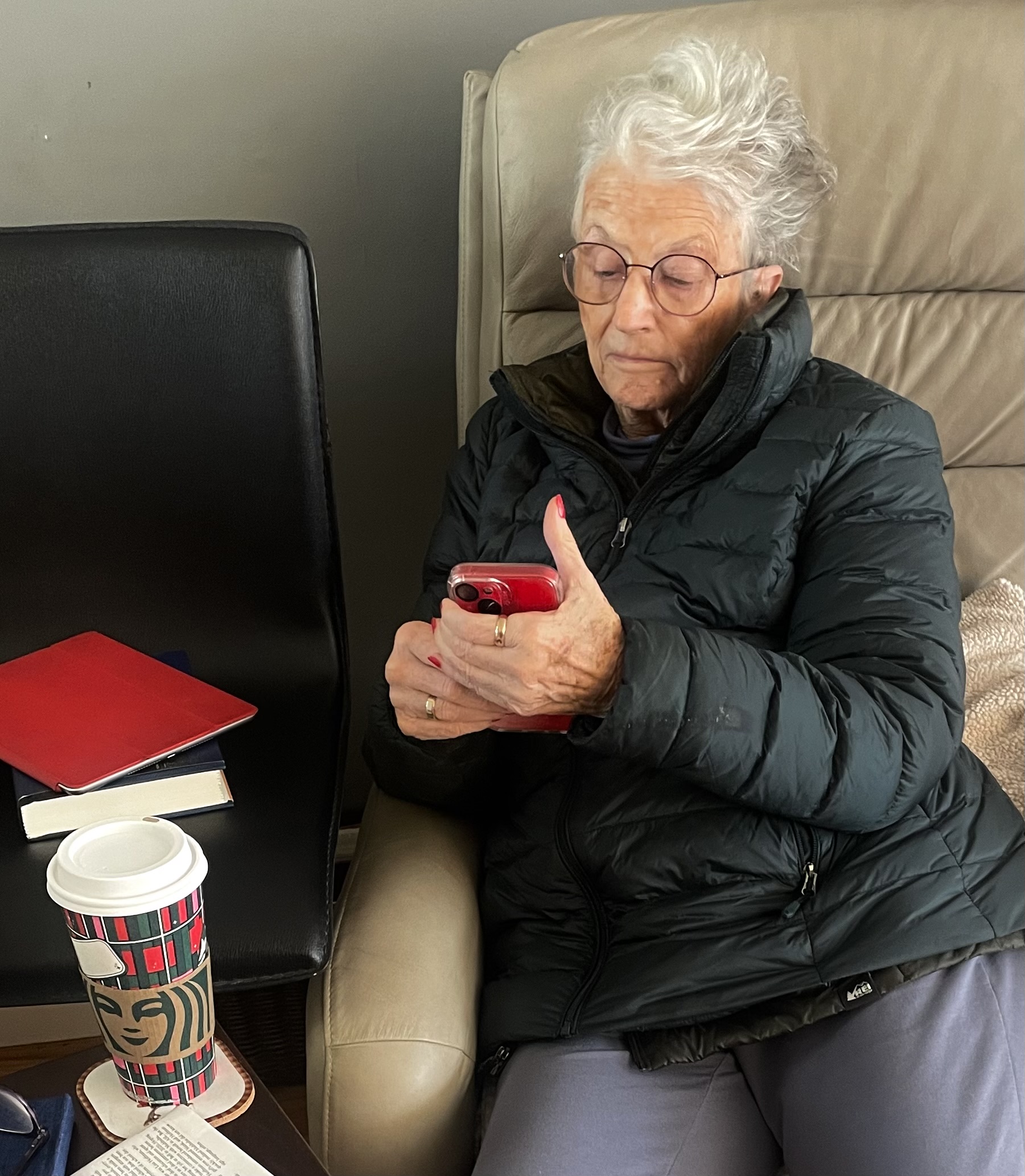
She is bundled, as she often is nowadays,
in puffy black vest and an equally puffy jacket,
shoes on, ready to go when I arrive at 9.
“Hi,” she says as I set down my stuff. “I’ve
been up since 5, and I’m resting.” She sits
in the recliner, feet up, blanket on lap.
“Where are we going?” she asks.
“Exercise at the church?” I suggest,
which earns me a frown.
“Starbucks?” I offer, and a familiar
Marilyn grin spreads across her face.
She’s already discarding the blanket.
“That sounds good,” she says. “Let’s
do that.” And so, on a morning showing
signs of blue sky instead of yesterday’s
spitty gray, we head out to my car.
I’m taking a tip from some of Marilyn’s
other chauffeurs who squire her hither
and yon, landing her at home bearing
the seasonal red and green cup.
“Do you know where it is?” she asks.
“I do,” I say. “What do you like there?”
And, without hesitation, Marilyn says,
“Latte with an extra shot.”
She’s on it, Marilyn, whose mind is
is working overtime to grow new
neural pathways after her stroke.
At the drive-thru, I order her drink
and mine (hot chai), then pull ahead
to the window where, with snappy
efficiency, a young woman takes the bill
Marilyn hands me, returns the change
and delivers two red and green cups
into my hands. We’ve rarely spent this
kind of time together—around a writing
table, yes, or at public readings, but
certainly not in a Starbucks drive-thru—
and would not be doing so if not for
a brain bleed caught early.
We find ourselves oddly grateful for
the gift of each other, of so many others
who’ve come to lend a hand these days.
Each week, each day, she improves as she
negotiates this rough road back to herself.
“How is it?” I ask as Marilyn, sipping
her latte, closes her eyes for a moment
and says exactly what I’m thinking:
“Good.”


 Güd wrtr