
Dr. Janis peers through the magical
machine that looks like a giant pair
of glasses on a swinging pole—
something Elton might have worn
onstage in the 1970s—
her eyes on the opposite side
of the device inspecting mine.
She’s done this for years, keeping
watch on conditions that, little by little,
darken and narrow my view.
Some can be helped; some cannot.
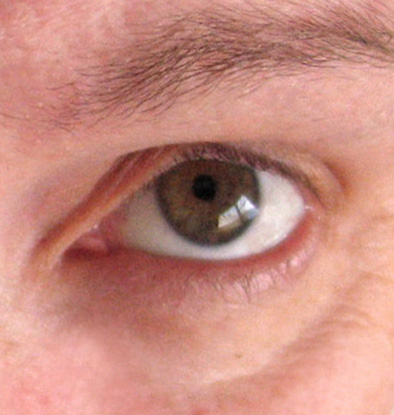
The eye, she tells me, is as plump
and translucent as a pearl onion
when we are young, allowing light
to easily pass through the dome-
shaped cornea that helps us focus,
through the pupil and the lens,
to land on the retina that turns
light into electrical signals, zings
them through the optic nerve
to the brain, which translates
them into images.
As our eyes age, she says, the supple
layers of onion harden and yellow,
making it harder for light to reach us.
As she looks deeply into my eyes,
I think of my aging layers of onion,
wishing that I might gently peel off
the crackly covering as easily as
slicing into a fragrant bulb to make
soup, somehow returning the pearly
onions of my youth to my ocular field.
No wonder I cry when I take apart
an onion, watching its tightly bound
sections loosen and fall on the cutting
surface. I weep as I inhale its aroma,
as I chop it into small pieces that will
vanish when they morph into soup,
becoming something I can no longer see
no matter how hard I look.
•••
for Dr. Janis Lightman, O.D., with much gratitude
•••
The magical machine that eye care professionals use to determine an optical prescription
is called a Phoropter, a device invented more than a century ago. It measures refraction
or how a lens should be curved and shaped to correct vision.


 Güd wrtr