
The night before I never saw
most of my students again—
only some of their framed faces
via a newfangled form of online
communication—
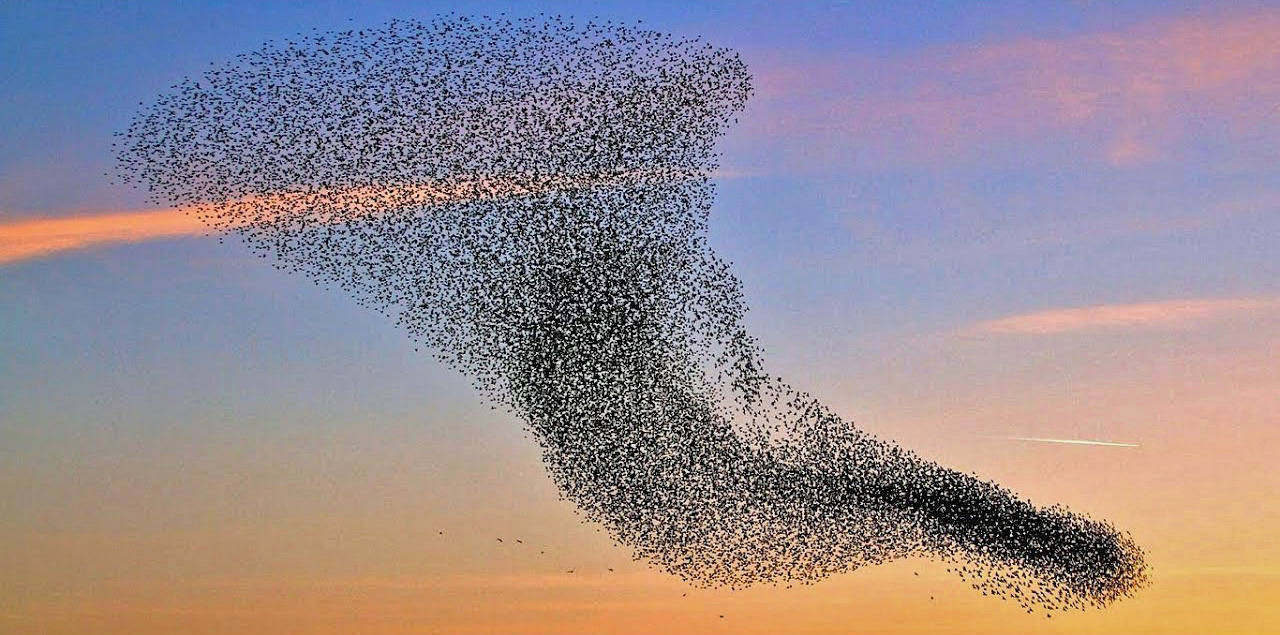
I watched a massive synchronized
cloud, thousands of starlings
zooming as a collective whole
over a fall-harvested field, looking east
over the stubble into the setting sun
of a promised spring,
bird ribbons whirling and pirouetting,
tiny ballerinas in silhouette
dancing as a single breathing,
wing- and heart-beating organism.
All this as crows cawed to their
brethren from not-yet-leafed trees
against the hazy sky,
end-of-day tangerine seeping
into blue-gray.
I did not see the murmuration as a sign
of what was coming, of the millions
about to be flung into chaos,
thrown into the air,
ready to fly or not.
Instead I stood in the parking lot,
unaware that this would be the
final in-person college class
I would ever teach, thinking
that it takes only one starling to copy
the behavior of seven of its neighbors,
then those nearby copy seven of theirs
and so on until the entire group
swoops as one to avoid a predator
or catch insects in flight
before finding someplace safe
to roost for the night.
I watched that evening sky show,
enthralled not for the first time
and certainly not the last,
by nature’s special effects
that astonish mere humans,
phenomena that transport us
out of our little lives for
a breathtaking moment
if only we stop, look up
and allow ourselves
to marvel.


 Güd wrtr
Poignant poem in so many ways!