
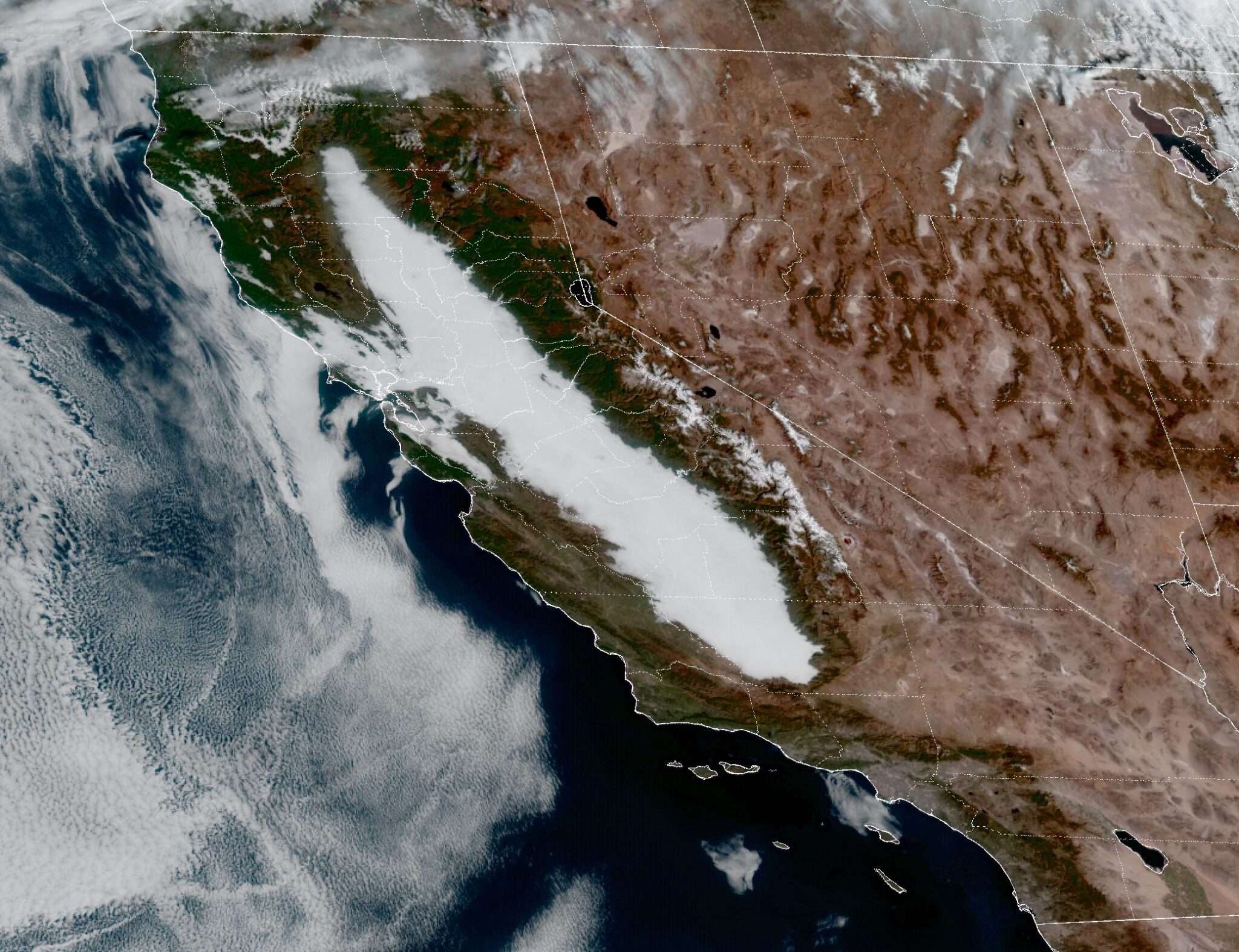
Yes, it arrives every winter.
And can, as it is doing now, hang around
for weeks. So I, a native of the long, slender
Golden State, who has spent most of my life
in the northern part of the great Central Valley,
should be well accustomed to this.
But I am a summer baby, a Leo
comforted by warmth and bright light,
so all this gray and cold do nothing for me.
The half dozen of you who love this stupid
weather mystify me, but I like you anyway.
Little cat feet, my Great Aunt Fanny.
Carl Sandburg did not know tule fog.
So, in the midst of a gray day of errands,
I sit in a parking lot and recall sun flooding
this same spot, where in July I often open
the car door into fierce heat that makes
many people—including you fog lovers—
wish for a day like today.
Putting a lighter spin on persistent tule fog,
I know that the sun is lurking behind it,
even if this high-pressure ridge is not allowing
our closest star to come out and play.
Though I know the answer, I search
weather apps to see how far I need to drive
to climb from under this low-hanging cloud.
About an hour, up one freeway or the other,
out of this foggy fishbowl into the foothills.
Tempted, so tempted. Take the groceries
home, grab shades and sunblock and drive,
baby. Toss the haftas to the nonexistent wind
(come on, wind!), to the nowhere-to-be-seen rain,
(come on, rain!) as I plot a solo road trip
on a going-to-the-sun road that will
(I pray to the weather gods) brighten
with every mile.
•••
You can read Carl Sandburg’s excellent six-line poem, “Fog,” here.


 Güd wrtr
Extended days of tule fog in winter can be dispiriting, though I do appreciate the quiet that descends over everything as a result of its natural sound-dampening effects. Only snowfall does it better. However, the worst has to be the arctic fog we get in the Columbia River Basin when temperatures drop below -10 Fahrenheit. We call it pogonip (from a Shoshone word meaning “cloud”).
I have been caught out in it while driving and it is so dense that visibility dies right at the end of the average car hood. One morning 30 years ago, it came on so suddenly that my headlights were of no use, with sparkling refractory effects actually blinding my way forward. I shut them off, threw on my flashers, rolled down my window and stuck my head out so I could at least see the road surface. I quickly found a wide spot to pull over for safety–navigation was simply rendered impossible. It turned out to be a smart move because in a few moments I could hear (but not see) the sounds of other cars and trucks crashing into one another or into roadside objects all around me. I silently asked the weather gods not to let anyone run into me. I was in a white car in white-out conditions. Not good.
The highways quickly became glazed with rime, and everything was covered in tiny faceted fingers of ice that grew, counterintuitively, against the barest of breezes as flake piled horizontally upon flake. My radio antenna comically sported white ice bristles! In two hours it cleared and I was able to drive home sans injury or dent, but I lost count of the accidents I saw in the twenty miles I drove.
Wow! What a story, Terry! That sounds terrifying… how smart to stop and wait. Love the description of the radio antenna (that dates this story a bit!), and I’m relieved that you got home “sans injury or dent.” And thanks for the new word for my vocabulary: pogonip. Excellent!