
(in memory of Captain Robert J. Schweitzer, U.S. Navy pilot,
who served from 1950–1974)
I did something today I haven’t done in years:
I stood, as requested by a speaker at an event,
and recited the pledge of allegiance
(trying to remember which hand crossed
my chest and where my heart is) at an
aircraft museum in the California desert.
I sat in the front row between my sweetheart
and a good friend who’d invited us,
waiting to see if they stood, hesitant to rise.
Like so many of my fellow Americans, part of
me feels that the flag of my country is no
longer mine, given that I and others like me
are considered enemies of the state, as
the current president refers to those of my ilk—
a progressive feminist Democratic poet
retired college journalism professor who
champions free speech and sees no reason
to ever ban a book or insist that women
must carry every fetus, intended or accidental,
into the world. In the end, I rose, too, feeling
the same get-with-it pressure I did as a kid
in sixth grade, compelled to recite the pledge
every morning before any education could
take place. Today the words choked out of me
along with tears for reasons I could not
have articulated in the moment. And later,
my eyes filled after my sweetheart,
himself a veteran, located the photo on the wall
paying tribute to American POWs—the husband
of my mother’s dear friend, a man we hadn’t met
but whose name we wore on metal bracelets,
my sister and I not quite understanding why,
who was released in 1973 after 1,896 days
in the infamous prison in Hanoi. A man who,
once home, lived nine months with his family
before dying behind the wheel of a car.
For him, I thought—and my father drafted and
sent to fight in Korea, along with so many others—
I stood and recited the long-buried words
that they must have said thousands of times
for their country.
And mine.
•••
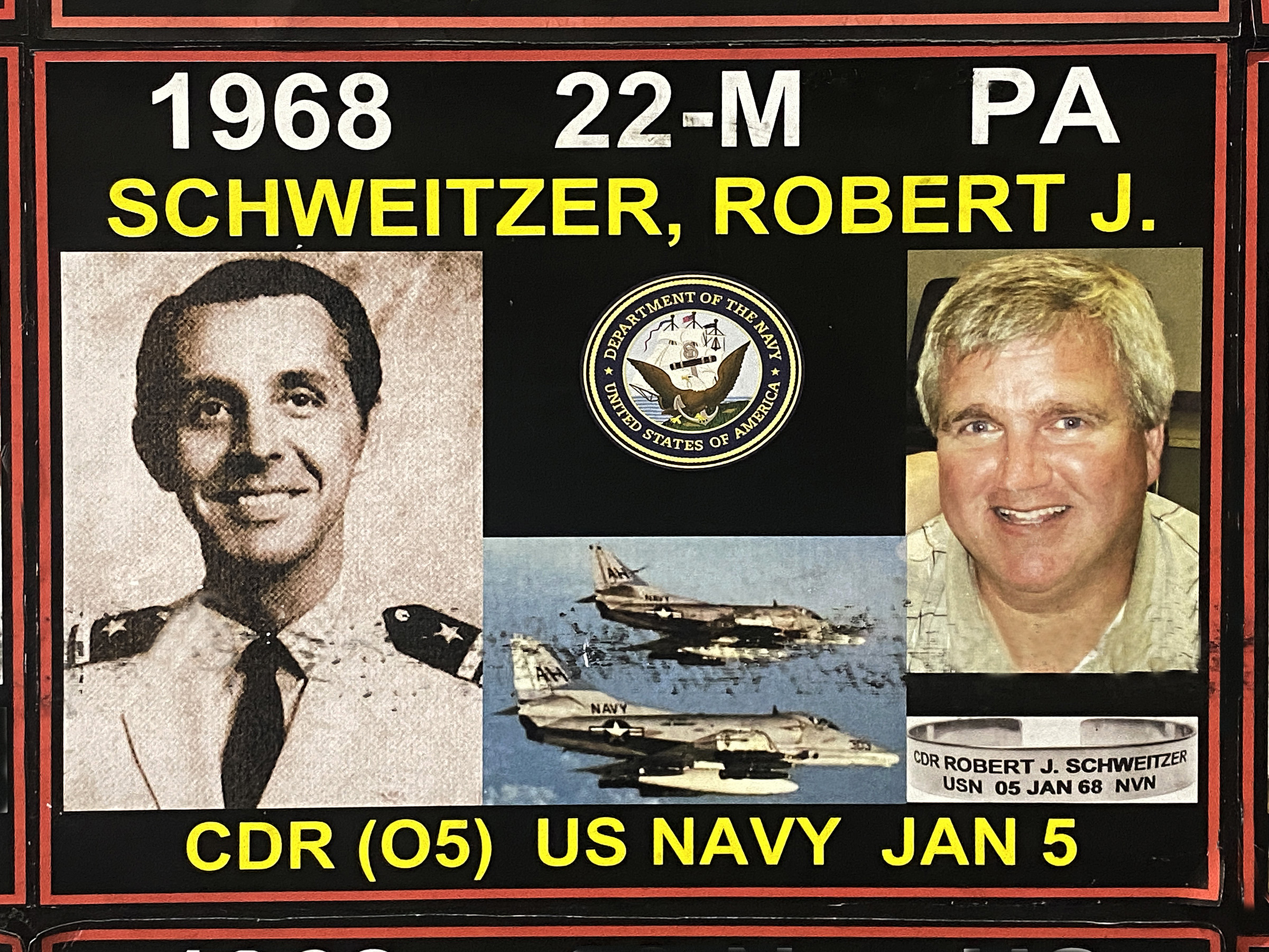
We were moved to see this tribute to Robert J. Schweitzer
(one of 591 American prisoners of war repatriated in 1973)
on the wall honoring POWs at the Palm Springs Air Museum.
You can learn more about Captain Schweitzer’s career here.


 Güd wrtr
You may not remember this, but shortly after his release, he gave your family a cassette tape whereon he narrated his harrowing experiences in Vietnam. You lent me the tape to take home (on pain of near-death if I didn’t return it the next day) when I was a senior in high school, and I listened raptly to his patient, even recitation of events that would have destroyed lesser men, a horror from which I simply could not turn away. Other than your family, no one else had heard the words he spoke, so you and I, impressionable and naive teens, were privileged to have been granted this inside information before the rest of the world would know of his experiences. It changed something inside of me and I never forgot it.
And I share your tears for our poor, benighted country and cringe at the fools who are running it. What a desecration of the memory of the sacrifices of men like Captain Schweitzer.
I had forgotten this! Thank you for the reminder, Terry. I have no idea what happened to that tape… and oh, how I wish for a transcript. But his story has never left me… and apparently, you, too.
Bob Schweitzer turned out to be a controversial figure, thought of by some hard-liner POWs (like John McCain) as a collaborator with the North Vietnamese, denouncing the war and agreeing to talk to a CBC reporter in 1970 with another prisoner and saying that they were well treated. It sounds as though they were treated less harshly, though Bob said he had genuinely become disillusioned with the war.
A complicated story and legacy for sure.
A very powerful poem, Jan.
Thank you, Amrita.