Rainbow bark

(Eucalyptus deglupta)

•••
For Dick
•••

Of course, it would be rainbow
on these islands where rainbows
abound,

vertical bands of peeling bark
stripped away, down to the essence
of eucalyptus,

visible from your hospital window
after the collapse, the vanishing,
the reappearing.

We watched the tree; I watched you
to see how much in the stripping
might return,

if Humpty Dumpty could be made
whole again. And you were made
more brilliant

in the peeling away, tougher than
either of us thought possible,
yet so lovely,

standing strong, all the colors
amassed in a long lifetime
exposed,

laid bare under the hottest sun,
under the most persistent,
pelting rain.

Posted in Uncategorized | Leave a comment

Pink Frigidaire

Frankly, it makes it hard
to concentrate on the task
at hand, so to speak, sitting
on the throne, looking into
a mirror on the inside of
a pink Frigidaire roughly
the same age as me.

But I love it.

Somehow I failed to appreciate
pink as a girl, though I slept in
a pale pink bedroom and rode
a rosy two-wheeler.

The budding feminist in me
came to shun the stereotypical
pink, much as I stopped writing
poems once I got serious about
journalism.

(Who ever heard of a Real
Journalist who liked pink?)

But every time I hit the ladies’
room at Tiki Iniki on Kauai,
there it is: the doorless
Frigidaire, rusty in places
and losing its once vibrant
color.

I am fascinated by its chrome
detailing and wonder if it
always had a mirror in it,
and whose kitchen it lived in,
and who decided it would
make a whimsical decoration
in the bathroom of a tiki bar?

(Wait a minute: Clark Kent,
mild-mannered reporter
and man of steel, liked pink
and in the movie told Lois
Lane that he did, making
her blush.)

The journalist in me has a lot
of questions, but the poet,
thinking of her 1950s pink
Royal typewriter at home,
looks in the old splotched
mirror and sees her own
rosy T-shirt,

and, before leaving the loo,
pats the old gal on her
dented side and tells her
her how beautiful she is,
a treasure of her era, in
her glorious pink dotage.

The Tiki Iniki pink Frigidaire / Photo: Jan Haag
Posted in Uncategorized | 4 Comments

Honu

Flippering into the sea,
bounced around by waves
more than I like, always
a beginner every time

I hit salt water, fogging
the mask, trying to clear
the snorkel, liquid
reminders that I am a

visitor in this world.
When I finally feel my
shoulders relax and
fin gently, no matter

how strong the surf,
my breathing evens out,
and the convict tang
darting below me

seem to linger a bit,
the shy humuhumu
not zipping away as fast.
And when a great

domed shadow appears,
flying slowly through
her realm, I hang
suspended, think,

aloha, honu,
grateful for a visitation
from this long-lived
sea goddess. Then

I don’t mind the surf
nudging my floating
tourist self landward,
where I will stumble

as I find my footing,
sink into soft sand
as the tide pulls out
and I wobble,

subject to gravity
and air, merely
human again.

•••

convict tang: a tropical surgeonfish with a creamy/silver body and black vertical stripes

humuhumunuknukuapua’a: Hawaiian triggerfish, the state fish, with a blue upper lip and a black chevron
down its sides; name checked in the song, “My Little Grass Shack in Kealakekua, Hawaii.”

Honu, Keoneloa Bay, Kauai / Photo: Dick Schmidt
Posted in Uncategorized | 4 Comments

Moonshadow

They really exist, especially the night
before full, raining down light
as if it’s noon,

the palm tree shadow on the lawn
so distinct the camera picks it up,
renders it faux day,

though it’s not yet 2 a.m., clouds
shrouding the moon, so it’s not
its brightest self,

but still so reflective of the sun
far below the horizon,
the faithful light

leapin’ and hoppin’
on a moonshadow,

as it so gloriously

shines.

•••

(for Deborah Meltvedt, my Cat Stevens-loving friend)

•••

Kuhio Shores palm tree: Jan Haag / fine tuning: Dick Schmidt
Posted in Uncategorized | Leave a comment

Here on the edge of the earth

at the beginning of a new day,
the sky murky with a curtain
of cloud

the color of mourning doves
cooing the morning into
being,

I can look mauka, behind me,
to the mountains, morning
misted,

hear birds peep and squawk
and chortle the day into
being.

But my eyes are always drawn
makai, to the unceasing sea
whose waves

have traveled an unfathomable
distance to froth the shore,
and to our nearest star

appearing on the far horizon,
not yet blazing, always delighted
to see it again

beginning to warm this dewy
earth on which I stand, silently
rooting for its survival,

this precious blue marble rotating
on an axis none of us can divine,
propelling you and me

and everyone we’ve ever loved,
and those before and after us,
slowly around our sun,

forever and ever,
let it be so,
amene.

Surfers ready to take to the waves off Lawai Beach, south shore, Kauai / Photo: Jan Haag
Posted in Uncategorized | 1 Comment

Crepuscular rays

The canvas of twilight sky
ripens into a supreme backdrop
for the show-offy sun

shooting searchlight beams
through clouds hovering
just above the horizon,

sending angular streaks
of bright orange the color
of fresh lava to create

an ephemeral sky show.
The photographer and I
have long called this

godlight, as if painted by
the hand of a celestial being
him/her/theirself

picking up the brush,
dabbing here and there
like the old master

he/she/they is/are,
then sitting back with
a satisfied smile as we

earthbound mortals
applaud the end-of-day
masterpiece, calling

hana hou! —
again! encore! —
as the crepuscular rays

dissolve into the
enfolding night.

Sunset from Kuhio Shores / Photo: Dick Schmidt
Posted in Uncategorized | 2 Comments

Ti leaf lei

(Thanksgiving Day, Poipu Beach, Kauai)

At the beach park the tourists
gather near sunset, not to gawk at
the ball of fire descending into the sea

but at the bale of turtles who have
trudged their way up the beach, leaving
tracks the size of truck tires on the sand.

They fall heavily on earth, gravity
working against them, as it does us all,
but they also fall quickly into sleep,

which the lucky among us do, too.
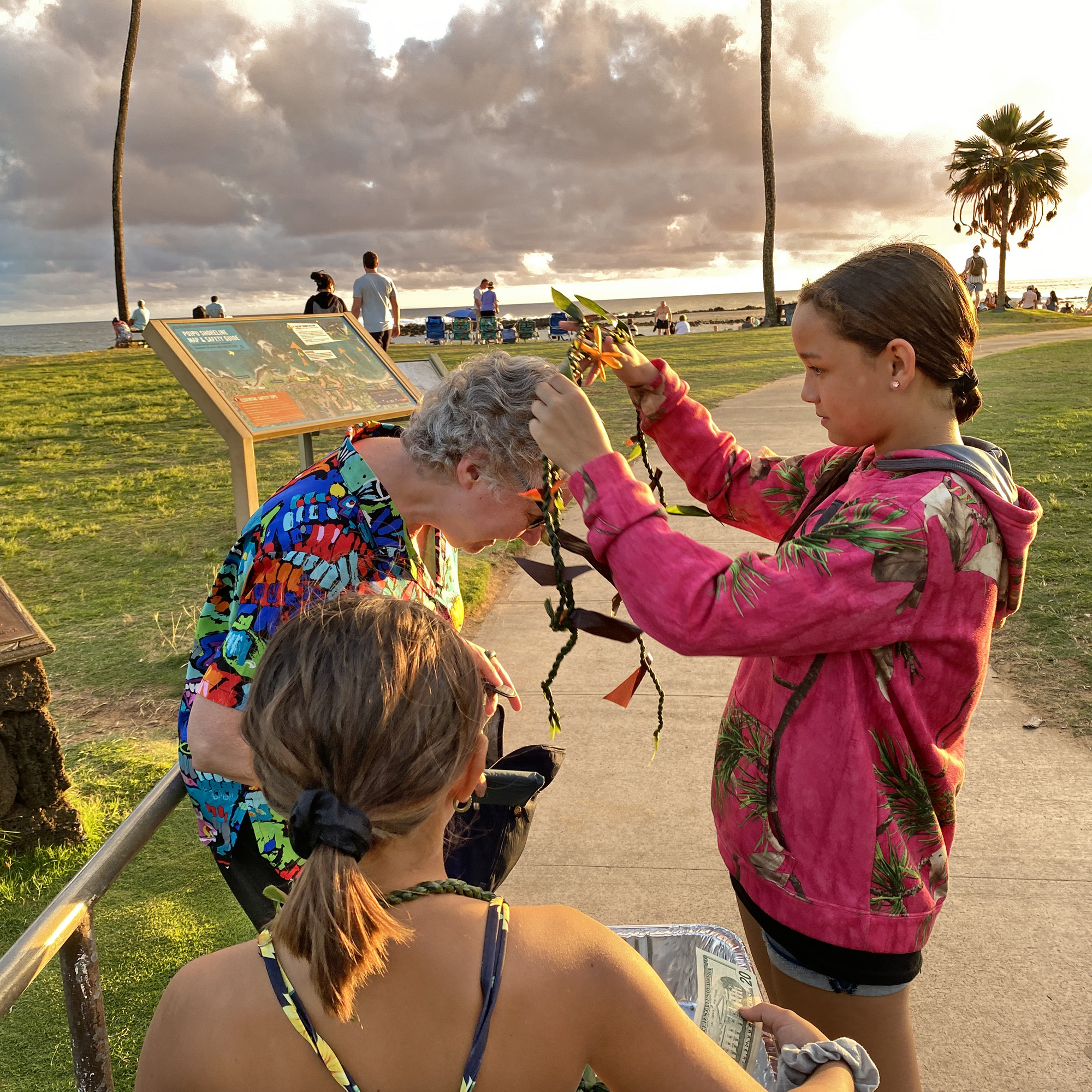
And there, working the crowd tonight,
two expert saleswomen disguised

as young girls, one carrying a large
aluminum pan, the kind that might
accommodate a small bird for roasting.

Would you like to buy a lei? the older girl
asks as we step into the park. The littler
one holds up the pan in which long,

dark green twists of ti leaves rest.
I peer into the pan. Ti leaf lei! I say,
and both girls brighten at this

old lady tourist’s recognition
of their craft. How much? I ask.
Ten dollars, says the proud seller,

citing the going grocery store price.
Did you make them? I ask.
Both girls nod and beam like the sun.

lowering itself toward the horizon.
I’m instantly sold. Always buy things
from little girls,
I tell Dick later,

harkening back to the Girl Scout
cookie selling days when it
took every ounce of courage for

my sister and me to go door to
door and ask grownups to buy
what we were compelled to sell

to raise money for our troop.
We didn’t even make the cookies,
we girls in light green uniforms,

but these girls, who likely learned
their craft at school or from older
female relatives, wove deep green

ti leaves into long strands, now
carried by hopeful hands, brave
enough to approach strangers.

I’ll take two, I say. Will you pick
them out for me?
And the lei makers
do—a shorter one for me, a longer

one for Dick. The taller girl holds
up the lei for me, and without
a thought, I bend my head and

receive the blessing and protection
of this lei made by young hands.
And after the exchange of cash

with our mahalo and aloha, I
I drape the longer lei around
my beloved’s neck and bestow

a kiss upon his cheek, a bit
of aloha amid admiring fans
of locally grown turtles on this

sweet day of thanksgiving.

•••

bale: one of the collective nouns for a group of turtles (also a “dole” or a “nest”)

Photo / Dick Schmidt
Posted in Uncategorized | Leave a comment

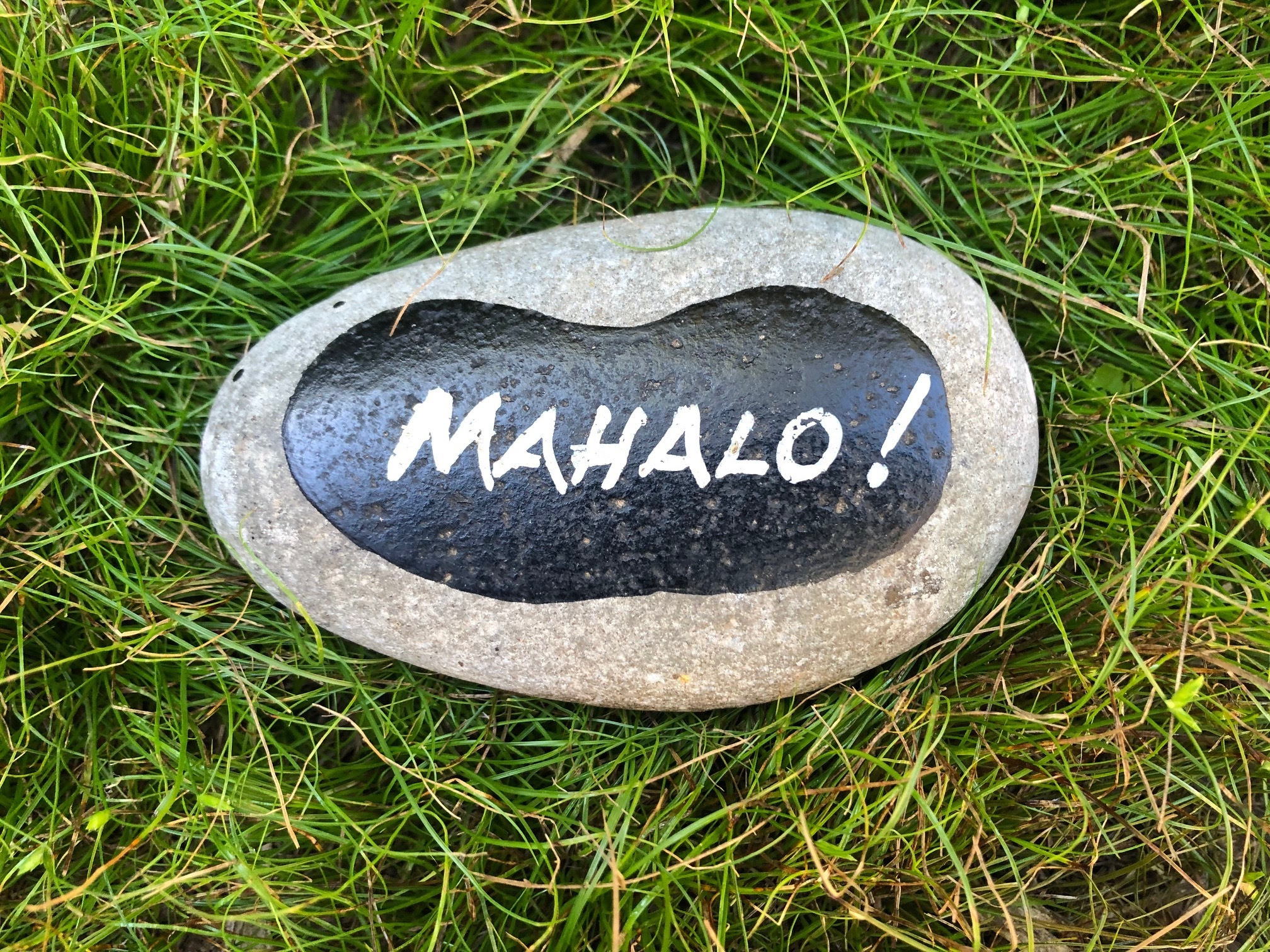
Mahalo

Photo: Dick Schmidt

(In memory of Ed Kato, artist of Kalaupapa,
on this day of thanksgiving)

There, on a peninsula of great suffering,
nearly a hundred years after thousands

were banished to die, an artist picked
up his paintbrush again and again

to record in oils what he saw around him,
on canvas, on the Welcome to Kalaupapa

sign and dozens of others—not least
on rocks he left around the settlement.

Smile—it no broke your face, reads one
next to a grinning countenance.

At the grave of the nun who later became
a saint: Peace to all who enter here.

And the simplest of all, from a man
branded a leper, who thrived and loved,

who lived and died with a grateful
heart: Mahalo.

Photo courtesy of Valerie Monson, Ka Ohana O Kalaupapa

•••

Dick and I have been fortunate to make several trips over the years as volunteers through the Sierra Club to the Kalaupapa peninsula on Moloka’i. Dick first hiked down to Kalaupapa on a Sierra Club outing in 1970, not long after the site was opened for tours to a limited number of visitors. We continue to be moved by the stories of the more than 8,000 people forced to live and die there in isolation because they were afflicted with Hansen’s Disease, commonly known as leprosy.

The first patients were sent there in 1866. With new drug therapies developed in the 1940s, there was no need for further isolation, but it wasn’t until 1969 that the century-old laws of forced quarantine were abolished.

Many former patients continued to live the rest of their lives at Kalaupapa, though, one of the most beautiful places in Hawaii, honoring the legacy of their kupuna (ancestors) and many who served there, including Father Damien De Veuster and Mother Marianne Cope, who have been venerated as saints in the Catholic church.

Today Kalaupapa is a National Historic Park, but visitors are allowed only on a limited basis. No tours are currently available as they have been in the past.

However, Ka ‘Ohana O Kalaupapa is a nonprofit group that promotes the value and dignity of every individual who was taken from their family and forcibly isolated on the peninsula known as Kalaupapa on Moloka’i, Hawaii, due to government policies regarding leprosy (now also called Hansen’s disease). 

Ka ‘Ohana has produced an array of educational materials and exhibits, helped more than 900 descendants learn more about their Kalaupapa ancestors, created a virtual concert, “The Music of Kalaupapa,” and worked with the state Legislature to designate January annually as Kalaupapa Month.

Their biggest project is The Kalaupapa Memorial, which will display the names of everyone who was admitted to Kalaupapa. Ka ‘Ohana deeply appreciates those who would like to support their efforts to honor the people of Kalaupapa and to perpetuate their lives and legacies. You can learn more about the group and, if you’re so moved, make a donation to Ka ‘Ohana O Kalaupapa here.

Posted in Uncategorized | 1 Comment

Billions

(South shore Kauai, looking due south)

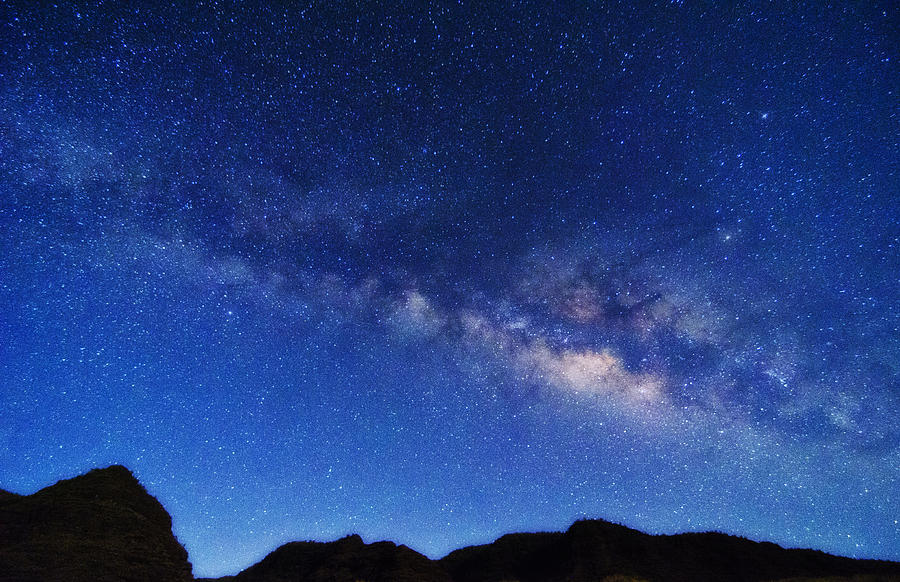
I rise a bit before 4 a.m. on an errand
of the night, surf sounds pulling me
to the lanai to see what I might see,

and there, while we’ve been sleeping,
the all-night star show spreads out above
like so many grains of bright sand

over perpetual waves that have lulled us
to sleep. The foreverness of it all strikes
me again, as it does when I think

to put myself amid the vastness and simply
take it in—not get out the star map
to remind myself of the names

of bright celestial objects I once knew,
resist the urge to identify, quantify,
instead to do what humans

have done since the beginning:
stand under that dome of forever,
inhaling our part

in eternity, too, we tiny bits
of starstuff who voyaged over
the sea to these islands,

who came from the sea
to walk upright in this
tender world, gently,

stopping now and then
to stand humbly before
its majesty

carrying nothing but
our awe.

•••

(for Sue Lester, the original BFF, on her birthday)

The Milky Way from Polihale Beach, Kauai / Photo: Lawrence Knutsson
Posted in Uncategorized | 1 Comment

Hot Spam musubi

(Lihue, Kauai)

We haven’t been on the ground
for more than a couple hours

when we hit the ABC Store
for milk and granola just as

a lady in a green uniform
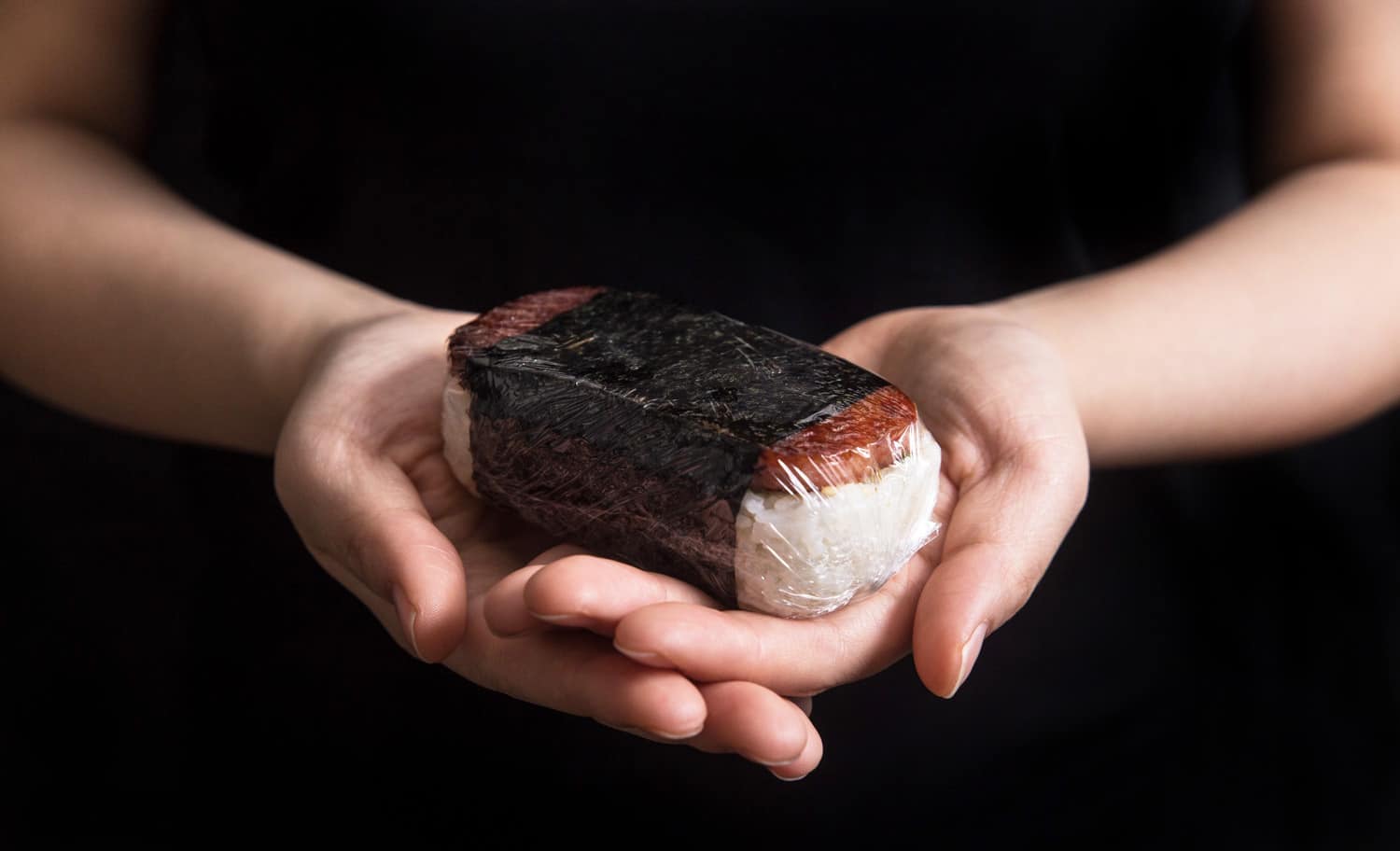
comes out with a tray and

a pair of kitchen tongs and
begins transferring plastic-

wrapped chunks of hot rice
topped with Spam and wound

with seaweed into a warm
display case. And though we have

just eaten, and I’m not in this
moment hungry, I ask the lady

for one, and when she moves
to hand me the tightly wrapped

package of not-at-all-good-for-
you, she realizes how hot it is,

so she tongs one to the counter
for me, which I purchase with

the milk and the granola, and two
bottles of Hawaii spring wada.

A lady at the checkout counter
rings me up as another puts

the items in two small paper
sacks and hands them to me.

I walk to the car cradling one
bag of cool, one bag of hot

on a day that has unleashed
a goodly amount of rain, so

the air has that only-in-Hawaii
blend of tropical petrichor and

slightly muggy intensity that
lets me know I’m home again—

in a place where I’ve never had
a permanent address, truly not

kama’aina, but oh, how I feel
I am thanks to a little Spam

and rice and seaweed—
the kind I traipsed down

to the hospital cafeteria for
after another rough night

on the pullout chair/bed
upstairs as he hovered

somewhere between here
and gone—

the one upright and opening
the car door for me now—

as my heart whispers,
mahalo nui loa for landing

us here together again.

Spam musubi
Posted in Uncategorized | 2 Comments