I see my first Great Lake for the first time on the last day in September, Truth and Reconciliation Day in Canada, the same day I watch Louise wade farfarfar into the shallows of Lake Erie, eager for a swim.
This is her lake; she grew up on the Pennsylvania side, swimming, sailing, lifeguarding. I feel a bit of water envy as she plunges in, bobs like a blonde buoy in the distance.
I bend over the sandy shore, look at Canadian rocks, pick up a few smooth ones to pocket—pale sandstone like mini speckled eggs.
I wear the new orange T-shirt, I bought two days ago on on Scugog Island, home of the Mississaugas First Nation:
Every child matters.
I put a hand to my chest, close my eyes, think about children ripped from their homes, their people, beaten and starved by white people trying to kill the Indian in them.
They nearly succeeded.
Like the beaver, the otter, the people have slowly returned. This day honors the children, the ones who never came home, and the ones who did, forever scarred.
Louise, mother of two sons, breast strokes slowly back to shore against a low bank of clouds shrouding the U.S. side of the lake. She looks as though she could swim to eternity and back if she wanted,
perhaps with a child in tow, returning him to his people, the too-long-gone prodigal come home at long last.
Louise Bierig on the Canadian side of Lake Erie / Jan Haag
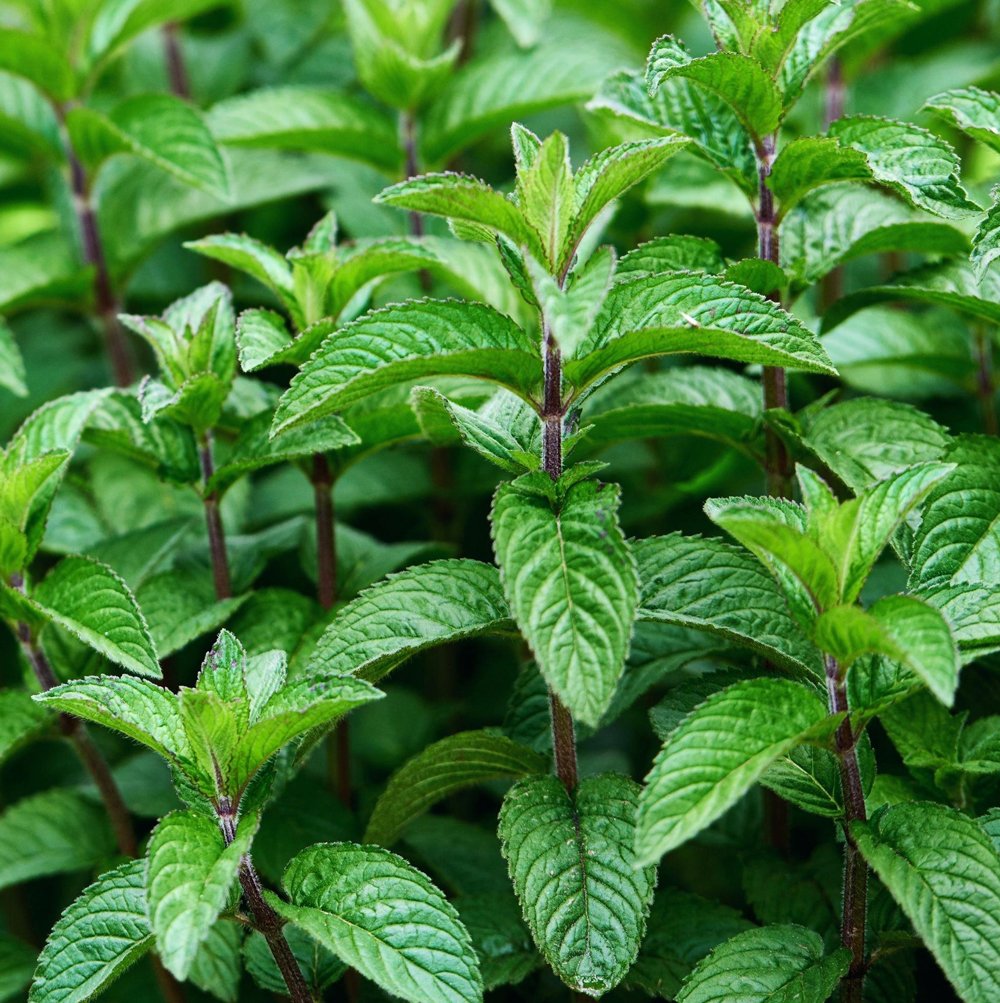
When Sue suggests, on my first night at her house, snipping some mojito mint from the garden for tea, I grin and wiggle like Whiskey, the big dog who accompanies her into the dark. She returns, flicks off the lamp strapped to her forehead, a handful of fragrance in hand.
She rinses the leaves, stuffs them in the sweet red teapot with its matching zippered jacket for warmth, and lets it steep, the delicate scent wafting when she hands me a cuppa a few minutes later.
I’m in heaven here, a guest in this house on the pond in this rural bit of southern Ontario. And the next night, when Sue asks, “Mint tea?” I’m all in.
The third night Whiskey and I go to the herbs, me wielding the scissors, him along for a sniff. And on the fourth day I cut a wicked mass of mint to take with us to a retreat center a couple of hours away.
It is a smell I will associate with this time, this place—late September, still so warm for these parts, sitting by the pond writing as the goldenrod and the purple asters, soon to disappear with the coming cold, wave lazily in a sweet breeze.
How simple, I think, how glorious, this minty bounty. How grateful am I.
It doesn’t have a name other than The Pond, its caretakers tell me.
To them, it is not big, but here, in the great province of Ontario, there must be thousands of small ponds and lakes in a place where rainfall is typically abundant.
It should be falling now, one of the caretakers says, adding that they’re in a moment of drought.
But to this Californian, coming from the land of little rain, everything radiates a dozen shades of green, even as fall’s yellows and crimsons begin to creep across the canopy, as leaves release and flutter.
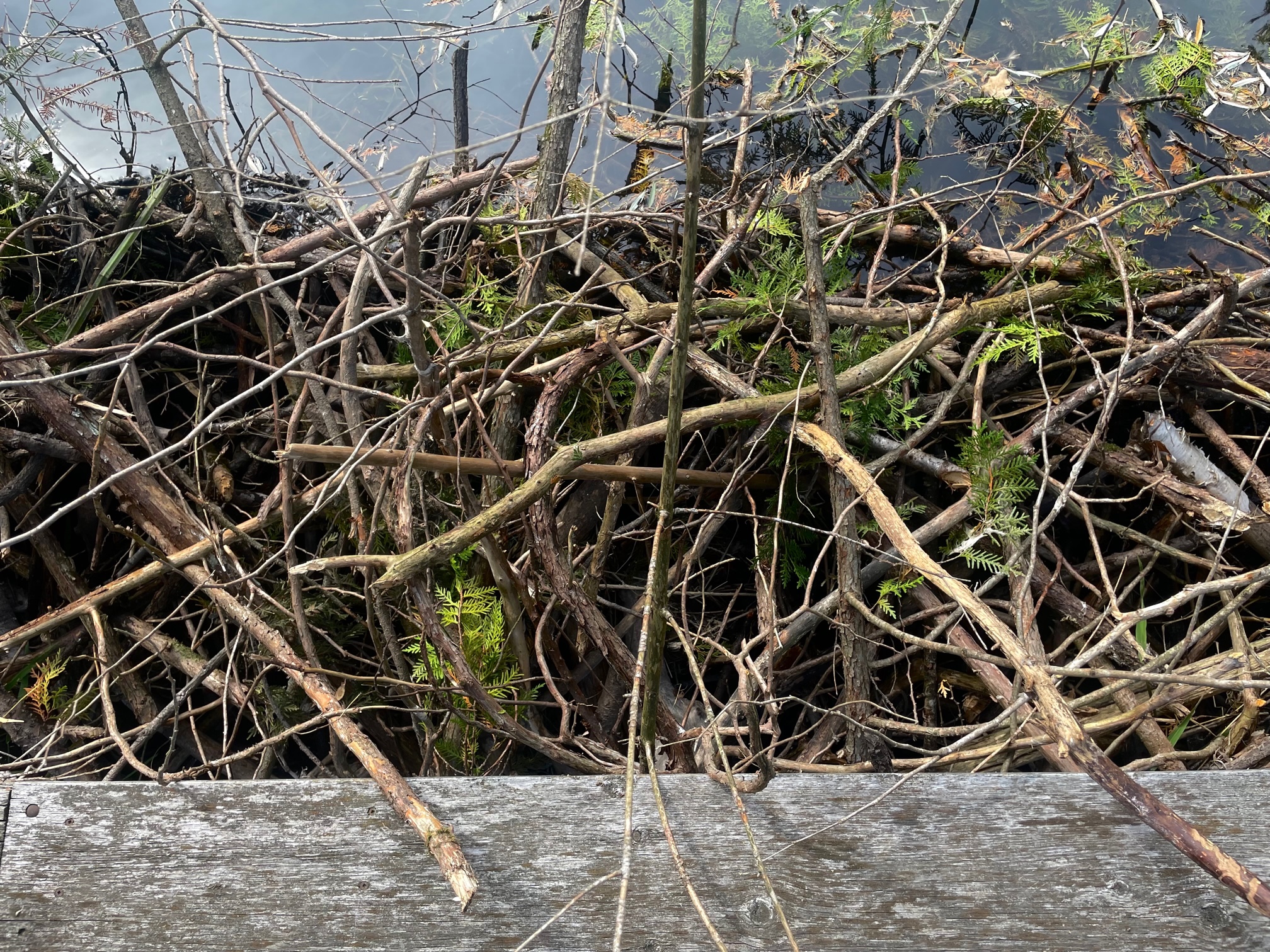
Sitting atop one of the man-made dams, listening to the stream cascade behind me, I keep watch for beaver who have done more than their share of beavering here, working by night to dam up the openings that contain the pond.
The caretakers tell me the pond has risen 4 feet because of the beavers’ work, and one of the caretakers regularly has to dismantle part of the avant-garde assemblage of downed branches that the builders so industriously construct so the water can flow merrily down the stream.
The beavers’ projects are still evident— the caretakers do not wish to destroy them— and I imagine the sharp-toothed crew paddling this pond and others in the dark, looking for spaces to build because, after all, this is their work.
Overlooking one of their innovative sculptures, I pause, amazed, and, my human sound rippling across the pond, applaud these creators so committed to their art.
The Pond / Jan HaagBeaver dam on The Pond / Jan Haag
(for Sue Reynolds and James Dewar, stewards of the pond)
Sitting atop the small dam next to the pond, I watch a squadron of dragonflies flit like tiny biplanes, coming to rest in the sun next to me.
The large blue dashers hover closest to the water, their four wings fanning the surface, helicopter-style.
The smaller, rust-colored autumn meadowhawks alight for no more than a minute, efficient hunters said to catch 97% of what they pursue.
Fall is beginning to take hold of the pond. Most of the insects of summer, the peskiest ones— the horse flies, mayflies, black flies— have fallen; the dragonflies will soon be gone, too.
But look—just there, next to me on the weathered planks—two dashers and two meadowhawks have landed, arranging themselves into a tidy flightline, engines revving, preparing to take off again.
The longer I sit, inhaling the warmth of the day, the more they show up, the closer they come— one on my knee, three decorating my shoulder like so many living brooches.
I close my eyes, feel a lacy- winged being tickling the knuckles of my left hand, alive in this moment by this sweet pond, with nothing to do but return to the breath, me and my happily full heart.
Autumn meadowhawk dragonfly, near Port Perry, Ontario, Canada / Jan Haag
At 35,000 feet I queue at the rear of the Airbus for the loo, lean over a pair of temporarily vacated seats for a gander out the oval porthole to the sky.
The blue upper atmosphere gleams as sun rains on scudding clouds far below us, and I’m surprised to see the ground splotched with a thousand lakes in imaginative shapes—a griffin, a locomotive, a sheep in need of shearing.
Where are we? Where is this state or province so generously lake’d that I’ve not heard of? Does each body of water have a name? Can I find them on a map?
It takes a full minute before it lands in my altitude-addled brain that the lakes seem to be moving too, and the illusion vanishes.
Now I see that they’re cloud shadows on the move, carrying their own moisture, some of which they will deposit at their pleasure when the proper conditions arise—
perhaps for thermals that birds and gliders ride like gentle waves carrying surfers to shore, air pressures we wingless souls cannot feel in flight,
an illusion that never fails to amaze me, that—no matter how many times the phenomenon is explained, how this steel and aluminum capsule manages to fly through weightless clouds, taking so many of us to a common destination—it always feels like magic.
•••
enroute to Toronto, Ontario, Canada, from Sacramento, California, with gratitude to the outstanding Air Canada team of flight 758
More fly than dragon, you, dragonfly, tiny biplane touching down
• • •
Agile flyer, you, dragonfly, flitting forward, then backward with ease
• • •
Dragonfly brings change, rebirth as tiny biplane, wingéd happiness
• • •
(Dragonflies belong to the infraorder Anisoptera, from the Greek meaning “unequal wing” because dragonflies’ hindwings are broader than their forewings.)
Though we appear to die, we do not. Death is merely a change of address, and loved ones wend their way like turtles or salmon or whales— by smell, by feel. This mourning, we do for ourselves, but when we raise our heads, sniff the breeze, feel gaps of air between our ribs—if we give them space, the dead loved ones return. Or maybe they never left. We only think they did, when like snakes, they shed their only skins and belly-crawled to the next place— which is the first place, which, when we think about it, is home.
•••
from Companion Spirit, 2013, Amherst Writers & Artists Press
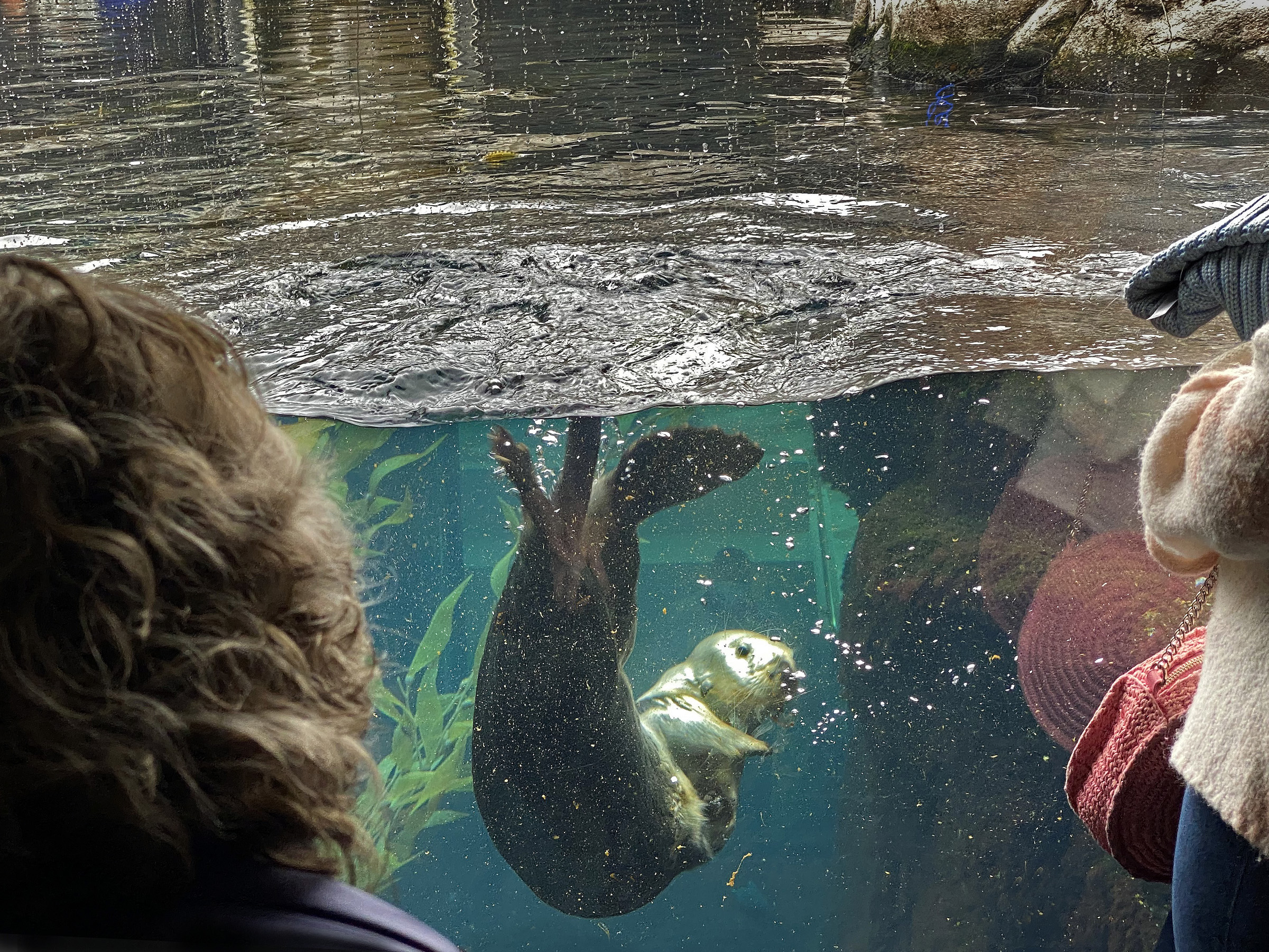
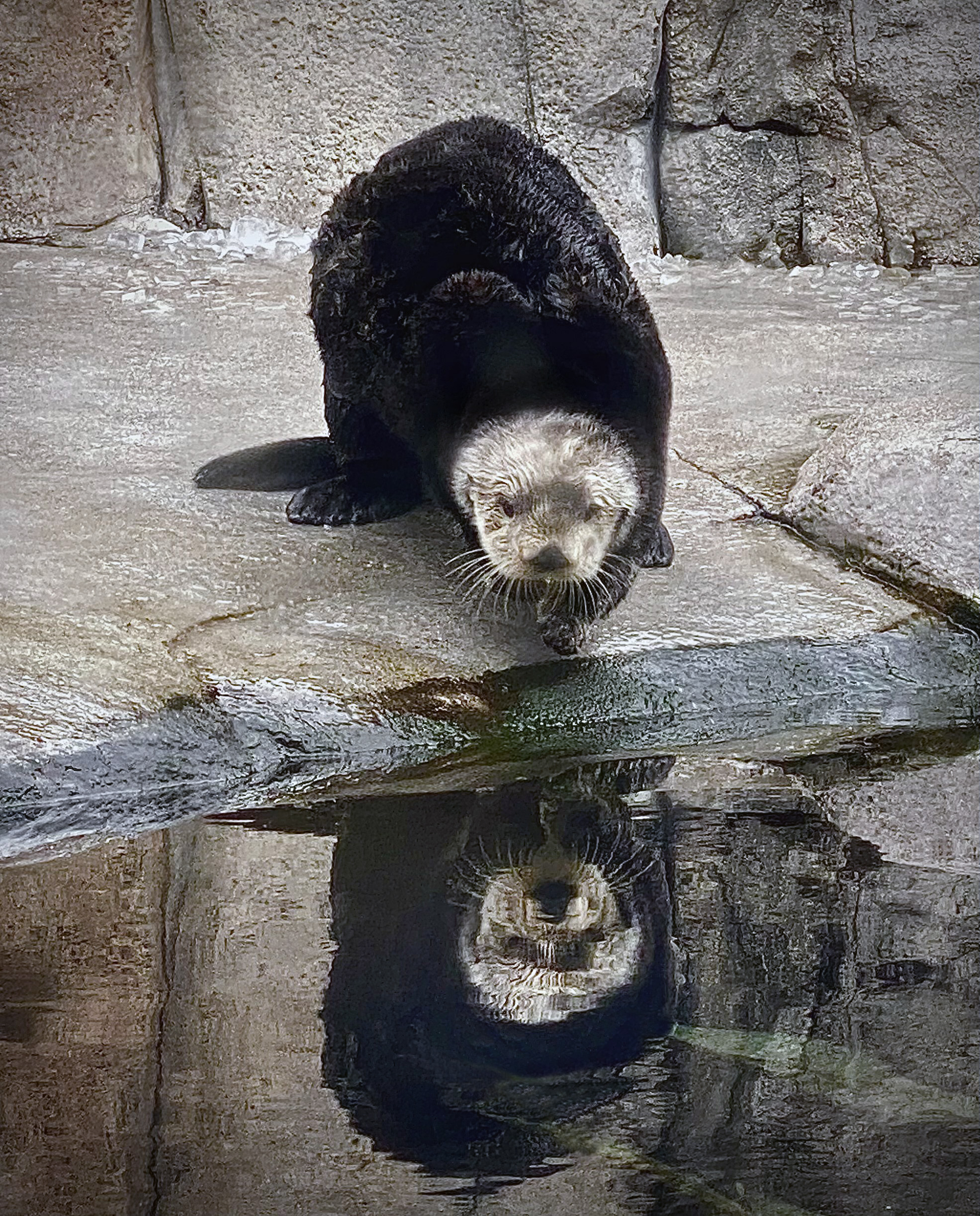
(In honor of Sea Otter Awareness Week and the Monterey Bay Aquarium otters)
•••
She log rolls on her side and rises, breathes and pats her stomach, rolls and pats, then, chin tucked to her fuzzy chest, curls into a forward roll, somehow undulating into a twist, which to my untrained eye would be a 10 in the gymnastics world—a perfect otter doughnut.
I couldn’t do that. Could you do that? No, you could not.
But Ruby can, and Rosa and Ivy and Kit and Selka, the aquarium’s all-girl otter band, can, and, oh, look— is that Ivy?—here she comes with her elegant backstroke, a blue bowl balanced on her chest as if she’s ready for dinner to be served, please.
And when she rolls, she transfers the bowl so smoothly to her paws, momentarily disappears underwater, her powerful tail twisting her lithe form, propulsion and steering all in one appendage.
How many hours on those dark days of lockdown did I spend glued to the otter cam? Looking up otter facts as I watched the girls zip in and out of the frame like sleek brown rafts:
Otters have the world’s densest fur— more than a million hairs per square inch. Their whiskers are called vibrissae; their valve-like ears and nostrils seal up as soon as they hit water.
I’d watch and chuckle, get all punny with exhaustion from hours of online teaching/coaxing/counseling/ too much worry/too little sleep—
I otter stop watching now, get back to grading. Gotta call the significant otter. Look at those gyrating girls— they’re just otterable. Aren’t they otter this world?
Some folks seek celebrity sightings of the two-legged variety. But even as these new versions of us have resumed our otterly rearranged lives, I still like to sneak a peek, catch up with sea otter girls—
the water ballerinas who made us smile, who helped us through those endless days and even longer nights.
•••
You can see the Monterey Bay Aquarium otters here.