Fat roses

There’s an obesity of roses weighing
down the stems in my back yard,
drenched by winter’s oh-my-god-
not-more-rain deluges so rare in these
parts that the lawn morphed into a
months-long lagoon.

The roses live just off the lagoon, which
has at long last receded, giving way to
the healthiest crop of dandelions and
tiny English daisies in years. I wouldn’t
let the yard guys cut any of it till
the grass swished up to my calves.

It’s astonishing what an outrageous
amount of water can do.

Of course, it was an indecent supply,
causing flooding the likes of which
parched California rarely sees, snowpacks
of unfathomable heights in the mountains—
Donner Party snow—trapping some folks
in their cabins, snow packed on roofs and
up to the eaves.

I know a woman who, barely able to open
a window, dug a tunnel bit by bit into the wall
of white outside—with a garden trowel
she happened to have in her house.

Meanwhile, my fat roses in the flatland have
reveled in the feast of water, a lavish banquet
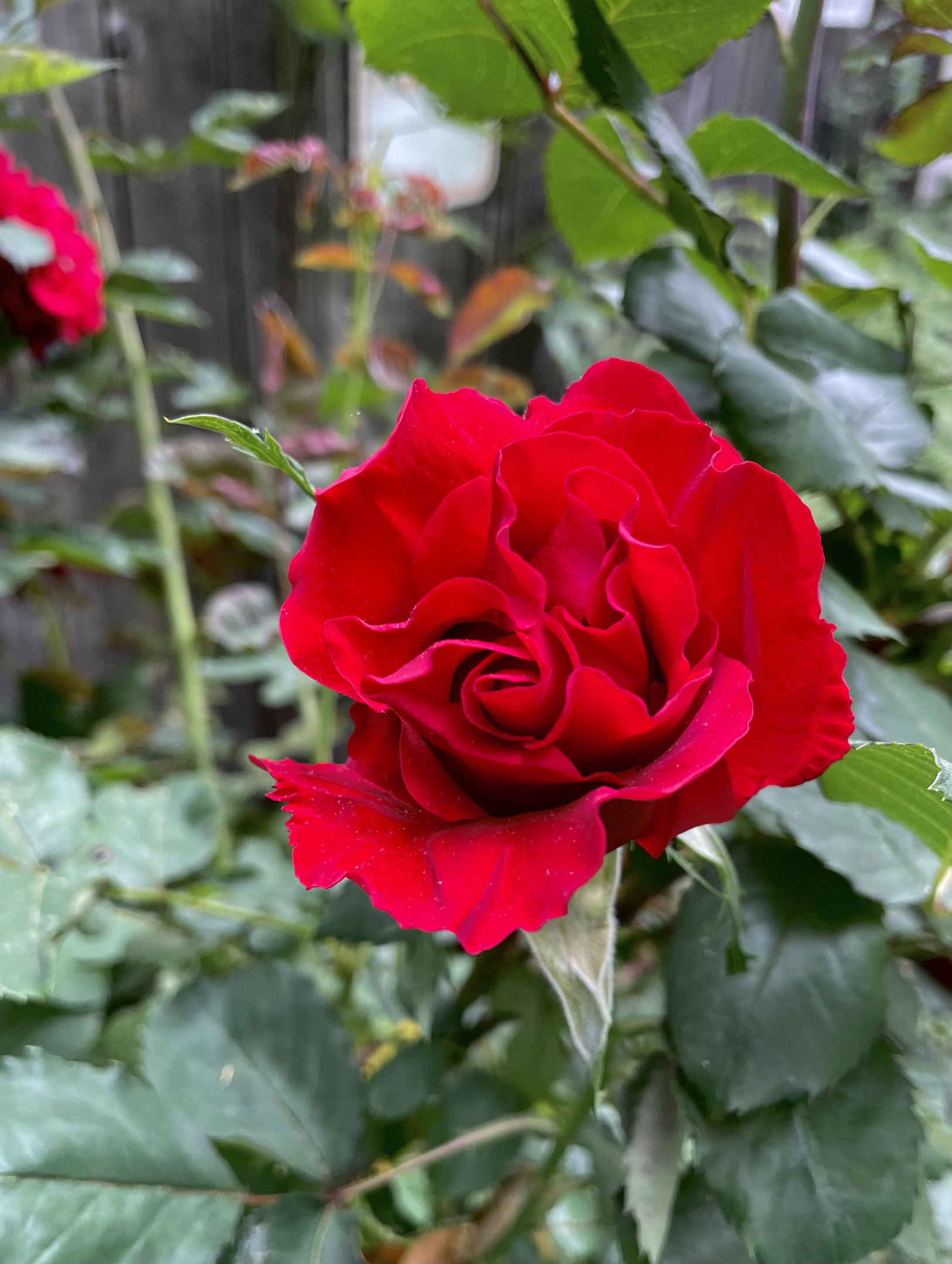
producing the most glorious bouquets. I hate
to cut them, taking only the ones bowed down
to the grass that will go quickly if left there.
But when I do, I load them into vases all over
the house, admiring them out loud every
chance I get.

The others left outside in their natural state
look like drooping, swollen breasts, unable
to lift themselves without help, fragrantly
crimson and cream, an embarrassing
extravagance. Every bush in the neighborhood—
the show-offy azaleas taking their final bows
for now—

every living thing brims in profusion,
delighting passers-by like me, who cannot
walk half a block without stopping multiple
times to, yes, smell the roses, then look up
into the still-sparkling blue sky and thank
the rain gods for such dazzling bounty.
Photos / Jan Haag
Posted in Uncategorized | 1 Comment

Choosing to stay

for Julia Ellen Cook,
July 15, 1916–May 9, 1998

Honey, she’d say,
in a voice that still comes to me
waking and dreaming,

Honey, you have to choose to stay.
You just can’t leave.

I was 22 and 100 pounds and passing out for no
apparent reason—waking up on the floor of the studio
apartment tucked next to the garage on Serenity Hills Drive.

No reason other than perhaps the stress of a job I loved
and devoted nearly every breath to. That and surviving
mostly on Dr Pepper and M&Ms with the occasional
cheeseburger.

She was my landlady in the big house up the hill—
the woo-woo, new age, holistic nurse with fiery hair
who shaved a decade off her age, who said things like,
You can leave your body, honey, but only when
you’re asleep, dreaming, or awake meditating.

Huh, I thought. OK.

She taught me to meditate, though I’d watched my mother
do so for years, sitting with me in the big pink recliner
built for two, teaching me to calm my breathing, to let
thoughts run through my brain without chasing them
like a flitting hummingbird, waiting until behind my closed
eyes deep violets and indigos pulsed like expanding
waves rolling into shore.

She fed me stews and broccoli, soups and homemade
sourdough bread, made sure I had access at all hours
to both full kitchen and washing machine in the big house.
Honey, you’re a gift, she’d tell me. You’re meant to be here.

And, she said, as I meditated, every day, I was to think,
very hard, I’m staying. I’m staying.

You never decided to stay in your body, she said.
You have to decide to stay and mean it.

I knew the story of my mother finding me blue
in my crib, picking me up and whacking the breath
back into me.

I’m staying, I’d think as I interviewed people
for the newspaper, as I typed up stories, as I
laid out long galleys of waxed words on big
pages at the slanted wood tables.

I’m staying, I’d think, as I explored the town
with its onion smell that embraced me, as I found
myself enveloped in the arms of a new lover.

And years later, as she was dying, as I sat by her bedside—
Honey, I need you to be a witness to the process
I reminded her of the mantra she’d given me.

Now you’re going, I told her.

There are no accidents, honey, she said. You’re staying.

I did. And I am. Staying, carrying forward
what she gave me, decade into decade,
in every meditation, every breath,
with my grateful heart.

***

You can listen to Jan read this poem here.

Winged prism / Photo by Christian Spencer
Posted in Uncategorized | 3 Comments

Lifelong learners

for Timi

On a breezy May afternoon,
driving down a street I once
traversed regularly to and from
the college, where I taught so many

kinds of people—the very young,
the not-so-young, the middles, the later
middles, the young old, the middle old and,
lucky for me, the later old, lifelong learners—

two ladies in the latter category make
their way down the sidewalk with walkers
like a couple of ships chugging alongside each
other—old friends, compatriots, I imagine, even if

they move more slowly than they once did.
Clearly, the forces of gravity, infirmity and age
do not stop them. Now on your way to me for a
walk—me well into the young old category, you in

late middle—I whisper a wish into the tousle of trees
overhead that we might one day be like them, deeper
into our already aging futures—each upright, outside
together, stepping carefully over cracks and bumps,

if necessary, hands guiding aluminum frames with little
wheels, on our way to matcha or hot chocolate, under
branches ripe with new leaves, or bare and waiting, two
longtime friends still learning each other, sharing tiny,

grateful moments—lucky us.

Walking buddy Timi Ross Poeppelman / Photo by Jan Haag
Posted in Uncategorized | Leave a comment

London Writers’ Salon

They had me at London. And Writers.
They write online at 8 a.m. London time,
12 a.m. for me. I’m up till midnight
anyway when I post the day’s poem,
so when the message pops up,

Writers’ hour starts in 15 minutes,

with a handy link, I decide to jump in,
wondering how many people are up
at 8 a.m. London time ready to write.
284 people today—that’s how many—
popping in like kernels coming to life
in a hot pan.

284 people writing, together, in silence
for 50 minutes at the beginning of
a new day (the very beginning for me).

And because so many leave their cameras
on as they write, I do, too, admiring
the morning light coming in Katrine’s
slanted ceiling window behind her, not
to mention the skylight over Jim’s head.
I relate to Patricia, chin cradled in her hand,
admire Carolyn’s profile at her computer,
am intrigued by Leigh writing in Dubai, a
faraway place I can only imagine.

We are all ages, shapes, sizes and colors.
Cathleen’s resplendent in turquoise,
lovely against her mahogany skin,
and Silvano’s giant glasses slide down
his nose, light gleaming off his smooth head.
I don’t know how to pronounce Wibke’s
name, but I love her thick black bangs,
and Oli has her eyes closed, perhaps
meditatively typing?

I’m deeply grateful to Matt and Tracy,
our hosts, headphoned and on camera,
Matt looking off into the distance, pen in hand,
stretching, taking a drink, fingers to
forehead, thinking, which counts as writing.
Tracy gazing into the screen, making me
wonder what words are coming to them
this morning.

I want to crawl through my screen into
Alison’s bookshelf behind her, give Sheila
a big high-five for appearing onscreen in her
pink robe, and props to Hilary for writing
outside in what appears to be a vigorous wind,
her hair blowing skyward.

I don’t know any of them, yet I feel like
one of them, some of them signing off because
they have to go to work (“Thank you for the space,
peace and companionship,” Net says). Me with
a poem draft that didn’t exist an hour ago,
thinking about bed almost an hour into this new day,
my bookshelves night shadowed behind me onscreen,

marveling at the writers around the world writing
at the same time—four times a day in different
time zones, oodles of us—as I pick up and sip
from my typewriter mug that says in bright red,
“You’re my type.”

All of you so are.

***

You can learn more about free writing dates with the London Writers’ Salon here.

Posted in Uncategorized | 1 Comment

Mistakes

You’ve traveled this far on the back of every mistake.
— Dorianne Laux, from “Antilamentation”

So list ’em. Write ’em down. C’mon, you’ve kept
some of them—too many of them—wrapped
around your heart like rusty barbed wire,

and if you make a list (too many rainstorms without an umbrella)
you’ll feel better, truly (I thought I could hack chemistry?)
the badder, the better (charred my lungs on one cigarette)

(sneaked a look at my notes on the final)
(who said red hair would look good on me?)
(the accident/relationship I drove away from)

Keep going, honey:
(shouldna kissed/slept with/married that one)
(took the wrong class/wrong turn/wrong job)

And?
(forgot to water the plants/feed the cat/pay those bills)
(ran the stop sign/ran up the credit cards/ran when it got tough)

Worst of all?
(didn’t trust you/love you/let you love me)
(didn’t say goodbye/should’ve stayed till the end/fell for someone else)

And now look at your list, fingers on the page,
lift it to your lips and kiss it, then let it go—
send your regrets floating off a bridge,

rocking to the river below, then floating away,
or folding it into an airplane, throwing it
as hard and far as you can,

or setting it aflame, or burying it in a deep hole.
Unwind that barbed wire from your heart
and repeat three times:

That and that and that made me
me.
Amen.

***

You can listen to Jan read this poem here.

Photo / Rakicevic Nenad
Posted in Uncategorized | 2 Comments

Everything on the labyrinth is a metaphor

—The Reverend Dr. Lauren Artress,
author of Walking a Sacred Path: Rediscovering the Labyrinth as a Sacred Tool

Walking the path
with nine others
is different than
walking alone,

which is how I
usually come to
the labyrinth,
solo, my preferred

way, undistracted
by others on
their journeys.
Today, though,

I find it hard to
focus on myself,
my gaze riveted on
on a woman in blue,

a bicycle with
blossoming flowers
sparkling on her chest,
walking slowly,

pausing, looking up,
other people
pausing, too, some
passing, walking

their own walks,
as we all must do.
And it takes me,
meandering into

and out of the
rhythmic turns,
some time to look
up and read her shirt:

Enjoy the journey,
it says, and I hope
she is, walking her
open-hearted walk,

perhaps finding peace
and healing, a sense
of calm, as I often do
on a labyrinth.

Only later does it hit
my distracted self that
perhaps the message
was for me, too,

delivered by bicycle,
blossoming on a sunny
Sunday morning,
opening, listening

to the heartsong
flowering within,
delivered by unseen
birds overhead.

***

With thanks to Rev. Lucy Bunch, Unitarian Universalist Society of Sacramento

Photo / Jan Haag
Posted in Uncategorized | 1 Comment

Acnestis

The itch that demands a scratch
right in the middle of the back,
the spot no amount of arm twisting
can reach, sends bears backing up
into trees to shimmy into rough bark
just right for scraping away annoyance.

The irritation that sends dogs into frenzy,
cats into paroxysms of agitation,
and me looking for someone,
anyone, with even the smallest
fingernails to go after the point that
my brownie-baking grandmother
would happily attack with gusto
for as long as I liked, saying,

Is that better, honey? More?

And when I’d nod or moan
my assent, practically bicycling
my leg like a happy dog, I relished
the pleasure of having another
lavish kind attention on my person,
this garage for my soul, still carting
me through six-and-a-half golden
decades.

May it always continue
with hugs and back scratches,
as much agreeable touch as one
can decently get in public, and
perhaps, with luck, the private brush
of caress, of cuddle, of embrace,
affirmation of endearment,
testament to true affection.

Grizzly bear back scratch, Denali National Park / Photo: Patrick J. Endres
Posted in Uncategorized | 4 Comments

Humility

(from humilis—Latin for low, of the earth)

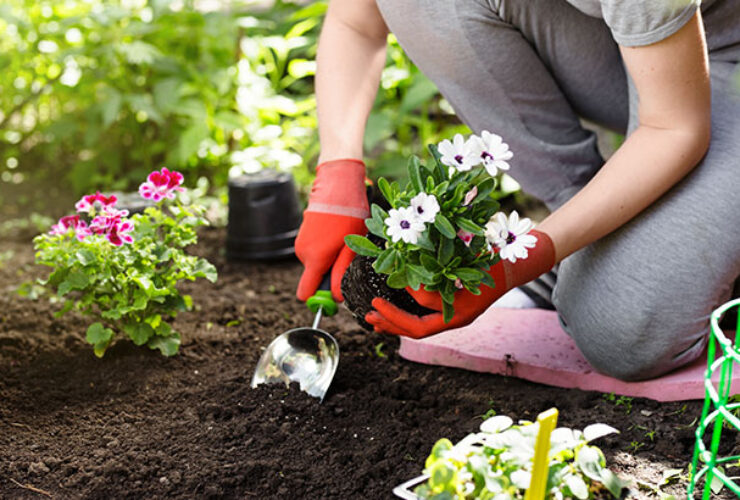
I retrieve the thick blue foam pad
and toss it in the empty bucket
along with a sturdy trowel, my favorite
pair of clippers and the digger—
a three-pronged fork perfect for
raking small patches of stubborn dirt.

If I remember, I grab the gardening
gloves I’d rather not use but know I
should in thorny situations. Dirty hands,
soil embedded in nails, drying the skin,
is such a satisfying feeling, as it is to
sink onto the foam kneeler before
a plant, a bed, a bush that needs
attention.

Is there a more humbling act
than this? I never considered myself
a prayerful person; it took years to see
that this pose that strains muscles
I use only to do this work counts
as communion, as divine interaction,

that every whispered, OK, grow now,
is a heartfelt blessing, a devotion.
This being human is blessedly low,
of the earth—me, here, with busy hands,
happy in quietude, tranquil mind.

And when I rise, brush off dirt and plant
bits—stray roots dangling from my knees
like lace—I grin at my creaking parts
as, unbidden, the prayer sweeps through:

thankyouthankyouthankyou.

***

You can listen to Jan read this poem here.

Photo: Jan Haag / Mural: Mary Sand
Posted in Uncategorized | 1 Comment

Dirt

Part 2

On an overcast Wednesday I walk
the front yard, casting like a fly fisherman
looking for the best spot. I eyeball
possibilities after yesterday’s wander
through a nursery, guessing how many
plants I need based on what survived
the drenching winter—as always,
driving home with too many.
But that, I figure, gives me options.

Which I need when, sinking to my
knees in supplication, despite my
best efforts at digging, I can’t
deepen a hole thanks to old roots
or decomposing clay pipe. The big
fellow in the gallon pot will need
a different place to land, so instead
I choose the small red-flowered
kalanchoe, a new-to-me succulent
that prompts a prayer of hope for
this little one.

As I dig, I unearth more than a few
earthworms, depositing their wiry
pink bodies in the dirt I set aside,
position the plant just so in its cradle,
then tuck the original occupants
back in with their new roommate.

I cringe when I accidentally trowel
one in half. But the two ends continue
to wriggle and, I understand, thrive,
reborn within eight days into fully
functioning worms—mouth, brain and all.

So I pray to the garden gods that
these blind and deaf creatures may
safely burrow their tubular selves into
dark soil, eating and pooing and creating
healthy space for new roots—silent
environmental helpers busily improving
their home place, which they so gracefully
share with us, too.

Posted in Uncategorized | Leave a comment

Dirt

Part 1

Moist, dark soil, ready for new life to begin.
—Tina Davidson

We live for this all winter, the first trip to
the nursery to see the babies, to coochie-coo
under their tiny leaves, to fondle their
too-heavy heads, so hard to hold up.

We can’t wait to bring them home
and tuck them into their beds, freshly
turned dirt waiting for them, our hands
busy with implements, a little food,
a hose—whatever we think they need
to grow.

We often come home with too many,
then search for places to put them.
But we find them places where we
will check on them probably far too
often. We will enthuse over each
centimeter of height, over new leaves.

We will pluck the shedding bits, and
yes, some of them we will mourn,
gone before their time. Already in
their resting places, we may just
tuck them under a bit more, thank
them for what they brought to us
in their brief lives, remember their

perkiness when we brought them home,
full of promise, as we promised them
everything, refusing to think of
the moment they would leave us,
kneeling in supplication, dirt
under our nails,

before we turn again to the ones
still growing—the taller, bushier,
thriving ones we hope, with luck,
will outlive us.

***

To listen to Jan read this poem, click here.

Posted in Uncategorized | 1 Comment