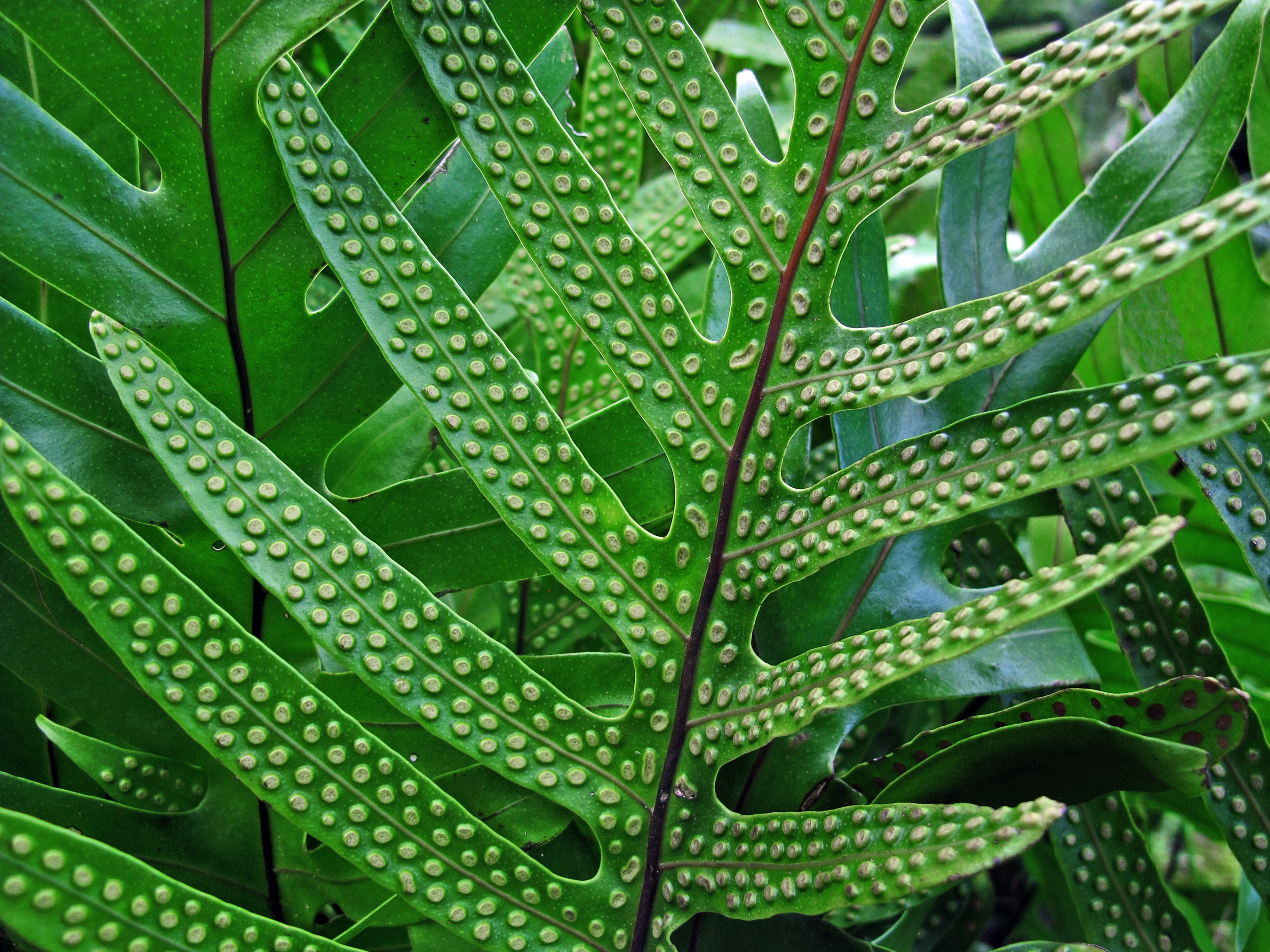
You taught me to see light falling through a broad leaf from the underside, its green veins illuminated like a manuscript, shining with lifeblood, and the lacy fingers of ferns hanging shaggy in rainforest damp, droplets poised just so at the tips, pointing to something else to be looked at closely, to be studied in the eyeblink it takes for a shutter to open and close, to capture what many people bypass, then praise after they see it spring to life, framed, hanging— when they call it art.
Limahuli Garden leaves, Kauai / Photo: Dick Schmidt
William Shakespeare’s birthday is traditionally celebrated April 23, though the date of his birth was not recorded. But because he was baptized April 26, 1564, which often happened when babies were three days old, his birth is celebrated on the 23rd, which, coincidentally, is also believed to be the date on which he died 52 years later.
***
Why’s dude so famous? a student once asked me. Because he’s perhaps the greatest writer in the English language, I said.
The student, a lanky kid made more for basketball than literature, said, You call that English? And I said, Yeah, a really old-style English, to which he nodded, and said, Show me.
So I went all fangirl, whipping out a little Macbeth contemplating murder: Is this a dagger I see before me? A sonnet or two, a little love poetry: I do love nothing in the world so well as you— is not that strange?
A little philosophy from Prospero: We are such stuff as dreams are made on, and our little life is rounded with a sleep. And a full-court press from Ophelia: We know what we are, but know not what we may be.
And I recited and showed him scenes from plays—Juliet panting after Romeo, King Richard hollering for a horse, any number of sword fights. The student listened, he nodded, didn’t seem enraptured.
He went away for the summer, returning, to my surprise, to sit in the front row of my creative writing class, telling me he’d been captivated by the old poet dude— he’d watched all the movies; he wanted to write poetry, too.
And he did, full of meter and rhyme, though I told him he didn’t have to do it that way. And he came to my office after class and said, Ma’am, I gotta rhyme! I just gotta rhyme!
So he did, touching my old heart with rhymes that were something more than rap, that sang, as he said, with the iambic and the pentameter, among other rhythms he didn’t even try to name.
And when he presented me with a sonnet—14 lovely lines, a fine rhyming couplet at the end— written for his lady love,
I swear I got misty-eyed listening to the young poet dude, of whom, I had no doubt, Will and I were both so proud.
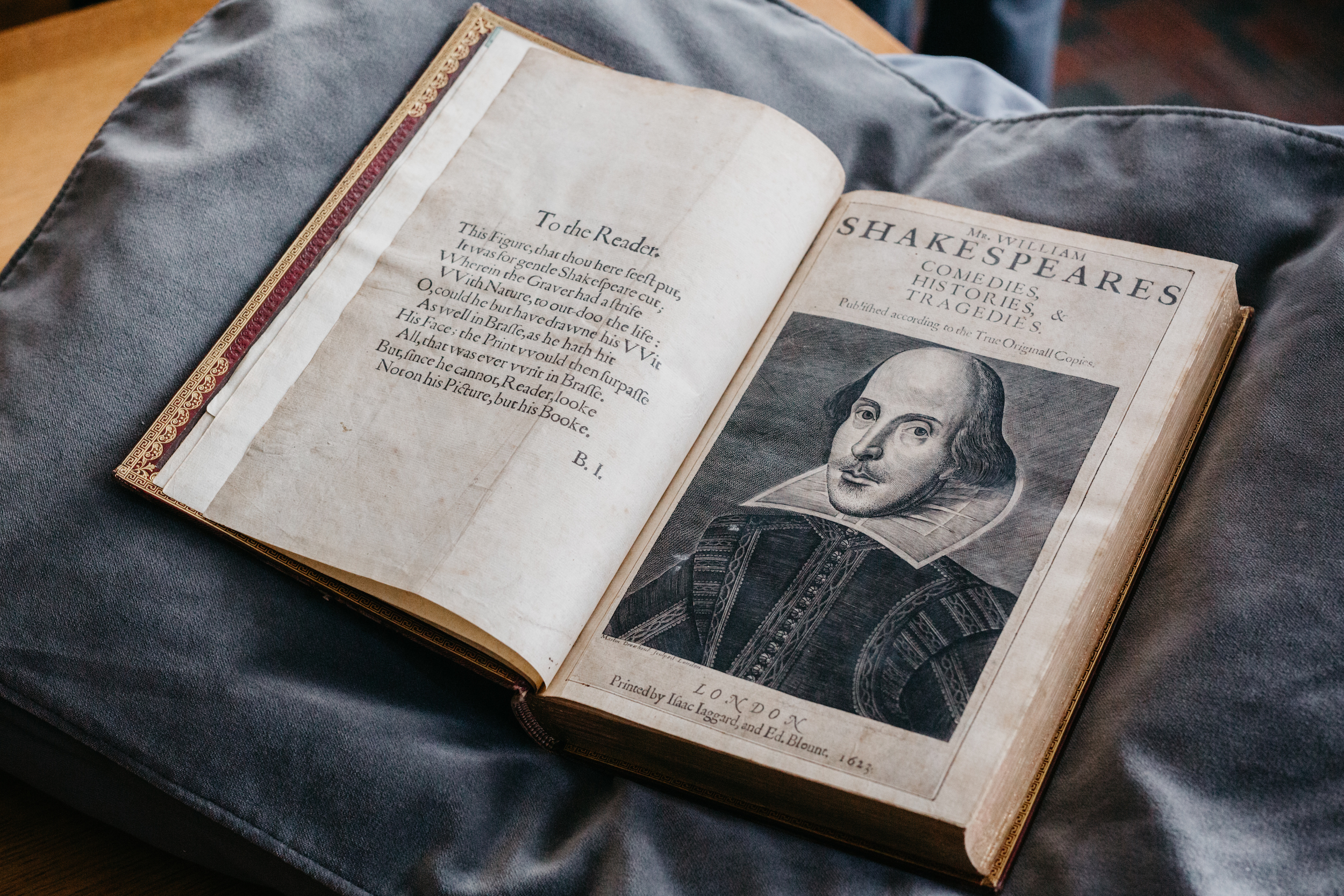
Will’s works / First Folio (published in 1623) at the University of British Columbia Library
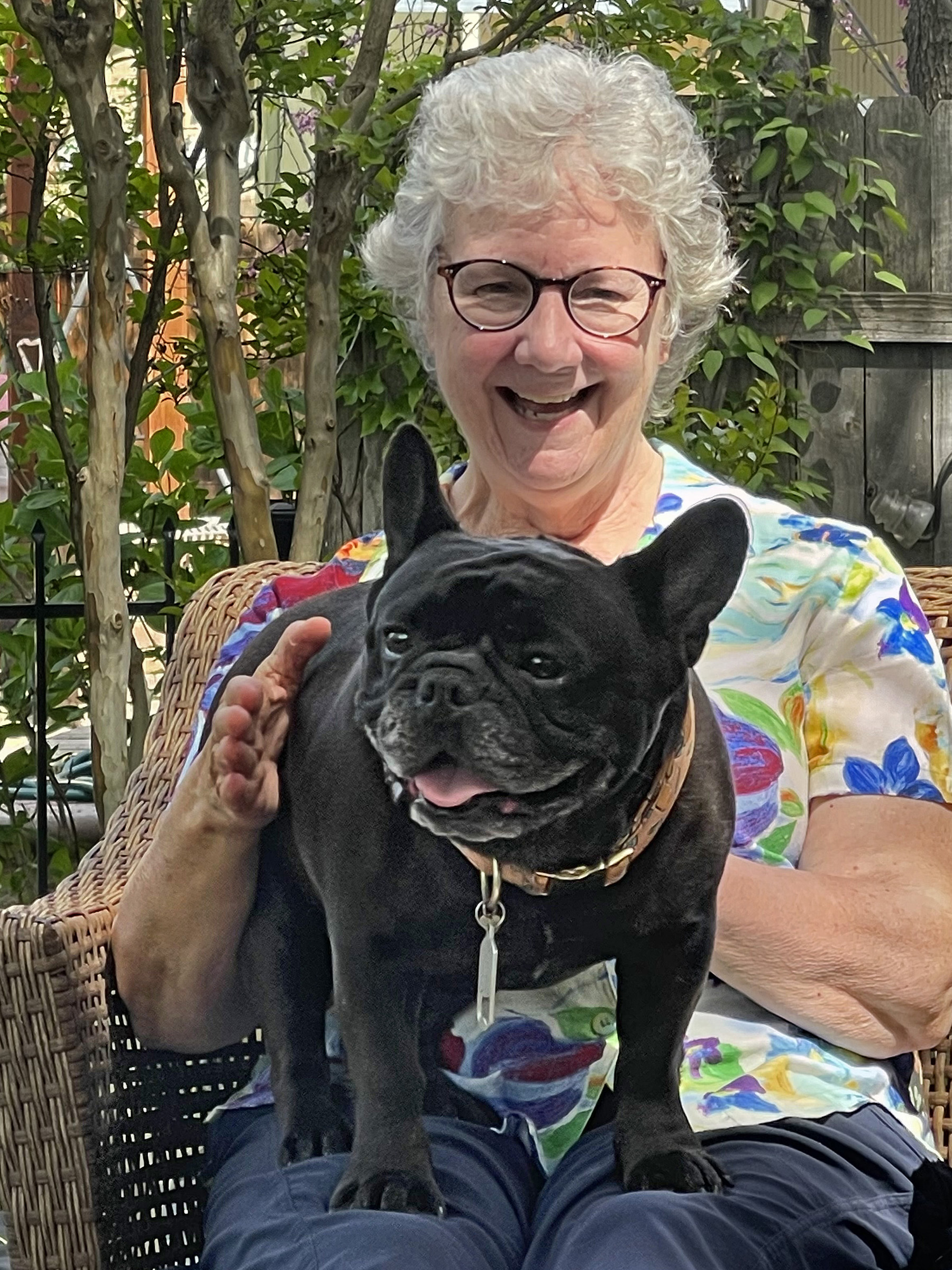
I like to think it’s not because I slipped Kyle some small bits of beef that his grandpa grilled in the backyard and the family ate on the deck under the old oak,
or because I fussed over him as a good aunt does. Because the whole family fusses over this little pudge of a dog—like his uncle, once upon a time
my little nephew, and others throwing blue rubber balls again and again, everyone stooping low to give him a pat, this happy guy who adores everyone.
So when Kyle hopped up on the ottoman where I sat, walking up my legs, his little Stitch face grinning at me (as only French bulldogs can),
I hugged the little fireplug with the big bat ears, who turned from the platform of my lap to look at this little family of three generations gathered—
with Kyle’s mama due to deliver the first of the fourth generation in June—doggie panting, me thinking on this perfectly ordinary, wonderfully warm spring day,
They floated around out there, the Apollo 17 crew in my 14-year-old imagination, snapping photos on a space-age Polaroid, the device spitting out a damp image spit from its slotted mouth,
astronaut hands waving it dry in the artificial atmosphere of a capsule. Actually the first picture of our whole round planet was shot on a Hasselblad film camera after the spacecraft
left its parking orbit around Earth to begin its trajectory to the moon. Three men on the final lunar mission looked homeward and took the first global selfie to go viral.
On Christmas Eve 1970, as the rest of us Earthlings got a peek at the photo dubbed the Blue Marble, I went to my red Folger’s can full of marbles, retrieved a swirly blue boulder and peered at it,
visualizing a tiny world inside—one partly shrouded by cloud rivers, dust plumes, even a sun reflected in oceans, wondering about tiny beings going about their lives.
And I, looking on from the outside, holding that boundless worldview in a cold glass globe in my palm, somehow knew to cradle it gently, set it down carefully, not tuck it into a pocket
as I usually did, before I headed out onto my home planet to crawl up my favorite tree, notebook and pen in hand, settle in for a spell, and write about it.
The original Blue Marble photo was taken “upside down”—with Antarctica at the top of Earth—on December 7, 1972, by the crew of Apollo 17, the last human lunar mission. According to NASA, no humans since have been at a distant enough range to take a whole-Earth photograph. Photo / NASA
I have come again to the granite boulders beneath the oak tree on the angled hill looking down at the lake—this spot I occupied a few weeks ago— to see what has changed.
So much. Oaks stretching their long limbs fully leafed out. Knee-high grasses, in some places thigh-high, waving hello, tousled by the vigorous breeze. The lake navy blue, furrowed with chop.
Spring comes and goes always too quickly.
Lavender twining brodiaea have almost gone, giving way to a profusion of purple vetch, their violet heads hanging on their stalks, trembling in the wind.
The lake has risen, almost covering a sea of purple blooming on the shore below, one small island still above water, a raft supporting a single tall tree. If the snow melt arrives as predicted, the little strip of land will likely vanish.
We all find ourselves underwater at one time or another, waiting for the waves to recede.
The sudden rise takes us aback; we feel as if we are drowning. We forget about rises and falls, comings and goings, beginnings and endings.
And then we remember:
We know how to swim. We know how to float, how to rest. We just need to lay our heads back, let our lungs fill with sweet air washing over us, and breathe.
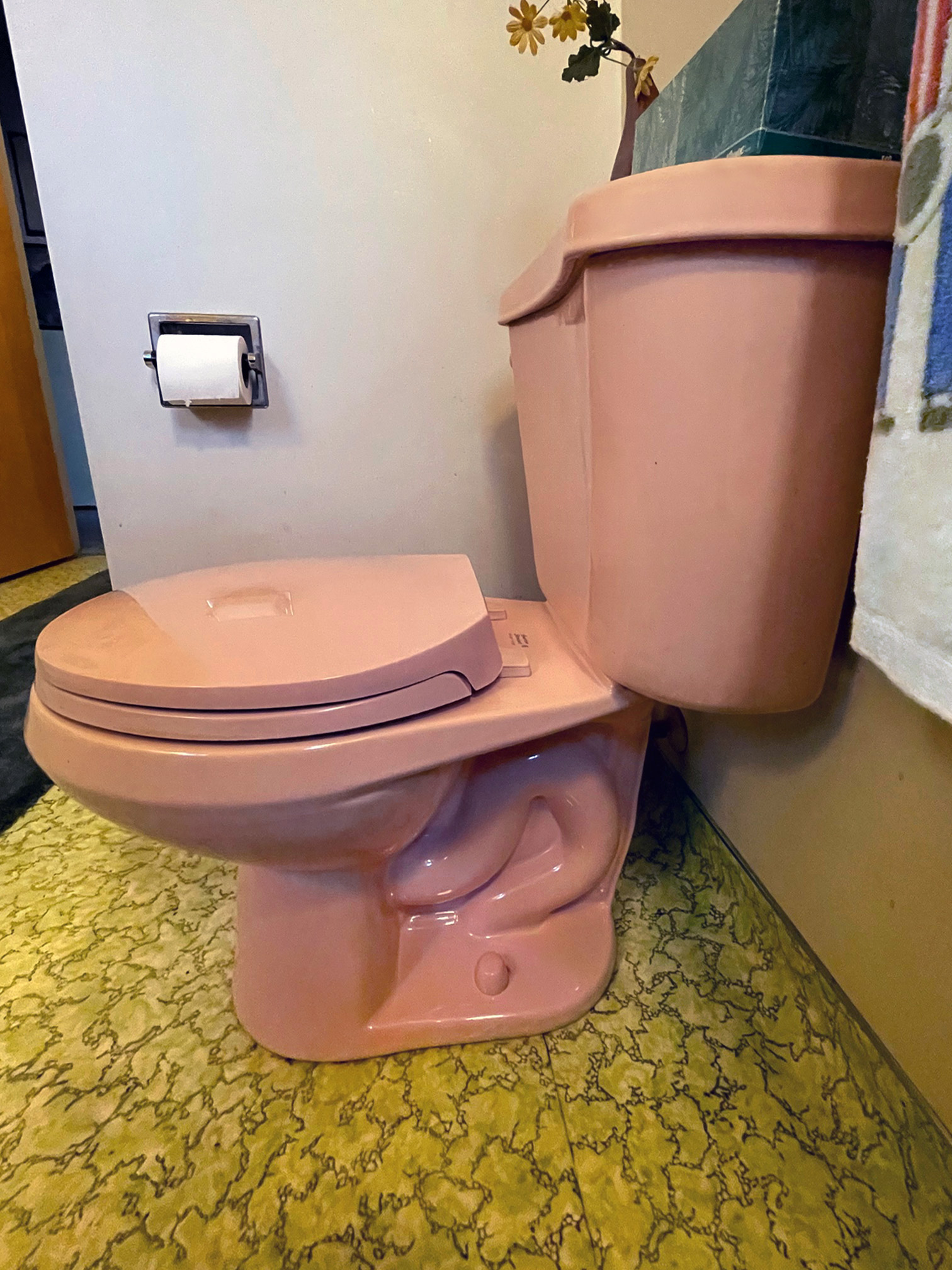
I sit on the rosy pink potty in the bathroom my sister and I share, automatically look to the right, to the wall above the toilet paper nestled in its chrome cave, study the list in my neatest sixth grade printing taped there,
a carefully constructed table beginning with the twos— because the ones are easy, so are the threes, really.
But from the fours on up, except for the tens with their telltale zeros on the ends, I need help.
So every time I sit here, I gaze right, trying to memorize combinations of numbers that swim before my eyes like midges rising from a stream, unaware of hungry trout beneath.
And if I don’t completely absorb the multiplication tables, others in this spot certainly have—
my sister, two years younger, always so much more nimble with numbers than I,
even our father, who occasionally emerges, announcing, “7×8 = 56!”
I try again and again to embed these equations in my brain— the math teacher not willing to accept a poem to make up for my last disastrous test— feeling the slithery digits slip away from me in a way that words do not.
The numbers escape, even as I chase them, calling their names, wondering what I need to do to make them stop, smile, chat a bit, to want to become my friends.
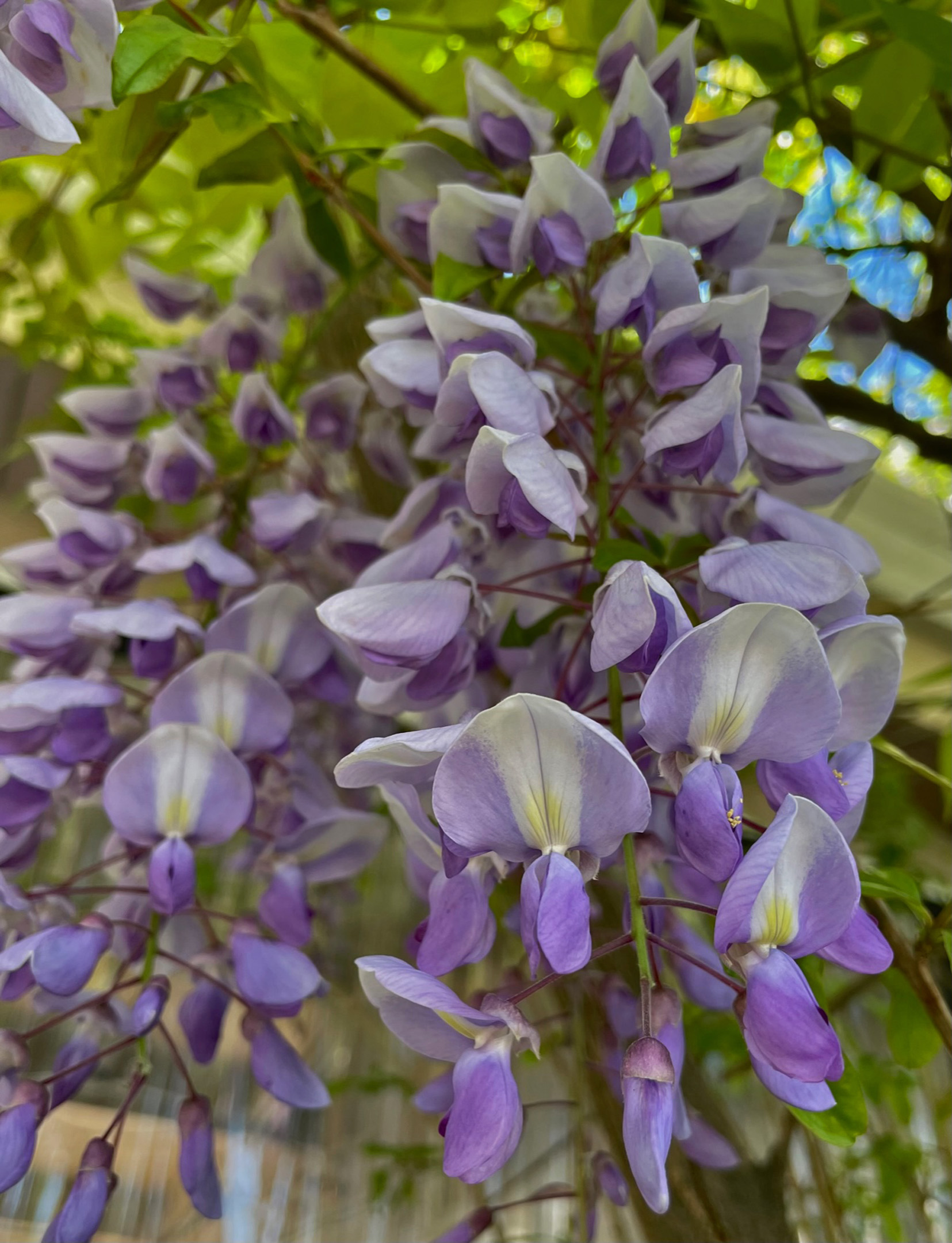
Last year, out of town, I missed the hanging lavender lanterns morphing the driveway trellis from a mess of bare sticks weaving over under, under over into the annual leafy bower.
Wisteria envy has seized me like another seasonal allergy, so I want to soak up the blossoms popping out this week in earnest, fleeting bits of loveliness—within a couple of weeks, masses of eager leaves will fill in as warp and weft.
Because I trimmed last season’s woody bits late this year, I inadvertently doomed the fragrant crop to come, and sure enough, less abundance sends me into the world seeking that particular scent, hoping to find cascades within easy sniffing distance.
Nature’s superstars blindside us, showy distractions from the fragrant miracle that blooms over my driveway each spring, before full-lipped leaves push through, providing summer shade before falling in fall.
But for now, and a few more days, I open the front door and look up, see my car temporarily tattooed with the most delicate purple petals. I inhale deeply to catch a whiff of what’s left—before the beauty lets go, dropping petal by petal into memory, the show over till next year.
You could’ve said no, but you didn’t when I asked you to heft that melon, sagging like an ancient breast lying in the cold drawer
of the fridge, walk it to the big green bin on the driveway where leaves and lawn clippings mingled with droopy daffodils so bright and
cheerful days earlier, too soon limp and spent—all the dying things in one dark, pungent place filled with the smell of rot. And
because you loved me, because you knew I’d shudder to open that lid, you did. Over your shoulder I detected resignation in the iron twitch
of your cheek as you palmed the softening fruit, placing your thumb as gently as you once did on the laces of a baseball before
you pitched it, avoiding the melon’s crusty bit, then walking it outside like a wounded bird in your hands. From the kitchen window I watched
you approach the bin, pause, open it with an elbow and execute an elegant slam dunk. I felt the plummeting thud as I recalled
all the dead things you’d removed from our lives—what the cats dragged in, what died on the lawn, sometimes intact blue jays fallen off their perch—
and I wondered how you’d toughened, seemingly untouched by loss after loss, your heart taking the beating. I recalled stories of stampedes in your family’s
turkey barns, frantic feathered balls trying to escape marauding skunks, many of them failing, you and your brothers, just boys, tasked with
shooting the intruders, burying the corpses of young poults— dumbest things on two feet, you’d say—my heart hurting for all of you.
You’d been close to death all your life, while I ran from it. Until the day I got the call from a coroner in another county
asking if I was your wife, if I’d come to the house you lived in alone, and I did, walking into your unexpected departure, sitting
with you one last time—me cross-legged on the floor, cradling your porcelain foot in my lap, looking at your sagging face, me cheek to jowl with what
I’d long feared—you, utterly gone, two strangers outside the front door, black zippered bag in their hands, waiting.






 Güd wrtr