noun: a hormonally controlled quiescence resulting in a reduction of metabolic activity, often occurring seasonally, especially in insects
I’ve just learned that as the cold descends, you, little red-suited beetles, cuddle tight to each other like cubs in a den napping, your metabolism slowed to the consistency of honey, your appetite for aphids momentarily on hold.
I had no idea you could survive a winter, but here you are umbrella’d under a broad leaf with your black polka-dotted buddies in what I now realize is ladybug hibernation— not a bad idea for us all—
a time of quiescence for living things, tucking into stillness, relishing dormancy, until the awakening signal plucks at us, persuades us to stretch our tiny wings and take flight into a whole new year.
2. One who, in certain places on the planet, is not permitted to determine what to do with her own body, particularly if she should become pregnant and does not wish to be.
3. Origin: from the Old English wīfman, which combines the words wīf and man. As in wife of a man. The original meaning of man, meanwhile, was simply “person.”
4. See “queen”; derives from a word simply meaning “woman.”
5. Consider: Queen Elizabeth II, the monarch of Great Britain for 70 years, one of the world’s longest reigning monarchs, before her death in 2022.
6. Consider: As of 2023, there will be a record number of U.S. women governors—12.
7. Consider: WNBA star Brittney Griner’s internationally condemned imprisonment by Russia and her subsequent release in December.
8. Consider: Online searches for the word woman increased more than 1,400% in 2022, a massive leap for such a common word.
9. The biggest search spike started at the end of March, during a confirmation hearing for Judge Ketanji Brown Jackson, who in April became the first Black woman to be confirmed as a U.S. Supreme Court justice. The surge in online lookups came after Brown Jackson was asked by Senator Marsha Blackburn to provide a definition for the word woman.
10. Because apparently the senator, who alleges to be one, did not believe that a Supreme Court justice nominee could adequately define a woman.
11. Because it’s no longer a term only for people born female. We are so much larger, have so much more impact, more possibilities, more strength.
12. We hold multitudes, whether we decide to carry children or not. Whether or not we have ovaries and/or breasts.
13. Let us hold each other with kindness and gratitude, regardless of whether we fit others’ definitions of woman.
14. Let each of us be uniquely us, calling ourselves by our chosen pronouns, whether she, they or, yes, he.
15. Amen.
(Statistics and information from dictionary.com / 2022 word of the year)
Sure, we tell people, it’s because we love the town, stayed in the same cute condo in January, and because there were 9 nights over Christmas when it was available, and our family
didn’t mind our absence, and if actual winter—gray cotton tule fog or the slim chance of rain—descended on the northern part of the state, then we’d have a nifty escape into the desert,
which, truth to tell, does have winter, too—it’s not always 85 degrees in bright sun, it does rain, and palm trees can weather cold just fine, it turns out. But we knew better.
We knew that in our hearts, it wasn’t completely about the weather or the champagne cork swimming pool or the ease of escaping our regular lives for a bit.
We came for Sherman’s, and even before we got the keys to our condo, we headed over to what might be the best Jewish deli in the state, mid-afternoon, a 10-minute wait,
a curved booth in the back with a view of the whole joint, celebrities’ signed photos polka-dotting the walls. We came for the meatloaf sandwich and the pastrami.
We came for the extra potato salad and dill pickles. One of us really came for the ginormous chocolate eclairs, and the other one for the liver and onions, and has
developed a fondness for the red velvet cake. It doesn’t matter. It’s all perfection on a plate or bowl, for which I thank Marty Weisinger, my father’s Army buddy, who
introduced my sister and me to our first Jewish deli when we were kids quite unused to dill pickles and pastrami, a man whose molecules have to be floating around here
somewhere with the aroma of chicken soup in the pot and matzoh balls being rolled in the kitchen, and yes, the joint will be jumping on Christmas Day with the spirits of those
who loved the place in life, too, who give us their blessing as we eat, knowing we’ll take half of it to go—yes, thank you, we’d love some extra pickles—and we’ll be back for more.
Listen, the voice said, and I did, sit, and I did, resisting the urge to ask why, and the voice said, rest a bit, honey, your soul wants to catch up,
and I thought, you mean I can outrun my soul? isn’t it like a shadow, always attached?
and the voice sighed, as it does, and said, shhhh, honey, lie down, close your eyes,
and if the voice had had a finger, it would’ve put it on my lips before I could say,
but I thought I had slowed down, this is not my old speed, and how will I know when my soul has caught up? will it tap me on the shoulder, saying, we can go now?
and the voice shhhhhh’d me, melting my eyelids, whispering, rest now, honey. give it a little time. you’ll know.
(Photo / World Famous Crochet Museum, Joshua Tree, California)
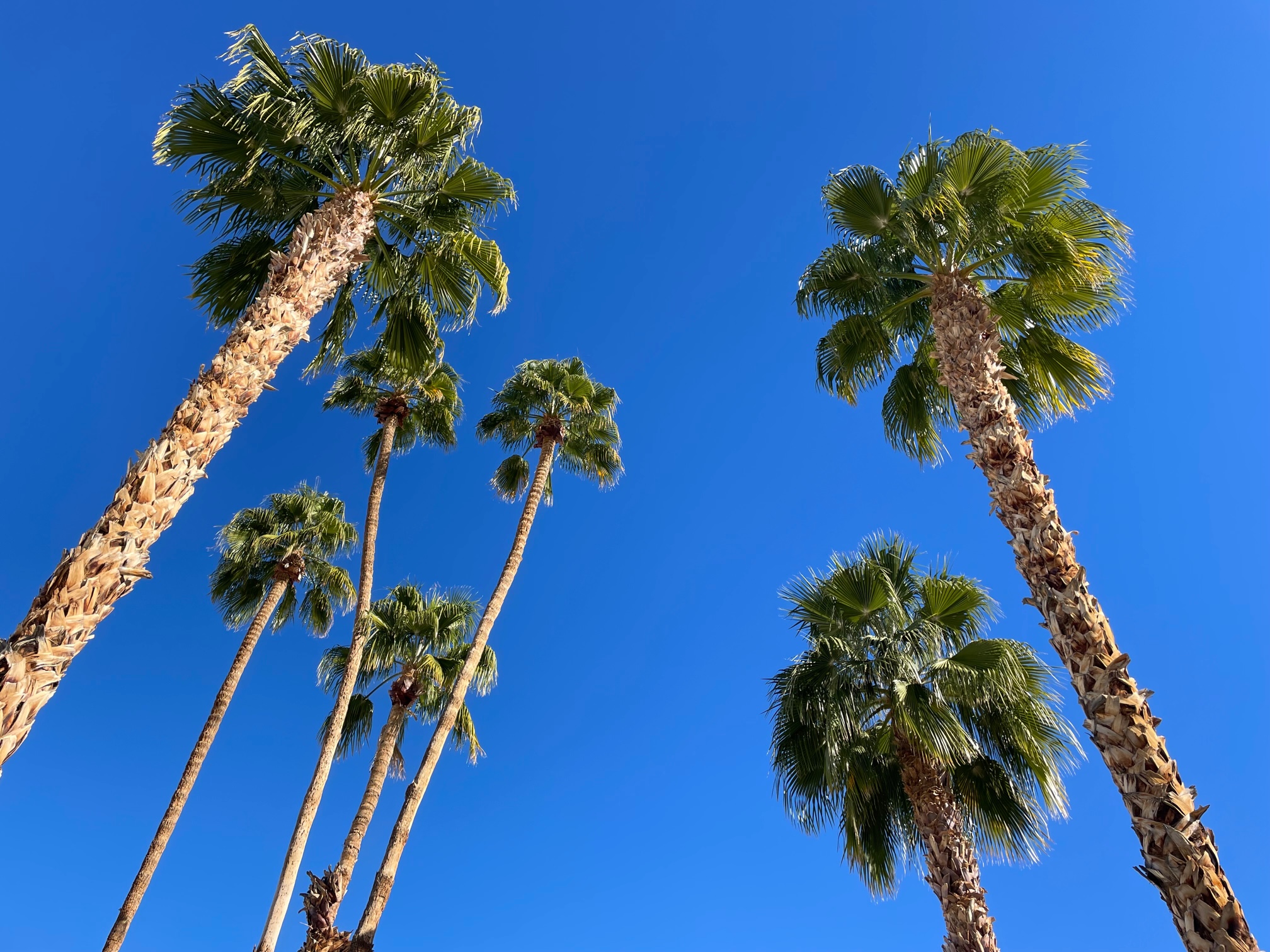
Actually, from where we sit, on the patio in the warm (southern) California sun, we see at least 20 shaggy heads rising high into the blue on long columns, their pendulous leaflets swinging freely in the merest breeze.
The seven closest seem perfectly arranged, a small choir of California fan palms singing their hallelujahs and hosannas, their fronds huddled at the top, an open crown pointing skyward—
not of thorns but of life-giving green fanning the quiet, as we sit and listen to this day we’ve been given, one overseen by wise ones like these, beloveds we cannot see, whispering, peace, sweet peace, and goodwill to all.
I said some words to the close and holy darkness, and then I slept. —from A Child’s Christmas in Wales, Dylan Thomas
In that close and holy darkness, yours, may memories arise in dream form:
the wool-white bell-tongued ball of holidays resting at the rim of the carol-singing sea,
in a long ago, faraway place that lives uniquely in you, one that arrives in sleep:
the Eskimo-footed arctic marksmen in the muffling silence of the eternal snows…
birds the color of red-flannel petticoats [that] whisked past the harp-shaped hills…
the stories re-given, as you knew them then:
…snow grew overnight on the roofs of the houses like a pure and grandfather moss, minutely ivied the walls and settled on the postman, opening the gate, like a dumb, numb thunder-storm of white, torn Christmas cards over the frozen foam of the powder and ice-cream hills…
You see the useful presents, the useless presents, the uncles and, not least: … Auntie Hannah, who liked port, stood in the middle of the snowbound back yard, singing like a big-bosomed thrush.
You once again with your pals who have not aged, have not passed into mystery, are as alive as new leaves, which lie still under bare branches for a while yet.
You remember the words to “Good King Wenceslas” and his feast of Stephen, and sing, your children’s voices high and seemingly distant in the snow-felted darkness.
It comes to you that everything was good again and shone over the town…
which, with luck, you will bring with you from the close and holy darkness into wakefulness,
grateful for the lasting gifts.
(Words in italics from Dylan Thomas’ short story, “A Child’s Christmas in Wales.” You can hear a 1952 recording of Dylan Thomas reading the story here.)
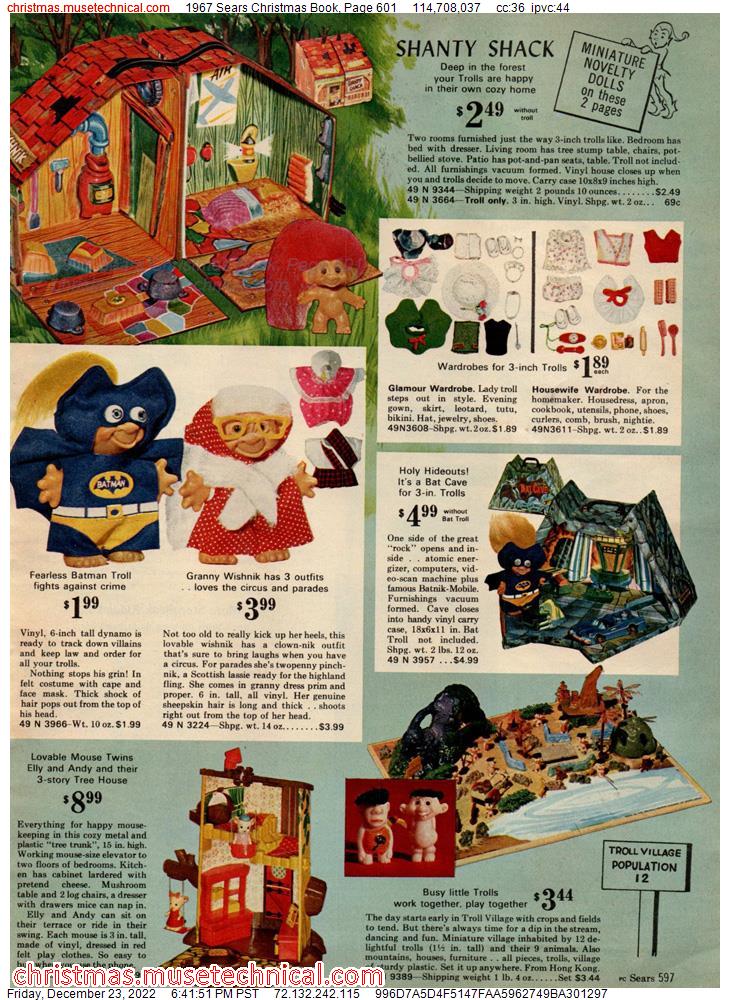
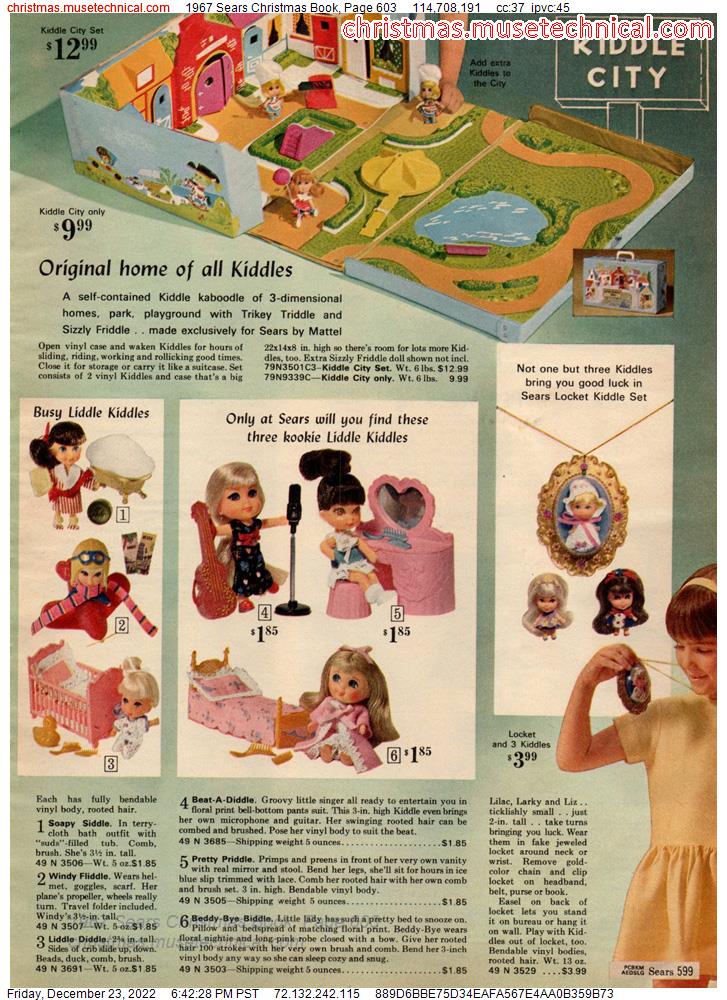
Look what I found: pages from our childhood bible, the one that arrived in fall and we pored over for weeks, working (at least in theory) on Christmas lists that we’d present to parents with our eternal hope—
pages selling trolls (not troll dolls, as our parents called them— to us they were real characters to whom we gave names and backstories).
And here are the Matchbox cars, likewise with names and biographies, the Kiddles, tiny dolls (OK, sure) wearing tiny outfits. Remember the girl with the guitar and mic stand, her long blond hair swinging behind her as she sang?
And one of us must have requested a kids’ record player because we certainly each had one, which was how we listened to our cousins’ 45s they passed on to us—
the “Flying Purple People Eater” debuted the year I was born— graduating to Snoopy vs. the Red Baron to Herman’s Hermits and the Beatles, eventually to Barry Manilow and John Denver.
I never got the kids’ typewriter I requested, on which I might have batted out any number of stories and poems—though my parents got me a dandy Smith-Corona electric when I graduated from high school.
But look, you guys, at what our little hearts desired more than a half century ago, what fed our imaginations, what helped us grow into women of substance and character, what we wished for— so much of it not from the Sears Wish Book—
They’re everywhere here, flitting about so fast I mistook them for butterflies the first days I walked the neighborhood. But if you pause, wait, you might see one land.
After a day spent in bed, felled by something (not that thing) that seized me, shook me and unceremoniously dropped me, when I finally rose to eat a bit, I stepped outside to the patio under three leggy palms and next to a lemon tree lush with yellow orbs.
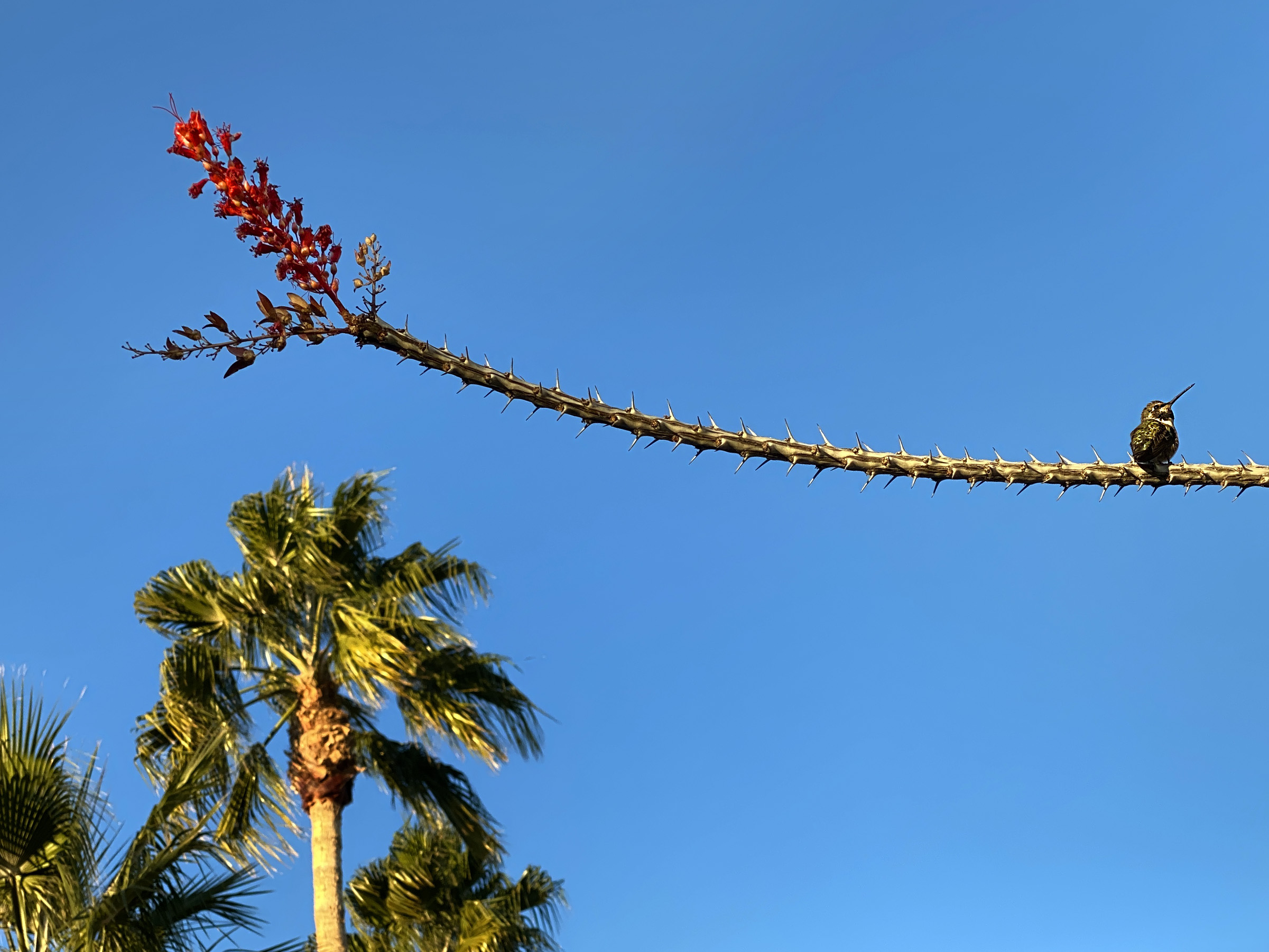
Taking a seat, I saw the hummer flitting about the blossom-less tree—no food there—but offering a handy perch for the wee bird, which, like a tiny Peter Pan, hovered, forward and back, before landing on a slender branch. Momentarily stilled, it looked down at me, head shifting every few seconds, left, right, down, needle beak occasionally pointing skyward,
and we gazed at each other for a few minutes, its little heart outpacing mine by about a thousand beats per minute. And when a noise startled the tiny iridescent missile, it arrowed up into the blue,
off to find the next blossom, always on the move, difficult for mere humans to see, but making this one feel a bit lighter, which is, after all, part of their charm.
Hummingbird on Ocotillo branch, Ocotillo Lodge, Palm Springs / Photo by Dick Schmidt