On my way to church on a sunny November Sunday

(In memory of my father)

Driving down H Street, I see
a man at the curb, rake in hand,

and another man’s voice comes to me:
I can pray just fine raking the leaves,

though he really said this about mowing,
not being inclined toward leaf gathering

since our yard primarily consisted of old
live oaks that, when they did shed, did so

so unnoticeably that the leaves just lay
on the grass until they got churned up

by the lawn mower, morphing into mulch.
I love these there-you-are moments when

he appears, reminding me that all moments
are holy, no church needed, unless you want

to listen to someone tell a good story, and
close your eyes as a superb pianist fills

a whole room with the sound of eternity.

•••

(With thanks to Dr. Irina Tchantceva, pianist at
the Unitarian Universalist Society of Sacramento,
for her wonderful weekly performances.)

Autumn Leaves, Lake George (1924) / Georgia O’Keeffe

Posted in Uncategorized | 1 Comment

Front yard redo

A pair of young, wiry men work over
my front yard for several days with
hands both strong and gentle,

lifting this earth that was once part
of their homeland—long before their
existence or mine as a native Californian—

for the 27 years when Alta California
was part of the new Mexican nation,
independent of Spain. It did not

take long for new conquerors to
decide that this vast land with its ripe
central valley, perfect for ranching

and crops, needed to be overtaken,
even before they knew about the gold
in these here hills. And they did—

people with pale skin like me—
as the Spanish did from the first
peoples who populated this place.

Many generations later I watch these
landscape artists, listen to their lilting
voices in Spanish as they work

for one more white lady, remaking
the small space I think of as mine
into a lovely swath of river rock

beds into which I will plant annuals
come spring. On a foggy Saturday
morning a trio spreads elephant gray

volcanic rock mixed with soft black
and iron-rich rust that once burbled
up through the earth in liquid form

before cooling into rough bits.
They install smooth slate called
Indian Paintbrush after the plant

as I think of the people who literally
paved the way for my existence,
the ancestors of this land,

along with my own young
parents who migrated west to
make a better life, to raise

California girls, we natives of
a different sort who owe our
comfortable lives to those who

sculpted this land. Like these
men who comprehend un poco
of my too-fast English, as I

struggle with their lyrical Spanish,
men whose wheelbarrows
clatter over chunks of ancient rock.

Who smile shyly when they summon
me to look at their finished work,
who acknowledge my muy bueno

and muchas gracias with a
gentlemanly tip of their ball caps
and a soft chorus of de nada.

•••

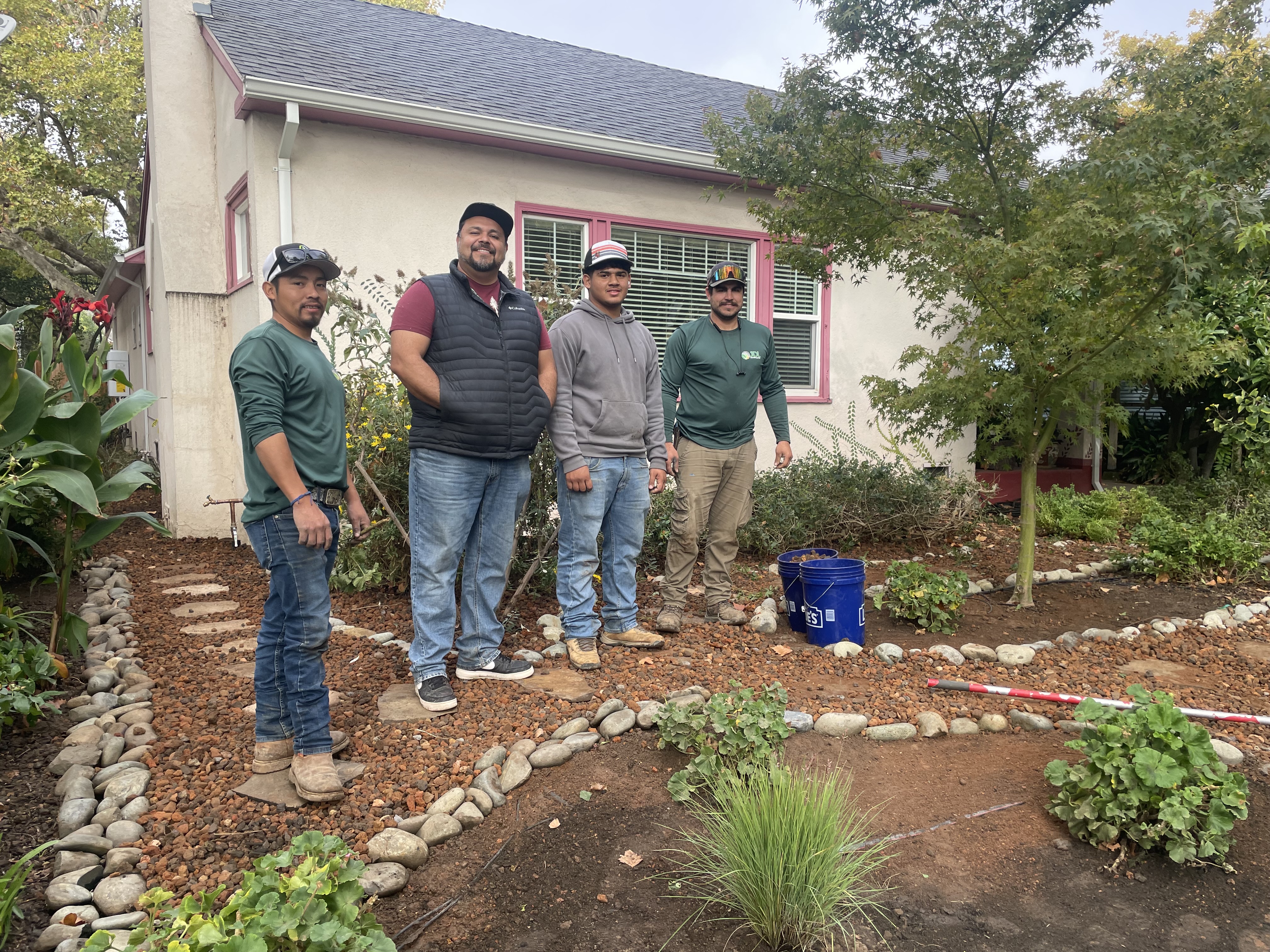
With thanks to the team of terrific professionals from JDL Land Management in Sacramento who remade my front yard into a thing of beauty. And to Lindsey Holloway and Chuck Dalldorf who highly recommended Gabriel Garcia and his team… as do I!
(Top photo: Dick Schmidt; photo below: Jan Haag)

The team from JDL Land Management who worked their magic to revitalize my front yard. Photos: Dick Schmidt and Jan Haag
Posted in Uncategorized | 4 Comments

Hair

Walking behind the young man paused
before the sliced meats in the grocery store,

I felt my feet skid to a stop at the sight of
the back of his head, the sandy blond hair

curling down to his collar, the style of many
a young man a half century ago when

such things began to matter to me—
almost feminine, above broad shoulders

and the narrow waist of one who
could be a swimmer, one whose hair

whispered to my fluttering fingers,
You know you want to.

I could not immediately place
the face of the one whose locks

my hands spent so much time fondling,
but my fingers knew the silk of that hair

as though they had explored it yesterday.
And the breath I did not realize

I had been holding left me
in a whoosh of remembrance,

more vibrant for its decades
of absence, leaving me

a little woozy, a feeling I have
happily not forgotten.

Photo / Jan Haag
Posted in Uncategorized | Leave a comment

Sonas

(Irish: happiness, joy)

•••

Sonas ort, the Irish say,
happiness on you,
my Irish friend tells me,

and in her lilt, I long for
the voice of my Irish
grandfather, who could

turn on a brogue in an instant.
Would he have known “sonas”?
Of course, he would,

from his mam and pap,
whom he came to call Mom
and Dad after they settled

in Chicago. And I feel my
ears pulling in a long-ago
direction to hear the music

of his voice that died more
than a half century ago,
too young at 64, younger

than I am now. Would that
he were around to explain,
as my young Irish friend does,

that sonas means not only
happiness, but also good
fortune and prosperity.

More important, I learn that
sonas requires a connection
to ancestors, their stories,

the ground they trod,
along with a longing for
that ancestral place.

I try to find calm,
the completeness,
the comfort

and happiness in all
that—even in the sudden
rush of missing him, the first

of four grandparents to die,
the one whose pipe smoke
arrives now and then with

the rustle of breeze through
leaves, the ones brittling now,
the ones soon to fall.

•••

With thanks to Jenny Cox of Clonmel, Ireland,
for telling me about “sonas” in my online writing group,
giving me a prompt that turned into this poem.

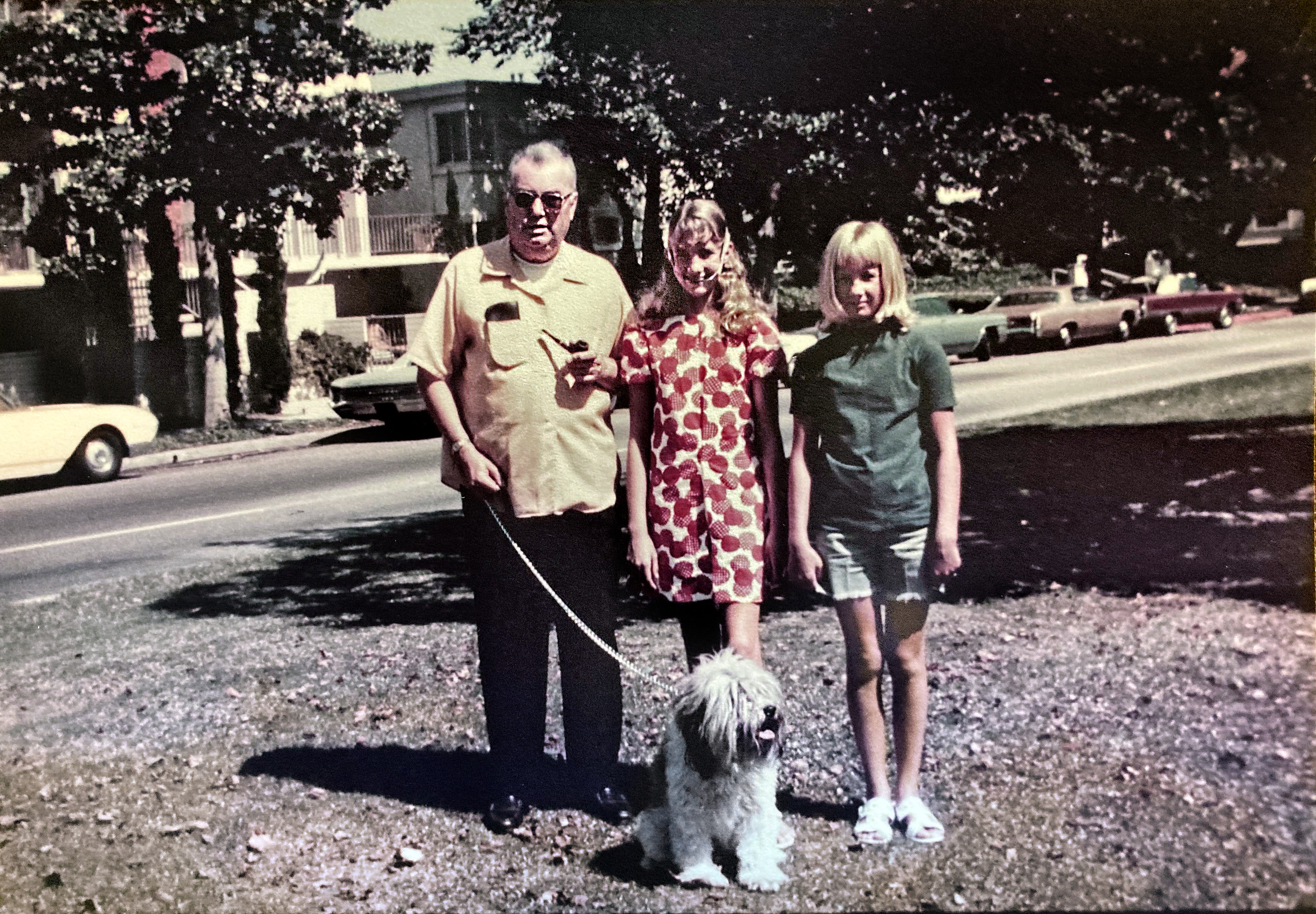
In memory of James E. Keeley (1908–1972), at left, with granddaughters Janis and Donna Haag, and dog Timmy in Santa Monica, California, early 1970s.
Posted in Uncategorized | 4 Comments

Fashion show

The first all-day rainy day calls for
donning the plum rain boots

as you head out for afternoon errands,
reminding yourself how to drive

on slick streets, to come to careful
and complete stops before proceeding.

Though you have things to do, you are
drawn to the edge of a parking lot

where the Chinese pistache trees
model the year’s most brilliant colors

while beginning to discard some of
what has clothed them since spring

in a mosaic of slick color at the curb.
Of course, you have to take a photograph

of this rich palette of loveliness—then
another and another. No wonder you

linger under these gently dripping trees
that punctually deliver this seasonal

fashion show before dropping everything
to stand proud and bare and tall

all winter long.

Chinese pistache leaves (and a few ginkgo leaves) with plum rain boots / Photo: Jan Haag
Posted in Uncategorized | Leave a comment

Addition

We are all hurling through space on a rock,
and we’re all going to die. You would think
we could be holding hands and singing.
—John Bradshaw

•••

Give me your hand. Here’s mine.
Whatever we think makes us different
is not as important as what makes
us human.

So human to human, let us not think
of division, of subtraction. Let us think
of multiplication, of adding my 1 to yours,
and to his and hers and theirs

as we stand on this sphere of rock
slowly rotating on an axis we can’t see,
in these brief lives between
the first breath and the last,
the first heartbeat and the last.

We are the bridge between
the ordinary and extraordinary.
Let us not curse the darkness
but instead light a candle
for each other and all beings
everywhere.

Who doesn’t need a blessing,
another hand reaching for ours?

And, while we’re at it—
one plus one plus one plus one
and on and on—let’s raise our voices
in song, add a little harmony to feel
the chord of many resonating
deep inside our chests.

May we hold hands and sing
as long and as loud as we can,
together, until the last breath.

Amen.

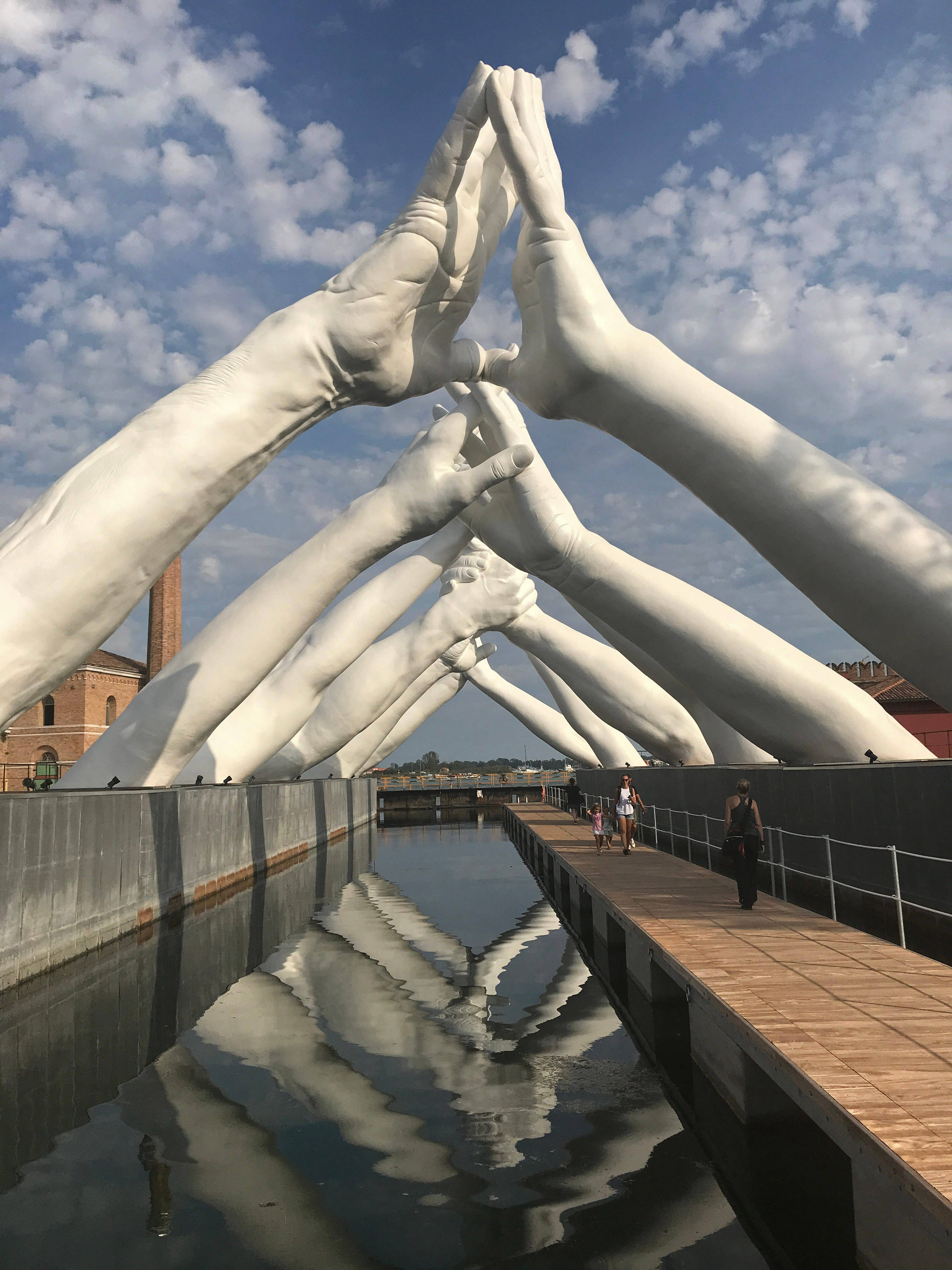
Italian artist Lorenzo Quinn created his sculpture “Building Bridges” for the Venice (Italy) Biennele in 2019. There are six pairs of the 50-foot-tall hands, each pair symbolizing a different human value: friendship, wisdom, solidarity, faith, hope and love. (Photographer unknown)
Posted in Uncategorized | 2 Comments

Soup season

Though the weather has not
chilled enough to holler Soup!,
on November’s first Sunday night,

after chopping up the Holy Trinity
of Soup, as my friend Lisa taught me—
celery, carrots and onion—

I dig out the new big pot, locate
the olive oil and seasonings, mostly
ignored since last soup season.

Tomorrow is Momday, as Mondays
were for years, the day I’d drive my
90-something mother to the gym,

the chiropractor, lunch at her favorite
restaurant, the grocery store for liters
of Moscato and maybe, nearing home,

up the hill into the state park to check
on the lake she and Father moved my
sister and me to in the summer of 1966..

Now, almost 60 years later, it’s officially
fall. She will want soup. Or someone will,
I think, as I sauté the Holy Trinity.

Certainly my fella whom tomorrow
I will drive to and from the “mean lady
who’s gonna pull my teeth,” he moaned

about this trip to the dentist he loves
“most of the time.” I’m sympathetic,
but this man is no lightweight,

having survived cardiac arrest, then
resurrection by defibrillator, followed
by open heart surgery six years ago.

Nonetheless, I’ve already set eight
little cups of custard in his fridge,
made from his late mother’s recipe.

Tomorrow I’ll bring split pea with ham,
his favorite. Hers, too. Ma, if I knew your
address in heaven, I’d get soup to you.

Neither of us imagined that—of the two
of us cooking-impaired women who’d
rather read—I would become

a purveyor of comfort food for my
dear ones. But here I am, still
a beginner in the kitchen at 67,

but wicked good at a few things,
especially Grandma’s brownies,
which, when I think of it,

with the soup and custards—
the greatest of these, after all, is love
makes a pretty fine Holy Trinity, too.

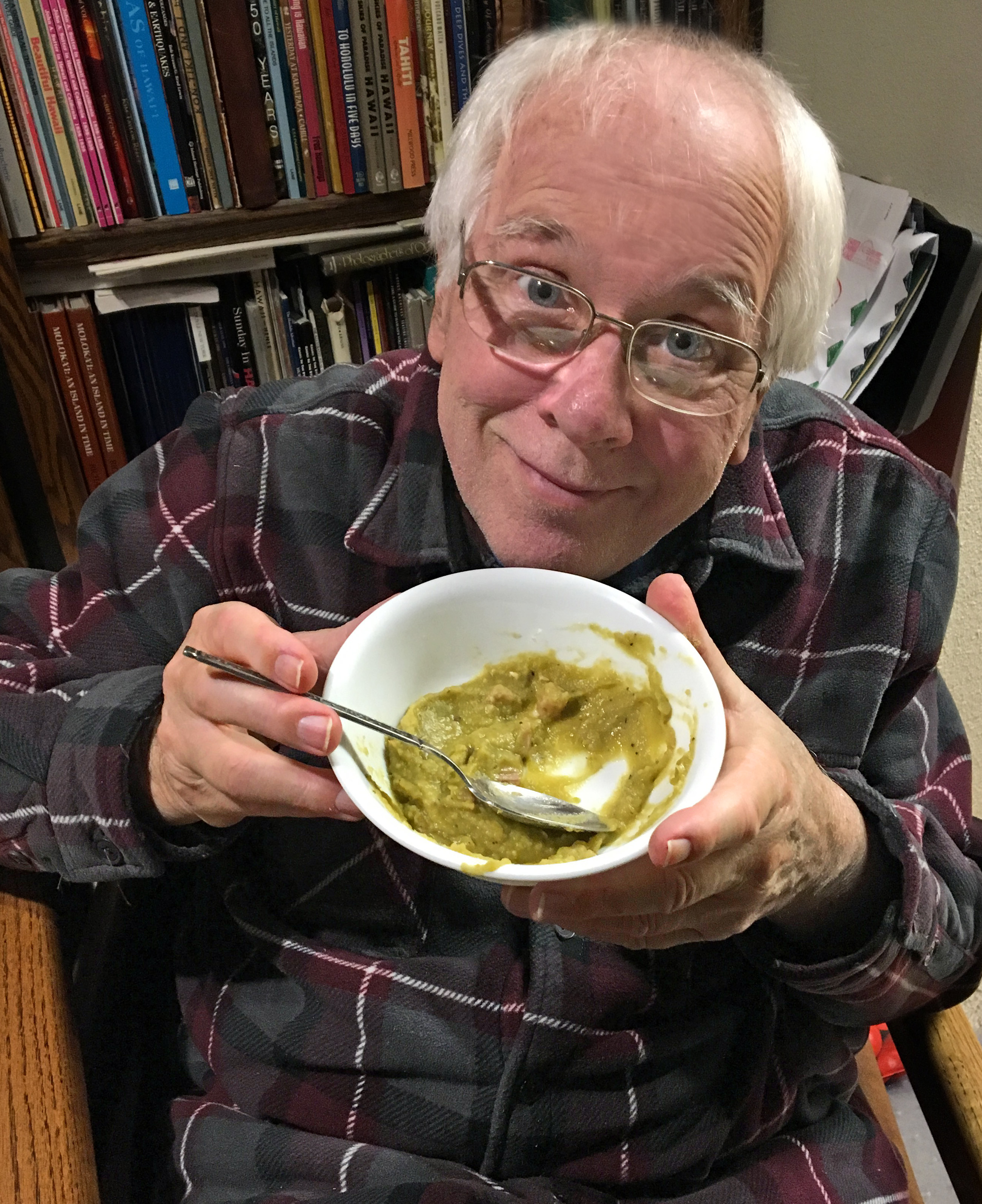
Dick Schmidt and split pea soup / Photo (and soup): Jan Haag
Posted in Uncategorized | 2 Comments

Released

Now that time has fallen back
an hour, I drive down L Street
shaking my head at the trees
still swathed in green, the leaves
stuck tight to the precise spots
where they were born.

In other parts of this hemisphere,
their brethren have already taken to
wearing gold and crimson sweaters
before becoming the fallen. But here,
many of us stubbornly cling to what
feels like our place, holding on to
the illusion of permanence.

This month we have no choice.
The signal will come to let go, and
if we do not, we will be released.
Which is the way of things.
All our cries cannot stop it.

But never mind—look at this day,
we say to each other—cloudless
blue-sky lovely, doing an excellent
imitation of spring.

On a day like today, it doesn’t seem
as if winter could ever tiptoe in,
delivering sorely needed rain,
lowering the temperature a degree
or two each day before it really
gets down to business.

And it will, as we who have
weathered many winters well know.

There we go, getting lost in
what’s coming instead of relishing
what’s here. As if we can change
the season, forgetting that after
a time—less than we think—

it, too, will pass,
and we will leaf again.

22nd and L streets, Sacramento, California, Nov. 2, 2025 / Photo: Jan Haag
Posted in Uncategorized | 3 Comments

Homophones

I love me some homophones, though
not the kind at home that once plugged
into the wall, and not bipedal primates,

but words that sound the same
but are spelled differently,
each unique in meaning,

which creates problems for folks
both familiar with and new to English,
an admittedly wacky language.

A friend recently asked about the spelling
of peak, as in mountain, to which I said,
yep, the eak is the one you want,

since it’s the one with an “a,” and a capital
A resembles a (hello!) peak. There’s also
pique, which I love, a fancy way to irritate

or interest someone, both of which have
an “i” in them—and the que is just fun.
But my favorite trick that my fourth grade

teacher pressed into this word nerd’s
impressionable little brain, is that peek
has two “e”s that look, if you squint,

like little eyes, and since it means to look,
well… Go take a peek at a peak
that piques your interest!

A fine mountain peak: Makana, north shore Kauai, Hawaii / Photo: Dick Schmidt
Posted in Uncategorized | Leave a comment

Sand mandalas

A Buddhist monk brushes away a finished sand mandala at Emory University. (Atlanta Journal-Constitution)

Write good poems and let go of them. Publish them, read them, go on writing.
—Natalie Goldberg, from “Writing Down the Bones”

•••

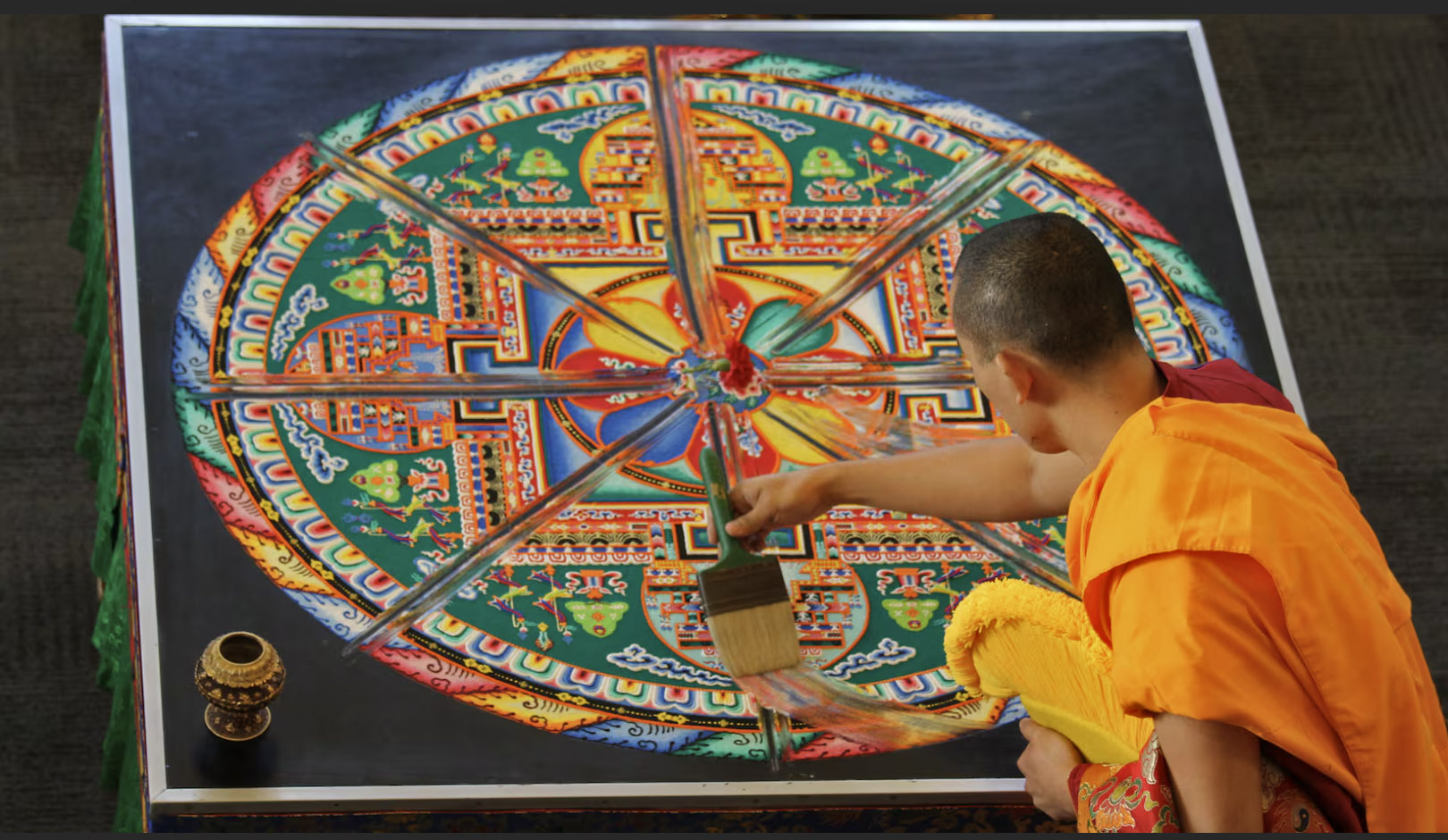
Buddhist monks train for years to create
intricate mandalas of colorful sand,
spending days of meditative work

to painstakingly build them, then,
when finished, ceremoniously brush
the sand into a pile, place it in an urn,

and pour it into a nearby river,
carrying the blessings of those holy souls
to the ocean to spread throughout

the world. The lesson of impermanence
teaches that everything, no matter
how beautiful, is not meant to exist

forever—a teaching I find myself
brushing up against here and here,
there and there, over the past year.

Again and again, what felt lasting
has been dismantled, scooped up,
taken away in rubble, in ashes,

and my little heart aches with each
passage. Which is why, for 1,095 days
now, I have put my sand mandalas

in poetry form into the world, without
expectation of acknowledgment,
to write them and release them,

awash in imperfection, so humanly
human, as I practice humility and
the hard lesson of letting go

again and again and again.

•••

Today marks three years that I’ve been daily sending these poetic sand mandalas into the ether with no expectation that they’ll be seen or acknowledged… though so many have, and for that I am grateful.

I continue to be inspired by long-time daily poets like Esther Cohen and Rosemerry Wahtola Trommer and others like James Crews who generously offer their work regularly on social media and on websites. Their words and those of other writers—younger and older, living and dead—are what feeds creativity in us all.

A Tibetan Buddhist monk from the Drepung Loseling Monastery in India creates a sand mandala. / Photo: Ben Doyle
Posted in Uncategorized | 4 Comments