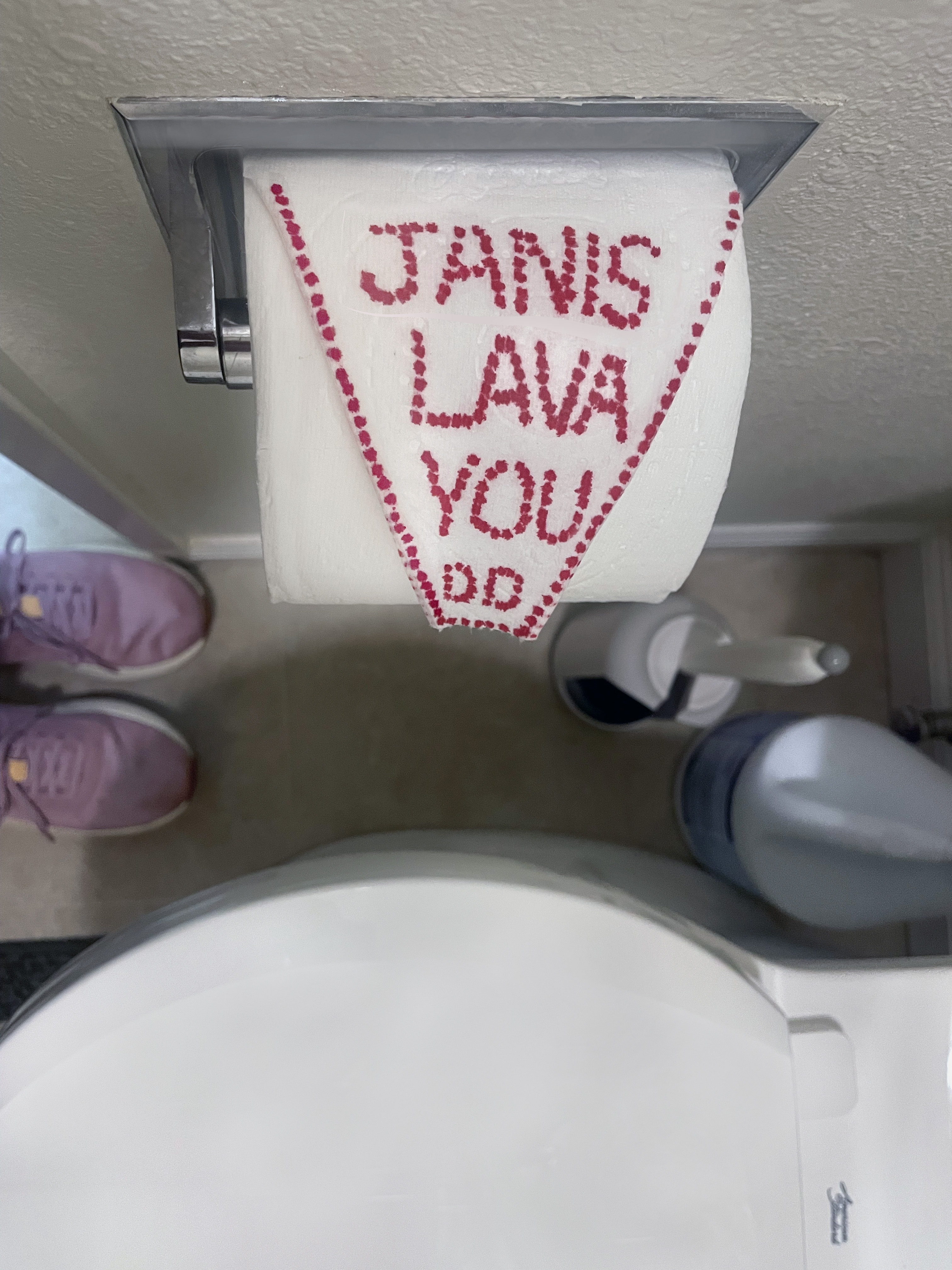
Soap bar prints, “Purgatory,” 2009, by Jesse Krimes
Leave a message for whoever is coming next. Even if nobody is coming next.
—Elizabeth Gilbert
•••
Like the imprisoned man who impressed mugshots printed in newspapers onto small bars of soap, then hid them between playing cards.
Or internees during World War II, imprisoned for their Japanese ancestry, making art from found materials— tin cans, fruit crates, onion sacks— turning the ordinary into the lovely.
Like the man who carved teapots, teacups, candy dishes and inkwells from slate in the Utah desert, along with the creative hands of painters, of sculptors who turned shells into floral pins and figurines.
Each of us makes something from seemingly nothing every day, messages to others who might happen upon what we’ve made.
Or maybe not.
What matters is that we made something from something discarded, something unwanted, figuring out how to do the undoable, through trial and error, sometimes under threat of punishment.
We made something. Sometimes people. Sometimes art. Sometimes love. All of which are so not nothing.
•••
For Eric Just, my talented artist of a brother-in-law, on his birthday, with admiration and love.
Teapot made from found slate by Homei Iseyama while in internment camp during World War II, Topaz, UT.
I stand at the kitchen counter holding a pair of slender hickory drumsticks I haven’t used in four-plus decades. My 35-year-old nephew, a middle school band director, has told me that no one holds drumsticks the way I was taught—the left hand turned up, thumb up, stick lying in the webbing between thumb and index finger, index finger loosely wrapped around; the right palm turned down, stick between thumb and forefinger.
The traditional grip, they call it. Military drummers used it, and jazz drummers. But nowadays, my nephew says, drummers exclusively use the match grip—both palms facing down, like the right hand in the traditional grip. What tympanists use on the big (as they used to be called) kettle drums, which I also used to play. Or on the xylophone and marimba.
I look up the grips online—as one can do nowadays—and I read that the match grip uses twice the arm muscles as the traditional grip, “allowing for more control and power. Match grip is literally physiologically superior,” it says.
Just reading that makes my hands ache.
What am I doing, heading back to a community college night band at age 67 and (almost) a half? I promised myself four years ago that, after retirement, I would do things I hadn’t had time to do as an always-teaching, never-idle college professor. Take an art class or at least try to swash watercolors across paper just for fun. Pick up music again. Go back to a band—concert or symphonic since I am not a jazz drummer, though I love jazz.
And there’s a reason now in the family. Sort of. My nephew the band director is married to a woman whose sister runs the music program at a nearby community college. Molly, the college band director, is a Ph.D. stand-up jazz bass player, who like her father, is now running a music program. Molly’s father, Clay, played saxophone in the night junior college band my sister and I played in as high school and early college students. Clay went on to become a doctor of music and teaches at the university down the street where I went to school long ago and where my nephew, the band director, got his degree in music education.
As they say, family is complicated, but in this case we are all musically related.
Molly started a nighttime jazz band at this community college couple of years ago, thinking, correctly, that musicians and music teachers in the area could come play together one evening a week. She’s done the same thing with a symphonic band. And her father Clay has joined both bands as a percussionist.
The first time I saw him behind a vibraphone in the jazz band, I about fell over. “You’re playing vibes?” I said, stating the obvious at the end of a pop-up jazz band concert in the college library a couple of years ago.
“Yeah,” he said a bit sheepishly. “I’m learning.”
Music professors have to learn to play every instrument, at least a little, so they can advise their students. So Clay must have had some percussion experience. And over the past couple of years, attending Molly’s bands’ performances, I’ve been impressed watching Clay’s progress as a percussionist—especially at the most recent concert when he was playing tympani quite well in the symphonic band.
And besides, just before that concert, at Thanksgiving at my nephew and niece-in-law’s house, I talked to both Molly and Clay about joining the symphonic band. “Do it!” they both urged. And so, after lots of challenges trying to negotiate my former college district’s insane online registration system (always a problem for my former students, too), I have officially enrolled in my first community college class in more than 40 years.
The first band class is next Thursday, and I have no idea how to prepare. Percussionists play whatever the music calls for, often pieces that involve a lot of counting measures of rest, waiting to come in here and there. Or they can require, say, a tricky bells or xylophone part, a run up the keyboard with two mallets held in, yes, the match grip. Don’t ask me to try four mallets on a marimba.
Honestly, I hope I end up on the bass drum. Or a triangle. I can probably handle a triangle. I have one at home. I can practice that.
In the meantime, I have recovered my heavy-duty metal music stand from the garage, dusted it off and set it in front of my marimba, which usually slumbers under a few layers of fabric to protect its four octaves of rosewood keys. It’s a beauty, made in the 1950s, and my mother bought it for me twenty years ago because I’d always wanted one. I found it on ebay, offered by a percussionist in Boston who’d taken lessons from one of the most famous Boston Pops percussionists back in the day. He wanted $5,000 for it, including shipping, which must have cost a fortune, since it had to be taken apart and shipped in wooden crates.
I still think it was a bargain, and, bless her, so did my mother who said she’d wished she could have afforded to buy me a marimba when I was actually playing in bands. But I went on to become a professional writer and journalist, eventually a teacher, and left music behind.
So last week I retrieved my old black stick bag from a tall bamboo basket and pulled out fuzzy tympani mallets with ends that look like falling-apart cotton balls and the skinny drumsticks and the triangle. And I am practicing on the kitchen counter—having long ago given away my practice pad and snare drum—using the match grip, then taking that same grip to the marimba where I peer over the gorgeous rosewood keys at the music on the stand and try to remember how to read music. Treble clef, the right hand on the piano. For tympani, I will have to remember bass clef—the left hand on the piano.
I don’t have a piano, so I’m picking out things on the much larger but identical keyboard that is a marimba, the overgrown xylophone that is the cousin of the metal vibraphone that Clay plays in jazz band. I used to have one of those, too. I am trying to stay loose and enjoy being a beginner again, a raw lump of human who loves music and is willing to try to play badly as my body recalls motions it used to know well. Relearning how to read music is like regaining a lost language—rather like going back to a sport that’s both physical and mental.
At this age I don’t mind walking into a band room and declaring myself a beginner, something I never would have done in the days when it was all about showing up prepared and looking competent. I’m chalking up to maturity this willingness to embrace beginner’s mind. Or perhaps it’s part of a greater life journey, a full-circle movement back to a much earlier me.
Or maybe it’s because I’m looking forward to standing at the back of a collection of people making music, adding little bits of percussion here and there, but mostly being carried away on a wave of sound that is unique every time the same parts are played. All of this will be done with a group of disparate humans who come from very different lives, working together to produce something lovely—or as at least as tunefully as they possibly can.
Jan Haag, freshman drummer in marching band, fall 1972 / Photo: Darlene Haag
It always looks darker when the new moon rises because from where we sit, we cannot see the sun illuminating the far side of our nearest neighbor.
And on this new moon night before the day honoring one who gave his life on behalf of all who struggle, when so many are being made
to feel less than in the country I think of as mine, we remember the man who said that he might not get to the promised land with those he marched with.
But, Dr. King, they are still marching. We are still marching, making our voices heard on behalf of those whose are suppressed.
Keep marching, keep marching on. ’Cause your ancestors are all the proof that you need that progress is possible, not guaranteed. It will only be made if we keep marching, keep marching on…
In your name, and the name of all that is fair and kind and good, even on the darkest of nights.
•••
You can watch the terrific performance of “Keep Marching” (written by Shaina Taub for her brilliant musical, “Suffs”) by Alex Newell and Broadway Inspirational Voices.
Dr. Martin Luther King Jr. linked arms with (from left) Ralph Abernathy, James Forman, the Rev. Jesse Douglas and John Lewis as they marched from Selma to Montgomery, Alabama, in a series of three marches along the 54-mile highway, between March 7–25, 1965. Photo: Steve Schapiro / Corbis / Getty
(In memory of Queen Lili’uokalani of Hawaii, 1838–1917, on the 133rd anniversary of the overthrow of the Hawaiian kingdom)
•••
It is not the first time that the country I think of as mine has muscled its way into another and bent unwilling people to the will of outsiders.
There’s a long list of which we should be ashamed, including the overthrow of the last Hawaiian monarch on this day in 1893,
a queen deposed by a group of mostly American insurgents, mostly for their financial gain, altering the history of the most isolated islands on the planet forever.
They later put the queen on trial in her own throne room, accusing her of plotting against those who usurped her— or at least knowing about the attempt— convicting and imprisoning her on the second floor of her palace.
Each visit to that room leaves me in tears as I stand before the quilt quilt where the queen’s embroidered handwriting lives—the one she and her companion stitched after being convicted of treason against the country that had forcibly taken her kingdom from her.
Nine quilt blocks, some fabricated from the queen’s clothing, inscribed with the dates she took the throne and abdicated it:
Her Majesty Queen Liliuokalani. Imprisoned at Iolani Palace. January 17th 1895. Companion Mrs Eveline Melita Kiloulani Kaopaokalani Wilson. Released Sept 6th 1895. We began this quilt here.
To think that my country, ’tis of thee, could attempt the overthrow of another innocent island—the world’s largest—ignites long- simmering outrage I thought I’d quelled.
But here we are, and I am as deeply shamed by the actions of would-be empire builders as some must have been in the 1890s, as I whisper a long-ago overthrown queen’s motto: ʻOnipaʻa.
May those islanders, like their Hawaiian counterparts more than a century ago, stand firm, steadfast, immovable in purpose as they strive to protect what is so rightfully theirs.
The quilt stitched by Queen Lili’uokalani of Hawaii and her companion, Mrs Eveline Melita Kiloulani Kaopaokalani Wilson, while both were imprisoned in 1895 in ‘Iolani Palace, Honolulu, Hawaii. (Quilt preserved and maintained by the Friends of ‘Iolani Palace, Honolulu, Hawaii.)
Seven years after, I can’t count how many times I look at you
in a moment of fleeting irritation, when the blue of your eyes shimmers
just so, as it did when they blinked open the day I lost you,
and you returned thanks to the help of strangers.
And that tiny moth of annoyance flits away, softening me with
the simplest blessing: Here you are. Here we are.
No greater gift than these extra 2,555 days of us.
No matter how many more lie before us, we are here
in this eyeblink of evaporating moment, and I will embrace
every sparkling instant of now that we are given.
•••
For Dick Schmidt on the seventh anniversary of his cardiac arrest and rebirth-a-versary, with our thanks to all the helpers who brought him back to life and tended him in hisrecovery.
•••
And, if you like, you can read more about Dick’s Great Heart Adventure in 2019 here.
Dick and Jan, Palm Springs Art Museum, January 2026 / Photo: Dick Schmidt
(for Dick Schmidt, aka Uncle Duck, in honor of National Rubber Ducky Day)
When, as little kids, your niece and nephew christened you Uncle Duck, giggling over the clever wordplay, you were stuck.
Forever after, ducks appeared for birthdays and Christmases, many of them designed for bathtubs that you did not use—
ducks sporting a variety of headwear— baseball caps and police helmets, ducks as pilots and nurses, pirates
and hard hatted workers. I acquired some, too, by virtue of being your duckly consort—Queen Elizaduck I
with her red hair and ruff is a favorite. (I have passed on presidential ducks and a gruesome zombie duck with its
eyeball hanging out.) But it is clear to those who know you as The Duck that you are unique among webbed ones,
one who, every spring, flies to his neighborhood pond looking for those of a feather who have flown in
seasonally, some of whom lay eggs and produce ducklings that bob down the waterways just like
the rubber versions of their kind, un-hatted, fluffy balls with little fast-paddling feet. You take their
photos, Uncle Duck, chronicling the newest generation of waterfowl that may not yet recognize you
as one of them, as one of us, our favorite bird.
This 61-foot-tall “Rubber Duck,” one of many constructed by Dutch artist Florentijn Hofman, appeared in the San Pedro, California, harbor in August 2014. The ducks have floated in more than 30 locations across the world since 2005. Photo: Frederic J. Brown / AFP-Getty Images