begin

(poem for a new year)

blessedly
empty calendar
pages stretch
before you

seemingly
endless time
categorized
in small boxes

and you
resolve again
to fill the boxes
thoughtfully

with more wanna
than hafta
more smiles
than grumbles

shorten the
to do list
unburden
the 365
days ahead
that you can
easily overfill

because you
are not
guaranteed
that number
any number
of days
of breaths

because the
date of your
eventual
passing is
not marked
on a particular
box

because all
we need
to do now
is smile
sincerely
say thank you
sincerely
feel the pulse
of this new
day that
beats within

and
breathe

Posted in Uncategorized | 14 Comments

Kalikimaka Man

e-2382 sharing the lightCR

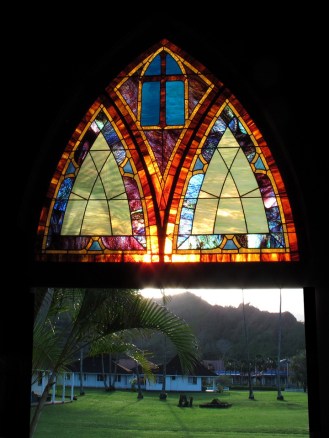
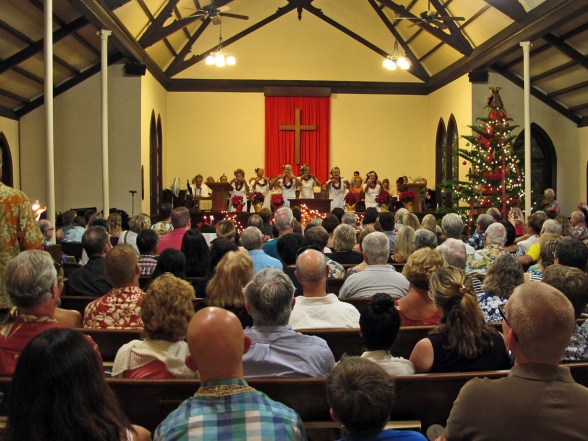
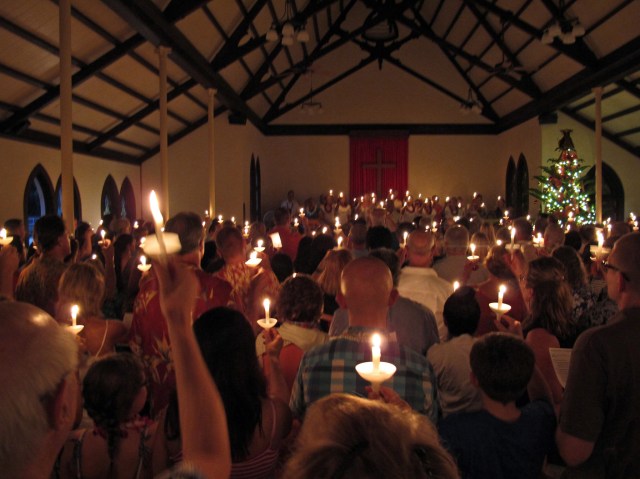
Christmas Eve 2015, Wai’oli Hui’ia Church, Hanalei, Kauai (Photos by Dick Schmidt)

It was Kalikimaka Eve on the north shore of Kauai, which looked like most winter days do—sunny, mid-70s, the air sparkling clean after two days of on-again, off-again showers. My partner Dick and I had been on the island for eight days, glad to escape our busy mainland lives, happy to spend Christmas in a place we love.

Since we arrived on the north shore, we’d planned to go to the little green church in Hanalei for a 5:30 p.m. Christmas Eve service. Nobody sings hymns in Hawaiian like the people in that church. We go every time we’re on Kauai, getting up (for us) early for the 10 a.m. service on Sunday because where else are you going to meet a kahu (reverend) named Alpha Goto who shows up in a lovely aloha shirt and is likely to deliver his sermon barefoot?

This church (the fifth incarnation of it on this spot) was one of the original Christian churches founded by missionaries who traveled nearly 6,000 miles from their homes on the east coast of the United States in the early 1800s. According to the church website, William and Mary Alexander arrived in 1834 and erected a pole and thatch meeting house next to where the current church stands. Depending on whom you talk to, the missionaries delivered a mixture of good (Jesus, for one thing, and a written Hawaiian language that led to one of the most literate populations in the world) and bad (discouraging the hula as well as insisting that unmarried people shouldn’t have sex ) to the Hawaiians.e-2337 church windowCrv

I’m mostly a cultural Christian myself, having grown up in a nominally Protestant family, one that rarely went to church because a., my parents said they couldn’t find a minister they wanted to haul out of bed and listen to on any given Sunday, and b., my father claimed he could pray just fine mowing the lawn. My sister and I showed up at church on Girl Scout Sundays when our troop went and, on occasion, when we traveled to Southern California to visit our Auntie Lo, who was a faithful attendee and often organist/pianist for her nondenominational community church.

I figure that our parents, who certainly exemplified most Christian principles but didn’t label them as such, did us a favor by not having religious restrictions and dogma to overcome later in life. Though I was baptized as a baby in Auntie Lo’s church, I grew up without church or a church family, which seemed fine to me.

But Dick was raised in the Evangelical United Brethren Church, which merged with the Methodists in the 1960s, and his parents  were religious churchgoers and believers. Dick’s mother played the organ and piano; his father sang in the choir. They both gave time and money and love to their church, which Dick still attends and contributes to, in no small way to honor his parents.

And it was Dick who 20 years ago brought me to Hawaii, which is his second home in many ways. The place resonates deeply with me, not the least the little Kauai hamlet of Hanalei. The first time Dick drove me over the one-lane bridge, past the taro fields that lead to the little town, something in me settled in my chest in a way I’ve seldom felt. When I try to describe it (as I’ve often done in the past two decades), all I can say is that it felt like coming home. It still does, every time. And, just before you leave the town to head to the end of the road on the north shore, you pass the little green Hau’oli Hui’ia Church. I’ve loved this little church ever since I first stepped inside. The Mission House behind the church, which was restored in the 1920s by descendants of missionaries, offers one of the nicest tours in all Hawaii, the story of the people who lived there lovingly and kindly told.

So this Christmas Eve Dick and I arrived at the little green church 40 minutes early, thinking the place would be packed to the rafters. We got in line behind about 20 other early folks. I saw an older man in a Mele Kalikimaka aloha shirt standing a bit behind the line, and I wasn’t sure if we should stand behind him.

I smiled and said, “Excuse me, are you in line?”

He glared at me, “Of course, I’m in line.”

Surprised by his tone, I tried to keep mine light. “Thank you,” I said, and he turned his back. Maybe he’s having a tough day, I decided. Maybe he’s not feeling well.

As he walked in the vestibule ahead of us, a man who was handing out programs and candles said to the Kalikimaka Man in front of us, “Where’s your wife?”

He shot back, “She’s dancing,” waving up at the altar with one hand and collecting his program and candle with the other.

He’s local, I figured, and probably annoyed with the tourists clogging up his church. Not without good reason. Because not long after we settled near the back of the church, the place started filling up, and by 5, they’d dragged out folding chairs and put them at the ends of the pews. At the end of ours, a family of at least eight people settled in, some of them in the pew in front of us, the teenagers in the folding chairs. A nice young lady with long, dark hair, a short skirt and legs up to her neck sat beside me. She reminded me of Dick’s niece, Rebecca, who had lived with me for a while when she was in college.

“Hi,” I said, grinning at her.

She met my eyes and “hi’d” me right back.

Before the service Kahu Goto announced that everyone should have a program because the words to all the hymns were in there—in English and Hawaiian. “We want to teach you some Hawaiian,” he said. And, he added, everyone should have a small candle and holder.

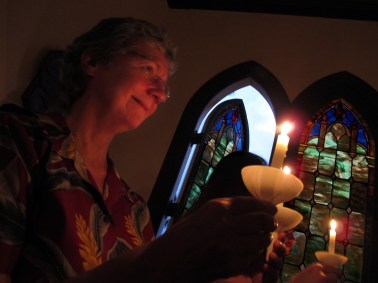
I looked up at the rafters of the old wooden church. It wouldn’t take much to set it aflame. The kahu, of course, knew this and said he’d light the first candle from one of the large ones on the altar, then pass the light to someone who would pass it to another and so on around the whole church. He cautioned us all to be careful in passing the flame from person to person, which struck me as good spiritual advice, too.

“We’ll have some gentle movements we want you to follow with the candles as we sing,” he said. “Do them gently and mirror us—don’t think you should move to the left because we are up here. Just follow what you see.”

The choir, which typically sits in the front pews and strums ukuleles on Sundays, was up on the altar, the ladies in white dresses and the men in white aloha shirts. The Wahine Hula group wore green and red leis with their white dresses. One of the ladies had bright white hair and wore a white, high-necked, missionary-style dress. She had kind eyes, and I hoped that she might be the wife of the Kalikimaka Man.

The kahu got the service rolling, and a woman standing next to the grand piano sang a nice version of “Mary, Do You Know?” From then on the pattern went: Bible reading, hymn in English and then in Hawaiian, then a reflection by someone in the congregation, then a time of silent prayer. e-2351 wahine hulaCRThe Wahine Hula ladies danced simply and beautifully during the offering to “Mele Kalikimaka Huihui.” The hymns were classics: “O Come All Ye Faithful,” “It Came Upon a Midnight Clear,” “Silent Night,” “Joy to the World,” “Away in a Manger.”

With all those people in the house, the voices swelled up to those old rafters and cascaded down us like the warm, friendly rain that had begun falling outside. Next to me, I heard the sweet voice of the long-legged girl and the young man next to her, whose warm bass resonated in my chest. I smiled as I listened to them.

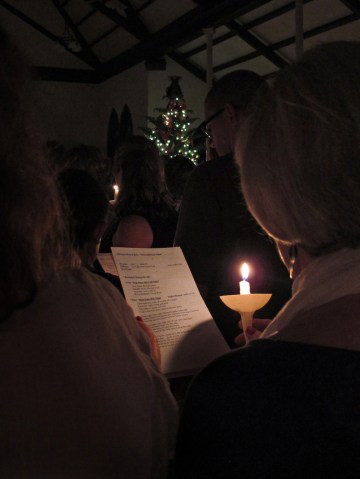
e-2408 silent night candleCRNear the end we got to “Silent Night,” the first three verses in English, the last one in Hawaiian. I had pulled out a tissue before the service started because, I swear, all my dead loved ones show up for that song—my Irish Catholic grandpa and his Christian Scientist wife, my grandma; the Lutheran grandparents (who worried that I’d convert when I married a lapsed Catholic); Auntie Lo, who played piano and organ by ear, even after she collapsed near the end of her life and returned much diminished but could still play music she’d known for a half century; the Jewish uncle who was really my father’s best friend from their Army days, who took my sister and me to our first “real” deli for pastrami and dill pickles; Julie, my fairy godmother when I was a young journalist still in need of mothering, whose voice is still loud in my head; my father, who died in 2004 and whose voice I don’t often hear but I sense that he’s around; and, of course, Clifford, the lapsed Catholic who loved me with a quiet devotion to the very end. I could hardly sing for the tears because at times like this I feel surrounded by the spirits of so many I knew and so many I didn’t—all our angels and Dick’s companion spirits have joined us by then, too.

I just stood there in that darkened church with probably 300 people, each holding a candle, and let the tears flow—there’s no stopping them then, especially during the Hawaiian verse:

Po— la ‘i e, Po— kama-ha’ o,
Ma-lu-hia, Ma-lama-lama,
K ma-kua — hi’ne a-lo-ha e,
Me ke kei-ki, He-mo-lele e.
Moe me ka mu—luhia la-ni,
Moe me ka mu—luhia la-ni

We huddled in the darkened old church, stranger next to strange — “friends waiting to happen,” as my friend Antsy McClain sings in one of his songs — and all seemed right with the world. Throughout the service I had offered prayers for people I know who are suffering, who are in physical and emotional pain right now, thinking of each of them, wishing them peace and ease. I prayed my most frequent and fervent prayer for peace, white healing light and safety for all beings everywhere. And it felt in that moment as if everyone in that small church sent similar wishes to the heavens, too.

When the service was over, as people were depositing their candles and programs in the vestibule and went out into the now darkened night where soft rain blessed every head, Dick moved toward the altar to take photos. I made my way across the church to the Kalikimaka Man. I smiled as I moved toward him, and he looked at me, clearly not sure why this strange woman was approaching him.

“I thought I heard you say as you came in that your wife was dancing tonight,” I told him.

His face softened. “Yes, she was.”

“It was beautiful,” I said. “The ladies did a wonderful job.”

His smile spread across his face like sunlight. “Thank you,” he said.

e-2369 jlh candleCR

I smiled back and nodded as he moved toward the door. I turned toward the altar where the dancers were gathered, perhaps gearing up for the next service.

I hope his wife is the sweet-faced, white-haired lady in the high-collared dress, I thought. Or whoever she is, that he is proud of her and she of him. I hope that they are kind to one other. I hope they have a very Mele Kalikimaka.


Posted in Uncategorized | 9 Comments

I don’t miss all the muss and fuss about the bird, but I do miss you

(for the Pollands)

You rose at 6 a.m. to see if the damn thing was finally defrosted, the decapitated hen with her big breast leaking fluids into the sink like an old radiator,

too heavy for me to lift, you could one-hand it and pull out giblets from its rear, run it under cool water to rinse off whatever needed rinsing,

plop it on the chicken-wire tile counter of our old kitchen and set to work, trussing its legs, applying olive oil and butter and spices,

while I, still sleepy, tore up stale bread in the big black-and-white speckled roasting pan where the turkey would rest, throwing in sage and onions,

giblets simmering on the stove, you adding olives and walnuts and Jimmy Dean sausage for texture because, your people believed,

stuffing should be more than just sage-y bread, and you were right—your stuffing was the best—but it took us a good two hours to get that bird in the oven,

so by 8 we were exhausted, especially in the days when you were so sick or recovering from having your chest sawed open and your ribs cracked,

not unlike the poor bird, but you insisted, as you laid down on the sofa for just a quickie nap, there was nothing poor about turkeys,

the dumbest creatures put on earth, and you would know—your family raised them on the ranch in Rescue, all six kids pitching in to feed turkeys

and water turkeys and scoop turkey poop and chase skunks out of the turkey houses because they could cause a stampede,

and you’d end up with a bunch of dead birds—because, again, you liked to emphasize, turkeys were the dumbest fowl ever, no brain in those tiny heads,

short lives for a reason, eat that good breast meat, chew on a fat drumstick and OK, be thankful for that dumb bird who now tasted good,

and I knew that you didn’t miss the turkeys one bit, but I knew you remembered those tough years

of early mornings and late nights on the ranch, endless work to be done, all six of you kids crammed into two bedrooms,

when there was Grandma next door in the little house, and Mom and Pops, her making her hand-sewn curtains and clothes, him making his tomato wine,

who were all gone by the time I came into your life, so I would never know them, only I did, in a way,

from the stories you and your siblings told around our table on Thanksgivings, all of you having long ago flown the coop in Rescue,

all of you grownups with jobs, some with spouses and families, you with your repaired heart ticking away, growing larger and larger each year,

your own life destined to be shorter than any of us wanted; we gobbled your turkey and your stuffing, Annie’s cranberry sauce on Grandma’s dishes,

and, after the huge meal, I stood over our old sink, scraping plates next to one of your siblings, listening to the rest of you

in the dining room telling tales of the time when…—you survivors of that ranch, those people, that long-ago life. I hear your voices still,

every Thanksgiving, and I want you to know: I am grateful.


Posted in Uncategorized | 9 Comments

Lakebed

The year I graduated from high school the country wrapped itself in the flag for the nation’s bicentennial. Everything turned red, white and blue in 1976. I turned 18 in July and began college after Labor Day. I voted for a Georgia peanut farmer in my first presidential election in November.

My family lived on the west side of Folsom Lake in a modest home my parents purchased a decade earlier. The summer after we moved in, my father hitched our small boat behind his blue Chevy and drove it up the curvy slope to the state park entrance. Then he and my mother plopped my sister and me in the big blue lake and taught us to waterski.

By 1976, we were serious water people. Summers found my sister and me lifeguarding and teaching swimming at the pool in town. Evenings after work, Dad would drive the boat, and we’d ski into late sunsets.

But that summer we couldn’t waterski. The lake level had dropped and kept dropping. We’d watched several dry years wither the lake to a trickle. Folsom Dam, built in the mid-1950s to keep Sacramento from flooding, stood like a towering wall with too many gaping mouths, the spillways through which water had once passed.

I wrote a story for a journalism class that fall and learned that the lake hadn’t been so low since the dam was built.

This year that lakebed is nearly as empty as it was in 1976, and I think of my father, a Korean War veteran who put up the flag for every holiday, who died in 2004. He began preaching the gospel of conservation in the mid-’70s.

“Shut off the tap while you’re brushing your teeth,” he’d advise. “Turn off lights when you leave the room.”

He stopped stringing Christmas lights outside. We started recycling newspapers, bottles and cans. We carpooled in ever-smaller cars.

“We have to,” he’d say. “We’re using up our resources. We don’t do water well in California—we either have too much or too little.”

If my father were here, on the brink of the U.N. climate talks, he’d be dismayed to see the Earth in such a precarious position. He didn’t consider himself an environmentalist, but he understood climate change long before we knew the term.

I can hear him now: “It’s the only planet we’ve got. We have to take care of it. It may already be too late, but we’ve got to try harder. We’ve got to do better.”

(published in the Sacramento News & Review’s Letters to the Future series)

http://www.letterstothefuture.org/letter/55/lakebed/

Posted in Uncategorized | Leave a comment

Shots fired

FROM THE NEW GLASS-WALLED STUDENT SERVICES BUILDING AT SACRAMENTO CITY COLLEGE, A JOURNALISM INSTRUCTOR EXPERIENCES CAMPUS GUNFIRE.

 Sacramento Magazine | November 2015

By Jan Haag

Four p.m., the second Thursday of a new school year, barely September on the campus I’ve considered mine for more than a quarter century. I sit in my new office in the new Student Services building at Sacramento City College. It still feels foreign to me, as though I’ve begun a new job, as if I don’t quite know my way around yet. I have moved across campus from the old “temporary” building where I spent two decades teaching journalism and advising the student newspaper and literary journal to this new glass, steel and brick structure.

I am an old fish in a new bowl, relearning how to swim.

Journalism shares the second floor of the STS building with the photography department. After several years of going steady, we’ve now moved in together, jokes the photo department chair, who was once our student on the campus newspaper. (Yes, I’ve been doing this a long time.) It is a unique pairing at Sac City, long known for turning out nationally known photographers and accomplished writers and editors.

I sit before my brand new iMac in our office suite. Out in the general area sits Vienna, the news editor of the print version of the Express, and beyond her in his new office, photography professor Randy works at his computer. I’ve been thinking for a half hour that I should head home but, as always, there is so much to do.

Suddenly, on my computer screen, a Facebook post pops up from a colleague.

“Sac PD is reporting shots fired at City College. If you’re there, take cover.”

My old news instincts kick in. “Randy!” I holler as I head out my office for his. “Sac PD says there’ve been shots fired on campus.”

As I reach his doorway, I see Randy at the screen, searching in the electronic way we all do now. How times have changed, I think. Once upon a time we’d have been on the phone. Now we’re looking at Twitter feeds and Facebook posts.

“It seems to be over by the softball field,” Randy says.

I go back to my computer and start searching, too. “At least two people shot,” I read.

I hear Randy walking toward the glass door that leads to our second floor landing. He’s moving fast, a long lens on his Canon, a photojournalist to the core, ready to go find the news and make pictures of it.

“You’re going out there?” I say, before I can stop myself. I was married to a news photographer; my longtime partner is one of Randy’s former Sacramento Bee photo colleagues. This is what they do—they run toward the fire, not away from it.

“Yep,” he says, whooshing through the big glass door.

Then I focus on Vienna, sitting in the office area, working on a computer, her cell phone to her ear. She’d been working on stories for our first print edition. She’s also a producer for Channel 13, and she appears to be on the phone with her newsroom.

Sitting near Vienna is Steve, the college district’s locksmith, who has been in our area rekeying one of our new doors. He’d been here the day before, too, explaining to me that institutions have to make choices between security and accessibility. “That’s the problem,” I’d said. “I don’t want to work in an institution.”

So now we sit, encased in our institutional glass building, and I am suddenly aware of how vulnerable we are. Before we are even told by officials that we should “shelter in place,” I know that we are birds in a clear cage, sitting ducks, should someone come along with a gun. I had thought of this before, spending 20 years in what was essentially a trailer across campus. Anyone could’ve easily walked up the ramp or the steps and barged in with a gun. Fortunately, it never happened, but I thought about it every time the news reported another school shooting.

Too many, too many.

Still, the former news service reporter inside me clicks in. I’m texting with Kris, our online Express editor who’s off campus, working with other student journalists, getting updates from them, talking about sources and what to post and where.

Vienna appears at my office door. “I want to go out there and see what’s going on,” she says.

She’s a grown-up, but she’s also my student, and I allow myself to say I am nervous about her proposal.

Steve stands up. “I’ll walk with her,” he says. “We’ll be OK.”

Vienna perks up and I blink. “Uh….” I begin, but they’re already heading for the door.

“Be careful!” I yell after them, thinking duh… as if they wouldn’t be. Thinking I can’t lose another student to a violent death. Thinking what if there’s someone out there on campus with a gun and an itch to use it?

Randy returns, maybe 15 minutes after he walked out. I whirl in my chair. “Did you get to the scene?” I ask.

“Oh, yeah,” he says, heading for his computer. I follow him.

Within a few minutes I see an image of someone on the ground under a blue tarp, someone dead, with cops talking off to the side of the photo. That person whose name I don’t yet know lies in a staff parking space next to the softball field, not 20 yards from Sutterville Road. Someone has died on our campus, and my heart falls, my gut twists. This has never happened here before.

Now it has.

I turn back to my computer, to monitor the tweets and posts and messages on my phone, and to respond and tweet and post myself, a long-ago reporter turned into a 21st century journalist, pressed into service because of a crisis.

============

I’ve lost three students this year: Maui, Emma and, we learn the next day, Roman Gonzalez. He wasn’t my student, like the other two, but he was our student. Though we later heard that this was possibly a gang-related shooting, I cannot help but mourn for this young man. He was killed and two others were wounded, and yes, one of those two was arrested on a parole violation and later released. It would be easy to say, well, they brought it on themselves. It would be easy to say, see? We weren’t in danger, most of us. They weren’t after us. The scenario we’ve all been fearing didn’t come true.

Yet.

Four weeks later to the day, I was again in my office when Randy told me about reports from Oregon that perhaps 10 people were killed and more wounded at Umpqua Community College in Roseburg. I shuddered, especially after I learned that the gunman had committed his carnage against a class of English composition students, killing eight of them and their teacher. The day before, we’d heard, an angry student hit one of our own English professors during class.

But the day the shots were fired at my school, as I sat in my office—as Vienna and Steve made their way near the scene and where she did a live report with her station—I thought of our journalism and literary journal student Maui, a fine writer and very capable copy editor. She had taken her own life in April, in tremendous physical pain, not wanting to deal with it any more. I thought of Emma, our lovely Express photo editor, 20 years old, jogging in Seattle in July, struck by a train as she crossed the tracks. And now this young man.

Roman Gonzalez shouldn’t have died. But he did, after a fistfight quickly escalated into a knife fight and then someone—a someone who walked to the street and disappeared—shot Roman, who was our student. Who, I like to think, was trying to better himself through education, as are all of our students.

Too, too much loss and sorrow.

And too, too much uncertainty. The not-knowing hours are the hardest during a crisis. Not having a lot of information about the situation, a lot of pseudo-information flying around in the ether of cyberspace. Not having official word from administrators—that would come much later, when they knew more. Eventually, after locking us in for a time, campus police returned to our building, looking stern, to tell people they could leave but to head for the perimeter of campus—don’t go through the center—to their cars, to light rail, to go home.

Randy and Vienna and Steve and I stayed till 7:30 p.m., a good hour after we were told we could leave. I later learned that the college president and public information officer were there until 1 a.m.

We all had so many unanswered questions. We didn’t begin to have all the 5 Ws and the H we teach our newswriting students to find. We had three whos, but no names of anyone. We had a what—shots fired, people shot, someone dead—and a where, our college, and a when, a bit before 4 p.m. Thursday, Sept. 3, 2015. But certainly no why or how, as there rarely is in a breaking story. Those details come later. Sometimes.

And so, after the students had gotten stories and quotes and photos on the website, on Twitter and Facebook, those of us on campus went home, though the students continued to monitor sources and post updates and text each other until midnight. Already we’d heard that counselors would be available on campus for the next two days for people to come and talk. There would be a gathering on the quad the next morning with the district chancellor and college president speaking.

============

When I walked out of the building into the dimming light on the day everything changed, I walked along Freeport Boulevard, under the great redwood trees, many of which were planted as saplings in 1926, when the campus was brand new. Twenty-six of them stand, some almost a century old, tall and magnificent in front of the college. My sandals crunched on the browned and downed pine needles, geometrically arranged by nature under those trees.

Now we are one of those schools, I thought. Now we are on a list of colleges where violence took place and someone died.

In the coming days our student journalists would be applauded for their quick and careful reporting. The president of the college would come to class and thank the staff for that, even buying them pizza. She would weep a bit as she talked to them after days of supporting her campus, being strong, comforting others, the epitome of compassion and grace.

We are united by tragedy, all of us.

And on the day Roman Gonzalez died on campus, walking to my car, I stopped, struck by that thought. For some reason I looked down. There, atop the rusty pine needles lay a single black feather, new and intact, on a sturdy, pointy quill. I bent and picked it up because I like feathers. Because at other times in my life, I have found lovely feathers literally strewn in my path. It never feels coincidental. It feels like a blessing.

I picked up that feather, perhaps dropped by one of the watchful crows that caw their way through Sacramento skies, and I went to my car, the last one in the parking lot, and I went home.

Posted in Uncategorized | 7 Comments

nine

love wins

he and him
she and her
they and them
ze and hir

hand in hand
lip to lip
arm wrapped
in arm
they rejoice
they celebrate
all over a union
the president says
grown a bit
more perfect

on the same day
in a small
southern town
nine black birds
fly over a
white-steepled
church where
inside
its occupants
mourn
as they forgive
the one who
trespassed
against them

amazing grace

love wins

Posted in Uncategorized | 8 Comments

Rangerette

I’m working on a series of short (you might say even micro) fiction pieces, 1,000 words or less, which is a challenge for me. This is one of the little pieces with fictional narrators, each in a different voice. This story arrived during a writing group after considering a postcard of the Rangerettes doing their famous super-high kicks. 

Now that you ask, I couldn’t kick that high when I started. Like everything else about being a Rangerette, it takes practice—lots of practice. When I first came to college, I never imagined I’d come all the way to Kilgore, Texas, from my little podunk town in Oklahoma, I’d watch the girls perform at the games. I admired their white cowboy hat and boots, their cute short skirts. I couldn’t fathom how a girl could kick like that and keep her hat on—even with a chinstrap.

But I started practicing in my dorm room, doing splits up against the wall—only when I was alone. I was a cheerleader at my high school (go, Broncos!), but the Rangerettes are another class of cat, as my daddy likes to say.

I couldn’t believe it when, at the third tryout in two weeks, they picked me to be one of three rookie Rangerettes. Within five days I had my own uniform—cute blue skirt, short cowgirl boots (“not cowboy,” I was told), tight red undies and yes, the famous hat. “That’s what makes a Rangerette a Rangerette,” says Carol Ann Greenway, our team leader.

She gives all us girls HE-double-toothpicks if our hats slide back on our heads. They have to stay on straight and flat (bobby pins!)—or as Carol Ann says, “Stee-ray-aht and flay-aht.” She has the funniest south Texas drawl, that girl.

But honestly, she runs us around like a drill sergeant—especially us RITs (Rangerettes in Training). “Stee-ray-aht-en that back, Shelley Marie,” she hollers at me, “or I’ll put a yardstick down your speye-in. I don’t want to see slouching when you’re on the fee-yuld at halftahm under those big ol’ lie-ahts with thousands of cheering fay-ans.”

And when we link arms, standing next to each other in line for our perfectly synchronized high kicks, there’s Carol Ann barking, “Higher, girls! I want the sky to see the soles of your boots!”rangerettes20

My roommate, Jolie Lee Cutter from Lubbock, a studious girl with a face—my father would say—like a board fence behind her round glasses, snorts when I tell her about Carol Ann and the high kicks.

“That girl just wants people to get a good look at your coochies,” she says. “It’s demeaning to women.”

Well, that set me up on my high horse, let me tell you. I straightened my spine without the aid of a yardstick and told Jolie Lee, “For your information, our coochies are not on display. We wear red swimsuit bottoms, and we make sure we are always,” I have to pause and take a deep breath, “spic and span down there. All people see is a leg—well, 12 of them—up in the air for a flash of a second and then another flash of leg.”

“Upper thigh, actually,” Jolie Lee puts in. “Leading to your coochie.”

I plow on. “Would you call what the Rockettes do at Car-nee-gie Hall demeaning?”

Jolie Lee pushes her glasses up higher on the bridge of her nose and looks goggly-eyed at me. “Yes, I would,” she says. “There’s more to you and the Rangerettes and the Rockettes, for that matter, than your nice legs and fancy dance moves, Shelley Marie. I don’t expect you to see that, but I do hope you’re not like so many of the girls who come here to college to earn their MRS degrees.”

She narrows her eyes as mine widen. “You have a perfectly good brain, and I think you should put some important information in it.” She taps the book she’s reading and holds it up. “Tudor/Stuart England,” it says on the cover the color of ripe cherries. “Something you can use someday when you can no longer kick your lovely legs with your white boots over your head.”

I want to throw words back at her like, “And Tudor/Stuart England—whatever that is—is important information? How’re you gonna use that someday, Jolie Lee?”

But as I sit on my bed, legs crossed in front of me, elbows on my knees, stretching, I feel my lower lip hanging open. No one has ever told me that I have a perfectly good brain. Not that I can remember anyway. I’m more used to comments about my pretty little head from my daddy, like, “Don’t worry your pretty little head over that, darlin’. Let us men deal with that.” “Us men” being him and my three brothers, who are always thought of as the smart ones in my family.

Jolie Lee shakes her head at me—the frizzy one containing her perfectly good brain—and goes back to Tudor/Stuart England, and I am left… I don’t know, but I bet there’s a good big word for it… with my own perfectly good brain wondering what I should do with it.

One thing I’m gonna do—I’m going to the library tomorrow and find out about Tudor/Stuart England. Is that a place or a person, do you suppose?

Posted in Uncategorized | 4 Comments

Love letter to a trailer

Dear P-26/T-3:

Back near the end of the last century, when the journalism department moved out here, you were called P-26—“P” for “portable”—though you’d been on this spot for a long time by then. That confused Ginny McReynolds and me, who at the time made up the entire journalism department faculty of City College. Did that mean there were 25 other portables on campus? We could maybe find eight or 10 others at that point, including the one next door, which was P-25 then. P-25 and 26 had been used as the campus child care center for I don’t know how long before the kids got their own brick building to the north of the portables.

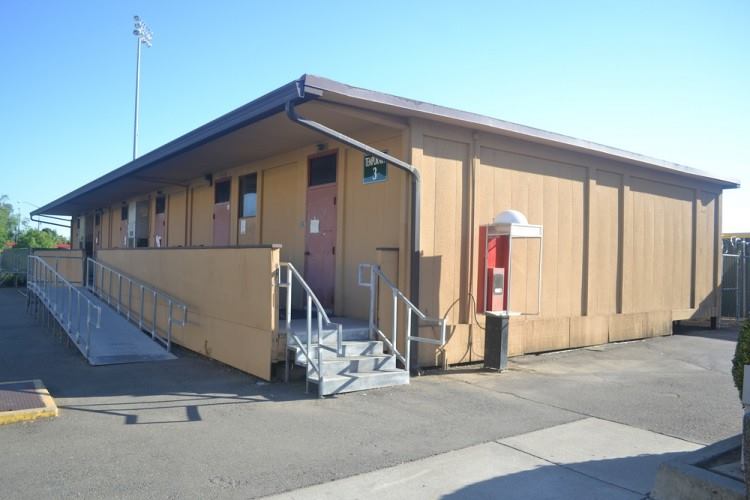
T-3 (formerly P-26), the journalism department at Sacramento City College for the past 20 years. (Photo/Gabrielle Smith)

T-3 (formerly P-26), the journalism department at Sacramento City College for the past 20 years. (Photo/Gabrielle Smith)

I will never forget walking inside you for the first time. Ginny and I looked around, amused at the inner doors with the knobs two feet from the tops so little hands couldn’t reach them. And, in the large room on the north end of the building, along the west wall, three small, close-to-the-floor potties sat like flower pots. We could imagine little butts on them and some erstwhile teacher saying, “Flush!” We joked that we should keep the potties and use the room as a darkroom—the receptacles for developer, fixer and washing prints were already installed.

Ginny, who was hired in 1986 to replace Jean Stephens—the retiring journalism prof who’d run the department for 29 years—had first occupied Jean’s former lair behind the bookstore, then located clear across campus from you.

By 1993, when I was hired full time, the journalism department and Express newspaper had moved to a portable behind the tennis courts where the roof regularly got thwacked with green balls. (The tennis courts have since been relocated.) We were out there for a few years in a single square room with an office for Ginny and a darkroom, but no office for me, when someone came up with the idea of parking us in you, on the edge of a literal parking lot between the new baseball stadium and the 1928 football stadium. It did not take long to hear the occasional whomp of a home run hitting your roof. We immediately felt at home.

You were a temporary location, we were told, till permanent space could be found for the journalism department. And somewhere along the line, your designation was changed to T-3 and your next-door neighbor to T-2.

Now, a good 20 years later, we are about to leave you and move into that promised permanent space across campus, back, ironically, to the same spot where Jean Stephens ran the Pony Express. The name got shortened to the Express in her time, and we currently have two journalism/photo profs who toiled on the Express as students in that space—one of Jean’s (Randy Allen), one of Ginny’s (Rachel Leibrock)—so for them, this move will be like returning home.

Only home looks nothing like it used to. In fact, it’s a brand new space—the new Student Services building’s second floor, designed just for the photo folks and us. Instead of an odd-shaped little one-story building, we’re moving into a state-of-the-art, everything-sustainable-and-oh-so-environmentally-perfect, photo-studios-with-floor-to-ceiling-windows, sparkling-classrooms edifice. It’s gorgeous. I find it amusing that photo department chair Paul Estabrook (who led the charge to bring our programs together) was once a student photo editor on the Express with Ginny and me.

Yes, I have been teaching that long. Ginny went on to become a dean at Cosumnes River College and recently retired from that position. Dianne Heimer came to be the second full-time journalism/English professor and is our current department chair.

The new building reminds me that you, dear trailer, have not been perfect. But, I’m happy to say, who among us is?

For years, when it rained, water would soak Dianne’s office floor. The custodians would bring in huge, noisy fans to dry it out, forcing Dianne to temporarily relocate elsewhere because she couldn’t hear in there. It wasn’t the roof that leaked—turned out to be the siding—but it finally got fixed two winters ago, and storms (more rare now) just aren’t the same… thank goodness.

You have only one toilet—a regular one, not the sturdy industrial types found in bathrooms all over campus. It can be, shall we say, a bit delicate. A plunger stands at attention in the bathroom, and I tell all my students at the beginning of a new semester to alert me if there’s a problem—it can take quite a while for custodial help to arrive, especially at nights and on weekends (and we do work then).

“Be nice to our potty,” I say. “I’m good with a plunger, but don’t make me have to prove it.”

Despite all that, we have loved our autonomy on the edge of campus. It’s been a perfect place for student journalists to practice their craft. People asked us recently as the photo and journalism profs all attended the ceremony for the dedication of the new Student Services building, “Won’t you be happy to get out of that trailer?” And Dianne and I smiled and said how lovely the new space is, how teaming up with photo will ensure the viability of our small journalism department, how great it will be for our student writers and photogs to work together and take classes in these related disciplines.

And all that is true.

But I have made no secret of this, dear trailer: You have provided a haven, a safe space not only for us teachers but also hundreds—easily thousands— of students, journalism and English, graphic design, photography and creative writing. We will miss you. Deeply.

You have watched the construction of literally hundreds of issues of the Express newspaper and other publications back in the days when we printed stories and headlines on strips of copy and waxed and trimmed them and slapped them onto large paper pages. When black and white film was processed in the darkroom built just for us (the tiny toilets were removed, after all). When photos were printed under the bright lights of enlargers and images brought to the surface of slick photo paper in baths of developer, fixer and clear water. When those photos were transformed into images called halftones made up of thousands of tiny dots that were also waxed and trimmed and pasted up along with the words on the slanted boards that still live in the south end of this building.

I am stunned to realize that we did all that, Ginny and Dianne and me, along with terrific part-time instructors and student assistants. What amazes me more is that wetaught people how to do all that, which is now done on computers and sent electronically, magically, to the same printer in Galt, which still delivers old-fashioned newspapers to us in bundles that Expressers deliver around campus via an old shopping cart.

It still astonishes me, this mix of the old and the new, that permeates everything we do.

As a young adviser, I brought a new campus literary journal to be produced out here, and you have served as the home of most of the 21 editions of Susurrus, now advised by other, younger colleagues. And more recently you’ve overseen the gestation of at least a dozen issues of Mainline magazine—what we consider the journalism department finishing school.

You, old friend, have seen a lot of birth and some death, I’m afraid. I once crawled under you to retrieve a dead cat, which led to the formation with my now-retired colleague Holly Kivlin across campus of the Sacramento City Kitty Committee (one year we took 38 non-feral cats off this campus and found them all homes). I was sitting in my office on a March morning in 2001 when I got a phone call informing me that my husband had died. And in the last month one of our students on both the Express and Susurrus staffs took her life.

We have experienced a lot, old thing, celebrated and mourned as a family. And we humans who’ve toiled here have aged along with you. I was 22 years younger and 20 pounds lighter when I came to work on this campus. You have been here for me—a consistent rock in my life—and offered shelter to so many people who have found their voices on the page and gained professional skills to last them a lifetime.

The cats will stay—ferals don’t move unless their shelter is taken away—and I will trot out here to feed them until I can persuade some truly temporary occupant to help with the feeding and watering.

One of the cats, a small gray female named Haroshea, often waits for me on weekends. She appears on your front porch from her hiding place under your belly and sits silent, watching. I think of her as your eyes and ears, sitting a quiet vigil. I will pay regular visits until I’m sure that you and the cats are in the good hands of others—or until you are taken away permanently, like your former next-door neighbor, T-2. When the bulldozer came to tear it down, I couldn’t be here. That wasn’t even “my” building. I hope I’m long retired and these cats long gone if that ever happens.

This is a love letter of gratitude to you. Others may see you as an old metal box the color of aging mustard, but we know how well you’ve sheltered us all these years. It seems silly—even to me—to grieve for an old trailer, but I have learned that home shows up for us in odd forms, that when we infuse a place with lovingkindess, the place gives it back to us—just as people do.

So as the semester ends, it’s time to get moving. I will clean out lots of paper, including old issues of the Express, and things I should’ve let go of years ago. (I have found a good home for the trusty red IBM Selectric.) Dianne and I will pack up and move across campus to our lovely new digs with a smile (“There’s no crying in baseball,” as Tom Hanks so memorably said in “A League of Their Own”).

Thank you, dear trailer, for everything, for being, as they say in Hawaii, puu honua, a place of refuge to me and mine. And the cats.

With love,

Jan

Posted in Uncategorized | 10 Comments

After a long absence… rain

(a love poem to precipitation)

For two days the sky has slowly clouded,
scrunched its face like a toddler winding up
for a tantrum, finally spitting petulant drops
at us, and the miracle of puddles and wipers
beating a steady cadence on the windshield
and the gratitude we had promised
to the heavens if only…
has given way to irritation.

We are a parched people who have
forgotten what it is to be wet.

We slip, we swear, we shake ourselves
and our umbrellas like dogs when we come
inside. We are surprised by the viscosity
of soil that yesterday gasped with dust
under foot, now turned scary slick.
We have forgotten how to drive
under anything but bright blue skies,
and already, we long for sun.

Oh, disciples of drought,
denizens of the dry:
Step outside without coats or umbrellas.
Feel yourselves pelted, even pummeled
by the seemingly endless rain,
summon to your lips a wet prayer
shaped to your most urgent need,
and let it radiate through ever form
of thanks you can muster—

because this is a gift like so many others,
coming at just the right time,
seeping into your skin,
moistening your hard shell,
washing away the stains and sorrows
all the way down to your bones.

Posted in Uncategorized | 6 Comments

Beginning

Because that’s what a new year does—
offer the clean slate, present the fresh calendar,
the new four-digit number that causes you
to shake your head and say, how can it be…?
The sense of time not so much passing
as racing, even more than the annual
notation of your birth—

and you, here on the brink, feel compelled
to make good, start over, resolve
(whether you say it or not):

This year will be different.

Of course, it will—with no help from you.
The months and days wear the same
names and numerals; the seasons
dress themselves in familiar clothes,
repeat in their reliable order.

Yet no two are the same.

Look closely. If you must resolve,
promise to find one new piece
of awareness every day—
within or without, one just out
of your line of sight, on the periphery,
that sound or color or thing
that makes you turn your head,
widen your eyes, attune your ears.

Yes, that. Only that.

Begin.

Posted in Uncategorized | 5 Comments