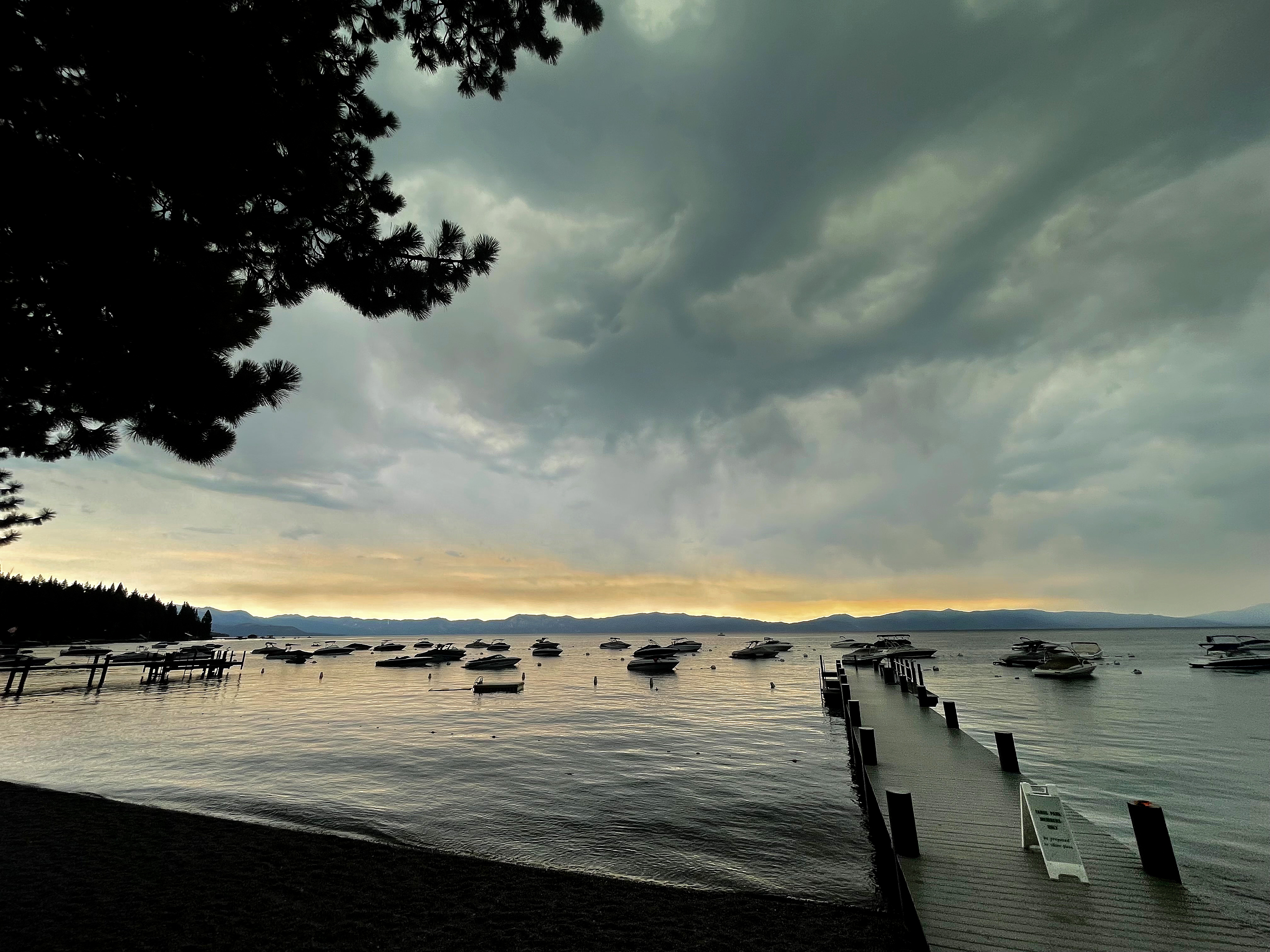
On the second day at the lake a storm warning and prophetic graying skies, rimmed by a hint of light over the mountains to the east.
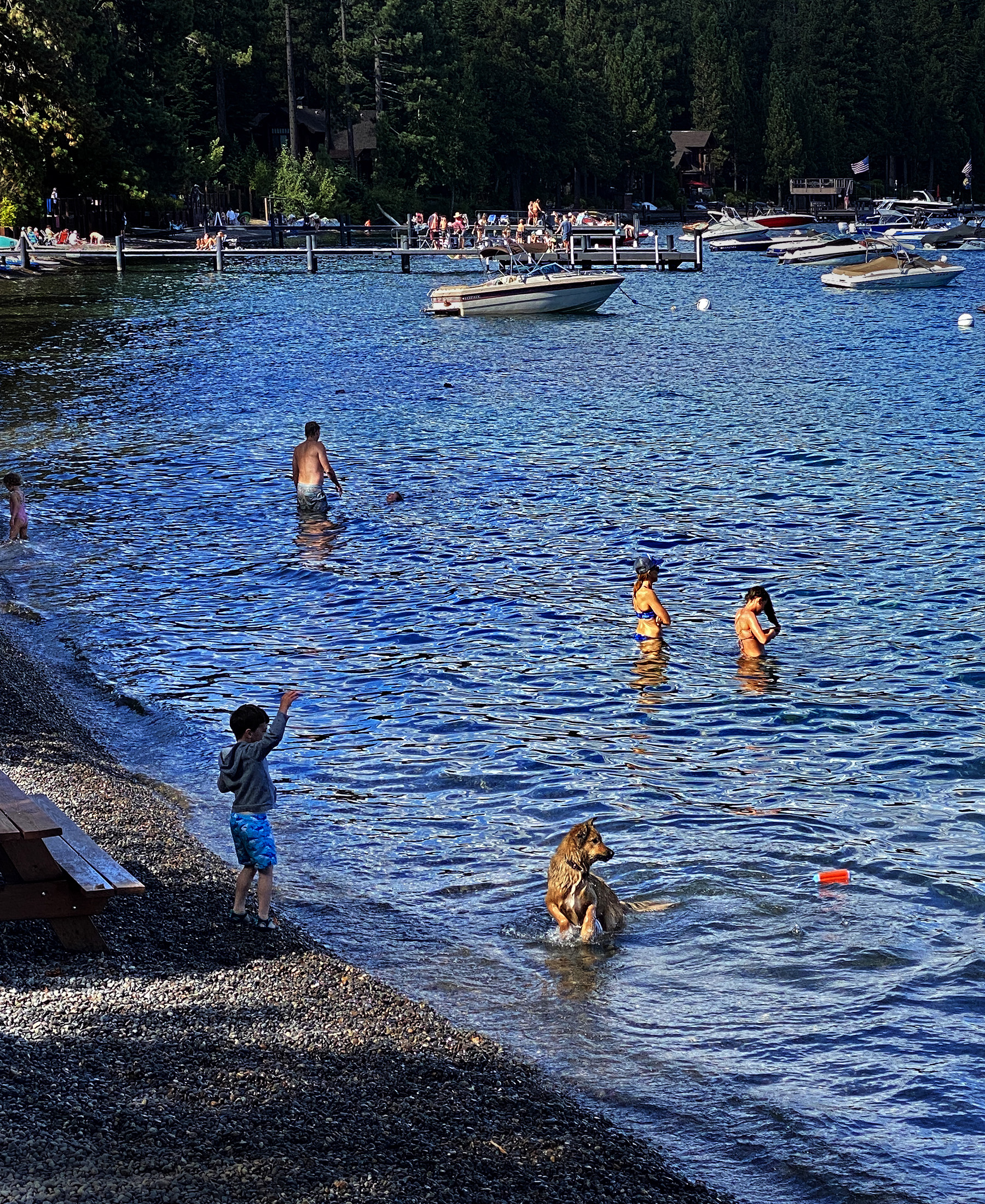
Sure enough, about mid-afternoon, I walk to the same spot overlooking the beach, where yesterday beamed with unseasonable warmth and happy lake-goers,
where today I watch a pewter sea of clouds turn thick and muscular, cumulonimbus body builders obscuring the far shore, and beneath them a vertical a wall of white moving north.
I love listening to thunder when it rumbles through this great granite bowl like the lowest note on the biggest tympani, though not when it turns ominous, slamming the sky like a sharp whack on a bass drum.
Now the temperature drops as the wind picks up, the pine boughs above me starting to shimmy, the lake matching the sky, no longer the rich cobalt of yesterday.
But two mallards swim and float near shore as I imagine they do daily in their ongoing search for sustenance, seemingly unconcerned about weather.
Now comes the rain, gently polka-dotting the surface at first, drops bouncing as if the rain gods have loosed thousands of marbles along with the rolling thunder and lightning I cannot see.
I think of the boatful of family and friends celebrating a birthday on this lake two months ago on the summer solstice, caught in a wicked afternoon storm that no one predicted, choppy ocean- sized waves capsizing the boat, drowning eight.
Today one small boat churns steadily south, and I, the only one watching from this rise above the beach, raise the hood of my jacket, whispering, Peace, white light and safety, my constant prayer these days,
hoping that this boatman soon reaches safe harbor, gets securely tucked in, as we all need to be until this storm passes.
Looking east across Lake Tahoe, Sept. 2, 2025 / Photo: Jan Haag
That, when I bent over and kissed her cheek as she lay on the sofa—the spot from which she would not rise the next morning—I didn’t say, aloha nui loa, mahalo nui loa—much love, many thanks.
That I didn’t say the same to her adoring husband sitting in a chair next to her, ready to get her anything she might ask for.
That her brother, my longtime sweetheart, stood nearby, thinking, like me, that we’d see her again.
That I said we would return in three days to talk about details for her “after-story.” That I didn’t want to use the word “obituary,” though she knew what I meant. That her generous, struggling heart was already counting its final beats.
Sorry that while I still have breath, she no longer does.
That as my belly swells and my ribs rise, air filling my chest up to my collarbone, she will never issue a hearty chuckle or sing a favorite song or dance to a good jazz band or cook a family dinner.
That I will never again sit at her table, happy to eat anything that woman put on a plate
That her essence will hover in my kitchen each time I make custards the way her mother taught her, the ones I brought this sorta-sister-in-law in her final months.
Sorry that I still don’t have all the particulars to write a proper obit.
That we will never again stand together before the fridge in her kitchen, looking at one of my poems affixed to the silvery box with a magnet shaped like a flip-flop.
That she—who claimed that she didn’t “get” poetry—will no longer tell me that she got a kick out of a particular poem and quote lines she liked.
Sorry that we’ll never again see her smile, which was—to so many who loved her—the perfect poem.
•••
(In memory of Margery Thompson, 1946–2025, the best sorta-sister-in-law ever.)
Margery and John Thompson, hangin’ 20, Kauai, 2005 / Photo: Dick Schmidt
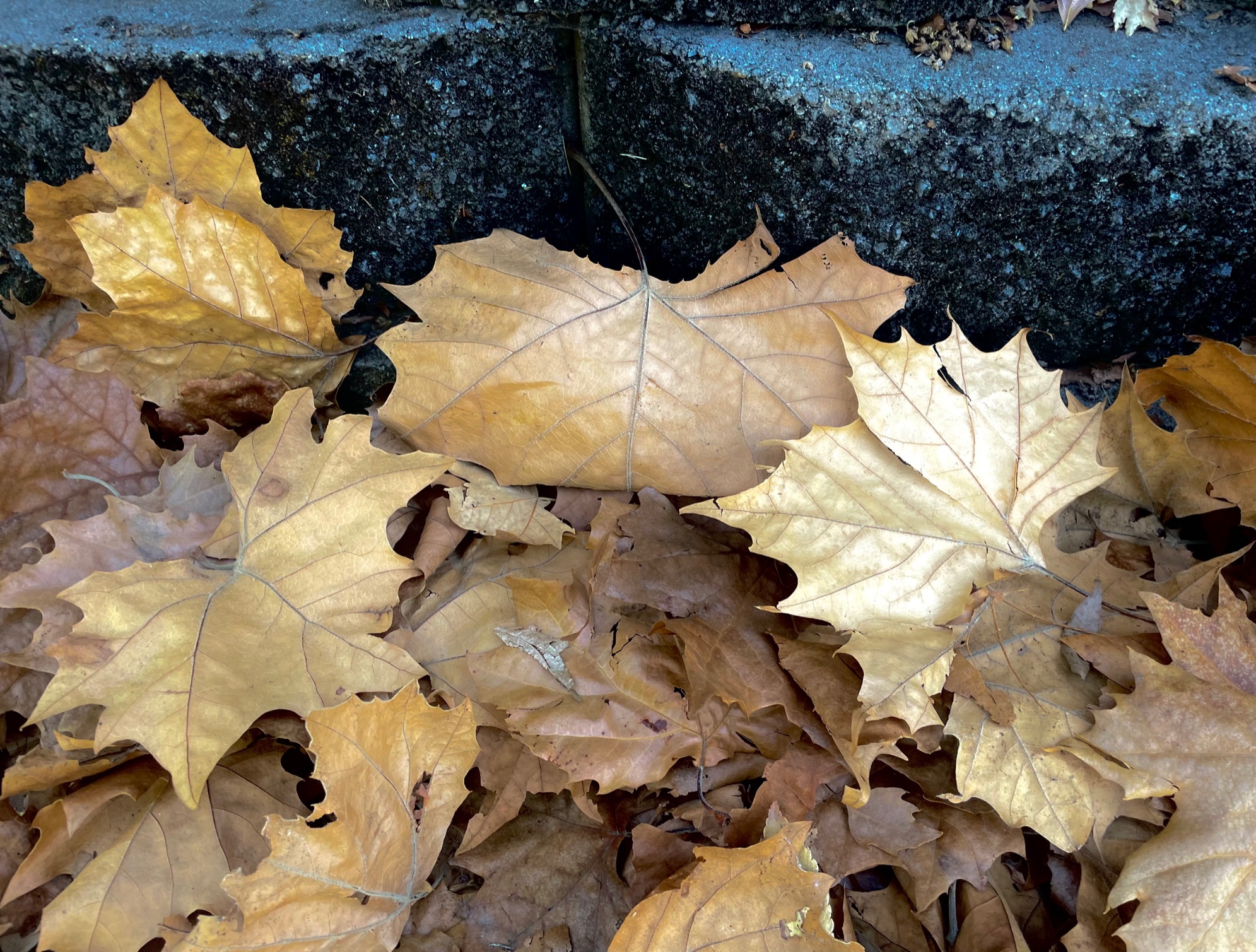
In late August when the sycamore starts tossing leaves brittled by unrelenting sun, I’m always surprised to find the lawn littered with the dead and dying. It happens annually, but it feels unseasonably early.
I’ve called this sycamore mine for 38 summers. Perhaps our real purpose is not to imagine that we own anything, but to embrace the notion of caretaking, that we are here to take care of what needs taking care of. Especially each other, I think as my feet crunch over what lies beneath, as I take up the wide fan of a rake, and begin taking care again.
You want me to write a triolet? OK, then, I’ll try. Turns out it’s a fun game to play. You want me to write a triolet? Once I start, I might just do this all day. Testing my wings, I find I can fly. You want me to write a triolet? OK, then, I’ll try.
•••
Now that I’ve written a triolet, where do I go from here? Diving into a virtual word bouquet now that I’ve written a triolet. So many themes I could portray— maybe a love poem, dear. Now that I’ve written a triolet, where do I go from here?
•••
Well, then a love poem it shall be, But for whom? Maybe for youm? Avoiding clichés of moon or tree, well, then a love poem it shall be. Maybe toss in a hummingbird or bee to make the little poem zoom. Well, then a love poem it shall be, But for whom? Maybe for youm?
•••
*In case you want to know… The triolet (TREE-oh-lay) dates back to 13th century France and is an eight-line poem with a lot of repetition and only two rhymes used throughout.(And the plural really is triolets, pronounced TREE-oh-lays.)
•••
(Thanks to Ellen Rowland for the prompt that plunged me into the triolet!)
Thanks to Kathy Keatley Garvey, whose bee photos—like this honeybee on a pink begonia—always make me smile!




 Güd wrtr