Did I ignore the words starting to ticker tape their way across my brain, imagining that I could collect them later?
When, in fact, they would roll away like spilled jellybeans, and, needing to walk onto the next thing and the next, and the next, I could not go back and retrieve them.
Now, in the midst of running errands, between the pet food place and the bank and the sandwich place and the grocery store, I sit in the parking lot and dictate what is showing up, having no idea if it is any good or not.
Not caring, really, just mindful that it is almost Easter, and jellybeans have been strewn in front of me,
and, after all these years, I have finally figured out that the only sin is to walk by all those gifts and not pick up at least a few bits of sweetness.
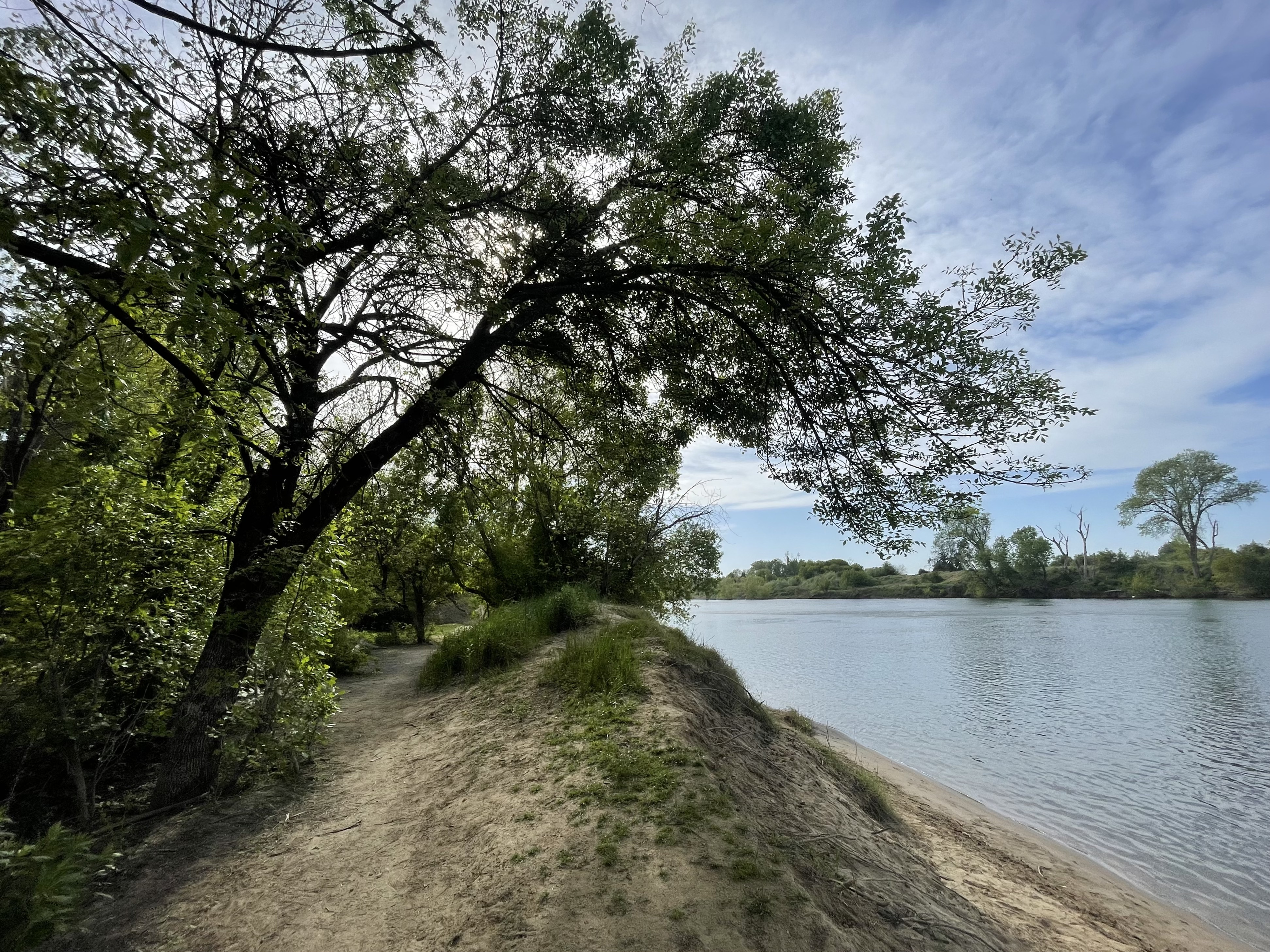
Needing the water but far from the ocean, I take myself to the river closest to me, the same one that turns into a lake by the house where I grew up, then is strained through the teeth of a great dam and released to flow 40 miles to the city where I now live.
I can’t explain why some days I need to see water and motion on its way to the sea that I am missing. Call it longing, call it grief, call it a settling.
But when I find my way to the riverpath, walking and stopping to take pictures of new purple vetch in high season, its florets hanging like ringlets off a young girl’s head,
I am startled by a splash and the arf! of one of the resident sea lions. His massive head emerges, a fish in his jaws, which he flings across the water in a pinniped game of fetch, then dives after it.
I am completely taken out of myself, caught up in the marvel, in the interplay of life and death before me— perhaps of actual play, too— of being just one organism in a great ocean or a swift river, whether walking or swimming or flying or crawling,
as all of us making our way through this world somehow manage to do.
•••
You can watch the sea lion I saw toss his fish here.
The American River in Sacramento / Photo: Jan Haag
The same Monday afternoon I cruise plants in a nursery, I walk by a large heart sculpture on an outside wall, and think, Nice, about to walk on.
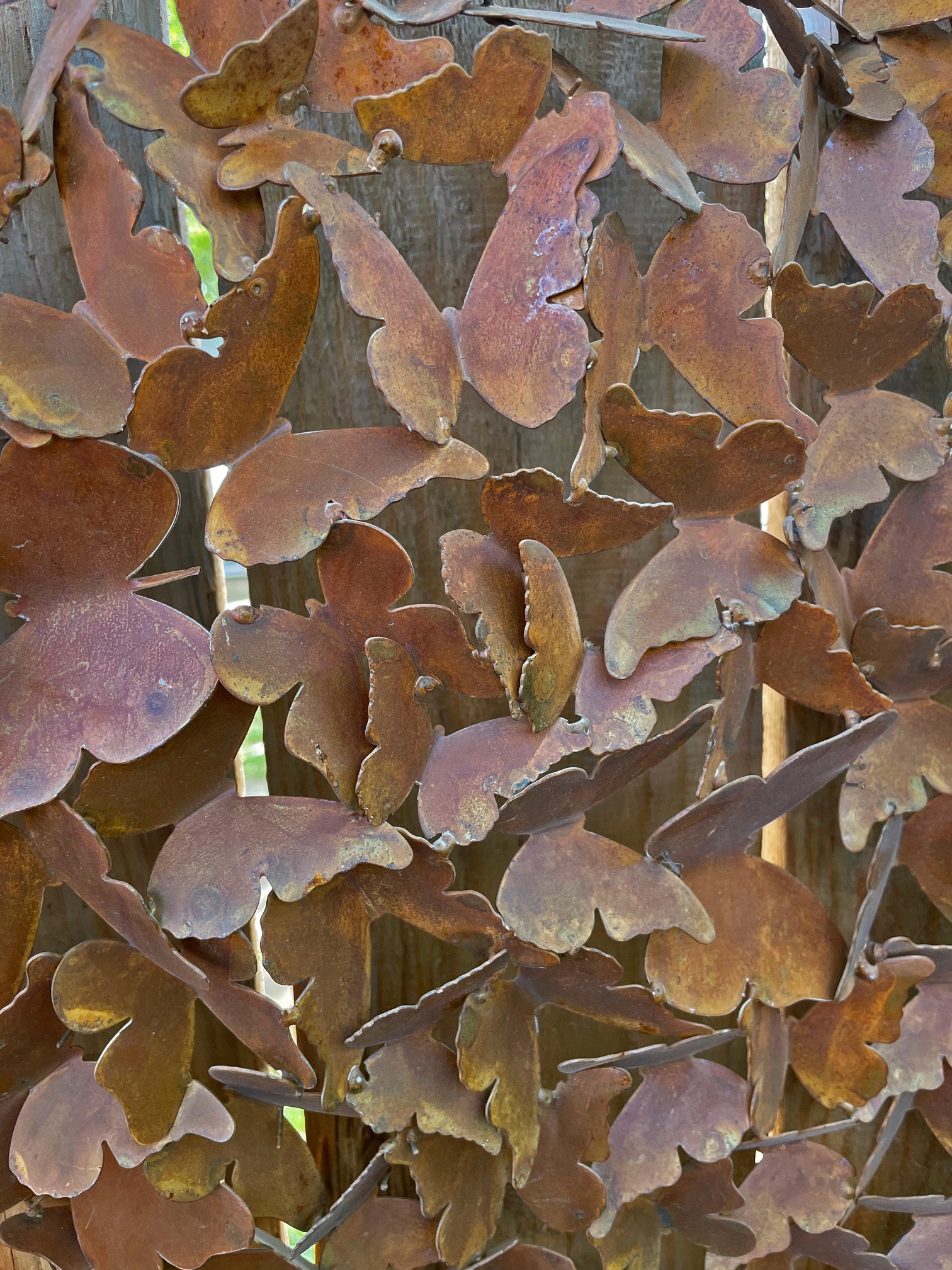
But something stops me, and I backstep to peer closely, discover that the heart is composed of dozens of small, open-winged butterflies, delicately rendered in rusty metal.
And it comes to me: Here you are.
Of course, it would be in butterflies, your favorite, like the one on every incarnation of your business card, on brightly colored stakes in the potted plants on your patio, the one that’s no longer yours but now belongs in the good care of your grandson and his wife.
I often see images of butterflies, but this one says Mom in a way that others have not.
I have to buy it, of course, knowing the spot on my backyard fence where I will hang this sweet swarm.
As I place it in my car, I feel my phone vibrate, and what I see makes me vibrate, too.
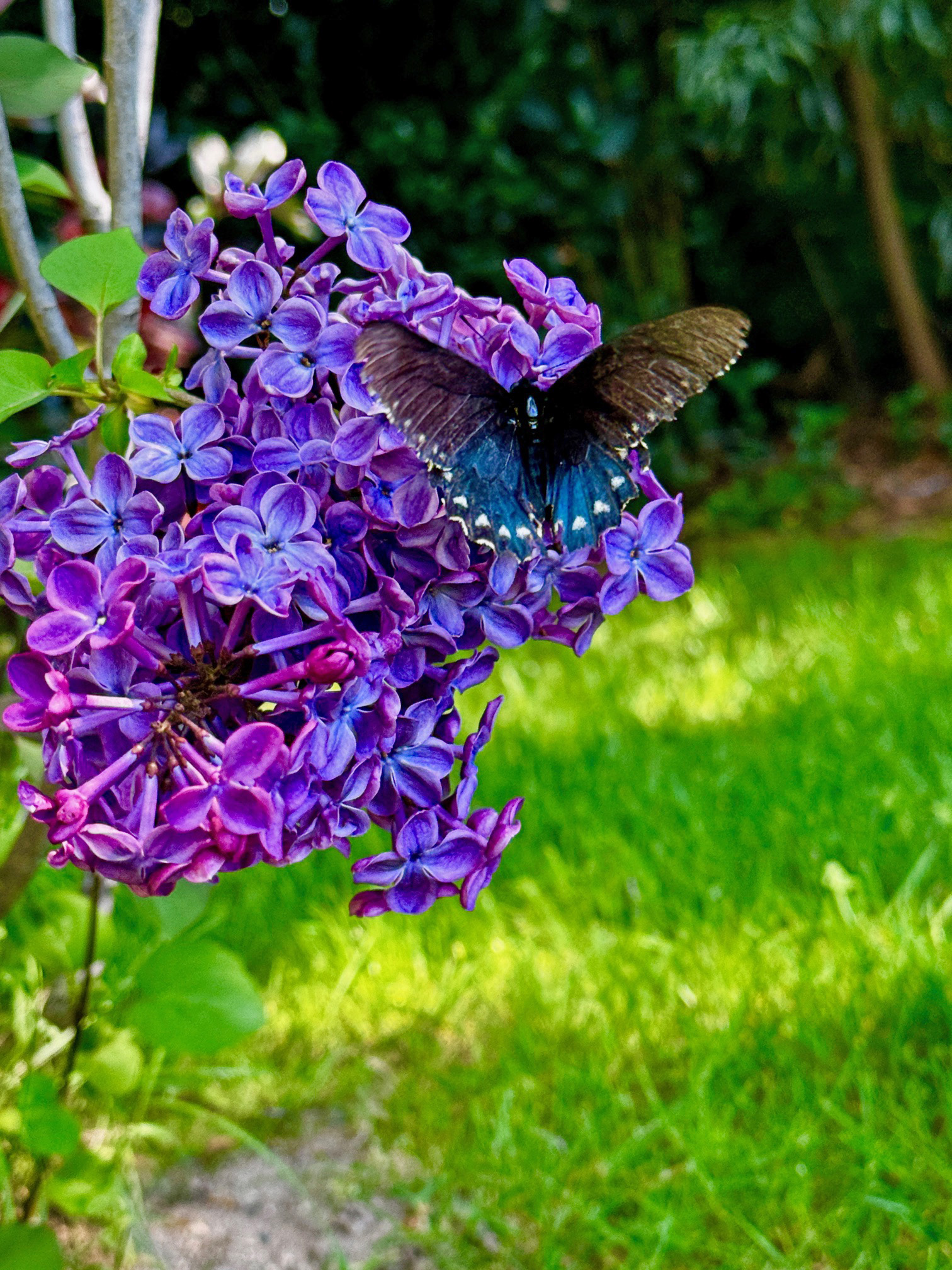
Your grandson’s wife has texted three photos of the purple lilac blooming its fool head off in your/her backyard. And on that bush that I hand watered through the three too-hot summers rests a large butterfly, its wings open to reveal a shade of blue that you would love—an aqua teal.
I think she saw me taking pictures of her flowers and had to check on them, too, texts your grandson’s wife. Purple lilac with a blue butterfly. That’s her in a nutshell.
It so is, I type back blurrily through damp lashes.
Which is when the voice of a long-gone beloved friend of yours and mine rattles through my head, as she often does: Honey, there are no accidents.
And I say aloud to no one and everyone who might be listening,
I know. I know. Thankyouthankyouthankyou.
Mom’s lilacs (now Ashley and Kevin’s) with butterfly / Photo: Ashley Redfield Just
I am terrible at games, even word games, which you’d think, wordy as I am, I’d cruise through
like a Sunday spin over smooth road. Not so much, which makes no difference to me until I take up a challenge
to convene quartets of sixteen seemingly random units of language. They have relationships, the game tells me,
and I puzzle over how to balance some of them, over what to do with the rest. I try to find some harmony
among the difference, the diamond among the remainder pebbles. And, when to my surprise, I succeed—
not only in making four sets of four, but also in figuring out how to play ball in this field of dreams—I’m aflush
and smiling as if I’d whacked one out of the park, a whole stadium of word fans cheering my prowess.
•••
(Thanks to Ellen Rowland for the prompt that sent me to The New York Times word game called Connections. Below are the words that I attempted to connect in some way… then I used all but five of them in a poem. You might want to give this a try, too!)
We whisper to the one setting off, one foot, then the other,
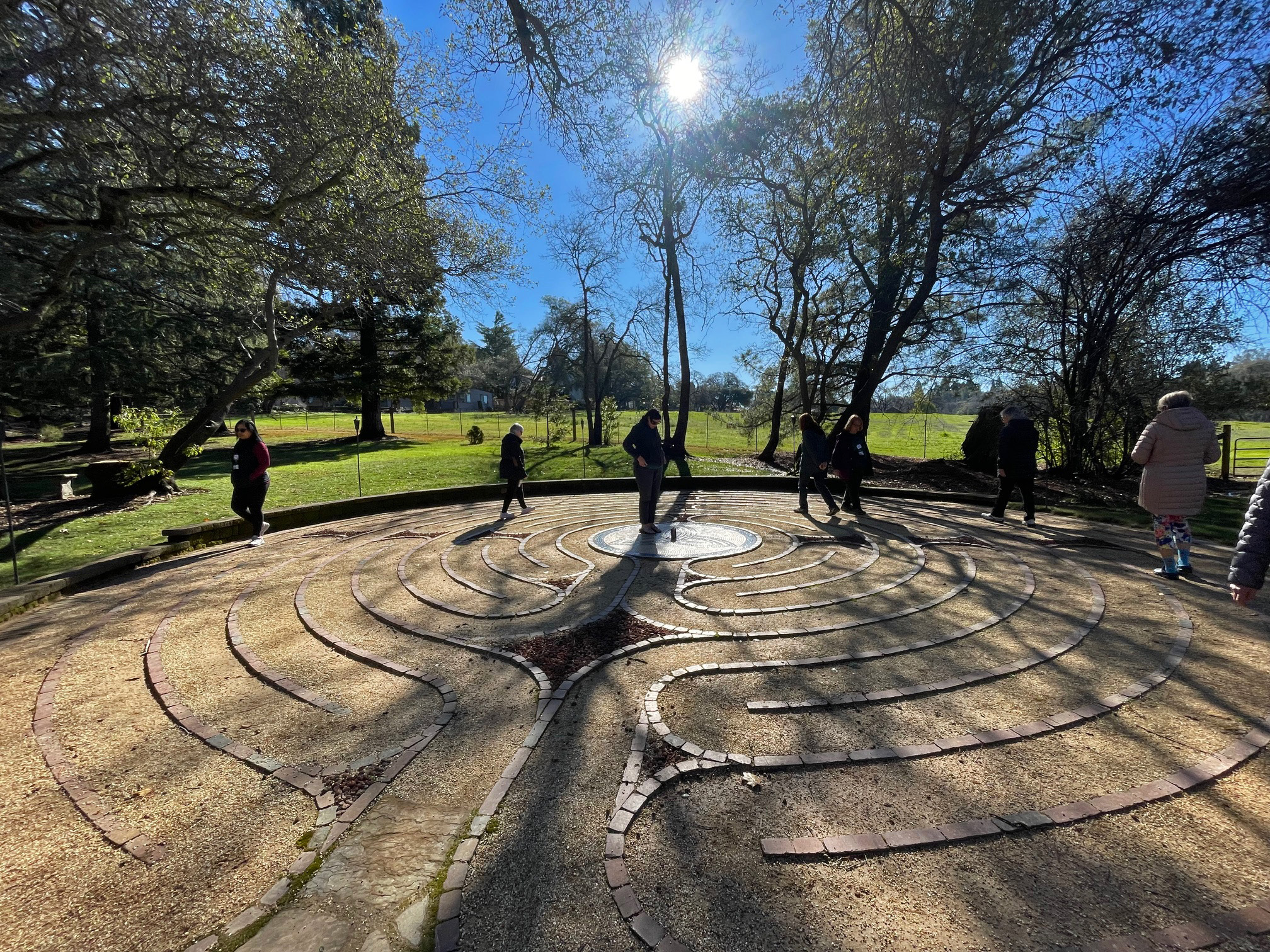
whether into the labyrinth that will take them to the center
or into the greater world. We infuse them with a bit
of the holy that we all carry, on this walk that at times
offers a spot to rest, a turn to pause, to remember
or reflect on the greater journey. We cannot see
very far down the path, often cannot intuit when
the sharp twists and turns will come. We can only
nod at those we pass, aware that we are both
accompanying and accompanied by those
seen and unseen—like the trees leafing out
above us, and above them, the sun-bright sky,
disguised as it is in its daytime wear. While
underneath all that blue, this very ground on which
we walk circles slowly under a forest of stars,
a pink moon rising, part of a whole universe
we will never see, but we trust is out there,
blessing our every step.
•••
(With thanks to Rev. Lucy Bunch of the Unitarian Universalist Society of Sacramento (UUSS) for her mentorship in the world of labyrinths and her good words that title this poem.)
Mercy Center labyrinth, Auburn, California / Photo: Jan Haag
The old one lies dead nearby, a 50-foot limp gray snake, all the air having left its body after years in the back yard.
I have not been able to remove it. What do you do with a hose pierced dozens of times by the teeth of thirsty raccoons? Throwing it in the garbage can seems so disrespectful for something that gave such good service, was such a faithful companion.
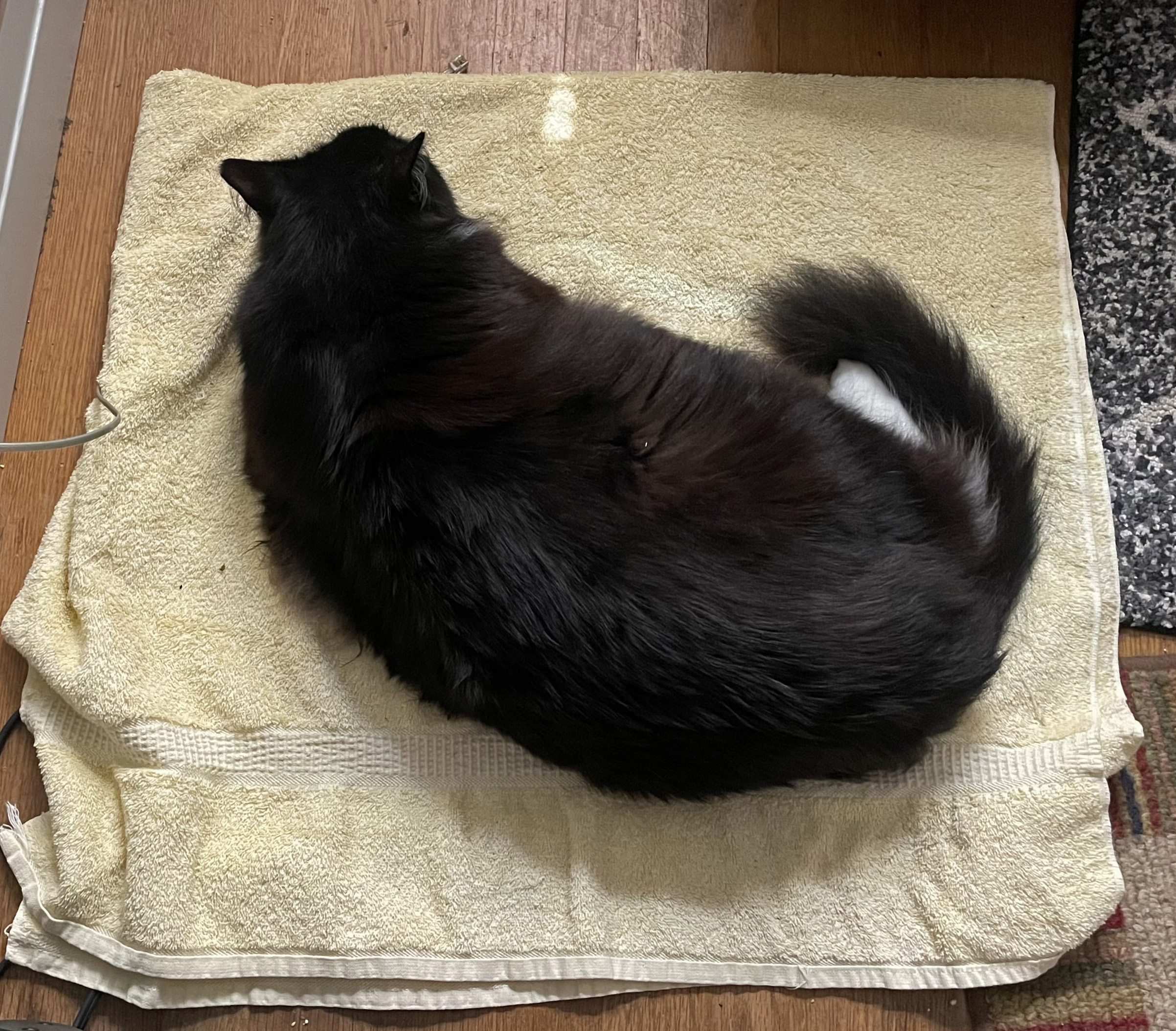
A week ago the kind veterinarian cradled Poki’s limp body in a towel after the final shot, her plaintive cry stilled, on the way to becoming ash and earth.
Now I screw the old nozzle onto the new hose, mindful to get it straight, to not strip the delicate gold spirals circling its shiny end.
I turn on the faucet, and, rather than having to wait for the water to inflate the old hose, the new one shoots into the morning air a fine spray through its squirter, which I train on three small pots atop the deck, their residents undoubtedly in need of a drink.
Later, I will gather up the old hose, thank it for its service, and take up the new one. Other thirsty neighbors are waiting—hollyhocks, irises, African daises—those early bloomers already risen from last season’s leavings without prompting, without any help from me.
New hose and English daisy in the back yard / Photo: Jan Haag






 Güd wrtr