Don’t be surprised if even on the darkest night a new, holy light shines. —Steve Garnaas-Holmes, from “Leveling”
Wholly light, entirely, comprising all, we find ourselves
humbled by the dark, craving the sublime glimmer that comes
with every shy dawn, as we listen for each breath of one
sliding away from us, as the space around us expands
like the universe, cosmic acceleration that we can’t see
but feel deep in our cells—we tiny particles of something
so much larger, so infinite, the barest whisper of the holy.
•••
(For this season of light in the dark that is Hanukkah and Christmas)
Carrying candles and crosses, these pilgrims were among a quarter million faithful gathered for a prayer vigil and mass with Pope John Paul II in Denver, 1993. (Sacramento Bee photo / Dick Schmidt)
Driving home at noon, coming down what was in our day a two-lane road with a stop sign, I was compelled to halt by a trio of lights on a tall standard leaning over the road like a leafless tree.
And there, next to a median, lay a furry black-and-white creature who had likely waddled across the now four-lane road when its luck ran out.
I had Strauss’ majestic tone poem playing on my phone, knowing that death and transfiguration were imminent in the house I had just left, too.
And with the scent of onions, rotten eggs and burnt rubber reaching me through the window on that foggy, foggy day, I felt my eyes cloud, then moisten, releasing their brand of rain.
I didn’t know if they were for the dead skunk or the beauty of the music swelling to its majestic peak, then gently drifting upward, like fog lifting, as I hoped she might ascend,
which she did several days later, rising above it all into two of her favorite elements— pure light and limitless blue.
•••
You can listen (as I have been) to the finale of Richard Strauss’ “Tod und Verklärung” (“Death and Transfiguration”), a tone poem for orchestra written when Strauss was 25 years old—this moving version performed by the U.S. Marine Band.
Strait of Juan de Fuca (between Washington state and Vancouver Island, B.C.) / Photo: Jan Haag
What if, even as we die, we find that this time of advent, of waiting, this in between here and gone, is not to be feared?
That each slowing exhale, breath to breath to breath, is a kind of bardo, the liminal state between death and rebirth, an outstretched hand between generations, offering us a chance to dance in this sacred moment.
That rather than resisting this moment of finite existence, we unfold with each exhale, feel our joints loosen, too, as hers let go.
That, of course, the unknown end date to a lifetime is what makes each one precious.
That this is an awakening, this space of uncertainty, that witnessing this undoing is a portal into understanding. That we are meant to be here for this passage. That this transition is an awakening, for her, for us.
That as we orbit her dying star, loosely tethered by DNA and gravitational pull through these long nights, all we can do is hold each other with kindness.
That, even now— in this moment-to-moment practice of in-breath and out, of opening and releasing, of holding joy and sorrow in our arms— we move through this graceful dance into mystery.
As we return to presence. As we return.
Wolf-Rayet 124, a dying star casting off its outer layers before going supernova / NASA / James Webb Space Telescope ERO Production Team
Her father would wince when he’d hear Mom call us “you guys.” To Grandpa, the father of two daughters, we were his precious granddaughters, and this usage stuck in his craw.
And though we preferred our rubber-toed tennies (blue for my sister, red for me) and corduroy pants to dresses and hard-soled Mary Janes that did us no favors, we suffered no gender confusion.
But Grandpa liked to tease. He’d type us letters on his manual Smith Corona that began, “Hiya, boys,” which made us giggle since he loved to buy us frilly dresses, worn rarely with the Mary Janes.
It was a matter of comfort, and our mom— never a ‘50s TV mom in dress and apron— knew that well herself, a pedal-pushers and comfy shoes kind of gal, who was no pushover.
“Knock it off, you guys!” she’d holler if we were quibbling. Or “You guys be sure to use the bathroom before you get in the car.” Or to move us along: “C’mon, you guys.”
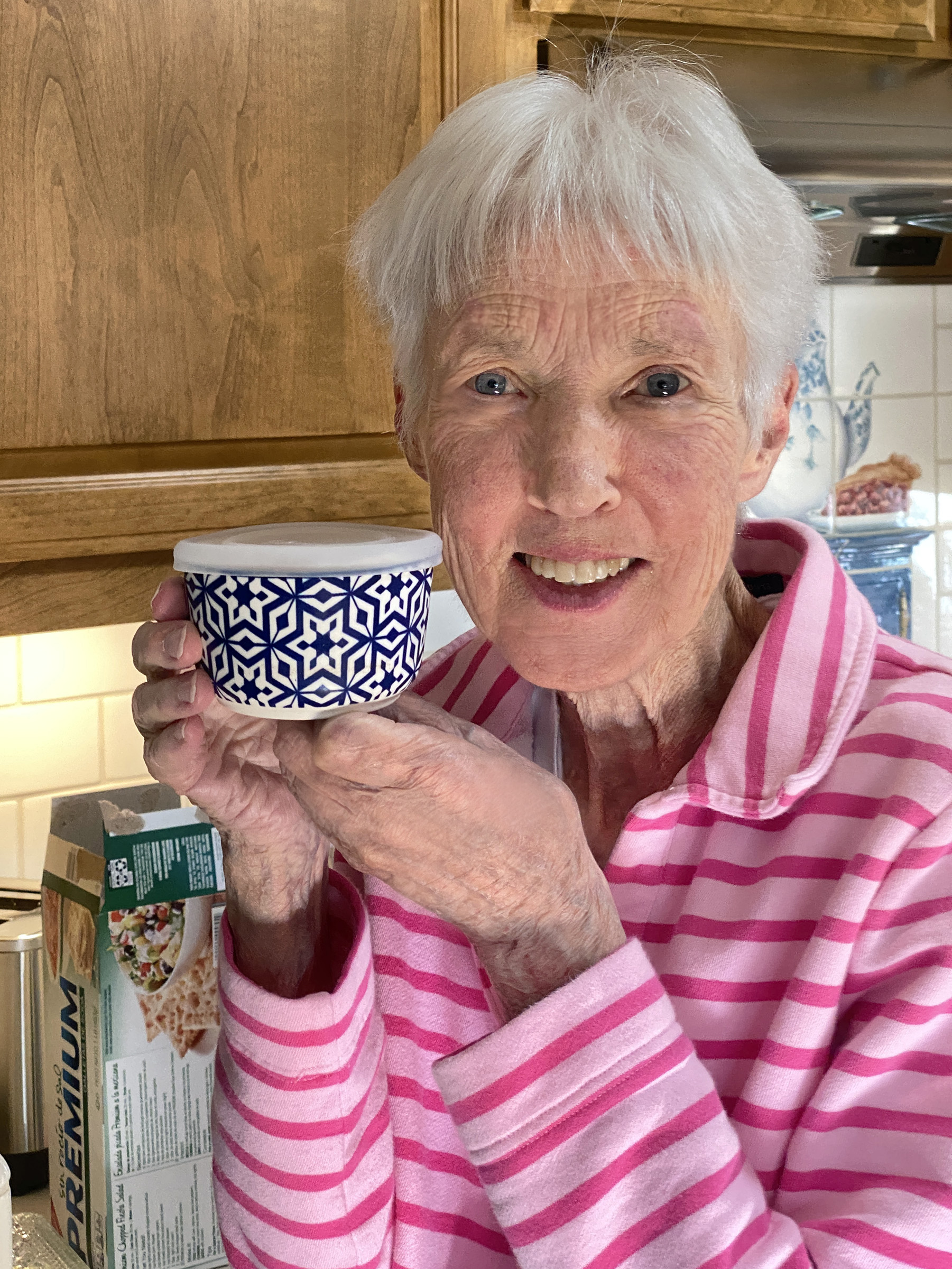
Now we guys tend her in her final days, lingering around the house more than we have in years. We guys jumped when she struggled to move from the recliner that cradled her fading self. We guys followed her as she guided her walker down the hall. We guys helped her choose the bright pink shirt for our holiday photo.
Now we guys adjust her in the hospital bed she never wanted. We tuck medication under her pale tongue that rarely speaks.
“For this you want daughters,” she told me when she still could.
“Well, it’s good you had two of them,” I said.
She nodded, looking up at me with mother radar, tuning in the details of my face that she can no longer see.
“What would I do without you guys?”
What will we guys do without her?
•••
Top photo: Sisters Janis (left) and Donna (right) Haag, ages about 6 and 4, Orange County, California.