Dewy, Dewy, Dewy, do you love me? Dewy, Dewy, Dewy, do you care? Dewy, Dewy, are you thinking of me? Dewy, Dewy, will you still be there? —1970s pop song
And he is there—Dewy remembers me, who visited him last year—coming to drape his long, lanky form down mine, gaze into my eyes with the soulful look of a momentary lover, making me feel adored, if not forever, at least in the moment.
I know that he will tire of this, remove himself to another part of the house, search for the human female to whom he’s truly devoted. I get it—she’s the kitty mom here, my friend who’s invited me to stay.
And you gotta love a guy who loves his mom, because that weighty feline blanket draped over me for even a little while offers the kind of warmth that, if nothing else, sends each of us— purring right along with him— into a sweet cat nap.
•••
With thanks to Terri and Al Wolf, for inviting me to visit them in the California desert, and to Dewy and Quince, most excellent feline hosts.
Well, first, it should be “fewer,” as I told way too many college students who truly couldn’t care less. But short is the point. Love short. Trying to write shorter. A lifelong task.
Anything can be a poem. Even typing the number for my to-go airport burrito into a note on my phone, which would in itself be a fine start, if not remarkable in any way,
if not for the fact that, as I waited, I watched a single person womaning the grill. No one stood behind the counter to take an order, this being the 21st century and only some oldsters like me wanting to use cash.
So I got with the program and stepped up to the little kiosk that younger people use with such ease and followed the simple directions to order.
How much easier things are for some of us travelers who can fly and cross borders with ease. How much more challenging for the fast-talking, Spanish-speaking woman tending the grill and others who have emerged from the kitchen carrying metal tubs of food, laboring, I imagine, for low wages, living on their dreams.
Where did their people come from? How easy was it for them to move from one land to another that appeared to promise so much? How many of those promises have come true? How many will be taken away?
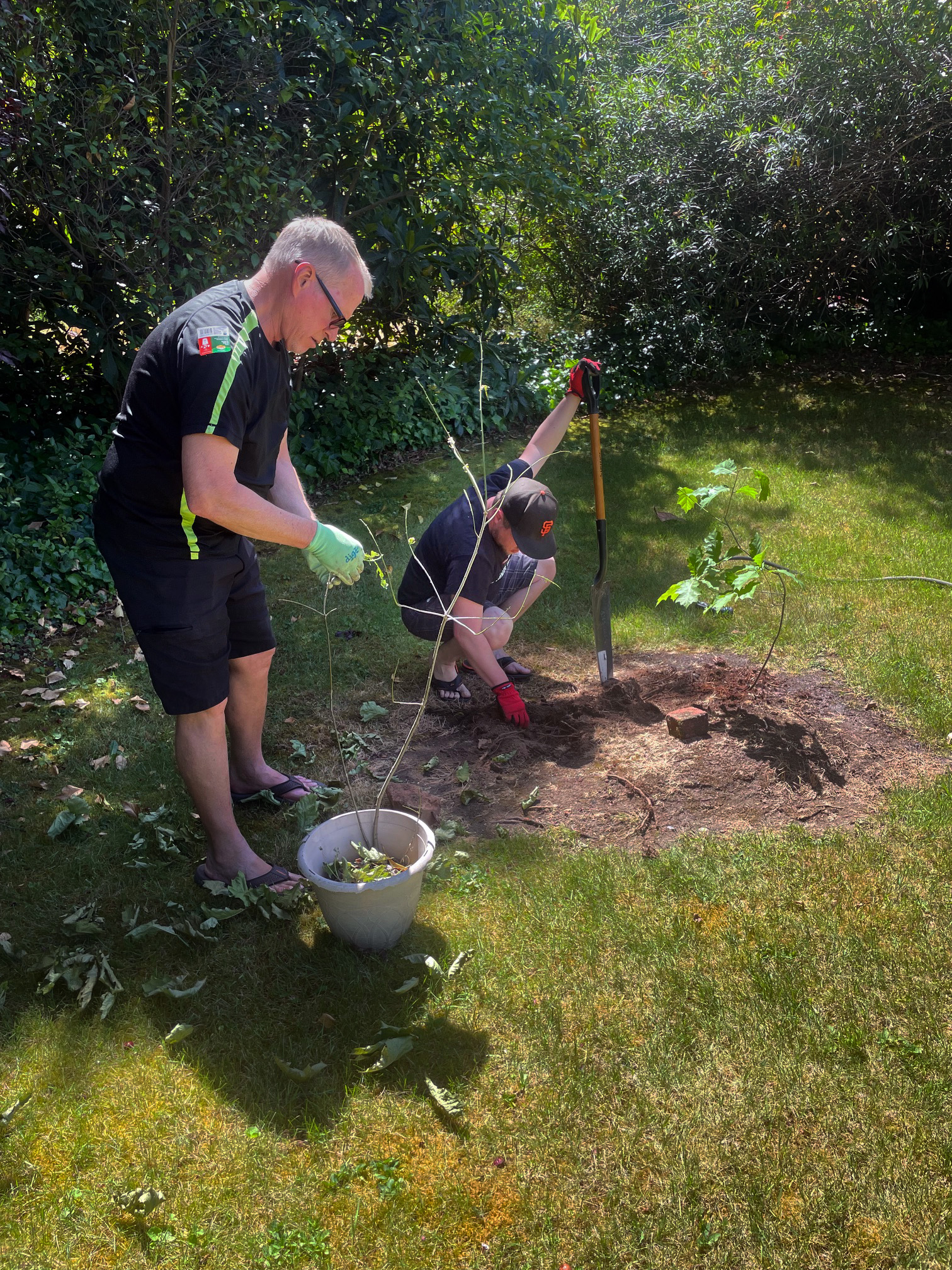
The kids are really putting their backs into it—my nephew, who, with his wife, are working hard to make the old house theirs,
clearing a half-century’s worth of overgrown front yard and remaking it anew with slender bender board and lots of shredded black bark.
It makes me smile and teary every time I see them out there, not unlike our parents nearly six decades ago, bending and planting, Dad going after poison oak, Mom planting camellias.
Today the kids set out a half dozen pittosporum plants in their black pots, ready for the freshly de-rooted soil under the windows of what were my sister’s and my childhood bedrooms.
Sitting on the floor of my sister’s room, going through piles of our late mother’s sheet music, I see their baseball-hatted heads popping up, then disappearing, as they bend and plant.
Later, after we all return to our respective homes in three different cities, my sister texts: It takes a family to rehab a home.
I add, Exactly—the newer generations of the family to rehab the family home. Especially the yard duty couple.
And my nephew texts back: We are happy to bear that weight on our useful lower backs with ample cartilage!
I paste a happy red heart on that text, a tiny metaphor for my very own.
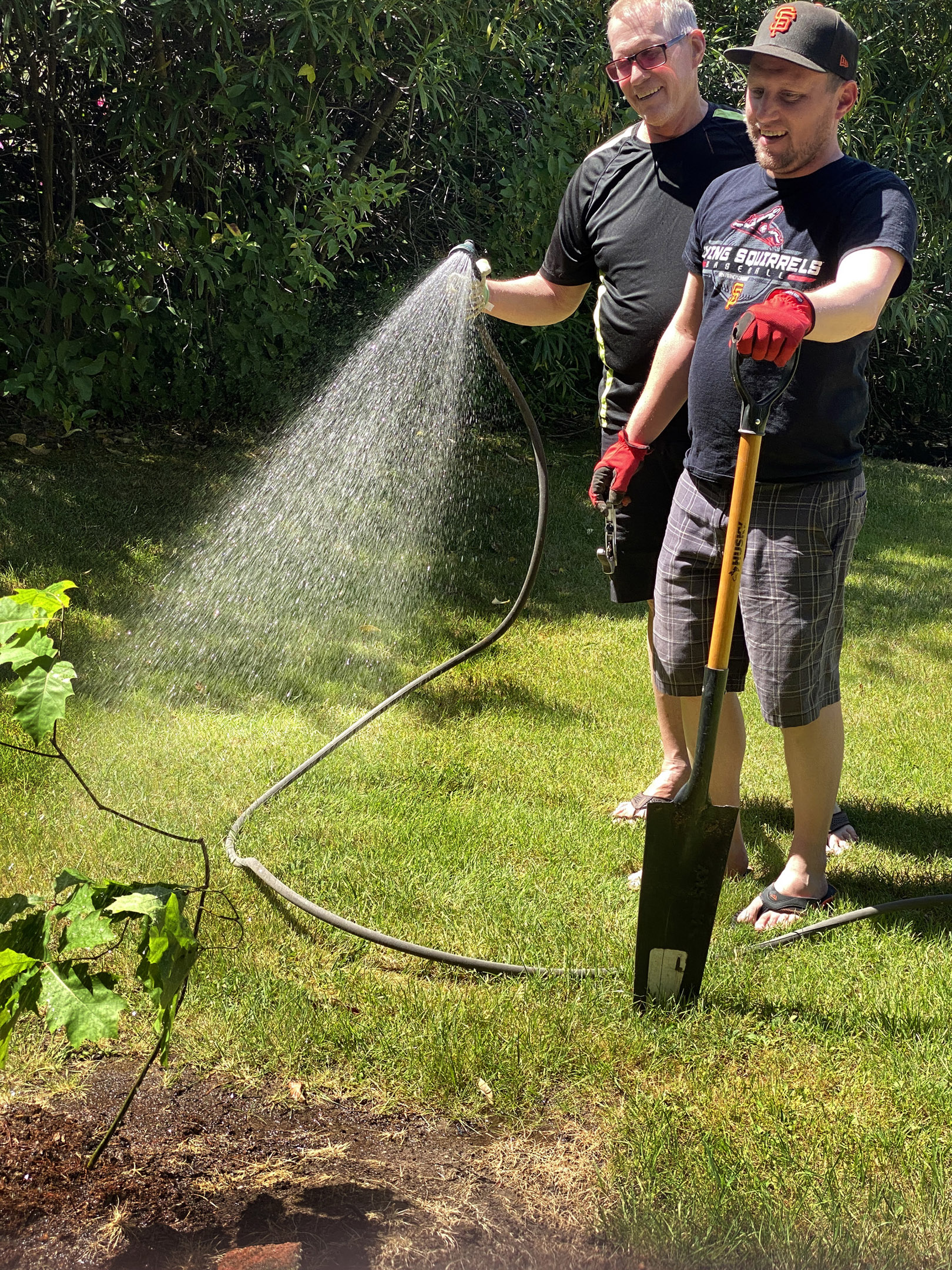
Ashley and Kevin Just in the soon-to-be-theirs front yard / Photo: Aunt Jan
In other words, it seems like love has left you because, perhaps, someone has.
Because it feels as if:
(choose your metaphor): —you’re alone at the bottom of the cold, dark sea, or —a great bird has just slammed into your chest and made off with your trembling heart, or —the gray haze of grief has wrapped its arms around you too tightly to be comforting.
So start there. Write every cliché you’ve heard or imagine about love putting on its fancy shoes and click-clacking its way out the door. Be sure to include where this hits you in the body—stomachs are overused, so consider, say, the elbow.
Strong verbs are a must, so sure, head for the thesaurus, a vintage volume anchoring a high shelf. Take it down, appreciate its heft, all the language it contains, and remember the too-many-to-count times you’ve used it to find the just-right word.
Make a list of those strong verbs and, while you’re at it, images of the beloved. Hair blowing in the wind should be avoided, since it, too, runs high on the cliché scale. Ditto for soft lips.
But you cannot miss if you describe the scene of her final breaths or the distinctly oaky odor of his skin or the texture of the four-legged’s fur,
if you show us the particulars of personhood (yes, beloved animals count) that made her or him or them so worthy of your precious affection.
Throw in a place name. Or their name, if you can bear to see it on the page. Maybe even if you can’t. You may cry, but you likely won’t die. And if you do, you’ll have gone out writing, which is never a bad thing—leaving these artifacts of human creativity, of what’s inside us,
which is to say, leaving the crumbs of love behind as we walk down a final metaphorical path into the who knows what, the who knows where.
•••
(Thanks to Natalie Goldberg, who, in her classic, “Writing Down the Bones,” urges writers to keep writing no matter what—adding that even if you die, you’ll go out writing. And thanks to the equally classic poet Molly Fisk for the prompt.)
Mailbox in Wilcox barn, Elk Grove, California / Photo: Jan Haag
He was the proverbial stick— or the rear right wheel of his car was— the rainy night of his 82nd birthday when he drove out to my late mother’s house by the lake to haul bags of her clothes 20 miles to the thrift store I love.
We thought he’d left when he came back in the house, where my sister and I were bagging shoes—well-used tennies, no; serviceable pumps, yes— saying, “I’m stuck.” And we looked up from big garbage bags of heels and blingy flats, alarm flickering in our eyes.
He was the one who collapsed in cardiac arrest six years ago on an airport floor, utterly gone, only to pop back with a single shock to halt his fluttering heart, give it a chance to restart.
He saw our concern before we said a word: “Not me, the car.” And we trooped outside, coatless, to stand in the drizzle and look at the spot across the road where he’d backed up too far, sinking into a half-century’s worth of lawn clippings and detritus that my father left behind, making for soft, tire-swallowing mulch.
My sister, always the innovator, dashed to the garage for long, slender pieces of wood to slide under the front tires. I retrieved two carpet remnants, having read years ago that if you get stuck in sand, try to drive out on bits of rug.
Neither worked. We gave up, called for roadside service—40 minutes, they said, which turned into another 40 minutes and another before I called again, pulling the old guy card—my “husband,” 82, needing to get home to take his medication—mostly true but not as urgent as I made it.
And when—exhausted, anxious— we finally saw the headlights of the tow truck blazing through the rural dark, illuminating the slanting showers that had let loose, I thought, not for the first time, Hey, no one died.
And no one had, and no one did, and tow guy Chue (whose name, he told us, rhymes with “shoe”) arrived at last to gently nudge the Civic bit by muddy bit with a gentle but firm tug, and another, and another, and another—one of us in the car shifting from neutral to drive on command, the other damp and hooded standing by, watching—
marveling again at the skills and patience required to extract us when we’re stuck, to jumpstart us so that we might drive off into the rest of these never-long-enough little lives.
Chue unsticks Dick’s Honda from the mud on Dick’s birthday / Photo: Jan Haag