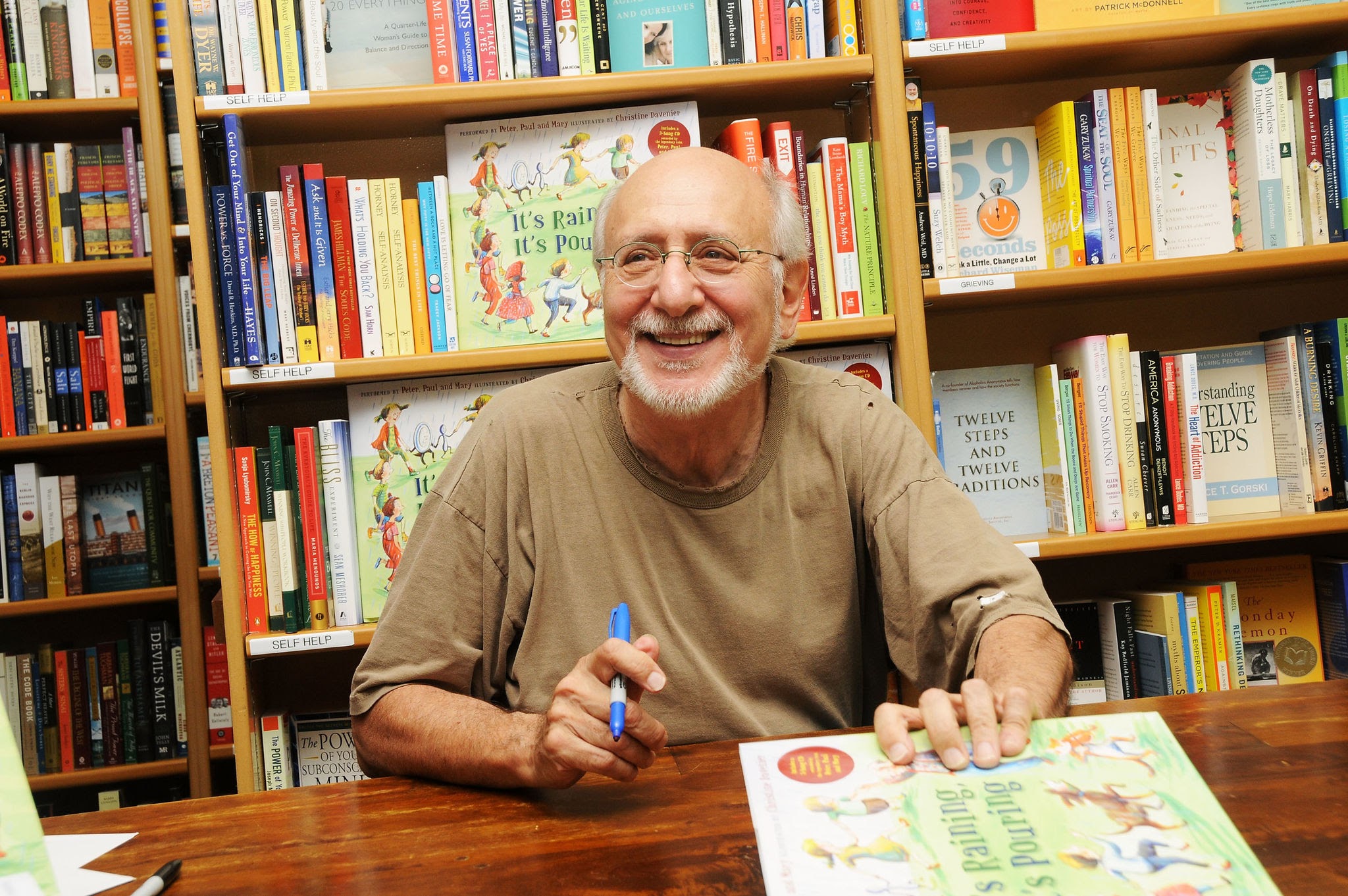
a link arrived to a Peter Yarrow video singing new lyrics
to his famous tune about how the song of Puff came to be
(before, Yarrow says, he knew about marijuana, so no, it’s not
that kind of puff), I didn’t yet know that he’d died. But, still,
I found myself in tears watching his face as familiar
as an old friend, especially when he sings that Puff’s
no longer lonely, that little Jackie Paper’s daughter visits,
“and the story has a happy end.” I so hope that his did, too.
•••
With gratitude to the memory of Peter Yarrow, as well as to still-with-us Paul Stookey and the late Mary Travers, for all the music… especially Puff.
Musician Peter Yarrow celebrating the release of his children’s book “It’s Raining, It’s Pouring” at McNally Jackson on August 1, 2012, in New York City. (Photo by Desiree Navarro/WireImage)
Though I’d been bribing him with yummy baby food for weeks,
after I added the magic powder to help him relax in the carrier,
Maxi walked away. Of course. You’re on to me, aren’t you?
I said at 6:30 a.m., too early for both of us. But I left the moosh
in a dish by his tall cup of water, which he has come to prefer in his
new room at my house, and I said aloud to the companion cat spirits,
OK, you guys. Help here. Dude needs a good clipping
to get all the mats off and a good once-over by Dr. Sue,
who as a girl sat with Donna and me in our mother’s house
with a fresh batch of six-week-old kittens of Fluffy’s (a mini version
of Maxi, now that I think of it). We’d diligently work to “train”
the baby kitties to use a litter box, plopping them in the sand and
guiding a little forepaw to dig. As if they didn’t have such instinct
hard-wired into their feline DNA. And decades later Sue became
Dr. Sue, and decades after that I’m driving the big guy an hour
up the mountain to see her and her team, Maxi complaining
all the way. But his cry wavers after a while, and I relax, too,
because Maxi did eventually eat the doctored baby food.
I imagine that he’s growing less fearful with every mile—
and me, too—as if, after all these years, I’ve learned
a thing or three about the mysterious minds of cats.
•••
With thanks to the original girl-next-door BFF and veterinarian extraordinaire Dr. Susan Lester and the great team at Four Paws Animal Clinic in Nevada City, California, for their excellent medical care as well as removing Maxi’s many mats.
Maxi feeling much better after medical care and excellent work removing so many mats from this super-furry kitty. (Photo / Jan Haag)
I’m not a resolutions kinda gal. I like to be surprised by what’s coming
since predictions seem silly. Life is nothing but unpredictable,
as is survival—for us, for the planet. And while we do all we can to assure
the going on—for us, for the planet— the evidence of my life on Earth might be
a breathful of some good enough words that I toss into the ether each day.
Ephemeral, sure, soon to wash away like impressions of our souls in damp sand.
Not meant to be literature embedded in the hearts and minds of most people—
except maybe you, reading this, where it may land like a bit of sunlight creeping
along a shining floor, then vanish in the wink of a moment—no less
meaningful for its brevity.
•••
With thanks to the inspirers: • poet Esther Cohen for her phrase, “some good enough words” • my multi-talented friend, poet and musician Antsy McClain for his memorable album, “Our Evidence of Life on Earth” • the wonderful late-great poet William Stafford for his poem, “You Reading This, Be Ready”
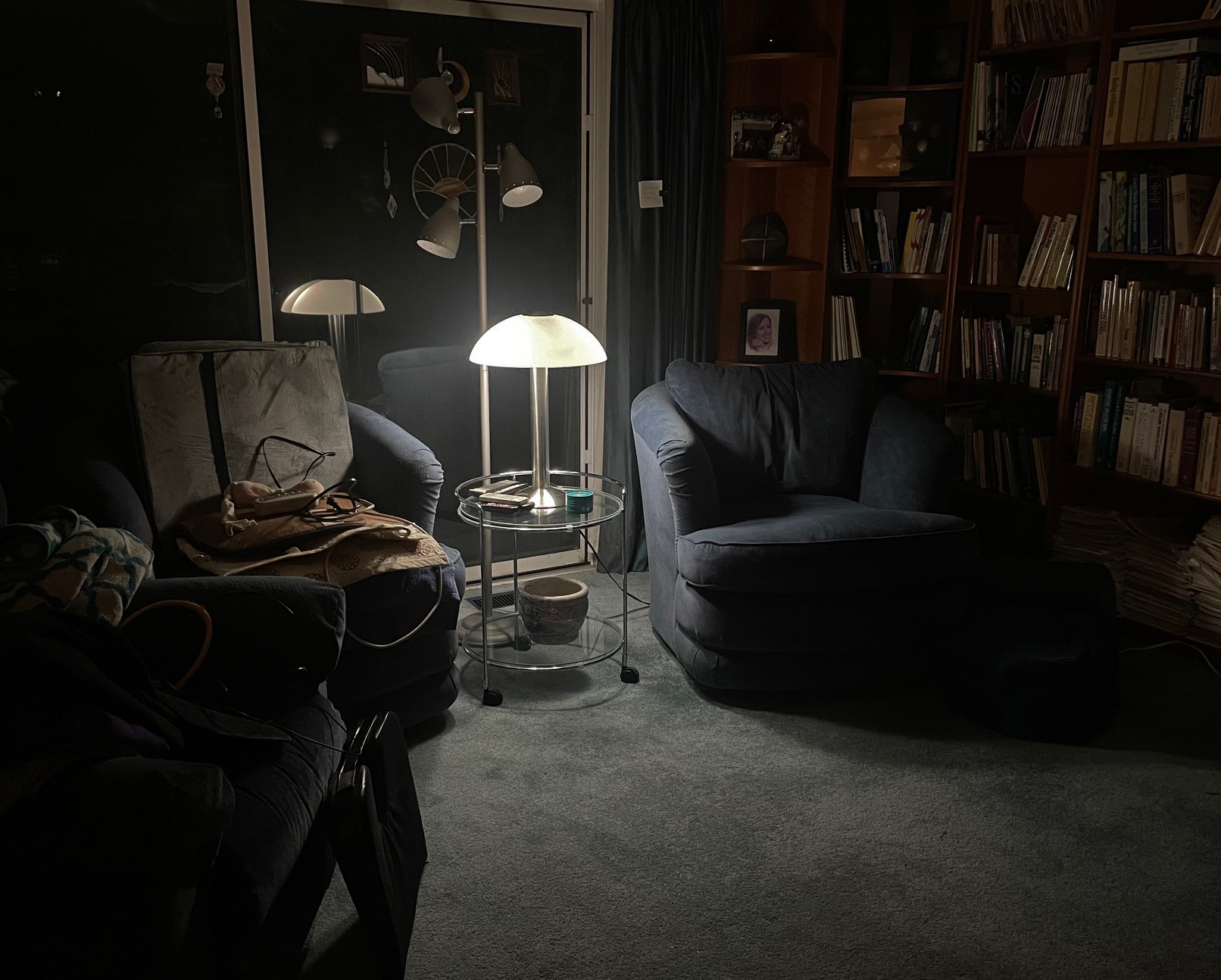
My sister’s note is still taped to the pole lamp in the living room on our mother’s well-trod route through the house.
I cannot bear to remove it just yet, though Mom’s innumerable trips pushing the red walker ended 21 days ago, and she faded into the hereafter 14 days ago.
I stand in this room where another lamp glows— the mystery light, she called it, the touch lamp that turns on unbidden.
We have tried to make it come on by stomping near it or bumping the table where it sits, but it remains stubbornly dark—until a hand ignites it.
As she walker’d her way into that room, Mom would often call, “Light’s on!” though no one had touched it. She loved that, she who strongly believed in unseen energy illuminating her path.
Two days ago, when I brought her home in a heavy plastic box, the lamp was on.
I lingered there in the room of the living, looking at my sister’s handwriting taped to the dark pole lamp, then at the mystery light glowing, and spoke the words I’ve been saying for two weeks to no one and everyone:
Moonset in the southwestern sky, Venus and Saturn suspended above a tiny fingernail of waxing crescent, as I pull into the driveway in her car with her in the front seat.
Never mind that she’s been gone for 12 days, that she lifted off from the family room on the winter solstice with “The Music Man” on TV, shortly after Marian the librarian was sweetly serenaded by a pitch-perfect barbershop quartet.
If hearing is, indeed, the last of the senses to go, then let her be surrounded, my sister and I figured, by some ringing chords on her way to the great chorus in the sky.
And if she’s still within shoutin’ distance now, before I get out of the car, I put my hand on the small box that contains what remains of her and say, “We’re home, Ma.”
This is how I know she’s gone: the singing silence. Something she was not known for.
I bring her inside—“Here you go, Ma,” I say—setting her gently on the dining room table with her official papers in her tasteful bag from the mortuary.
I walk into the hall and open the closet door where, for two decades, Dad’s been tucked away in his matching box.
“She’s back,” I tell him, hoping that, for all their tussles in life, they’ve met up again as points of light zinging around the universe,
attracted to each other like protons and electrons orbiting a nucleus that might just be the two daughters they made together,
the giantness in our smallness of this little atom we call family.
•••
(With thanks and love to Kathleen Lynch.)
Alabama Hills, Eastern Sierra, California, on the winter solstice, Dec. 21, 2024 / Photo: Rogelio Bernal Andreo
I walk under high fog because something has propelled me to get outside and see the neighborhood anew on this quiet afternoon as the world heads into who knows what.
Already, across this country, two major acts of public violence have rocked us. But because I thought to tuck a few bills into my pocket before I left home, when I passed the man in front of the church sitting with his knees up and his head down, possibly praying, possibly trying to keep warm,
I realized I had something to give. I turned around and walked back with my small offering to say, Excuse me. Might this help?
His head popped up and his smile brightened the day before his thanks. But that’s not why I did it. It’s because this has become my prayer:
For every horror humanity visits upon itself, let this year also be one of unnecessary acts of kindness, mostly small ones, that we can offer one another—
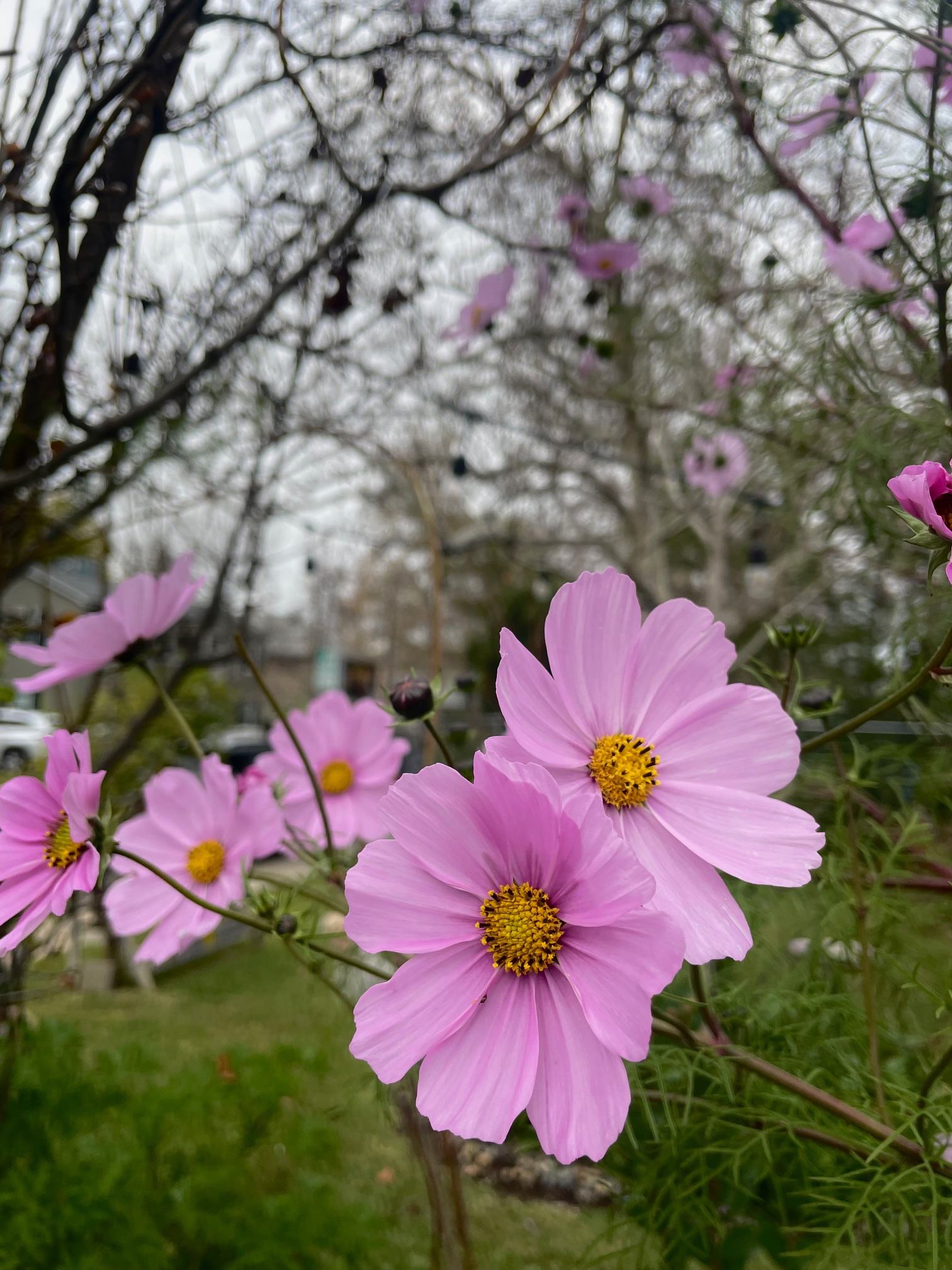
like the pink cosmos in my neighbor’s yard on the corner that, with no prompting, continues to produce the flushed, happy faces of bobbing blooms, even in the depths of winter.
My neighbor’s cosmos… on the first day of the year! / Photo: Jan Haag
On the last day of the year, sunshiny and chilly, I make my way back to Amy’s deck
where Shelley and the gals have been exercising their hearts out Tuesday mornings while
I’ve been otherwise occupied. Coming back into my world, delighted to be part of the circle,
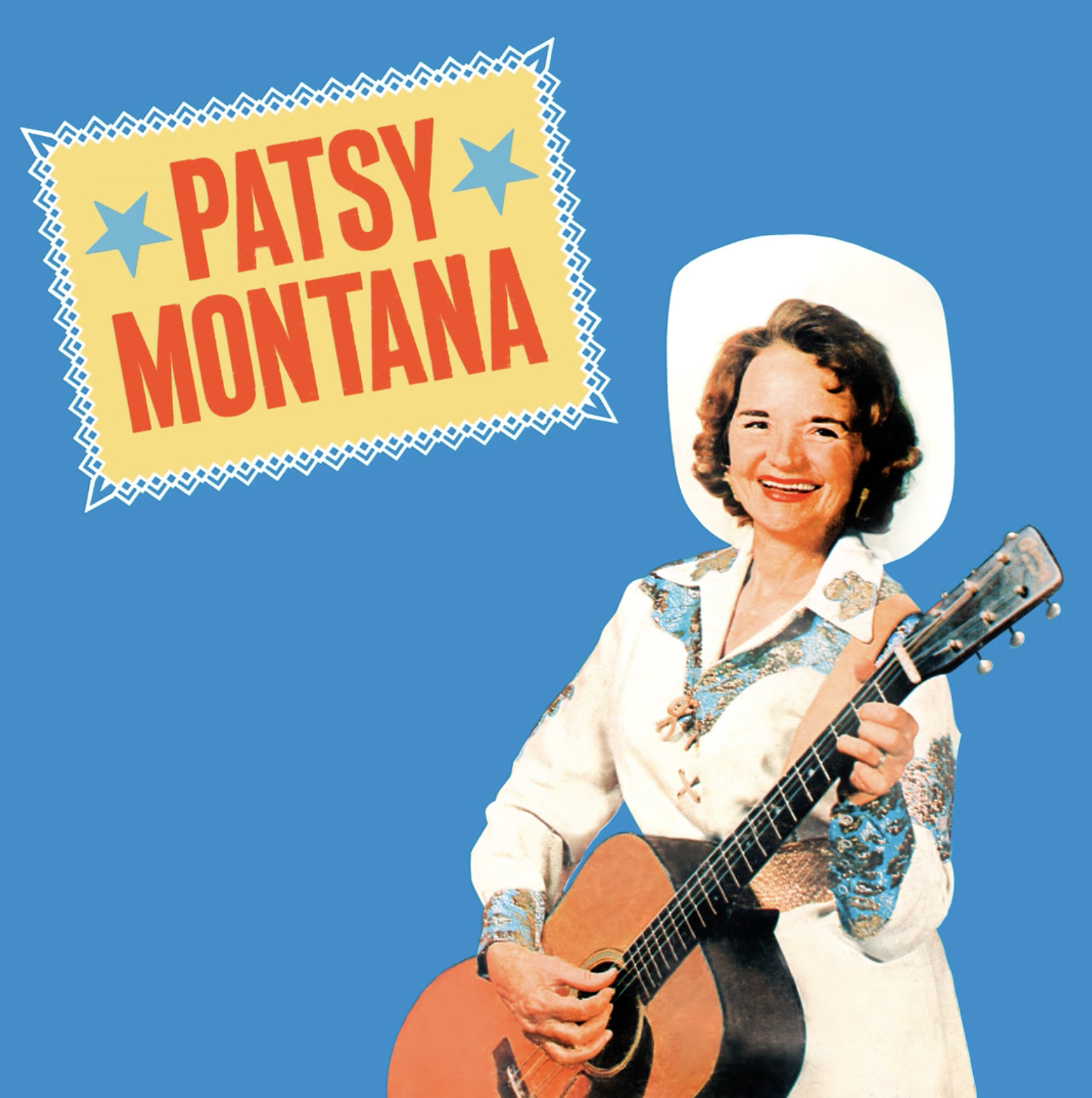
I begin to move to Shelley’s old-time country music— Patsy Montana yodeling,
I wanna be a cowboy’s sweetheart, I wanna learn to rope and ride… and then the tumbleweeds tumbling
with the Sons of the Pioneers— both songs written in 1934, and there I am thinking of her,
born three years earlier, my mother who loved horses, riding the docile mares stabled across the street,
delighted to sit on horseflesh and amble down the path to the lake.
She’d have wanted to be the cowboy, I think, not merely the sweetheart—
or maybe both, the woman who brought up two girls to believe they could do
anything they wanted. And on this cusp of a new year, we have, by golly.
We have.
“I Wanna Be a Cowboy’s Sweetheart” was written by Patsy Montana (born Rubye Rose Blevins in 1908 in Beaudry, Arkansas) in 1934. It was the first recording by a female country/western singer to sell a million copies. She died in 1996.
Just stop. Put away the phone. Look into the eyes of someone nearby— maybe in the grocery store line behind you—and offer:
Would you like to go ahead of me? I’m not in a hurry.
Or to the harried checker scanning thousands of items on a shift that’s lasting longer than she’d like: You’re so speedy. Love the way you pack those bags.
Return the cart to the little corral, or better, hand it off to the young man rounding up the stray critters with a sincere thank you.
To the woman at the bank: Great scarf. To the child carrying a fresh drawing: How pretty is that? Tell me about it. To the teenager down the block, raking, as you stroll by: How’s your day going?
Then listen. Truly listen.
Hold the door open for the man walking in as you’re walking out, and smile. Toss smiles like confetti stars. Grin when someone lobs one back at you. Doesn’t matter where they come from or if they voted or how. Doesn’t matter that they dress differently or appear to be strangers or speak a language that is not yours.
We’re all in this together, we humans. All we’ve got is each other on this blue marble of a planet, which, remember, from space reveals no borders, no walls, no divisions.
So more of this: kindness, tender smiles, a helping hand or two. Compassion. Hugs.
Let’s start with you:
Thank you, dear person, for everything you do. You’re amazing.





 Güd wrtr