Because you can’t stick a Latin ending on a Greek word, and octopus is as Greek as Achilles,
oktṓpous, the singular creature, and oktṓpodes amounting to more than one of the cephalopods,
whose very name translates to “eight legs,” though the creature possesses a beak like a parrot, injects venom like a snake and spouts ink
like an old-fashioned pen. A single octopus can weigh as much as a man, stretch as long as a car and somehow squeeze its baggy, boneless body
through an orange-sized opening. And while elusive in the wild, master hiders that they are, I stand transfixed before the glass where
I watch a young female octopus in temporary residence in a small aquarium. She tucks herself away here, too, and I cannot blame her.
She did not apply for this position. But she, who can taste with her skin, whose mouths ride in her armpits, who is as smart as any
dolphin or whale, captivates me with two long, floating arms, the translucent suckers like so much body art adorning her. I squeak
when one of her eyes opens, imagine that she sees me fangirling her, the saltwater star, wondering if she’s as curious about me
as I am about her—pearly smooth in her creamy outfit, soft bodied and relaxed before she is returned to her native
waters just outside these walls, for which I am glad. No one should have to live away from home for too long.
I wish her well, hope that she’s as happy as a clam (bet she’s heard that one before), watching her bubbles waft upward toward
the light, imagine her at home in the sea, a sly hunter waiting—the picture of patience— to make her long-armed move.
•••
With thanks to the astonishing writer Sy Montgomery for her classic book, “The Soul of an Octopus,” which has taught millions like me about these remarkable animals.
It goes back to the college boyfriend with the vision impairment who taught me to always cap the toothpaste, never to leave a clear glass in the sink, and always tuck sharp knives into the mini butcher block on the countertop where they were less likely to do either of us injury.
We used to joke that the mostly blind guy could chop vegetables better and faster than the nearsighted girl, whose fingers bore telltale evidence of accidental self-stabbings. No wonder the Girl Scout leader gently removed that girl’s whittling knife from her blood-spotted hands—and didn’t give it back for years.
But the blind boyfriend had a sixth sense for where things lay in space—the guy who whipped down the bike trail on two fast wheels—possessing a kind of radar that I don’t and I so wish my mother did as her sight dims.
He and I in those heady, early days of love walked the fridge and cupboards after trips to the store, making sure that he could find things—which he did, often more easily than I.
Now, almost a half century later, Mom stands before her open fridge, blinded by the light as she tries to discern honey mustard from shapely bottles of electrolytes. I walk the fridge with her, the two of us standing there letting the cold out (which could get you yelled at as a kid), as I point out three containers of egg salad and one of tuna along with the new salami and cheese packages atop the cheese sticks of Colby jack.
Mom runs her hands over the just-brought-home lunch leftovers in their traveling container, as well as the circumference of the receptable that shelters her special fruit—blueberries, strawberries, bananas—that her favorite restaurant assembles for her. She traces outlines of small water bottles that sidle up to Moscato chilling in thick glass.
And, when she’s committed to memory the locations of the to-be-consumed, she edges away from the chill and says, That’s good. I’ve got it.
And I marvel again at the ability of these beloveds who channel shapes into visual memory, those who can’t see the details of my face but who swear they’d know me anywhere.
(Muchas gracias. Arigato. Danke. Mahalo nui loa—thank you very much)
You did good. You did great. You made me me. You, dear teacherfriendsmentorparenthuman, I can’t imagine this life without you.
I apologize for all that stuff I did/said/forgot to do/ promised to do/thought I had done/thoughtlessly did or said. So sorry. Really.
I’m beyond grateful for all that you did in kindness, and anything other than that has dissipated like the kettle’s steam as it readies itself for tea.
Of course, I’ll miss you, whether for an hour or a lifetime. Of course, I want to hear from you. Send me a postcard, drop me a text, show up as a whisper in my head on my next walk or in a dream, one in which I’ll likely not remember what you said, just that we were together, and we were happy to be in each other’s company, which we are all the time anyway, carrying you in my heart as I do, sewn into the very fabric of me.
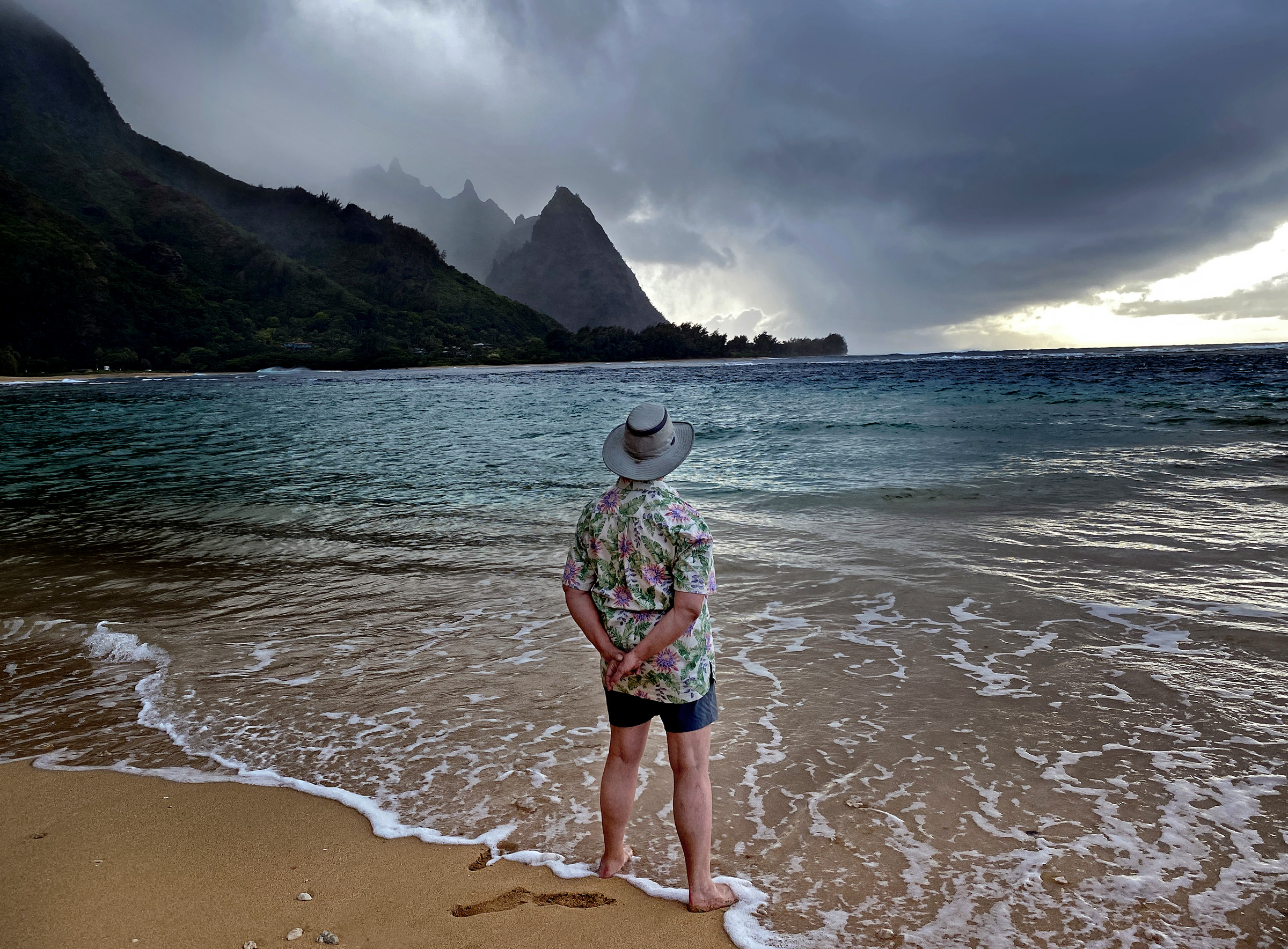
Jan Haag at Haena Beach, north shore Kauai, looking toward Mt. Makana / Photo: Dick Schmidt








 Güd wrtr