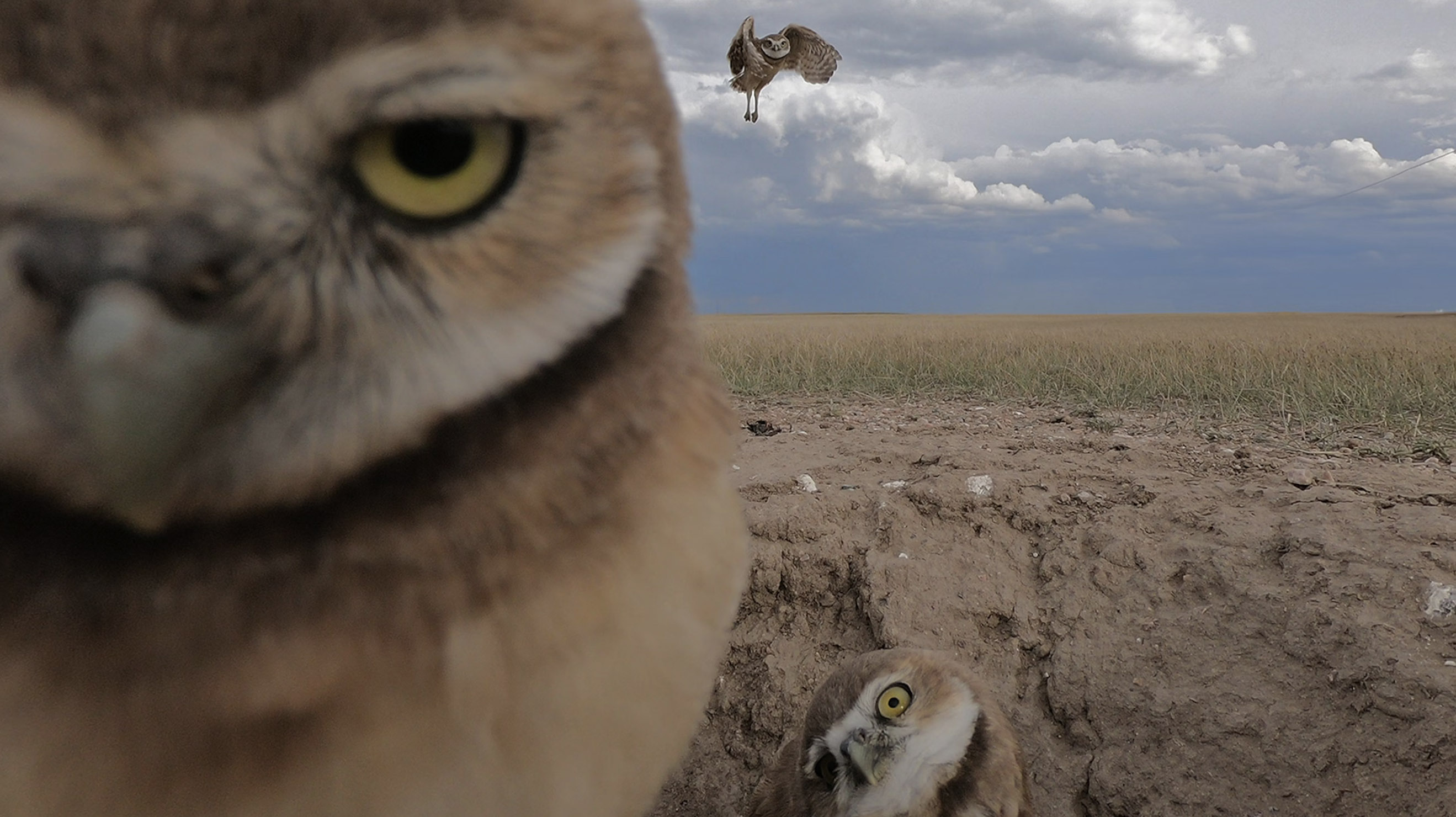
Don’t like it. Gonna stare it down. Make it leave. It’s not leavin’. Why’s it not leavin’?
Wha’cha doin’, you guys? Tryna chase this thing away. Give it the hard stare. It’s not leavin’. I know. Why’s it not leavin’? Dunno.
Maybe it can’t fly. It got here somehow. Just gonna sit here till it goes. ‘K.
How long we gonna sit here? As long as it takes. How long’s that? It takes as long as it takes. ‘K.
•••
Small, sandy-colored burrowing owls live underground in burrows they’ve dug themselves in grasslands, deserts and other open habitats where they primarily hunt insects and rodents. Wyoming photographer Pete Arnold set up a GoPro camera to shoot at regular intervals on the edge of a nest of burrowing owls near Cheyenne, and, among thousands of images, a trio recorded this memorable selfie on June 28, 2024.
Burrowing owls outside Cheyenne, Wyoming / Photo: Peter G. Arnold
(Richmond, BC, near Vancouver International Airport)
Clearly in the YVR flightpath, walking around the lovely pond, I cannot miss the great jets thundering overhead on their way into the sky.
Why, there goes one now, winking and gleaming against the soft blue and puffy white.
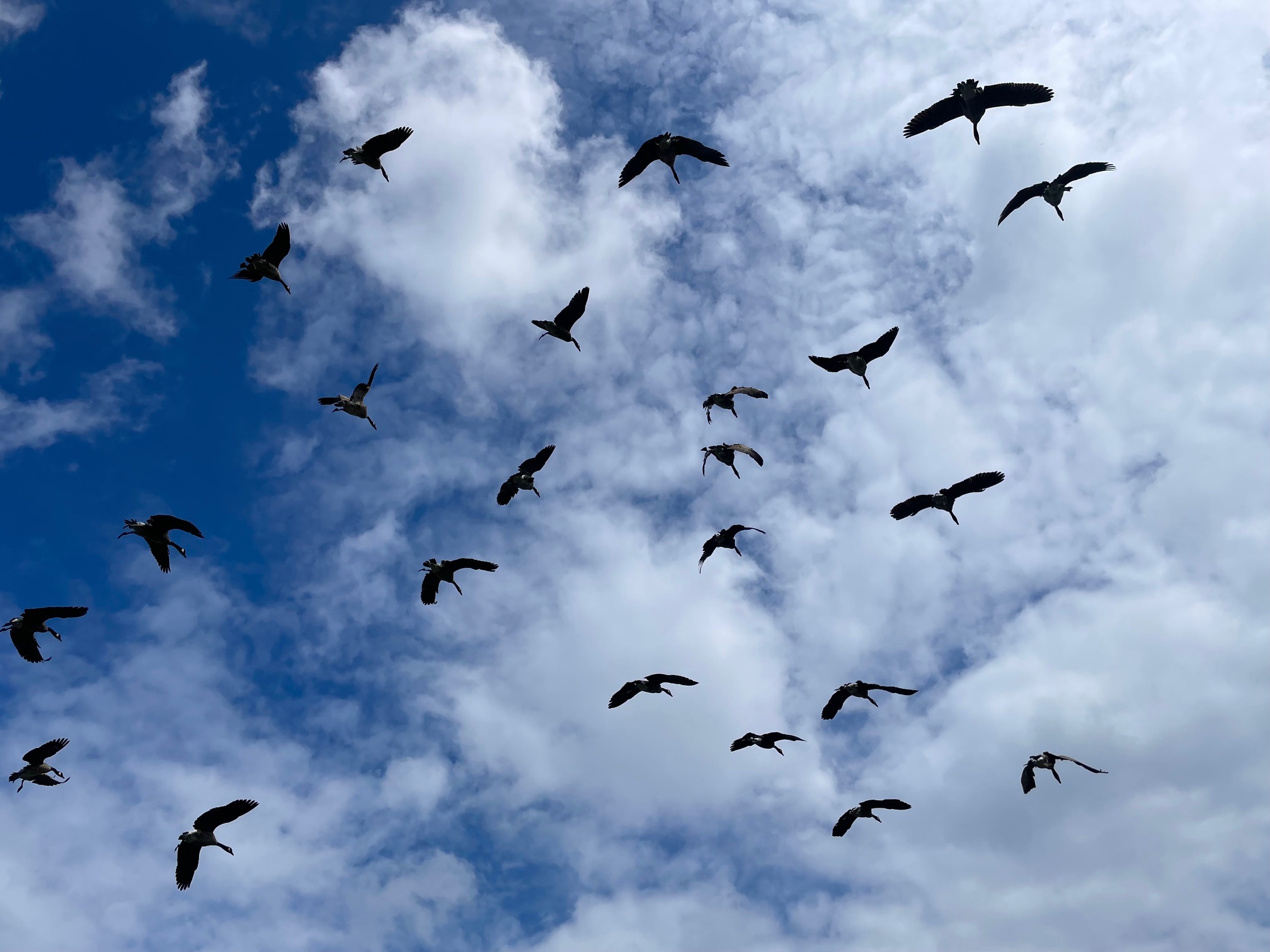
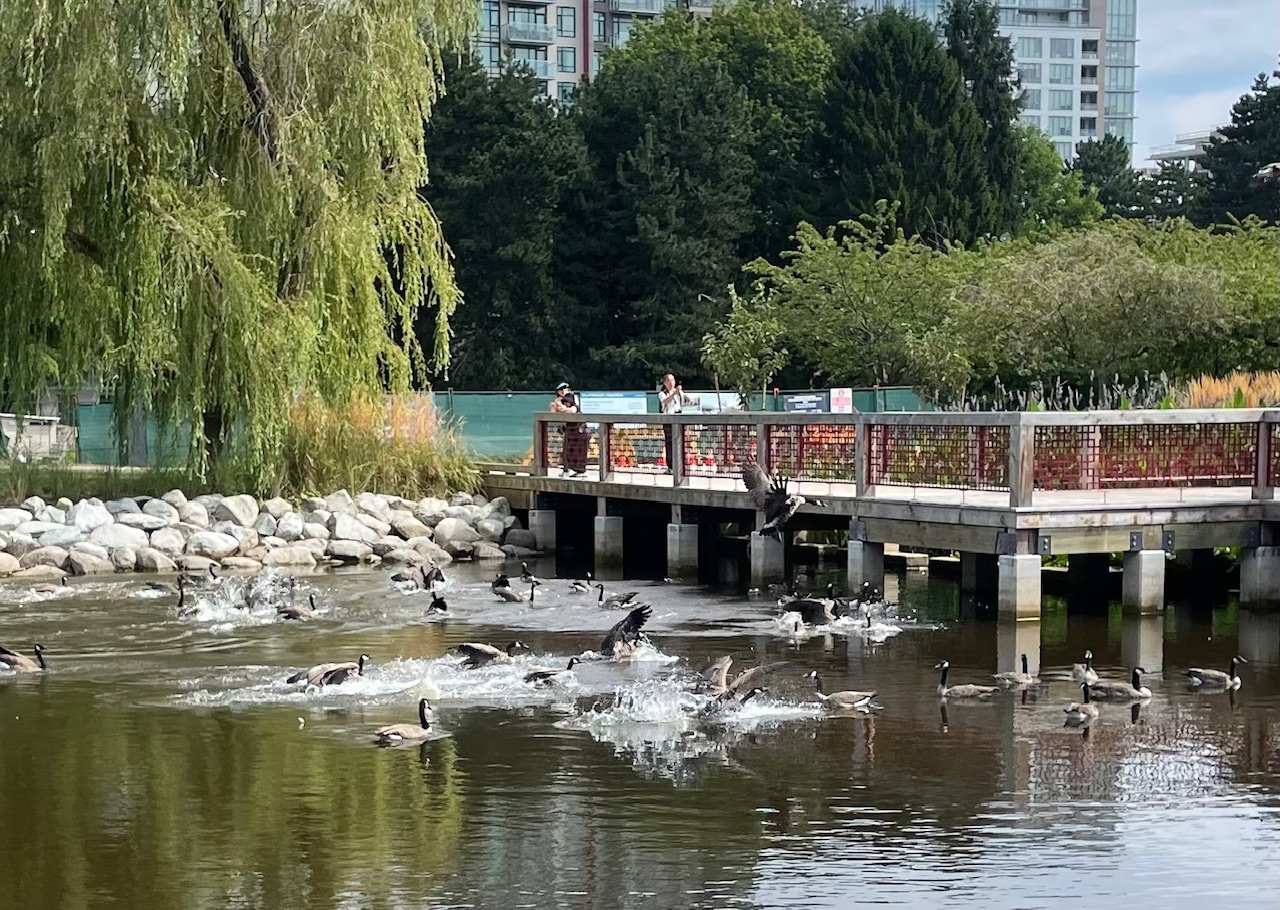
The wedge of Canada geese on the pond seems oblivious, though when a constellation of their brethren circles overhead eyeballing a potential landing spot, a flurry of feathered activity ensues,
the birds in flight angling in for a water landing with effusive squawks and splashes, far from graceful, but effective,
which is what I imagine human pilots must think on occasion when their touchdowns check in a bit bumpy.
But there they are, a poem descending with so much grace, safe landing on the planet that all of us in-flight souls call home.
(Top) Canada geese coming in for a landing at Minoru Park lake, Richmond, BC., and (above) making a splash landing. Photos / Jan Haag
As I look out on a familiar street at the grocery as Sunday shoppers pick up food for the week ahead, I sit at a table for two as one.
I do not mind.
He has been a good sport, sipped more than his share of tea this week and nibbled tiny sandwiches that to him do not constitute a proper lunch.
He will be happier with his pulled pork sandwich from the Irish pub.
Besides, this gives me a chance to have tea with you.
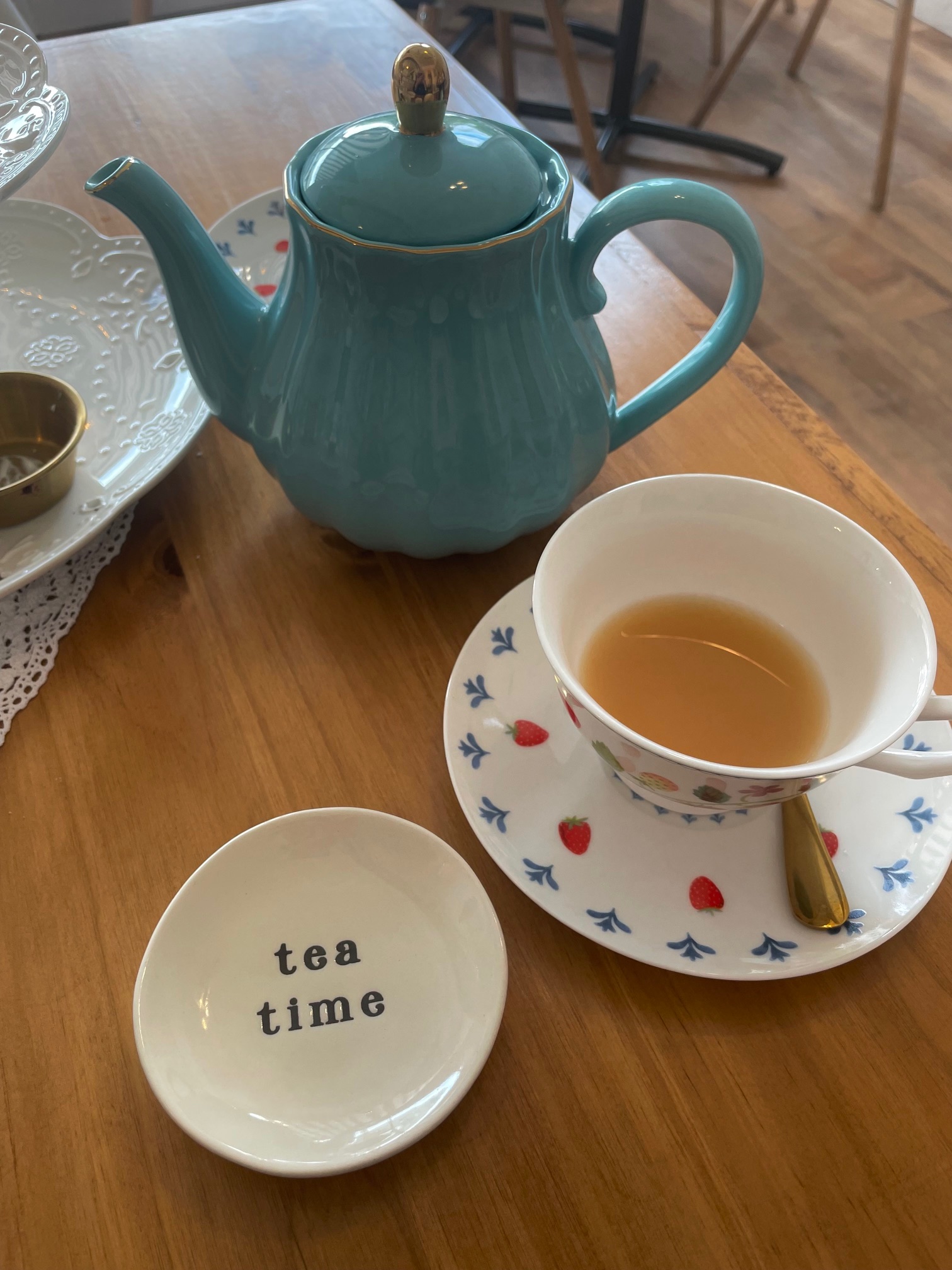
The young server brings my rose tea in an Alice blue pot, a pretty strawberry cup and saucer waiting. She asks if I would like milk or cream, and I say cream, because it seems a bit more decadent, and, besides, I think you would choose cream, too.
The small sugar bowl on the table contains a tiny spoon whose bowl reads Jasper, Canada, and is topped by a silver beaver looking most industrious.
We would smile at that, and I would tell you about my grandmother‘s souvenir spoon collection, as well as my own that she started for me when I was a girl.
Yes, I still have them, likely tarnished, though wrapped tightly and put away safely. Somewhere. More of the things no one will want someday.
Well before you made your exit three years ago almost to this day, you had your husband box up items you wanted me to have, many of them writing prompts for your own groups after I trained you to lead them.
I kept those, too, have set them on the table in the loft, amused to see what sparks words for writers, some of whom who knew you.
I’m sure you would like that, too.
Although I had not planned to have tea with you today, figuring I would sit here solo, here you are, as present as if you were still embodied.
That makes me so happy I can’t begin to tell you.
But you know that, too, don’t you?
•••
(For Georgann Turner upon the third anniversary of her death, Aug. 17, 2021)
Tea at Piggy and Paisley, Victoria, BC / Photo: Jan Haag
(I stop my quick walk when, looking down, I see words chalked in white, fading into sidewalk)
Poem by Honey Valley
(then a line of words in blue chalk, mostly worn away, unreadable, and three more lines)
Do you hear that? the engine of your machine whirring hard
(good lines, Honey)
That’s the sound of your heart thump thump
(and then, because Honey clearly likes repetition)
Do you hear that? Lean in Pause
(squinting, I have to turn around to see her final shoe-scuffed, upside-down word in blue, I imagine, for emphasis)
PAUSE
(and I do, with a smile, walking back up the sidewalk to the beginning to read this Honey of a poem hopscotching down Menzies Street on a sweet Victorian afternoon)
•••
We bid a fond farewell to Vancouver Island, British Columbia, as we head home to Sacramento today. We’ve spent a lovely fortnight here in some of our favourite places, walking and eating (fish! so much good fish! Tea! Nanaimo bars!) and visiting with friends, old and new, in Victoria, in Sidney and in Campbell River.
(In memory of Emily Carr of Victoria, BC, and Emily Dickinson of Amherst, Mass.)
Emily’s Elephant does not seem big enough to resemble an actual elephant, but that’s what Miss Carr called the small rectangular wooden structure that the artist used as a traveling studio.
How on earth did she fit her ample self through its narrow door? Where did she put canvases and brushes as she trundled her Elephant to paint on location in her caravan, often with a dog or two and a monkey in tow?
“Her square ugliness bathed in the summer sunshine,” she wrote of the Elephant, which sits outside her childhood home, “and I sang in my heart. “
How struck I am by this smaller yellow Victorian reminiscent of larger yellow Victorian occupied by a different Emily a continent away in the country I call home.
I climb the stairs to veer into the north bedroom and peer out the window, thinking about the Emily born in Victoria, much as I did in Dickinson’s Amherst bedroom, located in the same corner in her house.
The two Emilys did not know each other—the poet of Amherst born 41 years before the Canadian writer also regarded as one of her country’s great painters.
But I find myself looking west into this Victorian afternoon, thinking about them both, having stood in each of the home spaces that nurtured the gifts of these two creative souls who linger long, as does their light, shining clear into the now.
Jan with sculpture (by Barbara Paterson) of Emily Carr with her monkey Woo on her shoulder and her dog Billie at her feet, Victoria, B.C. / Photo: Dick Schmidt
Fishin’, my father believed, did not necessarily mean catchin’, though catchin’ was nice, too, especially the tender little trout he and my mother occasionally snagged from the West Walker River high in the Sierra Nevada.
Fishin’ rarely meant catchin’ to my fly fishing husband, who’d grown up bait fishing for the family larder on lakes and ocean. Tempting a hungry fish with a delicate fly was more challenging than with lures or bait,
and he was happiest up to his wader’d thighs in a stream casting his line, watching it float gracefully to the surface and waiting.
Should there be a catch, he’d admire the protesting fish, careful to release it as gently as possible—not unlike the way he released me.
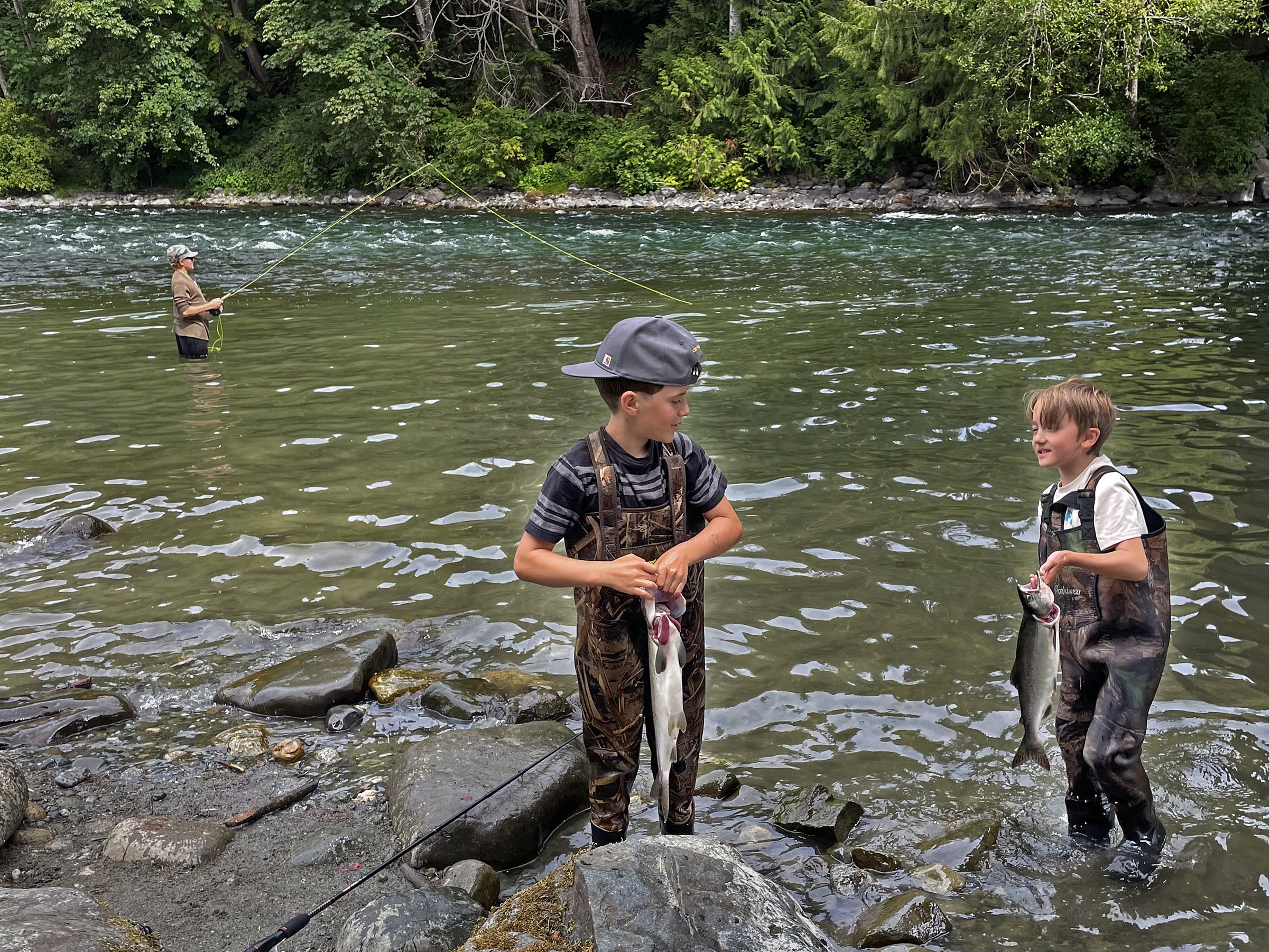
Years after his departure, on the Campbell River outside the town of the same name on an island called Vancouver, I watched two boys each land a sizeable salmon, all by themselves, then hold them up to gawkers and shorewatchers like me.
The boys turned back to rebait their hooks and cast into the summer-swift river, then wait, as the sport demands, wearing matching grins, hoping for another lucky catch—
their happy definition of fishin’.
Happy fishermen on the Campbell River, Campbell River, Vancouver Island, British Columbia / Photo: Jan Haag






 Güd wrtr