Bird feeders

(for Al and Terri Wolf)

Al’s bird feeders are diligently attended
by all manner of small-winged neighbors I
see from behind the glass. He has left all five
full for the wee birds who flit like butterflies,
land, peck and flee, making it hard to see
them clearly, much less identify them.

At times like this I wish for the knowledge
and experience of my birding friends,
who might pronounce one “nuthatch” or
“junco”’ or “wren” or “finch.” I manage
“bird” or perhaps “tiny, flitty bird.”

Even looking for their likenesses online,
I cannot tell—they’re here and so quickly gone.
Maybe this one is Sparrow and that one Chickadee.
Terri saw Flicker yesterday.

As if it matters. I imagine the birds don’t
care who’s who as long as there’s room
on a feeder for their winter-cold feet.

Terri and I watch the seed line slowly sink
in each feeder, which Al will refill upon
his return. I so admire these humans’
commitment to the birds intently watched
by Dewy and Quince, the ginormous cats,
from their permanent indoor perches.

The birds don’t seem ruffled by the presence
of potential predators. Perhaps they know
they’re safe from teeth and claws
on the other side of the glass.

Or perhaps they’re supremely confident
that their quick movements will keep them
safe, relieved to find food on the coldest days,
these bird-size containers of sustenance
thoughtfully refilled with plenty to last
them into spring.
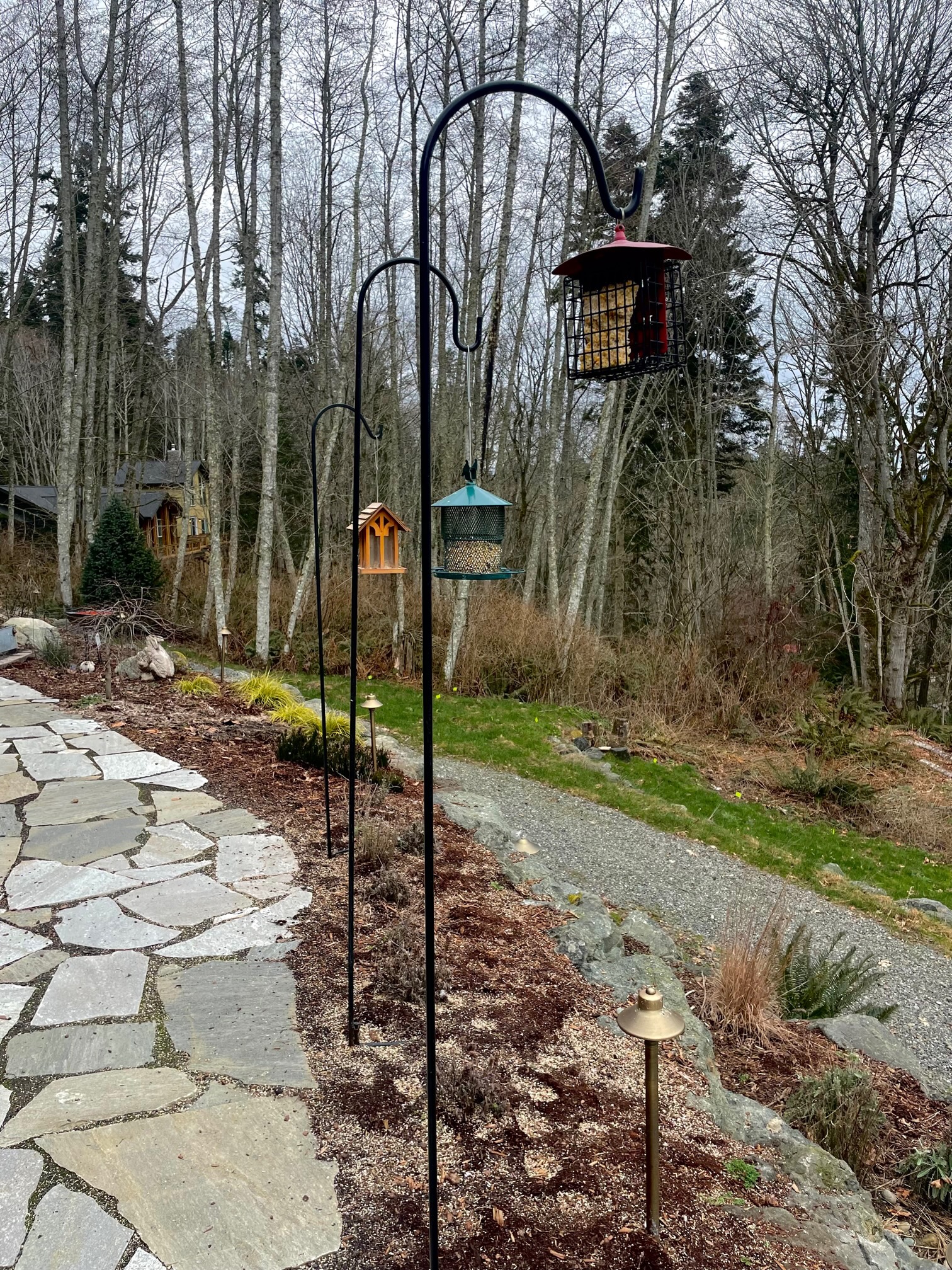
Al’s bird feeders, Port Ludlow, Washington / Photo: Jan Haag
Posted in Uncategorized | 1 Comment

Snot

(If you are oogied out by mention of bodily fluids, you might
want to skip this one! I quite understand…)

•••

Naturally, I employ Dr. Google’s expertise:

Snot, or nasal mucus, is a helpful bodily product.
Your nose and throat are lined with glands that produce
1 to 2 quarts of mucus every day. You swallow that
mucus all day long without knowing it.

Yeah, OK, so why this overproduction, this
turn-on-the-endless-waterworks already?

Increased snot production is one way your body
responds to colds and allergies. [and the Big Bad Bug]
That’s because mucus can act as both a defense
against infection and a means of ridding the body
of what is causing inflammation in the first place.

Yeah, OK, but if I swallow it daily without a problem…

Normally, mucus is very thin and watery.
When the mucous membranes become inflamed,
however, mucus can thicken. Then it becomes
the runny-nose snot that is such a nuisance.

You said it, Dr. Google! And then the scratchy throat
flashes its green light self to the fat snot, both
conspiring to keep me coughing, despite lozenges
and honey throat-coat and hot tea. Water.
And lots of Vitamin C. (C’mon, immunes!)

Bright spot: It’s washing the oogie germs outta me,
which I need to keep from my kind host. Thus,
isolation—don’t walk around spewing snot, Janis.

So what do you recommend? I ask Dr. Google.

Gentle nose blowing (in addition to what I’m
already doing). Vigorous nose blowing
can actually send some of your mucus
back into your sinuses.

Sigh.

And, from deep inside my mucus-y head
or perhaps my reliable heart:

This, too, will pass, my friend.
EGBOK.*

•••

*EGBOK: an acronym favored by my Grandma Keeley: “Everything’s gonna be OK.”

•••

Posted in Uncategorized | Leave a comment

Lent 2024

So on the third day of Lent I’ve got COVID,
it turns out, the day after a day of travel
when so many strangers came to my aid
as I made my way on public transportation
in a city not my own.

I think of them, because—forgive me—
I shunned the mask I’d worn on the plane
as I walked Seattle’s drizzled streets,
shedding and spreading germs I didn’t
yet know I had, turning my prayers
into protective pleas for all those I have
inadvertently infected:

Dear gods of fortification,

Shield the young masked man I sat next to
on light rail from the germs that have
made me feverish, not to mention
kind strangers like Ann who led me up
the escalator out of light rail darkness,
then two blocks down the steep hill,
as well as the young woman who
sheltered me with her umbrella as,
my hands full, we walked another block
toward the ferry and my trip across
the sound.

Most of all, safeguard Terri,
my friend whom I’ve come to support
as she works on her memoir—we two who
live two states apart—the protective
mask of Zoom usually between us.

Now I rest in her downstairs bedroom
as I repent and regret by a window
that looks out on a most glorious day,
the serene water stretching its blue
heart across the canal.

I watch a small boat in the distance
head south, sending perfectly spaced,
accordion-pleat waves toward this
placid shore that I occupy for a time—
giving up a bit of health, sequestering
for part of this Lenten season,

coming as I am—as we all are,
healing, trusting, breathing—
into a perfectly imperfect
moment.

Sick room with a view, looking out on the Hood Canal near Port Ludlow, Washington / Jan Haag
Posted in Uncategorized | 1 Comment

Suquamish

•••
(On the 2:05 p.m. ferry from Seattle to Bainbridge Island)
•••

(for Georgann)

I don’t remember the names of all the ferries
we rode across the water from your island
to the mainland.

And I don’t think I ever got out of the car
to walk up to the passenger deck. On our
last trip

you slept in the passenger seat as I drove,
trying to figure out how to get you
to the cancer center.

You insisted that you knew the way—
you’d been there a hundred times
or more over the years—

but by then your mind was, by your
own admission, not what it had been,
and I decided that

whether you or Siri were navigating,
it would take higher powers to get us
where we were going.

And today on a ferry called Suquamish
I sit inside on the passenger deck, having
gotten here via plane and light rail,

and you will not be on your island
to greet me—though another friend
will. I had no idea

how to get where I was going today,
but all along the way, angels disguised
as people in rainboots,

carrying umbrellas and kindness,
stopped to ask if I needed help. I said
yes to every one

and asked a few others you’d strewn
on my path like breadcrumbs leading home,
which this place will always be

for you, though you morphed into mystery
not long after our last ferry ride together.
We did get lost that day,

but it didn’t matter. We got where we
needed to go eventually, even if we
arrived late

for your appointment, so many good
souls there happy to see you—
me chief among them.

The Suquamish are known as the “people of the clear salt water” in the Southern Coast Salish Lushootseed language.
Riding the Suquamish ferry from Seattle to Bainbridge Island after plane and light rail trips.
The Suquamish car deck and passenger deck / Photos: Jan Haag
Posted in Uncategorized | 2 Comments

And breathe

You’d think it’d be simple,
to allow the stomach to swell,
feel the balloons of your lungs to fill,
your chest to rise like one of those balloons
lifting skyward

—and breathe.

But you find that as you try to inhale,
the vines you once thought so sweet,
decorated with little valentine-shaped leaves,
have Godzilla’d their way around the
sacs that frame your heart,

and by golly, inflation feels nearly impossible.
Of course, it’s possible. You’re still here,
drawing breath, even if they’re short, shallow
ones, and you can’t for the life of you think
why this should be so.

And then you notice your full eyes, your damp
cheeks, your nose that, while dripping, feels
packed with cotton, and you think,
Oh, yes, that’s why.

When emotion emerges from you as bodily fluids,
you have to remind your lungs, Inhale. Exhale.
You know how to do this. Again. Inhale. Exhale.

Feel the vines loosen. Hand your fluttering heart
a large drumstick, the kind with an amply
padded end.

Say, beat.
Again. Again.

And breathe. And beat. Breathe and beat.
Until you can rise, teary and spent,
and remind your lower limbs:
one foot, then the other foot.
One foot, other foot.

And there you go, off into the next thing
in the next place, you and your lovely lungs,
taking in oxygen, putting out CO2, you and
your always-beating heart powering
your powerhouse brain, those arms
and legs and feet—

the breathing and beating you,
so very much a part of this thrumming
and humming world.

Photo / Max van den Oetelaar / Unsplash
Posted in Uncategorized | Leave a comment

Comet of love

Love’s arrow pierces,
not always in the romantic sense,

but always square in the heart,
injecting sweet venom that,

if we are lucky, fills our veins,
infecting us with so much

affection for this one and that one
and that one, our dearest who

split us open, spilling oodles of
tender love crumbs, like

the ones pouring from me now
for you and you and you,

beloveds with equally adoring
hearts who send it right back,

one continuous comet of love
trailing across the universe,

circling through our bloodstreams
now and always,

amene.

Love’s arrow / Photo: Jan Haag
Posted in Uncategorized | Leave a comment

What we need is here

And we pray, not
for new earth or heaven, but to be
quiet in heart, and in eye
clear. What we need is here.

—Wendell Berry, from “The Wild Geese”

•••

(for Dickie on his 81st birthday)

Even on the coldest days, when our feet,
no matter how well socked or booted,
never quite get warm,

we find what is needed close at hand—
another hand to warm our own,
a steaming cup of dreams,

books and food, perhaps a whiskered
friend to settle on a blanket spread
across your lap and mine,

passed down through generations,
perhaps a bit frayed on the edges—
like us—but still capable of coziness,

every loosening stitch a wee bit
of love sewn into the very fabric
of ourselves, right here.

Jan and Dick, Kauai, December 2023 / Photo: Debra Michioka Thompson
Posted in Uncategorized | 2 Comments

Sehnsucht

(noun: German (zane-zookt) yearning; wistful longing)

We hear it in friends’ voices in the coldest places,
in regions where they’ll be lucky to see spring

by May, that wistful longing for something
not icy and cold, or even just wet and cold.

Done with the flannel gray skies, the frost
crystallizing outside glass, the having to chip

ice out of the birdbath so they can drink, the
daily refilling of feeders for the feathered.

We do this—yearn for what isn’t, for what was—
this humanness of hankering so tugging at us

that we walk by the window and miss—look!—
droplets stretching into delicate-bulbed icicles,

the doily-like flakes decorating leaves,
starlings squabbling, their dark bodies speckled

like snowfall in these just-hanging-on months,
hungering in more ways than one for

the sustenance to come.

•••

Inspired by this video, “Winter” by Jamie Scott

•••

Squabbling starlings / Photo: Roy Rimmer, UK
Posted in Uncategorized | 1 Comment

Aerogrammes

“Her words, written to bridge the gap between us, cut through space and time.”
— Genevieve Kingston, “She Put Her Unspent Love in a Cardboard Box” (The New York Times)


(for Georgann)

I have her letters scrawled in her
never-warm flat in Swansea, penned
at the kitchen table near the small box
on the wall that gobbled pence like
peanuts, then spit out meager heat.

But she loved Wales, cherished her time
as an older student attending university,
her barely teen daughter at the local school
down the lane, uniformed and learning
Welsh, the California kid coming home
one day to proclaim, Nigel fancies me.

The onion-skin-thin light blue page
that still folds into itself unfolds
her before me, and I strain to read her
scrawl. Once, I didn’t have to. Her
words leapt off the page like sweet
fleas, attaching themselves to my
person, never to let go.

If you write to me, I’ll be your best friend.

It’s her handwriting on the blue
aerogrammes that brings tears,
along with that of other companion
spirits—their fingerprints, long gone,
infuse the paper, their words
nip my flesh in all the best ways.

Posted in Uncategorized | Leave a comment

What we make out of language

Letter by letter, we assemble building blocks
that tower, that align, that make our lips
purse with sound, that we spit out as words

linked like train cars, coupling and un-,
rearranging into sentences, paragraphs,
pages that, written down or spoken,

become language. Yours might be quite
different than mine, but words make meaning
of the world—your vocabulary landing

like music on my foreign ear, your gestures
visual expressions of sounds, phrases, names,
chugging past me. Never mind—somehow

I can read the grammar of your eyes, hear
the poetry in your voice. Let us find our
lingua franca, our common tongue,

and meet in a place of understanding,
this spot right here, as we stand together
on this common ground, my hand

clasping yours, the definition of shared
humanity. Then, in your own words,
tell me a story.

Photo / kalevkevad
Posted in Uncategorized | Leave a comment