(for Sue Butler and Antsy McClain, with love and thanks)
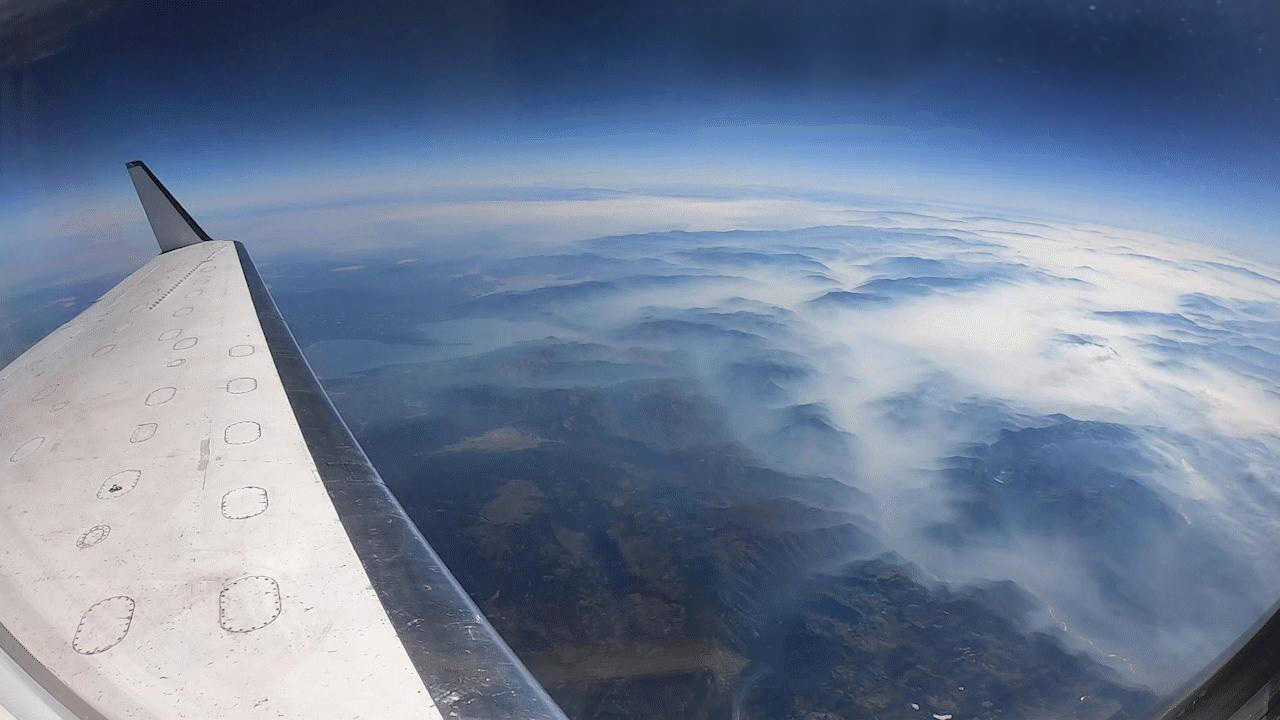
The light that gets lost is blue at the edges, the kind that, if you could soar high enough,
you might see hugging the curvature of the Earth like a soft baby blanket, wrapping this blue marble in light that does not touch you, cannot touch you, but holds you, nonetheless,
not as gravity pins you, but much more gently, the blue embrace of something you can’t name, that feels like being found, like coming home, a twinkling blue under a star-filled sky.
I practiced it multiple times a day from March on, after Mr. Rolicheck, my eighth grade homeroom teacher, commanded that I sing a solo at graduation.
How did he know that I could sing? He knew that I loved to write, returned story after story with the directive at the top: Again!
Usually with suggestions— “Let’s hear them talk to each other.” “Let’s see them moving around.” “Locate them in a place with just a few details.”
And I’d dutifully scribble a new version, hoping to earn my first editor’s approval, the one who told me, when I summoned the nerve to ask why I had to do so many rewrites,
“Because you, Miss Haag, have potential.”
I inhaled the deep voice on that talltall man that pingponged inside my chest, eventually finding permanent lodging somewhere south of my heart, where belief took up residence.
But sing? My parents were singers who harmonized at the drop of a middle C, barbershoppers that they were, who taught my sister and me the lead and tenor parts to their baritone and bass should someone feel the need to sing a tag around the dinner table.
I wanted to sing folk songs or pop tunes, envied Karen Carpenter’s dulcet voice, and so chose one of the hardest songs in her repertoire to wobble out of my larynx.
Who was the accompanist who fingered the school’s upright piano as I rehearsed after school? As Mr. Rolicheck and my mom listened. “Getting better, Miss Haag,” he’d say. “A little flat there, Janis,” she’d say. “But you hit the high note.”
And when the fateful evening arrived, my classmates and their parents crammed into the tepid multi-purpose room, me in my polyester yellow mini dress minus the clumsy headgear that typically attached to my braces (thank you, Mom). Equal parts terrified and exhilarated, I stood before my first microphone and shakily sang,
Bless the beasts and the children, For in this world they have no voice, They have no choice.
I fixed my gaze over the seated heads, looking at the tall man with the shaved head standing at the back of the room, his eyes closed, fingers of one hand at his chin listening to his pupil with potential.
Light their way When the darkness surrounds them; Give them love, let it shine all around them.
And when I finished, he opened his eyes, smiled and brought his big hands together in a clap that caromed around my chest, in that heart spot where it resides still.
•••
(In memory of Robert Rolicheck, mentor extraordinaire)
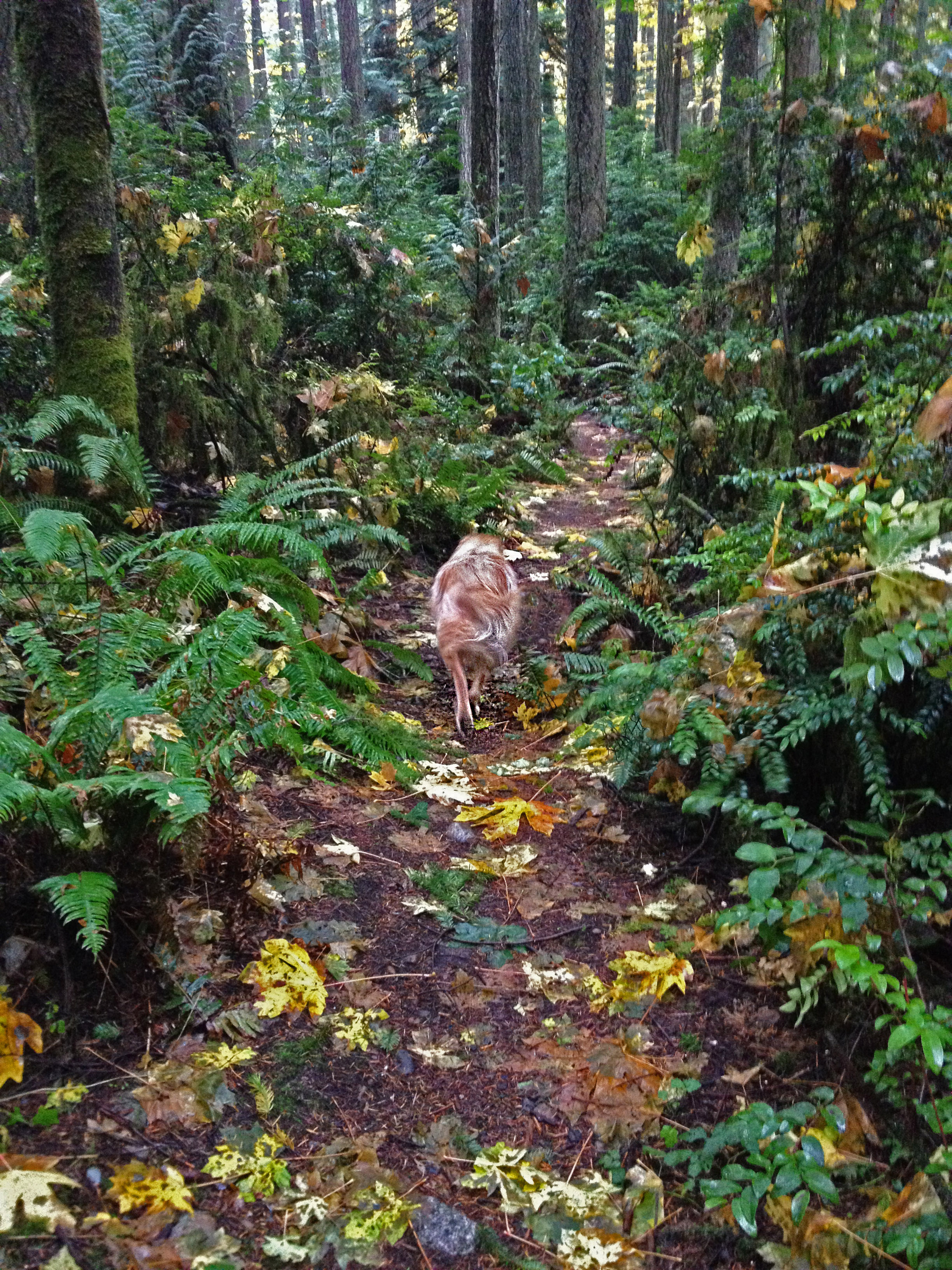
He sees the path in the wall of green before I do, veers onto it, and at the other end of the leash, I say: She takes you here, doesn’t she?
Or perhaps it’s the other way around as I follow the shaggy wag of the aging blond boy whose paws have already picked up detritus of the woods, the leavings of seasons underfoot, foliage that has let go and drifted groundward as it does every day in the grand forest.
In a few hours little ghouls and superheroes will take over this island, making their rounds, knocking on doors, but here, now, the only costumed one is me, the visitor from a dry land masquerading as one of the rain people in a plum coat.
Mushrooms display their jaunty caps, frilly mosses wear their everyday frocks, brightening the wet wood they cling to. Though some trees still sport dulled yellows and crimsons, I inhale green with every step.
I wish she was walking with us, though her big dog does a fine job showing me the way. Today is a down day after yesterday’s up day. This is how it goes.
For every up there is a down. After preparing a place for me, fetching me home to her island, she sleeps in her bed plump with pillows under the soft duvet, the small gray cat at her feet, the window opened just enough to let in the green and the patter of rain— her favorite sound in all the world.
She continues to teach me patience, about resting when the body can’t continue, about bearing illness with grace, about love in the form of a big blond dog on the floor by her bed, his feet clean and dry, sound asleep, waiting for whatever comes next.
Walking in the Grand Forest, Bainbridge Island, Washington / 2014
It turns out that wildebeests are gnus, and gnus are wildebeests,
great, hairy African antelopes resembling muscular cows with curved horns, but wearing bushy beards and manes accenting their charcoal-striped outfits that collectively makes a wildebeest a gnu. And vice versa.
That improbable combination of body parts prompted a wordsmithing actor* to coin a new collective noun, making news of a group of gnus—
an implausibility of gnus.
Before that, they traveled simply as herds, but now the largest of all antelopes carries a clever appellation for these wandering vegetarians of the Serengeti.
More than a million of them join hundreds of thousands of other ungulates in the planet’s largest migration from plains to savannah.
Look at them go: the zebras, the gazelles, the wildebeests. And look at what stalks them: hyenas, lions, crocodiles.
Not all of them will make it.
So much wildlife on the move that the great columns of gnus can be seen from space, a stream of migrants compelled to make their way over the sea of desert on a well-traveled route from one territory to, with luck, a place where the convoy can land—
in a stomping ground that feels something like home.
•••
* The wordsmithing actor/television writer/author who coined the collective noun “an implausibility of gnus” was James Lipton in his delightful book, “An Exaltation of Larks.” It contains more than a thousand collective nouns, some of which Lipton invented. Lipton was perhaps best known as the dean emeritus of the Actors Studio Drama School at Pace University in New York, and the creator and host of the television series, “Inside the Actors Studio.” He died in 2020 at age 93.
Once a dozen oaks lived on this third of an acre. Only four survive, the others watered to death in favor of grass for little girls to play on.
My parents had no idea that they were killing the great valley oaks —quercus lobata—including my favorite, a trunk that angled out of the ground at a perfect tree-climbing angle.
But one by one they collapsed, a limb here or there, till their massive structures gave way, collapsing in a gargantuan whoosh, much as whales fall to the ocean floor when it’s their time.
I cried for each one.
Still, four quercus wislizeni, craggy and stubby interior live oaks, rise in places the sprinklers never reached— the trees’ barbed leaves near the bottom to discourage deer and other nibblers morphing into smoother versions near the top. They live, these stubborn ones, a bit defiantly, hearty survivors found only in our native state.
Watering a parched lilac nearby, I stand shaded beneath one venerable elder, admiring the live oak’s thick leaves that help it retain moisture, so elusive and precious in this overheated summer.
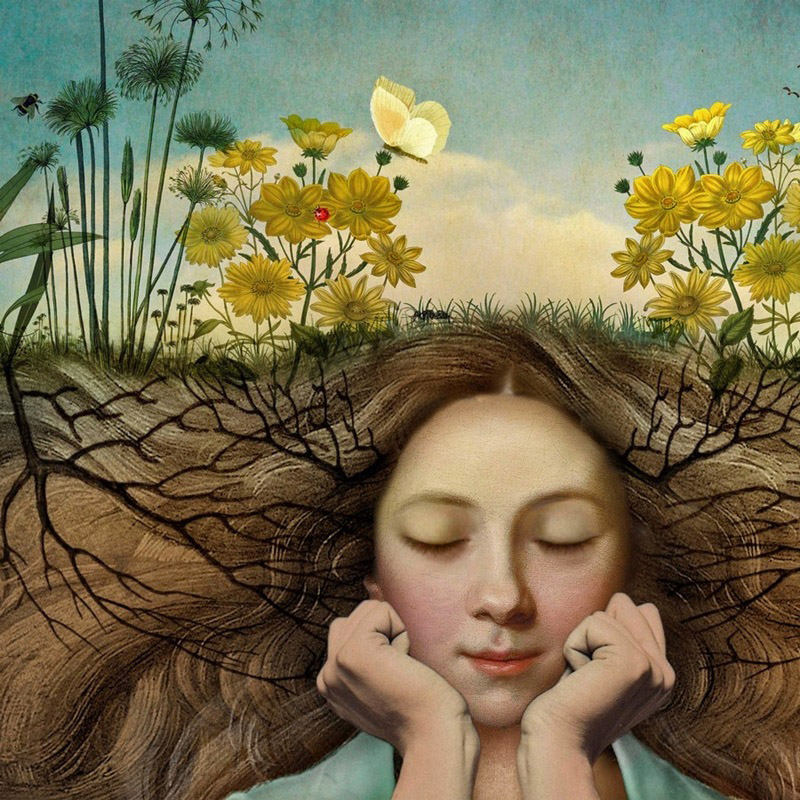
If you walk with me around the place that my family has tended for nearly six decades, I can show you where every one of their brethren stood, the long roots still sunk dozens of feet into the granite-y earth, anchoring us all to this very spot.
Interior live oak, a California native / Photo: randomtruth, flickr.com