I was hoping that the 26-second video that goes with today’s poem, “Water in conversation with other water,” would appear at the bottom of the email you received with the poem. Apparently it did not.
To see the video at the bottom of the poem on my website, you can click here. Or you can look at the previous email and click on the title of the poem, “Water in conversation with other water” or the GüdWrtr logo at the top. Either will take you to the website where you can read the poem and see the video underneath the poem.
Thank you for being a subscriber to GüdWrtr. I appreciate you!
Because stories are spells; they change things. When they hook us and reel us into their magic, they change us. It’s stories that will save us, in the end. Not just the stories we read or tell, or the stories we want to be in, but the ones that live inside us and the ones we live inside.
— Sharon Blackie, Hagitude
•••
You ask what I do in the comfy chair, laptop in lap, for so long, deep into tonight-becomes-early-tomorrow.
In the dark they arrive without distraction, the ones who people this story written in fits and starts
for more than a decade, who’ve never really left my mind, who seem as deeply embedded
in my soul as any dead loved one, though these beings have never breathed, except in my imagination
where I see them walking, hear them talking like old friends. This is a novel still trying to be born,
and I’m in the last trimester, the ready-to-push stage, putting the finishing touches on their lives,
revising for the third time, which feels like doing math (and I don’t math), checking
ages and hair colors and details on a wonky timeline back and forth from the 1950s to the 1970s.
And when they are delivered unto the world, they’ll no longer belong to me, as any
parent can tell you. With luck, they’ll make friends who’ll read about them, decide how to
feel about them, and some of those people will tell me how they feel about these fictional
characters, who, with luck, will become real to others, not just me.
•••
(for Caro and El and Lil and Ma and all those in “Three Sisters Antiques,” whom I thank for coming)
Jan Haag revising “Three Sisters Antiques” at The Sea Ranch, Sonoma County, California / Photo: Dick Schmidt
I start the day in my hometown circling a labyrinth as eight seekers wind around its twists and turns as the sun climbs and warms us.
I end the day by the sea at low tide, so low that rocks I’ve rarely seen here lollygag above the waves like lazy seals, winter storms having swept away dump trucks’ worth of sand, tossing huge logs like matchsticks dropped from heaven at the high water mark.
And in between you discover, curled in the bathroom sink in the little casa by the sea, an expired mouse so tiny it looks embryonic.
I’ll take care of it, you say, knowing that I don’t like to dispose of dead rodentia.
How? I ask.
Aerial burial, you say, as though you’ve given this some thought or done so before.
And I follow you—little dead thing in a paper towel in your hand—as you head outside to the deck where a vast meadow gleams golden in late afternoon light.
You windmill your pitching arm backward and, at twelve o’clock, catapult what was into the hereafter.
We have no idea where it has gone. Which seems about right—like this sweet day, like this tiny life, like the sand taken back into the heart of the sea.
Dick Schmidt performing the aerial burial, The Sea Ranch, California / Photo: Jan Haag
noun: 1. The condition or quality of being complete or whole.
•••
On my knees on the soft garden mat, bare hands telescoping into cold earth— because it’s spring, allegedly—
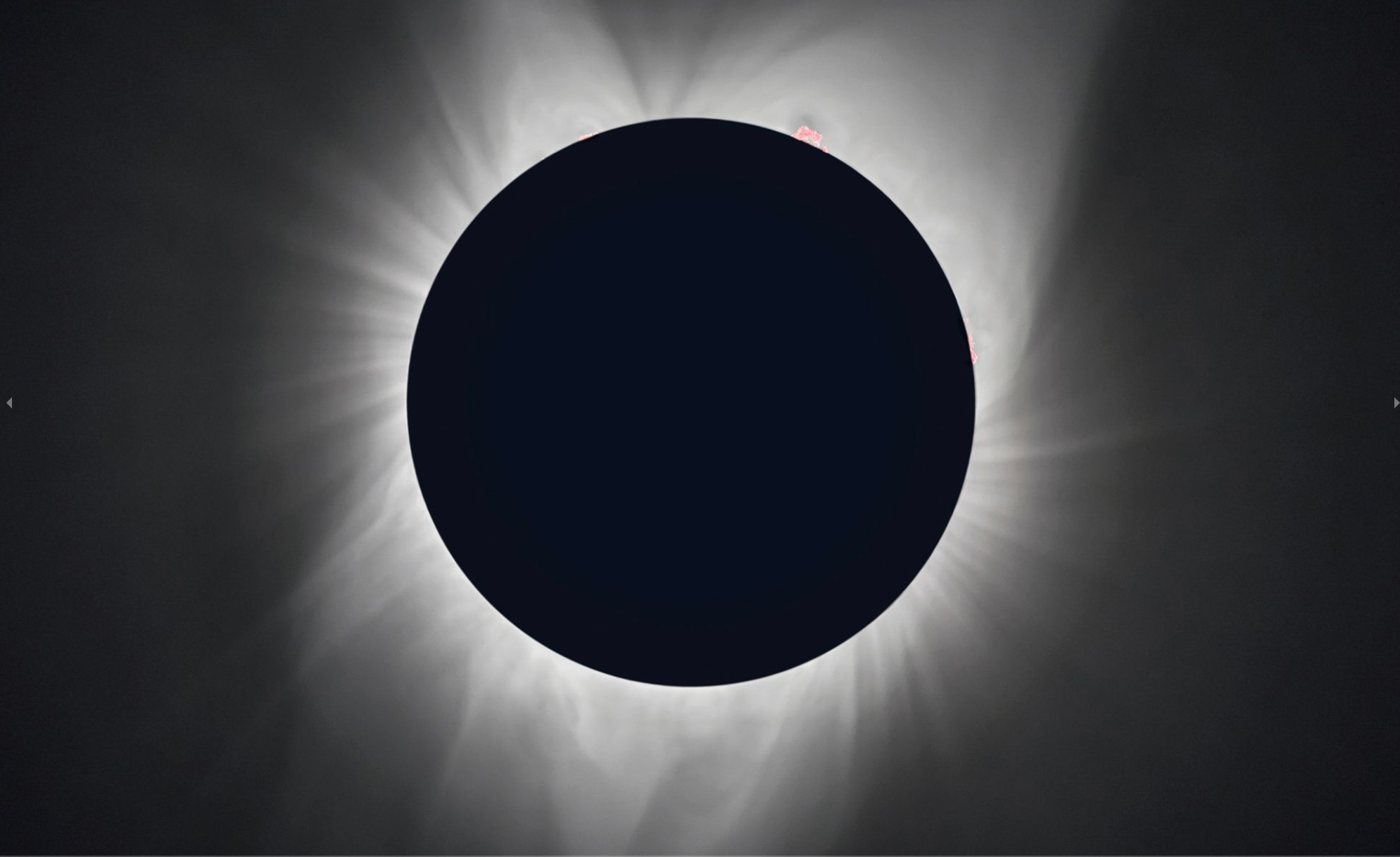
I think about the total solar eclipse that I will not see, far as I am from the path of totality. What a wondrous coincidence,
I read, that a 2,100-mile-wide ball of rock 240,000 miles away appears to cover an 870,000-mile-wide ball of gas
over 90 million miles away. If the sun were a bit bigger or closer, or if the moon were a bit smaller or farther,
totality would not occur. Up to my knuckles in freshly turned soil, it strikes me that I’m as
complete and whole—a humble bit of terrestrial humanity—as I’ll ever be, whether or not I stand in awe
and watch the heavens as an obscuring rocky body briefly blocks the ball of gas that
is our nearest star, haloing the shadow of moon, then moving on in its reliable
trajectory—looking up, as we earthlings love to do, at what we think of as sky.
•••
Quotation in italics and statistics from an opinion piece in the Washington Post by Sabine Stanley, professor of earth science at Johns Hopkins University and author of “What’s Hidden Inside Planets?”
Solar eclipse, Mitchell, Oregon—Aug. 21, 2017 / Photo courtesy of Randall Benton
Spring is the cruelest time to die, I used to think— just as winter rolls up its gray quilt and lifts off,
as the skeletons of trees hold the hope of green, some even budding into early pink laughter under warm sun.
The departed miss all this— the earth unfurling her best self just when we need to see it.
Stepping outside this morning to see over the driveway the tiniest bits of purple cascade off the trellis reminds me that spring arrives on time for those left behind,
those who look up, who notice color again where only yesterday there was none.