
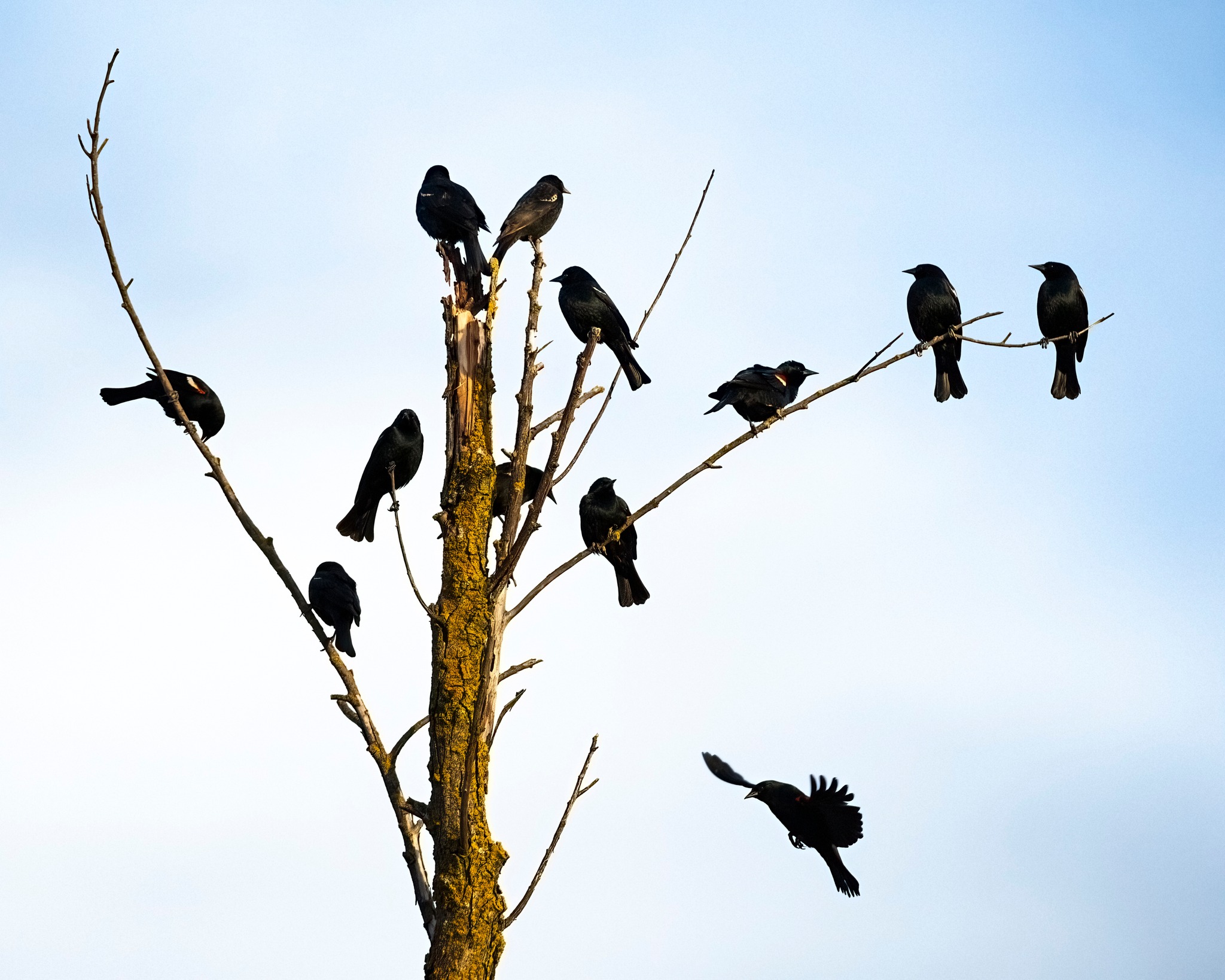
1. Yes, they have red on their wings, but they are not red-winged blackbirds.
2. Only breeding males look this glossy, this fancy, all spiffed up for the ladies.
3. They may sing in the dead of night, but they don’t have the same lovely voices as their red-winged cousins.
4. They’re found in marshes and adjacent fields.
5. Once they bred in immense colonies in natural freshwater wetlands of California’s Central Valley.
6. In the 19th century flocks could consist of hundreds of thousands of tricolored blackbirds.
7. Their numbers—like the birds themselves diving for insects—have plummeted.
8. Since then the population has declined from several million to fewer than 200,000.
9. Because so much of their marshy habitat has been lost, they are endangered.
10. Because they now often nest in fields where grain is grown, harvesting can destroy tens of thousands of nests.
11. But hope is the thing with feathers, after all, and birdfolk report seeing tricolored blackbirds flying in weed-filled fields set aside by farmers.
12. Take these broken wings and learn to fly.
13. All your life, you were only waiting for this moment to arise.
•••
Thanks to Sir Paul McCartney for the best blackbird poem/song ever.
You can see a one-minute video of a recovering tricolored blackbird colony in a weed-filled Central Valley field here.
And you can learn more about Merced farmers working to enhance the tricolored blackbirds’ habitat featured in “Dairy Cares: Protecting California’s Tricolored Blackbird.”


 Güd wrtr
Thanks Jan! My brother-in-law, Steve Simmons would be pleased you wrote about the Tri-coloreds! As you know, Steve banded thousands of birds in the Central Valley, including Tri-colored Black Birds in order to track and identify birds. Because the black birds don’t build nests in boxes, he build special cages to safely trap the birds, band them and release them back in the wild. I watched your video but the birds were too far away to see any bands. However, the next video “Dairy Cares: Protecting the Tri-Colored Black Birds” shows a bird 0:12 seconds into the video, sporting a band – leg bling! It is very possible that band was given by Steve. Good for those dairy farmers to help out and good for you to raise the black bird’s song!
Love,~Connie
Thanks for sharing this, Connie! I certainly recall Dr. Steve as The Great Bird Bander. I’m glad to know about the Merced farmers (Dr. Steve’s home territory!) working to enhance the tricolored blackbirds’ habitat featured in “Dairy Cares: Protecting California’s Tricolored Blackbird.” Folks can see that here: