
The tree is saying things, in words before words.
It says: Sun and water are questions endlessly worth answering.
It says: A good answer must be reinvented many times, from scratch.
It says: There are more ways to branch than any cedar pencil will ever find.
It says: Listen. There’s something you need to hear.
—from Richard Powers’ “The Overstory” © 2018, W.W. Norton & Company,
winner of the 2019 Pulitzer Prize in Fiction
•••
Trees, connected underground
by vast webs like rooted corpuscles,
move information through their
slender, entangled threads,
Earth’s natural microfibers, feeding
each other, communicating.
Listen, they wordlessly telegraph
to those listening. There’s something
you need to hear.
They want to remind us of our
common source, humans and trees,
like oaks whose roots entwine
below ground, loving arms giving
and receiving in equal measure.
When a tree knows it’s about to die,
it disperses its essence, its energy
through its mycelia—fungal cells
interacting with root cells, feeding
the soil, silently decomposing plant
material, turning it into carbon
dioxide—to share with other trees.
The tree is saying things, in words before words.
It is saying, Take what I have,
this sun, this water, eternal questions
that you above-grounders hold, too,
for we are the same being, reinventing
ourself again and again, starting over.
We learn; we remember; we share.
The tree recites an ode:
We absorb your presence;
after each footfall crosses our surface,
we leap up in a merry dance,
our micro-movements ingesting
what you leave behind.
The tree’s soundtrack echoes,
the voice of a thriving collective:
We are one. Remember.
We are one.
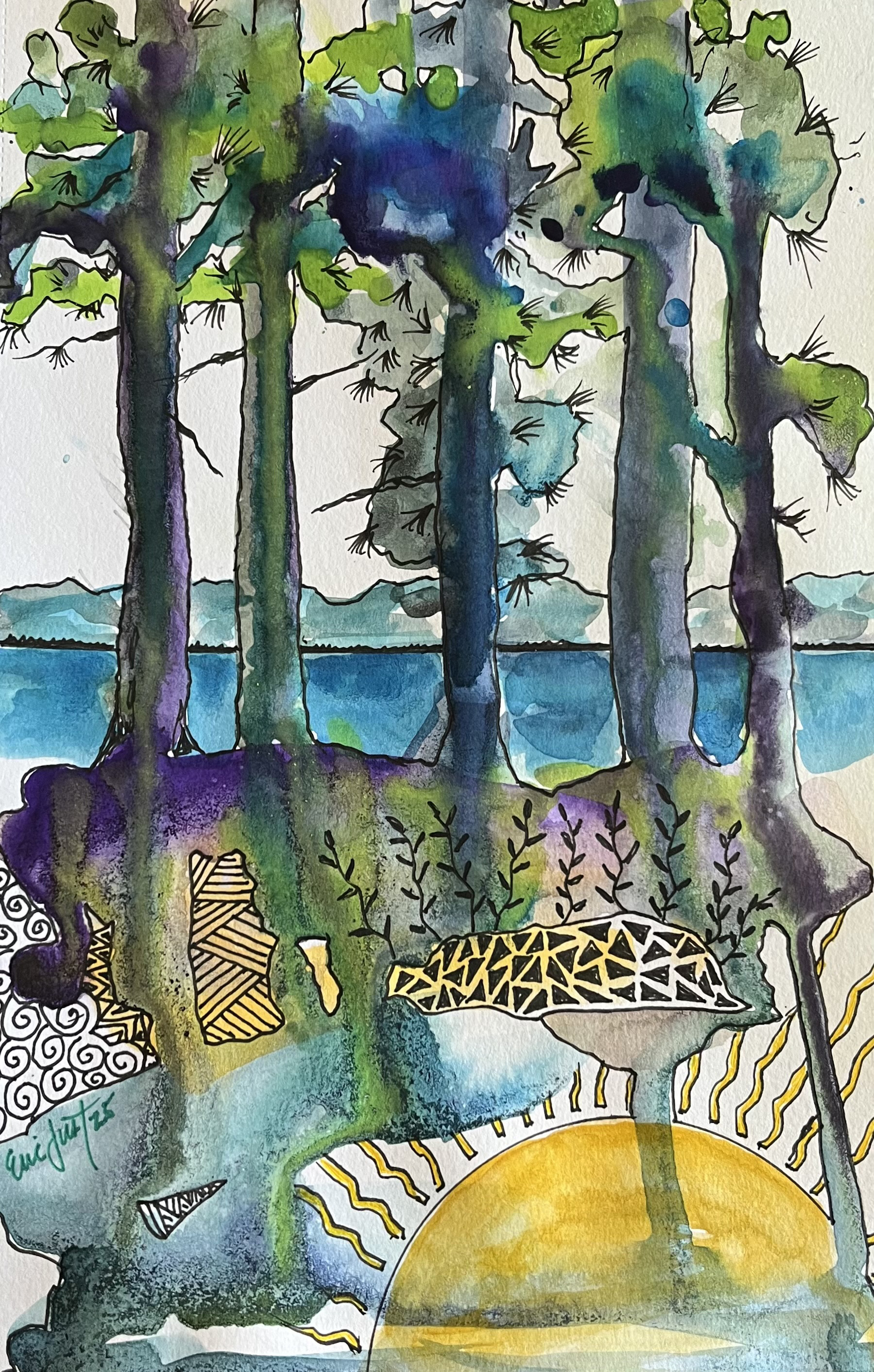


 Güd wrtr
Seventy five years ago, my grandmother planted two eight-year-old Douglas fir trees, each about four feet tall with narrow, spindly trunks and sparse foliage, at opposite corners of her quarter-acre yard. She said they were her nurse trees for her future orchard and the ancient pine forest all around the property. It was a struggle for them to survive because of the dry climate on the east side of the Cascades, but eventually they persevered and took off growing, putting out dense evergreen boughs and papery cones.
Today, we own that yard and the house and land that went with it, and my grandmother’s orchard, which contains pear, apple, plum, and American chestnut trees, still thrives and delivers us more fruit every harvest season than we could ever eat. We have come to understand how correct she was to plant the fir trees (which are actually not a true fir, but a kind of false hemlock) because the orchard and nearby enormous Ponderosa pines and Oregon white oak have gone through some tough times with insect attacks and drought, withering and coming close to death, but at each dire event, without anyone lifting a finger, they have come through and not just survived, but thrived, while trees in other forests and orchards around us perished.
Those Douglas fir now stand 115 feet tall with trunks that are 95 inches in circumference–to big for three people to reach around. They sport canopy drip lines that extend out 70 feet in every direction, delighting us every time we look out our windows at them as we watch the antics of the many birds and climbing critters that inhabit them–or the pleasure we get when we luxuriate in their dense shade in summer.
My grandmother already knew three quarters of a century ago what science has only recently discovered.