
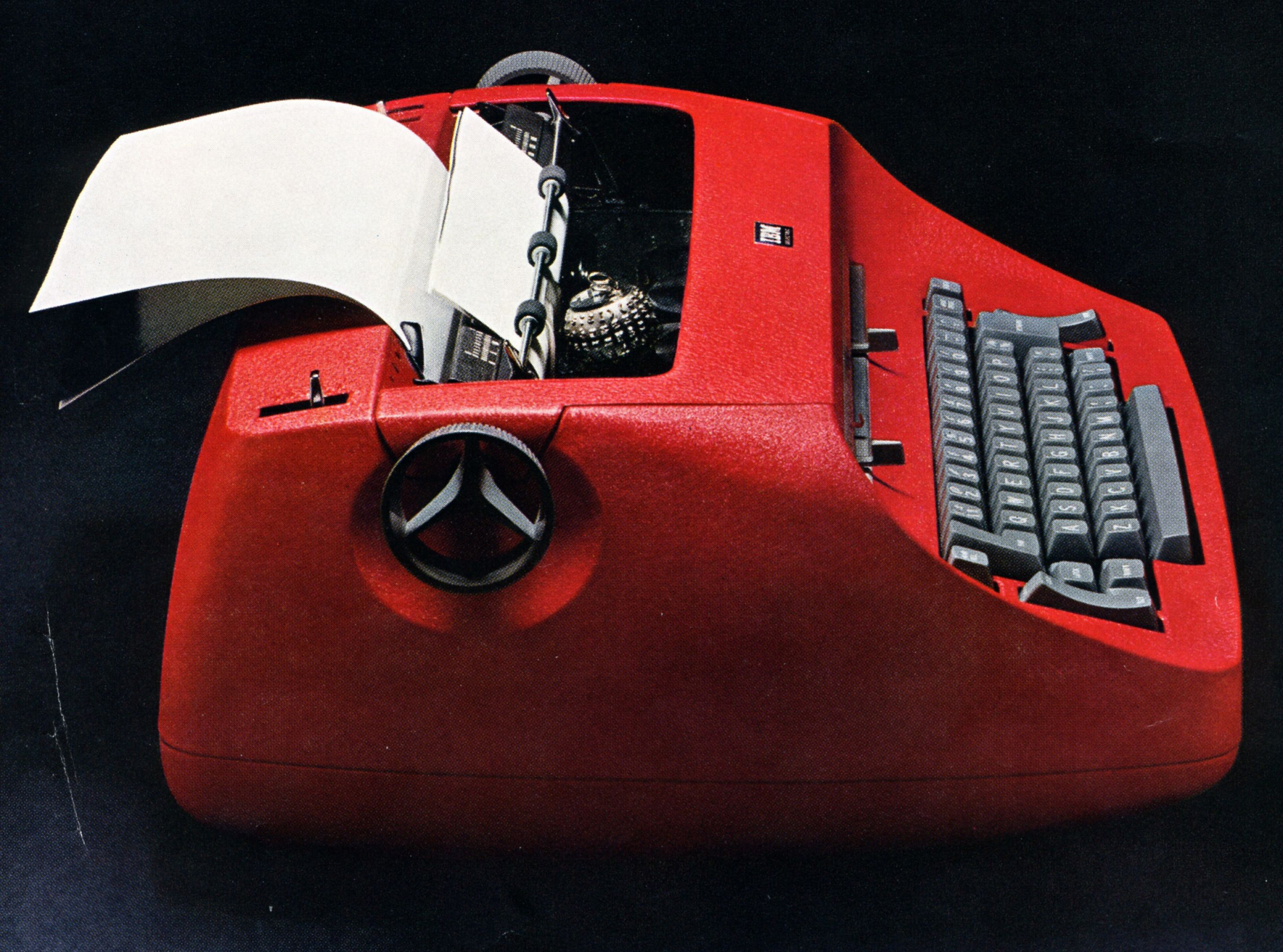
As I type with my eyes closed, as I often do, I think of my favorite high school teacher who made me type and retype student reporters’ stories onto clean, half sheets of newsprint. In the mid-1970s I was the editor of the high school newspaper, and the bonus of doing all that typing was that I got to do it on the first IBM Selectric I ever touched, the first typewriter I fell in love with, which lived in Mrs. C’s small office.
“If you can type clean copy with your eyes closed, you’re a pretty good typist,” said Mrs. C.
Over the years I worked hard to become that pretty good typist, my fingers growing stronger as they took me to other typewriters—from my mother’s small Smith-Corona portable to the gray elephants of Underwoods in their hard plastic skeletons at the college newspaper to the keyboard of my first Macintosh computer and many that followed.
But I never lost my affection for the Selectric, which, even without a correcting ribbon, was the smoothest typewriter ever made. (I still occasionally type on a 1960s red Selectric that lives with me.) I was never as fast on it as Mrs. C., though, or, I imagine, nearly as accurate.
After she was handed the responsibility for the yearbook and newspaper at a new high school in 1966, Mrs. C. sought guidance from editors at the local newspaper in our town. She’d been an English major and told me years later that she had known next to nothing about newspapers. But over the years she turned herself into a truly gifted journalism adviser who gave me and so many others some of our best lessons in reporting.
A couple of months ago, prompted by another one of her former students, I started looking for Mrs. C. a couple of months ago, wondering why, despite sending emails over the years, I had not heard from her.
She and her longtime partner had moved, so that was part of it. But when I recently reached her partner by phone, he told me that Mrs. C. was struggling—as had her mother and a sister—with dementia, though she is still in good health.
He said that Mrs. C. had opened my email and sat before the computer as if she intended to respond. “But she just couldn’t,” he explained. “I think she’s forgotten how to use a computer.”
He offered his help, and she refused it.
That’s when my eyes filled, and the crack in my heart widened a little for all those we lose in one way or another.
I wonder if, somewhere deep inside, her fingers still know their way around a keyboard, even if plaque in her brain is blocking the signals to make them perform.
When I knew her, Mrs. C. seemed at the height of her powers—not only a very clean typist but also a champion writing teacher, editor and encourager. She also advised the yearbook, and my dear friend Lisa, the yearbook editor, and I, editor of the newspaper, came to both cherish and fear Mrs. C’s left-leaning handwriting on copy she returned to us. She tapped my sister (also a leftie) to edit the yearbook two years later, and Donna got similar notes of correction and praise.
Though a serious taskmaster who did not tolerate sloppy writing or laziness, Mrs. C. had a delightful laugh and (years later she told me) loved “most of” her students. Even more important, she served as a springboard for many young people, including me, who bounced into college and later into careers as writers and journalists in print and broadcasting, teachers and professional communicators and much more.
She was not my only excellent writing teacher/adviser/coach, but she was one of the very best who installed important skills at a crucial point in my development as a writer—not least insisting on good typing habits.
My eyes are closed as I type this, remembering that petite, strawberry blonde-haired woman bustling around the small room in a high school in a small Northern California town where so many newspapers and yearbooks were born. I feel her still, leaning over my shoulder, noting a typo or praising a phrase.
My mother, who died in December, and Mrs. C. were two of my first, best editors, both gone now in different ways, both embedded in my writerly editor’s heart that—dear god, please—will carry on their lessons as long as I have breath and brain to do so.


 Güd wrtr
Oh, the IBM Selectrics! The best of typewriters! Although I wouldn’t give up my computer keyboard for anything….
Ditto on the computer keyboard with its ease of correction and, honestly, speed. But as part of the last generation of folks to regularly use typewriters (now they’re artifacts that some young people have embraced for creative purposes), I’m delighted to pay them tribute!
I inherited my IBM Selectric, not from my father whose used his for business and itineraries from the mid60s up until his death in 1998. Instead I bought a used one from the library at the school I taught in in the 1970s – by then it was no longer bright red but had faded to pink, but it got me through many years of typed tests and student report cards. I wish though someone had been there to insist on my really learning to type. Hooray for the Mrs C’s of the world and for the love of excellence she instilled in so many.
Great story, Martha! I love your story about the formerly-red-now-pink Selectric! You’re a two-generation Selectric family… I’m in awe! Keep up your fine work as an AWA facilitator!
Hello, Jan:
As a student of the same high school, I, too, held a profound respect and love for Mrs. C. I’m glad to know she’s still among us in whatever frame of mind. What a gift to the world she is.
One of the things I found most charming about her was that certain types of humor, especially if it were a bit scandalous, escaped her, if only momentarily. Despite all she knew of worldly things, she possessed a naïveté that was refreshing, an innocence that inspired as much as any other aspect of her. I often heard her admonish her newspaper staff to “keep it clean.” I guess I identified with her because I was always slow to get a joke, especially if it was on me. She was a friend and mentor, even though I was never privileged to have her as a teacher. I’ve gone back to her kind, articulate, compact, and inspiring prose in my old yearbooks often.
I’ve recently had the privilege after 52 years of becoming reacquainted with my chemistry and physics teacher from the same high school. We’ve sent dozens of emails back and forth after many months and had a few phone conversations. He was barely older than we were when he started his teaching career, with juniors and seniors as his first class. He remembers every student from that year, and to my surprise, he felt he failed us, that his teaching methods didn’t get through, didn’t inspire. When I reminded him of the many essential principles of science he taught us with his unique approaches–things I still remember and apply today–he was simply amazed. In five decades, no one had ever told him how good he was. I was glad to have remedied that.
I think somehow through the tau protein tangles Mrs. C has heard that message from you and received the love more than you know.
Good on you, Jan.
Thanks, Terry! I think I remember the chemistry/physics teacher you’ve mentioned. Though I was not his student, I knew many, like you, who were and who deeply admired him. So great that you told him how good he was… teachers rarely get that kind of praise, especially from former students who sometimes see that excellence via the rear view mirror of experience.
And I hadn’t thought about Mrs. C’s naïveté, but now that you mention it, I do recall that, too… though I was pretty naïve myself, of course. I’m glad she was your friend and mentor, too!
what a loving tribute! (And great typing)
I had an LOL moment with your note, Joan. Thank you! I’m grateful for the ease of fixing the boo-boos via computer keyboards these days, but I do cherish the typewriters!
And now I understand even more deeply your collection of typewriters! Not only are they a lovely kind of sculpture (and garden ornament!) they’re a connection to this lovely mentor. I’m grateful to have had a chance to read about her!
Thanks, dear Sue! You’re so right—the typewriters are tributes to many, including Mrs. C. who influenced my early writing years… not least the guys who toiled over the Linotypes at that small-town newspaper I mention in this piece. Now THERE were some typists!
What a lovely tribute to your teacher/mentor. I think we all have that one teacher who launched us.
After I got my first job as a secretary, I sent a letter to my high school typing teacher thanking her for being my taskmaster. She wrote back that the letter arrived at the point of the semester when the students were at their lowest — feeling discouraged and ready to give up. She said the letter had given her an opportunity to encourage them to keep trying.
As you know, typing and shorthand are central to all I do and I have Mrs. Winslow to thank for both skills.
What a great story, Gloria! And how wonderful that you thought to send a letter to Mrs. Winslow (which must have been an often thankless job). Of course, it made her day! Thank you for this story!
Very touching memorial for Mrs. C
Thank you so much, Linda!