The light lacy and muted on her last day, the year’s shortest, barely squinting through a heavy curtain of clouds, the impending goodbye looming.
She did not want to go, though her body disagreed— a brittle cocoon of her former self, her breath butterfly faint.
I need to find some light, I said on this day that held so little of it, knowing that every one hereafter would gain a minute of brightness and warmth.
Go, said my sister, she the patient one with the patient who had once been our mother, feather light in the foreign bed in the family room where we had watched Ed Sullivan and the Wonderful World of Disney, in the center of the house that grew us.
I’ll be back soon, I whispered, and my sister nodded.
And, as I had done countless times in my young years, I fled across the street, over the split rail fence, down the path to the lake where we water skied every summer of our childhoods, walking toward the water, so low now it resembled the river it originally was.
Overhead the gulls glided, some settling on the still, dark ribbon of water, the shroud of solstice over us all.
Go, I whispered, looking for more light, which did not come, tilting my head skyward to receive the lightest of drops, which did.
•••
For Donna In memory of our mother, Darlene Haag (July 6, 1931–Dec. 21, 2024)
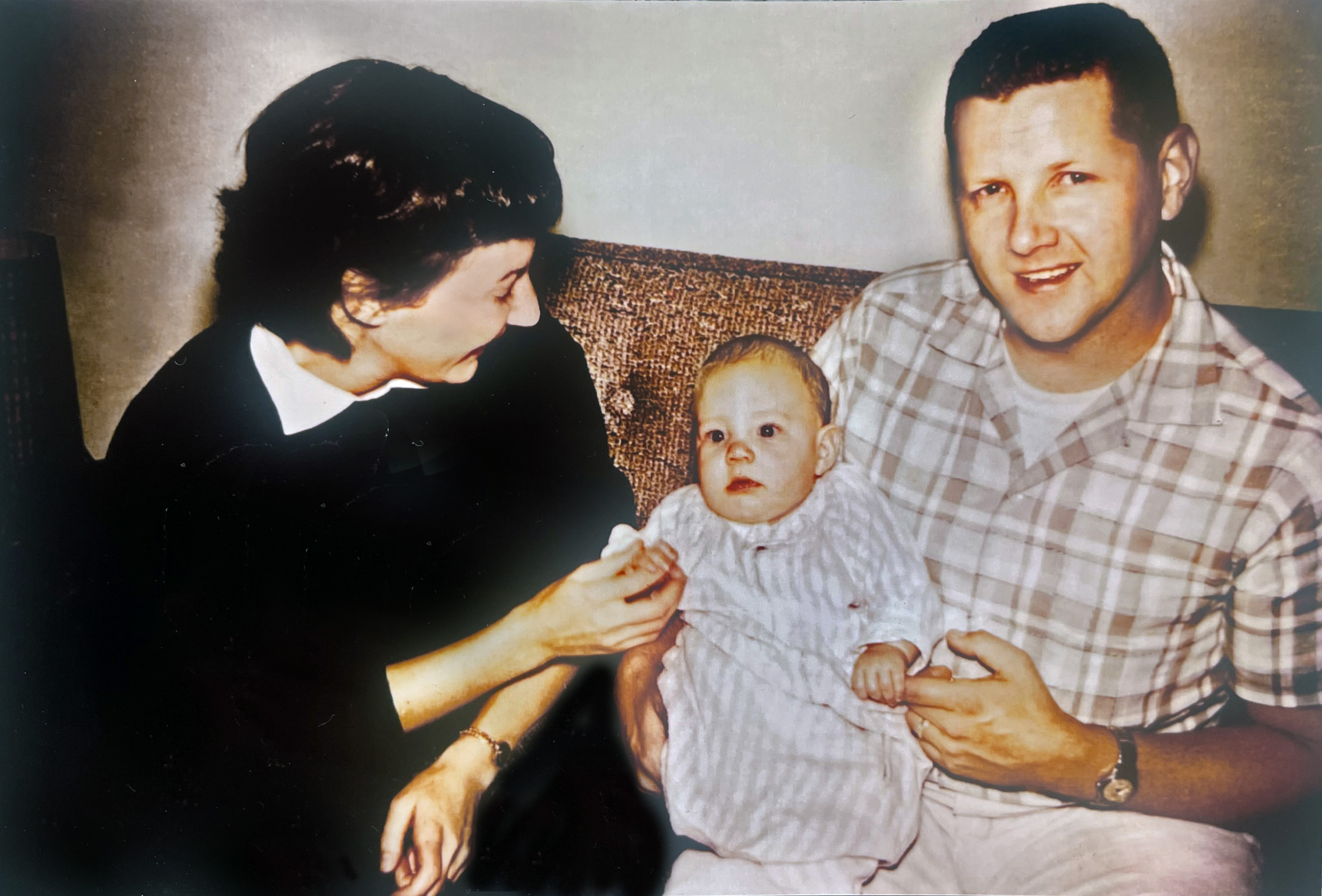
You two look so happy in this photo next to the phone in my kitchen, with a tiny me on Father’s lap, positively delighted by this new person you had made.
Did you coo over me and tickle my toes? Did you play peek-a-boo? Did you swaddle and coddle and sing to me and later my little sister?
The mother we knew was not a coddler. You said that I cried and cried, pained by colic, that I was fussy and difficult to soothe, that Father was better at calming me, holding me close to his chest, perhaps because he was warmer.
How often did you leave us to cry it out alone in the crib? “You can’t pick them up all the time,” you said. “You can’t let the baby be in charge.”
And I see the ghost of my hand hover over the phone, ready to dial the number that was yours for 59 years to ask, “Why not?”
You can’t spoil a baby with too much love. My sister proved that years later with her babies. The task is to help that little one carrying your DNA become comfortable as an old soul inside a new body.
Tell her how smart and capable and thoughtful she will be— as your second daughter did with her daughter, as that now-grownup daughter does with her baby daughter.
“You are an independent woman,” she says to her eight-month-old, who grins at her mama.
What your two daughters would have given, when you still had words, to hear you say, “I was so happy to have you girls, delighted to watch you grow into the women you’ve become.”
Do you hear the phone ringing, Mom and Dad? Pick up, please, each of you on an extension. Let us hear you say, in voices that ring inside us still,
I did not expect her to drop in this morning, did not expect her to squeal with little-girl glee
when her name was invoked through the ether. But there she is, her eyes doing their happy dance
as another poet reads her poem about the patience of ordinary things, and the unexpected happens:
At her line “the lovely repetition of stairs,” I feel the soles of my feet on the worn planks
in her yellow house on McClellan Street, negotiating the narrow wooden stairs that
received the bottoms of shoes, making my way up to the little blue guest room
with its generous window looking into the umbrella of a summer-leafed tree
beginning to think about fall. And she sits downstairs in her office, where
I will soon descend, notebook in hand, pausing at the threshold to see her
standing at the open window, setting out seed for the birds, a moment so tender
I cannot speak, but stay silent, watching, not wanting to startle. Then she turns
and smiles, and I do, too, before we turn together to the work at hand. It’s in that
ages-ago twinkling that I linger, the then that seemed so ordinary,
which, of course, was extraordinary, which, of course, I did not understand
until this time that I think of as now.
•••
You can read Pat Schneider’s poem “The Patience of Ordinary Things” here.
With thanks to poet James Crews for including Pat Schneider’s poem, “The Patience of Ordinary Things” as part of his December Monthly Pause session. She was a dear friend and mentor, and I have no doubt she was gleeful about that from her place, as she liked to say, in the mystery.
•••
You can also watch a 24-minute video podcast of an interview with Maureen Buchanan Jones (former executive director of Amherst Writers & Artists and now its director of trainings) remembering Pat Schneider and reflecting on the AWA method here.
Pat Schneider, the founder of Amherst Writers & Artists, at her home on McClellan Street, Amherst, Massachusetts, 2012 / Photo: Jan Haag
Beaming into the backyard like the big old spotlight you are, missing for almost a fortnight, though, of course, it wasn’t your fault, you constant star.
But like cats who get themselves shut into someone’s shed for days, we’ve been searching for you, walked the streets calling for you,
worried over your absence, and now, quietly, while we weren’t looking, the sky has shifted, the fog has lifted—at least for this moment—
and here you are, quietly brightening up the place, casting casual shadows in the last hour or so of this day’s wintery light, as if to say,
What? I’ve been here all this time. But thanks. It’s nice to be missed.
Mary Sand’s mural on my garage in a rare sunny moment in recent weeks / Photo: Jan Haag







 Güd wrtr