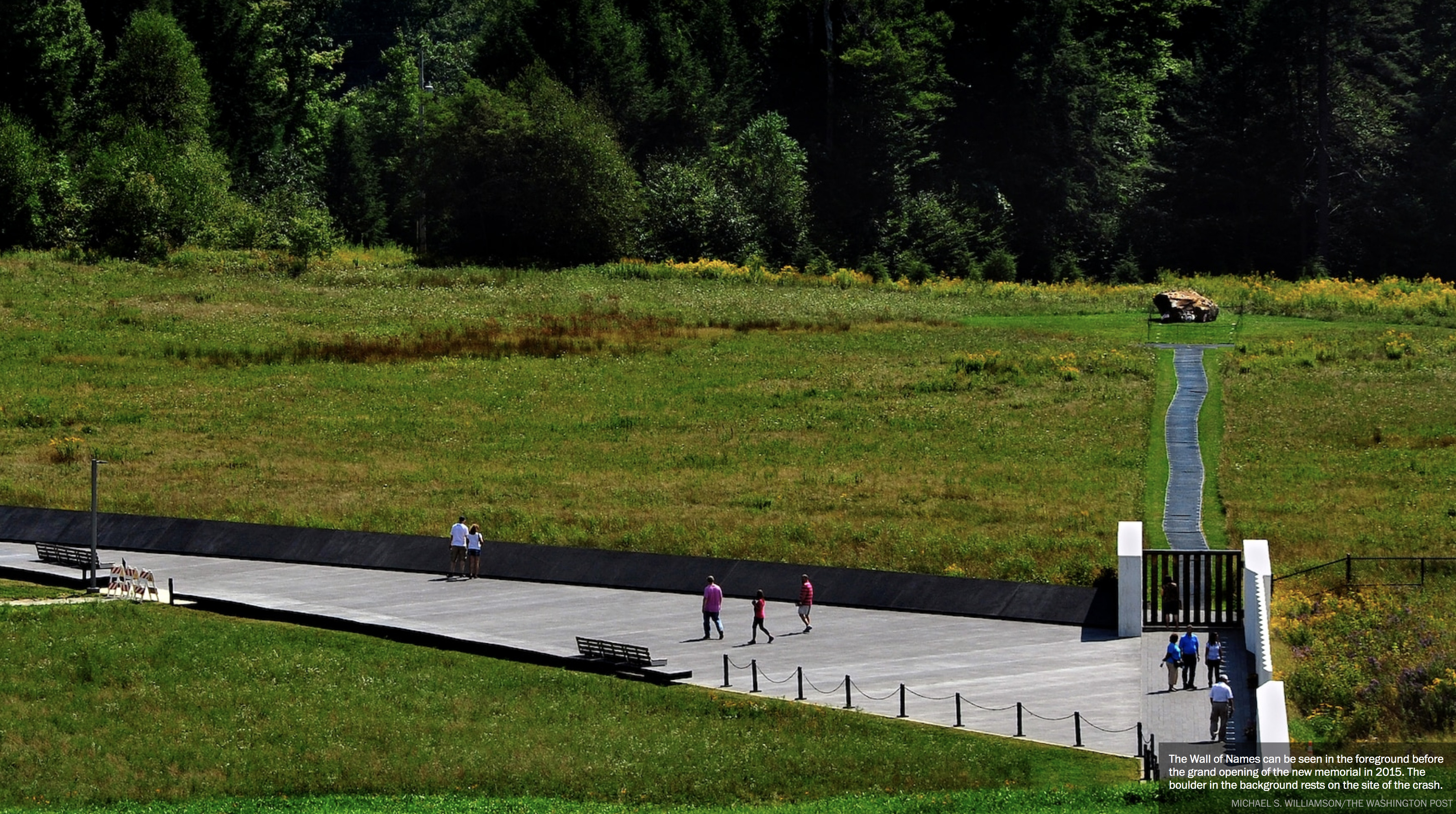
The Wall of Names can be seen in the foreground before the grand opening of the new memorial in 2015. The boulder in the background rests on the site of the crash. (Photo/Michael S. Williamson/The Washington Post)
for Clifford, 20 years after
Sitting in front of the TV, horrified, mesmerized, thinking, I’m glad you’re not here to see this, because, awful as it was, I was still wound up, sometimes in a ball on the bed, after your unexpected death six months earlier. And ever since, on this day, as others mourn a national tragedy, my mind falls to you, someone I grieved as the towers fell, as word arrived of a plane crashed into a field in Pennsylvania, another into the Pentagon. As images appeared of people fleeing down staircases in the dark, of firefighters going into the fray, never to return, of stunned, ashen souls walking for miles and miles, trying to get home, of those who never got home.
It’s how I feared your soul experienced those first seconds, minutes, hours after your sudden departure. Did you wander in the bardo, wondering what had just happened, where you were, what came next? Or were you plunged into nothingness, your essence released into the air, bits of energy sparking as you transformed into spirit?
If it sounds beautiful, perhaps it was. Perhaps only those of us on the ground called it tragedy. It’s not easy to go on believing in an afterlife amid a horrific aftermath. But perhaps those of you escaping bodies of ruined flesh felt freed, even as you blasted off, leaving the rest of us behind.
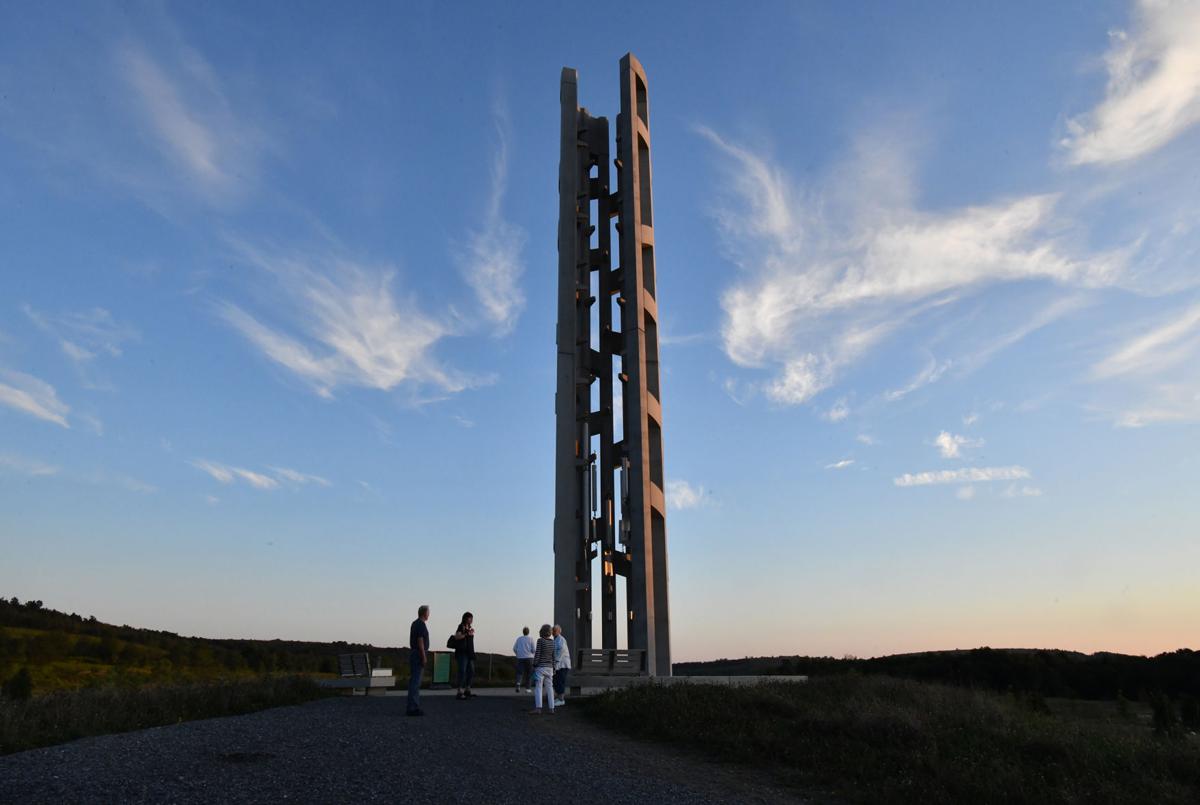
Tower of Voices at the Flight 93 National Memorial, Shanksville, Pennsylvania. (Photo/John Rucosky)
In June, newly retired from teaching, I decided to tackle the art of cheesecake and began practicing in earnest so I’d be ready to whip up what ended up to be three cheesecakes for my mother’s 90th birthday celebration in early July.
I learned to make a classic, cake-y, springform pan cheesecake. I made cheesecake from the recipe on the graham cracker crumbs box. And I made Margery Thompson’s cheesecake, which is really more like a creamy cheesecake pie—one that her family (of which I am a happily included part) deems The Best Cheesecake In All the Land. Actually, it was Marge’s son Mitchell who declared it so, though he died much too soon at age 43. When we in the family who have been tutored by the master (mistress?) make the cheesecake, we do so in honor of Mitchell.
I’ve been asked by a number of folks for that recipe, so here’s the version I took down, step by step, as Marge tutored her daughter Rebecca and me in cheesecake. I have to add that Marge got the recipe from an old church cookbook (the first version in the early 1950s, a later one that she still has in 1961). It was Helen Miniaci’s recipe, so we pay homage to her, too, with every incarnation.
“It’s easy,” says Marge, who has made this hundreds of times, and once you get the hang of it, she’s right. Easy-peasy, super yummy, not too sweet and very creamy!
Margery Thompson’s cheese(cake) pie
—Heat oven to 350°
—For crust (mix in 9-9.5-inch glass pie plate):
• 1 cup graham cracker crumbs
• 3-4 tablespoons melted butter
• 2 tablespoons sugar
(Press into plate so that crust goes up sides of plate nearly to the rim. Plate doesn’t need to be greased; “there’s enough butter in there so it doesn’t stick,” Marge says.)
—For filling (in a large glass or ceramic bowl)
—Beat with hand mixer or food processor until very creamy, almost runny:
• 16 oz. (2 8 oz. packages) of room temperature (“makes it easier to beat”), full fat cream cheese (“low fat doesn’t set up properly”) To make it easier to whip the cream cheese, beat in one egg with the cream cheese.
• ½ cup sugar (“basic white sugar is smoothest and easiest to whip”)
• 1 more egg
• ½ teaspoon lemon juice (“no pulp; tart lemons are best”)
• ½ teaspoon vanilla
—In a separate smaller glass or ceramic bowl, beatwith hand mixer or food processor until very creamy, almost runny:
• ½ pint (half a pint container) sour cream
• 2 tablespoons sugar
• ½ teaspoon vanilla (“rinse lemon out of measuring spoon first to avoid curdling the cream”)
—Fold sour cream mixture into cream cheese mixture “sloooowly to avoid air pockets,” Marge says, using rubber spatula to gently turn the sour cream mixture into the cream cheese.
—Pour into crust, smoothing “gently so it doesn’t pull up the crust” on the sides of the pie plate. (Optional from Mrs. Miniaci: Sprinkle graham cracker crumbs on top.)
—Bake 25 minutes (“Do not over bake!” warns Mrs. Miniaci.) Remove carefully from oven and cool on a wire rack till completely cool (“a good four hours”) before covering with plastic wrap and putting in the fridge. Allow to chill in fridge at least overnight (“24 hours is better”). Can be refrigerated for up to two days before serving.
—Optional: Serve with a berry topping (frozen or fresh). But honestly, it’s perfect all by its ownself. Very rich, and a little goes a long way!
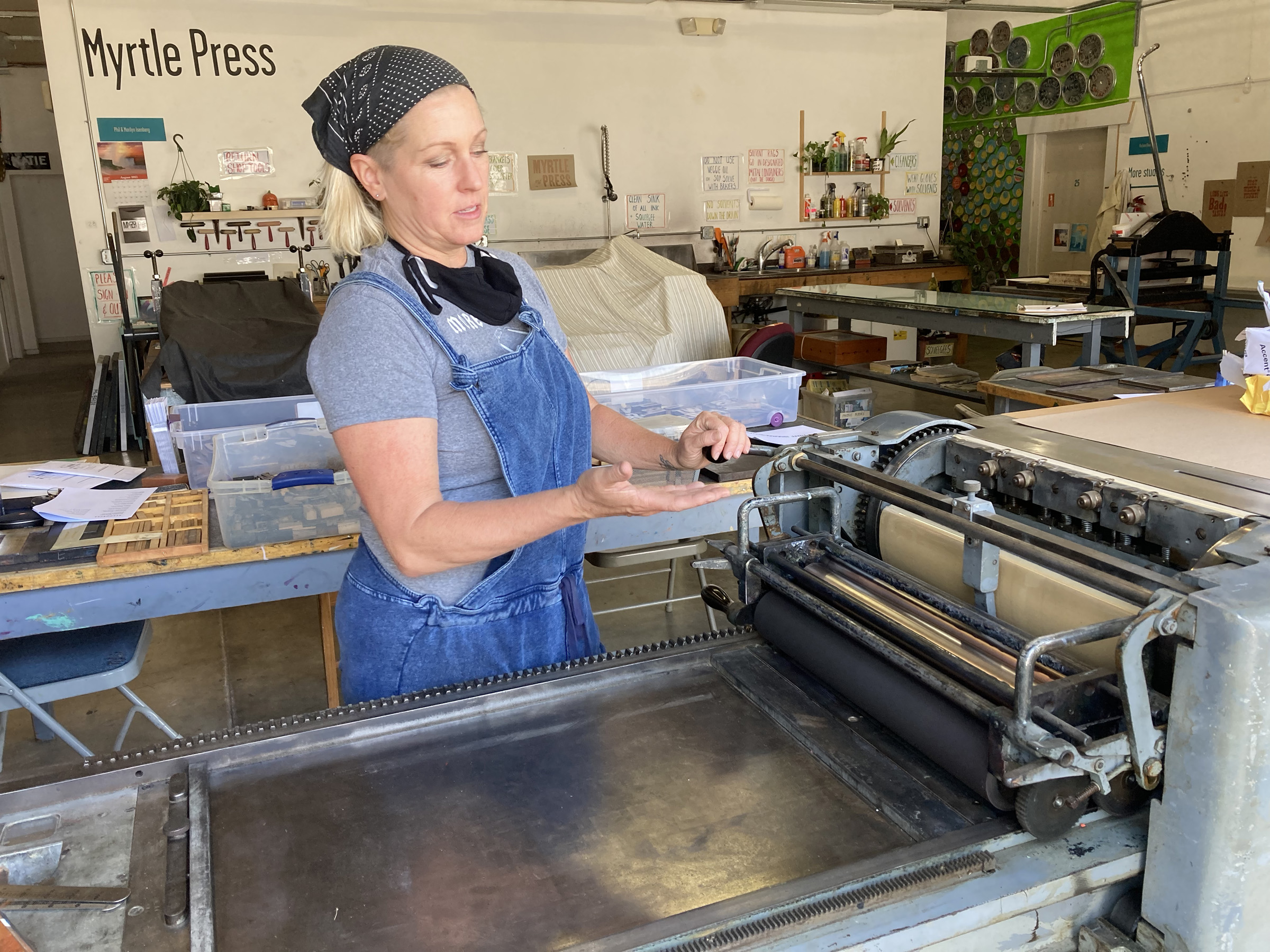
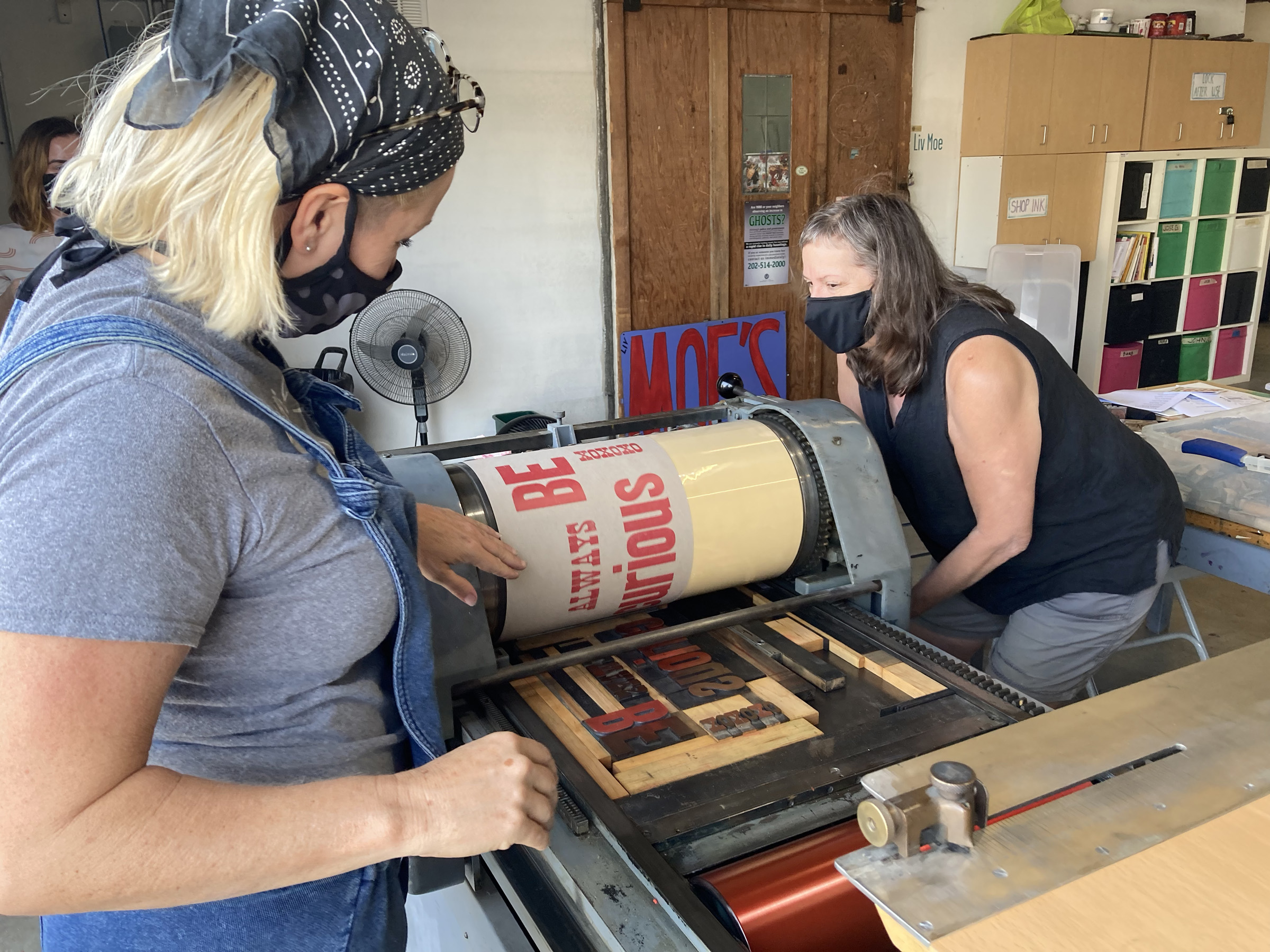
Printer Barbara Hennelly (her mask off for the photo) demonstrates the Vandercook proof press.
Old wood type holds the patina of years of fingers caressing it, tossing it, placing it on metal trays or handheld composing sticks, and, once arranged, transferring it to the bed of a vintage printing press. I like to think it contains memory, too, of the words each letter built. I’ve long loved handling type, whether chunks of metal that lie heavy in the hand, or the lightweight wood, often larger, used for posters and announcements and headlines.
So I was delighted to sign up for a letterpress printing class that, as it happened, took place in the back side of an art gallery five days after my best friend finally died. She spent a dozen years living with colon cancer, much of it in reasonably good health, and I got to spend time with her about seven weeks before she died. I count myself lucky in many ways, but seeing Georgann for a week, despite the fact that she spent most of it sleeping, is one of those ways.
Even a death that’s expected upends the loved ones who weather it, so I walked into Myrtle Press a bit unsteady. Death always feels like a gut punch, and the closer we are to the one who dies, the harder the punch. We try not to walk around doubled over, but it’s hard not to. And whether they’re aware of it or not, the dead walk with us, especially in the early hours and days of their new status. We think of them almost nonstop. We wish they hadn’t left. We wish we’d said or done something we didn’t say or do.
One of the manuals for Barb’s press
So it was that my newest companion spirit accompanied me into a space of old type and a Vandercook cylinder proof press from about 1950 to meet a young woman named Barb, who was both printer and teacher. When I looked into the plastic bins of large wood type and some smaller containers of smaller type, I smiled. I have lots of old type at home, both wood and metal, but it’s fun to see someone else’s collection. Even better to be allowed to touch it.
After she introduced herself, Barb gave us each an 11×17 empty metal printers tray. “That’s your template,” she said. “You’ve got that much space to say whatever you want to say.” She waved at the bins of type. “Dive in!”
Since I was already standing by a big bin containing letters about four inches tall, I plunged in and ran my fingers over the smooth surface of much-used type. I had no idea what I wanted to say. I hadn’t arrived with anything specific in my head. But just like in the writing groups, if you put yourself in the environment and relax a bit, things show up for you. In this case, I picked up a ligature—a word I’ve long loved—two letters put together on one piece of wood, a lowercase double f. ff, it said. What could I do with ff?
And there was Georgann’s laugh in my head. “BFF,” I heard her say, as though she was standing next to me. For decades she had signed off handwritten letters that morphed into emails and texts with BFF. I began searching for a lowercase b to go with the ff ligature. It appeared easily, and I set the two pieces of type on my tray. I saw a large ampersand, one of my favorite pieces of punctuation that looks a bit like a treble clef. Grabbed that. Pawed through the bin to locate a G, then an A and a T. BFF GAT! Georgann Turner.
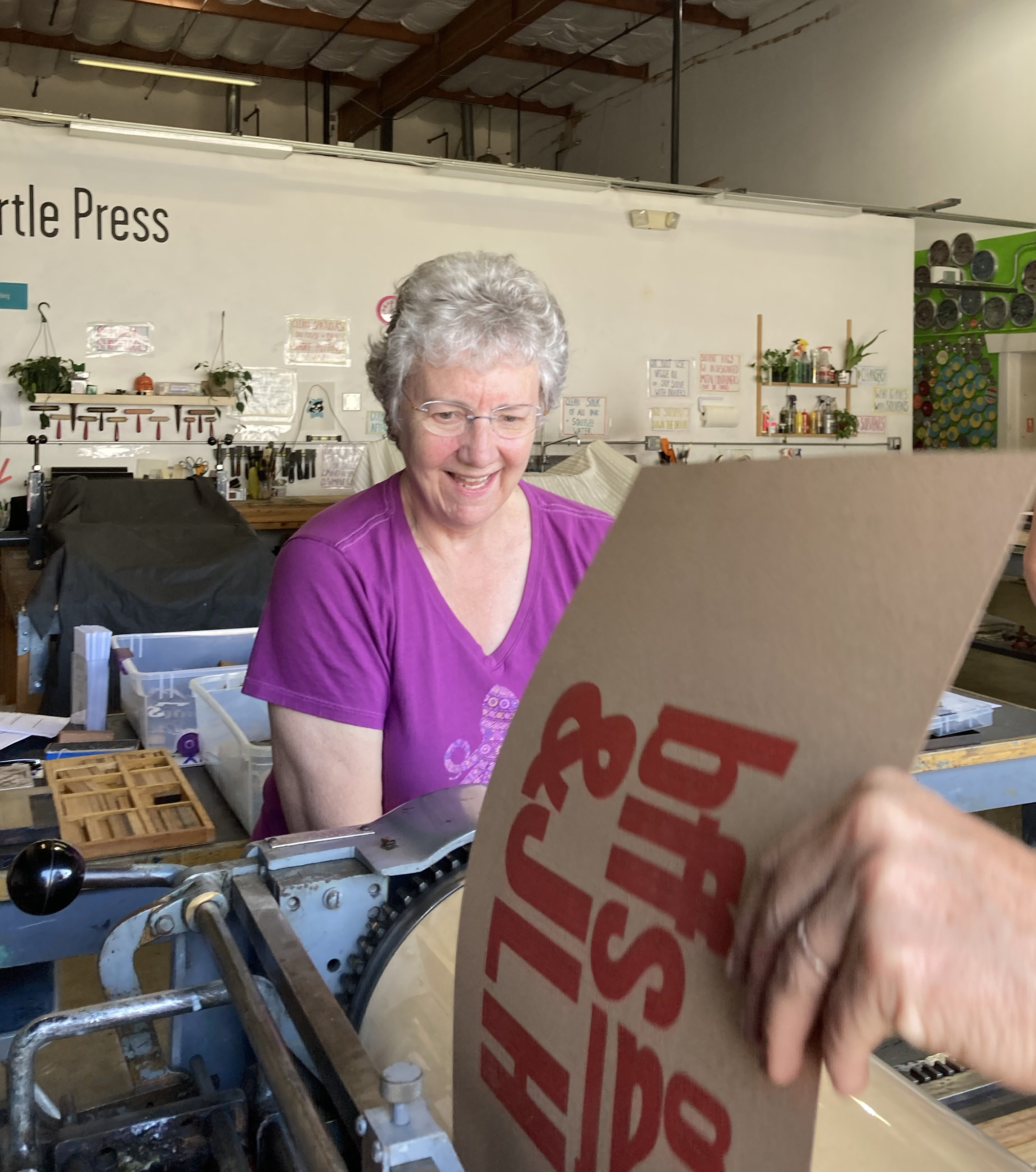
Missy Anapolsky prints on the Vandercook proof press with a hand from Barb Hennelly.
I giggled. Next to me, Missy Anapolsky searched through another bin. Missy is a graphic design professor at the college I just retired from. Several years ago she and I did a book together about the first century of the college’s history.
Missy looked at my tray. “Is that your friend who just died?” she asked.
Missy’s print
“Yep,” I said. We stood there for a moment, looking down at the initials.
Then Missy’s hand dove into the bin in front of me. “Here’s a J!” she said.
I blinked. It took me a few seconds, but I saw where she was going.
“Oh!” I said, and I started looking for my other two initials: an L and an H. They appeared, which seemed a bit miraculous since Barb’s type collection was definitely not a complete font. But there, in uppercase, to match the ampersand, were my initials.
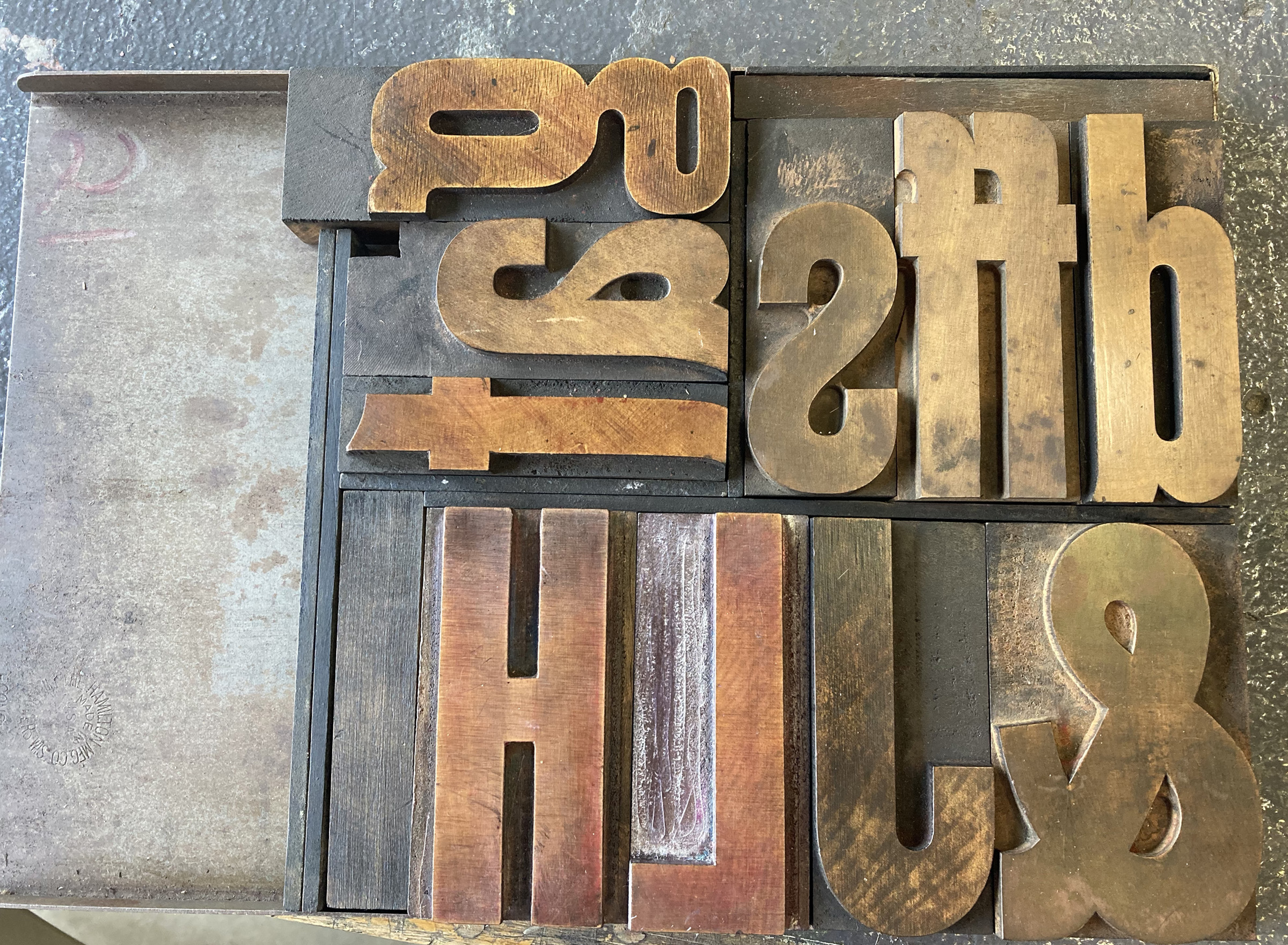
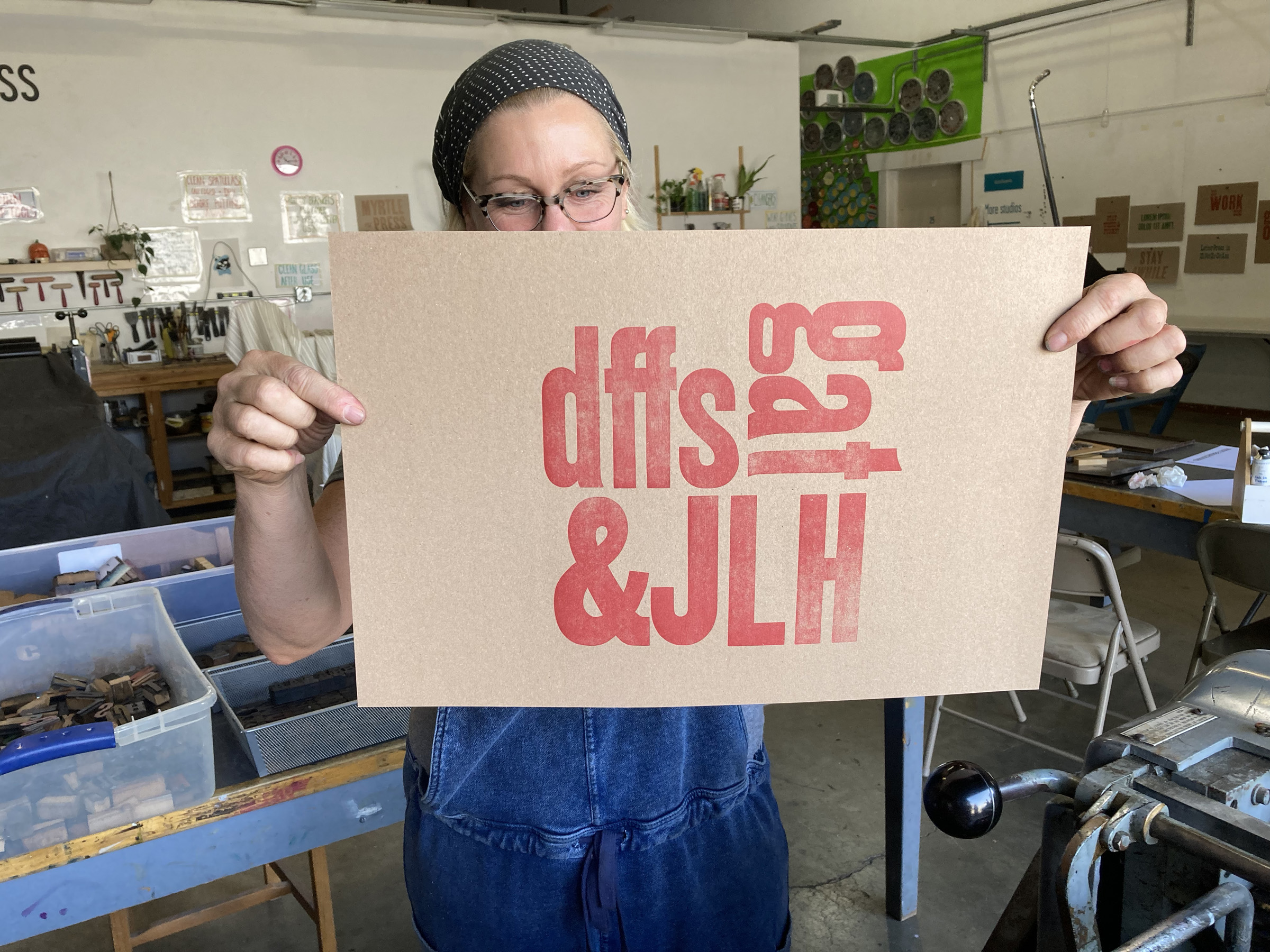
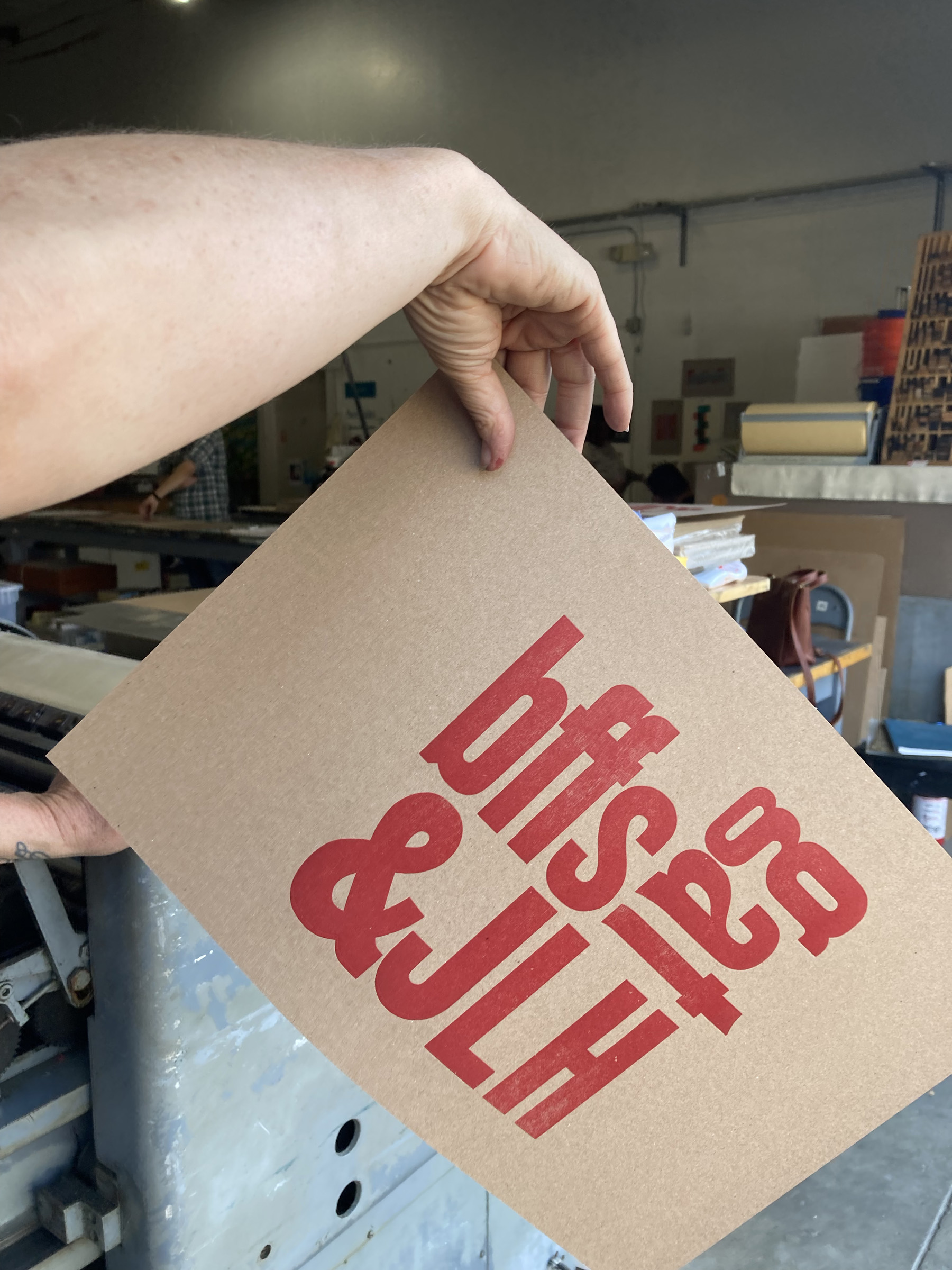
I added a lowercase s, and this is what appeared on my type tray:
There we were in upside down and backwards type that was probably older than both of us:
bffs gat&JLH
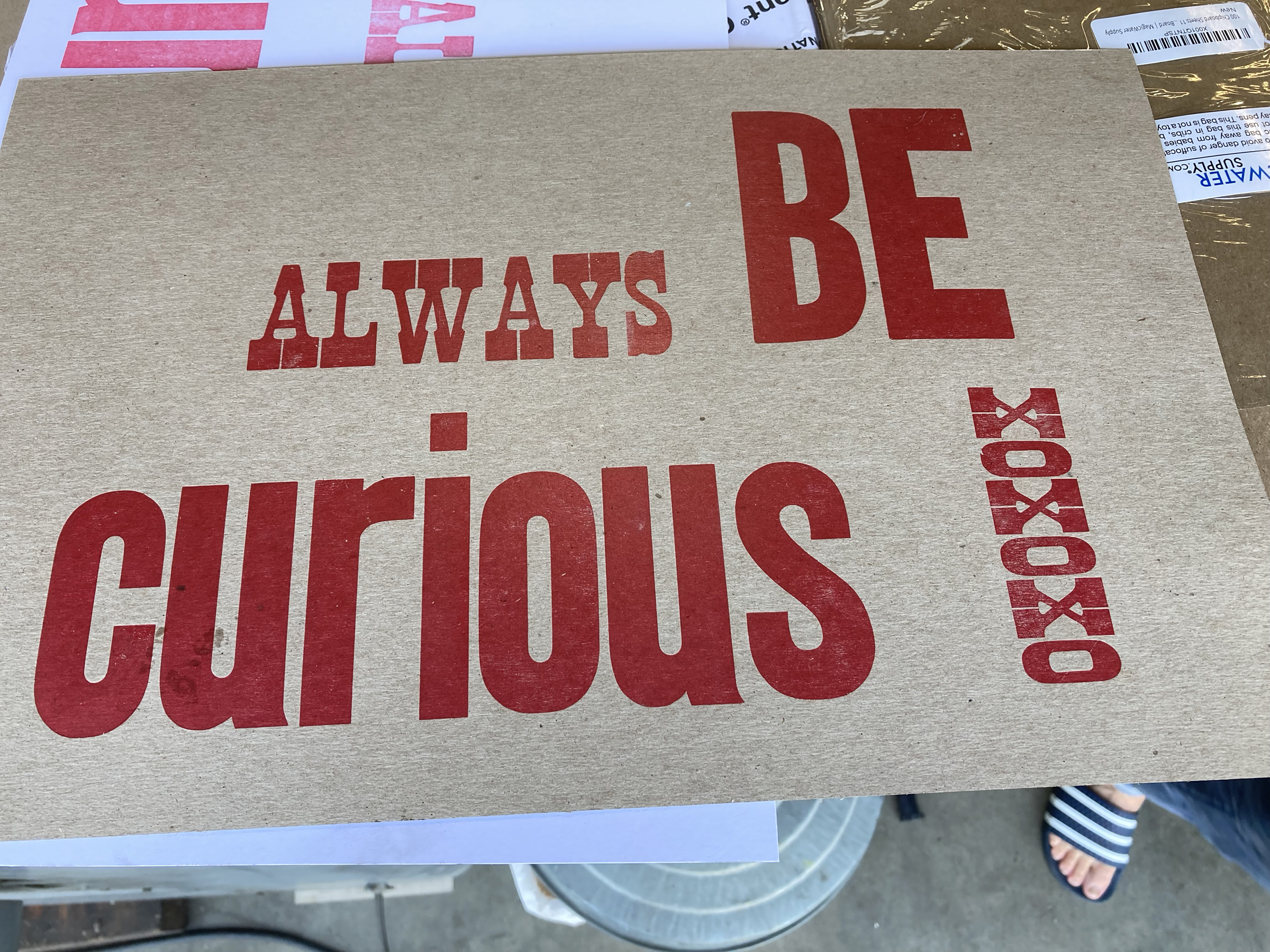
At least, I thought that’s what it said. Barb locked up the type on the bed of the press, snugging it in with various pieces of wood furniture, along with two quoins—slender pieces of metal that, with a special key, can be expanded to hold the creation in place. She put a piece of brown kraft paper (aka cardstock) on the platform atop the press and cranked the handle that drew the paper onto the great silver cylinder and over the type. Barb pulled the paper off the cylinder, and to our surprise it read:
Printer Barbara Hennelly with Jan’s boo-boo
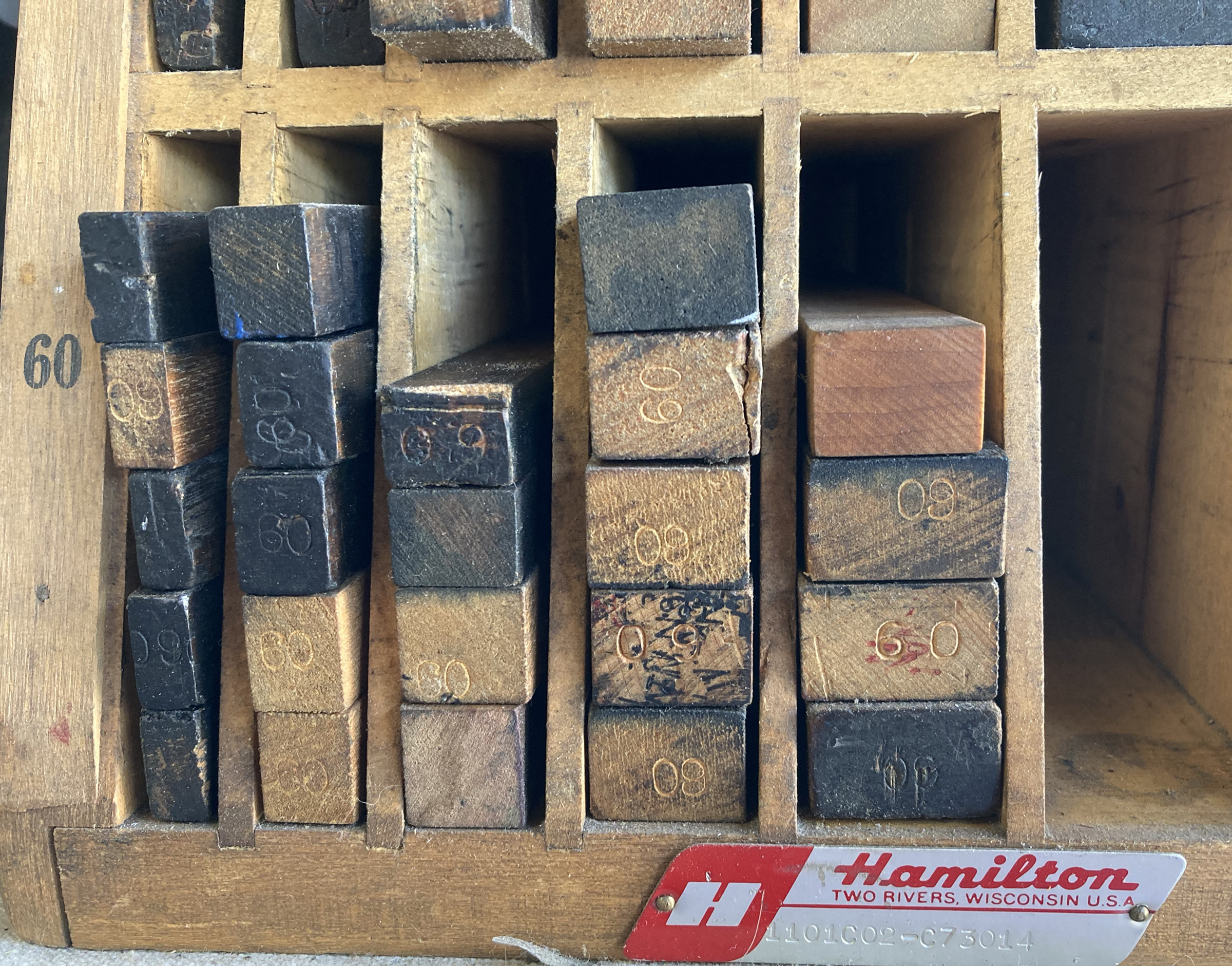
Lowercase b looks a lot like a lowercase d, and I laughed, remembering similar mistakes long ago at a small newspaper in my hometown, as I put away larger type used for headlines or posters in the giant Hamilton job cases, easily mistaking b’s and d’s or lowercase l’s with the number 1.
Furniture (spacers) in an old Hamilton case.
I remember the nearly deaf Linotype operators who, when I expressed my desire to become one of them, told me that theirs was no job for a girl, and besides, they wouldn’t be around that much longer. They were right: Within a few years the old hot type letterpress days had ended in favor of electronic offset typesetting machines that resembled giant IBM typewriters. Those produced long strips of copy that had to be cut into different lengths, run through a waxer and stuck to paper pages that would be photographed and turned into metal plates for the press. I spent many hours pasting up newspaper pages as a young journalist. That technology gave way to computers that produced similar galleys, as the strips of copy were called, and eventually to digital systems that sent completed pages directly to presses.
Me printing (mask off for photo purposes) with Barb lending a hand.
It has not escaped me that I have lived through the end of hot type into cold type into computer-generated type to no type at all of online publications. Perhaps that’s why it was so satisfying, as I weathered the fresh loss of an old friend, to put my hands on wooden letters, set them into a satisfying arrangement and print them on a press older than I. Even if it did have a boo-boo (aka doo-doo).
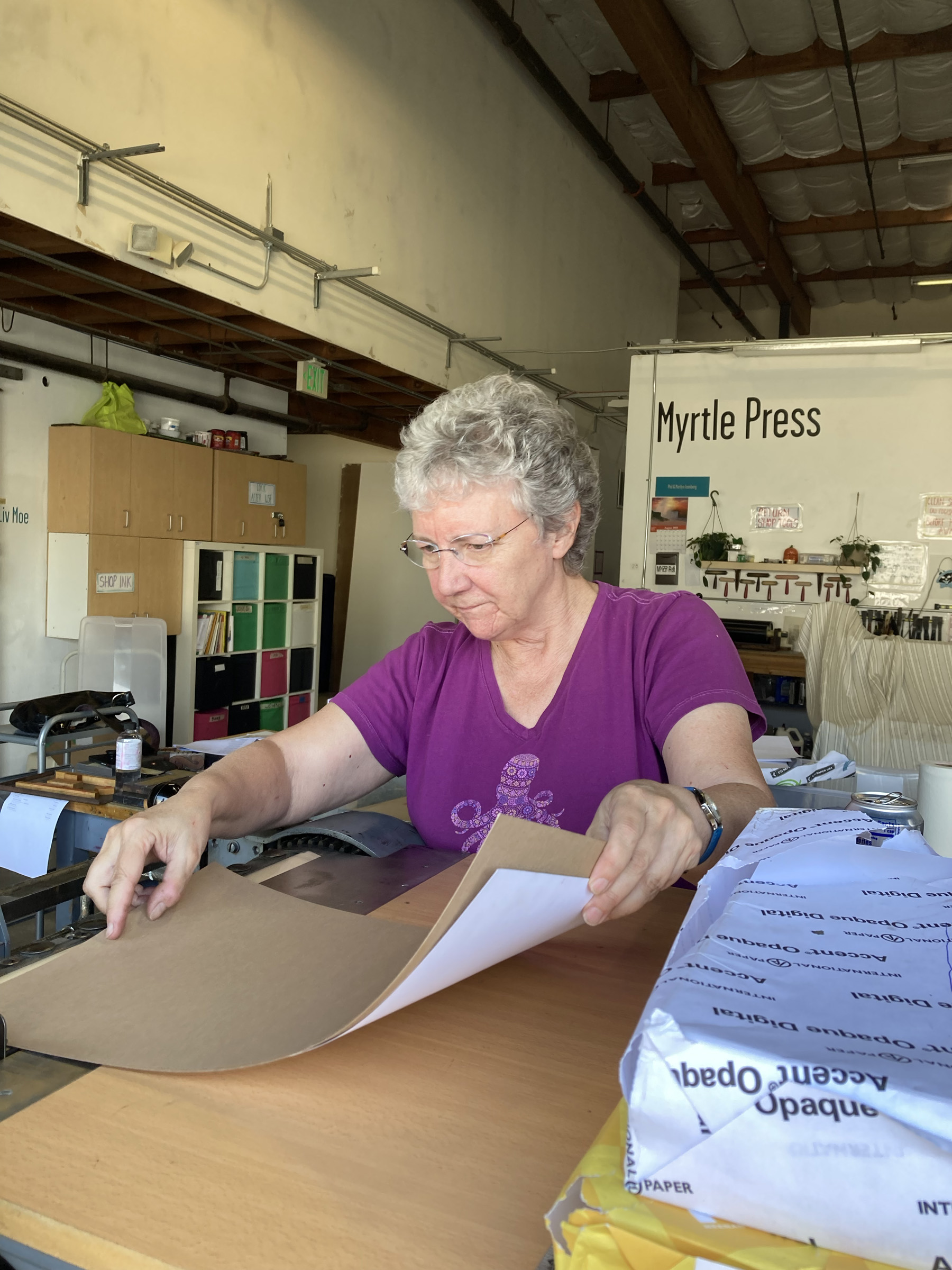
Placing the paper
Missy found the proper b and handed it to Barb, who removed some furniture to replace the letter and then locked it all back up again in a matter of minutes. She cranked the handle and made another print. Voila!
“Now you do it,” Barb said.
I grasped the handle that had been turned thousands of times and cranked it, grinning with delight at seeing red inked letters appear on paper—tangible proof of two of my longtime loves.
(Thanks to Karen, a printing classmate, for taking the photos of me!)
You may feel optimistic today as you think about all the possibilities awaiting you. Your upbeat mood could inspire you to manifest the life you desire. It may be helpful for you to visualize your life as you would like it to be. Try imagining your life as a road stretching into the future.
—Aug. 29, 2021, Leo horoscope, two days before the deadline for the U.S. to leave Afghanistan
Walking the road toward my future, thinking of those trying to do the same in a far-away desert, hoping to reach the airport, somehow talk their way onto a plane to anywhere but where they are.
My road stretches long, I hope. It runs fluidly alongside manicured lawns, past large trees preparing to loosen their leaves to fall.
For the many refugees trudging dusty roads, standing in canals, trying to gain the attention of soldiers who might help, their futures lie in the next barren moment, or, with luck, perhaps the one after that. No grass. No trees.
If they’re turned away, if they cannot leave—no matter how much they visualize a new life or how bright their beacon of positivity—they fear the worst.
How I wish them green grass, leafy canopies of comforting shade under which to rest. How I wish them a stranger’s fortuitous helping hand.
The day you died, I came across a naked man on my evening walk.
This is not the punchline to a bad joke, but it is something that would have made you laugh.
Balled up in the first hours of grief—despite the fact that I’d been wishing for your swift passage since I came to visit you seven weeks earlier—I drove to the house of the man I love and told The Duck, “I need to walk.” And so we did, the human Duck and I, to the Woodside duck pond where we sat for a while near the snoozing mallards, two occupying a rock each, all of us considering the universe. As you do when someone you love dies.
He’s The Duck because, long ago, his young nephew and niece mistakenly called him that instead of Uncle Dick. You loved that and called him The Duck ever after. I became Auntie Jan to your three youngest kids, and he was Uncle Duck.
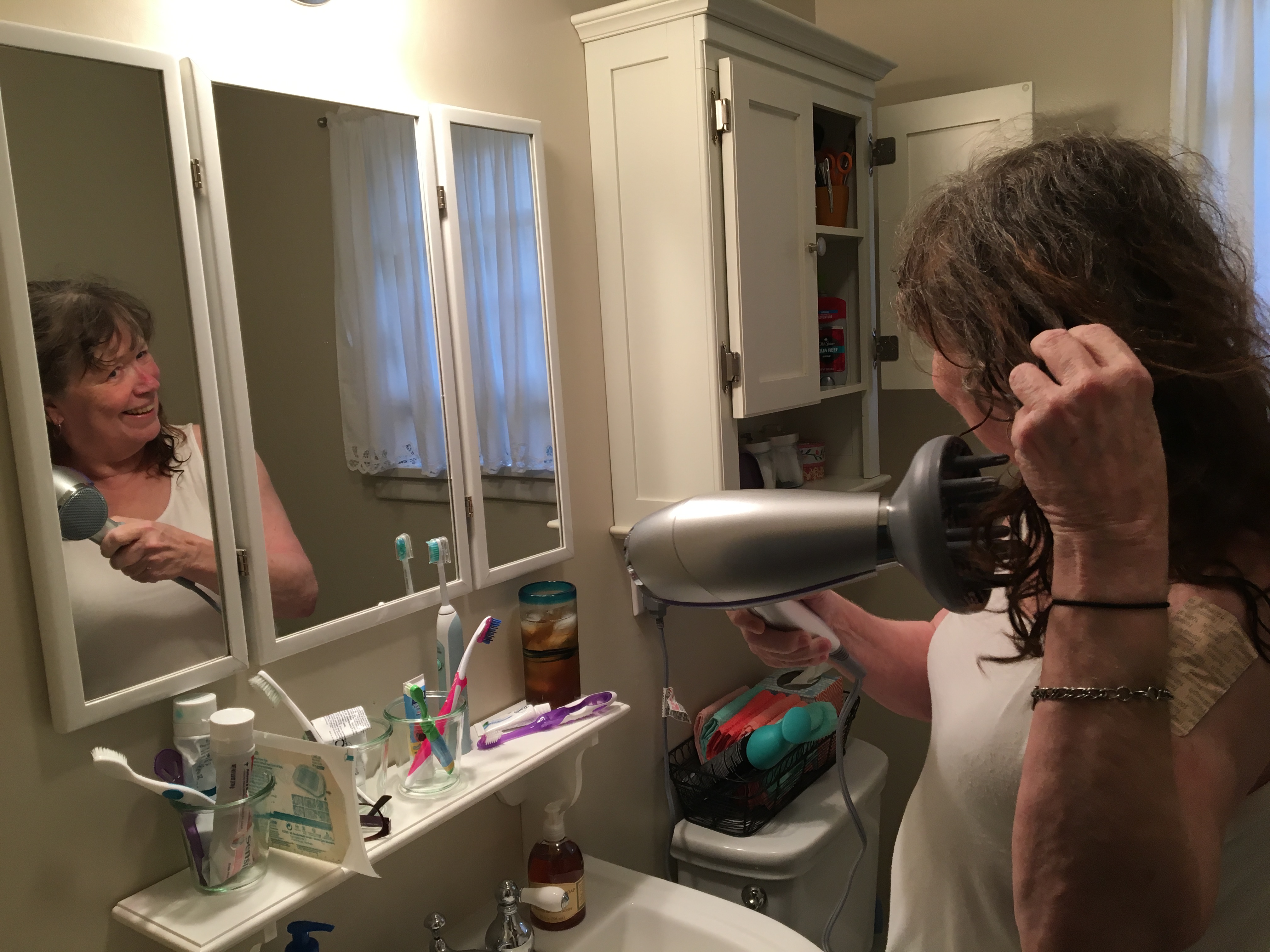
Georgann drying her hair, Bremerton, Washington, Sept. 16, 2017
But I digress. As I do. As you and I did in every anecdote we’d try to relay to one another.
So after sitting at the duck pond, we walked back to Dick’s condo where I left him and continued my walk through the former walnut orchard that is his condo complex. I didn’t get very far, and it was getting dark, when I passed three people walking toward me. One of the men said, after I offered a hello, “There’s a naked man walking over there.”
I chuckled, thinking, “Of course there is.”
And the clothed man walking with the two other clothed people said, “No, really,” gesturing behind him. “We’ve called security.”
I took about 10 more steps and saw the unmistakable profile of a tall, toned, naked man in the not-too-distant distance. I blinked to try to bring him into focus, but he remained blurry in the distance, which was probably just as well. He waved at me, I waved back, and he took off in another direction.
I meant to keep walking in my intended direction toward the naked man, but something inside made me take a hard right through a parking area and across a wide swath of lawn to head back to Dick. I thought, Georgann would love this, me encountering a naked man on a walk. “As one does,” you would say, tossing out one of your favorite phrases that means quite the opposite.
You picked that up in Wales, as you did many other British expressions, some of them just sounds that served as comments. Your “mmmmm” could convey a lot. That year or so in Swansea at university where you finished your bachelor’s degree in politics, where you wrote every paper by hand—because not even typewriters were allowed in the late 1980s—changed you profoundly, you said. It certainly gave you a new best friend in me.
That happened because my childhood best friend, Sue Lester, and I traveled through England, Scotland and Wales by train in the fall of 1988 shortly after you arrived in Swansea with your then 13-year-old daughter Jena. You and I had met when I was teaching journalism at Sac State, where you were working toward a bachelor’s degree. The day Sue and I visited you in your Swansea flat where you had to put coins in a machine so it would dispense heat (which was needed in September), Jena had just finished her first day of school. She came swanning in (another phrase I learned from your Welsh experience) in her cute uniform and announced, “Nigel fancies me.” We grinned like fools, trying not to guffaw at the ease with which Jena had already adopted some of the local lingo.
That visit was when you said, “If you write to me, I’ll be your new best friend.” Not that I needed one, I thought but wisely didn’t say. And so began our exchange of letters on thinnest of light blue Aerograms that folded themselves into something resembling an envelope, an inexpensive way to communicate with people across the pond. I still have the ones you sent me. And, true to your word, we did become best friends over that year or so, partly, you liked to say, because I was able to decipher your handwriting.
That was about eight years before you decided to become a foster mom and phoned me in Hawaii to ask if your oldest, college-aged son Andy could come live with me because you had a 2-year-old redheaded foster kid coming to live with you. I said yes, surprised, though I would have agreed to just about anything you asked. You liked to tell people that I, the teetotaler, was drunk on mai tais at the time. It was a better story. You were—though you denied this—always a very good writer who composed, then paid for, my personalized license plate that said GUD WRTR.
“I can’t drive around with that,” I said. “People will think I’m bragging.”
“Not spelled like that,” you said.
It went on my Honda Civic, and you deemed yourself a published writer, which you later were, too.
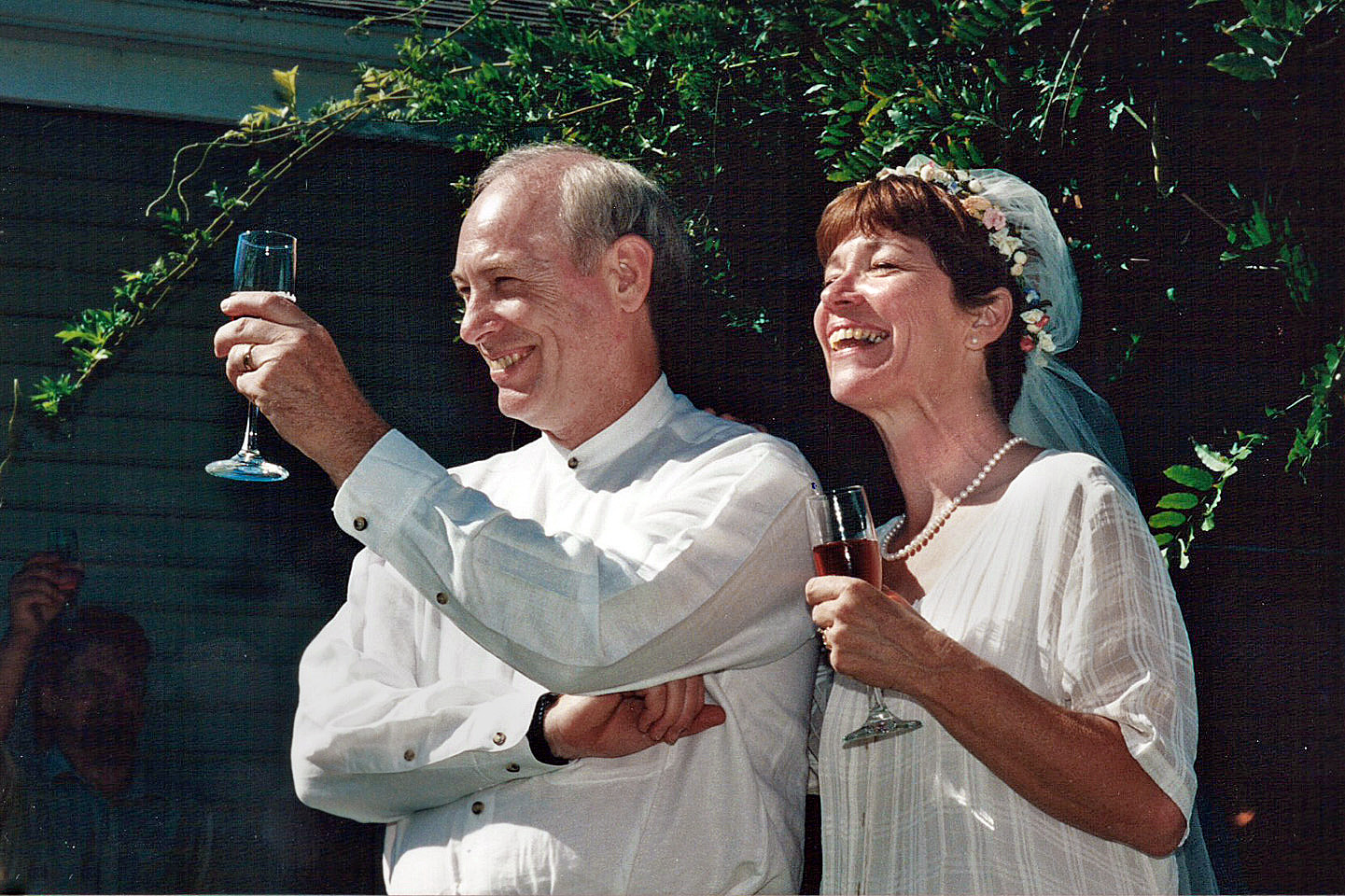
Ron and Georgann Turner on their wedding day, Sept. 26, 1996, Sacramento, California
Bringing Max home was the beginning of what became your second family—three foster kids, all born to drug-addicted mothers, who you, a single woman, adopted within a few years. I was deeply relieved when you met and later, on Sept. 26, 1996, married Ron Turner, who had a bigger house and a huge heart, ready to take on the role of dad to your little tribe. (His grown son Matt also became part of your blended family.) Ron saw you through your initial diagnosis of colon cancer and the devastating surgery that was the beginning of your cancer journey a dozen years ago. He has never left your side and supported your family through everything up, down and in between.
***
I realize that this is just the beginning of writing about you in the after, now that you’ve transformed into my newest companion spirit. You saw me through the death of my husband in 2001 and a book of poems I produced called “Companion Spirit.” I’ve long known that you would become one of mine.
In late June I flew to Seattle to stay next door to you for a week. Ron picked me up and drove me to the house you shared on Oyster Bay in Bremerton where you dozed on the sofa, one of your magic suckers for pain control in the corner of your mouth. Years earlier you’d taken liquid opium, which you hated, declaring that it tasted like cat butt and chasing every dose with chocolate. You were, I once remarked, on enough opioids to make Michael Jackson look like a teetotaler. You had been for years, and still, they barely took the edge off your considerable pain.
I couldn’t do much for you, especially since you slept 20ish hours of every day, either in bed or on the sofa. You could barely walk. You’d fallen more than once. You looked skeletal to me, and, in fact, we learned, you’d lost 15 pounds in a month. But you were so glad to see me. Had a couple of gifts for me that you’d ordered online—kitty socks and a striped top with a big cat on it.
Georgann with Diego at Jan’s house, December 2016
When you were awake and wanted to see me, we talked about all kinds of things, as we did. And I asked how you felt about approaching your end. “No one has asked me that,” you said, and as I began to apologize, you stopped me. “I don’t want it to end. I want to live forever.”
I didn’t say, “Even like this? With all the suffering?” I knew you wanted as much time as you could get, but I also could see that your life was literally ebbing away.
The “little kids,” as you once called them—Max, Emma and Maggie—are now grownups who also live in Washington. In fact, Maggie and her two girls also live in the house on Oyster Bay. But for some time you hadn’t seen your big kids, Andy and Jena, who live in Northern California. Stunned at your deterioration, I contacted them and strongly suggested they come see you as soon as possible. They soon did and brought their kids with them and, in turn, contacted your sister and brother. You had a lot of family descend upon you over the next few weeks. You loved it and rallied for them, awake quite a bit, eager and grateful to be with them.
While I was with you, when the breakthrough pain seared through you, I’d give you my hand and tell you to squeeze as hard as you needed. You hand weakly grasped mine as you wept. Twice you told me, “I’m ready for this to be over now.” Which is why, when we were alone, I broached the subject of hospice and even the end of life option your state offers. But you never took those options.
You did not want to leave the party. Ever. You had small grandchildren and bigger ones. You wanted to see how they and everyone else turned out. You, ardent reader—who launched me into more than a few of your favorite mystery series—wanted to read all the way to the end of the story.
***
The last day you and I spent together began as Ron and I somehow got your barely-able-to-walk self into the car for the ferry journey to the cancer center in Seattle. On the way to the ferry you perked up just like old times in Sacramento when the little kids were little and you and I headed to dinner and a bookstore on a friend date.
On our last day together you, who would typically sleep, chatted through the hourlong ferry ride. You directed me through the labyrinth of Seattle till we reached Aloha Street and the Seattle Cancer Care Alliance, which had cared for you for a decade. You chatted up the woman who took your blood and the nurses on the seventh floor overlooking Lake Union. You reclined in a comfy chair as fluids and minerals and your oncology P.A.’s “magic anti-nausea cocktail” rolled into you through the port in your chest.
You were having a good day, an up day after so many down ones.
You were hungry, so I went in search of food after discovering that the cafeteria kitchen had shut down for the day. You said you wanted a burger, so I found a snazzy restaurant on the lake and ordered a burger for you and fish and chips for me. I texted you that info, and you said you wanted fish and chips. After trudging back up the hill to the cancer center, I ate the burger and you downed every bit of the fish and most of the chips. And, even before the anti-nausea cocktail, you kept it all down.
This was, to put it mildly, unusual.
Ron and Georgann Turner, Poulsbo, Washington, 2015
You wanted to stop at an Asian market on the way home to buy a whole dead duck for your Asian neighbor Margaret, who would love one, you insisted. While I kept my questions about that to myself, I said, “I can’t imagine how I’d get you in and out of a grocery store. We don’t have a wheelchair.”
“I can walk fine,” you insisted, though I knew that wasn’t true. But you thought you could, just as you thought you could direct me back to the ferry, which involved another series of “turn here—no, wait—OK, next block maybe…” directions. We eventually got there, but not too many years ago you had the route down cold. Still, you spent the whole ferry ride home on your phone, “window shopping” for clothes. At one point, after having talked about hospice and your end that seemed to me to be coming soon, you said, “I guess I shouldn’t be shopping.”
“Why not?” I said, looking over your bony arm to the phone showing a selection of inexpensive tops. “You should be comfy even lying in bed or on the sofa.”
You liked that. You didn’t buy anything online, but neither did you sleep that whole trip. By the time we got home, I was ready to collapse. You slept well and didn’t throw up that night. But by morning, as Ron was ready to drive me to the airport to go home, you were on the sofa retching and in pain.
To you, who lived on Hawaii as a teenager, I bid aloha—until we meet again—and told you I loved you. You responded, as you had more than once, “You’re the bestest of best friends. I love you.”
Somehow I didn’t cry until I was strapped into my seat on the plane as it soared into the sky.
***
But wait. I digress. Again.
You became the Mystery Voman a couple of decades ago when I had arranged a rendezvous with my new beau Dick in a downtown hotel. I set up a scavenger hunt of sorts, with notes in different places telling him where to go next. You two had never met, but you were waiting for him at a café with a note from me that held the next clue. You introduced yourself to him as the Mystery Voman, and we have for years quoted your line after Dick read the note: “You must go now.”
After I came home from our final visit, I talked to you in the air many times each day. “Let go into the mystery,” I’d say, using a concept familiar to you. “Become my newest companion spirit. Your job is done. You don’t need to be in that pain-filled body, your systems shutting down.” By then you were in the hospital, a tube draining fluid from your abdomen. But you stayed.
“Why are you hanging on?” I wailed to the universe, as if it was up to me—especially after I’d talk to Ron on the phone, visiting you daily in the hospital. “You must go now, Mystery Voman!”
I got no answer from you, not even in dreams, but a wise friend who worked for years as a cancer nurse, reminded me, “She’s not done yet.”
Oh, yeah, huh? That was another of your favorite responses to an obvious truth. For years you had rallied—up and cooking, shopping, engaging with family and friends for a day or two, maybe three, before you crashed again, down for days or eventually a week or more. But you often said that you had a grateful heart, you who told us all that you loved us to the moon and stars… because to the moon and back wasn’t far enough.
In the early hours of a new morning, for reasons none of us will know, you did let go, in hospice for your final few days, at long last done with your incredible journey of a lifetime. And at dusk the universe presented me, at a distance, with a fuzzy vision of a naked man walking casually through a long-ago-walnut-orchard-turned-condo-complex.
I have no idea where he went or what that was about, just as I don’t know how to think about life on the planet without you here. I just know that you’d love the story. So I’m telling it to you, dear companion spirit.
As one does, you’d say.
As I imagine telling you stories until we meet again—please God—in the mystery.
Georgann Turner on her wedding day, Sept. 26, 1996, with her best gal, Jan Haag
for Georgann (Taylor) Turner March 1, 1951–August 17, 2021
“Dinner and books,” you dubbed our best friend dates, and while the restaurant might change, it had to be somewhere in the vicinity of the bookstore— you picking me up in the mini van that doubled as kindertransport for your second set of kids, first fostered, then adopted. The baby seat in the back rattled without Maggie in it, too quiet without Max lisping his way through a song or Emma looking out the window, Ron at home with them all.
This was your escape, and I got to be part of it.
The food didn’t matter; books did. We’d cruise rows of shelves like barflies on the hunt, searching for the just-right specimens to take home for the night, and perhaps, if it worked out, to keep for a long time.
As we added volumes to the growing bundles in our arms, we’d find each other in the stacks, you asking, “Have you read this?” You thought I’d read everything. But I was not the one who wintered with Dickens, summered with Austen, your paperbacks so well-thumbed I bought you new crisp-paged versions to give the veterans a break. And while you heartily thanked me, years later, I found them pristine on your shelves, realizing your preference for softer, familiar friends.
It stands vacant now, that store we circled like sharks. Who’d have thought such an institution could disappear? That you’d be flattened by cancer surgery, followed by a decade of pain, the metastases chasing you two states north because, you said, you didn’t want to die in Elk Grove.
And you didn’t. You’ve hung on all these years, rewriting the definition of Stage 4, stubbornly putting the lie to “terminal” in your rental house by Oyster Bay where the tides ebb and flow twice daily, where Ron mostly tends to you, the kids grown, though Maggie and hers live with you. You delight in your granddaughters, relay their latest antics when I can get you on the phone.
Now you tell me that you’ve fallen again, acquired a new shiner. “It’s a real beauty,” you say. Then, “You should come soon. I have a bookstore I want to show you.”
And though I don’t know if that shop lives in your head or in your town, or if you could stand for an outing to buy books you can no longer read, it doesn’t matter.
“Yes,” I say into the ether between us. “Yes, I’ll come.”
Published in Friendship, vol. 3 of the Lifespan series, Pure Slush Books, July 2021
Because she requested it for her 90th birthday party at the end of this week, and because she completes nine decades on the planet today (happy birthday, Ma!), I am practicing cheesecake.
My sister asked our mother what kind of cake she’d like for her party, and she immediately said, “Cheesecake.” And while I know that I can buy cheesecake in any number of places, I decided I’d learn to make it.
This is because Marge Thompson, my de facto sister-in-law (Dick’s sister), who makes the best cheesecake I know, said, “It’s easy.” I’ve long said that I’ll eat anything this woman puts on a a plate. She’s been whipping up cheesecake for decades based on Helen Miniaci’s recipe from a 1950s church cookbook. She gave me a photocopy of the recipe, which immediately stumped me.
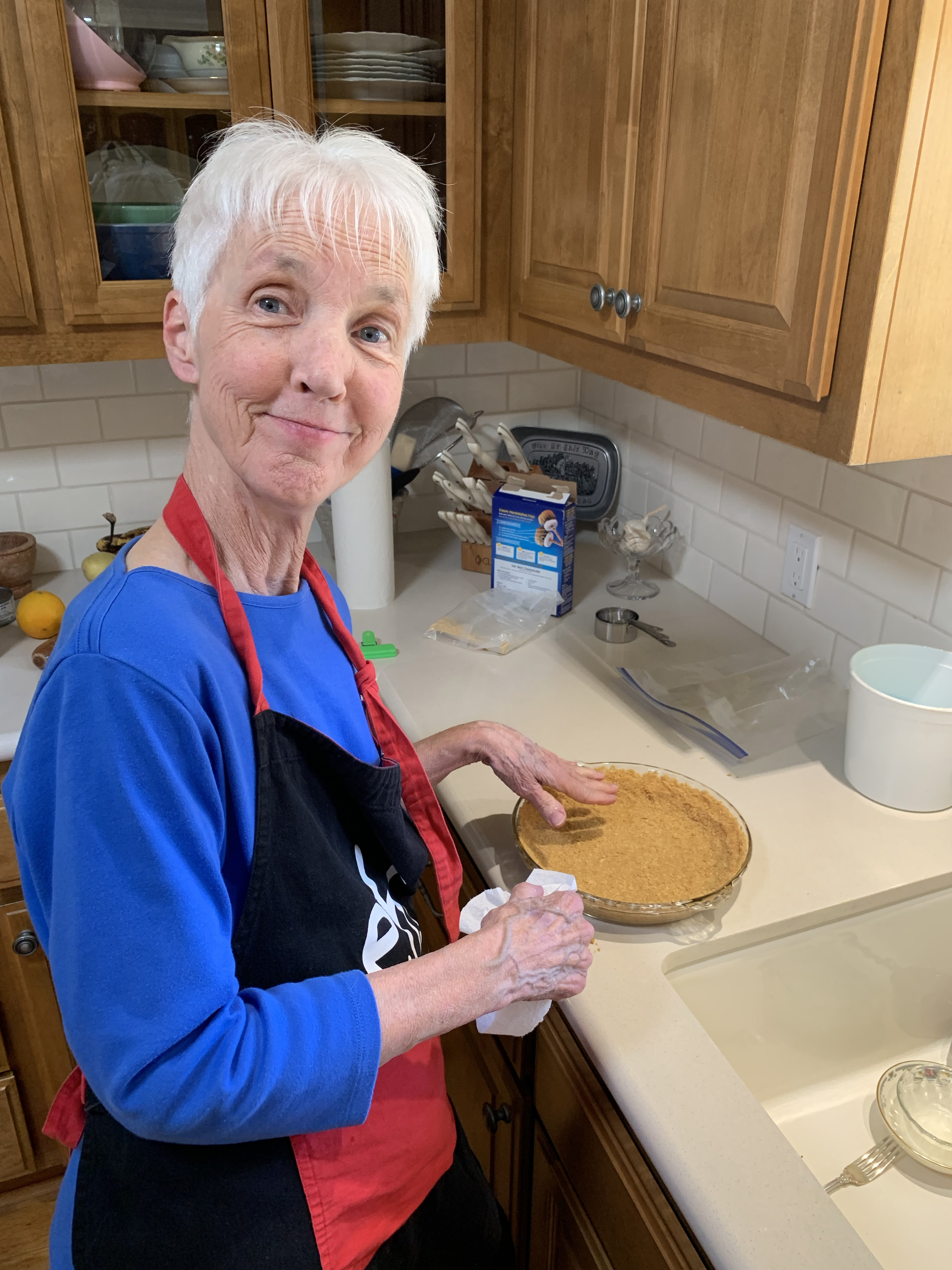
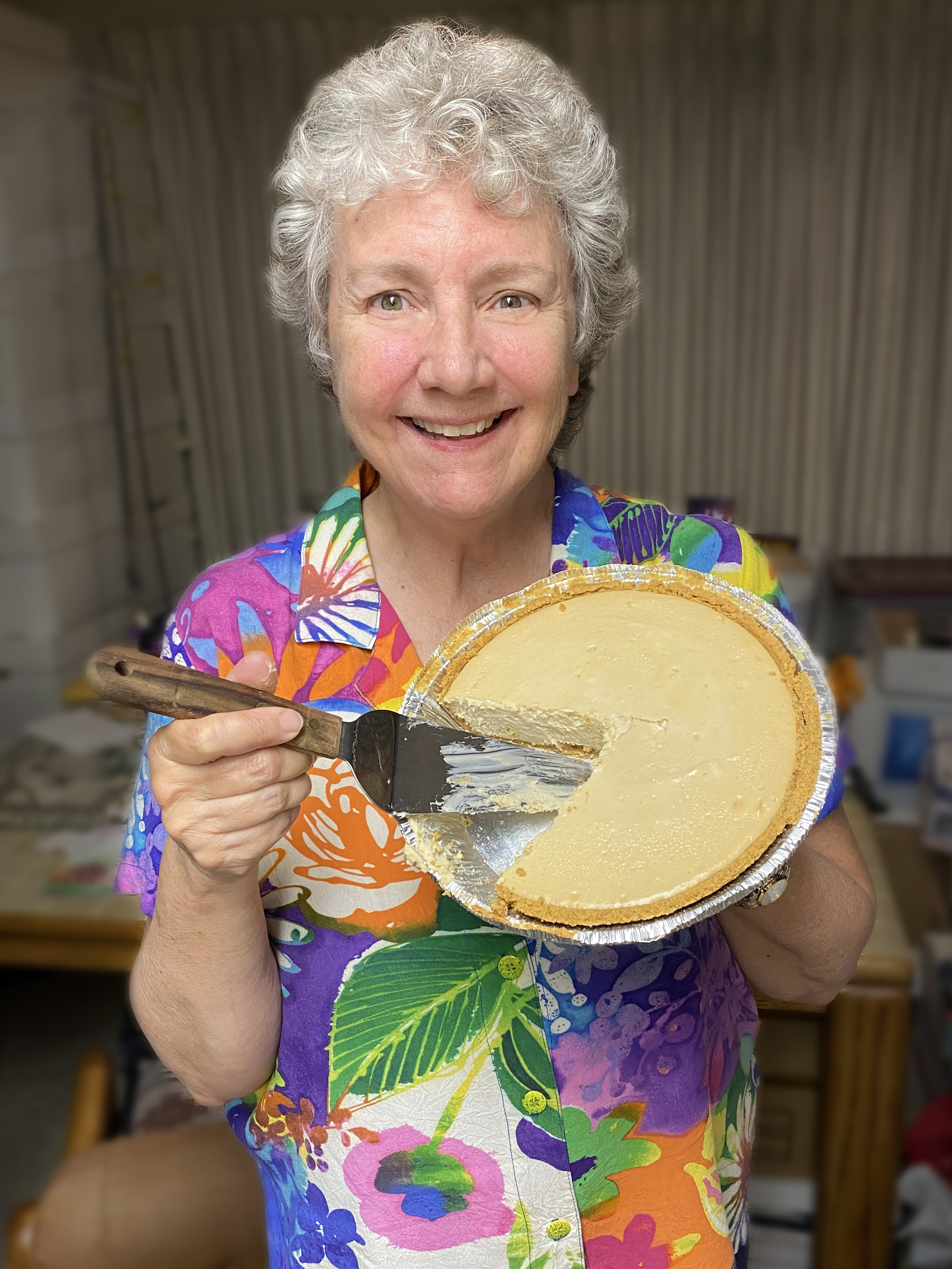
Marge Thompson putting her fine touch on the cheesecake crust.
It begins: “Crust: Crush 16 graham crackers fine…” I did, and it didn’t look like nearly enough to cover a 9-inch pie plate. Then: “Mix: 4 small or 2 large packages of Philadelphia Cream Cheese…” Wait—small? large? I saw only one size at the grocery store. What’s that translate to in ounces?
I asked Marge on the phone. “You know,” she said, “two blocks of cream cheese.”
“Are there two blocks in the little box?” I asked.
“No, just one,” she said.
“But it’s a big block,” I pointed out. “Is that enough?”
Pause. I could hear her rummaging in what turned out to be her fridge. “Noooooo, I don’t think so,” she said. “I generally use two of them.”
“So that’s 16 oz. total then?” I said. I’m not a numbers gal, but if you give me ounces, I can usually make that work.
“I think so,” she said. “I just do it the way I do it.”
That’s when I knew I needed to watch her make Mitchell’s Favorite Cheesecake. And R. agreed.
Mitchell was Marge’s oldest child, Rebecca’s (known as R. in the family) big brother, who, when asked always requested his mom’s cheesecake. To Marge, it was Helen Miniaci’s cheesecake, but Mitch and Rebecca knew better: It was their mom’s. And it was The Best Cheesecake Ever.
“It’s easy, very simple,” Marge always says when someone brings it up. She can do it by heart, but she still has Mrs. Miniaci’s recipe close at hand. I tried it at home alone, making the fatal error of using (horrors!) low fat cream cheese and sour cream, and it was a runny mess. (“Yeah,” Marge said, when I told her, “that’ll do it.”) I couldn’t get the graham cracker crumbs to set with the amount of butter in the recipe, so I added more, and it still didn’t set properly.
So R. and I decided to get some tutoring from the Cheesecake Goddess herownself in her own kitchen, no less. R. took direction from her mother as I watched, photographed and took notes. This was after I’d tried two other cheesecake recipes on my own—one using premade crust (very easy) and another with a springform pan and five eggs (for me, fancy). Marge thought so, too. Her recipe calls only for two eggs.
And she’s right—it’s easy, once you see her do it, as Rebecca and I asked dumb questions. Like when she rinsed the 1/2 teaspoon measuring thingie out after I squeezed a bit of fresh lemon juice in it for the pie filling. “Oh, you do that so there’s no lemon in there to curdle the cream. Because you need the teaspoon to measure the vanilla.”
Well, we did. She probably just tosses in a perfect splash.
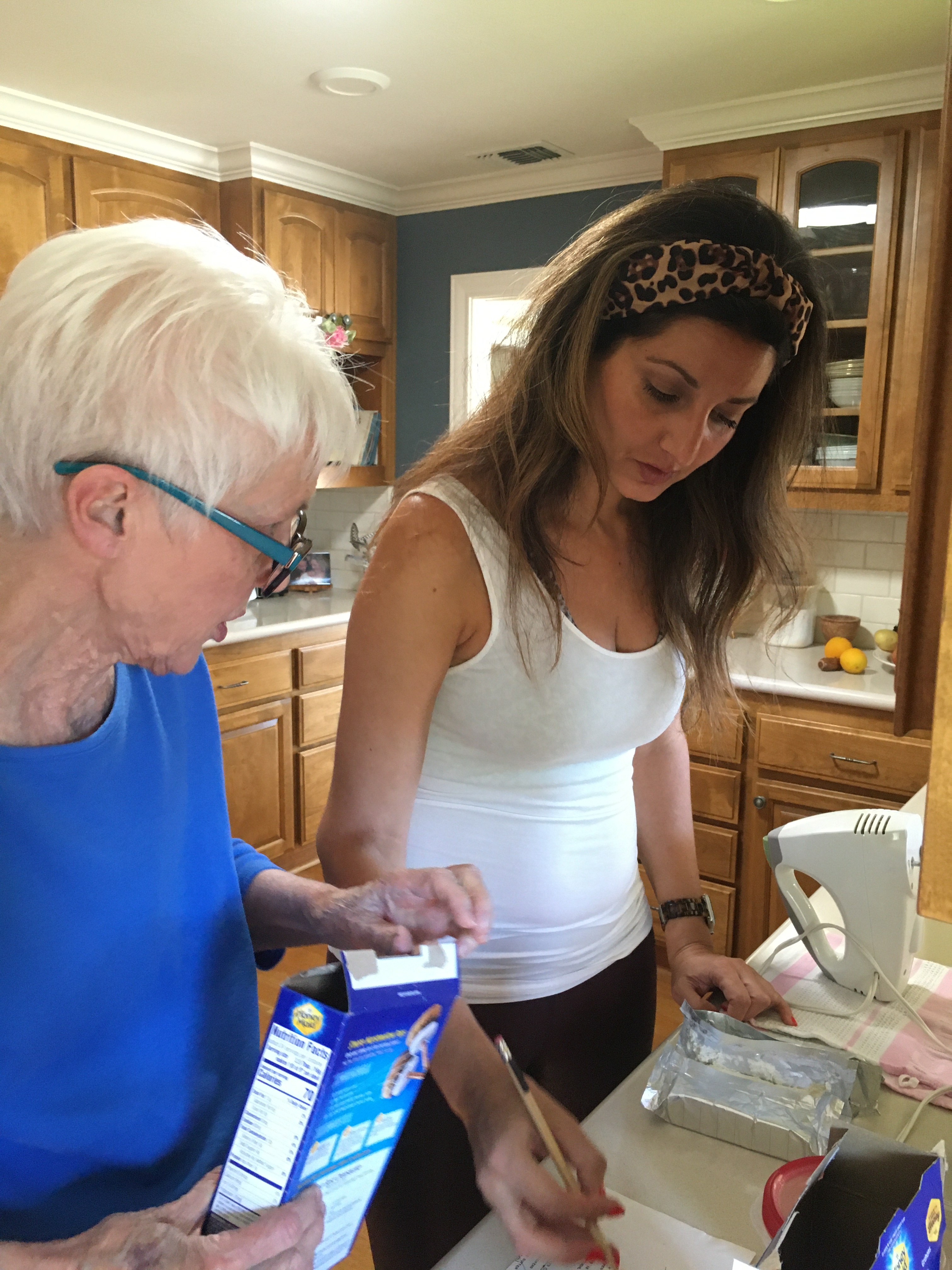
Marge coaches Rebecca in cheesecake.
Mitchell died three years ago at the much-too-young age of 43, and we all miss him terribly, especially his wife Christina and daughter Ella. I imagine that there hasn’t been a cheesecake his mother has made since his death that hasn’t brought Mitch into her mind. He was certainly with us as we practiced cheesecake.
R. followed the recipe to the letter—well, her mother’s instructions—penciling notes onto Mrs. Miniaci’s recipe.
“It’s really a pie,” Marge said more than once, especially as she pressed the graham cracker crust mixture into the pie plate. “Cheese pie.”
“Yeah, but that doesn’t sound as good as ‘cheesecake,'” R. observed.
“But it does taste superb,” I said, a veteran of many a Marge cheese pie. R. agreed.
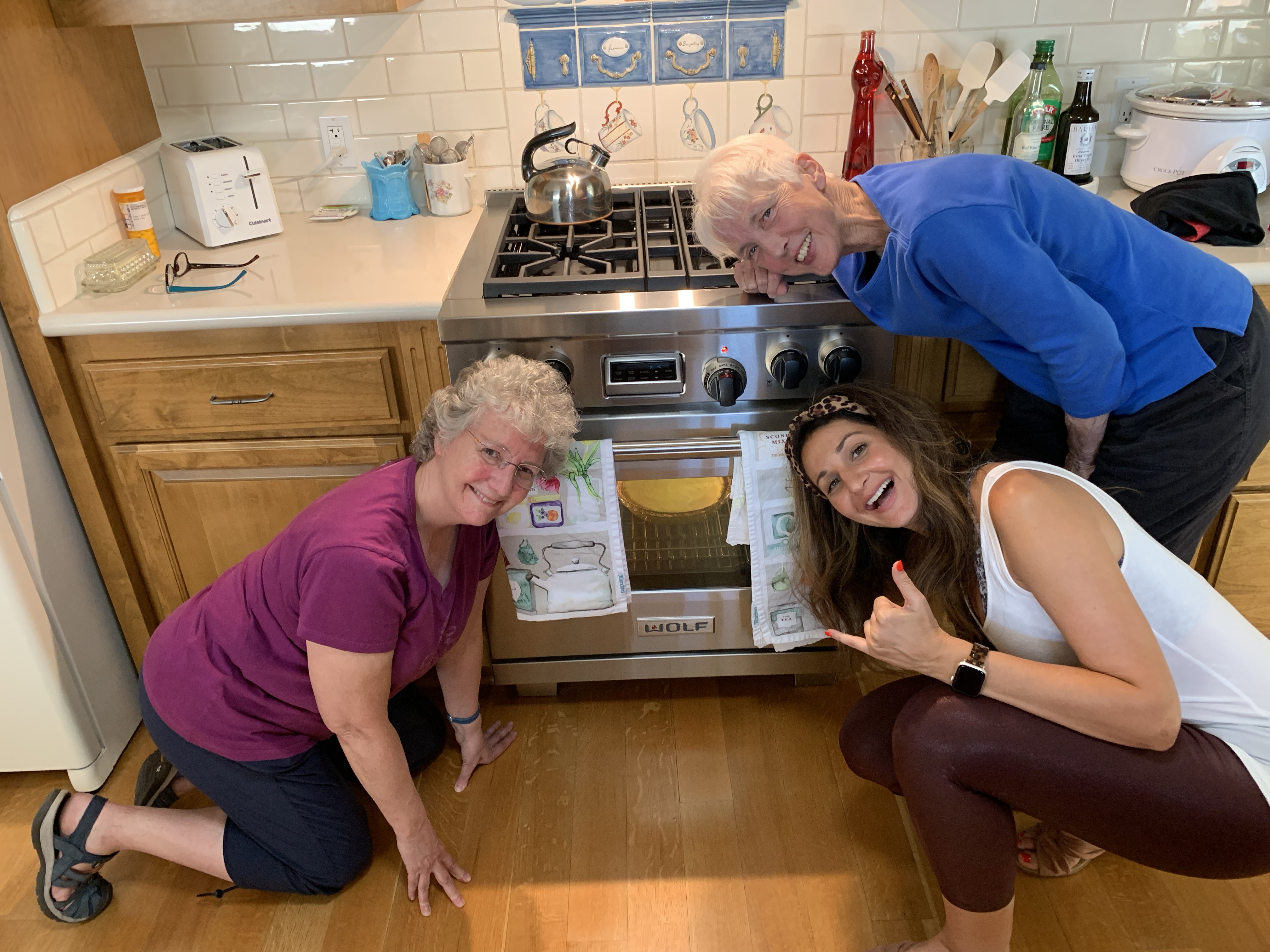
Once assembled, the cheesecake/pie went into the oven, and 25 prompt minutes (“Do not over bake!” warns Mrs. Miniaci’s recipe) later emerged to cool on a wire rack (“Gotta get me a wire rack,” I muttered to R) as we oohed and ahhed and inhaled its velvety smell.
Today at Marge’s house they can dig into the cheesecake. We all know what it tastes like—creamy heaven on a fork. It really is the best. Mitchell was right.
And Ma, it’s coming to a party just for you this weekend.
Thanks to Margery Thompson, Cheesecake/pie Goddess!
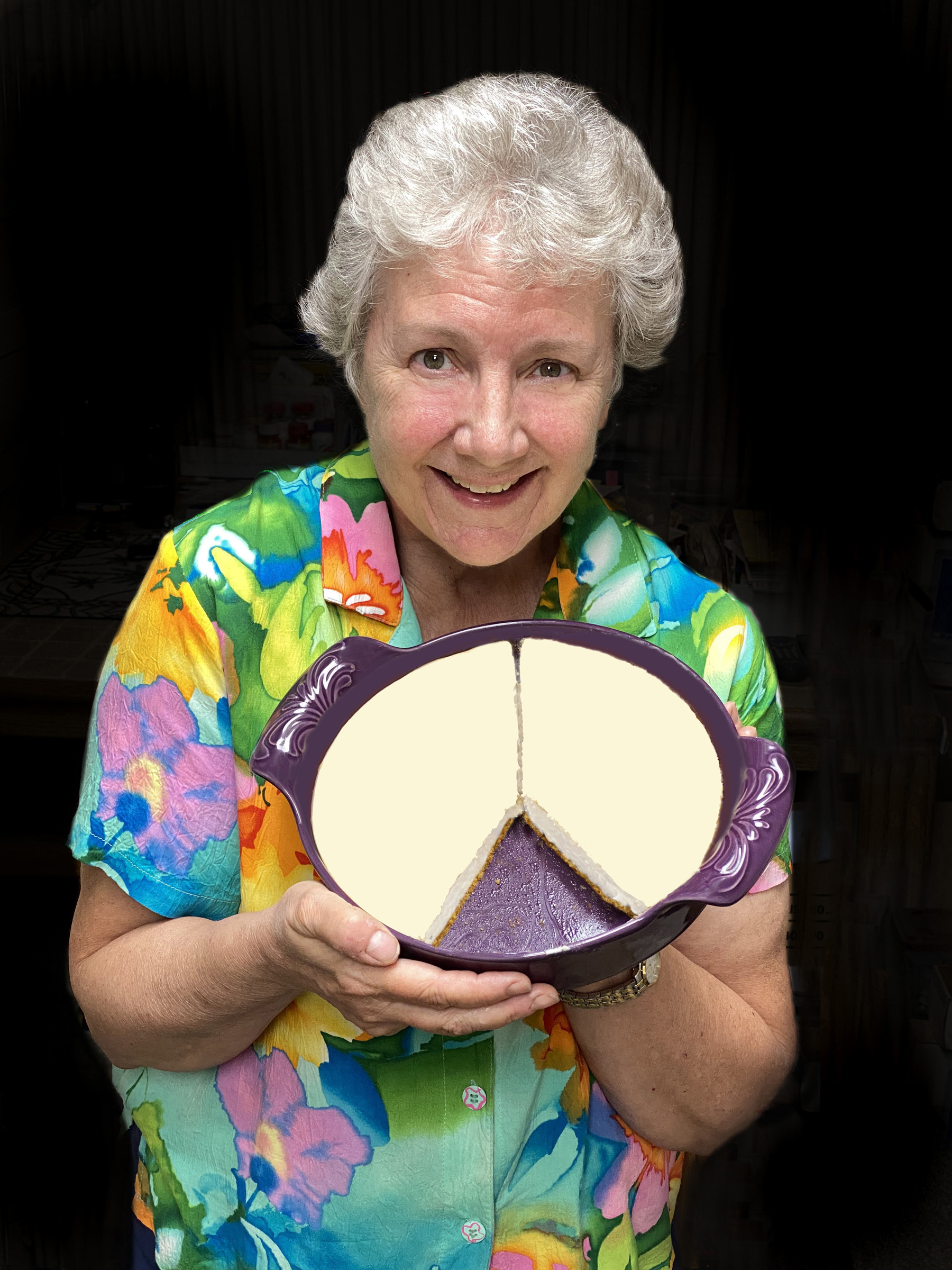
Marge the Cheese Pie Goddess and her proteges.
Margery Thompson’s cheese(cake) pie (“Because it’s really a pie,” Marge says, based on Helen Minaci’s recipe)
Heat oven to 350°
For crust (mix in 9-9.5-inch glass pie plate): • 1 cup graham cracker crumbs • 3-4 tablespoons melted butter • 2 tablespoons sugar
(Press into plate so that crust goes up sides of plate nearly to the rim. Plate doesn’t need to be greased; “there’s enough butter in there so it doesn’t stick,” Marge says.)
For filling (in a large glass or ceramic bowl)
Beat with hand mixer or food processor until very creamy, almost runny: • 16 oz. (2 8 oz. packages) of full fat cream cheese (“low fat doesn’t set up properly”) • ½ cup sugar (“basic white sugar is smoothest and easiest to whip”) • 2 eggs (“add one, beat into mixture, then add the second egg”) • ½ teaspoon lemon juice (“no pulp; tart lemons are best”) • ½ teaspoon vanilla
In separate, smaller glass or ceramic bowl, beatwith hand mixer or food processor until very creamy, almost runny: • ½ pint (“half a pint container; you don’t have to measure”) sour cream • 2 tablespoons sugar • ½ teaspoon vanilla (“rinse lemon out of measuring spoon first to avoid curdling the cream”)
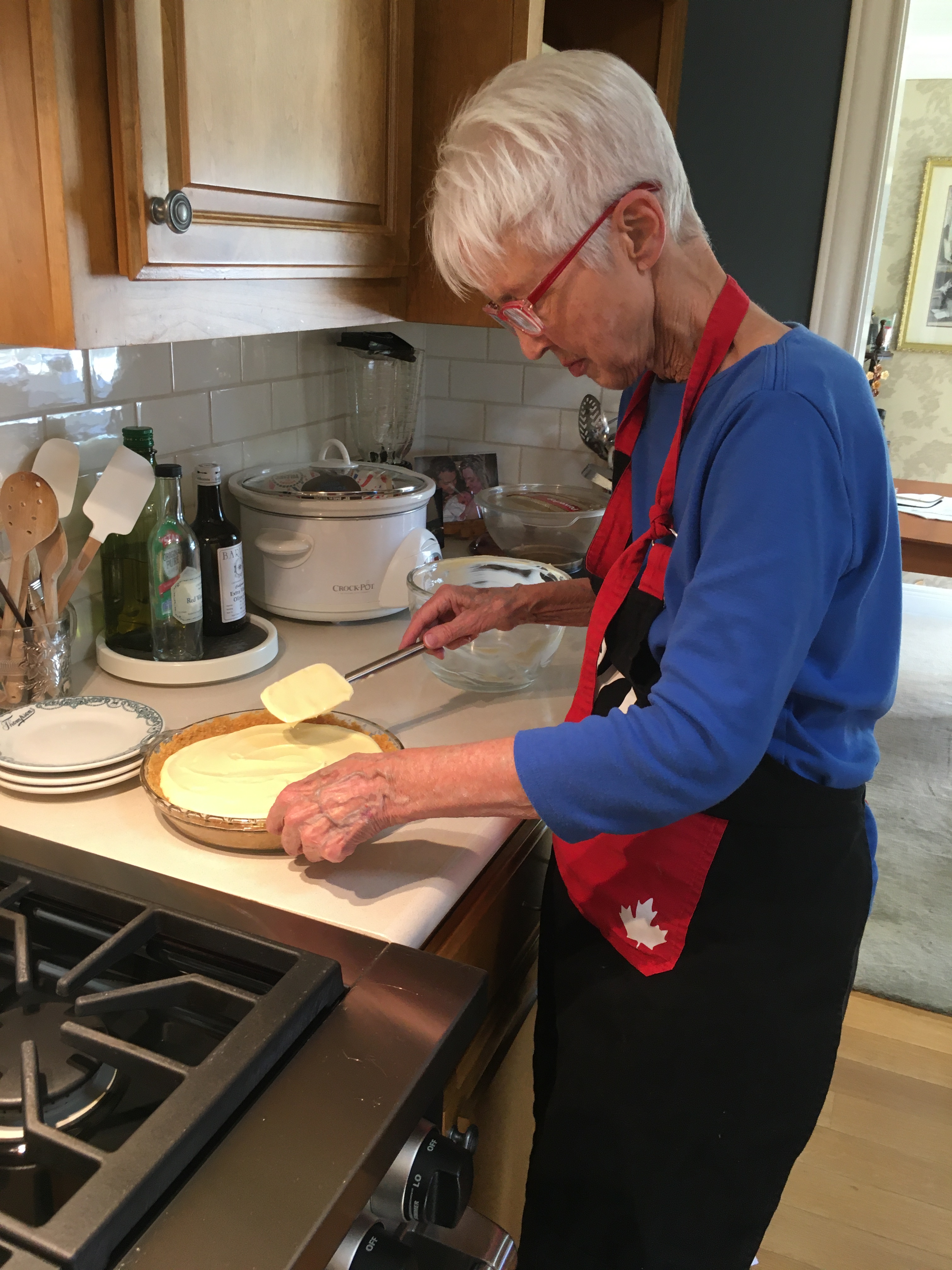
Smoothing the batter into the crust.
Fold sour cream mixture into cream cheese mixture “sloooowly to avoid air pockets” using rubber spatula to gently turn the sour cream mixture into the cream cheese.
Pour into crust, smoothing “gently so it doesn’t pull up the crust” on the sides of the pie plate. (Optional from Mrs. Miniaci: Sprinkle graham cracker crumbs on top.)
Bake 25 minutes (“Do not over bake!” warns Mrs. Miniaci). Remove carefully from oven and cool on a wire rack till completely cool (“a good four hours”) before covering with plastic wrap and putting in the fridge. Allow to chill in fridge at least overnight (“24 hours is better”). Can be refrigerated for up to two days before serving.
Optional: Serve with a berry topping (frozen or fresh).
Everyone says that, I chuckle, but not if you’re as cooking impaired as I am.
You make good brownies, you point out—you, who when you feel up to it, rise and head for the kitchen, and, in a frenzy of cookware and ingredients, turn out meatloaf and couscous salad and so much more, filling two fridges and freezers because you still want to feed your people.
From your residence on the sofa, you offer, Let’s get the ingredients, and we’ll practice cheesecake.
I don’t say, But you’re sleeping 23 hours a day. You can’t stand for more than two minutes, and you’re throwing up hourly. You’re in so much pain and on so many opioids you make Michael Jackson look like a teetotaler.
Instead, I say, That’d be fun, but you can just talk me through it.
By way of answer you reach for the TV remote, which about half the time you remember how to use, and search for the Food Network. Miss Brown will show you how, you say, and I assume that you’re hallucinating again.
I don’t say, Now you think you have friends on TV?
But you find her, Miss Kardea Brown, correct me on the pronunciation of her first name—Car-dee-ay—and start looking through episodes to find me a cheesecake lesson. And you do, after multiple attempts and stutters through cableland, and we watch this Southern chef in her home kitchen make chocolate cheesecake (you can leave out the chocolate if you want, you say) while I take notes.
Afterward you say, You can find all this online, you know.
I didn’t, I say, and you grin at me as I ask a dumb question: What’s this lemon zest business?
You’re gonna need a zester, you say.
What’s a zester? I ask because I must have missed Kardea’s lesson on that.
And, by way of explanation, you struggle to sit, wincing, breathing hard, then swing your legs around to plant your feet on the floor, sigh. Before I can protest, you rise, and I reach for you, swaying.
Follow me, you say, shuffling toward the kitchen, your favorite room in any house you’ve ever lived in.
I trail you, arms outstretched, ready to catch your depleted self, 15 pounds lighter than last month on the scale at the cancer center, as, wobbly but determined, you head directly to the drawer with the magic zester, retrieve it and wave it at me. It looks, my late furniture-building husband would say, like a mini wood rasp.
You need one of these, you say, reaching for a lemon in a blue bowl on the counter, one birthed from your tree on the deck. And you stand with me one last time at a kitchen sink, demonstrating, before handing me the zester caked with lemon rind.
Your turn, you say, coaching as you have long done—the one who taught me to properly iron a shirt, to soothe your screaming foster child, who guided me through potatoes from mashed to baked, who insisted that I read all of Austen and then all of Dickens, your favorites—positioning my hands just so on both fruit and instrument, nodding as we stand in late afternoon light soaring over Oyster Bay, absorbing this, the most tender of lessons.
You have traveled too fast over false ground; Now your soul has come, to take you back.
Take refuge in your senses, open up To all the small miracles you rushed through.
Become inclined to watch the way of rain When it falls slow and free.
Imitate the habit of twilight, Taking time to open the well of color That fostered the brightness of day.
Draw alongside the silence of stone Until its calmness can claim you.
Be excessively gentle with yourself.
—John O’Donohue
Excerpt from “For One Who is Exhausted,” from “To Bless the Space Between Us: A Book of Blessings,” 2008, Doubleday
As usual, Dick had the right idea—soon after my last semester of teaching to migrate west to the stretch of ocean that has calmed and healed what ails us again and again. Ten miles of bluff he teasingly calls South Gualala, just below the little town that pronounces itself (as you see on magnets and T-shirts) Wah-la-la.
A perfect place to begin to sink into retirement, to sleep and eat and read and dream for a week at The Sea Ranch, in Casa Pacis, the House of Peace.
Yes, we love Hawaii, but our retreat for decades on this side of the Pacific is here, and our favorite place to rent is a small house on a meadow with an unimpeded view of the ocean near Walk-on Beach. (Thank you, Klaus and Gundi!)
When people have asked what I plan to do in retirement, I’ve said (not really joking), “Sleep through June.” Though that’s not entirely true, Dick knew I’d need to rest and recover from the past 14 months of near nonstop work to recreate myself as an online writing professor. So much energy went into what I knew was my last year of work, but I don’t regret it: This old dog learned a lot of new tricks, as I’ve written before. Nonetheless, I felt as if I was stumbling into the after, as we all are, considering the what-comes-next and releasing expectations.
I’d always planned to retire the summer I turn 63, and that’s what I’ve done happily, but oh, I’ve keenly felt the need to “draw alongside the silence of stone/until its calmness can claim you.”
That’s the best part of our time in Casa Pacis—the ability to walk the blufftop trial, look out at the great Pacific which, even wind-tossed and choppy, as it has been for our last few days here, offers a calm we find harder to access at home.
The late Rev. Harvey Chinn used to tell his flock (of whom Dick was one) that successful retirement means that you wake up every morning with nothing to do, and by the time you go to bed at night, you only have half of it done.
Since I have long had summers of practice retirement, I know what that means, and I look forward to a lot more of it. I told retired folks for years, “I aspire to your status,” and now I’m so statused, another phase of this lucky, lovely life. Now I get to sink in to this way of being, take up friends on their offers of congratulatory lunches and walks, be excessively gentle with myself.
Which we all need to do in the after.
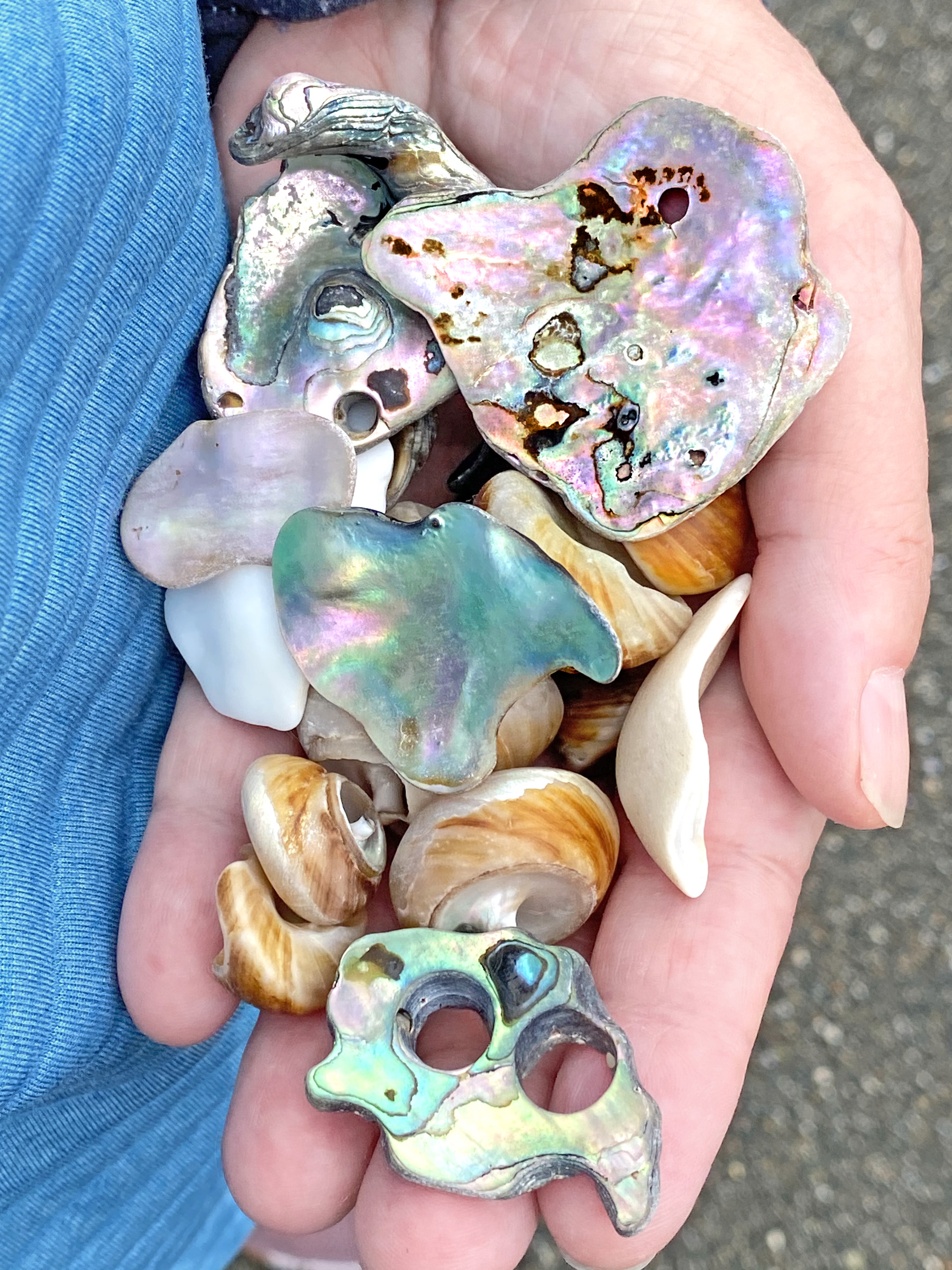
Here’s what I aspire to now: to remember excessive gentleness with self and others; to walks and yoga and gentle exercise to keep me upright and relatively balanced on my two feet; to time with friends and loved ones, including caring for those who need assistance; to delighting in unexpected treasures that appear before you, often at your feet; to time away to recharge because even in “retirement,” I have things to happily occupy me (a bit of gardening, writing, leading writing groups, publishing others).
And to promise myself not to get over busy, caught up in things I don’t want to do, to learn again that saying a polite “no, thank you” is perfectly OK.
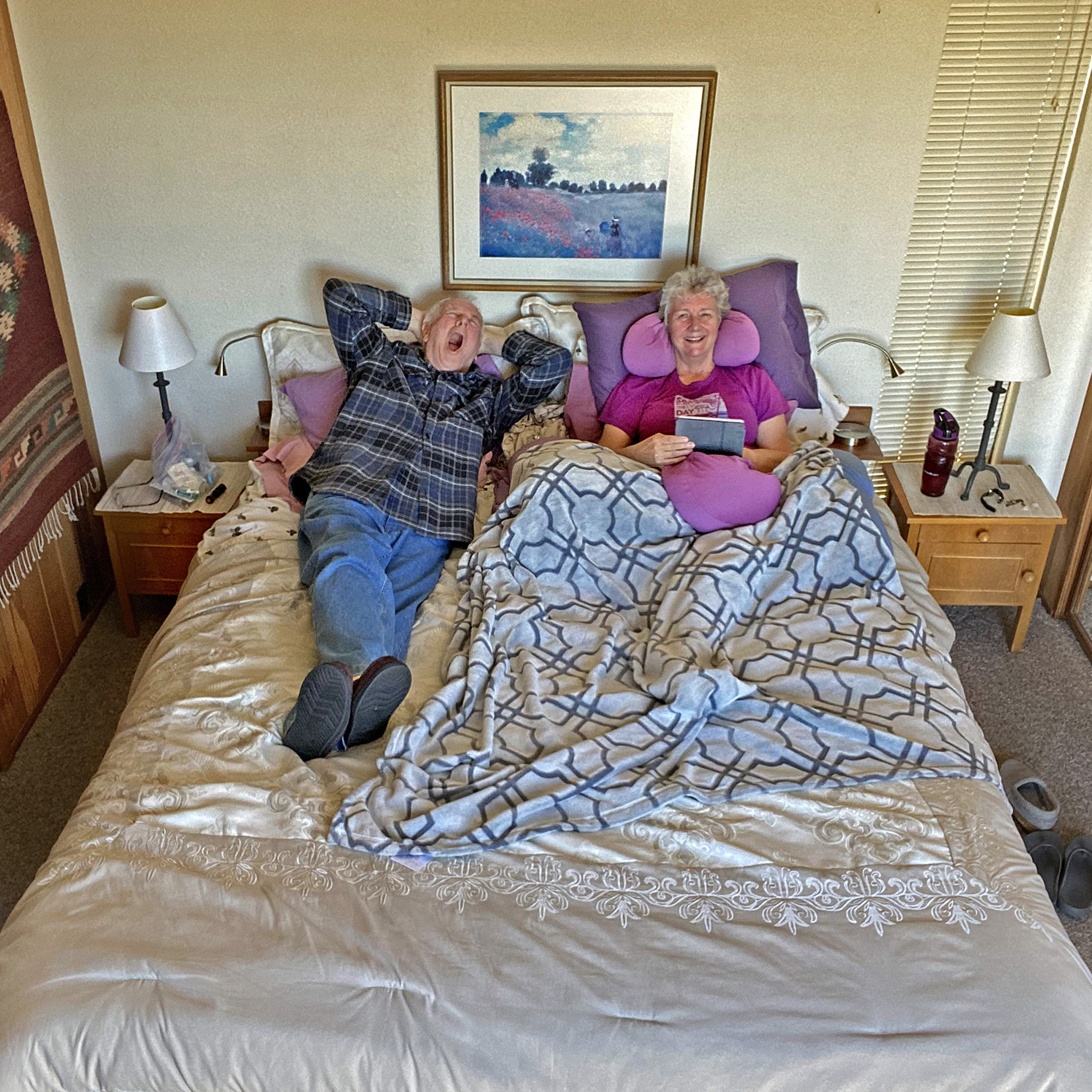
Oh, and take time every day to lie down and read/doze/whatever. Which we’ve faithfully practiced every day here at Casa Pacis. Because, as Dick says about naps, they’re easy, they’re healthy and they’re free. (He’s had a lot of practice at this, having been retired since 2003.)
Here’s to more of that and sweet, unexpected treasures in the days, months, years to come.
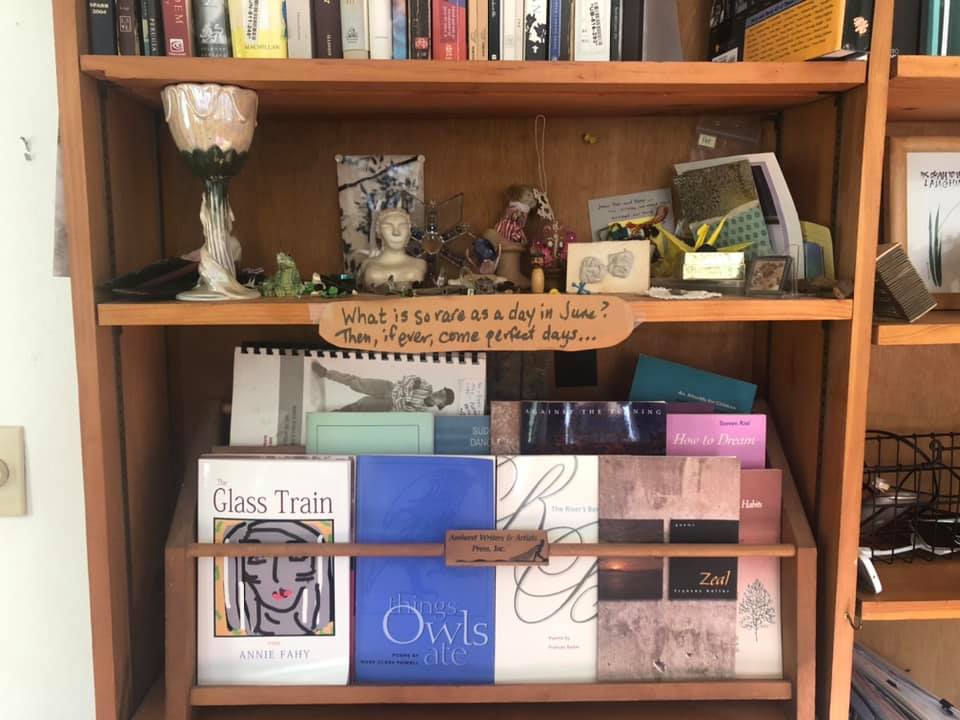
Pat Schneider’s home office, Amherst, Massachusetts, 2017
She lived as a fire and went as a coal on the hearth, yearning for more tinder until there was not one single thing left but the ash of her body and the curling smoke of her will, rising up finally and at last in peace after such a long and beautiful conflagration. It is her first birthday after death. She is leaning on the everlasting arms. Or more likely inspiring the everlasting arms to write. Happy birthday, dear fiery Mom. “What is so rare as a day in June? Then, if ever, come perfect days.” [James Russell Lowell] We love you.
—Bethany Schneider on Facebook about her mother, Pat Schneider, June 1, 2021
(for Pat)
Though you lived near it, the Pacific was not your ocean for most of your life, you Midwestern transplant to the Atlantic,
who deeply admired rivers and streams, arteries flowing seaward. How many visitors did you take to your favorite cemetery
hard by the Connecticut River, to walk among the revered dead, imagine their lives based only on names and dates?
Catharine, wife of Robert, 1779 Thankful, wife of Nathaniel, 1783
Now your stone in another cemetery bears your name atop your beloved’s, he who followed you into mystery
four months after your departure — no “wife of,” no “husband of,” though you two were that and more.
And on the 87th anniversary of your birth, almost a year after your death, I walk the western edge
of the continent, the Pacific peaceful for the moment, temporary occupant of Casa Pacis — house of peace —
as I turn the tiller into the wind. You would cheer this new direction, remind me that
a poet needs time and space to stoke the fires, let the white heat of the muse burn us into ash.
As I stroll the damp shore — white lace surf scalloping black sand — your voice surges, retreats with the foam:
“Enjoy these perfect days, regardless of the weather, so many precious hours with your beloved.”
Thankful, I look to him nearby, smile my silent promise to the horizon in this sea of serenity, forever and ever,
amen.
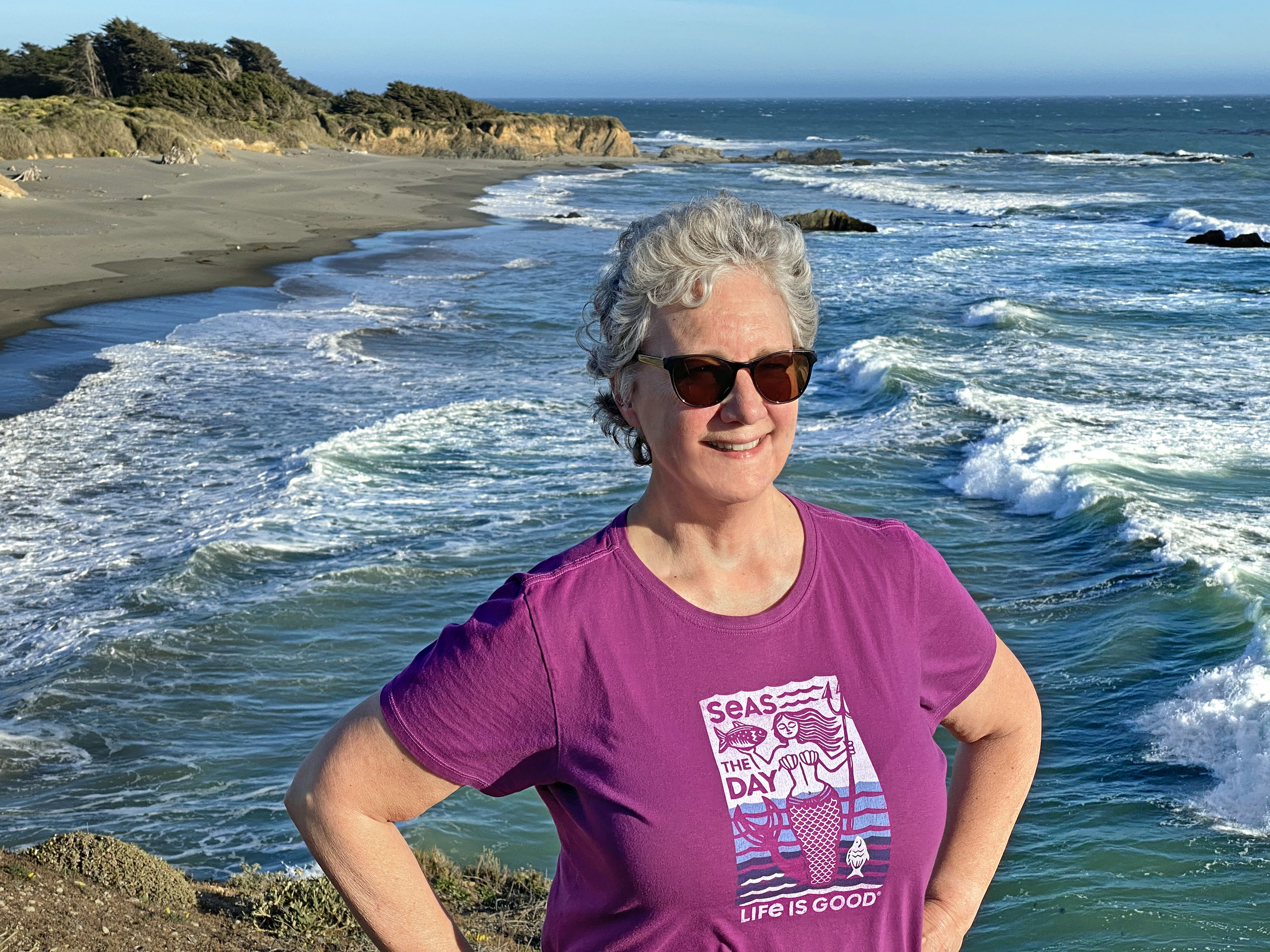
At The Sea Ranch, Sonoma coast, California, June 1, 2021, on what would have been Pat Schneider’s 87th birthday
Dick Schmidt photographing at Walk-on Beach, The Sea Ranch (Photo by Jan Haag)