It’s not every day you get to meet an AED sister, but today Dick Schmidt met Briana Martinez in Lihue, Kauai—both of them revived by AEDs after cardiac arrests in 2019.
Dick Schmidt and Briana Martinez, both cardiac arrest survivors who were resuscitated by AEDs in 2019, met March 22 in Lihue, Kauai. (Photo by Jan Haag)
Briana was a 39-year-old special education teacher on Kauai when, during a meeting at lunch, she froze in her chair, not breathing, not moving. A staff member called 911, a vice principal started chest compressions and a counselor grabbed the AED (automated external defibrillators). Before emergency personnel arrived, Briana was shocked twice and then life-flighted to Oahu where she made a full recovery.
Briana Martinez’s tattoo commemorates the day of her cardiac arrest and her resuscitation by an AED. (Photo by Dick Schmidt)
Briana is a mom of three children who is now deeply involved in sharing her story and training others in CPR and the use of AEDs. That’s what she and Jenna Tanigawa (of the AED Institute based in Honolulu) were doing on Kauai today—training members of the mayor’s staff.
Jenna Tanigawa packs up the CPR manikins used to train members of the Kauai mayor’s staff in CPR and the use of AEDs on March 22. (Photo by Dick Schmidt)
We were delighted to see Jenna and meet Briana, part of our AED ohana, to hug them and wipe away happy tears. We also invoked the name of Pamela Foster, the president and CEO who created the AED Institute that has placed AEDs in airports all over Hawaii, as well as getting them to schools and in other public places.
Team AED on Kauai: Briana Martinez and Jenna Tanigawa, who trained members of the mayor’s staff in CPR and the use of AEDs March 22. (Photo by Dick Schmidt)
We cannot say mahalo nui loa enough to Pam and Jenna for their generous help after Dick’s cardiac arrest at the Daniel K. Inoyue International Airport in Honolulu in January 2019. And, once again, our mahalo to the on-the-scene quick actions of Claudio Alvarado and Salesi Maumau moments after Dick collapsed, and to Chris Ohta of Hawaiian Airlines, who fetched the AED that brought Dick back to life.
Our deepest aloha to you all.
A happy meeting of AED ohana: (from left) me, Dick, Briana Martinez and Jenna Tanigawa. (Photo by Jenna Tanigawa)
This is the story I’ve been avoiding writing about my best friend, who died last August after 12 years of coping with metastasized colon cancer. It’s something I’d love to talk to her about—especially today, which would have been her 71st birthday—how our friendship slowly evaporated as the cancer took over every bit of her.
Not only because she moved two states away but also because I stopped bringing her my stories of successes and difficulties. I mean, really, did I want to pour my heart out about some minor slight to a woman who’d had every kind of chemotherapy and radiation possible and spent most of her days in ungodly pain, even with the best drugs?
No, I did not.
And she, in return, didn’t want to keep whining (her term) about that unending pain or all the things she’d rather have been doing than being cared for by her nearest and dearest as she slept sometimes up to 20 hours a day. Georgann had good days, when she’d rise and shower, head for the kitchen to cook for her family, one of her favorite activities. Maybe take her daughter and granddaughters shopping. Talk on the phone and listen to the stories of what her favorite people—especially her out-of-state children and grandchildren—were up to.
We both agreed that that’s what best friends do—listen well—along with having to forgive each other a lot. And we did plenty of that, too, for the unasked-for advice or the thoughtless, off-the-cuff quip that was meant to be funny. And God, was my best friend funny.
About the phrase “best friend”—“best” did not mean “only” to Georgann. I would argue (and I suspect so would she) that Georgann had many best friends. At one point, early in our acquaintance-ship, when she was studying at a university in Wales, she said, “If you write to me, I’ll be your best friend.” I did, and so did she, finishing a degree in politics as a 40-something single mum, communicating across the pond on thin blue aerograms that could be sent cheaply between Britain and the U.S. And through those letters, we did become close friends.
Georgann returned to her hometown of Sacramento (and to me) earlier than she planned because her mother died in a car accident. She often said then how grateful she was for our friendship, that I helped her through that difficult time. She returned the favor years later when my husband died at age 48. Each of us had other friends and family who were of great support, but Georgann was the one I could call at 2 a.m. when I couldn’t sleep, when I couldn’t stand crying alone. She was the first person to call me her BFF, that new, younger, hipper acronym. And I was one who babysat the three kids she adopted (again as a single woman in her 40s) and a few years later stood up for her as her “best woman” after she met Ron Turner, the wonderful man who became her second husband.
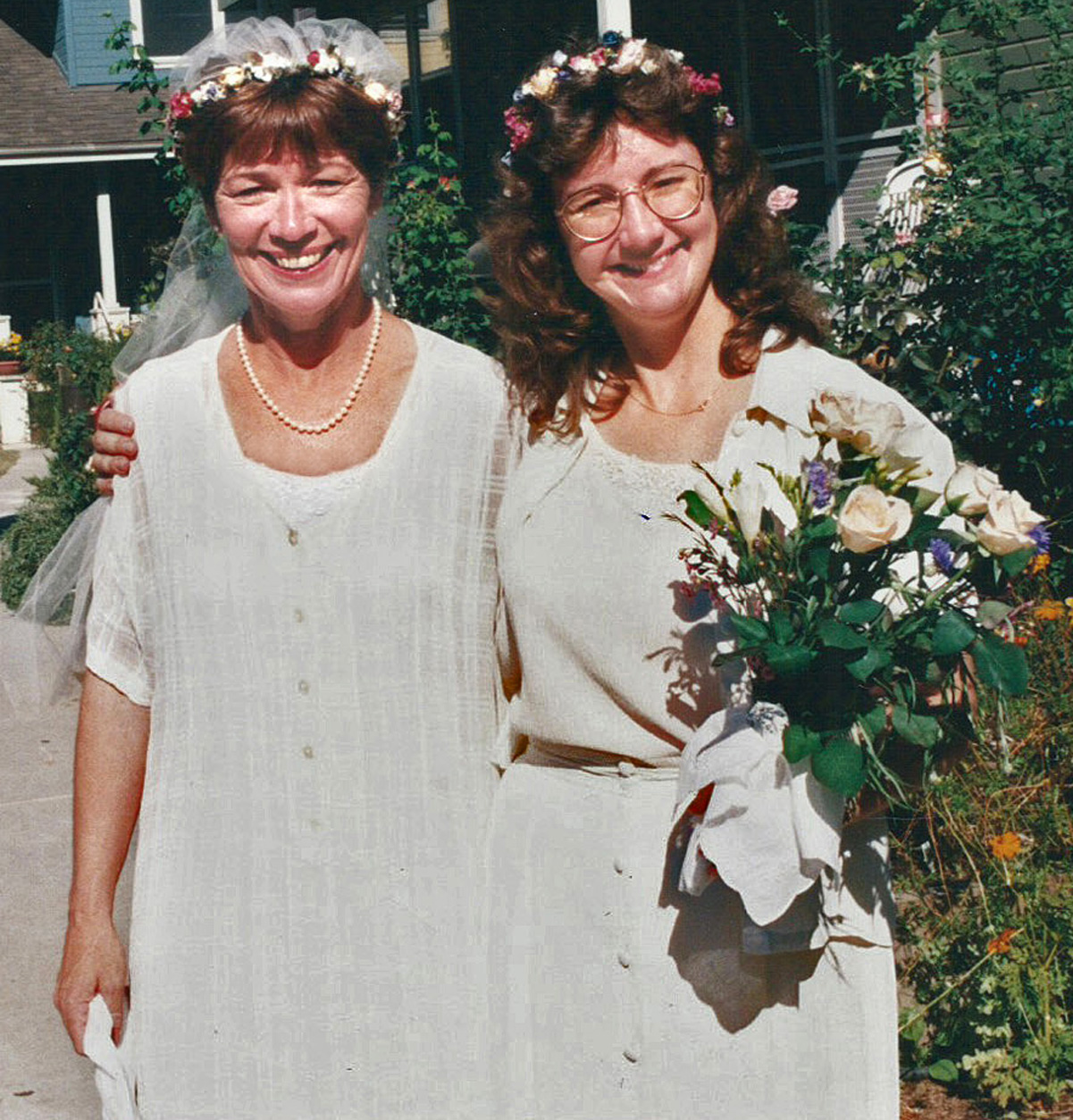
Georgann and me on her wedding day, 1996
It’s my favorite photo of the two of us on her wedding day—younger, slender, each of us in casual off-white dresses we bought at our favorite midtown shop, both of us with a wreath of dried flowers in our hair, she wearing her mother’s pearls. We are beaming at the camera. That was a good day.
*
One of the things that has hit me since her death is that I’ve not had many close friends who’ve died. I’ve certainly lost friends and relatives, including a husband, but Georgann was a sister to my heart. The only other death (which, fortunately, hasn’t happened and, please God, won’t in my lifetime) I could imagine being as devastating would be that of Donna, my only sister, or my childhood best friend Sue, who feels like a second sister.
I learned decades ago that there are things that make friends, well, friends, thanks to Oxford psychologists Michael Argyle and Monika Henderson who in 1984 published a paper called “The Rules of Friendship.” The six rules cited as most important were that friends should trust and confide in each other; show emotional support; share news of success; strive to make the friend happy; volunteer help in a time of need, and stand up for each other in his or her absence.
We did all of those for each other and more.
After writer/playwright Nora Ephron died in 2012, her friends were shocked. They had no idea how sick she was because she hadn’t wanted them to know. As Jennifer Senior wrote in a recent article in The Atlantic, “It’s Your Friends Who Break Your Heart,” Ephron’s friends were “mourning all those dinners they never had. It’s the dying that does it, always.”
I completely understand this. I’d pay any amount of money for one more dinner out with Georgann, one more evening cruising the aisles at Borders Books. But Borders died, too.
COVID didn’t help, of course, but I can’t blame our lack of regular contact on a pandemic—even if it did send me home to teach journalism and creative writing via a laptop in those early months with little to no support from my college. I had to depend on (hello!) two local female friends, also professors, with more up-to-the-minute tech skills to bail me out. And they did—again and again. I also have to give a great deal of credit to a young friend—a former student who transferred from my program at the community college to the “big school,” the university in our city. I literally couldn’t have done my job without those women. (Thanks, Timi and Rose and Dani!)
It’s also taken me a bit to realize that these friends—who volunteered in my time of need and showed tremendous emotional support—have become among my closest. Whether our relationships will last for many years has yet to be seen, but perhaps I don’t need to do what Georgann suggested, which is to take applications for a new best friend. It’s not a job one can apply for. It happens or it doesn’t, this best friend thing, with one or more people. And it can end, too, not necessarily because of disagreement or abuse or neglect. It can be no one’s fault.
Long before Georgann died, I realized that in so many ways—because of the effects of her illness and massive amounts of opioids she took to try to keep the pain at bay—she was not the BFF she had been.
She, of course, noticed it first, and would say on our increasingly rare, in-person visits and phone calls, “I’m the worst best friend ever.” I’d respond, “Of course, you’re not.” And she wasn’t. Neither did I automatically pick up the phone to ask about the kids or her (since the answer to, “How are you feeling?” was, inevitably, “crappy”) or enthuse over an accomplishment or send her my latest poem.
But, as always, she had a point. It wasn’t the same relationship we’d had when she’d need to download the latest anecdote about a frustration with one of her kids or a disagreement with her husband. Or when I’d need to mull over something I’d said or done to upset a student, or the time a dear friend dumped me, saying that we could no longer be friends without saying why.
“He’s an idiot,” Georgann reassured me and then proceeded over the coming months—as I obsessively tried to figure out what I’d done to drive this friend away—to list the many traits that made me a superb BFF. One was “best to wander a bookstore with.”
I still treasure that.
*
I have regrets, too. I apologize to her now—just toss an “I’m sorry” into the air—for the harsh judgments I sometimes felt it necessary to relay to her about situations in her life. I regret not traveling to Washington state more often to see Georgann where she lived the last decade of her life. I did visit her before she died, staying in the little guest house next door to hers in the small bayside town where she and Ron lived. She loved it there, said she’d have to be taken out of that house feet first… and she damn near was, though she ended up dying at a hospice not far away.
Over the week that I was with Georgann, one day I got to take her, via ferry, across the bay to the cancer center for the last time where she had an infusion of fluids. And though she was sleeping more than 20 hours a day at that point, she rallied, lively and chatty on the ferry, hungry (which she typically wasn’t), she told me at the cancer center. I walked to a nearby restaurant and brought back her requested burger as well as an order of fish and chips for me. When I returned with the containers, she wanted the fish and chips. I set them next to her on a small table and watched her devour two big pieces of halibut and a fair number of chips, which she pronounced “perfect.”
“As good as the ones you ate in Wales?” I teased her.
She looked into space for a bit. “I don’t remember,” she said. “But they sure taste good now.”
That was a good day. Before her body shut down completely. Before, seven weeks later, she became my newest companion spirit, as I call the dead loved ones who linger nearby.
“What do you do with friendships that were, and aren’t any longer?” Jennifer Singer asks in her Atlantic piece. She’s talking about friendships that end because of disagreements or simply growing apart. I’m talking about the ones—the most important ones—that end in death. And I’ve come to realize that Georgann, who was not my longest-lasting or oldest best friend, but “best” in every sense, is teaching me in her absence the answer to that question.
What do you do with friendships that were? If you’re lucky, you continue them with your companion spirits, sending words into the ether, talking and writing to them—even if you don’t know the ZIP code of their new location. Because the Beatles had it right: Love is all there is between BFFs, and forever, thank goodness, is a very long time.
The Little Guest House on Oyster Bay / photo by Jan Haag
How often do we forget— watching the nightly sky show, clouds purpling, the last of the day’s energetic yellow and orange rimming the horizon— that the sun will return again?
We find ourselves sinking, too, anticipating the coming dark. Perhaps the angry evening sky thunders like artillery overhead, grays and blacks bumping like colliding armies, an abrupt shift from yesterday’s painterly wisps of white scudding across blue, an egg yolk horizon brightening day’s end.
We cannot foretell what each sunrise will deliver based on the sky that closed the previous day. Sometimes we must hunker down and wait for the all clear.
In those moments, then, we close our eyes and envision our favorite sunsets, the ones that warm us, the sunrises that feed us with four million tons of light each second. In every moment, even the worst ones, we carry solar radiance inside us—reflected by unseen ones wishing us well— as we call on that hope to see us through.
That day you melted, the collapse of a self, your remains burned down to a heap of humanity on an airport floor.
Gone.
I witnessed your death and transfiguration at the literal hands of strangers who worked to pour your melted self— one that had taken flight— back into another form.
You arose that day, blue eyes blinking, ragged and bloody, lifted onto a gurney by so many sets of kind hands, the beginning of being made anew,
and we learned that resurrection is not pretty.
But in the act of revival, we become ones who can bear light, candles whose brightness cannot be diminished—
reanimated, re-formed—
our hearts reshaped by grace and everyday, imperfect human love into something we never imagined we might be.
(for Dick, honor of his third rebirth-a-versary, Jan. 15, 2022)
Diego and Georgann, Dec. 12, 2016, at Jan’s house.
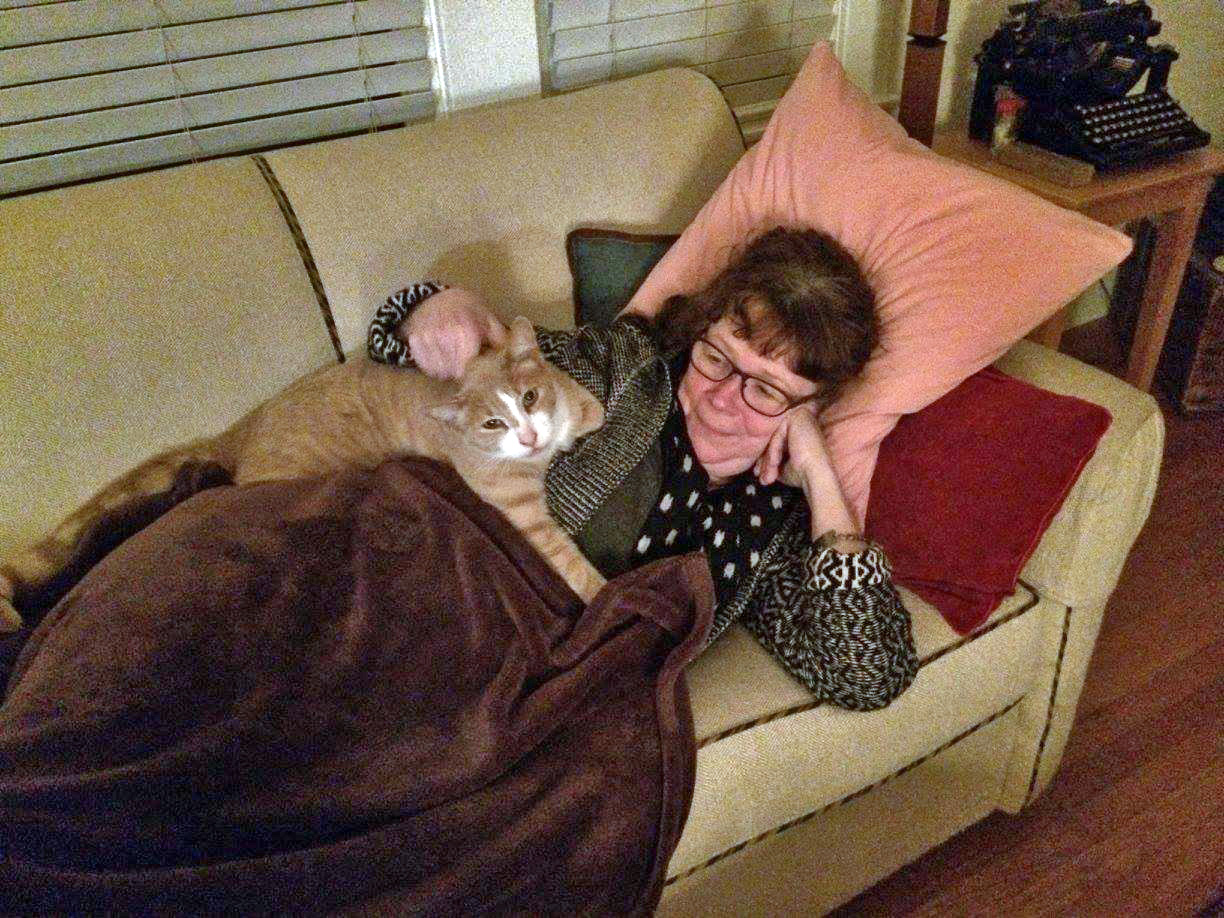
Diego, the big doofus, loves to lie on people, and here he sprawls on my BFF, Georgann (Taylor) Turner, on this day in 2016. I believe this may have been her last trip to Northern California, despite her tremendous pain as she dealt with metastasized colon cancer.
Never one to pass up the opportunity to take advantage of a warm blanket and person, Diego and Georgann rested together for a while that afternoon and evening. She, a kitty person, too, accepted Diego’s love (and enormous purr) as the great compliment it was and is. (And it is great—he’s a whopping 15-pounder of feline.)
Thinking of my BFF who died in August, as I do pretty much daily, grateful that she survived a dozen years with cancer. She wanted as much time on the planet as possible, and she got it at her home in Bremerton, Washington, thanks to the love and care of her family, particularly her husband, Ron Turner.
Thank you, BFF, for all the love… and your parking fairy, who found me a super-close spot today as dear friend Lisa and I went to the theater. We thanked her, as one does the parking fairy, as you taught me. That’s one way I know you’re still around!
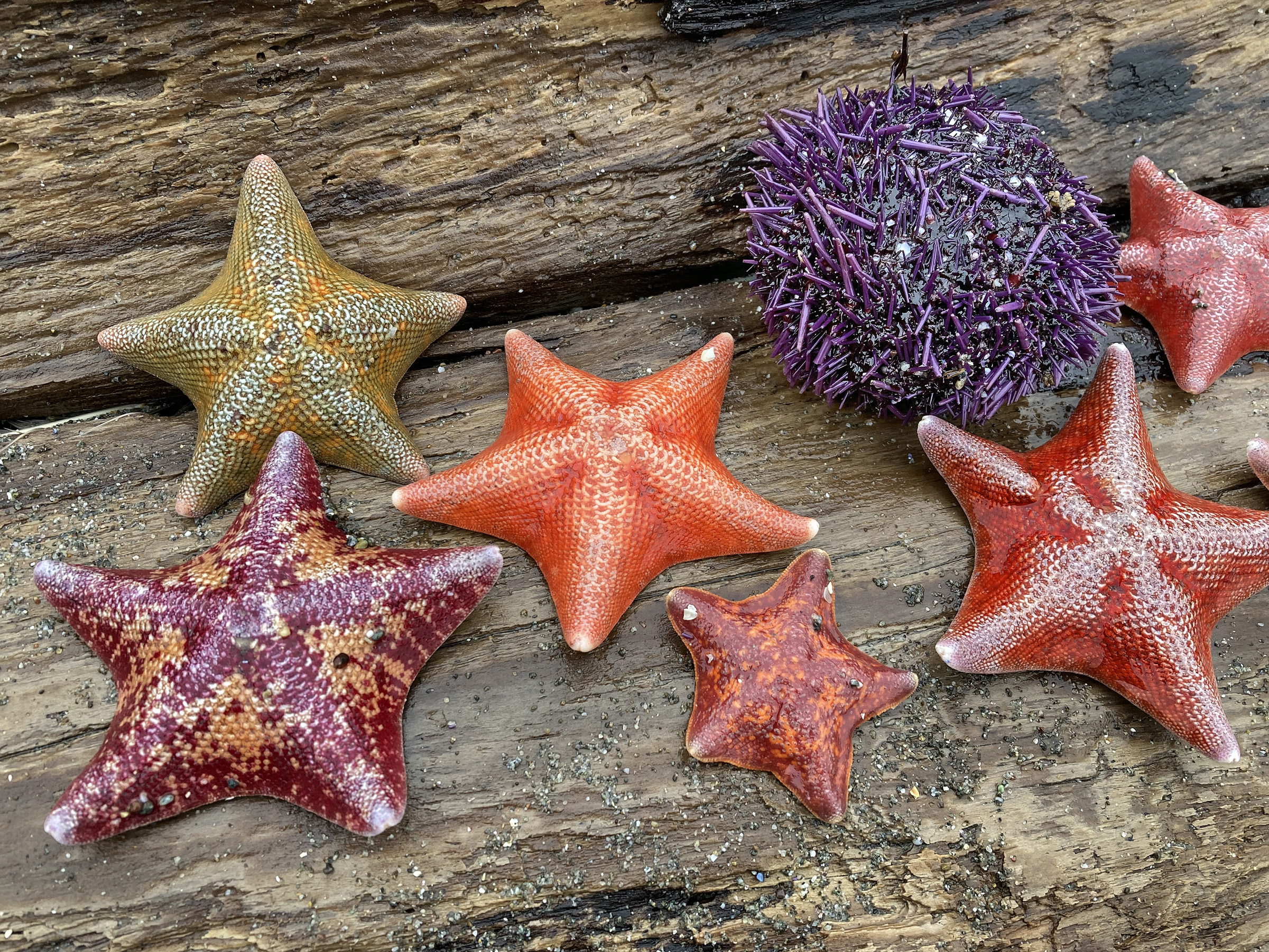
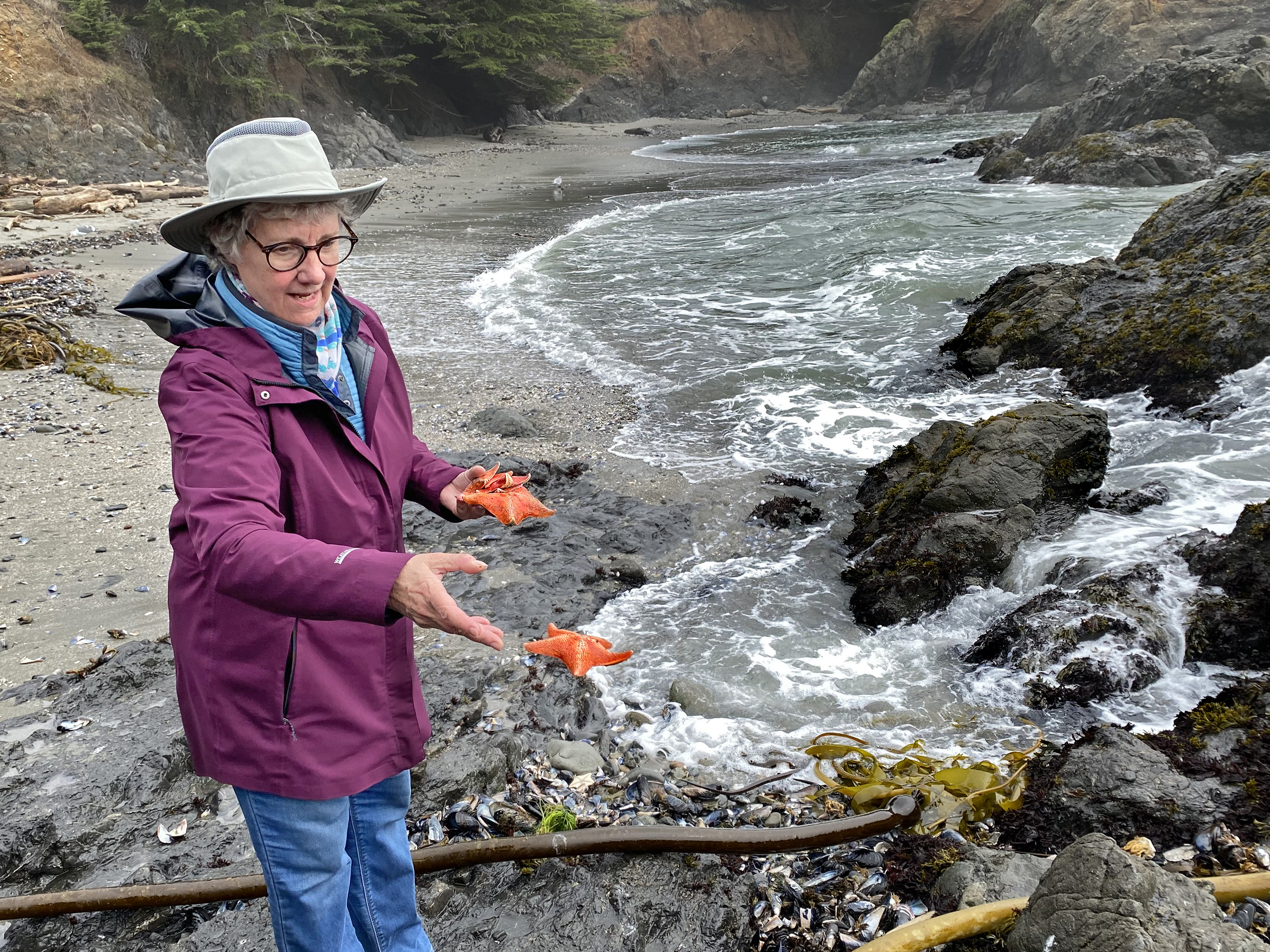
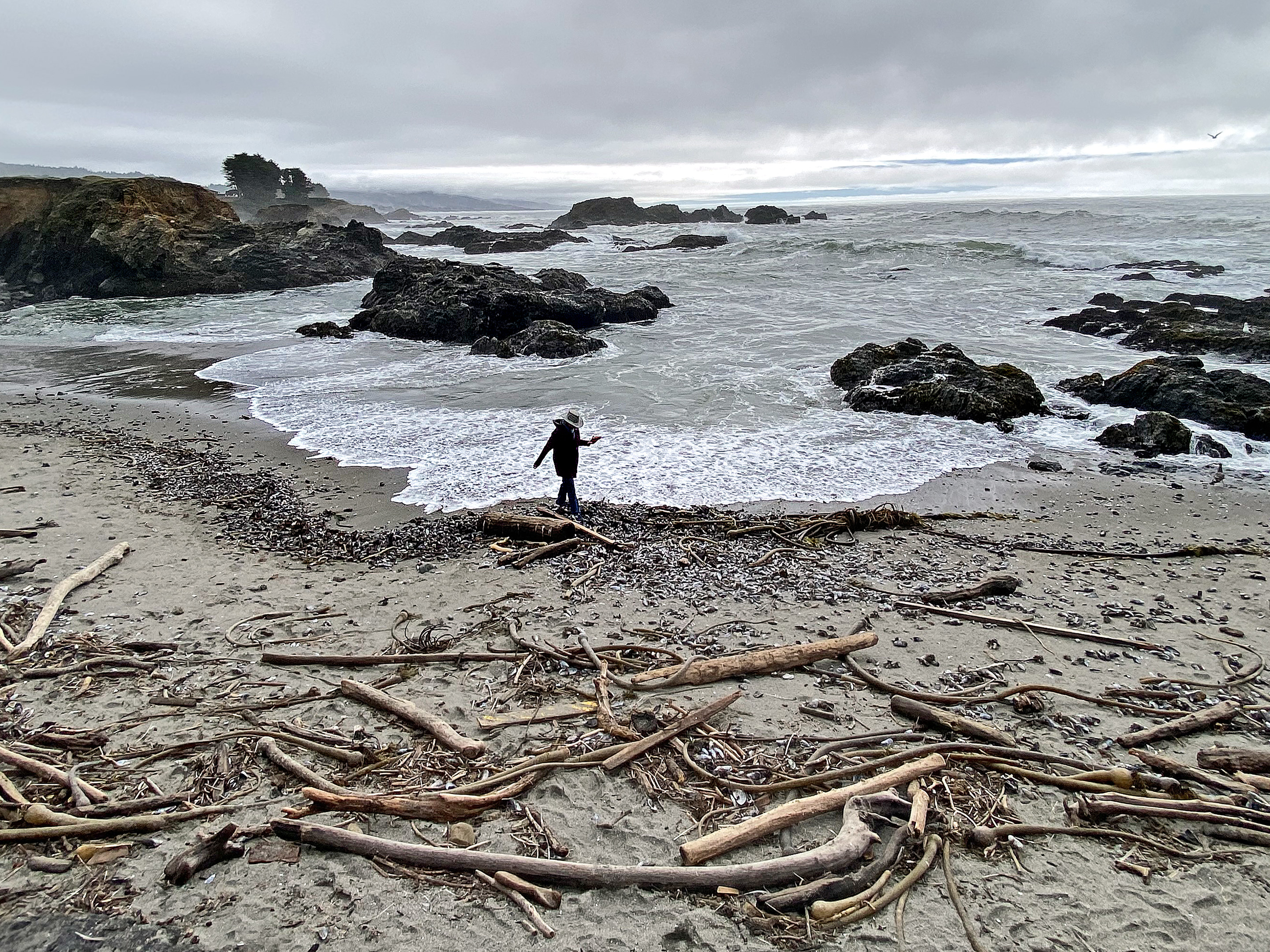
I’ve never held so many stars, but the October storm washes them ashore, bright points of light wrapped in knotted ropes of yellowed kelp and dulled mussels. Wave after wave bounces them to the sand, and, as the water recedes, I run to their rescue, scoop up as many as I can, return dozens to normally placid tidepools.
But the ocean is having none of it, churned and frothed as it is, crashing into the crevices and pools with the force of an angry god. I continue my vain efforts to restore the sea stars to their rightful home. Perhaps they—like the bent-spined purple urchins and oval gumboot chitons I send into the surge—are already lost.
I cannot tell.
For an hour I collect their carroty five-pointed bodies from the debris, cradle the rust, the crimson, the cranberry, one the color of a mottled lizard, ferry them to the corner of the cove where tide kisses land. I can do so little— the proverbial drop of water in a vast sea— but I fetch and toss the little invertebrates with great hope, small beings I can try to save in a lifetime of watching death win
Put on your shoes and walk in the world, talking to me. I’m right here with you; I’m always within reach. It’s a good time to chat, so go ahead. You’ll know it’s me when you know it’s me. But even when you’re not sure, I’m listening.
Sure, I can help you find missing things, but I’m not one of them. I have not gone astray. Death is just a change of address, remember? You wrote that a long time ago, and you were right.
No, I can’t give you my new address— it’s not a place—but when you stand in the back yard, hose in hand, watering the last yellow zinnia that insist on popping up its sunny head, even if it is October, listen with your whole heart.
When you sit in the loft with others and see what shows up as you type, when you let the words appear, take good notes. You’ve gotta whole cheering section here. I’m just the latest addition.
You did it better than you thought you did. You’re doing it better than you think you are. What it? Every it. You always have done.
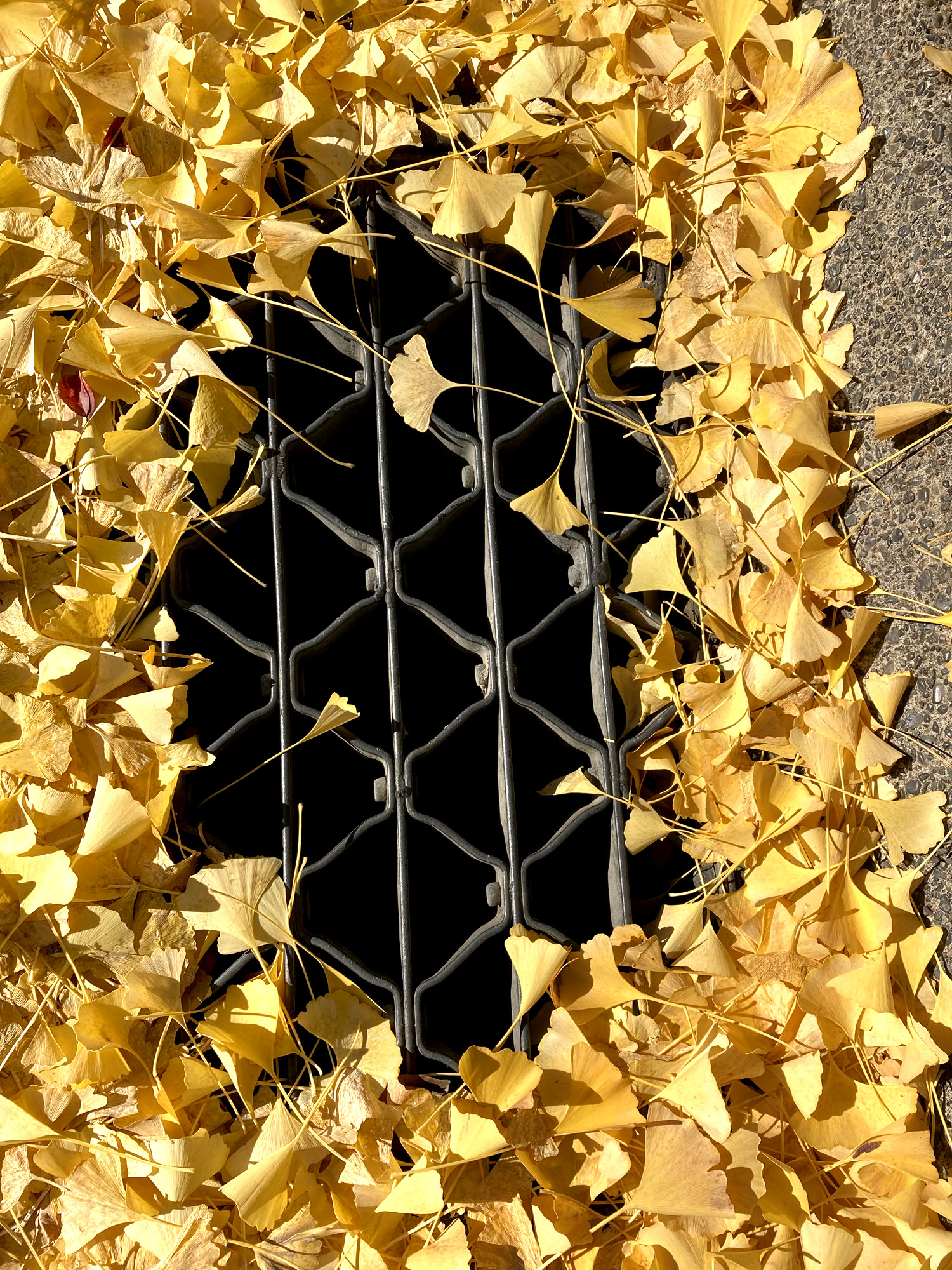
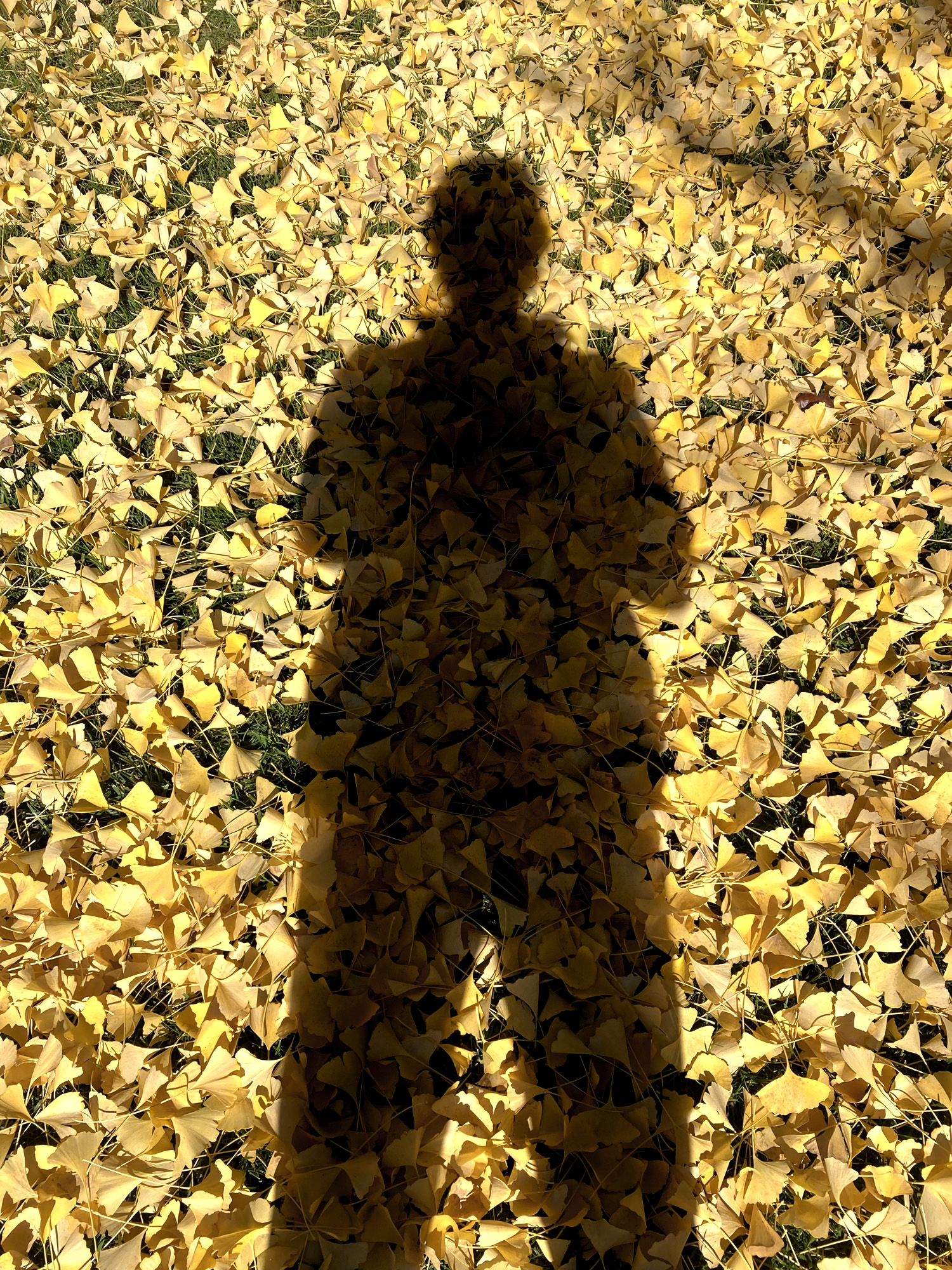
Yes, it’s fall, the dying season, not your favorite, though it was mine. Now, as you walk, inhale the cool. The heat has finally shifted hemispheres. Scuff your feet like a little kid through leaves on the path. Stop, crouch, admire their fallen state. Soak up golden gingkos and blushing maples. Pick up acorns and their jaunty caps that have separated in the falling. Relish the crunch of brittle sycamores.
Every leaf is born, lives, dies. Tuck them into your heart, where the ebbing summer and I will carry you through every winter, into every spring. As one does.
This is no ending, my friend. Trust me. It’s not.
Georgann Turner on her wedding day, Sept. 26, 1996, with her best gal, Jan Haag