Our relationship continues

eCP-copy macintosh

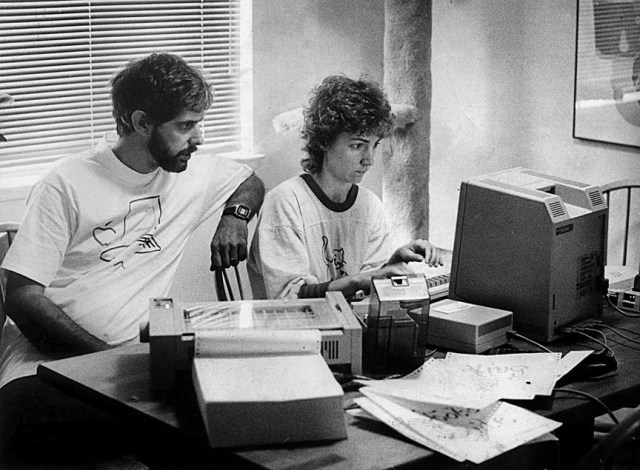
Cliff and Jan at home in Davis, 1984, with first Apple Macintosh.

(Thanks to Margo Fowkes for asking me to write this for her fine website, findyourharbor.com, a place where people tell stories of their grief after losing loved ones. You can find this essay on that site here, too.)

One person was brave enough to say it after my husband died: “You weren’t living with him. Why are you still so upset?”

I hope I was charitable to that person, that I didn’t snap at her with the answer I often gave people who asked more nicely:

“We’d been friends since college, and even after we separated, we rebuilt a friendship around a house we still co-owned and a dog we both loved. We saw each other every weekend. I helped him change his IVs after he left the hospital during his last illness, though he lived almost an hour away. We were family.”
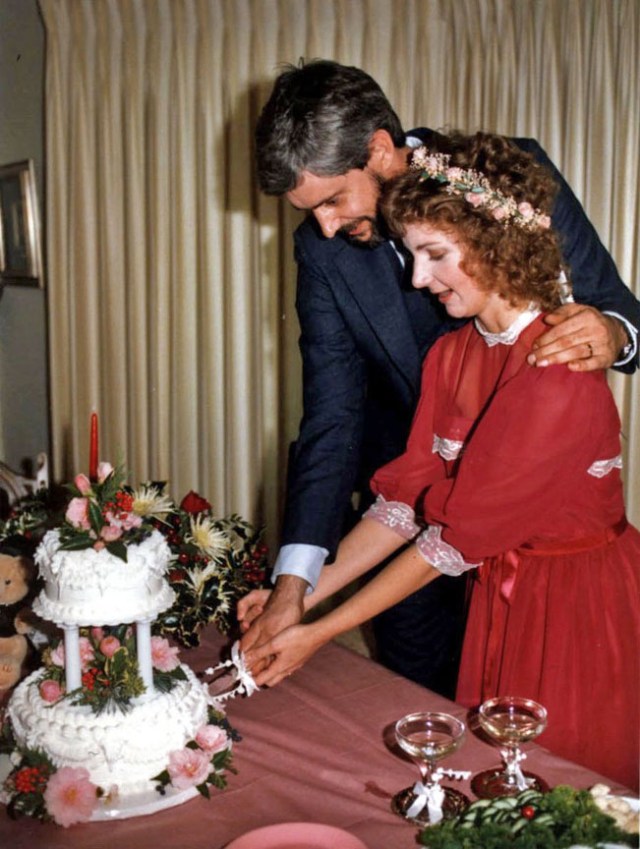
eCP-copy cake

Dec. 17, 1983

One of the reasons we decided early in our marriage not to have children was because of his illness. He’d told me that he didn’t expect to live a long life. Cliff had been a sickly baby, as they said in his family. They kept him alive as an infant with goat’s milk because he threw up everything else. He grew tall and skinny, no one having any idea that he had congenital heart deformities that wouldn’t be discovered until his early 20s, during an exit physical for the Coast Guard. Though he grew stronger after surgery to replace his faulty aortic valve, Cliff was never truly well.

But he was shy and kind, and he adored me. Even when I said that I could no longer live with the depression that often pinned him to the sofa on weekends, he said, “I’ll help you move.” And he did. I have rarely experienced such overt demonstrations of love as those from Clifford Ernest Polland, who died alone at his home in Winters, California, on March 18, 2001.

When I got a call from the county coroner that spring day asking if I was his wife, I said yes, of course, knowing that bad news was coming. (Coroners never call to wish you a good day.) I asked them to leave him as he was when he died, so I could see him. I raced to his house to find him slumped in the oak Arts and Crafts-style recliner he’d made in our garage, an IV in his arm still trying to pump antibiotics to quell the infection around his artificial valve. He wore the pump and bag of penicillin in a tummy pack around his waist. I reached into the pack and turned off the beeping pump, indicating that the bag had run dry.

Then I sat down on the floor beside one of his big feet that had fallen off the ottoman and took that cold, cold foot into my lap. It felt like marble. I looked at his chin settled on his chest, thinking about how often I’d seen him sleep like that. I prayed that his ending had come quickly. It had, I learned later, from the pathologist who did the autopsy. The valve hadn’t failed; he’d had a stroke, always a possibility due to the required blood thinners.

“Oh,” the pathologist added. “You might find this interesting: His heart was three times the normal size.”

“He always did have the biggest heart,” I said, though I meant it metaphorically.
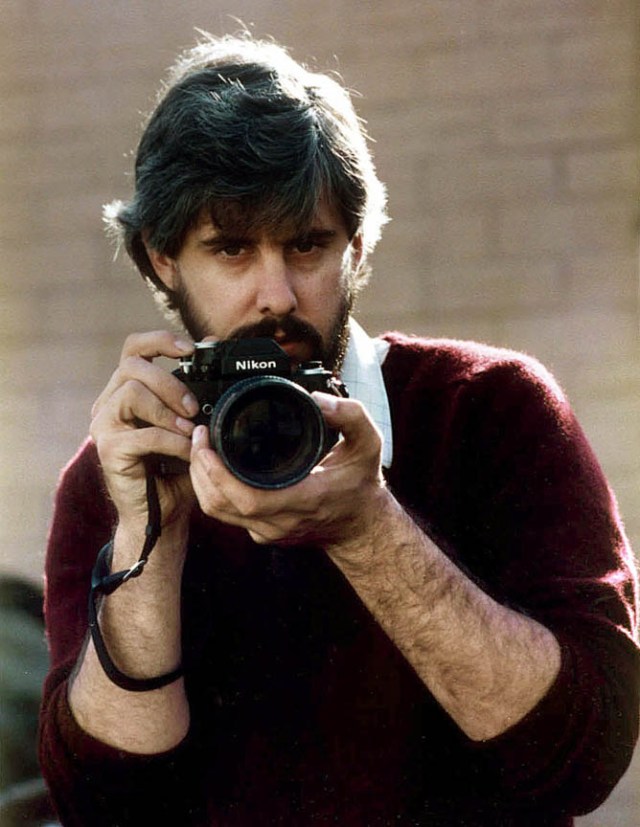
eCP-copy nikon

At work, The Vacaville Reporter, 1984

I don’t recall many details during the days and weeks that followed, though after a week off I went back to my job teaching writing at the community college. Colleagues stepped in to proof the campus literary journal before it went to the printer because I couldn’t concentrate long enough to do it.

One of the things I learned very quickly was to ask specifically for things I needed, not to be afraid to say, “I can’t manage this right now. Can you help?” Everyone I asked said yes, of course, because so many people want to help, but they often don’t know how. Some folks would say, “Let me know if I can do anything,” but often the grieving one can’t think of what anything might be. I learned to make lists of what I couldn’t manage—even the most basic things like remembering to buy toothpaste—and then, often without my asking, someone would appear who could do that thing for me.

That was the other thing I learned: Angels appear when we need them, especially in times of great grief. We just have to have the eyes to recognize them, not to say, “I’m fine, really,” but instead to say, “Yes. Help, please.”

This extended to letting people feed me. Often, after someone dies, people show up the first week with food. But many of us who don’t feed ourselves well at the best of times need food support for weeks or months. I loved it when people would call or email and say, “Have you eaten today? Would you like me to come feed you? Or can I bring you your favorite burger/salad/whatever?” At times I’d forget that I even had a favorite burger/salad/whatever. But when someone would ask, I’d realize that what I really wanted was a hot fudge sundae. And that someone was happy to comply.

(Grief is no time to be worrying about your weight, by the way.)

I was also reminded that this was a time to allow help to walk in the door. Sometimes I asked; sometimes people offered. But I think of my mother, who kindly paid for Cliff’s autopsy when one wasn’t originally planned because I wanted to know why he died (not from a failure of his artificial valve but from a stroke, it turned out). My sister, who accompanied me so many times to Cliff’s rented house to help me clean it out. She scrubbed the inside of the filthy oven in that house until it gleamed. Cliff’s best friend Rick who happily adopted his dog. His sisters, too, arrived to lend their hands and hearts. It made all the difference.
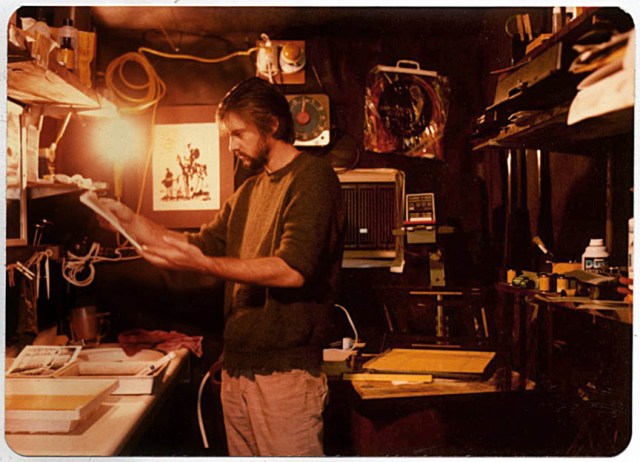
eCP-copy darkroom

Cliff in his home darkroom, Rescue, Calif., 1981

I think the highest calling for someone who wants to help is to be the person who shows up. I didn’t need someone with me all the time, but I did need someone I could call in the middle of the night. I had a few of those people, and even when I awakened them, they would listen to me talk and cry and give me a big EGBOK.

My grandma loved EGBOK, which stands for Everything’s Gonna Be OK. I needed lots of EGBOKS because boy, did I have guilt—after all, I’d left the sick, depressed guy. He died alone. I broke his heart. What a terrible person I was.

But dear ones convinced me (as did my therapist, whom I saw twice a month for the first year) that I was uselessly torturing myself. My therapist—bless her—insisted that I tell her about every one of my alleged transgressions and failures, which no one heaped upon me but me.

“Now is that really true?” she’d ask gently.

And, little by little, I came to believe that most of what I thought was not true.

It was that conscious walking through grief with my therapist that brought me back to writing, which has always been my other good form of therapy. I imagined that I’d write profound essays about my relationship with Cliff. But what emerged at first were pinched, stilted little poems. I wrote them anyway, knowing they weren’t, technically, “good,” but hoping that by getting it out of me and onto the page, it would become a healing thing. It did. The page can take whatever we dish out, I’d long preached to my writing students. It was never more true for me than in that year after Cliff died.
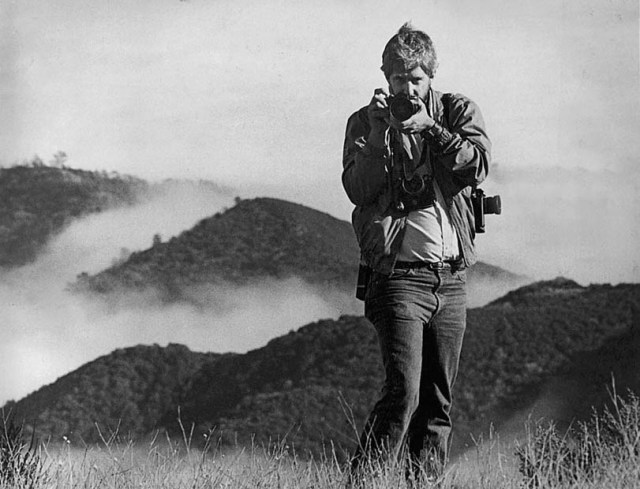
eCP-copy hilltop

Cliff at work, Vacaville, 1984 (Photo by Dan Trevan)

And here’s where that writing led me—to hearing his voice, to feeling him around me, though this took months and months. Those first poems, with time and editing, improved and eventually turned into a poetry collection called “Companion Spirit.” Because that’s what Cliff had become.

Even eighteen years after his death, I feel him with me. Sometimes I’ll hear him in my head, offering an “atta girl, Toots.” I sometimes feel his presence in the empty passenger seat as I drive or smell wood shavings and dog—classic Cliff—when I walk in the front door. About once a month I’ll awaken in the night and feel as if we’ve just had a conversation. It always makes me smile.

And I’ve learned, as I wrote in a poem in “Companion Spirit,” that:

Death is merely a change of address,
and loved ones wend their way home
like turtles or salmon or whales—
by smell, by feel.

The relationship has changed. I can’t call him on the phone; now I speak into the air. I often say, “Thank you, Clifford,” and while I’m at it, I thank the other companion spirits, the dead loved ones, who I hope hover around me, too. I’ve learned that our relationship continues. It goes on as long as I do.

And that is the biggest gift, among many, that Cliff Polland left me. I am beyond grateful.

 

Posted in Uncategorized | 9 Comments

Equals

You can get through your whole life
without one, I tell my students.
Really. You can. Periods and commas
will do you fine, if you use them
correctly, if you resist the urge
to polka dot a page or sprinkle
them through a field of letters
like so many chocolate chips.

If a period puts a button
on the end of a sentence,
halts a declaration, and
a comma serves as a mere pause,
when you combine them—
that simple dot over a curvy
wink—you arrive at the spot
dividing two complete thoughts.

A semicolon creates parallels;
it speaks of relationship—
your road running next to mine,
each of us equals,
holding our own weight
in this lovely dance
of a sentence together.

semicolon

Posted in Uncategorized | 4 Comments

Poet friend

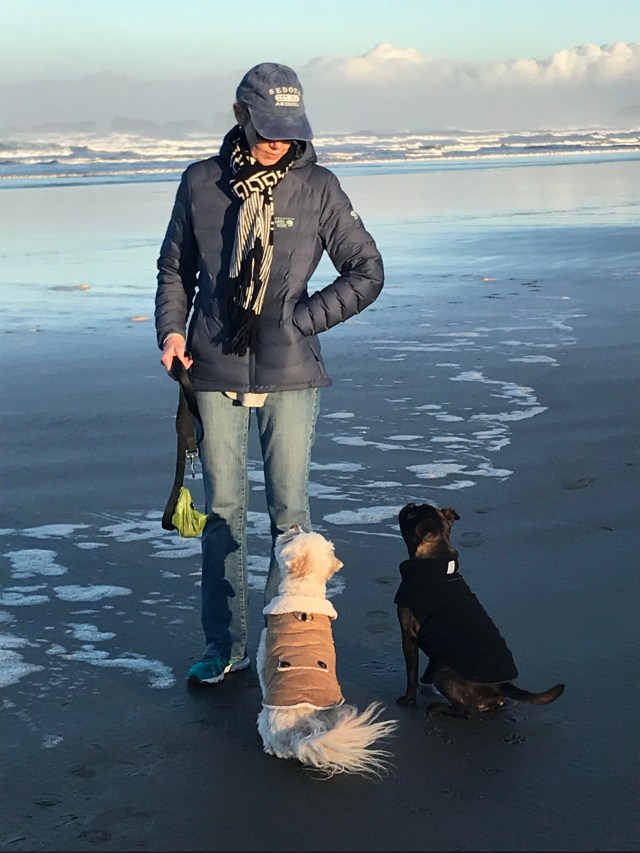
e-Marie dogs beach

Marie with Finley and Luna (photo by Rose Varesio)

Thinking of my dear poet friend Marie Reynolds on the first anniversary of her passing, grateful for so much about her… among other things, that she was able to hold her book of poetry, “Seaworthy,” close to her before she died, so happy with that great achievement. It is a fine collection, and I am honored to have published her elegant, wise poems with the help of some of her local poet friends.

She was my best poetry buddy, editor, gentle critiquer, and her suggestions were always spot on. I miss her for that and for her devotion as a friend. But in the wake of her passing, Marie left us many gifts, not least some of her friends who’ve become closer, people with whom we can remember and celebrate her.

I am so pleased to call Rose Varesio, Annie Andrighetto, Susan Flynn, Julie Brower and others my new friends. I’m also grateful to her family for their love and care at the end of Marie’s life. Thanks, Marie, for your bountiful gifts to so many.

light year

(for Rose and Marie)

how long is a light year?
you asked

i looked it up:
a unit of length equal
to the distance traveled by light
in one earth year,
about 6 trillion miles
or 9 trillion kilometers

a trillion has 12 zeroes
after a number,
which feels like a very
dark year

like this one,
missing her

because the second
definition of a light year is:
very far, in distance or time

which is how she feels
to us much of the time, like
the milky way stretching
over 200,000 light years

except for moments
like now, when we talk
about her, and she’s
right here, in our spiral spur
of milky river across the sky

in that pinpoint of light
in the corner of the room

just there
and there
and there

Posted in Uncategorized | 11 Comments

Schlepping rocks II

es2735pano

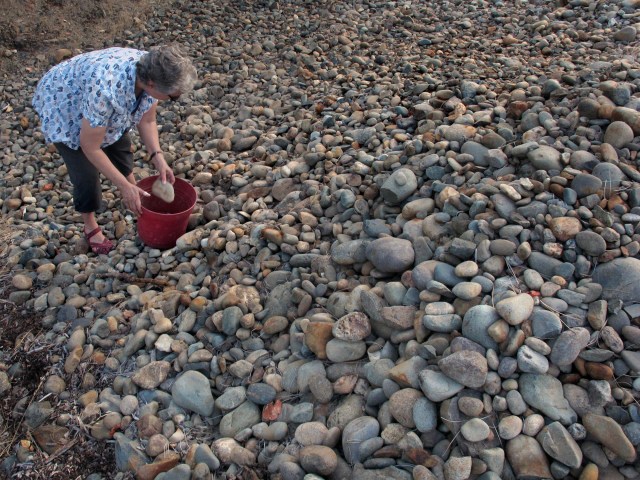
A half century later I’m the one searching
for those piles of rocks along Auburn Folsom Road.
The man who led us there died 15 years ago,
and I begin my quest for river rocks thinking of him.

But as I drive past the spots where we once hefted rocks
into the trunk of my father’s Chevy, the two-lane road
has morphed into a four-lane highway, one side
rimmed with houses, shopping mall, light rail
replacing railroad tracks. No longer a safe place
to pull over and paw through piles overgrown
into hillocks sprouting grasses and trees.
Five decades of rain and dust and debris have turned
the mounds into living organisms—although perhaps
they always were alive, those river rocks keeping
their stories to themselves.

I want these rocks—suddenly attached to memory
like ions clinging to water molecules. I want
them in my life again, in my yard,
far downstream from where I started.

As I drive and search, the prayer arrives:
“Our father, who art in heaven, Roger be thy name,
guide me to a quiet place where I can safely
lift rocks in peace, in the name of all that is holy—
river, rocks, you, the universe, amen.”

And I turn down a road into a space once populated
with grasses and oaks, perhaps a deer trail or two
the only way through, to find myself arrowed
into a small, empty parking lot. I park, head down
a bike trail that I suspect meanders toward Lake Natoma,
dredged more than sixty years ago from American River soil,
those rocks joining the huge field of tailings left
a century earlier in the rush for California gold.

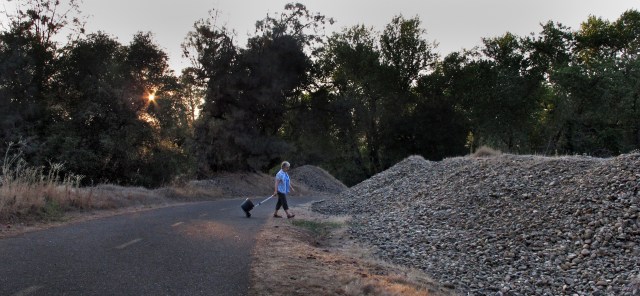
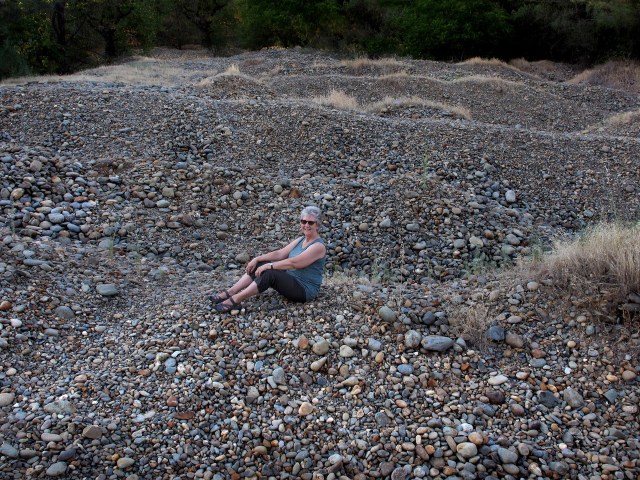
0288 jlh rocks10cr

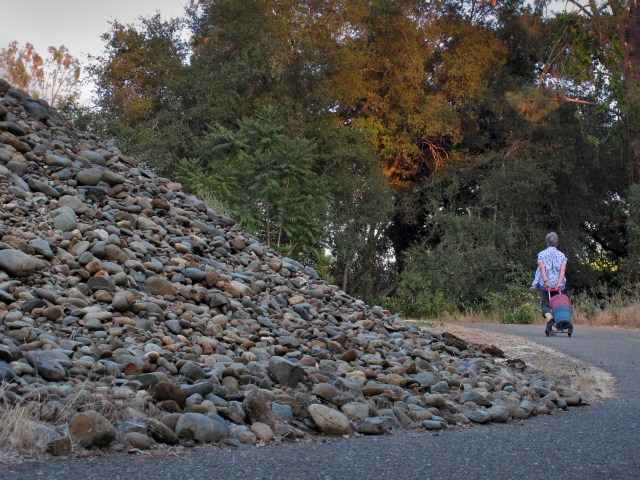
And around a curve they stand, gleaming as if brand new
under summer sun: naked mounds of river rock.
I climb one pile, feel stones shift as my weight
bears down, chuckle at the top to see a field
of exposed piles undulating northward,
as if deposited just for me.

I grin my thankyouthankyouthankyou to the sky,
set to work hefting, selecting, tossing keepers toward
the bike trail, know that I will come back, come back,
come back to this place outside of time.

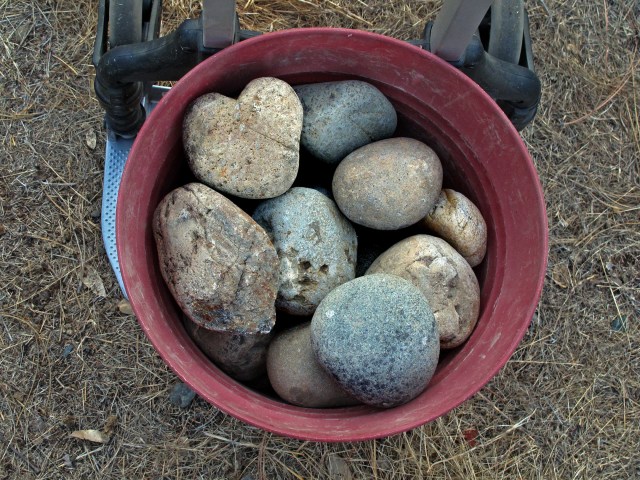
Again and again I will load rocks “yay big,” as he
used to say, into a red bucket on a wheeled cart,
tow it up the trail behind me to my own waiting Honda,
transfer each rock into that welcoming space,
head back down the trail for more—
each step a meditation,
each rock a memory,
each breath
love.

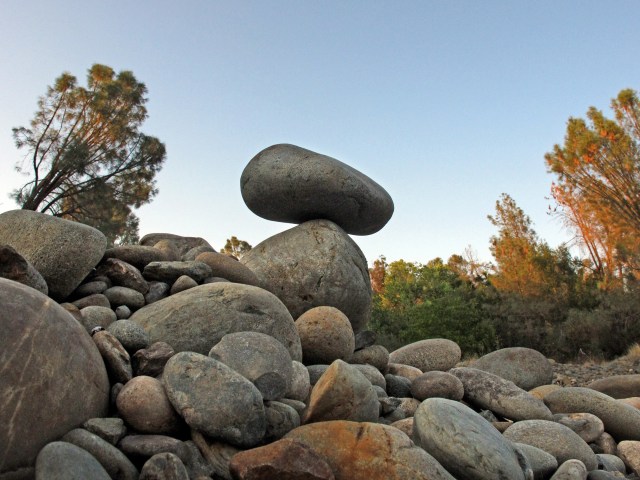
es2751cr

Photos by Dick Schmidt

Posted in Uncategorized | 4 Comments

Schlepping rocks I

es2822cr

How many times did he load us into the car,
my mother, my sister and me, head south
down Auburn Folsom Road by the huge mounds
of tailings left over from gold mining days?
There, we’d pile out, he’d open the trunk,
and tell us to look for rocks “about yay big.”

“Yay big” was a different size every time—
sometimes small enough for a child’s palm,
sometimes ones that took two hands to lug
to the trunk. But my father, young, crewcut’d,
before his belly grew and his enthusiasm shrank
for yard projects, had rock walls to build.
And there they were—all those lovely, roundish
river rocks dredged from the American River,
just sitting there.

The summer men walked on the moon
for the first time, my sister and I imagined
not astronauts on another world retrieving rocks,
but Gold Rush miners lugging them in wooden
wheelbarrows, then later bucket dredges that
assembled great piles like pyramids, a field
of humped stones 10 miles long and 7 miles wide.
I didn’t know then that the river was dredged
to build a second dam downstream from the one
that created the lake we swam in, skied on,
saw as ours—Folsom.

es2802cr

My father was as proud of those dams
as if he’d built them himself, ones that
ended annual flooding of one of the rivers
that circled Sacramento. Years later, when
I migrated to the college hunkered down
next to the American bordered by tall levees,
my father assured me that, no matter
how much it rained, I’d be safe because
of the dams upstream.

I think of that in winter when rain pours
and the river rises fast, once again
channeling the liquid mystery of movement.
“California doesn’t do water well,” my father
would say. “It’s either too little or too much.”

Sometimes during deluges, I head for my alma mater
snuggled next to the levee and climb its manmade
steps to the top. I watch the hefty American
rush its muddy way to become one with
the Sacramento surging down from Mt. Shasta,
and, thus braided, forging on to the sea.
I think of the rocks embedded in its rich soil—
perhaps like those still lodged in moondust—
that will likely never see daylight, others tumbling
in the current that carries the stories of river,
the whoosh of watery highway,
right past us.

es2707cr

Photos by Dick Schmidt

Posted in Uncategorized | 2 Comments

Gettin’ the band back together

alabama hills jlh bday 11.5x6.9 copy

The great birthday 2012 birthday surprise: Cora Johnson (left) pops into the Alabama Hills.

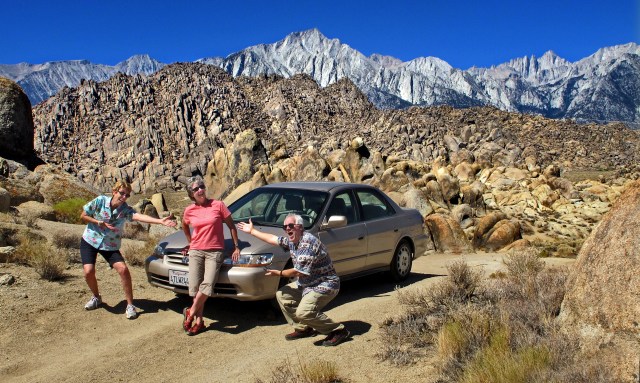
Some years ago Dick pulled off a nifty surprise for my birthday. In July 2012 we took a driving trip down Highway 395, along the back side of the Sierra Nevada range, overnighting in Lone Pine, which is the perfect kickoff spot for, among other things, the Alabama Hills. Beginning in the silent movie era, Hollywood folks migrated north to film movies in the Alabama Hills, gentle contours of rock set against the rugged peaks of the Sierra.

The morning of my birthday we were in our hotel room in Lone Pine when we heard a knock at the door. I opened it to see our dear friend Cora Johnson, who had driven up from her home in Southern California just for the day to surprise me. That’s the kind of friend she is.

8766 cj jlh surprise1cr

Cora surprises Jan on her birthday, 2012

Gunga_Din_Temple_movie_set

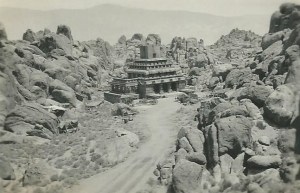
The set for “Gunga Din” in the Alabama Hills, 1938, standing in for the hill country of India

We spent that lovely July 30 driving around the Alabama Hills, looking at spots where old movies were filmed, including “Gunga Din” and Tom Mix and Hopalong Cassidy cowboy film, and later “The Lone Ranger” and “Bonanza.” We also toured Manzanar, the former World War II relocation camp, where some 120,000 people of Japanese ancestry were incarcerated. Then Cora aimed her car south and drove home to Cerritos.

Cora, of course, and her BFF from college, Connie Raub (both of whom have known and loved Dick for more than a half century), were the two angels who literally flew to his side in January. They mother hen’d Dick for two weeks on Oahu after his surgery to help him regain strength and confidence before flying home with him to Sacramento. In mid-February. Since they both live in snowy places (Cora now lives in Minden, Nevada, and Connie many years ago moved to Colorado Springs), getting home from Sacramento proved to be tricky. Cora ended up spending some extra time in Sacramento at the home of Dick’s sister and brother-in-law Marge and John Thompson. Then the Thompsons drove Cora halfway up the mountain where they met one of Cora’s Minden friends who delivered Cora home at last.

I often remind people who think that Cora and Connie had a lovely two-week vacation on Oahu of these two things: (a) They were taking care of a man recovering from heart surgery, monitoring his medications, blood pressure, exercise and food intake, and (b) They all froze in the little rental house Pearl City, Oahu, in the clouds (no heat in those houses), far from the ocean. In other words, it was not easy duty, but they were a superb example of longtime friends and the things you do for love.

8812 cj climbing rockCR

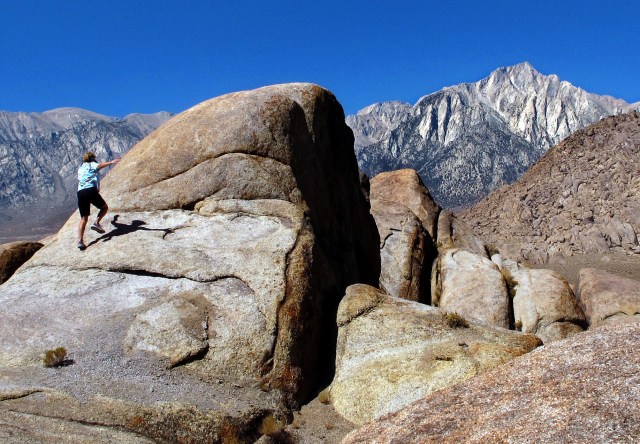
Cora boulders in the Alabama Hills, July 30, 2012  (Photo by Dick Schmidt)

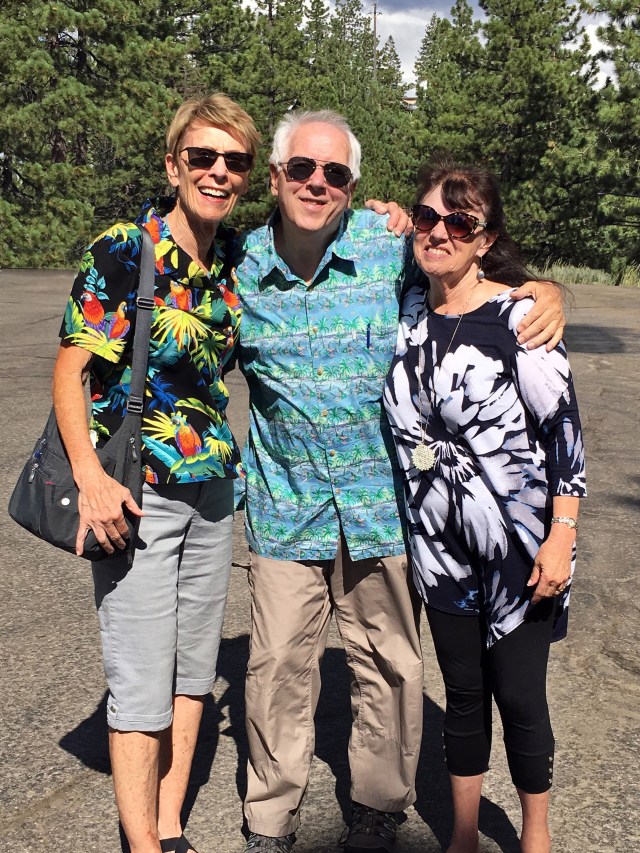
I say all this to explain that Dick and I have been trying for years to figure out a way to surprise Cora. This year we had even more reason to do so. We finally managed it a few days before Cora’s birthday by arranging a dinner at the Chart House overlooking Lake Tahoe on the Nevada side. What Cora didn’t know was that Connie was coming to Sacramento to see relatives a couple of days before our scheduled dinner, so we sneaked in a Special Guest Artist just for the occasion.

And it worked wonderfully. We drove into the Chart House parking lot to see Cora waiting for us. Dick and I got out of the car first to greet Cora as Connie hunkered down in the back seat. “I need to get something out of the car,” Dick said, and he opened the back door with Cora standing by, and Connie popped out, stunning her former roomie.

•e-IMG_3016-surprising Cora

The big reveal for Cora’s birthday 2019

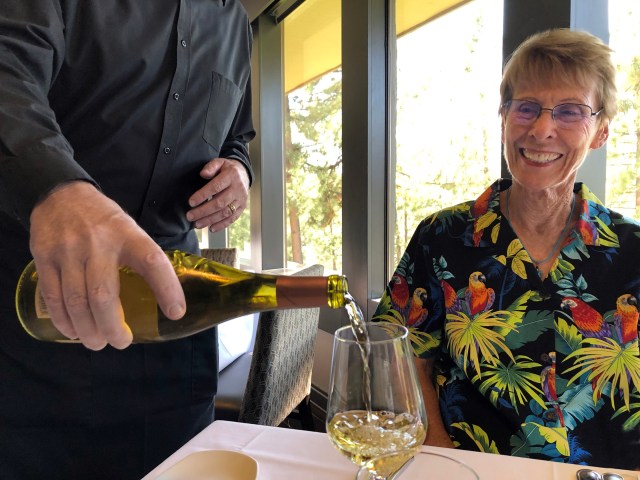
Much laughter, many hugs. We had gotten the band back together for the first time since mid-February. We had a lovely dinner—peach-bourbon glazed scallops and shrimp for Dick and Cora, summer vegetables and shrimp for Connie, and macadamia nut-encrusted wahoo for me. And for all of us for dessert two plates of the Chart House’s famous hot lava cake (ooooo! not on anyone’s heart-healthy diet).

i2432 cj wine pouring

And a lovely bottle of Reata chardonnay, 2016, from the Sonoma Coast (photo by Dick Schmidt)

We have so much to celebrate this year—not just our three summer birthdays (Connie’s in June, mine in July, Cora’s in August) but more than a half century of friendship between Cora, Connie and Dick. And though I am newer to their group, they have made me part of their tribe, as we consider each other family, or, as they say in Hawaii, ohana.

Once again we are grateful for our ohana… these two here and all of you out there who have been cheering Dick on since January. Mahalo nui loa to you all!

(And haouli la hanau… happy birthday, dear Cora!)

cj rds cer-cora bd 2019

Cora, Dick and Connie, Aug. 7, 2019

Posted in Uncategorized | 7 Comments

Six months out

RDS six months out

This guy is #1!

Six months ago today he had a triple bypass, resulting in a refurbished, snappy heart 💜.

Nine days before that, he was felled by a cardiac arrest in the Honolulu airport and was revived—after excellent CPR and assistance by two bystanding angels—with the use of an AED, an automated external defibrillator.

Today he’s wearing his AED Institute shirt with gratitude to that organization for placing AEDs in airports all over Hawaii. He literally would not be here without that foresight. A big mahalo to all who saved and supported Dick Schmidt from his first moments to today… and me, too!

Posted in Uncategorized | 2 Comments

Gracias, Dr. Favaloro

download

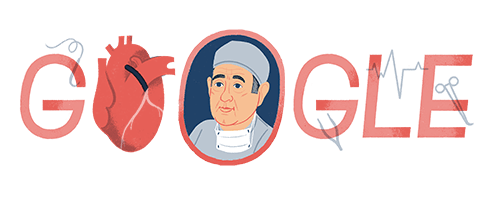
We were pleased to see a Google doodle tribute today to Dr. René Favaloro, highly regarded for his pioneering work on coronary artery bypass surgery using the great saphenous vein… one of the large veins in the leg. He was born this day in 1923 in Argentina.

The technique he developed is what Dick had done in January in Honolulu by Dr. John Y. Lee at Kaiser Moanalua hospital. Working in Northern California as a cardiothoracic surgeon, Dr. Lee become a pioneer in endoscopic vein harvesting, which involves removing the leg vein through a tiny one-inch incision for bypass surgery. He extracted Dick’s great saphenous vein that was used to create three bypasses around blocked arteries. 

Five months later, as we vacation on Vancouver Island (a very different island than Oahu), we honor the late Dr. Favaloro. We’re also thinking today of the cardiac team at Kaiser Moanalua, including surgeon Dr. Nicholas Dang and the cardiac P.A.s Whitney Regan and Tim Berkeley. We think of Dr. Diana Kim and nurses Jaime and Erin and Donovan and Sally and so many others who literally nursed Dick back to good health.

He’s better than he has been in years, this fella, and we continue to be aware of our great good fortune, wishing we could pass it on to others we know who are struggling, health-wise, right now. Our thoughts and prayers are with them, too.

Gracias to Dr. Favaloro. Mahalo to our ohana in Hawaii.

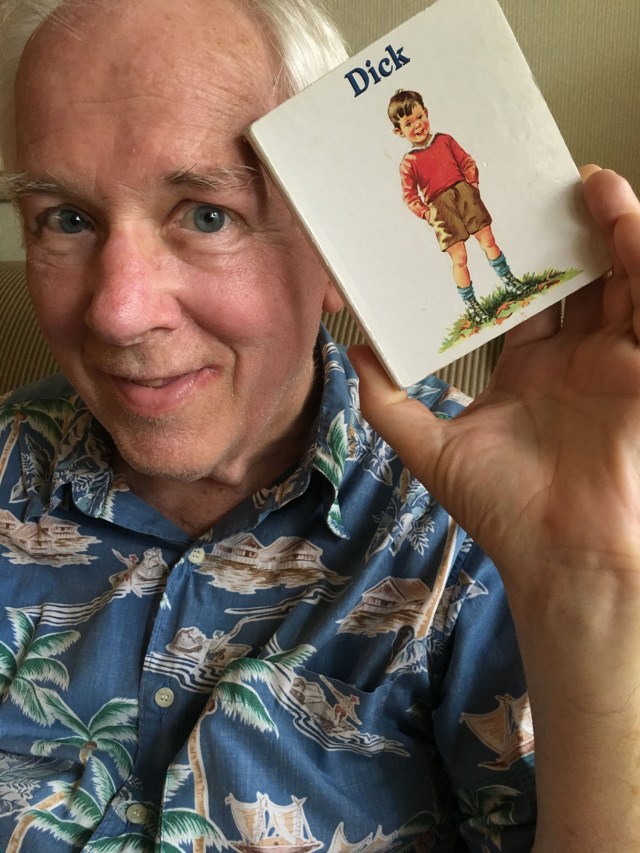
e-IMG_2584-Dick book

Posted in Uncategorized | 1 Comment

Free & clear

IMG_1537REDO

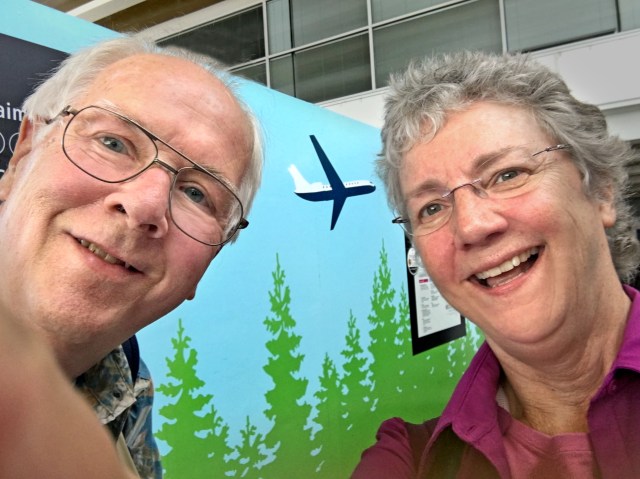
Us at Sea-Tac, en route to Victoria, B.C.

This time I go first,
hand my boarding pass
to the young man at the gate,
who scans it—beep!—
& says, “Have a good flight.”

I turn to watch you—
in photo vest identical
to the one cut off you
nearly five months ago
when you collapsed
at another airport gate.
You step forward,
extend your arm,
pass in hand.

You stand tall, do not pitch forward
like a domino as you did then,
do not make an early departure.

“Have a nice flight,”
you hear the young man say.

“Thank you,”
you are able to say.

And I feel my heart literally skip
a beat—this time with relief—
as, free & clear, we make
our way down the jetway,
as we have dozens of times
together,

our hearts leaping in the most
blessedly ordinary manner,
aware again of grace bestowed,
as something essential
envelops us—something
that feels acutely
like joy.

Posted in Uncategorized | 9 Comments

Happy Annie-versary 3!

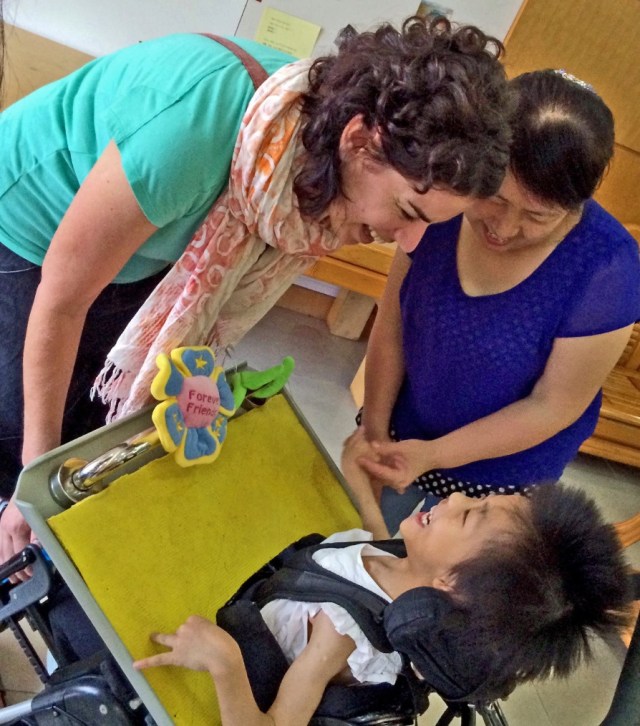
Annie meets Nikki

June 20, 2016: Mama and daughter become a family.

Three years ago my friend Nikki Cardoza adopted her daughter Annie in Changsha, China. I got to be a part of that once-in-a-lifetime experience to travel with Nikki and help bring Annie home.

It was a tremendous journey of love that took Nikki back to the country where she’d volunteered for years at orphanages and where she met Annie as a tiny baby at Butterfly Children’s Hospices. The marvelous staff there helped save Annie, and on that trip to China I got to visit Butterfly House and the other orphanage where Annie was cared for.

Now I look at this series of blog posts and photos from that trip, moved by Nikki’s determination and Annie’s strength that allowed her to survive her early years, which has moved them through the challenges and joys of the past three years as mother and daughter.

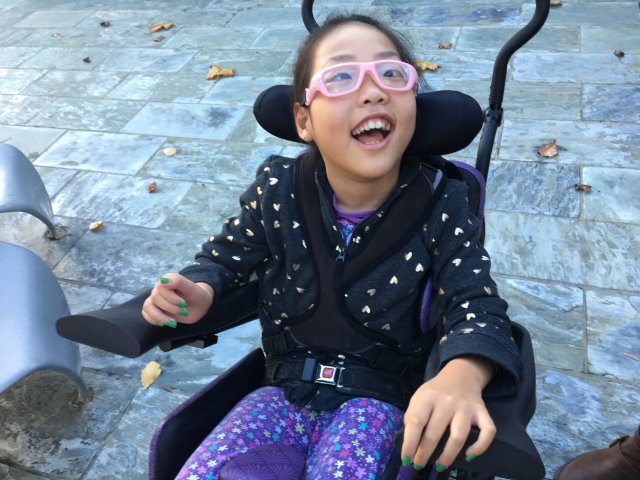
And I look at the photo of Annie in November 2018, hardly believing that this is the same child who met her mama on a hot summer day in a city far, far away, who bravely made the journey to her new forever home in a place called California.

I am ever richer for that experience and for their friendship and love.

Annie

Annie Nov. 2018

Annie, November 2018

Posted in Bringing Annie Home, Uncategorized | 2 Comments