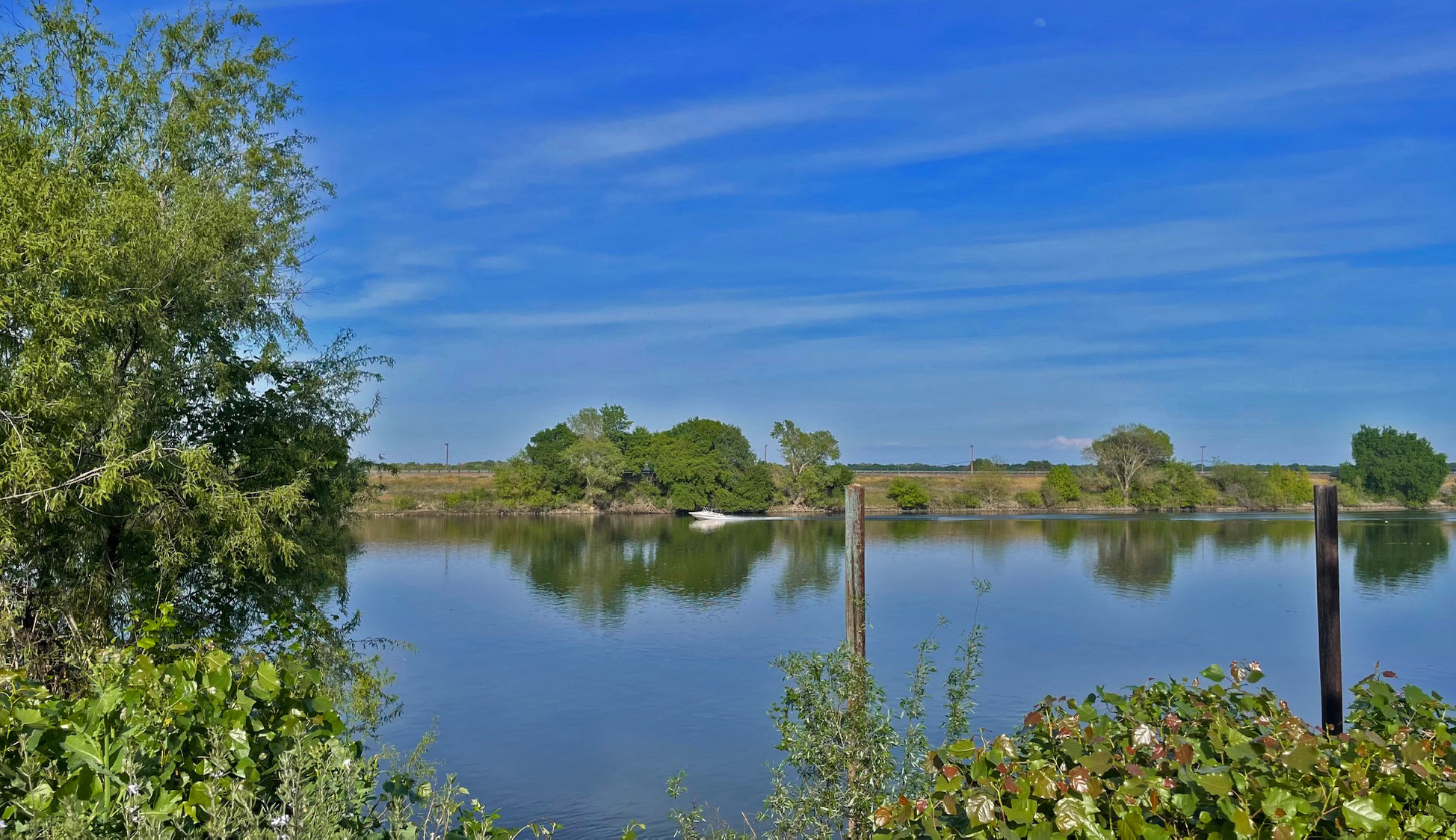
Where it has been doing its California imitation for months, pretending that this green place, too, is the land of little rain.
Where the unirrigated roadside has gone golden, like much of my home state.
Where the climate flip-flops like a just-landed salmon, the migrating ones heading upstream that bears snag like candy out of rivers from here to Alaska.
Where I awoke, looking out the window to a gray veil swaddling the canal in—can that be?—actual rain.
All morning I watched the curtain slowly rise to the arrowed tops of the pines, then higher.
Where the gray lightened into a question of sun, though, of course, it was up there, making its daily arc across the sky, the one we humans think of as ours,
as if we’re the fixed ones being revolved around, as if we have the answers.
Daisies under cloudy skies looking toward the Hood Canal, Port Ludlow, Washington / Photo: Jan Haag
The tree is saying things, in words before words. It says: Sun and water are questions endlessly worth answering. It says: A good answer must be reinvented many times, from scratch. It says: There are more ways to branch than any cedar pencil will ever find. It says: Listen. There’s something you need to hear.
(for the crew of Southwest flight 3361, Sacramento to Seattle, July 24, 2025)
We rise in this soaring silver bird, aiming upupup, to a height humans cannot achieve unless encased in such a magnificent beast.
And I think of the early years of air travel, when attendants were young nurses, Julie told me, she who flew for American in 1940, employed to serve drinks, offer a pillow and care for those woozy from flying so high.
All of 10,000 feet in those days, she said, maybe 14, cabins not yet pressurized, all souls aboard feeling the weight of their lungs struggling for air, cruising at altitudes higher than terrestrial bodies were designed for.
Still, in these times of even higher flight that make it easier on passengers and crew, the gyroscope in my brain always tilts on takeoff, liquid sloshing from hemisphere to hemisphere, until the trap door at the top of my skull opens, and I rise,
I rise with the lift of weightless feathers burnished bronze, as I imagine I will one day when I no longer need this body and these great silver wings to fly.
When it’s your birthday month, gifts show up daily—often a photo card emailed with some version of your face (so many years of face to choose from) on it.
And one day you come home to find a box with a bright blue hair dryer waiting for you, the older one having lost its high speed, to which you can relate.
Because this is what he does, the man who says he loves you in a hundred ways: He makes sure you have your favorite hair dryer—two of them— at his house and yours,
all the hot air you’d ever need, with your smile on electronic cards that remind you how long he has loved your aging face, how long you’ve loved his, the best gift of all.
…sometimes it is necessary to reteach a thing its loveliness, to put a hand on its brow of the flower and retell it in words and in touch it is lovely until it flowers again from within, of self-blessing…
—Galway Kinnell, from “St. Francis and the Sow”
•••
All the years I stood before students in classrooms, I reminded myself
that I was not their ultimate teacher— though I doled out assignments and grades.
And, if I remembered, I’d say that my job was to teach best what I most needed
to learn—often nothing about writing or putting out a newspaper or publishing
a literary journal, not how to write an essay or a poem or make a photograph.
The best teaching, I learned, is often what what we reteach ourselves—that we have
voices worthy of the page, even if we imagine that we don’t. That our words
matter. That we are lovely beings, coming just as we are to the world,
to the table, to sit with each other and listen, as someone reads,
and we watch them flourish from within, giving us the great gift
of themselves, which now becomes part of ourselves, a sweet blessing
as we hold their words gently, listening to each other as we
Odd things appear on the kitchen windowsill— this week two apricot pits that, if I had a compost pile, should go there, or perhaps tossed with the loose tea in the flowerbed where the rangy volunteers might find some sustenance in my leavings.
I watch the golden pits dry more each day, skeletal ovals that produced something luscious from Gail’s tree in the backyard where we gather to exercise on Tuesday mornings, this place of abundance that she and Amy have made together.
I savored those apricots, wanting to bite into them at their peak of sweetness, feeling their gold fuzz on my lips, not imagining that a week later I’d still have the essence of what made them, pearls from people who share what grows around them, whose arms, to my surprise, open upon my arrival, and mine open, too.