More new poems

I thought I might put up a few of my new poems written at the recent conference I attended. I’ll offer one here, and if you click through to the blog itself, look across the top of the page, click on “Poems.” There you’ll find “New poems.” Click on that, and you’ll find four new poems of mine.

Thanks for reading!

——-

Grow

Your death, when it finally arrived,
was not wall after wall of crashing waves,

but a single body blow—
air leaving me so fast

I had to sit down.
I counted my heartbeats,

tried to reel in breath
with your bamboo fly rod,

the one on which you’d snagged
your first fingerling trout.

I still have the picture pinned
to our kitchen bulletin board—

your teeth like stars behind
broad lips, shades blotting

your eyes, the spotty fish
gleaming in your palm.

I saw you let it go, saying,
Grow. As I cast for air,

I felt your steadying hand winding
the line, the leader, the caddis fly,

the same hand that stroked my thigh
before sleep. I heard the rumble

of your voice, Great gams, Toots.
And, as the laugh

lurched up my throat—
breath.

Jan Haag

Posted in Uncategorized | 1 Comment

The Healing Art of Writing conference

So the thing is… (one of my favorite prompts!)

…this week I’m attending The Healing Art of Writing conference in San Rafael—actually on the park-like campus of Dominican University—with my friend and AWA facilitator Terri Wolf, living the pseudo college life. Dorms, three meals a day that require a credit card-like thing (what happened to meal tickets?), walking around campus in search of wi-fi spots (not easy to find, which seems odd for a college campus—we hear say they’re concerned about poachers) so we can email our daily poems in for printing. It’s all a bit more difficult than our cushy, well-ordered lives at home, but that’s part of the adventure of it.

There are two tracks—prose and poetry. The prose writers (like Terri) bring a piece of up to of 13 pages for their group of eight or nine folks to read. They review two pieces each morning. The poets must turn out a new poem each day (no pressure!), and every poet gets a 10-minute critique of that poem. All group are led by guest faculty, some of whom turn out to be Big Time Writers.

Like today, my poetry group was graciously led by Jane Hirshfield., a Berkeley poet whose latest book of poetry, After, is one of my favorites. She wrote a great book of essays about poetry called Nine Gates: Entering the Mind of Poetry. She’s been featured in two Bill Moyers PBS specials, and her poems end up in The New Yorker and The Atlantic, as well as in The Best American Poems. She is a Major League Poet.

Yesterday, the poet who led our group was not in the same league—at least not in her approach to leading a critique session. Her bio says she is known for writing “disturbing, edge and provocative” poetry and prose, and that’s an accurate description. The challenge yesterday was that in her role as group facilitator, she was very brusque and efficient, and so the group was, too. I felt like my poem got kicked around by an unruly soccer team. Admittedly, mine was a very rough poem; it turned out (surprise!) to have some confusing parts, so it probably deserved some kicking. But an AWA-style review, it was not.

Today, Jane (we all felt we could call her “Jane”) sat her lovely self down at one of the tables and instantly changed the tenor of the room. She explained how she likes to run critique sessions—10 minutes per poem; the poet reads then has to remain silent until the end; the group takes a “Quaker moment” of silence to digest the poem before jumping in; she speaks last but does guide the discussion, and she likes to offer specifics about where to trim and what to add, if anything. Then she flashed her sweet smile, and we were off.

My poem was first, and after the day before, I was ready for the group to Let Me Have It Again. I was prepared for Jane to do the same. It happened so fast I didn’t have time to get nervous. I was pushed into the pool; I had to swim. But the nicest thing happened: They liked it. Jane liked it. Jane called the poem “terrifically successful” and “a pleasure to hear.” I felt myself get a little squishy at that.  She said the poem was “beautifully ordered” with “acute observations” and “all kinds of interesting language.” They all offered helpful suggestions, especially Jane, who, it turns out, is one of the best editors I’ve ever seen. She knows exactly what should come out to make it the tightest poem possible.

I left the room a few inches off the ground, trying not to jump up and down hollering:

“JANE HIRSHFIELD LIKED MY POEM!”

In fact, I kinda did at lunch with Terri, who grinned and said, “Of course, she did.” She’s a good friend, Terri Wolf.  She spent a lot of yesterday reviewing a very shitty first draft of a poem and helping me spiff it up. Then I had to put it away and start over again—we’d kinda beaten the life out of it. The start-over version is much better, but I’m not sure the poem will see the light of day.

Here’s the lesson for me today: Jane said to one of the poets around the table about reworking her poem, “I think you’ll know how to turn the wheel and give it another spin, or thank it for being a good exercise and put it in the drawer. It depends on how magnetized you are about the poem. If you are, keep working on it. If not, let it go.”

I love this. It reminds me that it’s OK to appreciate much of what we write as simply exercise for the writing muscle. Not every poem or journal entry or story is successful. That’s not only permissible, it’s necessary to get to the next piece of writing that might be more successful. It’s wonderful to look at piece and say, “That’s OK for now. On to the next.” And then, move on.

I needed to hear that today. My poem from the first day’s critique may be one of those “on to the next” poems.  I do not have to beat it up, thinking I’m actually spiffing it up.  I can let it go.  It doesn’t mean the topic isn’t worth pursuing; it means it’s not necessary to chase after it today.

Also, it’s important to feel comfortable with the person who’s leading any writing group you’re in. The first poet who led our group probably has people who adore her style, but she didn’t resonate with me. Remember that Pat Schneider says you want to find a facilitator who makes you want to write more. If one makes you want to write less, it’s time to find a new group. Jane makes me want to write more.

And Jane Hirshfield liked my poem. Just in case you missed that.

You don’t have to like the poem, but here it is, with most of the group’s, including Jane’s, suggestions in it:

Night watch

From my bed, I hear it—
soft plump of a furry body dropped,
tiny nails scrabbling to flee,
a pounce. I sigh, tap on the light,
feel my feet hit hardwood.

She sits, head bowed,
looking at her downed prey
curled into a C. I can see it
breathing hard, imagine
the staccato of its heart.

As I reach for a towel to scoop
up this possum-playing mouse,
hoping to return it to the night,
it springs, scurries behind the bookshelf.

The cat looks up at me.
“Your fault,” I hear her think.
“You’re right,” I say.
We both study the wall of books.
She settles down for the night watch.

I know how this ends.
I go back to bed, lie there, knowing
one heart will stop beating in my house tonight,
knowing I cannot save this one little life,
as I could not save yours.

Jan Haag

Posted in Uncategorized | 5 Comments

You will grow

In the words of the immortal Elisabeth Kübler-Ross:

“You will not grow if you sit in a beautiful flower garden, but you will grow if you are sick, if you are in pain, if you experience losses, and if you do not put your head in the sand, but take the pain as a gift to you with a very, very specific purpose.”

Let me add: You will grow, too, if you write it out, all the goods and bads, the uglies and the pretties, if you create characters (fictional or non—it’s up to you) who leap off the page and into the imaginations of readers, or if you craft poems that elicit emotion in those lucky to read them.

Let the pain, yes, and the beauty, too, the miracle of “being alive and knowing it, too” (as writer Tess Slesinger said) fuel you, move you to do what you’ve longed to do, what scares you, what will feed you in the deepest ways imaginable. Take up the pen and leap.

But write it down, as Rumi said, “so others will understand the passage.” No one can tell the tale quite like you, in your own original, authentic voice.

Write it. Down.

(Elisabeth Kübler-Ross quote from http://www.ekrfoundation.org/quotes)

Posted in Uncategorized | Leave a comment

“I’ve always wanted to be a writer…”

… the woman in line behind me at Subway said today.

I turned and looked at her, wondering what had marked me. I didn’t know her; we had not spoken. I did not sport ink-stained fingers (I love that Ralph Fiennes does in the lead role in “Shakespeare in Love”). I was not wearing my sweatshirt that says, “English Major—You Do the Math.” (Really.) I was not near the car with its “GUD WRTR” license plate.

Then I realized that under my arm I had tucked a notebook and a pen clinging to the spiral binding. Why I brought it into Subway, I don’t know. I was heading out again as soon as they finished making my foot-long tuna. (And by the way, if you’re in the vicinity of 37th and J streets in Sacramento, stop in. This is my favorite Subway—lovely people, super efficient and fast!) But I didn’t have the notebook open. I wasn’t writing.

The woman, 50-something with dark hair, was gazing longingly at my green notebook. I smiled at her and actually, for once, thought about my response. My usual one is something like, “You are a writer…” and then I go into my song and dance about how everyone can write, is born with creative genius, how the term “writer” is not reserved for the privileged or the published, that writers are not just dead white guys with Big Names and Major Novels, blah, blah (thank you, Pat Schneider, not only for the Amherst Writers and Artists method, but that philosophy and those words, too!).

Today I said, “What makes you think you’re not a writer?”

She blinked and said, “Because I’m not writing.”

Ah, Pat has an answer for that, too. “You’re always writing,” I said. “Every time you speak, you’re writing on the air. Every time you tell someone a story about your day, you’re writing that story aloud. You write all the time.”

The woman looked down at her shoes, shook her head. “But I’m not writing any of that DOWN,” she said, hitting the last word with a verbal hammer.

Now I really had to make a decision—go into full-bore, writing counselor mode, which I can do in an instant, or offer some impolite comeback like, “So write it DOWN!” But I had to tell one of the young women at Subway what veggies I wanted on my tuna (lots of green peppers, a few onions, olives, pepperoncinis, salt and pepper, spinach), and I had to go to Trader Joe’s and buy food for my Saturday writing group, and….

What I was really thinking was: How do these people find me? and There are no accidents.

So I said, “Are you serious? You really want to write?”

And the woman looked me in the eye and said, “Yes.”

“What’s stopping you from grabbing a pen and a notebook,” I waved my green one in my right hand, “and starting?”

She shook her head and said what I’ve heard a thousand times: “I’m afraid it won’t be very good.”

And I said, “If you don’t get it out of your head and on paper, how will you know?”

She narrowed her eyes. “Are you a writer?”

“Yes,” I said. “I am.”

“What have you published?” she asked.

I sighed. I hate this question. Not that I haven’t published, but I am not Big Time Published in most people’s eyes. Still, yes, I have lots of articles and history as a journalist and a small book of poetry and a novel-in-progress, and yes, I’m a writing teacher. But you tell that to someone who wants to be a writer, and they’re either intimidated as all get-out or they think you’re bragging. Some want to take a class with you.

“That’s not important,” I said, channeling Pat a bit. “What’s important is that I’m a writer because I write. That’s all. Not because I’m published or not published. Not because I know how to spell or use commas correctly. I write shitty first drafts so I can clean them up and write better second ones. Most of what I write stays in here”—I waved the notebook—”and never sees the light of day unless I share it with other people, usually other writers.”

I looked at her quite seriously. “And that’s all it takes to be a writer,” I said.

Then I turned to the young woman behind the counter who was already putting exactly the right veggies on my sandwich. (They know me well.) She looked up at the woman who was asking me questions and said, “She’s a very good writer,” which was a nice thing to say because, as far as I know, she hasn’t read me. Still, I’ll take it. I smiled at her.

The woman behind me said, “So all you have to do to be a writer is write?”

“Yep,” I said.

“I just have to start?”

“Yep,” I said. And then I did what I often do. I gave her my card and invited her to email me if she wanted to talk more or find a writing group or a class. She left the store smiling, thanking me, waving.

I think this is one of my reasons for being on the planet. Not to work toward world peace or fix the broken political system or feed the hungry even. Though, now that I think of it, encouraging people to write their art out, one word at a time, could help with all three of those things. I’m here to remind people that they are writers, to put notebooks and pens in their hands, or urge them to pick up laptops, give them a prompt and go. Read aloud if they like in safe environments with supportive listeners.

And I’m also here to, as Anne Lamott says so brilliantly in her terrific book on writing, Bird by Bird, get my own work done. (She’s the one who has a great chapter in that book on “shitty first drafts” that I mentioned earlier. She’s funny and right on about all things having to do with writing. I highly recommend it.)

Because if I’m a writer, I have to write. So do you. It’s just a matter of sitting down with notebook and pen or laptop and fingers and putting the words down, one at a time, bird by bird. We chase the words down the page, whether they’re prose or poem, and see what they have to tell us. We’re often surprised by what appears. We didn’t know we knew that. We didn’t know we were that smart or funny or clever or—oh, yes—dumb.

But we write stuff down to find out what we’re thinking. And that, for me, is the biggest surprise and joy of all.

Posted in Uncategorized | 1 Comment

Ah, the photo

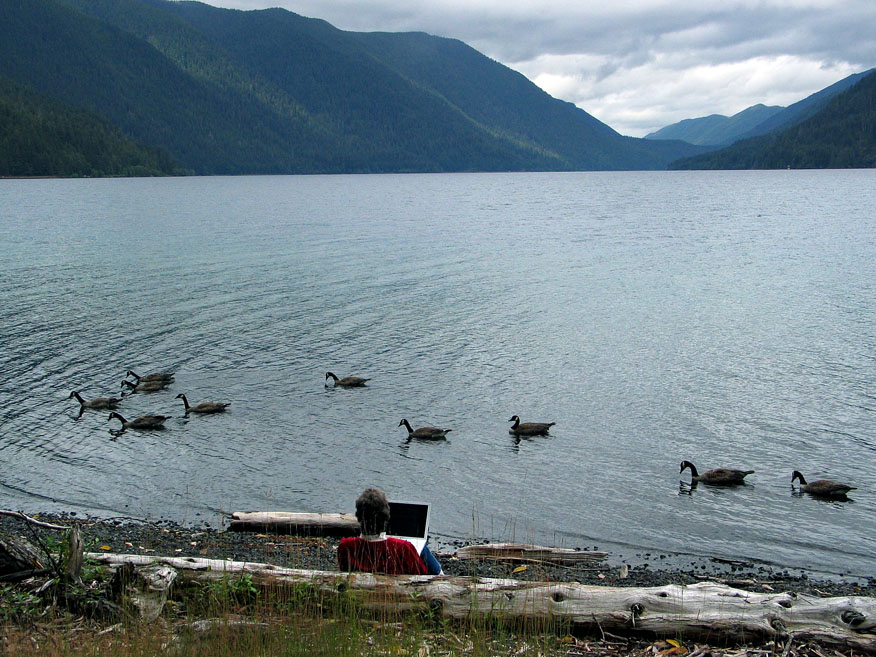
A little shout-out to my guy, Dick Schmidt, for the fabulous work on the photo at the top of the blog. (I’m learning, in blog-ese, that this is a “header photo.”) Yes, it’s me, working on my novel at Crescent Lake, Washington, west of Port Angeles. The lake is part of the Olympic National Forest and is on the highway that leads to the little town of Forks, Wash., made famous by vampires… at least the ones in Stephanie Meyer’s Twilight books.

Dick and I have spent a fair amount of time in recent summers at Crescent Lake in cabins around the the 100-year-old lodge. The lodge is the only wi-fi’d place in this portion of the Olympic National Park, so folks go there in the evenings to check their email and so forth. I went there, often after 9 p.m., after the late diners and drinkers and checkers players had retired for the night, to write on the enclosed porch that looked out on the lake.

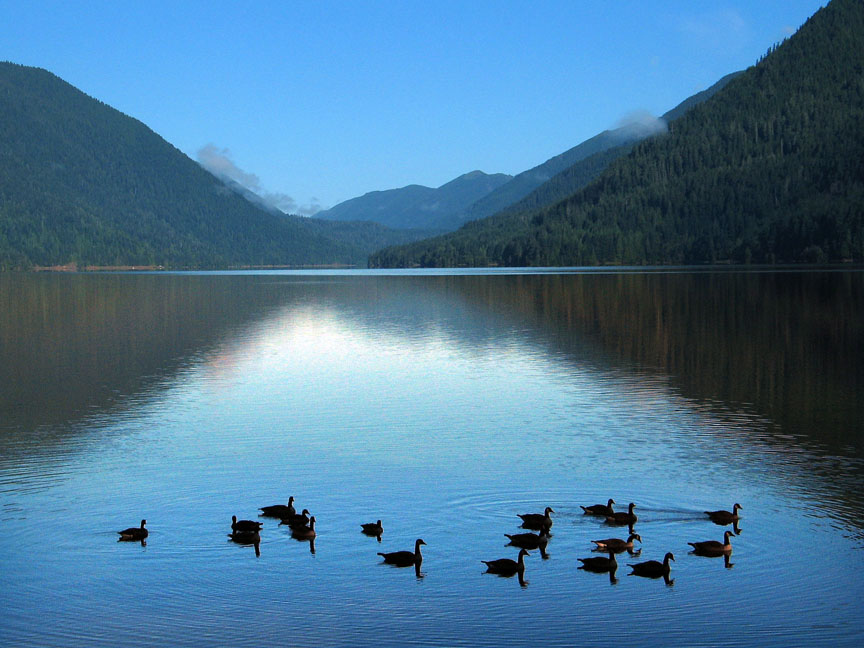
Crescent Lake is far enough north that it doesn’t truly get dark until after 10 p.m. in the summer, so that many nights, I’d sit on the lodge porch writing about Ocean Falls, B.C. (another place surrounded by trees, mountains and water), watching the light play on the lake, as you see in the photo.

It’s been a perfect place to work. In fact, the Crescent Lake resident flock of Canada geese inspired me to write a section in the novel about geese influencing my 17-year-old protagonist’s synchronized swimming team.

The Crescent Lake flock, early morning, summer 2005 (photo by Dick Schmidt)

Ever watch geese paddle around? They’re as much of one mind in the water as in the air. They’ll often bob, butts up, at the same time, and pop up again as a group. They fly in a V-formation because their flapping wings create an uplift for the bird following. If a bird falls out of a V-formation, it feels drag and resistance going it alone and quickly gets back into formation. When the lead goose gets tired, it rotates back into the wing position and another goose flies point.

And I love this about geese: The ones at the back of the V honk to encourage those up front to keep up their speed. If a goose is sick or is wounded by a gunshot, two geese fall out of formation and follow the bird down to help and protect him. They stay with him until he is able to fly or until he is dead. Then they launch with another formation or catch up with the original group.

Me writing with the Crescent Lake Canada geese (photo by Dick Schmidt)

Dick is my point goose. He has supported the birth and development of this novel for six years. He goes with me on research and writing trips, shoots photos and helps with research, and falls back to rest with me when I am flagging. He believes in this novel as much—and sometimes more than—as I do.

He had to do a bit of PhotoShop manipulation of this image to get the window and lake and me in the same horizontal sliver for the header’s format, but let me assure you—it’s all real. I really was there writing and editing. It really looks like this… when it’s not raining, which is does quite a bit at Crescent Lake.

I couldn’t have a better image for myself as a writer than this one. Even from here, I see the geese on the lake, the dock jutting into the sherbet-tinged water. I feel the pen in my hand, my hand on the page. Thank you, Dickie.

(Information about geese from Parish Publishing, New Canaan, Conn., provided by Connie Johnstone, Director of Spiritual Care, Kaiser Medical Center, San Jose)

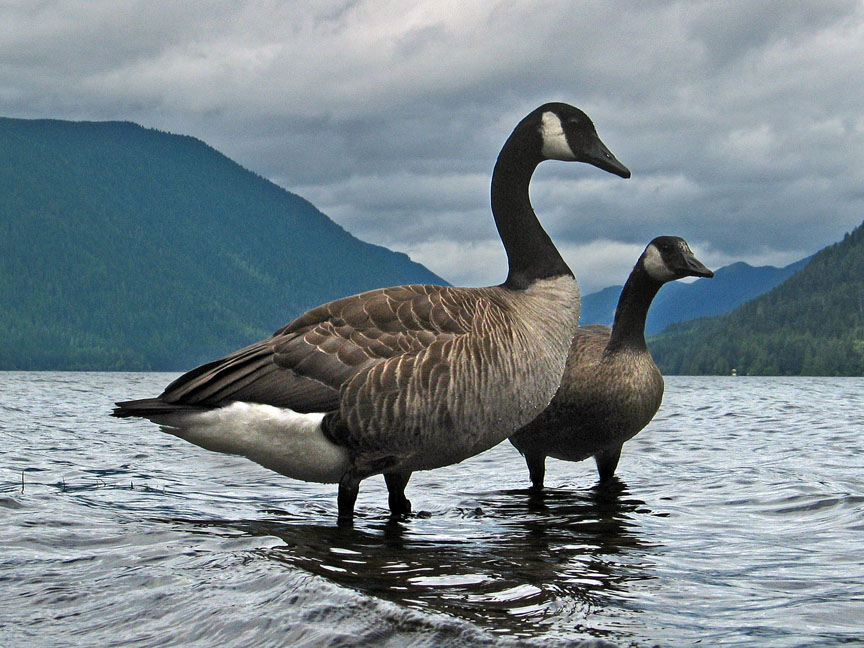
Love the geese! (photo by Dick Schmidt)

Posted in Uncategorized | 5 Comments

Summer solstice

(for Georgann)

Pretend there’s a cup of water on the dashboard,
said the former ambulance driver,
and you must drive so carefully, so gently,
you don’t spill a drop.

I tried, I tried so hard after his surgery
to make the drive as gentle as a feather
drifting onto a cloud. But unexpected road
cracks, hidden bumps and train tracks—
even rumbled over so slowly—pained him.
I noted every wince crinkling his closed eyes.
I could not soften the blows enough.

Today, on the longest day of the year,
I drive you home from the hospital—
a thick strip of tape over your newest incision,
your belly chartreuse with four-day-old bruises,
clutching two pillows to your middle after
your second major surgery in a year
of near-constant pain.

Your pod of protectors wants it to stop—
we try to bump you to the surface for air,
we hover over and around you with
pills and puddings, sweet tea and toast,
books and distractions.
We are present; we are witnesses to your suffering.
But we are as helpless as the two new kittens
who await you at home—clueless, really,
stuck in our love.

We do not believe we are enough.

But you guide me through town as I gentle
the car around divots and cracks.
You direct me to the easiest onramp.
Mid-afternoon traffic parts, allows us
smooth passage over a typically bumpy sea.
We pull into the driveway, breathe,
look at each other across the stretch
of this long friendship.

You were perfect, you say.
You didn’t spill a drop.

Posted in Uncategorized | 5 Comments

The boys are back in town

Camera time is not something I typically long for. I have spent much of my life in front of still cameras—hanging out with photographers will do that for you—so I don’t mind being photographed. When I get the chance to get even, I take photos, too. But being interviewed in the moving picture way on video or digital makes me a little nervous. I am suddenly full of “ums” and “ahs,” tripping over my tongue as if the words are new to me.

So old friends of Dick’s and mine, Dale Maharidge and Michael Williamson, a Pulitzer Prize-winning writer/photographer team, called last week and said they were coming to town toting a documentary filmmaker who wanted to interview us. “You knew us when,” Dale said on the phone. “You can help put our time in Sacramento in context, give some background.”

Dick and I love Dale and Michael. We would do just about anything for them. But we are not Big Time People. Dale and Michael (aka, “the boys”) run in major journalistic/movie/music circles. They are on close terms with Bruce Springsteen, for instance. We are little people in their world. We did not think we had anything to say that would be useful.

But the boys and Ron Wyman of Zero Gravity Films (www.zerogravityfilms.com) arrived at my house one morning shortly after 11. Ron, a lovely man with a kind face and silvery hair, began casing the joint—not as a potential burglar, but for good spots for the interviews. The rest of us exchanged enthusiastic hellos and hugs. It’s been a long time since Dick and I have seen the boys at the same time. None of us can remember exactly when the four of us were last together. Michael lives in Washington, D.C., and works for the Washington Post as a photographer, and Dale divides his time between teaching journalism  at Columbia University in New York and his property up in Humboldt County. Though, really, when they’re not working their day jobs, they’re usually traveling, interviewing, photographing for their owns projects separately and together.

The boys are, if I can brag about them for a bit, tremendously accomplished journalists. They won a Pulitzer Prize in 1990 in General Nonfiction for their second book, And Their Children After Them. Michael won another Pulitzer at the Post in 2000 with other colleagues for their coverage of Kosovo and has several Newspaper Photographer of the Year awards from national and international associations. They’ve done many books together and separately–beautifully written and photographed. They are, to us, the quintessential writer/photographer (or as Michael might say, “photographer/writer”) team.

In short, these guys rock.

But they were in town to reminisce on camera about their first book project, Journey to Nowhere: The Saga of the New Underclass. In the early 1980s, while working for The Sacramento Bee, they hopped freight trains and rode the rails with backpacks to meet people who had lost jobs, houses, sometimes spouses and children, in the recession of that decade. These folks were not typical “hobos,” and Michael and Dale did a series of articles for The Bee that said, quite plainly, This could be you, readers. Pay attention.

That book, which was born and faded into quick obscurity, was resurrected in 1996 by Bruce Springsteen, who pulled a copy of it off his bookshelf when he was in the process of working on the album that became “The Ghost of Tom Joad.” Several songs on that album were inspired by Journey to Nowhere. Springsteen got in touch with the boys, declared that the book had to be put back in print, and so it was. Journey to Nowhere had a second life thanks to Bruce Springsteen.

Though Dick and I had admired his music for years, you can bet we were grateful, diehard Springsteen fans after that. Good taste, that man.

So now, with a feature film in development based on Dale and Michael’s forthcoming book called Someplace Like America: On the Road With Workers, 1980-2010 (www.eitherorfilms.com/upcoming), Ron Wyman is creating a documentary about Michael and Dale in their train-hopping days.

Ron has been retracing the boys’ tracks across the country and came to Sacramento where it all started. They were in the railyards shooting video of trains and reminiscing. They traveled up to Oroville to hobo camps. And they came to talk to us.

Dick and I had the odd experience of sitting in my dining room and kitchen, and talking about two of our oldest and dearest friends as Journalists of Importance as they watched and listened to us. We had no problem with that—we were just afraid we wouldn’t be quotable, wouldn’t remember enough specifics to be credible.

Michael has long called Dick his “mentor and friend,” naming Dick as the guy who taught Michael how to print photos in The Bee’s old-fashioned darkroom in the 1970s. Ron interviewed Dick first in my dining room about the young photographer who hung around the darkroom, pestering the older guys.

Dick said he never thought Michael was a pest. “I thought he was smart and talented,” Dick said, adding that he admired Dale, too—”who treated the most mundane stories as if they were the most important.” He talked about Dale and Michael’s passion for good journalism and was impressed at the lengths they went to—often on their own time and at their own expense—for stories they believed were important. Stories about homeless people, hungry people, people who had lost their jobs and their hope. They shed light on people’s whose stories would otherwise not be told.

When it was my turn in the kitchen, I think I said something about Dale and Michael brand of storytelling with words and pictures helps not only brings public awareness of people in difficult straits but also helps bring healing to this broken world. And that listening to people’s stories, taking their photographs, has perhaps allowed Michael and Dale to heal some of their own demons as well.

Out of the corner of my eye, I saw Michael leaning against my stacked-tall washer and dryer, listening. His eyes were moist. Ron at the camera’s side looked surprised. Dale, his head cocked to one side, wore a small smile.

“Does that work?” I asked after Ron turned the camera off.

“Yeah,” he said. “It’s great.”

Michael said as Dale nodded, “You’re downright eloquent, Miss Jan.”

I don’t know about that. Though we’re a bit biased, Dick and I believe they are masters of their craft. We have long been impressed by the boys’ work. We don’t get to see them as often as any of us would like, but we are touched by the fact that when they hit our town, they call, visit if they can. The conversation picks up where we last left off, as if no time has passed at all. We appreciate that.

And sometimes when I’m thinking of the boys, I’ll call up a video of Bruce Springsteen singing “Youngstown”—just the man and his guitar—and I get goosebumps. That man pulled an old copy of a book off a shelf once and was inspired to write music because of it—a book by two of our friends who are, to us, two of the brightest stars we will ever know.

Posted in Uncategorized | Tagged , , | 3 Comments

The big kids

I’m sitting here in my BF’s hospital room, one of the day’s trio of family members on watch. My BF had her gallbladder removed yesterday and is doing well, but, as she says about so many things, “It’s complicated.” Indeed, it is. She’s in great pain—as she was before the surgery—but now she’s got a nifty diagonal scar that intersects with the nifty vertical scar she earned last summer in this same hospital. She lifted her gown and showed me this afternoon. (She is not shy, my BF.) Her belly is beginning to look like a geometry book.

So today I had the great pleasure of getting to see both Andy, the oldest big kid, and Jena, the youngest big kid, at their mother’s bedside. I adore them both. If I could steal them away from their mom, I would, though now that they’re 36 and 34, I think it’s a little late for that.

Andy came to live with me in 1995 when his mother took in her first foster kid who became her second son. Andy was the first kid to occupy my back bedroom (which I still think of as Andy’s room, though Rebecca, R.G. and Lauren also took turns there), and I fell in love with the sweet big boy. We went through his first romance together—his mother and I distraught when his girlfriend dumped him—and while Andy lived with me and attended the sheriff’s academy, he met his future wife, Tiffany. They are now the parents of 5-year-old Evan and send me a Mother’s Day card every year, which always makes a little teary.

I met Jena when she was 12 and accompanied her mother to Wales. My BF had the opportunity to finish her bachelor’s degree in politics there and hauled her youngest child with her. (Andy stayed with his father in California.) I visited Jena and her mom shortly after they arrived in Swansea. Jena had just come home from her first day at school, very cute in her blue skirt and blue sweater with the blue and yellow tie, sashaying into the kitchen to announced, “Nigel fancies me.” I’m pretty sure I fell in love with her that day. I reminded her of this story the other day here in the hospital, and she laughed. “I remember him,” she said.

Jena sits here now, doing her trigonometry homework for her college summer school class. She is now a mom to Cine, who is 4. Jena hopes to be a physician’s assistant or a pediatrician someday. She will be a good one, whatever she decides. She has a huge heart, is a natural helper and so much her mother’s daughter that I could not do anything but adore her, too. She sits at her mother’s bedside for many hours every day.

The big kids are two of the best things my BF has ever produced. Her little kids are good people, too, though, as my BF says, their situation is complicated. So much is in life, it turns out. But Andy and Jena include me in the update phone calls about their mom’s status—as does the BF’s husband Ron, who is in Utah now with two of their younger kids. (It’s complicated.)

So I sit watching my BF sleep, one knee propped up high, her Harry Potter, round tortoise-shell glasses a little askew over her closed eyes, her hands resting just under her collarbone. She has much to recover from, but she will—surrounded by the love of her people, her big kids and family and husband, her many friends. Whether we are all at her bedside or not, we find it easy to be a mirror, to watch her sleep, to reflect back to her the love and devotion she has given each of us over so many years.

Posted in Uncategorized | 8 Comments

Naptime

The challenge of these busy lives is that there’s not nearly enough time for naps. It’s hard to stop, say, of an afternoon, and put your bod down fully horizontical, as my guy Dick likes to say. Dick is a huge fan of naps, as was his mother, who faithfully took one every afternoon. She knew well how much naps restoreth the soul, and Dick agrees.

So we were delighted, a year and a half ago, while on vacation the Big Island (of Hawaii—as opposed to other big islands where we like to go—Vancouver Island, for example), to watch the napping honu of Kona Village. Here it is:

Lazy honu finds a good shelf for an afternoon nap at the Kona Village on the Big Island of Hawaii. (Photo/Dick Schmidt)

Every afternoon the honu (turtles) of the Kona Village haul out on the beach for their naps. They have it down. They are napping pros. They are fine inspiration. And Dick and I, so inspired, made sure to adhere to the local custom, though we found a softer place to nap.

Even so far away from the Kona Village, I continue to follow their custom of the afternoon nap whenever I can. Now I can—it’s summer. Nothing like a nap on a good bed, late afternoon light falling through the blinds in slants on the comforter, a cat or two on the bed.

I think I’ll take that advice right now…

Posted in Uncategorized | 2 Comments

At your service

My friend John Crandall signs his emails, “At your service,” which always makes me smile. He truly is a man in service to others—no, he is not a minister or chaplain or doctor, though he informally ministers to others all the time… not in a religious sense, but as a verb: “to give service, care or aid; attend, as to wants or necessities: to minister to the needs of the hungry” (dictionary.com).

He gives away so much of himself—as a writer and writing group facilitator, as a blacksmith, as a psychologist leading an anger management group, as cook/caterer, as husband to one and friend to so many others. And yet John would tell you, without a trace of irony, that this is what makes him happy, what fuels him, that in serving others he serves himself, too.

Some time ago I came across this quote by Jennifer Hoffman from “Uriel Heals”:

You are here to serve others, to be a light for them, to participate in their lessons and to help heal humanity. You are also here to serve yourself, to heal your karma, to enable your soul’s growth and reconnect to the Source. Your challenge is to find a balance between serving others and yourself so that you can accomplish the tasks that you established for yourself in this lifetime and even go beyond that. How you view your role in serving others is an important part of this process.

Neale Donald Walsch, author of the Conversations With God books, sends free daily inspirations (sign up at http://www.nealedonaldwalsch.com), and I saved this one:

On this day of your life, dear friend, I believe God wants you to know that your job, your invitation from the Universe, is to give people back to themselves.

You can do this every day, in a hundred ways. Why not practice it with the first three people you encounter after reading this?

It is really a very easy thing to do, yet it can affect a person mightily. All you have to do is look for the best in that person, and then show it to him or her, right then and there. Describe it. Admire it. Thank him or her for it.

Do this for three people every day and watch how your whole life can change. At last you will realize what you are doing here. All the rest will be just stuff and nonsense.

This is the essence of what my friend John does—and what so many others do, too. Be a light for others. Give people back to themselves, as well as serving ourselves and healing our own karma. No small tasks. But really not difficult either.

Let’s try that, shall we? Let’s put it out there. Let’s ask every day: How may I serve? How can I find balance in serving others and myself? The ways will appear. I promise.

Posted in Uncategorized | 4 Comments