I understand the need for some bucking up in the dark times, the impulse to light candles halfway between the winter solstice and spring equinox—
the tradition of renewal in Candlemas or Imbolc, as the seeds of spring begin to stir in the belly of Mother Earth. Not to mention that groundhog peeping out, whether or not he sees his shadow.
Even in a place of mostly sunny winter days, so come the dark ones, when the world turns cold, and ice sheets our paths, ready to trip us up. A time when tyrants rant, and tribes become more tribal, when generosity of spirit seems, like the leaves, to have vanished.
Then I look for moments of lightening, ever-present signs that kindness has not gone dormant. I light candles, inhale the compassion shown to me by so many, seen and unseen, living and not.
I try to find the halfway point between here and gone, to do something for someone else this day, a bit of benevolence to let someone know that they— like me, like you— are not alone.
•••
Feb. 2 is, indeed, the halfway point between the winter solstice and the spring equinox. Not only is it Groundhog Day (if the groundhog sees its shadow, so the theory goes, then there are six more weeks of winter; if not, spring is on its way), but it’s also the time of the Japanese Lantern Festival and the Chinese Spring Festival.
The second of February also prompts the celebration of Imbolc, a pre-Christian festival that blessed the spring planting for the coming year while celebrating the return of the light. Candlemas, with its Christian roots, was once a time when priests would bless candles to be used in homes the rest of the year.
Most important, Feb. 2 signals that the light is steadily returning, winter is on its way out, and spring will soon return.
•••
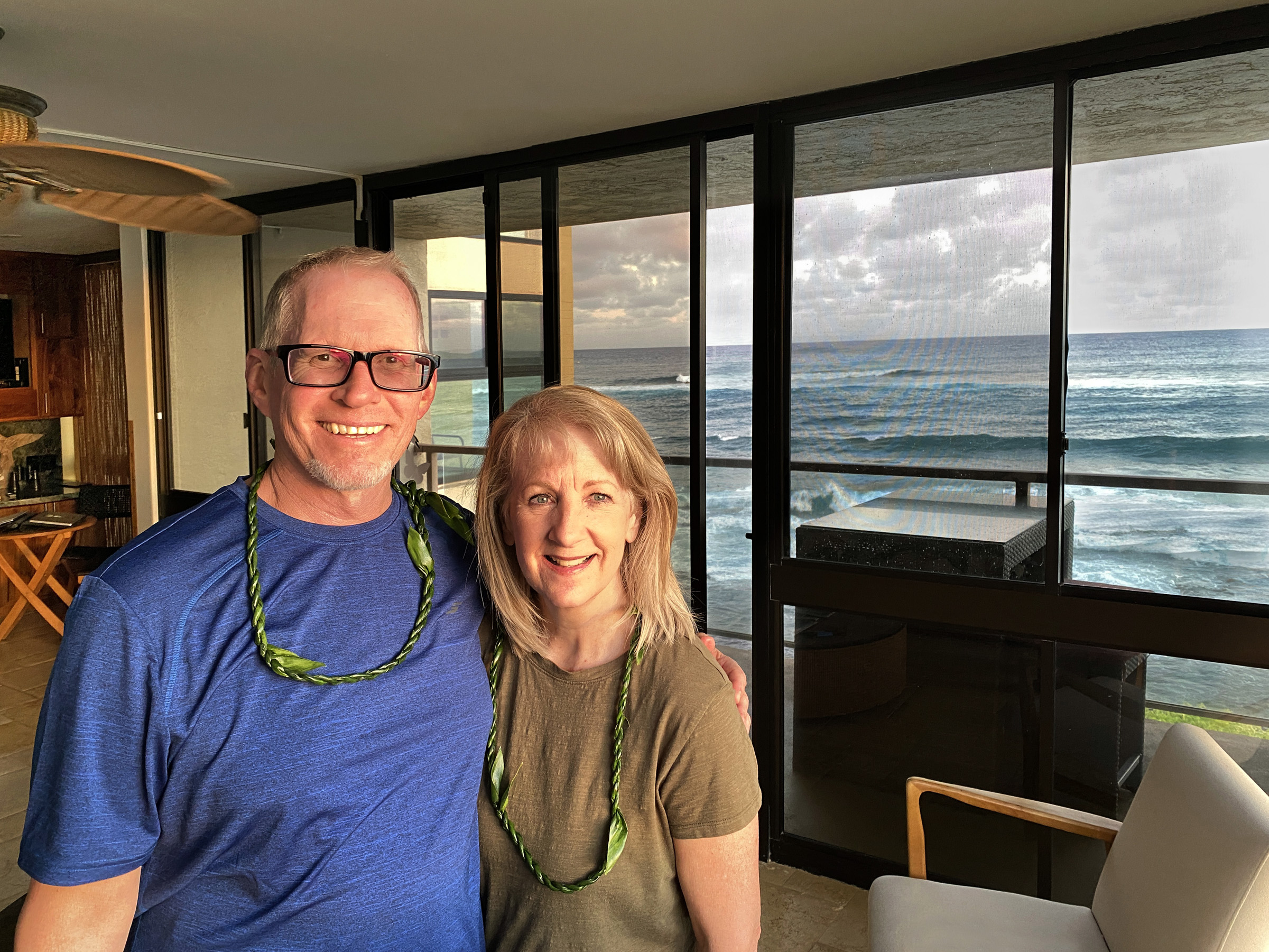
Jan at Wai’oli Hui’ia Church, Hanalei, Kauai / Photo: Dick Schmidt
As the first daffodil pops up its brave yellow head on the second-to-last day of January,
the sign in her yard that she planted the first time still proclaims:
• Black lives matter • Women’s rights are human rights • No human is illegal • Science is real • Love is love • Kindness is everything
And I remember my similar sign, wonder where’s it’s got to— did I tuck it away or let it go, thinking it was no longer needed?
Imagining—silly me—that somehow we’d solved all those thorny issues, knowing better, of course, but not wanting to admit
how we still have such a long way to go, how now, again, more than ever, we need those signs, not just stuck in our yards, but plastered in our hearts and minds,
lovingkindness the order of every day, each of us looking out for us all because, truly, there is no them.
We have the best conversations now that she’s dead.
She’s become a much better listener.
I talk to her when I am alone in her house sorting through her things. I try not to say, “Why do you have so many…?”
Because there are so many… of everything.
I don’t think of her as a hoarder so much as an archivist, if not a thoughtful one. She’d just shove things farther back in drawers or cupboards and closets and forget them.
So now my sister and I dig through the archaeology of our childhoods, unearthing treasures long forgotten.
“You kept these?” I ask my mother, as I finger two pink plastic curlers rolling around like puppies in one of the small drawers in what she called “the girls’ bathroom.”
She does not respond, and I know the answer.
She did not so much keep them as forget about them, and it turns out that finding these old bones, trinkets of who we once were,
might just be the greatest delight in this untangling of a life.
One of the drawers in “the girls’ bathroom” / Photo: Jan Haag
Hey, Ma, you know who else died the same day as you? You’re gonna love this: Jeanne Wakatsuki Houston,
the woman incarcerated as a child at Manzanar during World War II, the one who later wrote “Farewell to Manzanar,” her memoir that you gave me in high school, calling it a must-read.
So I did, devastated to learn that this little girl, all of 7, and her nine siblings, their mother and grandmother, were imprisoned for the crime of being Japanese in wartime. Her father, a fisherman, was sent to military prison for nine months before he, too, came to Manzanar, a hastily assembled prison in California’s Mojave Desert, where they were held for three years.
“That was wrong,” you said, and even Dad agreed, the guy who’d fought in Korea and had the bad habit of referring to one of our school friends as “that little Jap girl” because he couldn’t remember her name. You yelled at him more than once, “You can’t call her that! She’s Carrie!” He eventually caught on.
Years later I got to introduce Ms. Houston when she spoke at the college where I taught. You loved the story of how I gave her pieces of broken dishes that I’d collected at the Manzanar dump site, ones that said “Tepco” on them— the same brand of old restaurant dishes that Cliff’s family used, plates and cups that he brought to our marriage and lived in his grandmother’s china cabinet in our dining room.
When I gave her the shards of dishes wrapped in a soft cloth, Ms. Houston put her hand over her mouth. Little stars of tears glistened in her eyes. Then she hugged me.
“I’m so sorry that happened to you,” I said, adding that you’d given me her book and said that I had to read it, and I did. And it so infused me that for years as a journalist (she’d been a journalism major, too), I sought out former internees to interview, moved by their stories of survival, which some of them rarely shared.
She died at home, too, Ma, in Santa Cruz, the two of you less than 200 miles apart, lifting off into whatever’s next. And oh, how I hope that your two souls might’ve crossed enroute, both of you in your 90s, both mothers of daughters, both of you with stories to share.
Author Jeanne Wakatsuki Houston speaks at the El Dorado Hills, California, library, in 2012. Photo / Noel Stack
The ones who stand there in ungodly weather—the rain, the sleet, the snow of postal delivery folk, yes, but also amid the godawful heat and fumes of all manner of heavy machinery spitting dirt and gravel and sand and Lord knows what else. But they stand there in their hard hats and orange vests and heavy work boots with walkie talkies and stop signs on long sticks that they swivel to the side that says SLOW when it is time for us to move along. And my fella and I cannot resist waving at them as we drive by, and sometimes they wave back, and I hope that they are well paid for what must be a boring but dangerous and important job— like firefighters, like police people, like waitresses in rundown diners, the ones who call you “hon”—though I bet they’re not. And some are, indeed, flag babes with long braids flowing from under their hard hats, and some are, indeed, fine looking fellows with handsome beards, and some are regular Janes and Joes, and we drive by, noticing, grateful that it’s our turn to proceed, never blaming them for the waiting, whether long or blessedly brief. Because good heavens, what a service, what a calling, pausing traffic for the safety of those working on the surfaces on which we drive, another kind of angel, too, thankyouverymuch. Amen.
Can’t get enough I love yous, sincerely delivered from ones we adore, especially from children or spouses, dear friends, or the paw and maybe a lick from a favorite four-footed one.
Thanks is always nice, too, and an I’m sorry from one who had a thoughtless moment does wonders.
But mostly we need to hear, I mean you no harm, regardless of where we hail from or our skin color. We need to hear, you’re safe,you can continue to do your job, earn what you need to support your family, not feel threatened in any way for simply being who you are or whom you love.
We need kindness, not threats. We need to be held in light and with compassion, as I hold you, wishing you well— truly, I do, fellow human, you traveling this path next to me.
Nice to meet you. Let me give you a hand along with a smile, maybe sit for a bit. Tell me about you, and I promise to listen with a wide-open heart.