Has rolled off the U.S. Mint assembly line in Philadelphia, presumably with others of its kind, though, as its New York Times obituary noted, it was more or less worthless.
“Not even penny candy” can be purchased any more with the thin pseudo-copper coin, having long since given up up most of its precious metal in favor of zinc-coated steel.
Still, the penny “was the going rate for thoughts,” its obit said. “It could sometimes be pretty and other times arrive from heaven.”
And though some 250 billion of the Lincoln-faced discs still exist, that they cost more than 3 cents each to make spelled their doom at age 232.
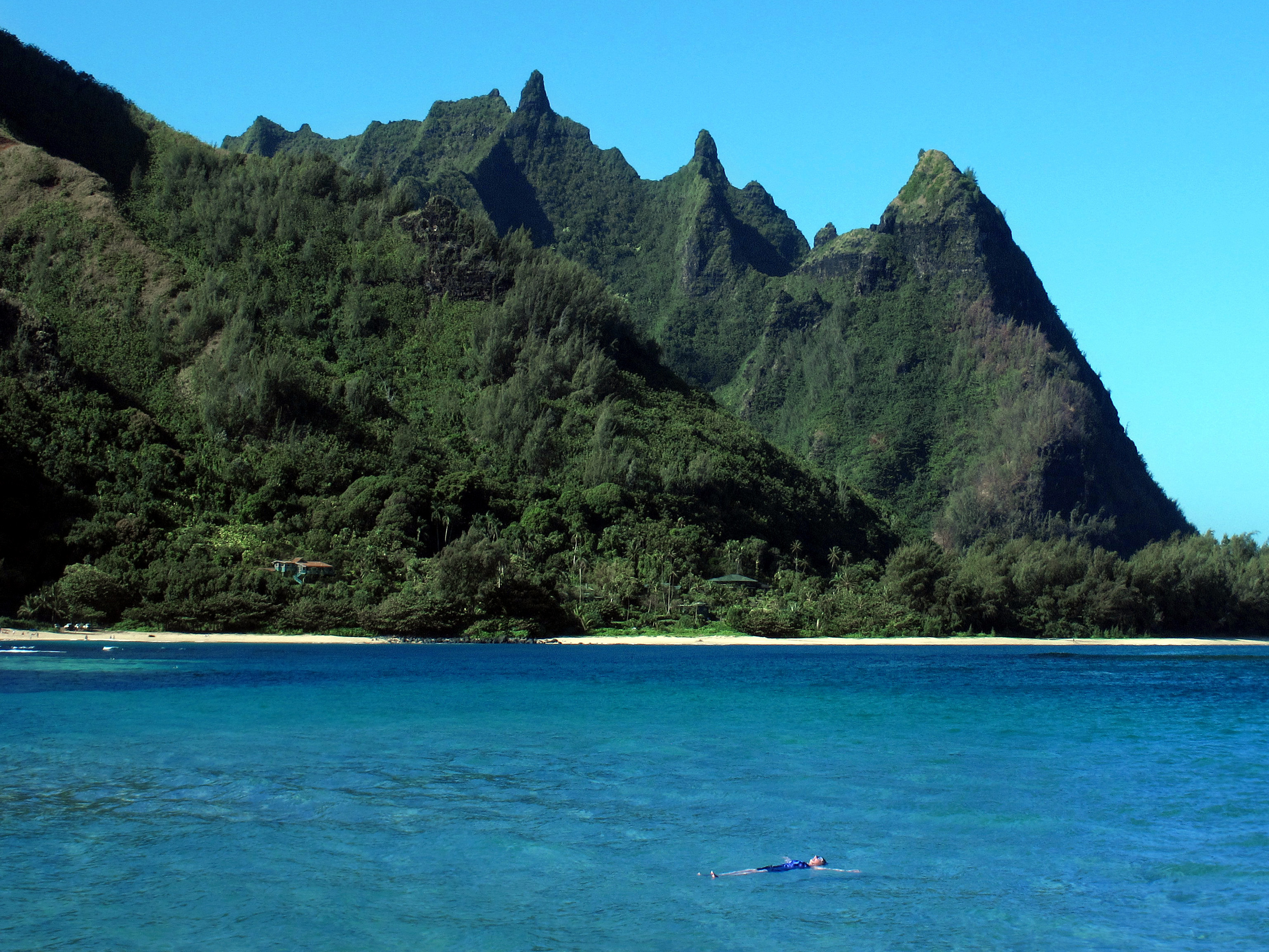
I think of you, my dear, jingling the once-ubiquitous pennies in your pocket, sidelining a particularly shiny one to place in my palm each time I cut your hair. It’s still my going rate—a penny or a kiss. Nowadays you generously deliver both.
And I, along with so many of my fellow Americans, have mostly taken for granted this tiny bit of legal tender like so much of what is fast disappearing from our world.
I vow to stop each time I spy a penny on the pavement and pick it up, regardless of how much in-God-we-trust luck it might or might not deliver for the rest of the day.
I promise to cherish its enduring legacy—Liberty— embossed near the spot on Mr. Lincoln’s head where the bullet must’ve gone in.
Long may equality, freedom and justice for all somehow survive in this land still filled with so many of the tired, the poor, the huddled masses yearning to breathe free.
Jan cutting Dick’s hair, the Tiki Hut, north shore, Kauai, 2012 / Photo: Dick Schmidt (via remote)
The Garden Goddess on the corner is collecting the fallen, arranging the downed and brown around the base of a tree and allowing it to do what comes naturally— turn itself into compost.
“You make your own dirt,” observes a woman who likes to periodically drive by the GG’s corner to appreciate the profusion of plant life, as I do, awed by year-round cosmos, by hydrangea blossoms in November.
The GG nods and smiles. “Yes, I do,” she says, citing the money-saving benefits of homemade dirt.
But I think she is offering more than beauty on her corner. She reminds us that, in this season of releasing, of letting go, the fallen become compost for new growth later.
And that, if we can be persuaded to loosen our tight grips, if we can interrupt hate with love, we can watch life grow from decay— someday participating in that bit of recycling ourselves—
if we just get out of the way.
The Garden Goddess’s garden, Sacramento / Photo: Jan Haag
A pair of young, wiry men work over my front yard for several days with hands both strong and gentle,
lifting this earth that was once part of their homeland—long before their existence or mine as a native Californian—
for the 27 years when Alta California was part of the new Mexican nation, independent of Spain. It did not
take long for new conquerors to decide that this vast land with its ripe central valley, perfect for ranching
and crops, needed to be overtaken, even before they knew about the gold in these here hills. And they did—
people with pale skin like me— as the Spanish did from the first peoples who populated this place.
Many generations later I watch these landscape artists, listen to their lilting voices in Spanish as they work
for one more white lady, remaking the small space I think of as mine into a lovely swath of river rock
beds into which I will plant annuals come spring. On a foggy Saturday morning a trio spreads elephant gray
volcanic rock mixed with soft black and iron-rich rust that once burbled up through the earth in liquid form
before cooling into rough bits. They install smooth slate called Indian Paintbrush after the plant
as I think of the people who literally paved the way for my existence, the ancestors of this land,
along with my own young parents who migrated west to make a better life, to raise
California girls, we natives of a different sort who owe our comfortable lives to those who
sculpted this land. Like these men who comprehend un poco of my too-fast English, as I
struggle with their lyrical Spanish, men whose wheelbarrows clatter over chunks of ancient rock.
Who smile shyly when they summon me to look at their finished work, who acknowledge my muy bueno
and muchas gracias with a gentlemanly tip of their ball caps and a soft chorus of de nada.
•••
With thanks to the team of terrific professionals from JDL Land Management in Sacramento who remade my front yard into a thing of beauty. And to Lindsey Holloway and Chuck Dalldorf who highly recommended Gabriel Garcia and his team… as do I! (Top photo: Dick Schmidt; photo below: Jan Haag)
The team from JDL Land Management who worked their magic to revitalize my front yard. Photos: Dick Schmidt and Jan Haag
We are all hurling through space on a rock, and we’re all going to die. You would think we could be holding hands and singing. —John Bradshaw
•••
Give me your hand. Here’s mine. Whatever we think makes us different is not as important as what makes us human.
So human to human, let us not think of division, of subtraction. Let us think of multiplication, of adding my 1 to yours, and to his and hers and theirs
as we stand on this sphere of rock slowly rotating on an axis we can’t see, in these brief lives between the first breath and the last, the first heartbeat and the last.
We are the bridge between the ordinary and extraordinary. Let us not curse the darkness but instead light a candle for each other and all beings everywhere.
Who doesn’t need a blessing, another hand reaching for ours?
And, while we’re at it— one plus one plus one plus one and on and on—let’s raise our voices in song, add a little harmony to feel the chord of many resonating deep inside our chests.
May we hold hands and sing as long and as loud as we can, together, until the last breath.
Amen.
Italian artist Lorenzo Quinn created his sculpture “Building Bridges” for the Venice (Italy) Biennele in 2019. There are six pairs of the 50-foot-tall hands, each pair symbolizing a different human value: friendship, wisdom, solidarity, faith, hope and love. (Photographer unknown)