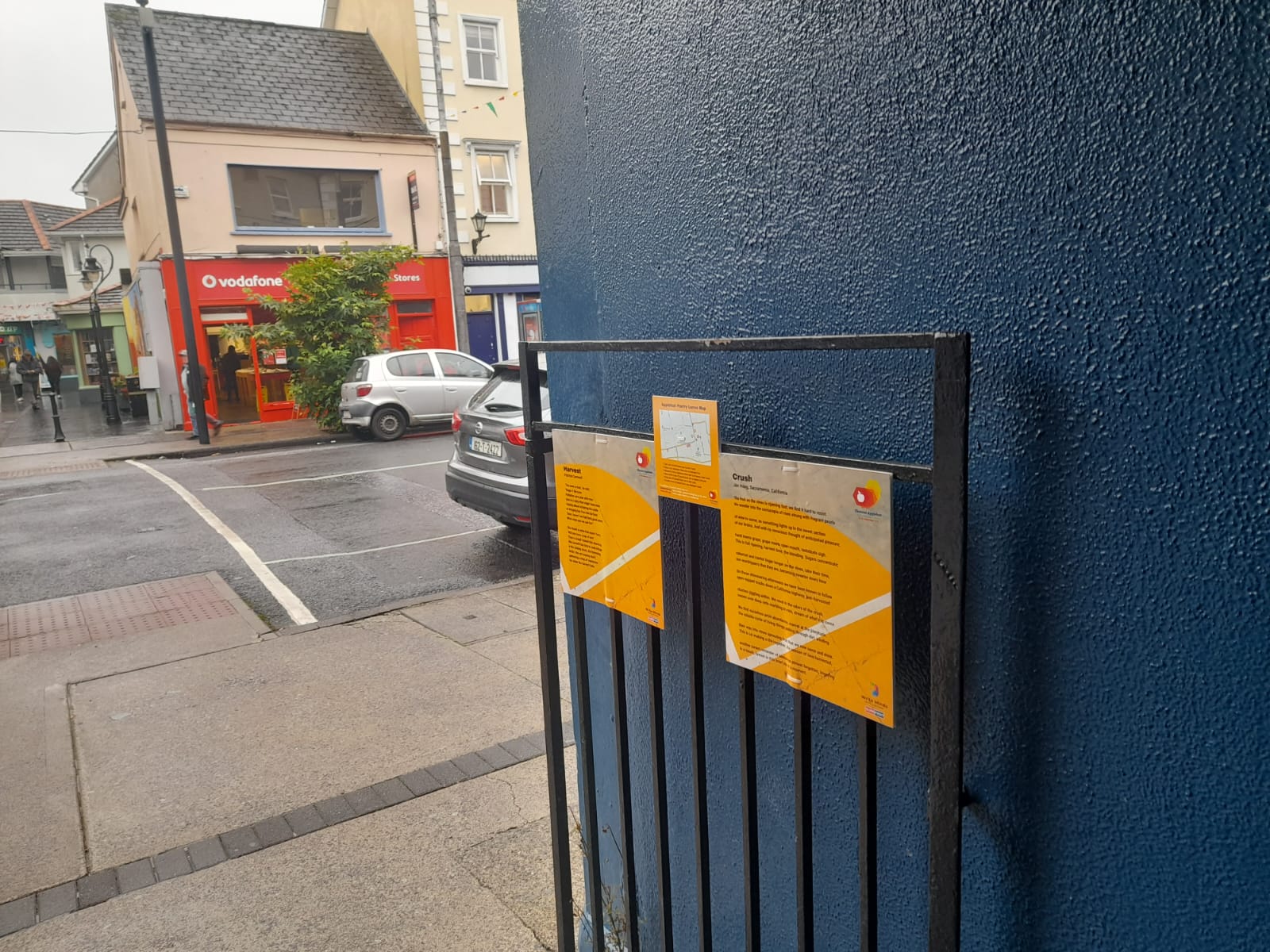
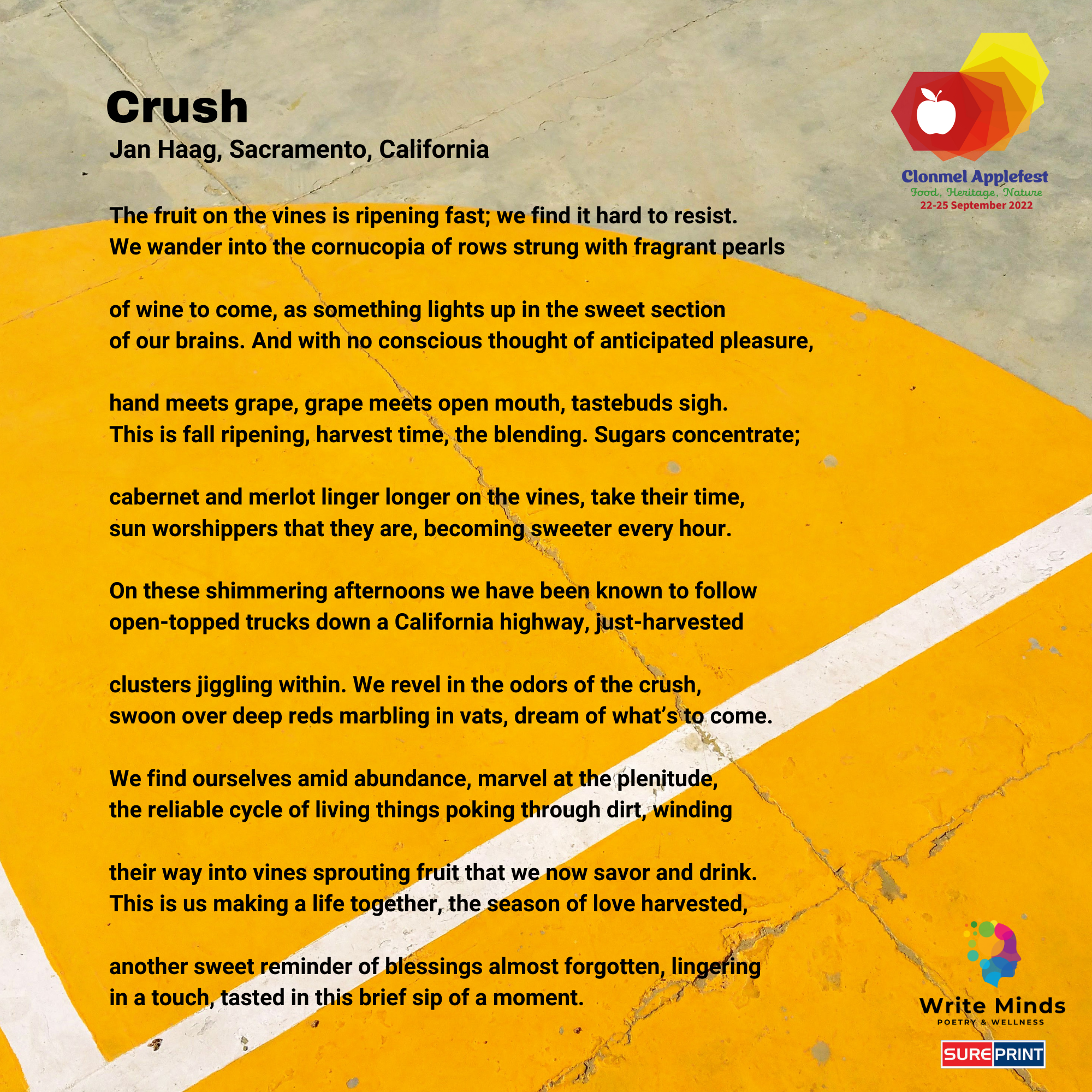
My poem, one of 39, posted as part of the fourth annual Applefest Poetry Trail in Clonmel, Ireland.
I’m fortunate to have poems and stories periodically published, but I like to remind people in my writing world that I generally get at least four or five rejections for every piece that’s accepted. Not a bad rate, but I target things carefully to journals/anthologies that seem particularly well suited to pieces I’ve written… or pieces I write to try to suit them. Still, editors get a LOT of submissions (I know… I edit a literary journal, too), so there’s a lot of luck involved in gaining an acceptance.
Every so often, though, someone invites me to submit a piece to something they’re working on, and though publication is not guaranteed, these feel like better possibilities. Such was the case when Jennifer Cox invited me to submit a poem on a harvest theme to the Clonmel Applefest in Clonmel, Ireland, where Jenny lives and works as a poet and writer. For four years she and her friend Eileen Acheson have asked poets to submit their work to be printed on plaques and posted on the outdoor Poetry Trail among the lanes of Clonmel.
I submitted a poem and didn’t hear anything for a bit. Then I got a group email about where the poems would be on display. I had to ask Jenny if my poem had been selected, and she said, of course, which both surprised and pleased me. I’ve had poems published internationally, but this is a first: to have a poem (one of 39 poems) posted on an Irish lane in Tipperary County. (You can click on the photos to enlarge them.) My Irish ancestors would be proud!
I’m honoured (proper Irish spelling) that Eileen and Jenny accepted my poem, “Crush,” which is a version of a poem I wrote as a wedding gift. Tomorrow (Sunday) Jenny will read “Crush” along with other local poets at a spoken word event. Thank you so much!
(You can listen to me read the poem here. Even better, here’s Jenny reading the poem Sunday, Sept. 25, at the Clonmel Applefest poetry reading.)
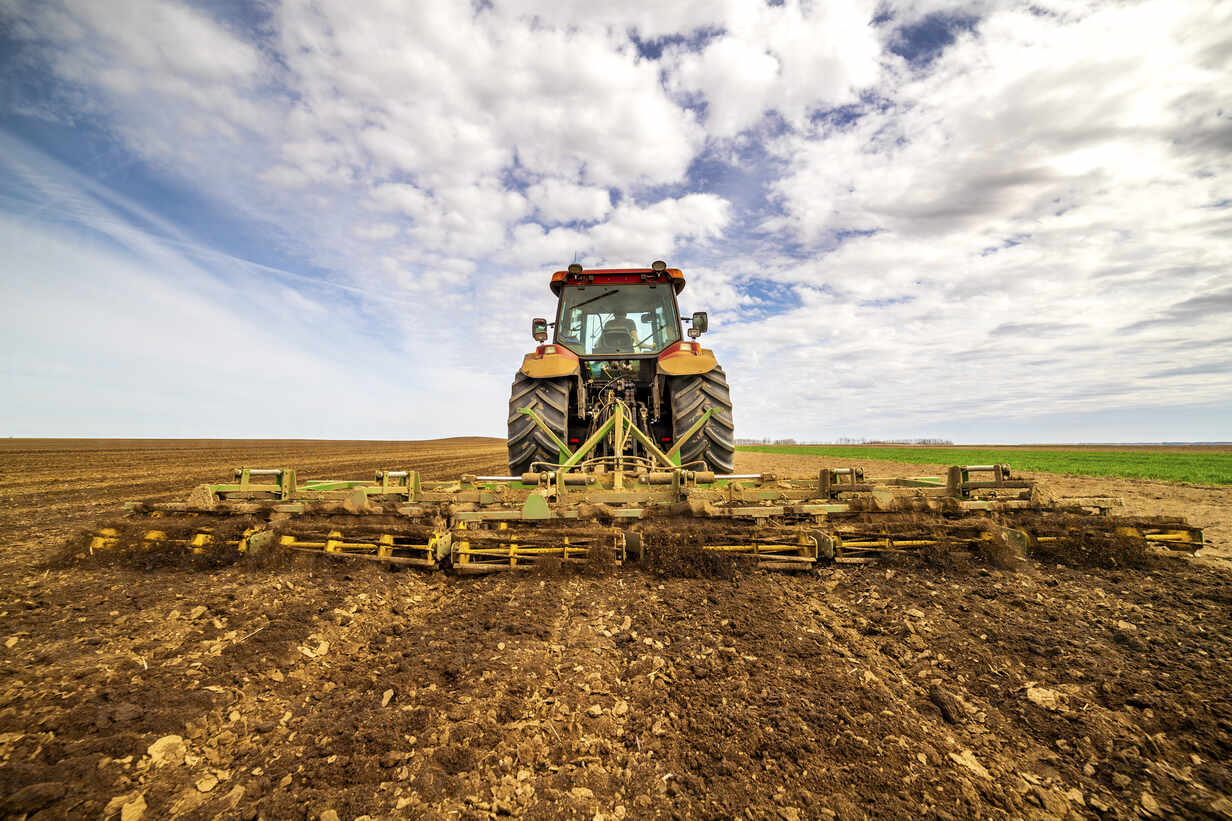
I picked my way across virgin furrows, hundreds of unplanted rows somewhere outside Winters on a breezy June day under insistent sun, teetering on unsuitable footwear toward a lean man whose name I cannot recall, nor the story that sent me there.
A rookie journalist in a neighboring rural county, I took tea at noon in my pink skirt and low white heels with service-minded Soroptimists nibbling triangle finger sandwiches, afterward driving 20 miles to take an unsteady walk toward a farmer perched on his high-rise tractor “way out there,” his wife said, pointing.
What I remember is the farmer’s face astride a giant beast, snorting through billowing dust to a gradual halt, as if bridling a stallion that, given its head, could rear up and buck him off. The man climbed down from his mechanical steed, wiped his sweaty brow with a red bandana, tugged up his work pants, smiled kindly.
“What can I do for you, young lady?” he asked, as if 20-something girl reporters regularly found him plowing the rich earth of his family land that would, with luck, yield a worthy crop in a matter of months.
We must have talked; I would have taken notes in my slender reporter’s notebook. And, when we finished, he offered me a ride back to my car atop all that horsepower. Knowing he wasn’t done with that day’s work—he’d said he had many more rows to furrow—and not wanting to delay him, I declined with thanks.
He climbed back up on his stallion trembling with barely reined-in power, ready to paw long, shallow trenches into soil. I wobbled my way back across the field, half wishing I’d accepted his offer, turning to wave, gratified to see the callused hand and extended salute of that gentle bronc rider silhouetted against a bleached summer sky.
I am grateful to YoloArts and their 15th annual Art Farm exhibition of art inspired by the farmlands of Yolo County, California, for hosting the first Art & Ag Poetry Contest, judged by Julia B. Levine, poet laureate of Davis, California. This poem won third place in that contest, and I read the poem at the event’s opening reception. Thanks to Julia B. Levine for selecting the poem and to Janice Purnell, creative director of Yolo Arts, and her team for their work on the exhibit.
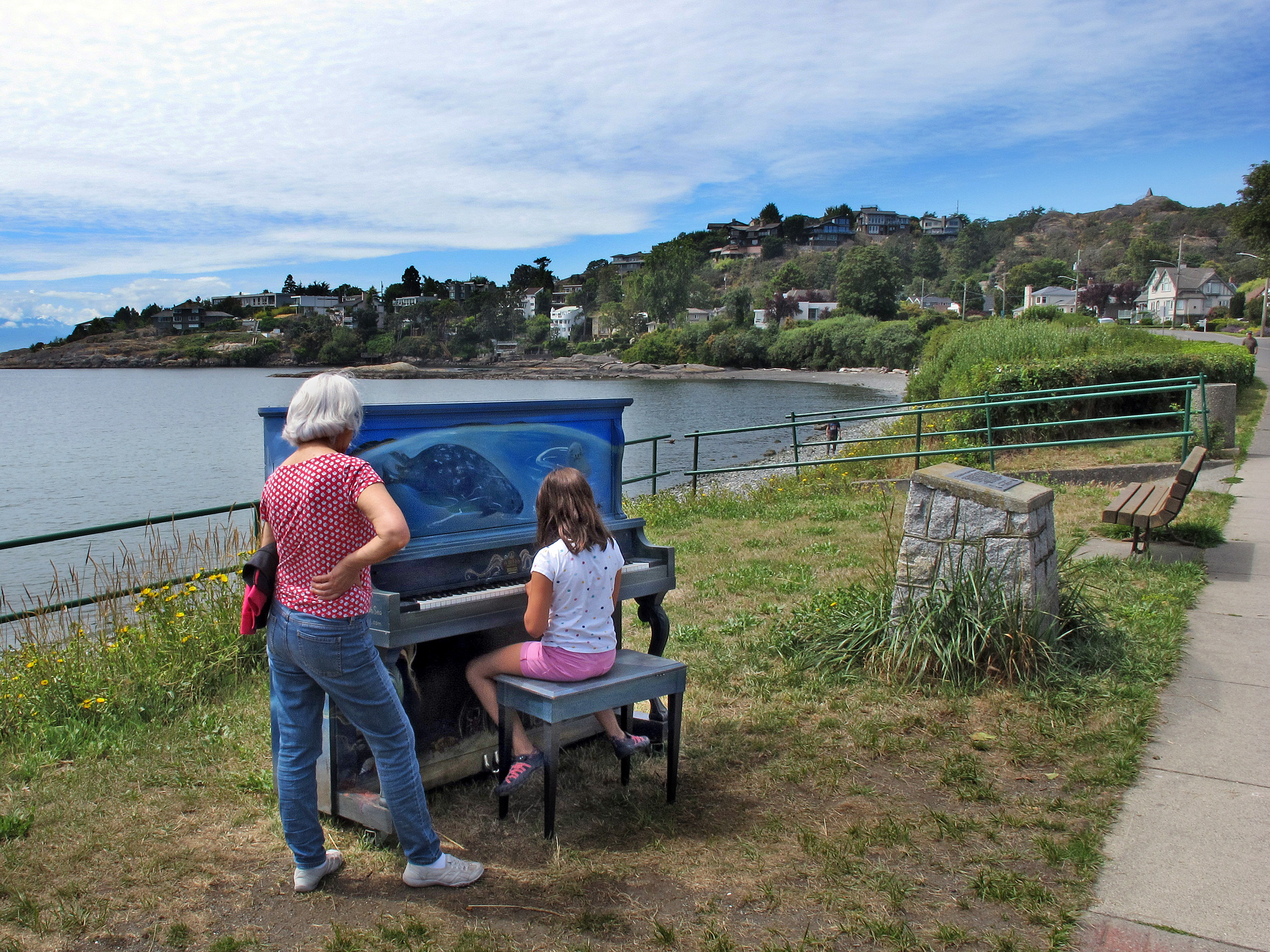
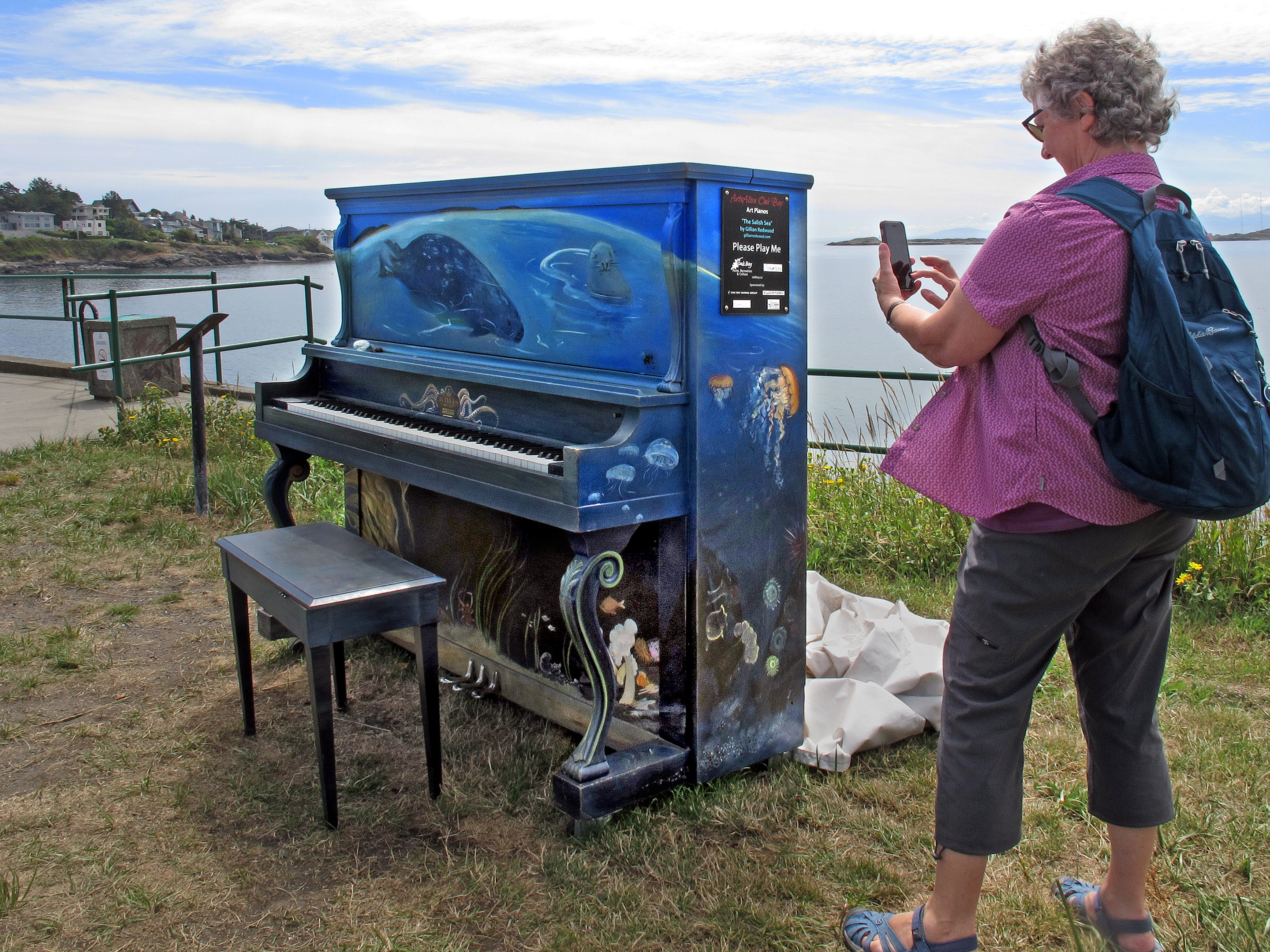
The seaside piano at Beach and Oliver streets, Oak Bay, Victoria, B.C. / July 2019 / Photos by Dick Schmidt
The last time we were in Victoria, B.C., three summers ago—before, as they sing in “Hamilton,” “the world turned upside down”—it was July 2019, and Dick and I were marveling over our good fortune.
Six months earlier in January, Dick had collapsed in cardiac arrest as we were about to board a plane in Honolulu to return home after a two-week vacation. As I’ve written about elsewhere (you can look at the whole series, Dick’s Great Heart Adventure), Dick’s heart stopped and was restarted after a few minutes thanks to a team of strangers who came to the rescue and the swift application of an AED (automated external defibrillator) that brought him back to life with one massive shock.
That began a series of miracles and lifesavers who put Dick back together again, resulting in a triple bypass at Kaiser Moanalua Medical Center in Honolulu and two of his oldest and dearest friends who came to Oahu to care for him when I had to return home.
So coming back to Victoria—a place we love and have spent parts of summers since 1999—in July 2019 felt a bit miraculous, too. I remember walking around thinking, “It might have been otherwise,” which is the repeated line in a lovely poem by the late Jane Kenyon.
Nothing like a crisis to remind you of how lucky you are. And boy, did we know it.
Driving around the south shore of Vancouver Island is one of our favorite things to do. It’s a relatively small peninsula with an oceanside road that winds through the neighborhoods of James Bay and Oak Bay, and we took the drive—stopping here and there to take photos and soak up the glorious weather. You never know what you’re going to see, I often say as we park someplace to get out and look. Some surprising thing will happen that you would’ve missed if you’d just driven on by.
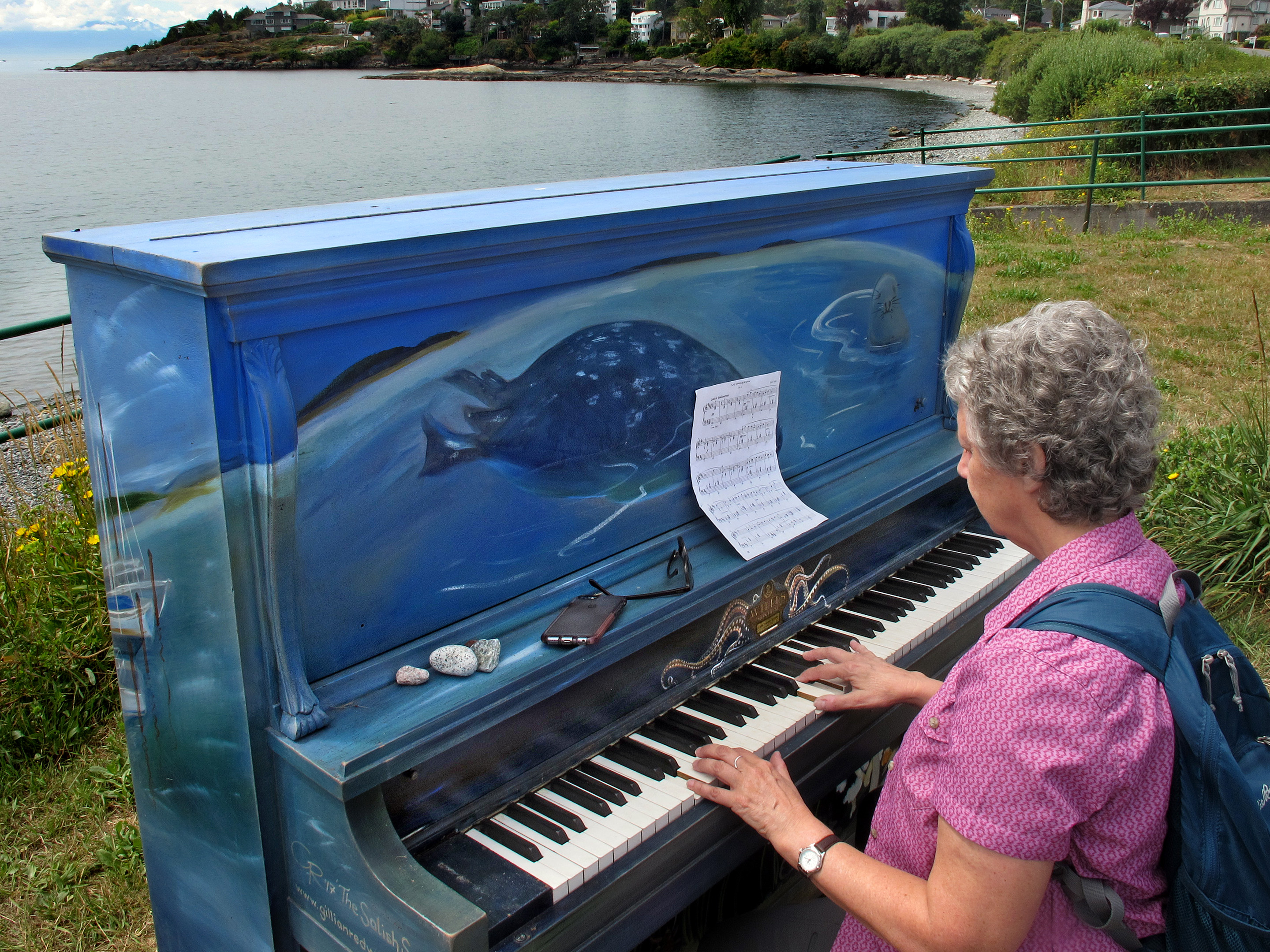
Victoria artist Gillian Redwood’s painted seaside piano, “The Salish Sea”
So when we passed an old upright piano painted with seagoing creatures sitting oceanside at the corner of Beach and Oliver streets, I hollered, as I’m wont to do, “Ooo! Pull over, Dickie!”
He is used to this, so with a bit of protest—“Janis!”—he did so, as I babbled about a painted piano on the side of the road. I got out of the car and walked back to see if it was a real, playable piano. It was.
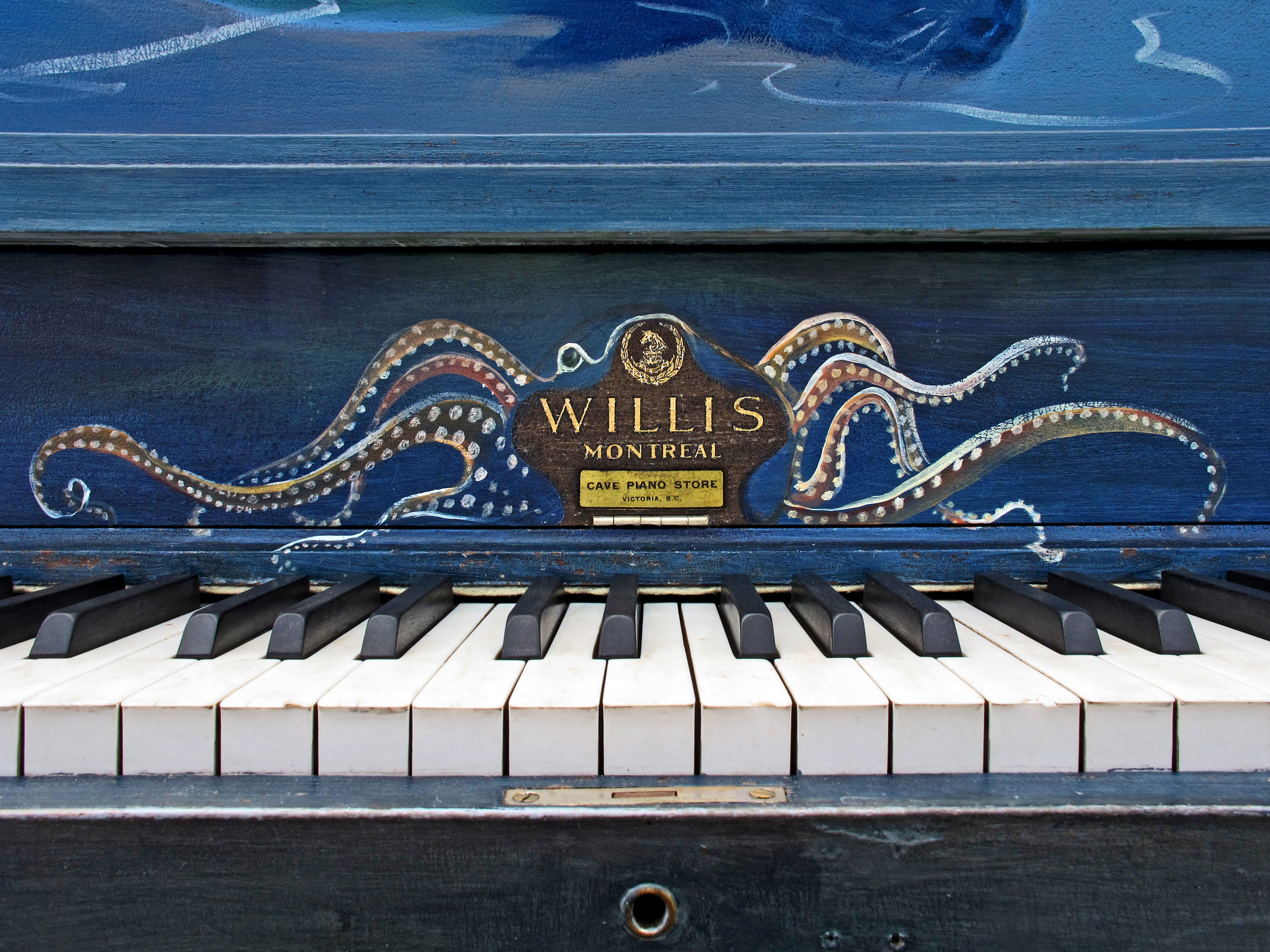
The piano was angled so that the left side of the pianist faced McNeill Bay. It had a retractable cover over the keyboard (called a “fall”) that immediately drew my fingers. I lifted it and pushed it back into its little garage, letting all 88 keys gleam in the sun. Just for kicks, I played a few chords. It sounded a little like the rinky-tink piano in the pizza joint my parents, sister and I patronized in the early 1970s.
The piano and others painted by local artists were deployed around Oak Bay as part of the Arts Alive program. This one at McNeill Bay was painted by Gillian Redwood, and she calls it “The Salish Sea.”
What charmed me was its funky, imperfect sound… not that it wasn’t in tune… but I felt that as if I lifted the top of the piano and peered in, I’d see its insides heaving with sound, its old hammers compressed and grooved from hitting the strings millions of times, the strings themselves fatigued with age, the tuning pins loosening. Pianos have something like 10,000 parts with mysterious names—unless you’re a piano tuner: flanged shanks, whippins, damper works, a soundboard with a crown.
Like many kids, I took piano lessons, and I was not a successful student. Trying to get ten fingers and a foot pedal going was tremendously hard for me. My little sister was the far better pianist, and her daughter is quite good, too. But I love pianos—their sounds and their feel, the magic that emanates from them by superb players.
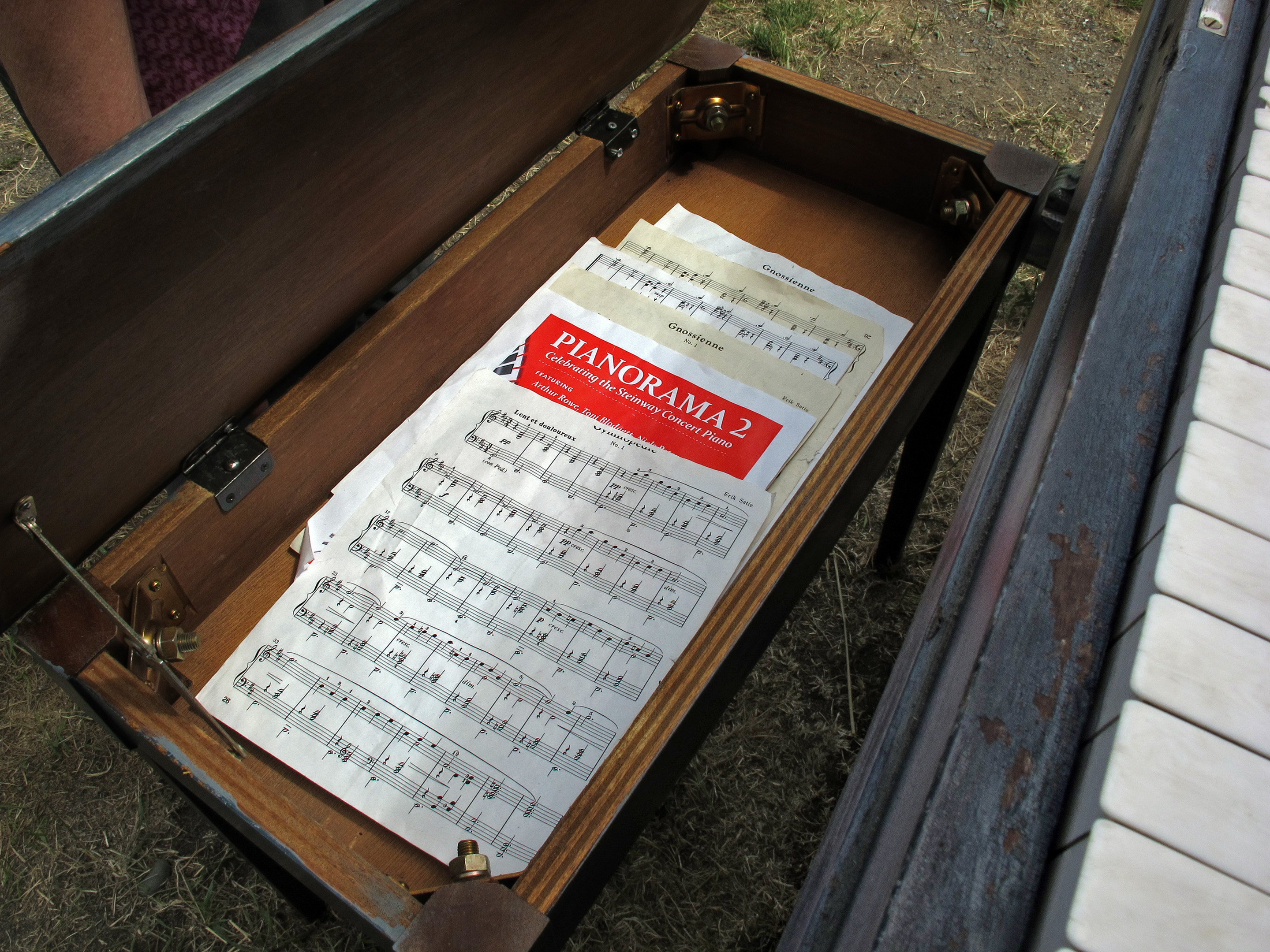
And this one, the Salish Sea, had a piano bench with a lid that lifted. Of course, I lifted it. Inside were several pieces of sheet music. I chose one I had at one time played: Gymnopédie No. I by Eric Satie. It’s the first of three related pieces—all in 3/4 time, deliberately slow and deceptively simple… if you remember how to read music. I had to think about it and figure out some of the notes.
Sheet music to play!
But I sat at the keyboard six months after Dick had been brought back to life and figured out, slowly, painfully, how to play a bit of Gymnopédie No. I at McNeill Bay, grateful for the chance to do so with him there taking photos.
During the pandemic, on some of the darkest, locked-down days, I sat at my computer at home and emailed and Zoomed and talked on the phone with my students. So many of them were upset, depressed, scared—as we all were. The world—the whole world, all at once—was undergoing a tremendous shift, a gigantic ending to life as we knew it. And the new life had not yet been born. It was a time of mourning and sadness, and I kept saying to students who bemoaned the shifting tide, “It won’t always be like this.”
More than one student wailed, “How do you know that?”
And I fell back on the Buddhist teachings of impermanence—nothing ever stays the same; change is constant. We don’t always like it, but it’s going to happen, I told them. Everything vanishes. The pandemic reminded us of that in a huge way. The Buddhists say that we should learn not to cling to “the way things are.” It’s not the fact that everything is born and lives and dies that causes suffering; it’s our reaction to it. The idea is that loss can be a catalyst for a profound shift in perception and a transformation of our sense of self. Being willing to let go, to release our attachments (whether to people or animals we love, to jobs or where we live), and hold on loosely helps us be less anxious about impermanence.
Working my way through Gymnopédie No. I.
But that doesn’t mean it’s fun to live through or that we don’t grieve what we’ve lost. We do; we should. We must endure the hard stuff that knocks the wind out of us, over and over in our lives. “It might have been otherwise” reminds me to say thank you, out loud, again and again for the experiences we’re given, no matter how difficult, how joyful, how fleeting. I often think of my friend Antsy McClain’s sweet song “Scrapbook,” in which he sings: “I won’t cry because it’s over. I’ll smile because it was.”
Today—after a three-year absence during which we so longed to return here—we drove the ocean road and there, at the corner of Beach and Oliver streets, sat the piano. It was covered with a custom, piano-shaped tarp. We drove by and noticed it, then a little ways down the road, I asked Dick to turn around and go back to the piano. I wanted to see it again.
So we did. We gently pulled up the tarp to reveal Gillian Redwood’s sea creatures across the front of the upper panel. To our surprise, the piano had a lock on the fall. The keys were not accessible. It appeared to have been locked for the season. Ah, well.
I later looked online about Oak Bay’s pop-up painted pianos. They’re out in summer through early September, the site said, and well, it is early September.
So I couldn’t play the piano this time, but we admired it and patted it a bit, then carefully replaced the tarp. Releasing the attachment to playing it, I was able to leave only a tiny bit disappointed. The music is still there in the piano. And it’s in me.
And I resolved, as I did three years ago, when I get home, to dig out my copy of Gymnopédie No. I, find a piano (or on the marimba in my living room) and relearn that song—a reminder of gratitude for life’s unexpected delights scattered between the difficult and sometimes downright awful, life-changing moments… like finding a piano by the sea, waiting.
“The Salish Sea” piano sitting at McNeill Bay, Oak Bay, Victoria, B.C.
Georgann Turner’s version of meeting Jan (written in 2012):
Twenty-four years ago I was getting ready to go do a “junior year” abroad. I was no spring chicken. I was thirty-six years old, a divorced mother of an eleven-year-old and a thirteen-year-old, and a bit of a late bloomer.
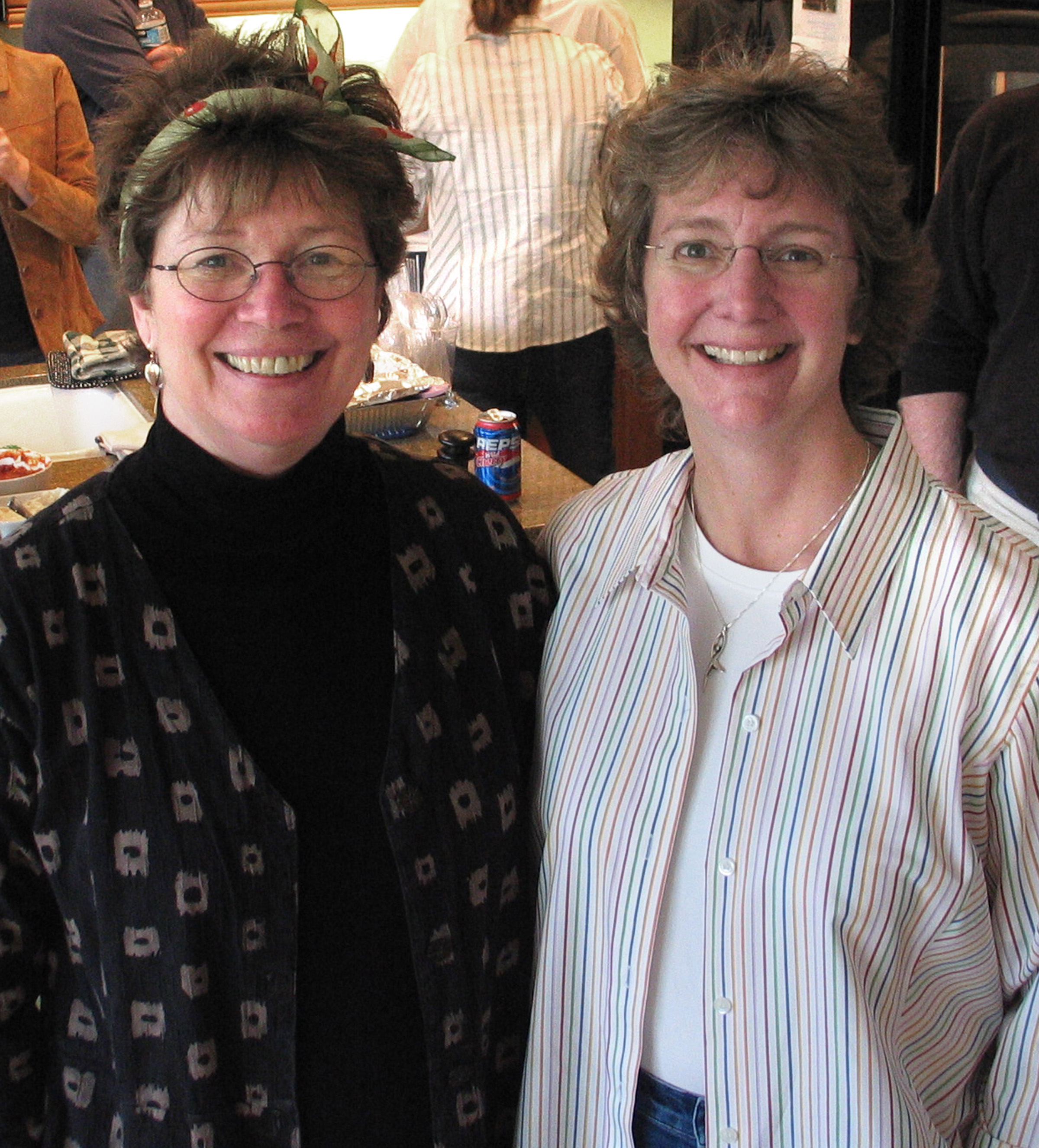
I LOVED school. I had just won a journalism scholarship and received it at a meeting held at a journalism teacher’s house. Her name was Jan Haag. And she was younger than me. We liked each other, so she kept inviting me to her classes even though I wasn’t enrolled in any of them. She knew everyone. She was also the editor of a magazine and her guest speakers were amazing—Pulitzer Prize winners, famous photographers, name brand journalists. So we got to know each other a bit.
And one day I said to her, “I’m going to Wales. If you write to me, I’ll be your best friend.” And I think she thought I meant it.
As it turned out, she had a trip planned to Wales around the same time that I was planning to arrive there. I’d only been there less than a week when she popped in for a visit. After that, we started writing to each other. And the first letter I got from Jan was an epiphany—I heard her voice. I understood what writing was—it was putting your voice on the page. So when I wrote to her, I put my voice on the page. And it was easy. I just talked to her.
•••
Jan’s memory of this:
The way I recall it, Georgann suggested that we write to each other when I was visiting her in Swansea, Wales. She and Jena had just arrived and were living a two-story flat where, to get heat, they had to insert coins in a device on the wall like the kind you might find on washers and dryers in laundromats. I was traveling through the UK by train in the fall of 1988 with my best childhood buddy, Sue Lester, when Georgann said (in Sue’s presence), “If you write to me, I’ll be your best friend.”
I may have this wrong about when and where she delivered that memorable line. But we both remembered her saying it because it was typically Georgann funny, and it made us both laugh.
Sue didn’t take offense, as I recall, and, because I liked Georgann, too, I came home and went to the post office to buy single sheets of thin blue paper called Aerogrammes. I think they cost about 50 cents, which was pricy postage at the time. You wrote on one side of it, then folded it into a rectangle, licked and sealed the gummed sides, and addressed it to your friend overseas.
We sent our Aerogrammes back and forth across the pond for the two years that Georgann was in Swansea finishing her bachelor’s degree in politics. I still have her letters—her voice bounding off the page, a fine writer, though she didn’t know that yet—great treasures that they are. They chart the beginnings of our friendship that neither of us imagined would last for the rest of her life—as she adopted three children, first as a single parent and later with her second husband, Ron—more than 30 years of love.
for Georgann, on the first anniversary of her death
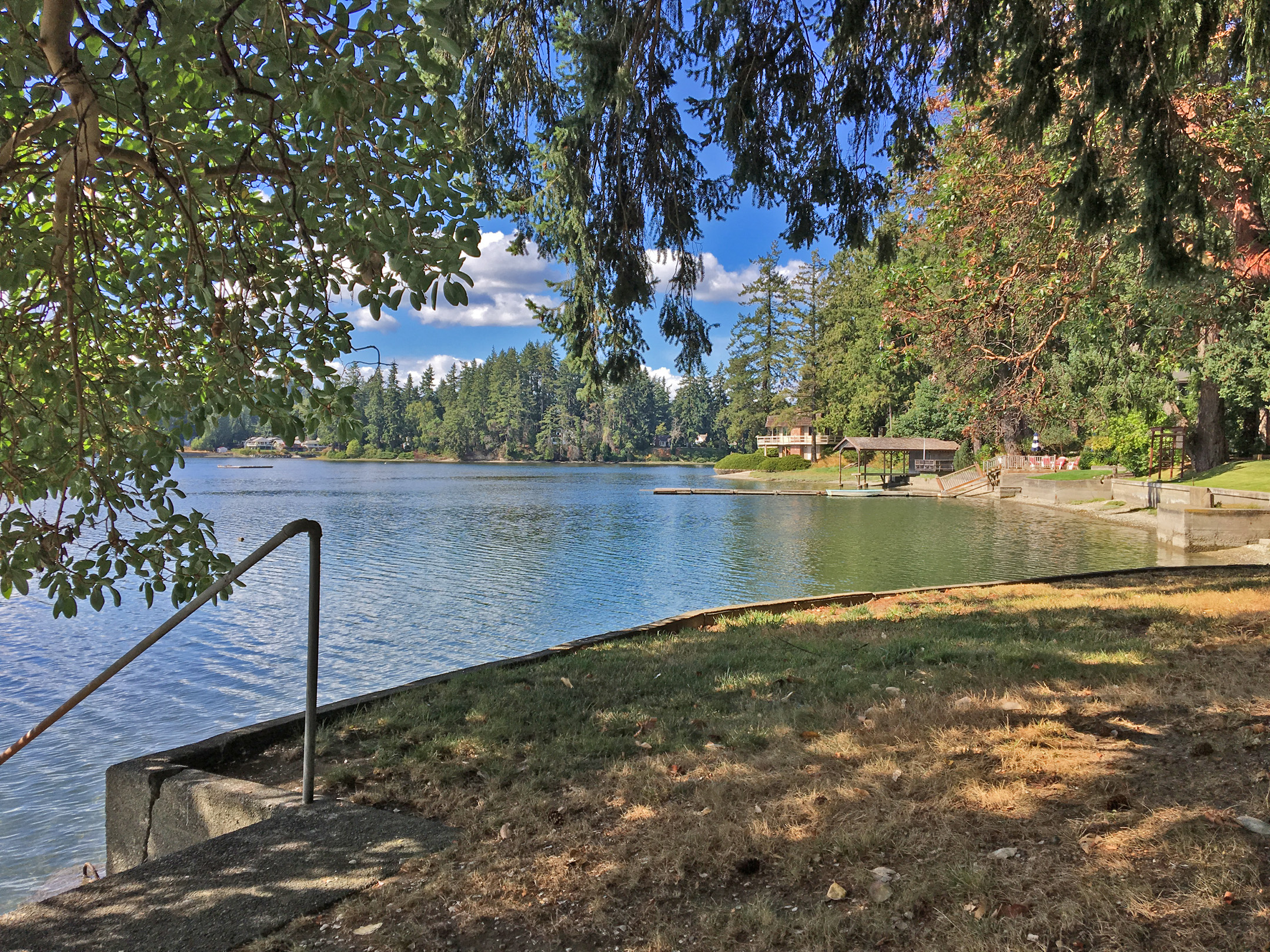
While I wait for you to die, I putter next door in the old house rendered new after its occupants passed years ago, the neighbors having rehabbed it into a quaint guesthouse. I cannot help make comparisons between the creaky floors on which I pad and you, brittle and sweaty in your bed, as the temperature soars inside and out.
Every morning I head for your house, pick up the leash off the hook by the door to the garage, find the old dog sprawled on the dining room floor. You used to have to step over him to put food-laden bowls and platters on the table. Now he is the only one who occupies that relatively cool space.
He, too, is literally on his last legs—arthritic and prone to falling. I follow his slow progress outside to the little house next door where I alight for now. He prefers the freshly mown grass there to the patch in front of his own house. “It’s good to get out,” you observe in a rare moment of wakening. It takes me a second to realize you’re talking about the dog. “He likes to read the news left by other dogs.” I chuckle, good audience that I am.
Your husband lingers at the doorway of the small room where you are enthroned. “Don’t forget the blackberries,” he says, the one in charge now, who looks after you, a daughter and two granddaughters—cook, chauffeur, pain meds dispenser, cat and dog caretaker. “Oh, yes,” you chime in. “They should be getting ripe now.”
I’ve been reluctant to take up a bowl and plunge into the blackberries wrangled into rows by the neighbors, though I’ve been invited to since I got here. It is early for blackberries; I can see the ruby jewels from my bedroom window. They need more time on the vine, and I’m not certain I’m ready to bear the inevitable scratches that come from pursuing such sweetness.
“Would you like some blackberries?” I ask, you who are eating so little, whose guts release so quickly what you ingest. You extract the little opioid sucker from your mouth, hold it up: “This makes everything taste bad.” It has long been so, the cocktail of pain meds that has taken your teeth, your appetite and not a little of your mind. Wanting as much time as you can get through this rocky passage, you’ve paid for it with every lost pound, shred of memory, bit of balance.
“Still,” you say, popping the sucker back in, “a blackberry or two might be nice.”
And that sends me into the vines, willing to bear the tiny wounds, searching for the purplest ones, settling for slightly violet-red. If you could make it outside to stand nearby with your own bowl, you’d hand me a fat berry to sample. I let kindness melt on my tongue, lingering in the midst of an overheated day, the tall pines stilled, no wispy bay breath drifting by.
Without thinking, I steer toward it, needing to see that swath of strength making its way through the artery of Delta to the sea.
I always find you there.
Under a blue-sky June dome I travel back decades to a time capsule once anchored hard by this river where you waited for me.
When the car dead ends into the levee road, faith stretches a long lazy arm before me, cobalt calm on the surface, turbulence churning below. I pause, knowing that to turn left and follow the road south, crossing one bridge, then another, I could reach that sweet spot where we found communion far from the world.
You are not there, but I carry us always.
So I turn right, tuck you back into my heartspace, trusting the undulation of asphalt before me, of young peaches ripening at the bottom of the levee on my right and the perpetual river on my left to carry me home.
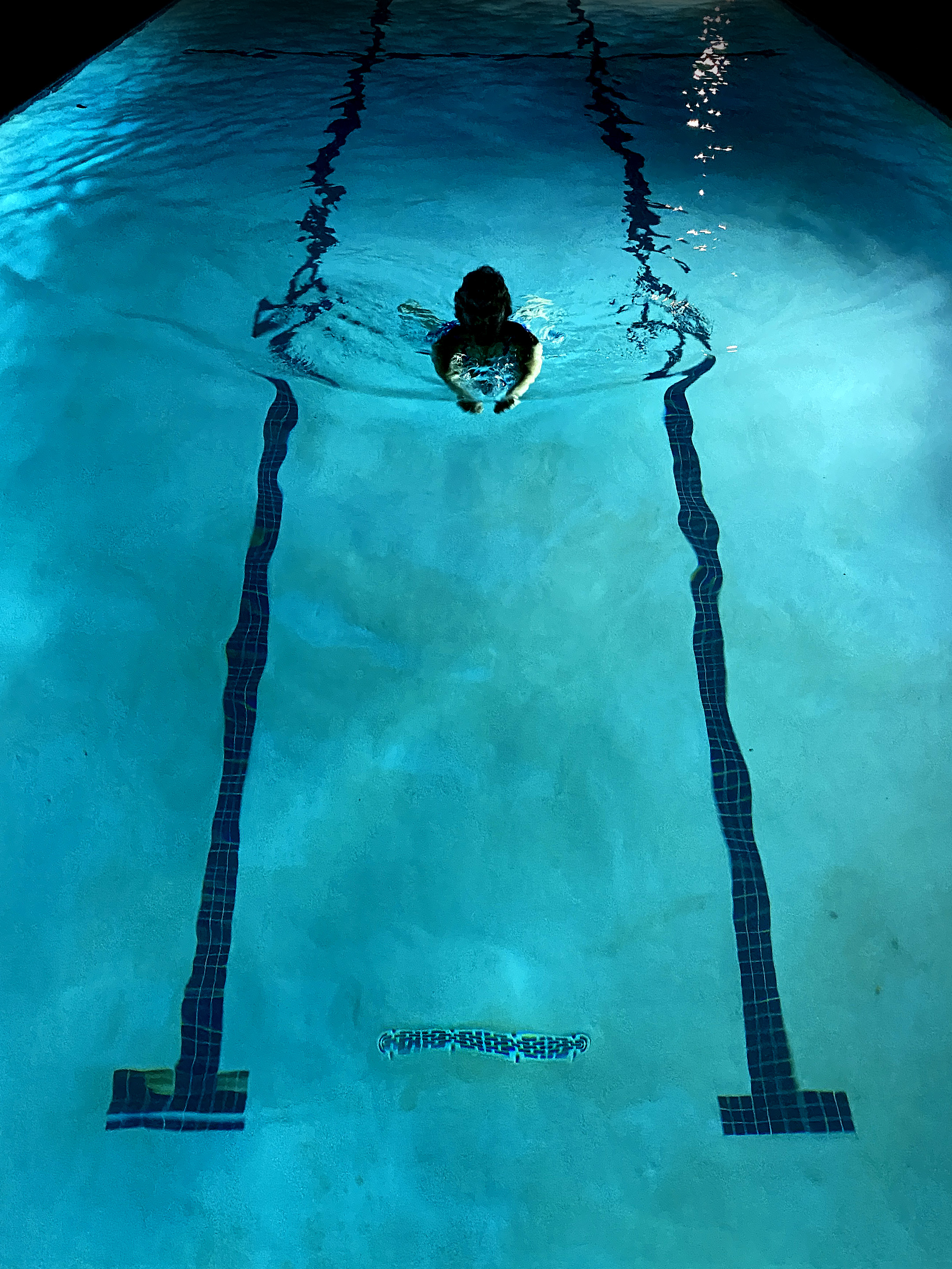
Always after dark when the pool floods with underwater light, the very definition of aquamarine, so that it feels like stroking through turquoise.
Alone, there’s no need to stay in one lane, which is fortunate since every summer I must relearn how to pull and scull evenly, especially on my back, so as not to torpedo off at such an angle or bash into a wall, a step, a railing arcing silver into the water. Even in the pool my perennial klutziness manifests.
But after the annual reorientation of a land mammal returning to a liquid state, my laps straighten themselves out, body memory taking over what the mind cannot direct. From water we long ago emerged and to water we return, especially at the end of superheated summer days, to cool ourselves, to switch off thinking, to float—blessedly float—
and find ourselves supported by something greater, something simpler, always held.
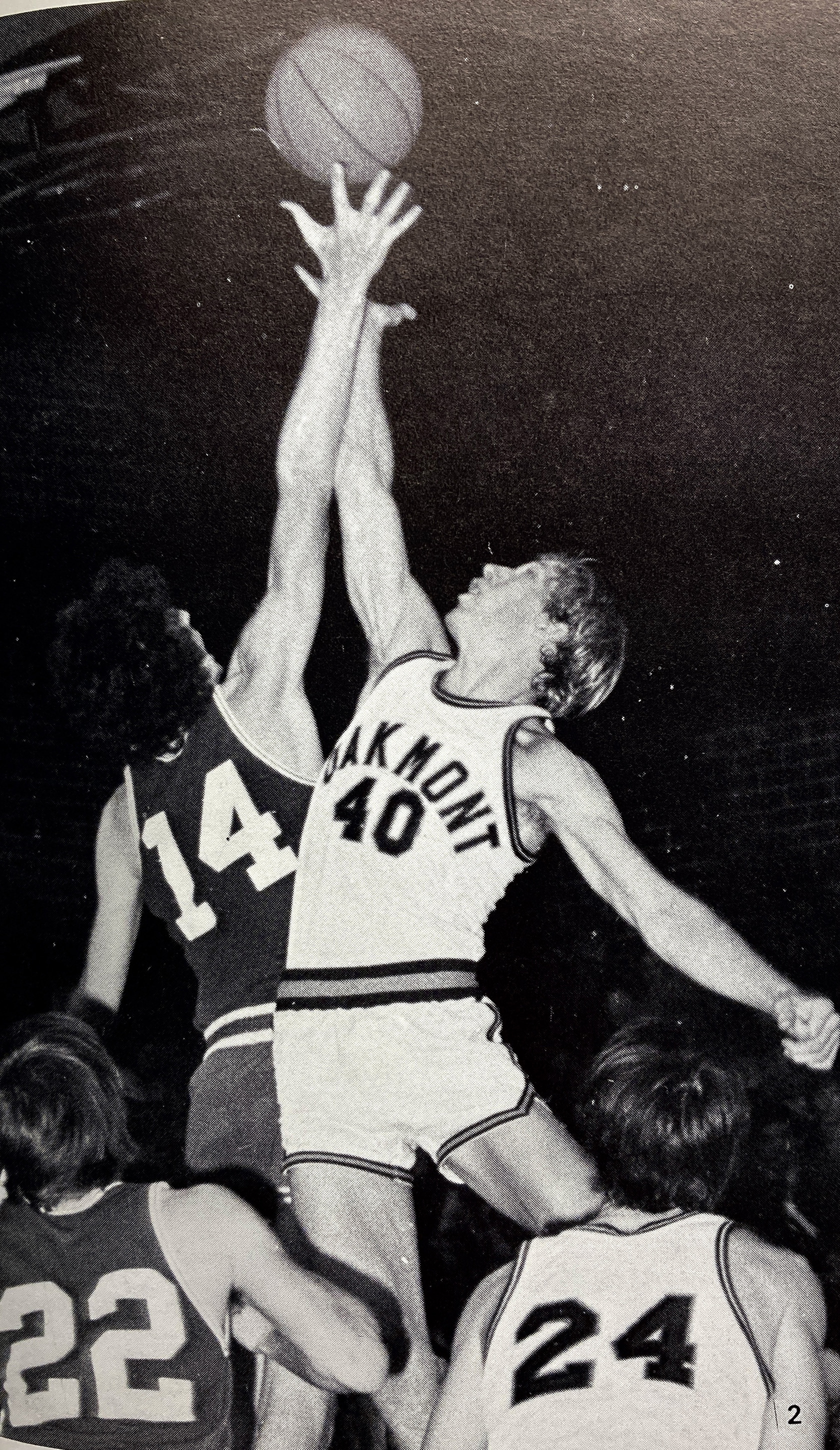
Don DeVorss, Oakmont High School varsity basketball team, 1976
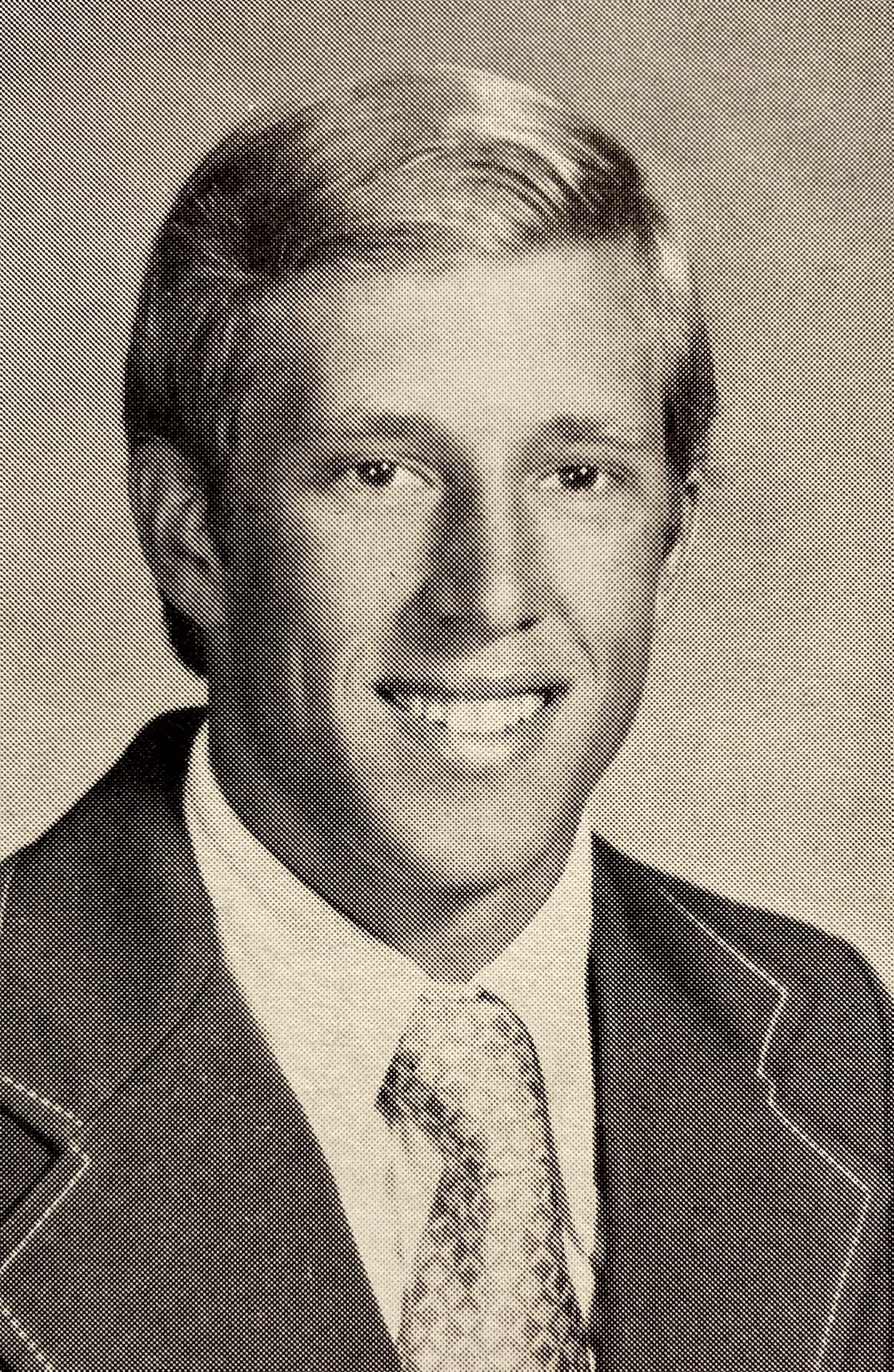
As best I can tell, the last time Don DeVorss and I saw each other was probably at our high school graduation—Oakmont High School, June 1976, in Roseville, California. We’d gone through elementary school as well as high school together—living within a mile or so of each other, riding the same buses, sharing friends in common—but never in each other’s immediate orbits. I remember Don in high school as a tall, gifted athlete playing basketball and running track. I was the girl drummer in the marching band, directing the pep band at home basketball games, working on the school newspaper.
Don DeVorss, Oakmont High yearbook, 1976
After high school we veered into our grownup lives—Don becoming an architectural and landscape designer with his own business, marrying a lovely woman named Julie with whom he has three grown children, and living on the other side of Folsom Lake from where we grew up. Me writing my way into journalism, marrying Cliff, living and working in Sacramento, losing Cliff when he was 48 years old, then partnering with Dick.
What Don and Cliff and Dick have in common, though, are tricky hearts that needed some work. Cliff with his nifty clicking artificial aortic valve installed 17 years before he died. Dick collapsing in cardiac arrest in 2019 and being brought back to life thanks to an airport defibrillator, then having a triple bypass in Honolulu. And Don, whose heart began to fail because of a virus he acquired in Mexico, felling him with a heart attack and leaving him close to death—until, years later, someone else’s heart gave Don a second chance at life.
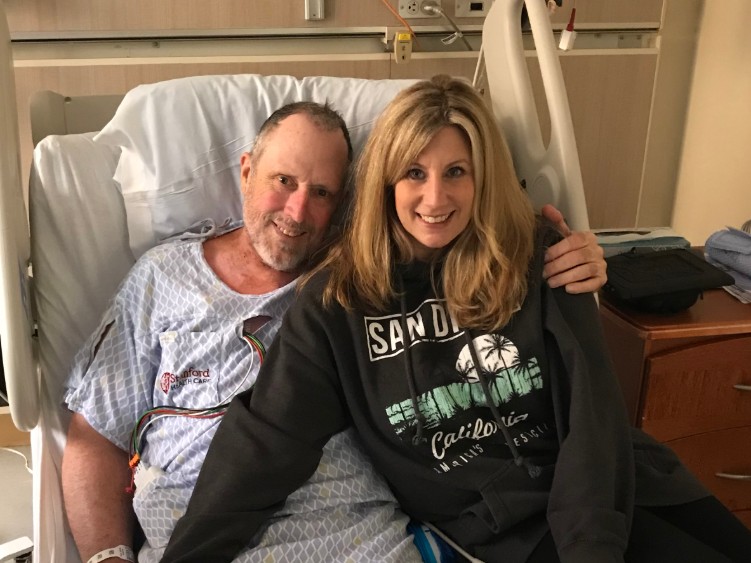
And, coincidentally, Dick and Don both had their chests opened by heart surgeons—one in Honolulu, one at Stanford—in January 2019.
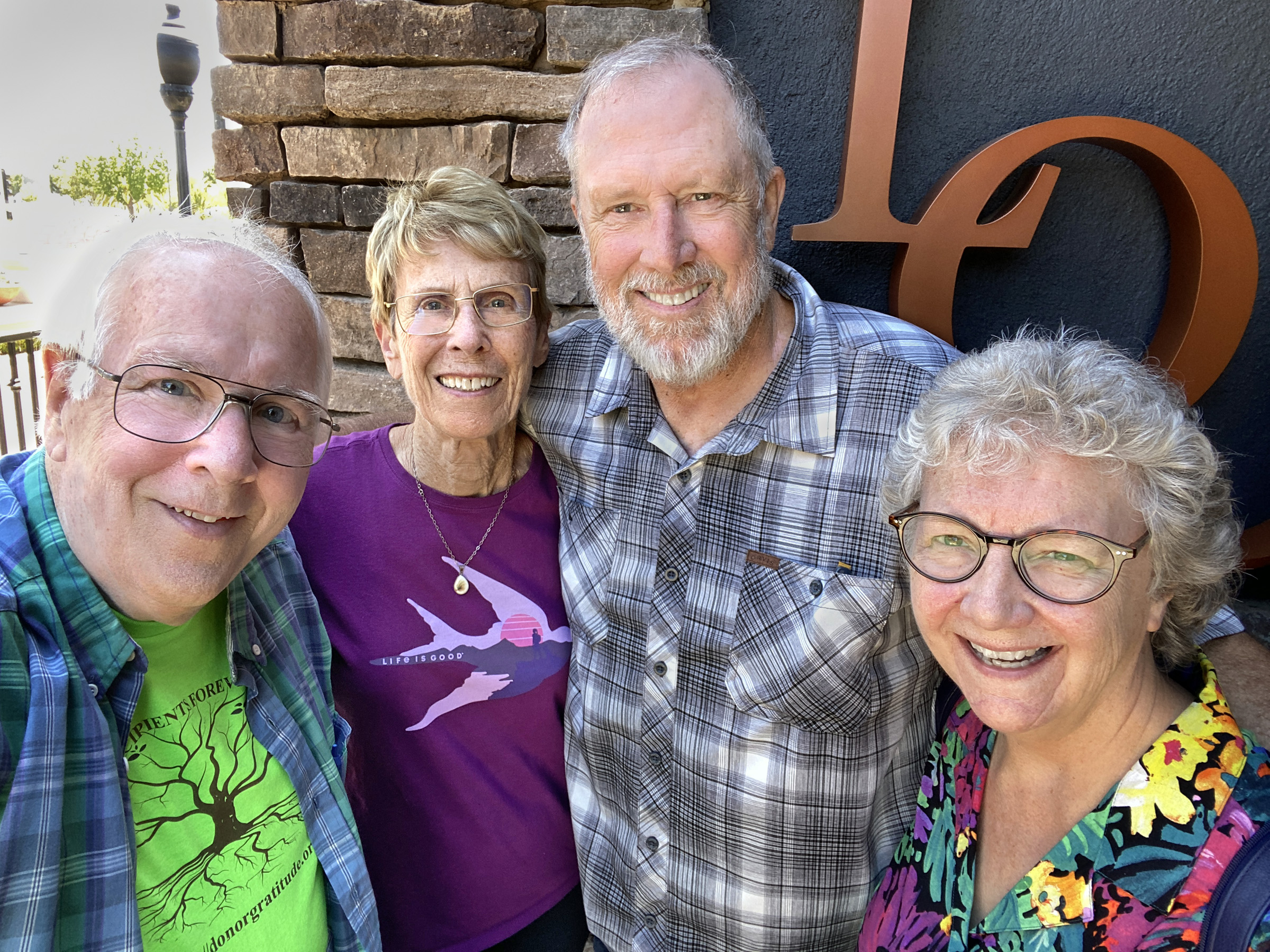
Dick and Don and I met for lunch this week in Folsom so we could hear the amazing story of Don’s transplant, his bout early in the pandemic with Covid, and how he and Julie have started a wonderful nonprofit called Donor Gratitude. It’s all about, as it says on the website, “People saving people.”
Many transplant recipients never meet their donors (there are, in some cases, living donors) or their donor families, but, Don says, “I hope and pray that someday I do.” Don and Julie wanted to provide a way for organ recipients “to thank all of those who make the ‘Gift of Life’ possible,” according to the website.
The Donor Gratitude website is a place where people can share their stories about organ transplant and to help donor families heal from the loss of a loved one. Don’s heart came from a 32-year-old man (the same age as Don and Julie’s oldest son at the time) during a 13-hour surgery that put his donor’s healthy heart into Don’s then 62-year-old body at Stanford Medical Center.
It was a long journey back to health for Don, as well as for Julie, his primary caretaker, who works in Blue Shield’s Human Resources Department. He got Covid-19 two weeks into the shelter-in-place order in March 2020, but because of the immunosuppressants to prevent rejection of his donor heart, they helped control the cytokine storm that kills many Covid patients. “So it’s probably because of my transplant that I didn’t die of Covid,” Don told a writer for Blue Shield.
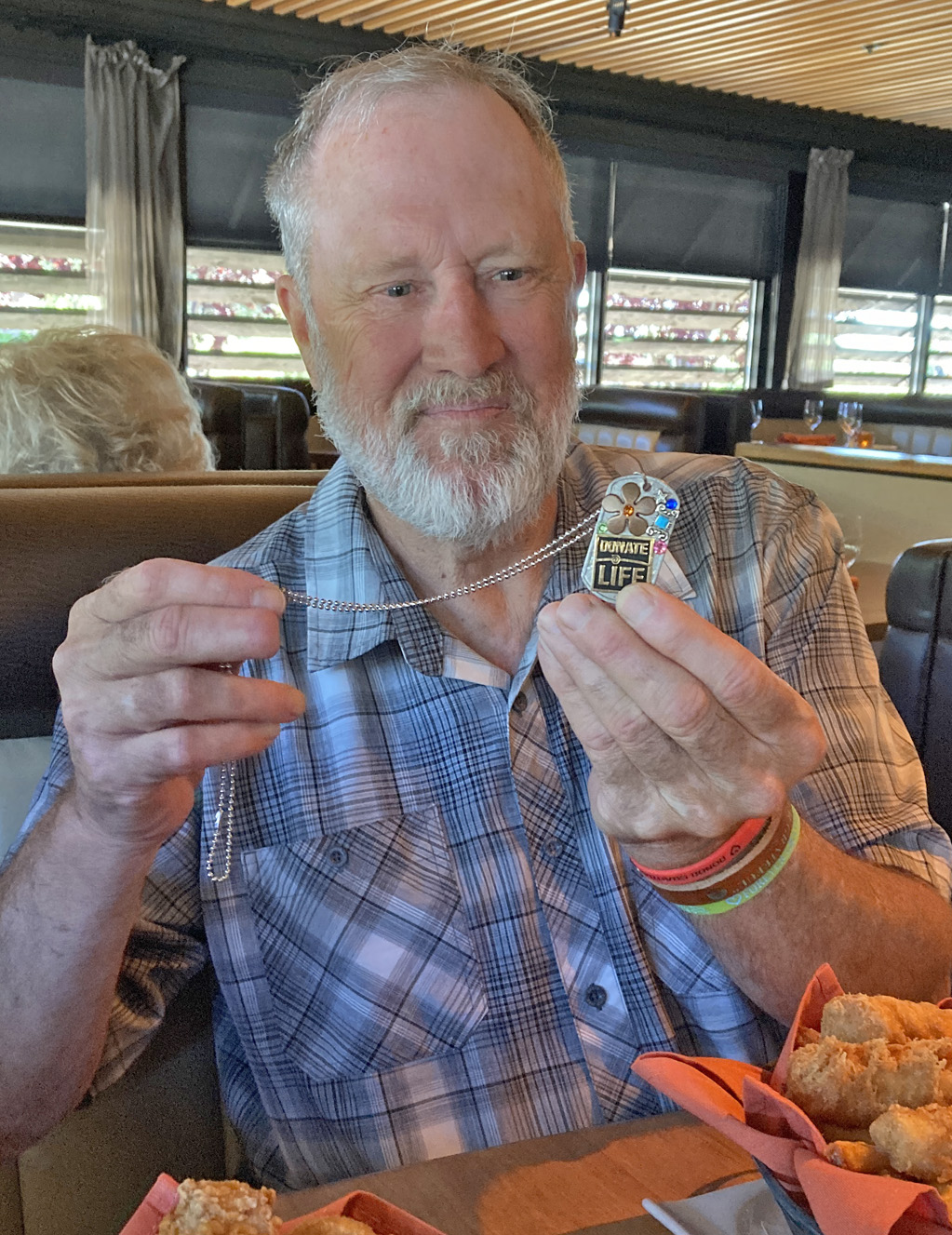
Don with his Donate Life medal.
So Dick and I—as well as our dear friend Cora Johnson—met Don for lunch in Folsom and talked hearts. Dick and Cora have been friend since their college years, and Cora was one of two dear friends (with her best friend Connie Raub) who flew to Hawaii to care for Dick after his heart surgery in January 2019.
To put it mildly, Cora Johnson’s got a lotta heart. For more than one reason.
Cora’s late husband, Bob Johnson, had a heart transplant in 2001, and both Johnsons became very active in organizations such as Donate Life and Mended Hearts. They donated literally thousands of hours and dollars to both groups, also getting to know Bob’s donor family and participating in fundraisers for years to raise scholarship money for the high school that Bob’s donor, Tim Baptista, attended in San Francisco.
Don and Cora had a lot to talk about. She drove down from her home in Minden, Nevada, for the day to meet Don and present him with a Donate Life medal in honor of his new heart. He gave us Donor Gratitude T-shirts and bracelets, as well as lots of smiles and hugs all around.
Dick Schmidt, Cora Johnson, Don DeVorss and Jan Haag—friends in hearts.
We’re eager to help Don and Julie as they create more awareness about organ transplantation. These two, who have built more than one business together, are now building what they call the Bridge of Life through Donor Gratitude to connect those who make organ donation and transplant possible.
There’s a place on Donor Gratitude’s home page where people can share their stories—anonymously, if they prefer—and the DeVorsses encourage anyone involved in organ donation to do so.
I’m only telling a small part of Don’s story. He tells it even better on the Donor Gratitude website. It’s one miracle after another, as Cora and Bob’s journey was, and as Dick’s and mine was. Angels come from everywhere to conspire on your behalf, I tell people, and Don’s story is full of those folks, too.
Don and Julie after Don’s heart transplant, Stanford Medical Center, 2019
This month I’ll be 64, and I often look around, thankful about how fortunate I’ve been in my life. I’ve walked through my life on the shoulders of so many good people, from my grandparents and parents who literally made me to dear family and friends. But all of us are also surrounded by folks who are seemingly strangers who show up at just the right time and place to help, influence and sometimes literally save our lives.
Don and Julie have a lot of those people, too, and Donor Gratitude is just one way they’re thanking them and providing a forum for others to do the same. If you know folks who have been organ donors or recipients, or families of either, you might suggest that they look at Donor Gratitude. The DeVorsses’ generous hearts are all over the site, and, indeed, are all about spreading thankfulness.
I’m so glad to be in the orbit again of this childhood friend, and to be able to hear Don’s story and become enthusiastic fans of the DeVorsses and Donor Gratitude. We ❤️ you!
May you hear in your own stories the moan of wind around the corners of half-forgotten houses and the silence in rooms you remember.
May you hear in your own poems the rhythms of the cosmos, the sun, the moon and the stars rising out of the sea and returning to it.
May you, too, pull darkness out of light and light out of darkness. May you hear in your own voice the laughter of water falling over stones.
May you hear in your own writing the strangeness, the surprise of mystery, the presence of ancestors, spirits, voices buried in the cells of your body.
May you have the courage to honor your own first language, the music of those whose lives inhabit your own. May you tell the truth and do no harm.
May you dare in your own words to touch the broken heart of the world. May your passion for peace and justice be wise: Remember—no one can argue with story.
May you study your craft as you would study a new friend or a long-time, much-loved lover. And all the while, lost though you may be in the forest, drop your own words on the path like pebbles