Stayin’ alive

e-aedtraining3

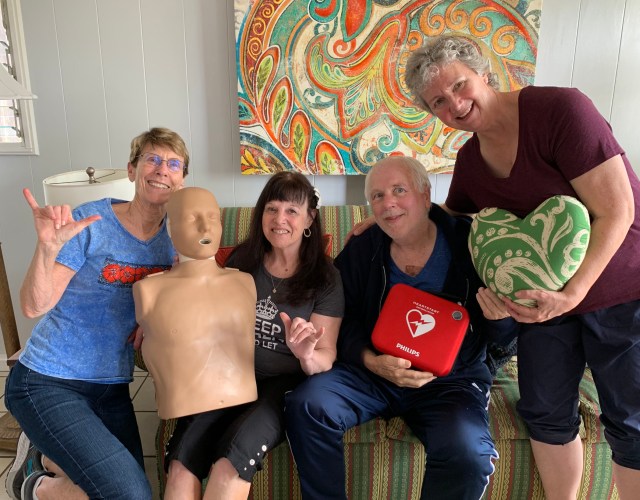
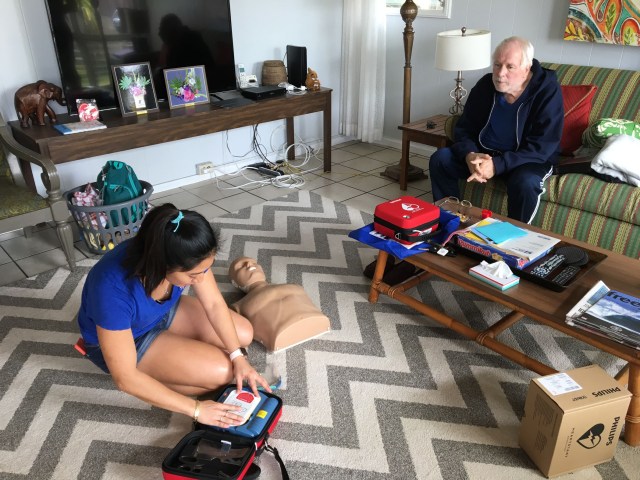
(From left), Cora, Mr. Manikin, Connie, Dick (with our new AED) and me (photo by Jenna Tanigawa)

So it turns out that if you’re performing CPR correctly on someone—high quality, fast compressions between 100 and 120 beats a minute—it helps to hum a song. One that’s been suggested for years is the Bee Gees “Stayin’ Alive.” You gotta love the irony of that.

But, according to an NPR story done in 2017 by Rebecca Hersher, there are a number of good song choices:

“In addition to Stayin’ Alive, Hanson’s MMMbop, Michael Jackson’s Man In The Mirror, Missy Elliott’s Work It, Cyndi Lauper’s Girls Just Want To Have Fun and Mariah Carey’s Heartbreaker also made the list.

“Another One Bites the Dust by Queen is one thematically interesting choice to include,” Hersher wrote.

Apparently, Spotify has a list of possible tunes called “Songs to do CPR to.” There are even more current tunes, but for some of us oldsters who were re-trained in CPR and the use of an AED, we’ll stick with the Bee Gees and Cyndi Lauper.
e280a2e-img_6262-jennachest

Jenna Tanigawa

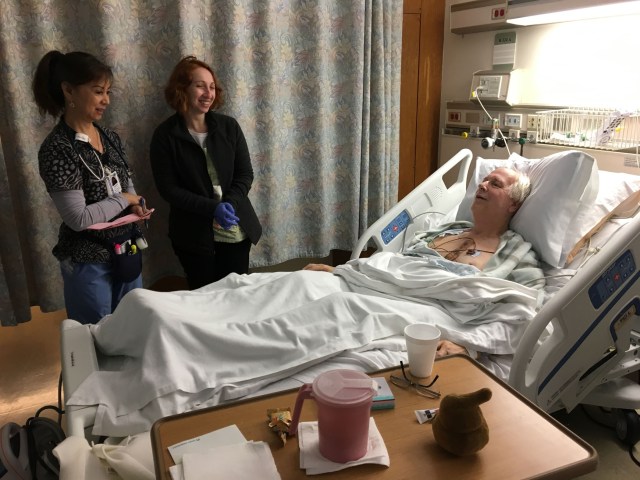
Jenna Tanigawa, project manager of the AED Institute in Honolulu, who with her boss, Pam Foster, came to visit Dick the day after his cardiac arrest in the hospital, today brought us our very own Automated External Defibrillator to take home with us. Talk about a door prize!

I learned CPR back in the dark ages of the 1970s when I was training to be a Water Safety Instructor for the city of Roseville where I eventually went to work as a lifeguard, swimming instructor and synchronized swimming coach. In those days, you also gave mouth-to-mouth resuscitation—two breaths to every ten chest compressions, as I recall. In subsequent re-trainings over the years, that’s what I practiced. Nowadays, mouth-to-mouth is out partly because, Pam Foster told me, if it collapses, the body has about 10 minutes of air. CPR is all about the compressions, keeping that heart pumping oxygen-rich blood to the brain.
e280a2e-img_6267-coracompressing

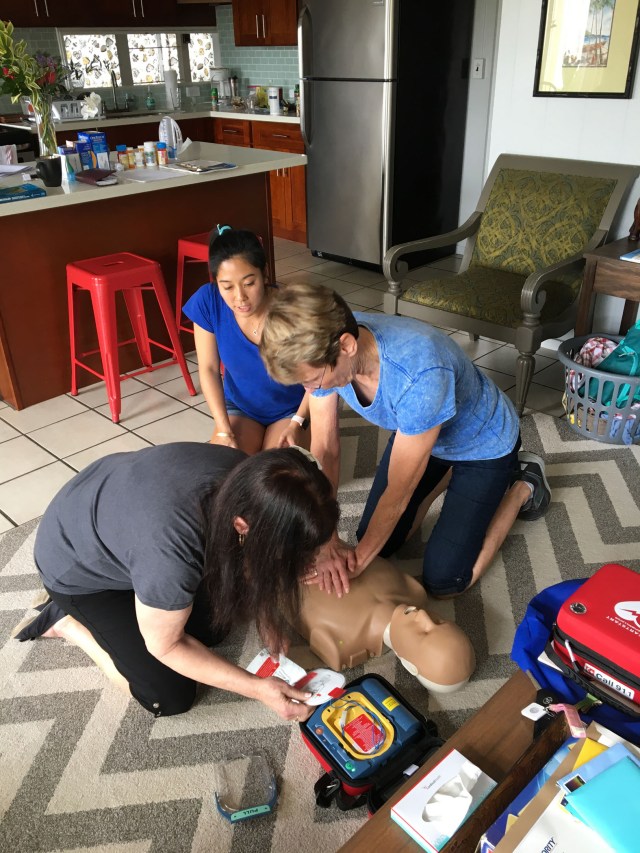
Jenna Tanigawa coaches Cora and Connie through CPR and the use of an AED.

That’s one of the things that made me realize that it’d been way too long since I’d had up-to-date CPR training.

Connie, Cora and I got that on the last day of January from Jenna, who just the day before had been training folks at the airport about AEDs. “After Dick’s cardiac arrest, there’s been a lot of interest at the airport,” Pam Foster told me on the phone.

We’re amused and rather tickled that he’s become a poster boy for AEDs and the lifesaving work they perform. But, we’ve learned, AEDs don’t actually restart stalled hearts; in fact, they stop the heart with a sudden shock, allowing it a chance to resume a regular rhythm. It doesn’t always work. It depends on the reason for the heart attack or cardiac arrest (which are different things, it turns out). Dick had the latter. His heart went into ventricular fibrillation, a kind of cardiac arrhythmia when the heart quivers instead of pumping due to disorganized electrical activity in the ventricles, according to Wikipedia. People with vFib lose consciousness, as Dick did, and have no pulse.

An AED automatically analyzes the heart rhythm of a pulseless person and, if the person is in ventricular fibrillation (VF) or ventricular tachycardia (VT), will shock the victim’s heart in an attempt to restore its rhythm to normal. AEDs will not shock patients who do not require a shock.

e280a2e-img_6261-jennapadsSo Connie, Cora and I practiced, putting two pads—one on the upper chest, one on the belly—on the training manikin Jenna travels with. We did chest compressions and watched as Mr. Manikin’s right shoulder beamed with green lights (to signify the correct kind of compression) or red lights (not correct compression). What we three learned on the floor, as Dick watched from his spot on the sofa, is that CPR is physically demanding. It poops you out, and that’s why it’s good to have someone else to take over compressions when you need a break. We also learned that not only do the compressions need to be done in a consistent, pretty fast rhythm (stayin’ alive, stayin’ alive), but they also have to be fairly hard and deep.

“You can’t hurt the patient,” Jenna reminded us. “He’s gone.”

And one formerly gone patient one week after his bypass surgery sat there watching us, unable for the moment to join in the training. But he will when his chest heals, as his newly repaired heart grows stronger. He is now the proud owner of an AED, which he hopes never to have to use. But he will know how, and for the rest of his life, he will tell the story of how one saved him.
e280a2e-img_6248-jennards

Jenna Tanigawa demonstrates the proper use of an AED as Dick Schmidt looks on.
Posted in Uncategorized | 6 Comments

E komo mai

And so, fifteen days after his heart stopped and was restarted again, after some major league replumbing of that heart, and with the help of a lot of people, I sprung him from the hospital.

He was untethered from his last wire, deftly pulled out of his chest by cardiac PA Tim Berkeley the morning of Wednesday, Jan. 30. Shy, the health aide who shaved him before his triple bypass Jan. 24, helped him shower for the first time post-surgery. Nurses Agnes and Tatyana were the last ones to care for him on the third floor. And he was showered in the metaphoric sense with hugs and handshakes by staff who’ve become ohana (family) to us.

We have a long list of people to thank at Kaiser Moanalua Medical Center.

•e-img_6197.-agnes tatyanajpg

Nurses Agnes (left) and Tatyana prepare to help Dick check out of his fancy Hawaii hotel.

This heart surgery stuff has come a long way since the days 35 years ago when I watched my late husband undergo an aortic valve replacement. Yes, they still open the chest. But the whole process feels far less brutal. Techniques to make this easier on the patient have clearly been developed and brought to a high level—including the small incision below the knee to extract the vein for the bypass, pioneered by Dr. John Lee, part of the surgical team that operated on Dick.

•e-img_6200-heart pillow

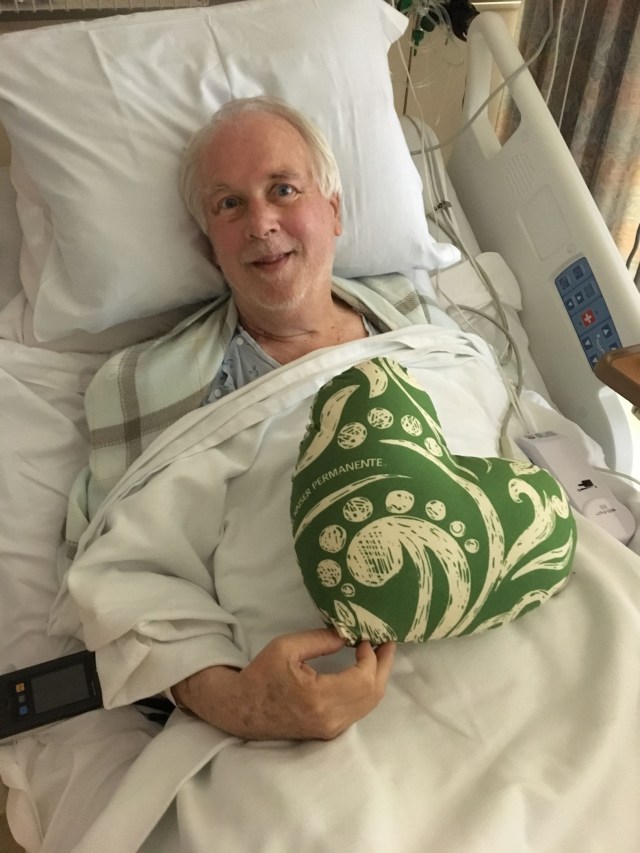
Kindnesses continued to come our way, even on the last day. Agnes, our nurse on departure day, after learning that Dick never got an official Kaiser heart pillow, searched and found him one—made of official Kaiser fabric and inscribed on the back, “Made by Manoa Lions.” Mahalo, Manoa Lions! And Agnes, too… she made our day.

•e-img_6219-rds & cj

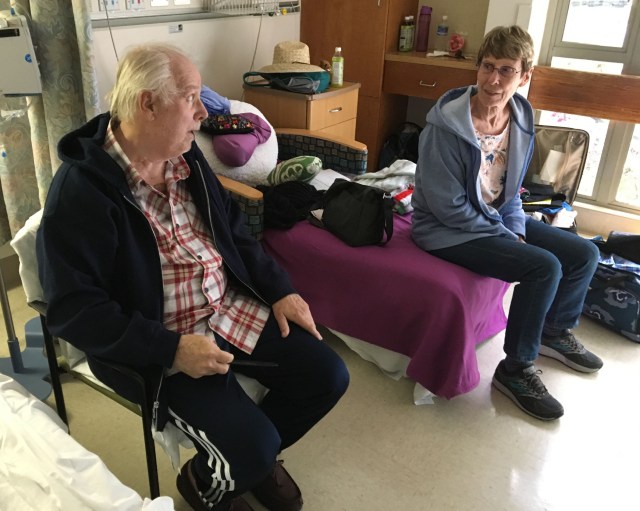
Our dear friend Cora Johnson flew in a bit before noon from Nevada, half of the team of devoted people who will care for Dick over the next two weeks after I go home. She brought Dick new duds—from sweatpants and undies to button shirts and a blue hoodie, new socks and moccasins. She saw her late husband, Bob Johnson, through a CABG many years ago and, in 2001, a heart transplant. This is a woman who knows how to help a fella heal after heart surgery.

•e-img_6216-scruffy chest

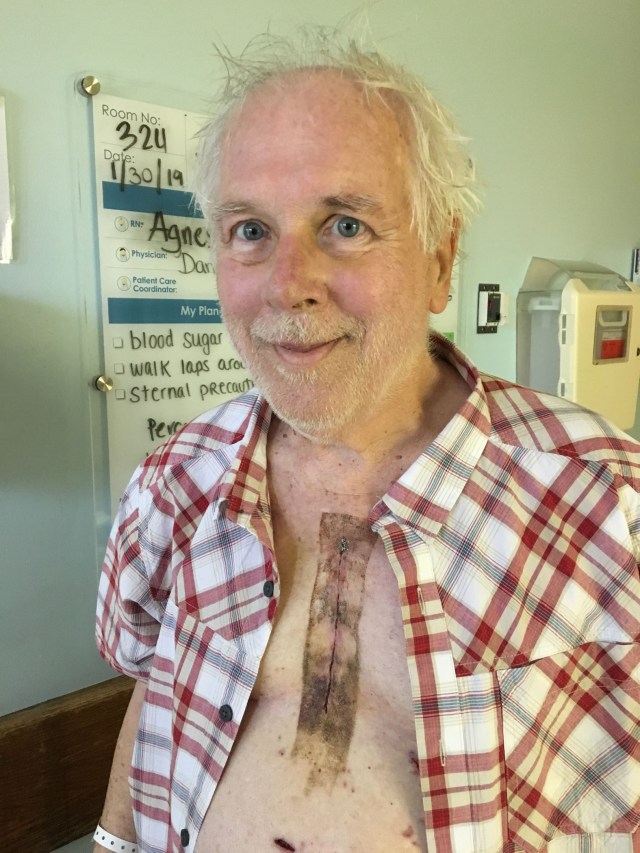
Because this is what it looks like less than a week after surgery—no tape holding anything together, just the imprint of silver that will gradually wear away, a substance that helps prevent bacteria from entering that lovely incision. He’s got a few new puka (holes) in chest and belly and leg, but the docs now leave them uncovered at this point, breathing along with him. (And he’s rocking the beginnings of a new beard, too!)

•e-img_6224-rds wheelchair

Dick with his sack of meds

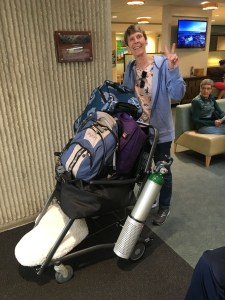
Then, after picking up medications at the hospital pharmacy, Dick was ready to be wheeled out to the rental car Cora and I picked up at the airport after her arrival, and make our way… well, away from the hospital, which has been a remarkable place of refuge and healing. Sure, they wake you up way too often to poke you and measure you (my mother, the former hospital nurse, always says the worst place to get some rest is in a hospital). But these folks were so compassionate and caring—above and beyond, it seemed to us, what is typical in hospitals. They hung around and talked story when they could; they asked us about ourselves and our lives. They treated us like old friends. More than one person asked to see the video Dr. Dang, the surgeon, shot of Dick’s heart before and after the repair and, like us, marveled at the difference.

•e-img_6223-cora and stuff

Cora with all our stuff

And we got in the rental Nissan and made our way west to Pearl City and a neighborhood called Pacific Palisades, where, coincidentally, our friend Connie Raub (who also landed in Hawaii today to be part of the care team) used to live in Southern California.

As my late friend Julie used to say, “Honey, there are no accidents.”

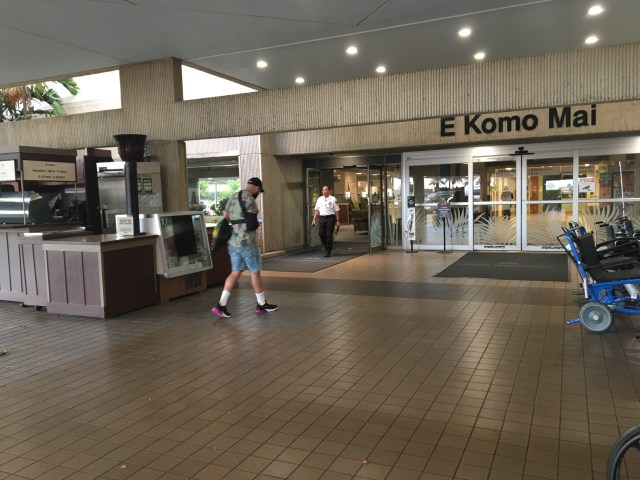
We came to a sweet little house on a street called Komo Mai Drive, which made me smile. E Komo Mai means “welcome” in Hawaiian. It is emblazoned over the entrance to Kaiser Moanalua Medical Center. You see it on mats outside homes and in hotels. It says to the visitor (malihini), come on in, leave your slippers on the mat, sit a spell and talk story with us.

•img_6075-e komo mai

This is a place where we have been made welcome, and while we are happy to be again released into the world, we’re a bit sad to leave, too. But then look where we’ve landed—on welcome street.

This occurred to me today on what is my half birthday. I am 60-and-a-half years old. I’ve always had a fondness for the date Jan. 30—my name in the first month and the number of the day on which I was born in July. It feels like a bit of a rebirth for me, too, this whole experience. In some ways it seems as if it happened yesterday—there’s nothing cliché about that. That image of Dick dropping to the floor in the airport will stay with me forever. But in other ways it seems like more than two weeks have passed. How could so much happen so quickly? To die, be brought back to life, rest and allow experts to evaluate his condition, determine what needed to be done… and then do that… and then begin to heal and suddenly, out the door not even a week after bypass surgery?

Miracles about in the land of “komo mai,” and we continue to have full, happily beating hearts, awash in it all.

•e-IMG_6226-CC&D.jpg

Connie, Dick and Cora share a giggle in the new digs on Komo Mai Drive.


Posted in Uncategorized | 9 Comments

Doggie kisses

e-IMG_6169-jlh Tono.jpg

Tono and me

All shall be well, and all shall be well, and all manner of thing shall be well… for there is a Force of love moving through the universe that holds us fast and will never let us go. 
—Julian of Norwich

I can’t tell you how many times I’ve thought or whispered to myself as I’ve walked down the stairs to the cafeteria here at Kaiser Moanalua Medical Center, “All shall be well, and all shall be well, and all manner of thing shall be well.” Regardless of what happens next. Which is a difficult posture to maintain—life or death… recovering from a cardiac bypass… Yes, Life Is Good. And we have been graced with the kindness of strangers and people we barely know throughout this whole experience.

For example, today in Room 324, we had validation of that all manner of thing shall be well with the arrival of two four-footed furry friends making the rounds with their people.

mel and tono

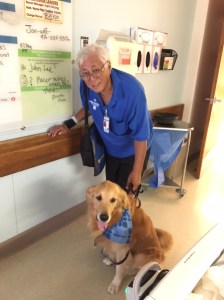
Tono and Mel Kai

Tono Kai, a local service dog, travels the hallways of Kaiser Moanalua Medical Center with his person, Mel Kai a couple of times a week. They’d visited us once before in a room across the hall before Dick’s surgery, and we both melted at the sight of the big blond dog with his blue bandana and official Kaiser ID hanging from his collar.

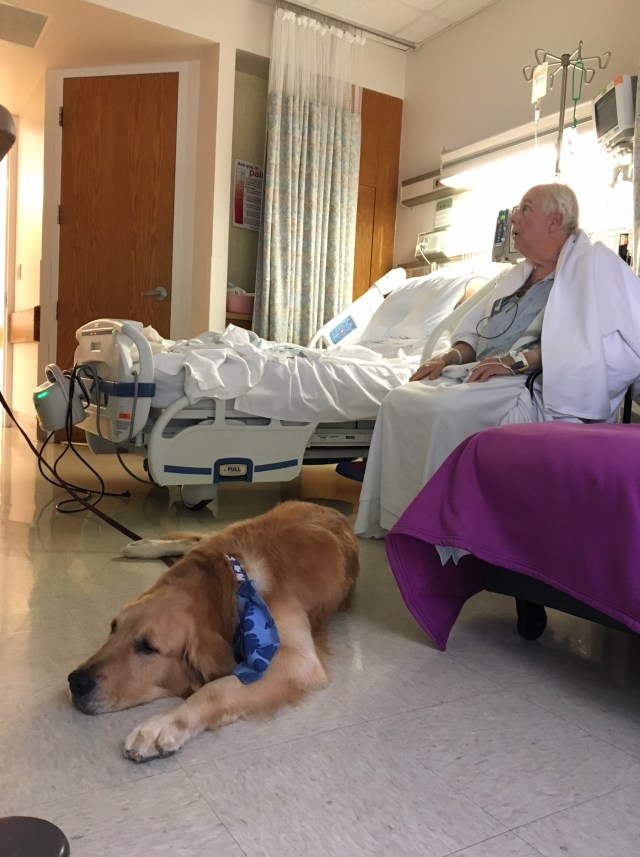
Mel asked if we wanted a visit, and though Dick couldn’t see them at first from the bed, I jumped up and said, “Oh, yes!” So they came in and, after sniffing each of us, Tono lay down on the cool floor. I got down there with him and learned again that Tono enjoys head scratches (like Dick) and belly rubs (Dick not so much right now), and is a master healer.

We’ve enjoyed visits from a number of folks here—some of whom we know and some of whom are new to us. Yesterday Sue Young, one of Dick’s friends whom he met in the 1970s when he lived here and worked for the then-named Honolulu Star-Bulletin, came to see us. Sue was married to Bob Young, who became Dick’s best Hawaii buddy. He and Dick stayed close until Bob’s death a decade ago.

And in one of those there-are-no-coincidences moments, we learned that Bob Young’s sister Jackie was also in this same hospital. She’d had a stroke and was in a room two floors above ours.

Today we also got a visit from Jervin Wait, who took a series of local buses out to see us. He and his wife Dolly spend four months in Honolulu every year, escaping part of a South Dakota winter. They bus everywhere, and though Jerv (who is a high school friend of Dick’s brother-in-law, John Thompson) doesn’t know us, he’s been kind to email and make a visit.

e-img_5965-rds hi jan

Dick and Hawaii Jan

Hawaii Jan (as we call her; I’m California Jan), the daughter of one of Dick’s former Sacramento Bee photographer buddies, has been a lifesaver. Not only did she find us the rental house we’ll stay in starting Wednesday, she also brought us supplies to make our stay here easier (the warm pink sweatshirt-material blanket!) picked me up and took me to lunch last Saturday. Few visitors get to lunch at the Alley Restaurant, which is a part of the Aiea Bowling Alley. I had the specialty chicken sandwich, Jan had a good-looking burger, and we both shared the lemon crunch cake, which had what tasted like crushed toffee on top. Heaven!

Also today we got a second visit from a four-footed, furry friend named Indy, who arrived with his person Steve. And chaplain Leavitt Thomas has been in pretty much daily to chat with us. Andy and Leona Doughty, who came to take me to dinner the night before Dick’s surgery and then sat with me during the surgery, as well as my former student Makena Ongoy, who’s done Target runs and bought me stuff I’d never have thought of… this has meant the world to us.

We’ve been bidding our fond aloha to nurses and health aides who’ve tended to us over the past two weeks, to internal medicine docs and cardiac folks—even the cafeteria ladies—each of whom has treated us like ohana—family. We are beyond touched by this. And while it’ll be nice to let Dick rest in a house where he won’t be awakened so often, we’ll miss these devoted Kaiser Moanalua staff folks who have taken such tender care of him… and me, too.

Mahalo nui loa to you all.

tono and dick

Tono and Dick


Posted in Uncategorized | 8 Comments

Life Is Good

•e-img_6031-lig shirt

I’m a big fan of the Life Is Good T-shirts. Have been for years. I like their fun designs and upbeat messages (one of my faves is the simple drawing of a glass with some liquid in it that says “Half full”) by this company founded by two brothers, Bert and John Jacobs, in Boston in 1994.

A couple of years ago on Kauai I bought Dick a special Hawaii LIG shirt with the company’s stick figure named Jake snorkeling on it. Dick has worn it on every Hawaiian trip since. The day of his cardiac arrest, he was wearing that shirt as we stood in line to board the plane. When he collapsed and people began working on him, they cut through the shirt to place the pads and leads on his chest that brought him back to life.

We are keeping the shirt—and his precious photo vest that was also cut off—because of what it represents. As our friend Andy pointed out when he saw this photo, the shirt was slit vertically down the center, right between the “i” and “s” in “Is.” If that’s not irony, I don’t know what is.

Dick is. Life is… not perfect, as some of the LIG shirts say. But it is good. He is great. And though it’s unlikely we can replace this same LIG shirt, we will treasure it always.

e-Donovan Sally RDS laugh.jpg

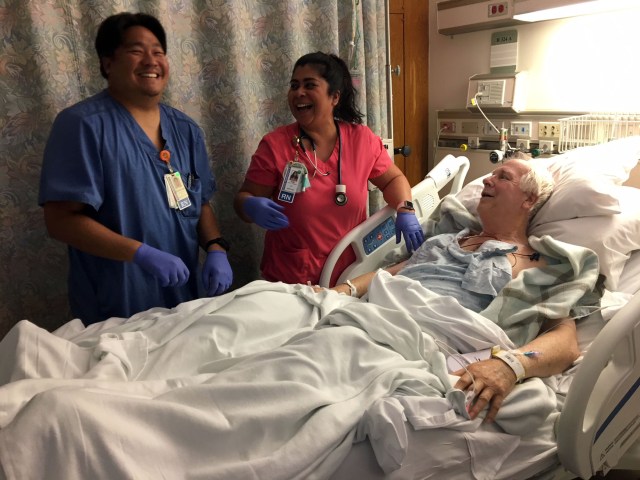
RNs Donovan and Sally have a chuckle with Dick on Day 4 after surgery.

Posted in Uncategorized | 8 Comments

A visit from two angels

•e-img_6022-rds sits eats

Day 3 after Dick’s surgery:

• This morning Dick was moved from the ICU back to the third floor (where we spent nine days before his surgery), across the hall from his former room. Now we’re in a two-bed (i.e., much bigger) room with one hospital bed and the same pull-out chair/bed I used before. We could dance in here! (Or do yoga… gotta find me a mat!)

•e-img_6024-rds walk

• Dick had all his tubes removed—chest drains Saturday, neck tube today, bandage around the left leg from the vein donation site… pau, as they say here (finished/done). All he has now is the big bandage going down his chest. And he’s in very little pain. He gets a bit uncomfortable in the back, which we understand is to be expected, but he’s only taking a couple of Percocet morning and evening. He’s doing well at walking the third floor west wing, too.

But the best thing of the day (and yes, journalist friends, I’ve buried the lead, saving the best for last):

• One of the young men who came to our aid at the airport came to see us today. Camron Calloway (who is the partner of Claudio Alvarado, the UCDMC nurse who administered chest compressions) is in the Air Force and flew into Honolulu today from California. He contacted me and asked if he could visit Dick. “Of course!” I said.

•e-img_6035-camron dick

Camron and Dick

While Camron was here, we learned that he and Claudio were right behind us in line… but that they should have already been on the plane. Camron, who likes to board early, was a bit annoyed that Claudio wanted to do a couple of things before they got on the plane. But if they had gotten on the plane, they wouldn’t have been there when Dick collapsed—Claudio to do the CPR, Camron to stand with me and hug me.

During our visit today, Camron contacted Claudio via FaceTime so we could all chat and express our thanks to both of them again. We plan to take them to dinner when Dick gets home and is feeling better. We were so touched by Camron’s visit (we got verklempt more than once) and amazed at one of the many miracles that put them in our vicinity at just the right time.

Aloha and mahalo nui loa, Claudio and Camron!

•e-img_6037-camron claudio

Claudio and Camron pay Dick a visit.

Posted in Uncategorized | 10 Comments

The gift of time

rds & dr. dang

Dick, cardio-thoracic patient, and Dr. Nicholas Dang, cardio-thoracic surgeon

Two days after CABG, aka bypass: The news just keeps getting better.

Dick’s thoracic surgeon, Dr. Nicholas Dang, stopped by yesterday and today to show us photos that he took during the surgery. Dick had asked Dr. Dang to take photos, so the man ungloved himself, asked for his iPhone, and shot both stills and videos of Dick’s heart before and after the repair. Dr. Dang came by the ICU on his day off to airdrop them to my iPhone, and Dick and I have been watching the videos off and on all day—amazed at how much stronger his heart is now. Dr. Dang called it “snappy,” and it is. What a miracle to see photos and video of your own beating heart!

rds walking with kevin

Dick and Kevin

Starting the day after surgery, Dick has been walking the ICU a few times a day, today with RN Kevin. He had Jamie as his night nurse, who tended to Dick on the third floor for days before his surgery. She’s one of our favorites.

And we were delighted to see RN Erin Shulze in the ICU (another one of our favorites). She was Dick’s nurse the first day… hours after he was brought back to life after his cardiac arrest. She was then and today funny and kind and calm, extremely good at her job. Today Dick was moved to a new room in the ICU that did not have a clock. Erin was assigned as Dick’s nurse and not only found him a clock but also installed it on a wall in his room so he can see it because he likes to know the time.

Erin, like so many incredible people at Kaiser Moanalua, literally gave him time. There is no better gift.

rds erin clock

Dick and Erin

Posted in Uncategorized | 6 Comments

Heart of my heart

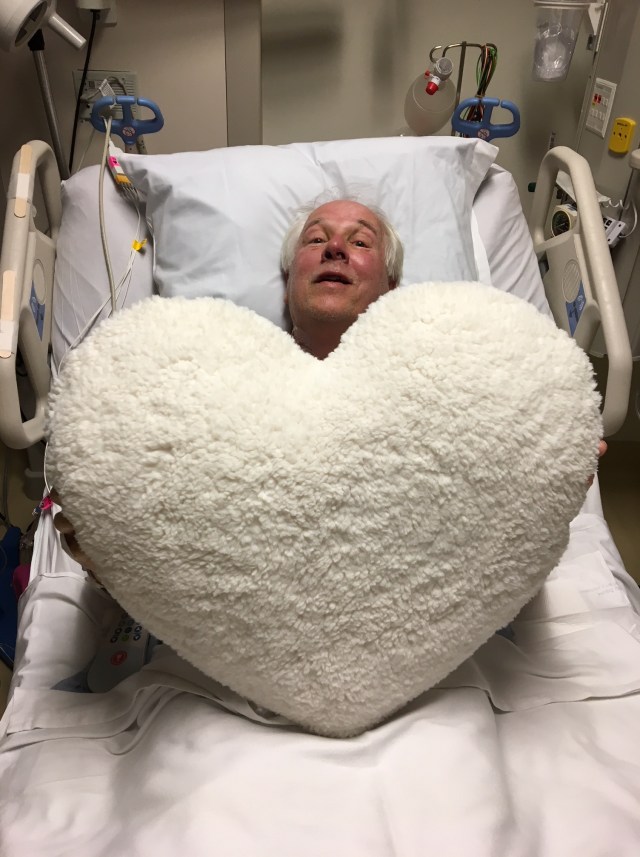
rds heart pillow

Dick Schmidt, 32 hours after his triple bypass, Honolulu

Apparently when someone undergoes heart surgery, the tradition is to bestow a heart pillow on that someone. But Dick was told after his surgery in the cardiac ICU that they’d run out of heart pillows here at Kaiser Moanalua. He was a little disappointed; I was very disappointed.

So on a run to Target today for other things, I walked by a display of huge heart pillows. Some gleamed in bold gold with sequins. Only a couple were made of off-white faux wool. I grabbed one of those immediately and held it to my chest. Soft but sturdy, it went into the shopping cart and into the cardiac ICU for the heart of my heart.

Yes, it’s that big and substantial enough to press to his sore, healing chest when the coughs come. Because this man, whose great heart is loved by so many, deserves his own special heart pillow.💜❤️💙

Posted in Uncategorized | 5 Comments

Baba Yetu

stellenbosch

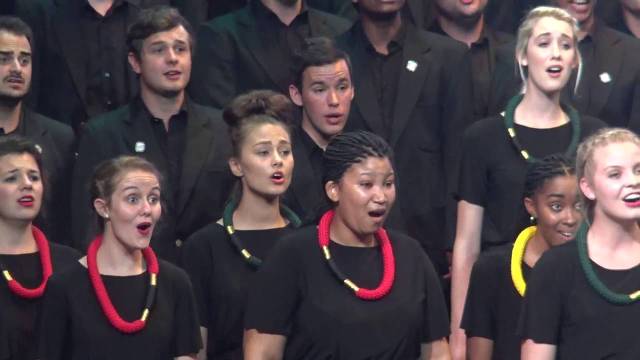
The Stellenbosch University Choir of South Africa

First, before you read further, watch this short video of the Stellenbosch University Choir of South Africa singing “Baba Yetu.” I promise it’ll make you smile:

www.youtube.com/watch?v=PCa8RxaOPW8&fbclid=IwAR3wb7CmGoq9CEHe9DPJS4u2feRTa2RlWvXrB-IziEOcMjLClUUH4E2Rmag

The song, written by Christopher Tin and arranged by André van der Merwe, was recorded in 2018 at the Llangollen International Musical Festival in Wales. It was written to accompany the 2005 video game, “Civilization IV,” and it became the first piece of video game music to win a Grammy Award.

This video was reposted on Facebook by Nevada City poet Molly Fisk and was just what I needed to see after watching my dearest one collapse with a cardiac arrest, be brought back to life and spend nine days and nights in a Honolulu hospital room. All that culminated in a triple bypass surgery Thursday for Dick, who, not surprisingly to his medical team, came through it like the champ he is. He’s now recovering in the cardiac ICU and should be transferred to a regular unit in a day or so.

Believe it or not, we’ve been looking forward to this—Dick to getting his heart replumbed after resting and gaining strength. The bonus for me—besides getting to spend time visiting Wednesday afternoon and in the waiting room Thursday morning with Andy Doughty and his wife Leona Boyd, our dear friends from Kauai—was that I knew I would sleep tonight in a hotel room with a real bed for the first time in nine nights. And that I could take a bath, too (though I did use the shower in Dick’s hospital room).

After spending time with Dick in the ICU, I came back to my room and listened to “Baba Yetu” probably a half dozen times, watching the energetic choir sing their hearts out, cheered by their energy, having no idea what they were singing.

So I looked it up. “Baba yetu” means “our father” in Swahili and the song is a translation of the Lord’s Prayer. Look at these lyrics. You don’t have to know Swahili to hear the poetry in them, especially as the choir sings:

Baba yetu, yetu uliye
Mbinguni yetu, yetu amina!
Baba yetu yetu uliye
M Jina lako e litukuzwe.

Utupe leo chakula chetu
Tunachohitaji, utusamehe
Makosa yetu, hey!
Kama nasi tunavyowasamehe
Waliotukosea usitutie
Katika majaribu, lakini
Utuokoe, na yule, muovu e milele!

Ufalme wako ufike utakalo
Lifanyike duniani kama mbinguni.
(Amina)

And what that means in English will sound familiar to those who know the prayer:

Our Father, who art
in Heaven. Amen!
Our Father,
Hallowed be thy name.

Give us this day our daily bread,
Forgive us of
our trespasses,
As we forgive others
Who trespass against us
Lead us not into temptation, but
deliver us from the evil one forever.

Thy kingdom come, thy will be done
On Earth as it is in Heaven.
(Amen)

Dick comes from a long family tradition of Christianity and has been a Methodist for most of his life. When we visit Hawaii, we like to go to churches with choirs and congregations that sing in Hawaiian, where they end prayers with “amene,” the Hawaiian word for “amen.”

Tonight I’m offering a big amene/amina for Dick’s safe passage through this valley of the shadow of death. It has been a journey neither of us expected to take and truly a resurrection—from seeing him dead on the airport floor to strangers coming to perform CPR to the lifesaving shock of a defibrillator. To meet the people who’ve placed those defibrillators all over Hawaii. To be in the caring hands of doctors and nurses and aides who were so kind and gentle, always. To have the cafeteria ladies recognize me during my at-least-twice-daily visits and, while never asking why I was there, giving me sweet smiles and more than one pat on an arm. To have friends like Makena and Jan and Andy and Leona and Tara in Hawaii provide advice and on-the-ground support. To be in the same hospital at the same time as a dear friend of Dick’s who has had a stroke and will likely not return to her loved ones as he has returned to his.

To have hospital chaplain Leavitt Thomas visit us and offer this blessing on more than one occasion in a voice redolent of his Maine roots: “We are affirming a safe and successful procedure followed by an easeful and graceful recovery.”

We are so appreciative, weepy with gratitude for the hands of healers and the prayers and good wishes of so many who are very present, even if they’re thousands of miles away. More than ever, Dick and I have realized that we are spiritual beings having human experiences, and once again our faith has been restored… in the unseen hands of our companion spirits that support us, in the kindness of strangers, in the music of people from across the globe, singing their joy. Baba yetu, indeed.

Posted in Uncategorized | 7 Comments

Ohana

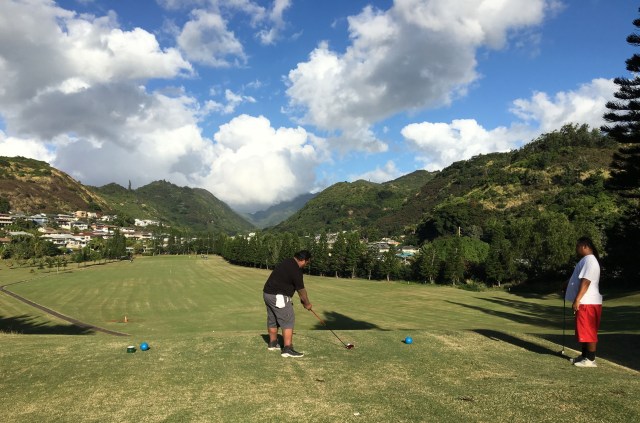
•eimg_5605-golf valley

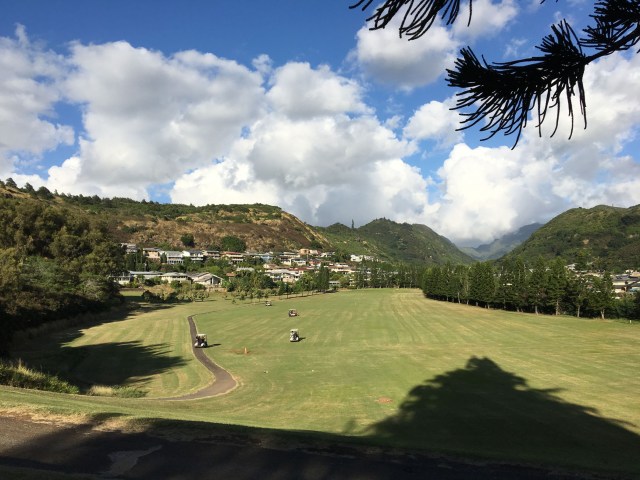
The Moanalua Golf Club course

Golf—or at least a golf course—turns out not to be a good walk spoiled, but the best walk so far of the ones I’ve done daily around the area of Kaiser Moanalua hospital in Honolulu. The hospital sits on a crest of the mouth of Moanalua valley, and from some windows, if you look makai (toward the sea), you can catch a glimpse of blue. Dick’s room looks mauka (toward the mountains) and out the large window, eucalyptus trees with their lovely peeling bark reveal green the color of a young gecko.

Beyond the trees I can see the pink edifice that is Tripler Army Medical Center majestically atop a Moanalua hill. You can easily see it when taking off or descending in a jet from Honolulu International Airport. I often forget its name and have to ask Dick. Now I’ve got it. I doubt that I’ll forget it.

Today, we celebrated the week-aversary of Dick’s new life after his cardiac arrest at the Honolulu Airport Jan. 15. We have learned that such resurrections are rare, and we are pleased he is one of them. We also got the news today from one of the two cardio-thoracic surgeons here that Dick will have his bypass/CABG surgery Thursday, two days from now. We are pleased about that. He’s had a week to rest (he’s sleeping a lot) and get stronger, and they’re pleased with his progress. It makes Dick, the surgeon said, an excellent candidate for the surgery.

•e-img_5611-golfersI look forward to my daily walks here. One of the nurses suggested that I walk to the golf course, part of which we can see from the hospital. So I did yesterday, finding my way down the sloping hill, passing free-growing flowers the likes of which one sees in botanical gardens in Hawaii… but there they are, planted once by someone and now going greengreengreen (with occasional flowerflower) on their own. Hawaii is a place where it’s easy being green.
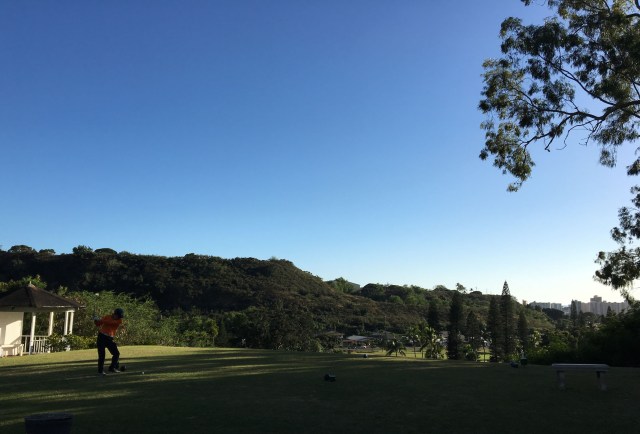
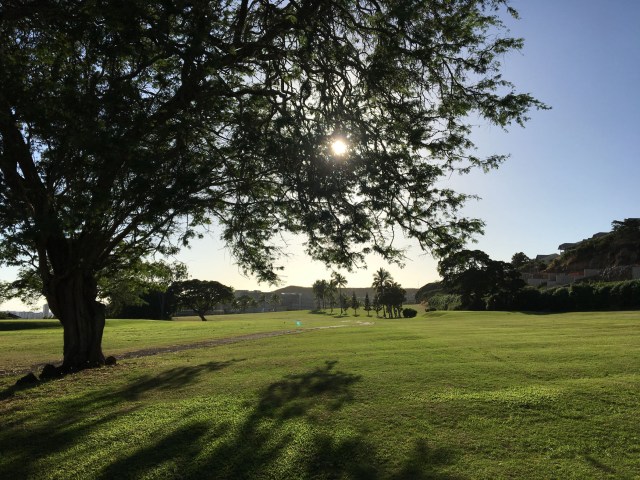
I found my way to a path that rims the Moanalua Golf Club, whose sign claims it as the oldest golf course in Hawaii, built in 1898. It’s a long, slender course that points toward the back of Moanalua Valley, whose main road leads to the Moanalua Valley Trail. I wasn’t going to hike that far, but because it was late afternoon, and few golfers were about, I ambled along in a pleasant bit of sunshine with huge, cartoon-fluffy clouds over the mountains.

•e-img_5609-mike

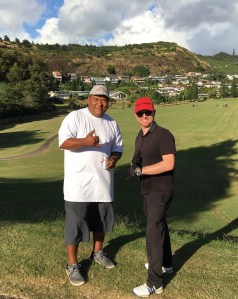
Mike and his golfing partner

I passed some men golfing, and, stopping to take some photos with my phone, one big guy in a very clean white T-shirt and baggy shorts below the knees called out, “Wanna take our picture?” He smiled at me, so I called back, “Sure!” And he approached me with a smaller, paler guy wearing a red cap. “We give you a pose,” he said, and they stood atop a rise with the Moanalua mountains rising into the clouds.

I took their photo on my phone, showed it to the big guy who walked over to me. “Mike,” he said, sticking out his hand.

“Jan,” I said and put mine in his.

Mike gave me his phone number, and I texted the photo to him. He said, “You on a walk?” On the golf course?”

Ah, I thought. “I know I’m not supposed to walk on the golf course if I’m not golfing,” I said, “but my husband’s [when he’s sick, he’s my husband] is in the hospital up there, and we’re waiting to find out when he’s going to have heart surgery.”

I didn’t say that we’ve been waiting for a week, that I’m sleeping in the hospital next to him, that he had a cardiac arrest at the airport almost a week ago, that he was brought back by a portable defibrillator, that he is one lucky duck. And so am I.

•e-img_5622-golfer gazeboMike put his hand over his own heart, a big brown paw against that white shirt, and he sighed.
“Ah, sistah,” he said sadly, shaking his head.

Tears popped into my eyes. Those Hawaiian terms of endearment–”sistah,” “auntie,” “uncle”—are not used casually with visitors, almost never with tourists. But from the beginning of this crisis we’ve been treated like ohana (family). Local women who work as aides in the hospital come into Dick’s room and, after getting to know him a bit, josh with him and call him “uncle.” Some of them, coming to collect urine, stick their heads in the door and say, “You shi-shi yet?” (the local term for peeing).

•e-img_5634-signAnd here was this big man who didn’t know me, his hand on his heart, looking at me with sad eyes, basically embracing me with one word as ohana. It was all I could do not to cry on that nice white shirt.
“Do you work here?” I asked Mike.

“Yeah,” he said. “Pau hana [after work] we play a round. Exercise!” he grinned.

He didn’t translate; somehow he figured I knew a bit of Hawaiian. “Yeah, you not ‘sposed to walk on the course, but you go ahead, sistah. Up that trail right there, you walk right back to the hospital.” He emphasized the middle syllable—hosPITal.

“Mahalo,” I said, and Mike and his golfing partner headed down the big hill to their next hole.

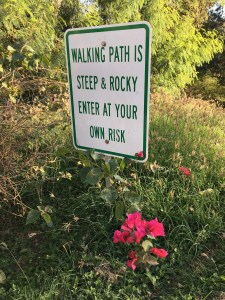
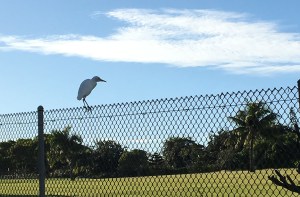
I followed the trail Mike suggested, coming into a broad plain that circles behind the hosPITal. I found a sign that said, “Walking path is steep and rocky—enter at your own risk,” which made me think, well, yeah, kinda like life. I saw a cattle egret, •e-img_5653-egretone of my favorite local birds (introduced here in 1959 to keep insects from pestering cows, they’re now considered invasive), perched on a fence. He let me take his picture before he flew off. I walked by the emergency room entrance where the ambulance had brought Dick seven days earlier. The doors swished open, and I walked in, finding myself on the same floor where Dick lay in his hospital bed, covers up to his chin, tucked in and warm. Waiting for me.
I sat down on my little chair/bed and watched him breathing for a bit, grateful for every moment I get to do that now, to be with him, the linchpin of my ohana.

•e-img_5632-sun tree golf


Posted in Uncategorized | 15 Comments

Glad to be here

5 a.m., the sixth day after

He’s the third person who’s walked in our room in the last half hour, which they don’t do in the better hotels, and this is one expensive place to stay. The first two took his vitals, weighed him, pulling off all the blankets in this too-chilly room, removing the pillows, one of them holding the heavy heart monitor. They call out a number in kilos, which means nothing to us, then replace his pillows and blankets, which I will have to get up to adjust because I’ve learned how he likes them.

And then the blood guy knocks on our closed door—as someone like him does every morning at this time—with his little vials wearing different colored plastic caps and his rubber band tourniquet and, of course, his stabber, and like everyone else who shows up in room 329 at Kaiser Moanalua hospital, he’s curious about our story.

Barely awake, Dick gives him the 30-second version:

At the Honolulu airport, about to board the plane, he feels dizzy and collapses, heart stops, breathing stops, two nurses in line jump out to give him CPR, the defibrillator arrives, one shock, and he’s back. To the hospital, major blockages in three arteries, now waiting here for a CABG.

Blood Guy, focusing on his job, is silent for a few moments, finishes his collection, unsnaps the tourniquet and in one smooth motion puts a new cotton ball already lined with tape on Dick’s arm.

“Sorry your vacation ended this way,” says Blood Guy, then adds, as most people do, “but it’s good, I guess, that you didn’t get on the plane or that you weren’t in flight. I’m sure you want to get home, though.”

“Glad to be here,” Dick says, and he means it.

And even at this early hour, my eyes and brain fuzzy, I detect the sincerity, the layers of meaning in those four words.

I’ve been thinking this for six days now: It could have been different, Dickie. You could’ve not come back. Me standing there at the Gate C1 watching strangers work on you, your two shirts and a photo vest cut off, your pale chest exposed to the world, sticky conduits pasted on in a seemingly random pattern like a deranged stripper. Me calling, “Dickie, no! Come back! Come back.”

And you did, though you’ve returned to all these young people awakening you every few hours (hospitals are the worst places to try to rest) and you’re facing major surgery here. But you, with your usual optimism, say, “Glad to be here.”

And so softly that Blood Guy, as he prepares to turn off the light and let us go back to sleep, can’t hear me, I say, “Me, too. Me, too.”

Posted in Uncategorized | 9 Comments