Kalalau

It was the last day of our stay on Kauai. We looked at each other the night before and said, “How do you want to spend the last day?” Every time we get a little sad, hating for vacation to end, wondering when we’ll get back here. We try to make the last day special.

“Well, we’ll start at a garden tour by 8:30 a.m.,” Dick said.

And we did, touring the Allerton Garden, a series of garden “rooms” created by Robert Allerton and his son, John Gregg Allerton, beginning in the 1930s. Not only is Mr. Allerton’s Garden of Eden home to the famous Moreton Bay Fig trees featured in Jurassic Park (the very same trees!), it’s a showplace of sculpture in stone and concrete and, yes, foliage.
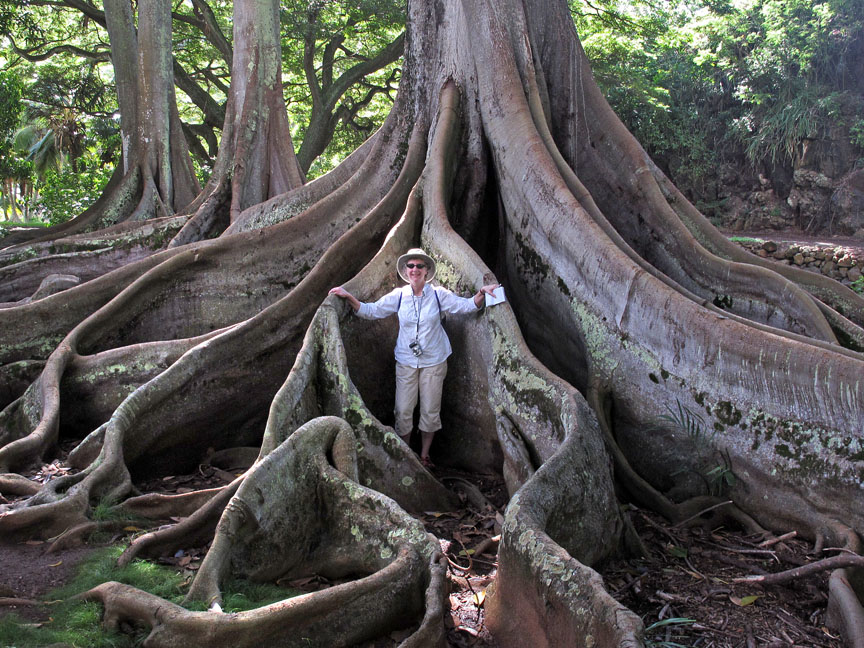
Jurassic Park tree (really, a Moreton Bay fig) and me.

Robert Allerton was originally an artist, and the garden reflects his method of sculpting with plants.

It’s a magical place and widely used in films and TV. Parts of “Gilligan’s Island” were filmed here, as well as the fourth “Pirates of the Carribean” movie. And Tattoo in “Fantasy Island” stood on the lanai of an Allerton house in the garden to point and call, “Da plane! Da plane!” The garden, a non-profit part of the National Tropical Botanical Garden system, makes no money from Hollywood. It can’t, our guide David told us, or it would lose its non-profit status.
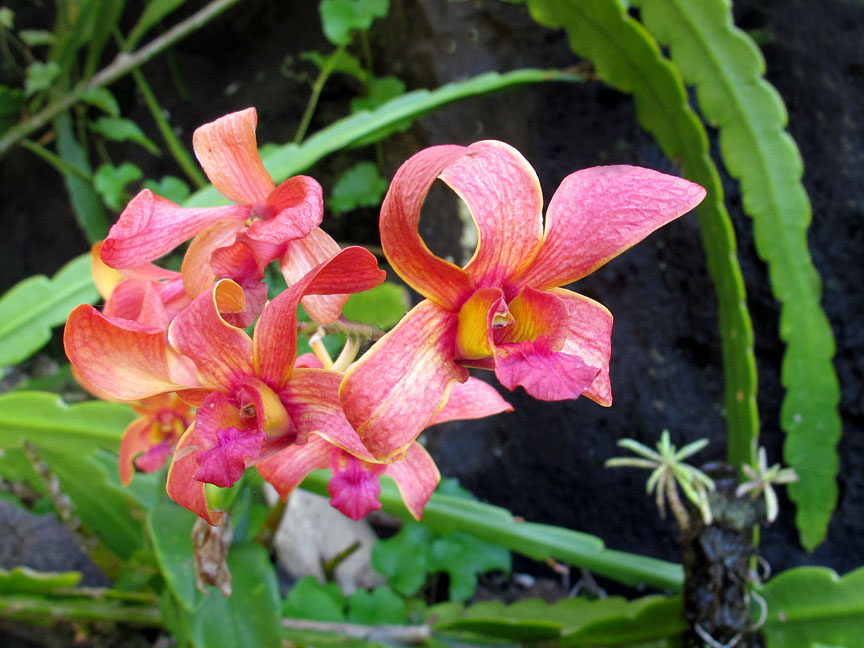
One of Mr. Allerton's orchids.

But the garden can brag about its fame. And lots of tourists can pose for photos in the huge roots of the Moreton Bay figs.

And while that was fabulous, the highlight of the day was zooming (as our friend Cora likes to say) up to Kokee State Park, past Waimea Canyon (the Grand Canyon of the Pacific, Mark Twain allegedly called it), to the end of the road to see if we could catch a glimpse of what may be my favorite sight in all Hawaii.

The Kalalau Valley is reachable on foot via a wicked trail called the Na Pali trail on the north shore of the island. You can also get to its beach by boat or zoom in for a quick view via helicopter. But I love to drive to the second lookout, plop my butt on the edge of what was once part of a volcano and look out to see the spines of ancient rock cascading to the sea and green cathedral spires reaching for the sky.

The challenge is that Kalalau is often shrouded in clouds, so the best time to see it is in the morning… when we were in Mr. Allerton’s garden. And for the past few days, it’s been rainyrainyrainy. We tried to see Kalalua a couple of days before, and it was socked in… really, it looked like a white sock or a big cotton ball or… pick your similie… had descended upon the majestic sight.

So after the garden tour, we decided to take a big chance and zoom up to the overlook. Though it is not far in miles from the Poipu area where we were staying, it takes a good hour and a half over slow roads (there are no fast roads on Kauai, honestly). And there was no guarantee the valley would be open.

This is where faith comes in. Dick hightailed it to the little town of Waimea in our rental car, which, naturally, tailed two verrrry slooooow tourists for some time. (Funny how we don’t think of ourselves that way, huh?) Stopped briefly in Waimea to get a sandwich to go and then raced up the winding road, bypassing the Grand Canyon of the Pacific, as clouds swirled around and over us.
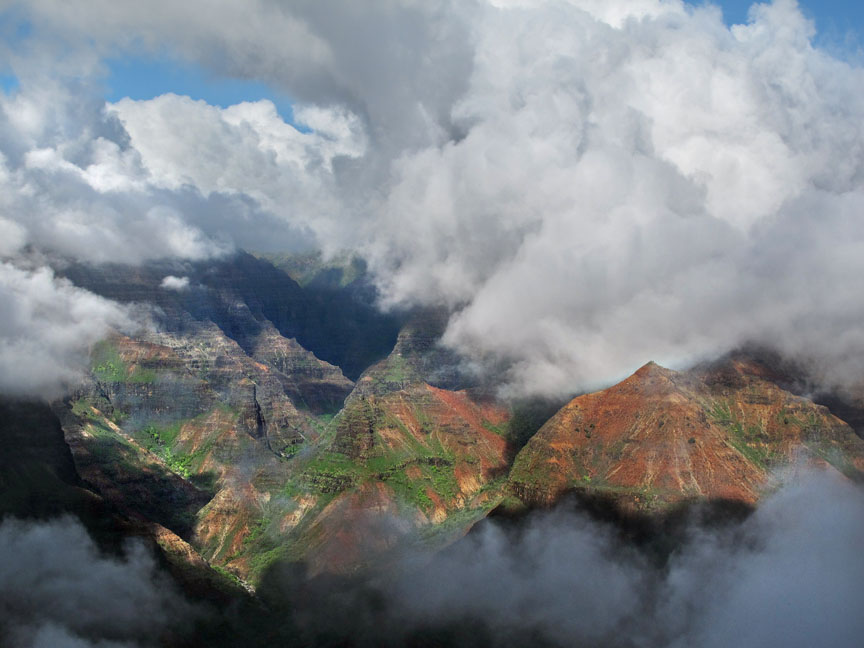
Waimea Canyon (the Grand Canyon of the Pacific), clouding over.

Every so often, they’d part, revealing a piercing blue sky and huge, friendly, fluffy clouds miles high. I thought, “Be open. Be open.”

We drove to the second overlook at Kalalau, blue skies overhead, parked and ran up the incline to see… yes! the same wispy clouds slowly climbing one wall of the massive green valley… and majestic peaks on the back wall in full sun, cascading into impossibly blue ocean. My breath catches every time I first see this place. Part of me wants to weep—I can’t believe it’s still here, still so perfect.
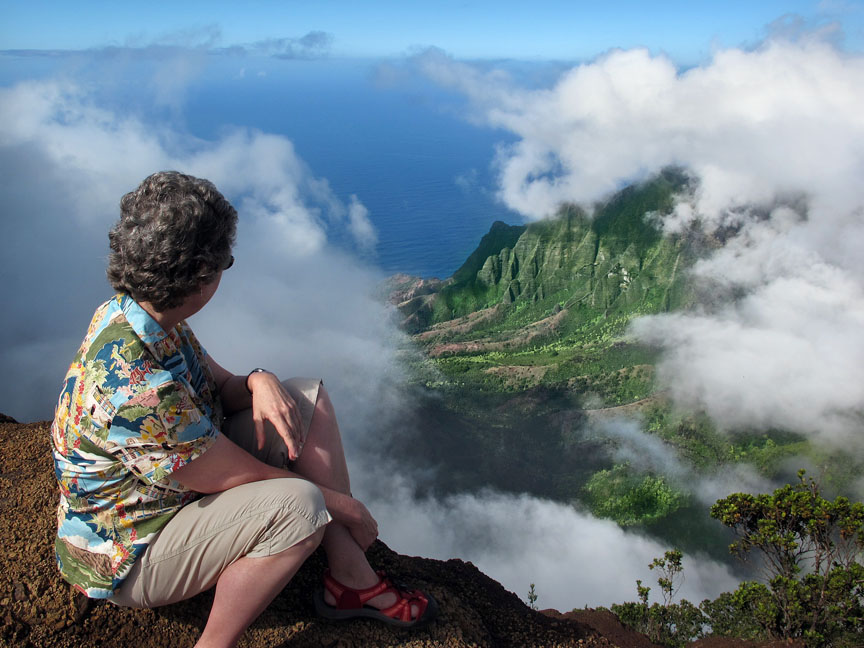
Kalalau Valley being overtaken by mist.

I plopped my butt on the edge and watched. Dick took photos. Tourists milled about, one young woman saying what everyone thinks about this place: “It’s magic.”

And it is. Not because it’s always visible, but because, like Brigadoon, it isn’t. It emerges from the mist when it’s ready, perhaps when weather and air conditions permit, perhaps when someone asks. Two days earlier, I stood on that same spot and looked into a shroud of cloud. I asked. It did not open up. On our last day, we watched the mists overtake the valley and close off the view within ten minutes of our arrival.
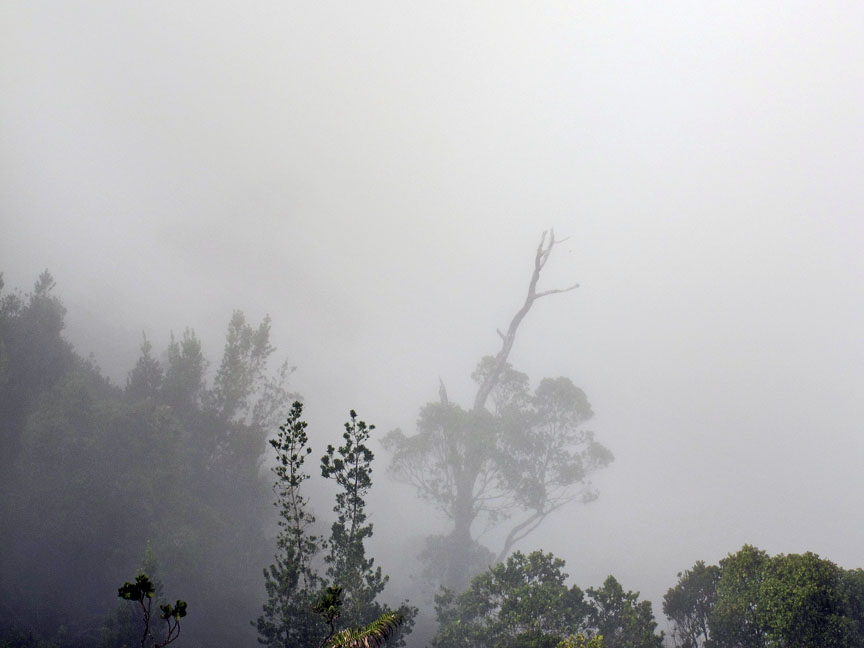
The Kalalau mist

We hung around for another half hour or so, waiting, watching. I asked, “Open up again. Please.” But those clouds were persistent. We’ve seen wispy ones wander into the valley and lift up and over it like white hot air balloons, but not today. As we waited, Dick noticed a tiny ladybug on him… not a traditional red one but a pale green one that landed on his pants of about the same color.
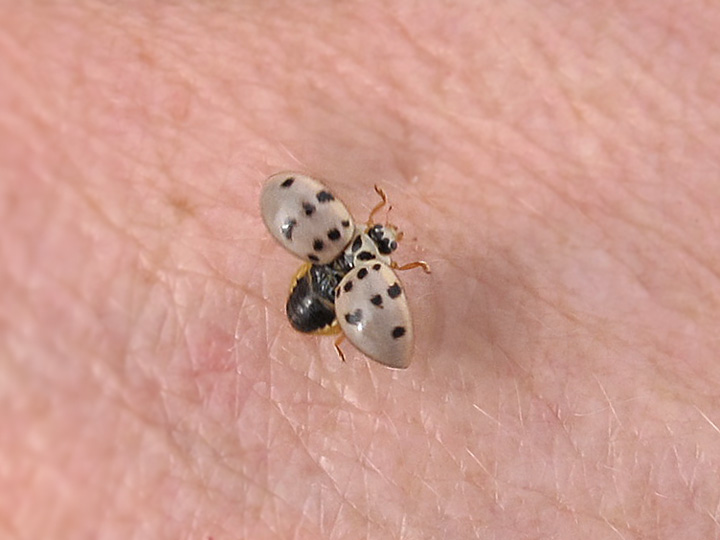
Green ladybug at Kalalau overlook.

We tried to get it to hold still for a photo, but the camera close to it made it nervous, we think. Finally, it flitted to my hand, opened its wings and flew away.

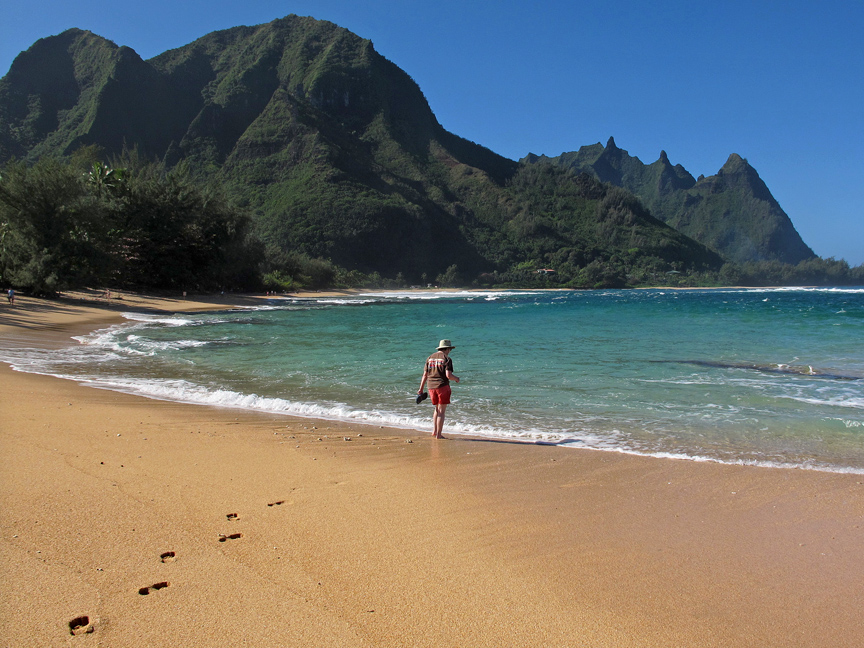
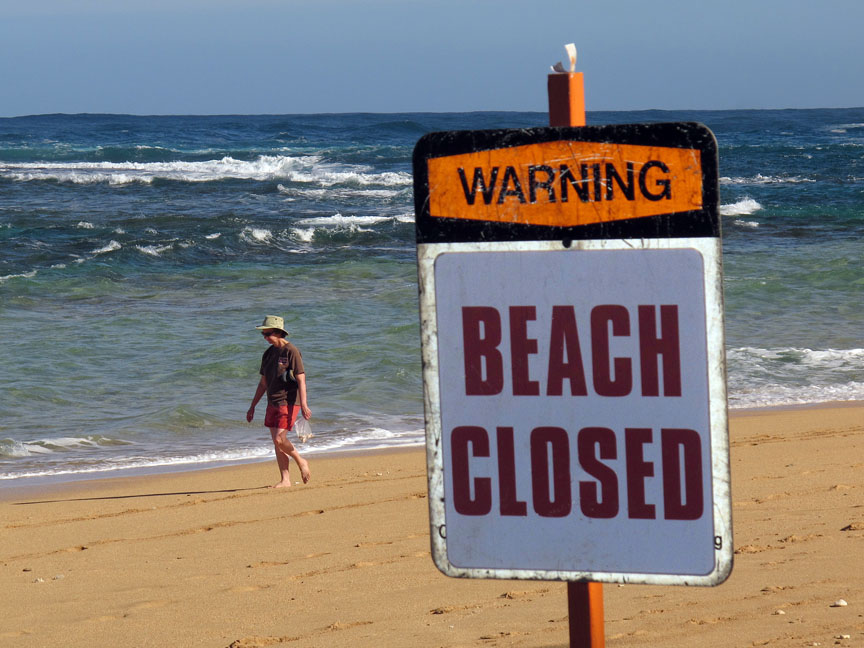
But we got to see the Kalalau valley, however briefly from above, to remind us that there is magic alive and well in the world… even if we can’t always see it. (And other gifts besides the ones you hoped for, like a little green ladybug.) The lovely things are always there—like blue skies and big fluffy clouds, like Kalalau. If you’re lucky and patient, have a little faith, they show themselves, and yes, they can literally take your breath away.
Posted in Uncategorized | 6 Comments

Bali Hai

Well, not really. It was used as the model for the fictional Bali Hai in the movie, “South Pacific,” but here on Kauai, the famous triangular peak is known by its Hawaiian name: Mt. Makana. It serves as the backdrop for what may be my favorite beach in all of Hawaii—Makua (more commonly called Tunnels) Beach on the north shore of Kauai.

Check it out:


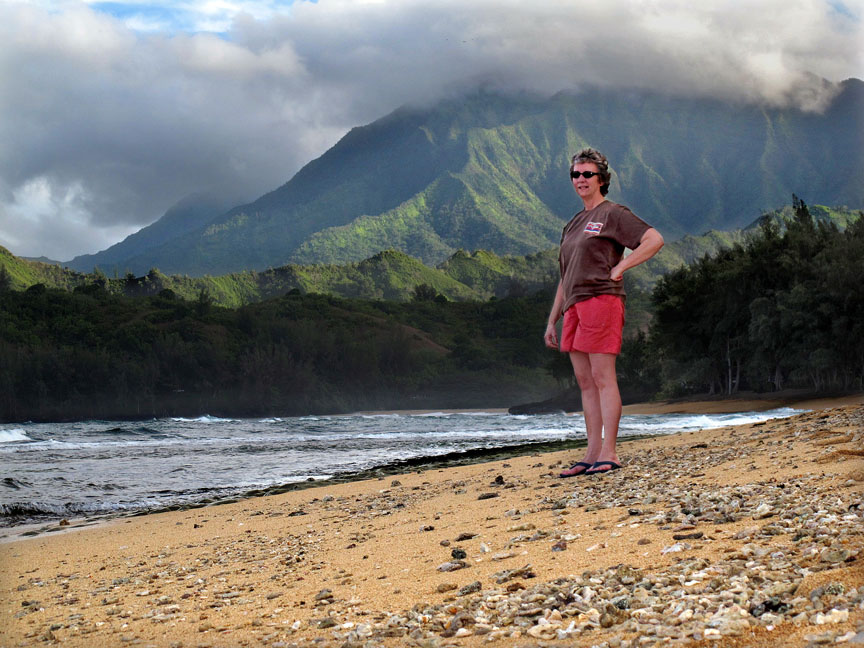
Me on Tunnels

Dick and I have been lazing around the north shore for a week now, and on sunny days (not as many as we’d like; it’s winter, after all) we rise at a reasonable time (it’s also vacation) and head north on da beach. Walkng on the rain-softened sand is a workout, lemme tell ya, and we need the workout. When we rech the point on the beach where you can first see Mt. Makana, Dick goes into his mouth trumpet imitation, blowing a dead-on version of “Bali Hai.” (Ask him for it if you see him.)

I’ve heard it a hundred times, and it still cracks me up.

And there, looming in the distance, at the end of a water- and wind-worn ridge of mountains, towers Mt. Makana. I feel a sharp intake of breath, feel my chest tighten every time, as it does when I put my face in the ocean, trustin that I can breathe through a snorkel. I put my feet in the water, even if the ocean is raging, as it has been this week, and I stare at that ridgeline. Or I cruise the waterline looking for interesting shell pieces for the hobby I picked up a couple of years ago on this very beach—making amateurish shell pendants. They’re completely out of my typical skill set. That’s why they’re fun to do. Each necklace is unique—I have no idea what I’m doing—and I give them away to friends and family, some of whom actually wear them. But I have the most fun making them.

It doesn’t matter what I do out there. I could sit or stand on that beach, dig my feet into the warm sand or let the incoming waves give me a friendly slap about the knees. Dick moseys around, taking photos of the mountain he’s shot thousands of times before because he can, because it’s there. Could there be a better reason?

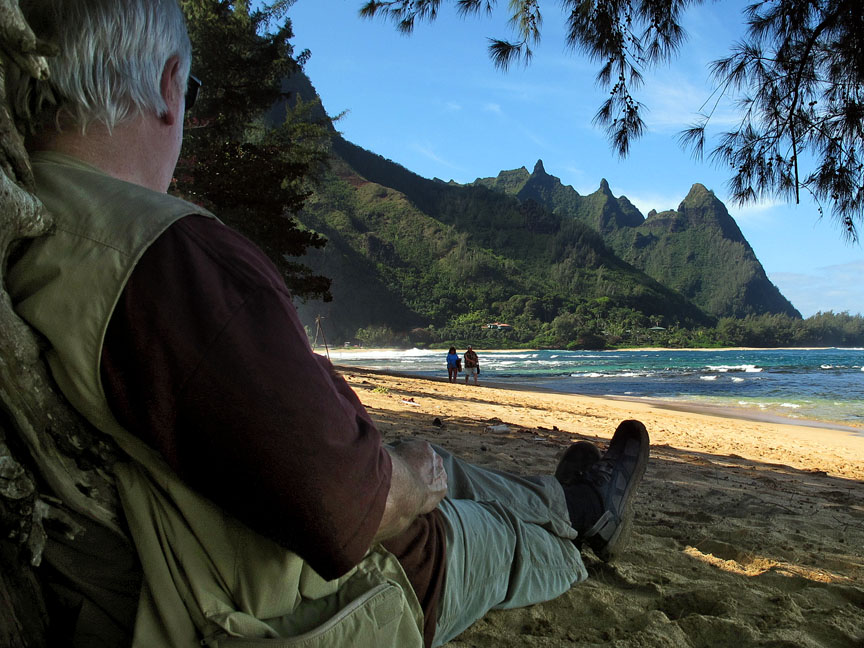
Dick workin' on some serious R&R on Tunnels Beach.

When he’s tired of that, he sits in the shade against the exposed, above-sand roots of an ironwood tree, resting, and waits for me. Awwww…

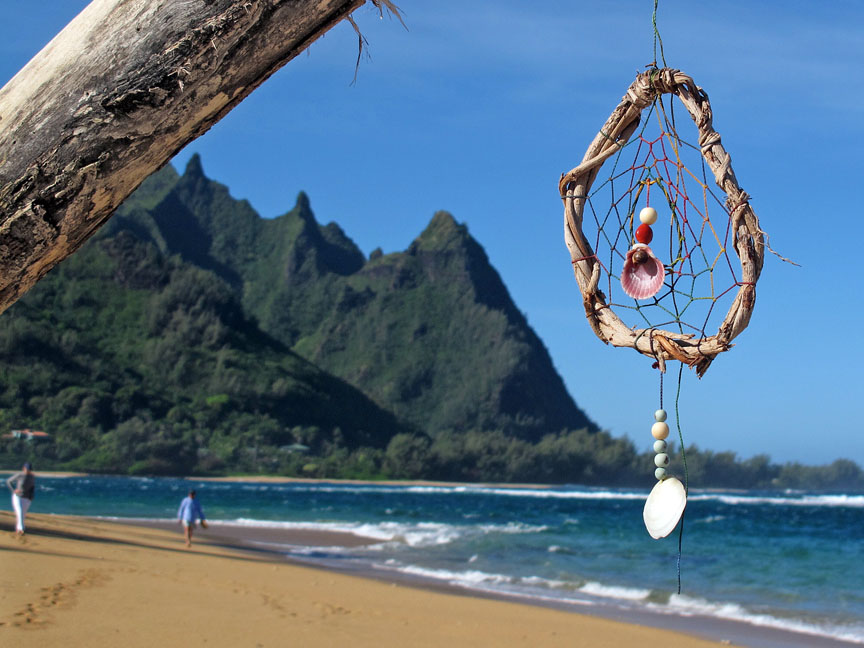
When we made our way to the beach on sunny Sunday, someone had erected a piece of driftwood on Haena Point. Someone had hung two dreamcatchers made of things found on the beach from the long, angled mast. Each wore a shell dangling from the dreamcatcher. How many dreams did they catch? How many people did what we did—walk up to them, reach up to touch them, perhaps make a wish or voice a dream?

Mt. Makana and the dreamcatcher

Yesterday we went back and only one dreamcatcher remained. Where had the other gone? Did its creator reclaim it? Did the ocean take it with a big wave? Did someone need to bring it home to help their dreams?

There’s no way to know. And it doesn’t matter. This is a place where dreams are made and where they begin to come true. Whether you think of it as Bali Hai or Mt. Makana, she calls you, saying, as the song goes, “Come away, come away.” I reached up to touch the little shell and whisper a dream to the catcher on our last day on the north shore.

“Mahalo nui loa,” I said. “Thank you very much for this place, this time, everything.”

I have great faith that she hears me.


Posted in Uncategorized | Leave a comment

Aloha from the north shore

The only problem with vacationing in Hawaii is that all your friends hate you for it. It’s impossible to write postcards (those old-fashioned 4×6 things with photos on them of impossibly beautiful, and sometimes faked, images) or emails or, yes, blog posts without making the people you love most wildly jealous.

I know. I get that way when other people vacation in stunning or exciting or out-of-the-way places. We all do. It’s one of those human things: We’re jealous creatures who want all the good things of others for ourselves, too.

So that’s why, upon reading this blog, I encourage you to loosen your lips, stick a relaxed tongue between them and blow me a big raspberry.

Feel better?

Besides, you’d hate Kauai. No matter how lovely the photos you’ve seen of this greengreengreen island, I always tell people that Dick and I go to the soggiest place possible. Two years ago in December, we were on island for ten days, and it rained—no, it poured—for all ten of them.

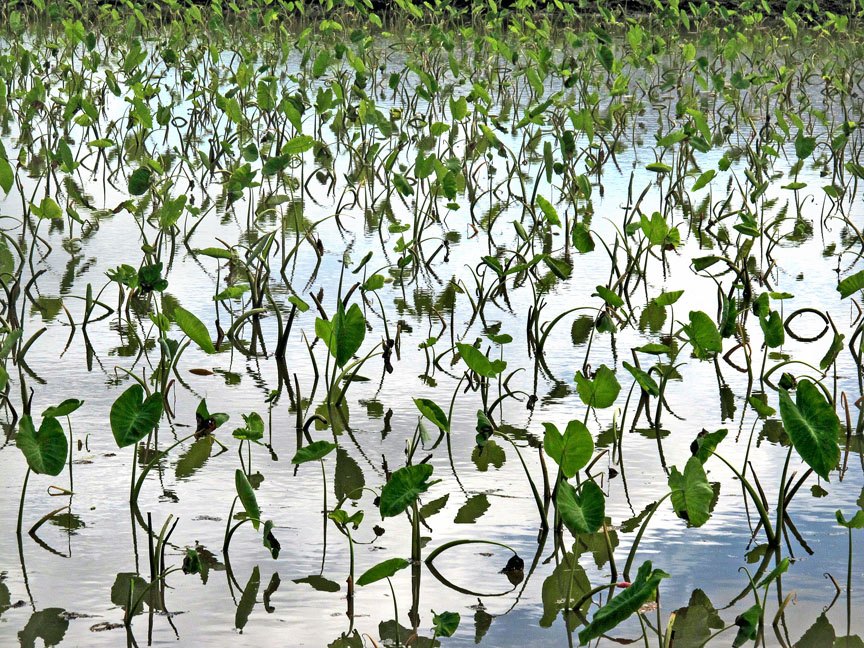
Hanalei taro (photo by Dick Schmidt)

We drove around the two-thirds of island you can drive here, looking for sun. Hanalei on the north shore seems always to be drippy—it’s what makes it beautiful, when the clouds hang low over the rim of mountains behind the town and gorgeous bay. Lihue, the main town, lay under cloudy gray, damp skies. Poipu, the “sunny” south shore—ditto. Only when we drove up the mountain to the often drenched Waimea Canyon (“Grand Canyon of the Pacific,” Mark Twain allegedly said), did the sun peek out a wee bit amid the passing clouds, parting like white curtains to reveal glimpses of dramatic red rock.

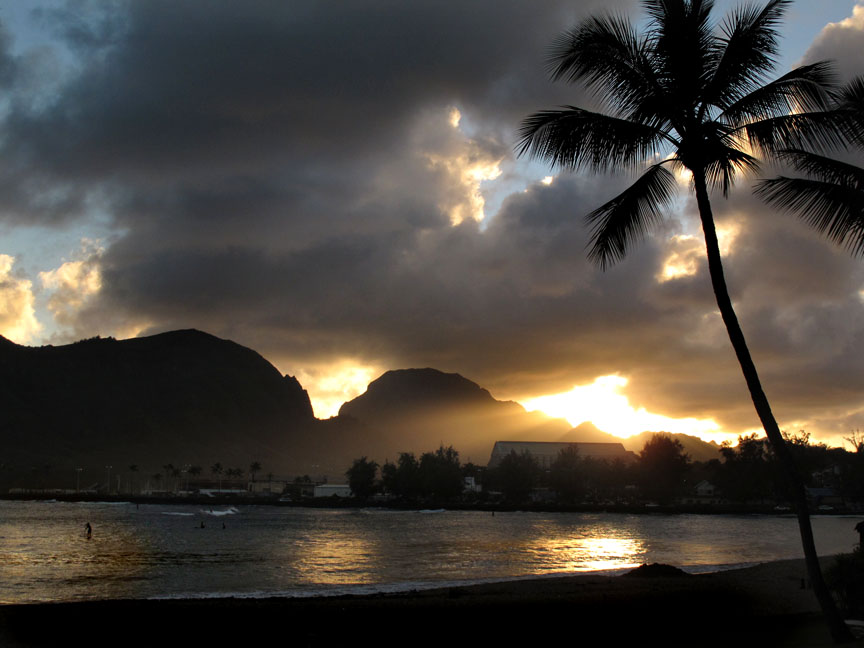
Kalapaki Beach sunset (photo by Dick Schmidt)

“It’s a good thing we’ve been here before,” I said to Dick. “If this was our first trip, we’d be mighty disappointed.” But the truth is, Kauai is stunning in all weather. And, as they say here, if you don’t like the weather, wait ten minutes. It changes that fast. Usually.

This year, though, we apparently brought a bit of Sacramento winter with us. It’s been below 60 degrees pretty much every night here (and there are no heaters in Hawaii—who needs heaters in the semi-tropics?), and the locals are freeeeeeezing, poor things. We, who left behind 40-degree fog, think it’s heaven. Any time I can chuck my long undies, slip into shorts and sandals and put my feet in warm ocean water, I’m happy.

Jan on one of her favorite beaches (photo by Dick Schmidt)

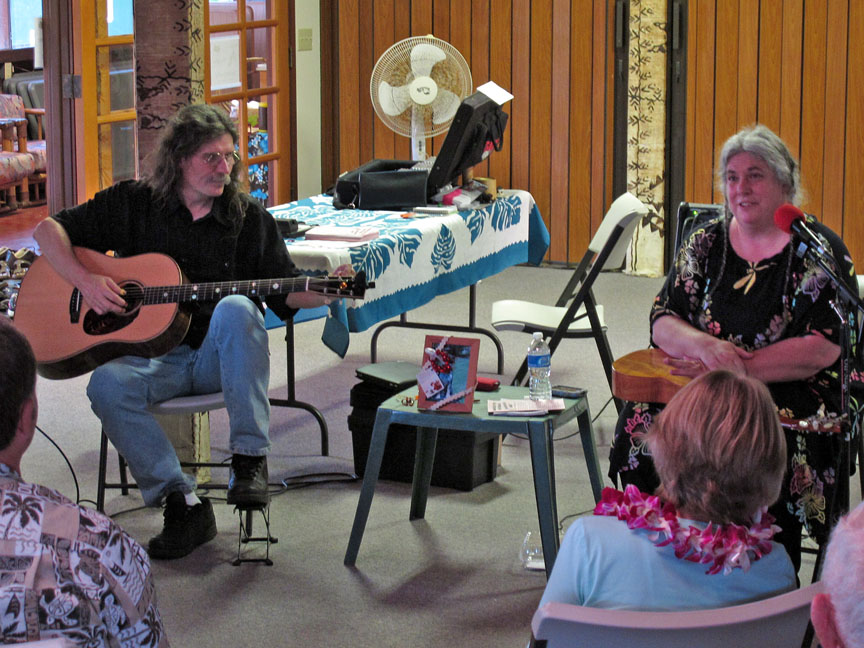
Yesterday we went to an afternoon slack key guitar concert put on by Doug and Sandy McMaster in Hanalei. They perform twice a week here, very informally. Doug is the slack key guitar master, and Sandy talks story and strums a ukulele. If you walked in wound up about anything, within ten minutes of listening, you’re a wet noodle. You leave your shoes or sandals at the door, as people do in Hawaii, wander in to find a folding chair, and settle in for a lovely couple of hours in your bare feet.

But poor Sandy was wearing socks. Socks! Doug had boots and socks on. It was almost as shocking as if they’d been wearing mittens.

But when Doug starts to play, Sandy often puts her uke in her lap and her hands on top of it, closes her eyes and listens. You can’t help but do that, too, and let the music take you where it will. The McMasters promise that slack key will slow your heartbeat and lower your blood pressure, and it’s true. You can feel every soul in the room decompress until they’re all floating on a wave of gentle notes.

The McMasters have a CD with Doug playing and Sandy talking that is so meditative, they warn you not to play it while driving. No joke.

Doug and Sandy McMaster, slack keyin' it and talkin' story.

So Dick and I sat there, floating and listening to a style of music the Hawaiians adapted from Mexican vaqueros who brought their guitars when they arrived in Hawaii to help with wayward cattle in the late 1700s. The Hawaiians didn’t know how to tune the guitars and figured out tunings that worked for them (they have lovely names like “Taro Patch,” “Punahele” and “F Wahine”). And so ki ho alu (which means “loosen the (tuning) key”), or slack key guitar, was born.

Doug played what has become a local favorite for his second-to-last song, his arrangement of “Puff, the Magic Dragon.” He arranged this under pressure years ago by a two-and-a-half-year-old named Emma Rose, who, Sandy told the audience, is now twelve-and-a-half. Emma Rose and her parents came to the beach where Doug and Sandy played more than 2,000 consecutive sunsets and asked Doug if he knew “Puff, the Magic Dragon.” He didn’t, and the next night, Emma Rose was back. “Do you know Puff yet?” she asked.

“You better work on an arrangement,” Sandy said. “She’ll be back.”

So Doug did and performed it for Emma Rose when she returned. Sandy recalled that Emma smiled and danced. “She still asks for her song when she’s here,” Sandy said.

I would, too, but I didn’t have to. Instead, I sat with closed eyes and restful mind and floated in that land called Honalee, which is awfully close to Hanalei, the little town ringed by mountains that resemble a dragon’s back. In Hawaiian, the dragon is a mo’o, a giant lizard, and his head lies atop the water at the north end of the bay. But he is a peaceful mo’o, like Puff, who lives forever in song.

Doug and Sandy finished the concert, as they always do, with “Hawaii Aloha,” which may be my favorite Hawaiian song, even if it does make me cry. Though there are English lyrics for it, I’ve only heard the Hawaiian ones, and they’re beautiful. It’s a song often played at the end of Hawaiian concerts or gatherings or church services, its lyrics written by the Rev. Lorenzo Lyons, a missionary to the Big Island, and sung to the tune of an old church hymn, “I Left It All With Jesus,” by James McGranahan.

The chorus goes:

E hau’oli na ‘opio o Hawai’i nei
‘Oli e! ‘Oli e!
Mai na aheahe makani e pa mai nei
Mau ke aloha, no Hawai’i.

And it means in English:

Happy youth of Hawaii
Rejoice! Rejoice!
Gentle breezes blow
Love always for Hawaii.

Yes, oh, yes… love always for Hawaii.

Posted in Uncategorized | 3 Comments

Hatchling

This is my annual Christmas poem, this year written to honor a new baby born Dec. 8, 2010. She’s the daughter of Christina and Mitch, Dick’s nephew and niece-in-law. (See my earlier post, “Welcome to the world, baby girl,” for more about the baby and her parents.)

Merry Christmas to all!

————-

Hatchling

Not quite winter—
trees still shudder
in their crimson sweaters,
days darken earlier
as they sink toward the solstice,
and nights dip their toes in frost.

The world falls to a hush,
except for the encouraging honks
of homebound geese overhead,
a dark arrow winging toward the river.

Then a baby’s new voice rises,
the high treble fresh and clear
as morning. The elders gather
in protective formation
to welcome and hush,
cuddle and rock the hatchling,
who, although unfeathered,
blinks into strange light,
who already understands
that this, now,
is home.

Jan Haag
December 2010

Posted in Uncategorized | 1 Comment

True grit

Yesterday I visited my friend Judy at her home in East Sacramento. She greeted me at the door in a fuzzy winter hat. Her hair stuck out at odd angles from underneath it, and she immediately put her hand to her head.

“I haven’t been able to wash my hair,” she said apologetically, though it didn’t matter to me. I was just happy to see her walking and talking. “Twelve days.”

Twelve days since a team of doctors made a sausage-shaped incision on the right side of her skull to try to remove a cancerous brain tumor. Twelve days and she’s walking and talking—not perfectly normally—but she’s up and moving.

For four-and-a-half years my friend Judy has battled metasasized breast cancer. It’s migrated everywhere—to her liver and bones and now her brain—and yet she’s still in the game, pitching and catching. She may not run the bases at top speed, but she gets around. I tell her she’s the poster girl for metasasized breast cancer.

She told me, right after her diagnosis, when I ran into her at our local post office one breezy summer day, that she was hoping for a miracle. By my count, she’s had at least a dozen.

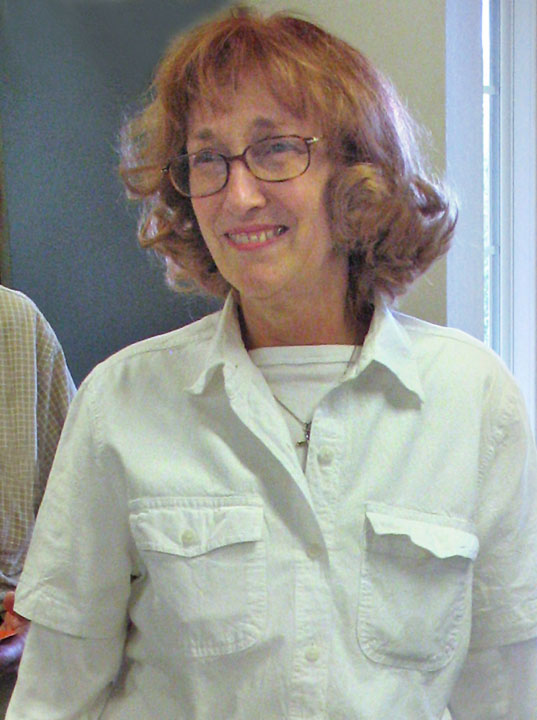
Judy at her 65th birthday party, May 25, 2007

She lived to see her 65th birthday and had a doozy of a party. She’s pursued a variety of treatment methods—both Western and alternative medicine—and some combination of those two has kept her alive all these years.

That and sheer grit. Faith, too. She has a lot of that.

Cancer has been her full-time job, and she’s gotten good at it. I sit with Judy every three weeks in the Kaiser chemo suite when she gets a dose of a drug to try to halt the progression of her tumors. We talk and laugh and have way more fun than is probably typical in the chemo suite. But I have seen her decline over the past three months. She forgets things much more easily. She’s had weakness on her right side. The tumors are on the move. She’s in a last ditch fight for her life.

This morning, I made tea and carried the teapot to the living room where we drank from heart-shaped cups on heart-shaped saucers. We drink a lot of tea together—mostly peppermint, her favorite. Judy took off her cap so I could see her incision. The stitches had just been removed, and I was mighty impressed. The wound is pink and healing nicely—not puffy, not infected. Her doctor, I teased her, is an amazing seamstress.

She beamed. “I know. She’s so nice. I really like her. I trust her. She said she’d try to retain function on my right side, and she did pretty well.”

Judy’s right side is still weak, but she gripped my hand with the thumb and two fingers of the right hand in a powerful grip. “I can’t feel my last two fingers,” she said, and they are floppy.

But she is not giving up. She and her sweetheart, Walt, have been through so much during this long journey. She is grateful for his love and assistance, as she is for her son Eddie’s help, too. After we drank our tea, Judy needed to lie on the sofa to talk. So I sat in a chair, cradling my teacup in my strong right hand, watching her rest. I have sat with people in the last stages of long illness before. I know what this looks like.

But this woman’s not done fighting. She doesn’t want the radiation doctors are suggesting. “That would cause dementia,” she said, her dander rising. “I’m not gonna let that happen.”

She was concerned that she can no longer dye her hair the bright red it has been, she says, for fifty years. I confided that my new year’s resolution is not to color mine anymore either. It’s an odd combination of brown/mousy gray, as one of my grandmothers used to say. It is not particularly pretty, but it’s mine, and I am grateful for it.

“We’ll be as we are together then,” I said.

Judy smiled, stretched her right hand out to squeeze mine with three powerful digits.. “We’ll be as we are,” she repeated.

Which is all we can be, isn’t it?


Posted in Uncategorized | 1 Comment

Happy anniversary

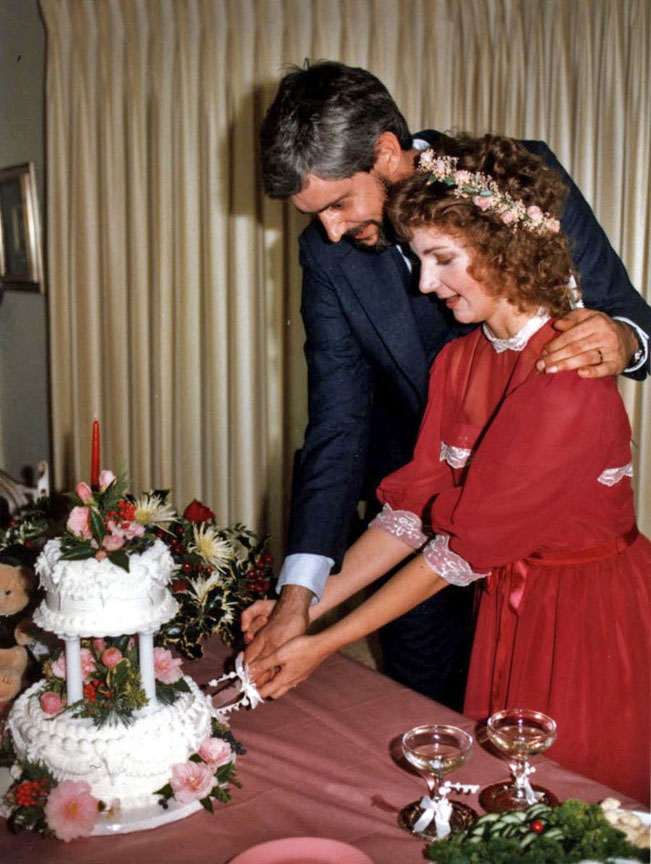
It is significant only to me now, but 27 years ago today I married for the first and only time in my life.

Clifford Ernest Polland married me on a cold but clear Saturday in a friend’s living room in Farifield, Calif., before all of about 25 people.

Cliff and Jan, December 17, 1983

He joked for years that he thought we were going to a movie, but instead I insisted he wear a suit, dragged him before a minister, and the next thing he knew, there were rings and vows.

“Oh, well,” he’d say. “You got me.” And he’d wink.

The truth was that we married partly to buy our first house together. We used his Cal Vet loan, one of his military benefits from his service in the Coast Guard, and Cal Vet wouldn’t count my income unless we were married. We looked at each other when we learned this, and I shrugged.

“I guess we better get married then,” I said.

He shrugged, too. “OK,” he said. And that was that.

The truth was we were planning to be together anyway at that point. I knew I was marrying my best friend on Dec. 17, 1983, and he knew it, too. Though it was a relationship complicated by his ill health and my frustration with that fact, and though we ended up living separately, we never divorced.

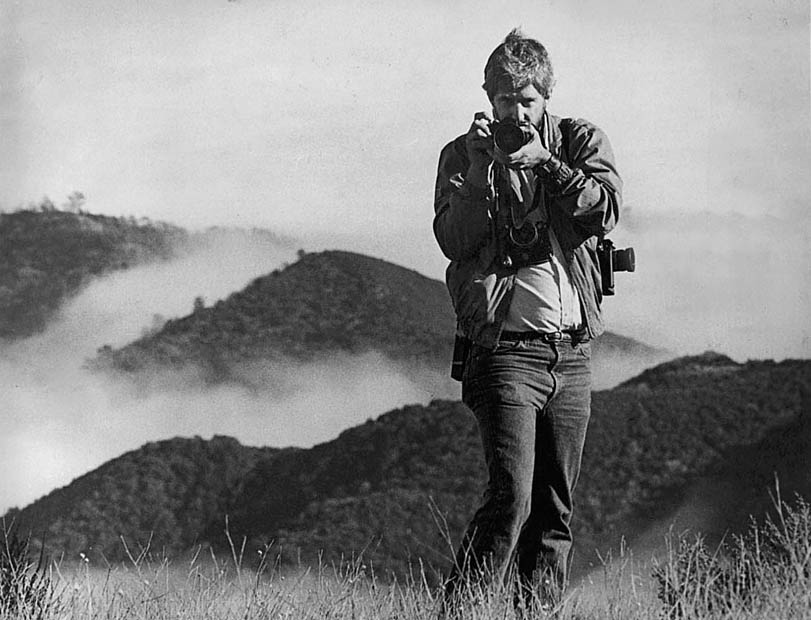
Cliff on assignment for The Vacaville Reporter.

We were made into family the day we married, and we were each grateful for that. He was the stable, centered, thoughtful, kind man I’d always wanted. I’m not sure what I was to him exactly.

But he loved me until he died, even after I broke his heart and told him I couldn’t live with him any longer. “I’ll help you move, Toots,” he said, and he did. I moved about a half mile away and came back to our house on weekends to walk the dog. Eventually I came back to our house, and he moved to Winters to be closer to The Vacaville Reporter, where he worked as a photographer for 17 years.

The year after we married, he got a shiny new aortic valve to replace his faulty one, which bought him 17 and a half years of life. (He used to joke that if evolution really worked, he’d have died long before.) Eventually, he blew a gasket, as he had predicted he might, suffering a bleed deep inside his brain that could not have been prevented. Artificial valves require huge amounts of anti-coagulants to prevent clotting, and he was on enough of them to kill an elephant, he used to say.

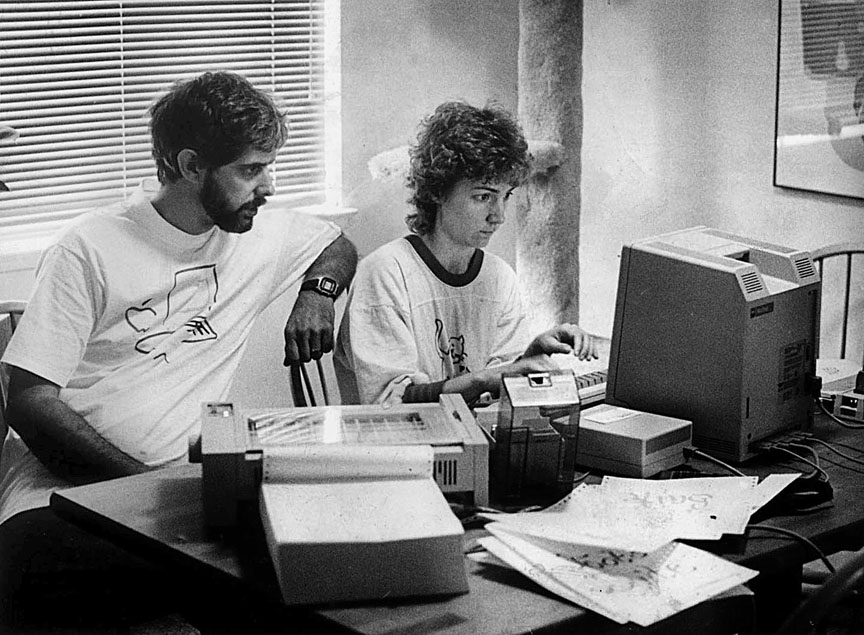
With our first Mac—all 512K of it—in our dining room in Davis, Calif., 1984.

In many ways, he was my elephant–almost 6-feet-5, a full foot taller than I–kind and gentle with a huge heart. Literally. His heart had grown to three times its normal size by the time he died since it was never completely repaired. He had a leaky mitral valve, too, which caused his heart to swell and swell.

I think that heart grew so big because he had such a huge capacity for love and forgiveness. He was a generous soul—not just to me, but to so many people whom he befriended and loved.

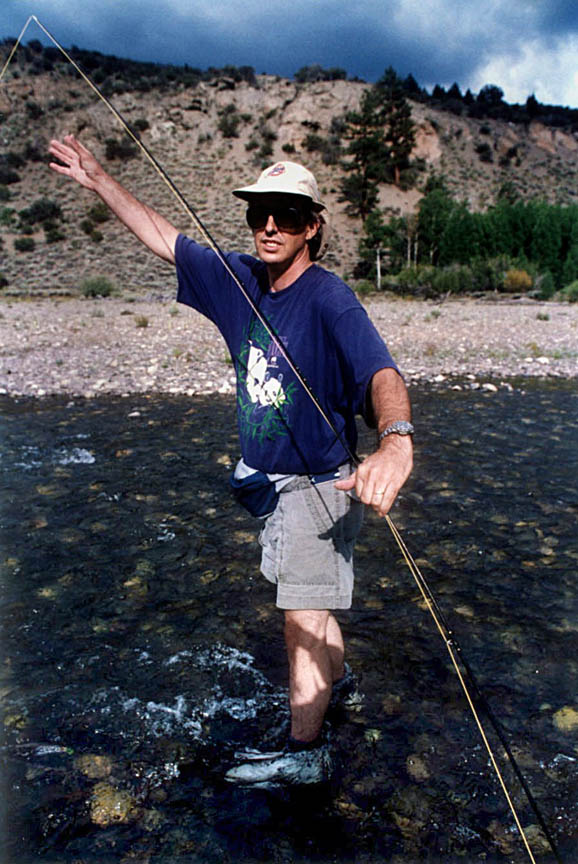
For years after he died, I carried the thought that on some karmic level it might be my fault–I’d broken that heart after it was fixed, and it never recovered. But with time, I learned that Cliff never really went away, that he has been my companion spirit. All I have to do is think of him, and he’s instantly hovering around me. I wake some mornings, knowing I’ve just been with him somewhere, talking, maybe watching him fly fishing in a lovely stream. He loved to fish.

When people ask if I miss him, almost ten years after he died, I always say yes. But the truth is he never left me, and I am grateful. I have my house and much of my lovely life because of him. I can say that yes, I was once married to a terrific man, who was my best friend and teacher, though I did not appreciate him as much as I should have when he was alive.

I do now.

Happy anniversary, Clifford.

Posted in Uncategorized | 2 Comments

Welcome to the world, baby girl

One of the great joys of my life was my 29th birthday, which was when my sister Donna made me an aunt for the first time. Lauren Michelle Just was born six weeks early, and I like to think she did so for me. That day I held my new niece in my arms and whispered in her teeny ear: “Hi. I’m your Aunt Jan. You’re going to love me. I’m going to buy you things.”

Today that baby girl graduates from Sac State with a bachelor’s degree in anthropology. Aunt Jan is so proud.

But on Dec. 9, I got to hold another brand new baby girl, and even though I’m not technically her aunt (though her great uncle is my sweetheart), it was all I could do not to whisper in her little ear, too. But I figured that was her Aunt Rebecca’s job.

So here’s what I really said to her when I got to hold her: “Welcome to the world, baby girl!”

I’m not the only one, of course. Her very proud parents, Christina and Mitch, must be whispering all kinds of things to her.  They are two of the loveliest people I know–both inside and outside. Christina will miss her own Sac State graduation this weekend. She has done something few women do in the same month–give birth to her first child and complete a master’s degree in English.

“That’s pretty remarkable,” I told her the day after the baby was born. Christina and I were taking a little walk–not because she wanted to, but because she was told she had to get up and walk at least four times that day… the day after she had a Caesarean section, for heaven’s sake. I understand why that’s important, but really. The woman had just had a baby, for heaven’s sake.

Still, C. is a trouper. She was out taking what had to be very painful steps. “Yeah,” she said. “It’s been a big month.”

“And look at the door prize you get to take home,” I said. “Way adorable.”

C. grinned. “Isn’t she?”

We got back to the room where father and daughter were waiting for Mommy to return, and C. asked Mitch to change the baby’s diaper. He looked stricken. I smiled. Dick smiled.

“I can help with that,” I said. It’s been a while since I changed such a teeny diaper on such a teeny person, but what an honor. 

Mitch laid the baby in the plastic baby-holding box that passes for a bassinet in hospitals, and I retrieved a teeny diaper. The poor little girl wailed as we unwrapped her like a little burrito, and I removed her (yes!) wet nappie. She had just eaten, after all. Mitch held his baby’s head as I worked on her other end, trying to be quick about it but also trying to make sure the sticky parts didn’t stick to tender baby flesh.

Then Mitch wrapped up his baby burrito again and handed his daughter to me. Such an honor to hold someone barely a day old. Aunt Jan was so happy. I floated around for the rest of the day.

Now that baby is all of a week old, home with her parents, the little princess who has to be adored by relatives who drop by to oogle her and hold her. Every child should be so doted on, I tell you, so lucky to have so many grownups delighted to see her.

We’re so glad you’re here, little one!

Posted in Uncategorized | 1 Comment

Gingko

If you read the previous post, you might be interested to know that after I wrote it, I walked down the street to my neighbor’s to pick up more downed gingko leaves, and I saw an older man out raking. I introduced myself and said I was his neighbor and a teacher at Sacramento City College.

He looked surprised, this man with soft eyes, and said, “I’m Byron Patterson. I taught English at American River College for 26 years.”

How about that? Another English prof! I taught at ARC for a year in the mid-’80s, and I told Mr. Patterson that.

He shook his head and smiled at the coincidence (though my late friend Julie was fond of reminding me that there are no “coincidences”).

It turns out that yes, he planted the tree many years ago (he’s lived in his house for 32 years; I’ve lived in mine for 23… inverted numbers!), and he often curses the tree this time of year because, he says, “It’s so messy.”

“Yes,” I said, “but so beautiful.” Still,  I’m not the one who has to rake up all that gold on the ground.

Then I handed Mr. Patterson an envelope that contained the poem I wrote for him about his tree:

Gingko

Look—
thousands of little yellow fans
artfully arranged on crewcut grass
just before Thanksgiving.
For twenty-three seasons, I have
watched this neighbor’s tree
leaf greenly each spring,
weather the furnace of Sacramento
summers, then shudder itself
into its bright yellow sweater
come fall.

Now the gingko relaxes into
what is coming, lets go,
sends each fan waltzing its way
groundward like so many pieces
of scallop-edged origami.

As families turn to the table
fat with turkey and stuffing,
I come to the gingko every year
with plastic bag in hand
to retrieve those last spots
of sunshine, bound for glass bowls
spread around my house,
enough to last me
through winter.

———–

Long live Mr. Patterson and his great gingko tree!

Posted in Uncategorized | 2 Comments

Fall

I do this every fall now. I did it years before I started leading writing groups that required prompts. I’d go out in the neighborhood—sometimes even stopping by the side of the road if I saw lovely specimens—and load up a plastic bag with leaves fresh off trees—delicate, fan-shaped gingkos, star-shaped maples, serrated ones that look like blood-letters… anything in the process of migrating from light green to dusty yellow to red-bronze. I’d pick up spiky seed pods and snip red berries off pyracantha. I’d disdain the crunchy ones that every year fall from my gibogus sycamore in the back yard because they’re not pretty. One day they’re green, the next they’re a whiny yellow, and then—whump!—they’re toast on the ground. Mulch, as Margaret observed today in the writing group.

She mentioned this after I’d spread out a small collection of leaves and pods and berries on a blue tarp on a table in the middle of the room. My prompt today was  “fall,” which seems highly unoriginal, given the obviousness of the season. But it’s a season long in coming. We’ve had the most glorious Indian summer that’s lasted, with a few chilly days here and there, into November. It was in the mid-70s at the beginning of last week. This is rare for Sacramento. Yesterday it started raining—serious, cold, freakin’ winter rain. I put what I considered a writerly spin on the prompt: Write about fall, the autumnal season, I said, or “fall” as a verb, or the concept of falling.

Margaret, who is new to the writing group, teased me. “You brought your mulch?”

“Yep,” I said. “Carefully chosen mulch. Maple leaves the size of saucers. Spent seed pods like blasted open stars. Halves of walnut shells the squirrels left behind. Gingkos from my neighbor’s gorgeous tree down the block.”

Every year, right before Thanksgiving, that gingko busts a gut, bursting into yellow and tossing off its little fans. I walked down there yesterday to retrieve some of those leaves and noticed a light in the window. To my embarrassment, I don’t know this neighbor—though I have seen an older man working in that narrow front yard, raking those leaves.

I should leave him a note one day, I thought, thanking him.

 ————

Dear Neighbor:

For twenty-three years now, I have watched your lovely gingko tree leaf greenly every spring, weather our hot Sacramento summers, and shudder itself into its bright yellow sweater come fall. I love this time of year when your gingko sends its sunny little fans floating to meet the crewcut grass below it.

For twenty-three falls, I have stopped by to pick up a couple dozen of the discarded fans. Yesterday, they were spotty with the day’s raindrops, every one of them washed clean. I put them in a plastic bag and took them home. Sometimes I place them in glass bowls to shine some of the last of the year’s color before winter sets in. Or I take them to school, spread them on a blue tarp in a classroom and invite writing students to pick them up, along with other treasures of fall… bronze-y maple leaves, spent, spiky seed pods, red pyracantha berries.

My students love the objects of fall. They write beautifully about them.

This is just to say thank you. Perhaps you were the person who planted this tree long ago, who dug the hole and set the little sapling to its life task. Certainly you tend and nurture it now.

This is just to offer my gratitude for the gingko’s annual gift—always at Thanksgiving—of thousands of sunshine-y fans that always make me smile.

With deep thanks—

Your neighbor,

Jan Haag

Posted in Uncategorized | 2 Comments

Permission granted

I wrote this on the ninth anniversary of the Sept. 11, 2001, terrorist attacks, at the beginning of Rosh Hashanah, the Jewish new year, on the first day of my Saturday fall writing workshop. We’d had a six-week summer hiatus, and people came back to write and share, as giddy as little kids to see their school chums again. 

I gave this writing prompt: Take the piece of cardstock in front of you and a marking pen (any color you like; feel free to decorate!), and write these words on it: Permission granted. Sit with that for a minute or so, then pick up your pen or go to the computer and write. What do you need permission to do? What have you been waiting for so you can proceed with something that you want to do?

This is what I wrote:

Everything is permitted.

Everything is permitted.

Everything is permitted.

Everything is permitted in the imagination.

Everything is permitted on the page.

Yet we pause, the pen hesitates over the paper, as we do when standing on the edge of the pool, nervous about diving in. We long for the soothing water but fear that immediate shock of submersion, of the abrupt change in temperature. We wonder if we’ll survive, if this time we’ll be able to come up for air.

Well, yes, we will. I sit here as a writer, like all of you, and I tell you with every bit of faith and years of practice, yes, we will come up for air. We will find things in the depths that surprise and scare us, that slap the breath from us like big ocean waves. But we float. We float, people, and our heads find the water’s surface, our faces turn toward the sky, our mouths open, and we breathe—long inhales, gulps of gratitude. Then we swim, long, languid strokes that get us to a place some distance from where we started.

We breathe, and we write—or draw or paint or compose music, or perhaps all of the above. We dive down again, on purpose, looking for pearls we didn’t know were inside us. We bring them to the surface, hold them in our hands; we are surprised by their luster, their simple beauty. We are astonished that we found them.

We sometimes need permission to dive deeper, need encouragement in the form of others writing with us, listening to us, reminding us of what they hear that is strong, what stays with them. It is easier to go in the water with a friend, always wise to swim with a buddy.

So welcome back, my buddies, to this body of water in which we swim, dive, surface, breathe. Not that you need it—you never have, never will—but you have my permission to get wild and wonky on the page, to weep or wail, to toss away inhibitions and dance. You have permission to let your pens skate between the lines or let your fingers fly over the keyboard, making your own music. You have permission to sing the words as you make them up, to hold up the pearls you have retrieved from the deepest parts of yourselves, to admire them or throw them away.

Everything is permitted on the page.

Posted in Uncategorized | 3 Comments