Takin’ a tumble

Ms. Coralee Hoffmaster Johnson of Cerritos, California—this is for you, darlin’.
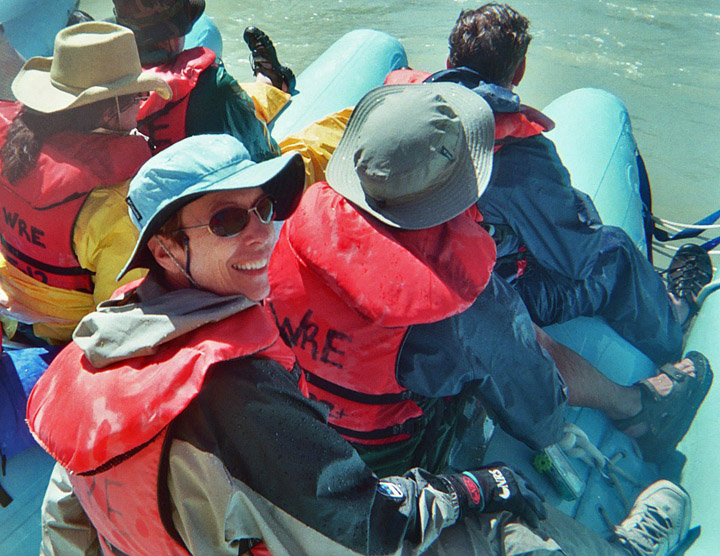
Cora on the mighty Colorado River, 2005


I know that this week you had planned to find yourself on a small raft on the Colorado River with two of your closest women friends—Connie and Shirley. You, the three widows, who’ve each lost a husband in the past couple of years, had signed up for the biggest, baddest, most beautiful river trip around—188 miles of some of the fiercest whitewater and most incredible scenery on the continent.
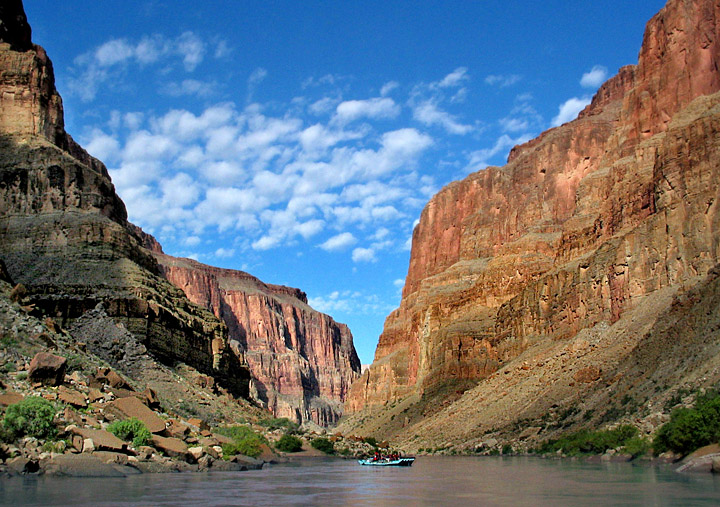
A lovely summer day on the Colorado River, deep in the Grand Canyon. (Photo/Dick Schmidt)


You asked Connie and Shirley to join you, the veteran, on this expedition with a well-known river company and expert guides. This would have been your third trip down the mighty Colorado, and it is not a trip for wimps. I know—after your first river trip, you raved about it so much that Dick and I did one, too, with the same rafting company. It was a change-your-life excursion—for me, at least. Dick had been down that river twice before in the late ’70s and early ’80s, and he wanted me to experience it, too. You’re a different breed of human coming off the Colorado after rollercoastering over whitewater and drifting along the lovely peaceful parts surrounded by some of the oldest rocks on the planet. The word “phenomenal” doesn’t do it justice. And in how many places in the world do you get to see dark Vishnu schist and salmon-pink Zoraster granite? Very few.

You and your late husband Bob, with his transplanted heart, signed up for your first Colorado River trip together in 2004.
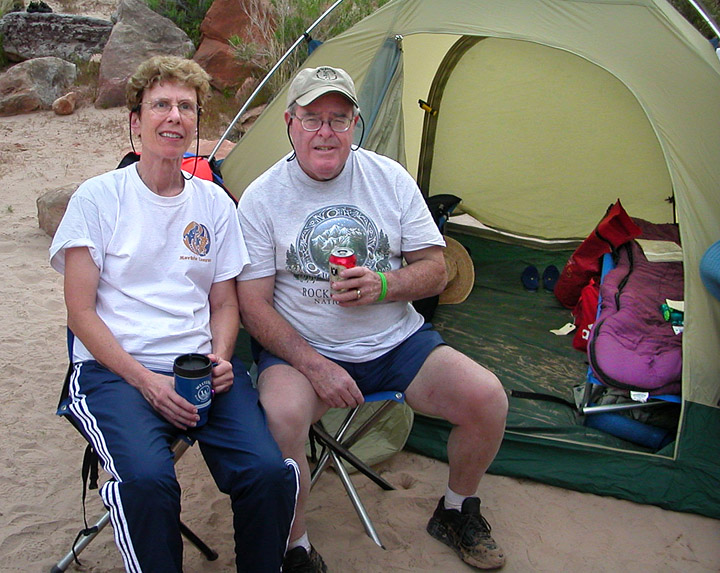
Cora and Bob Johnson at a campsite on the Colorado River, 2005.


You two went again the following year. And now you wanted to show it to your buddies.

Five days before you were to leave for the river trip, you took a different kind of trip. You collided while playing with Bronco, the neighbor’s yellow lab whom you walk several times a week for exercise and companionship. “I felt a pop in my ankle, and I fell,” you wrote in an email. “I knew right away this was not an ordinary turn of the ankle, and I asked one of the neighbors to take me to the ER.” 

There you got the bad news: You had fractured the tibia tip in your right ankle, which is now encased in a knee-to-foot cast.

“The ER doctor told me that there would be no way that I could take the river trip,” you wrote. “I almost started to cry as I couldn’t believe my ears. What? Me not go?”

We can only imagine your disappointment and sadness, even as you said bravely on the phone tonight, “It could have been much worse.”

And you added, in your usual forthright manner, that this sitting around with your foot up was a “pain in the butt. Literally. I’m sitting too much.” (That made us laugh.) And I said something that was perhaps a bit irritating, too—or at least not something you might be ready to hear. “Out of difficulties like this come gifts,” I said. “It’s the ‘when-one-door-closes’ phenomenon.”

You experienced this tenfold after Bob died, eight years and one month after his transplant. Neighbors, friends and family appeared immediately to offer comfort and assistance as you rebuilt your life as Ms. Cora, not so much Mrs. Johnson anymore. Though you miss Bob, you’ve charted an incredible course into your future. One of your most impressive accomplishments—besides being an ambassador for Donate Life, a national organization that promotes organ, eye and tissue donation—is as a float builder.
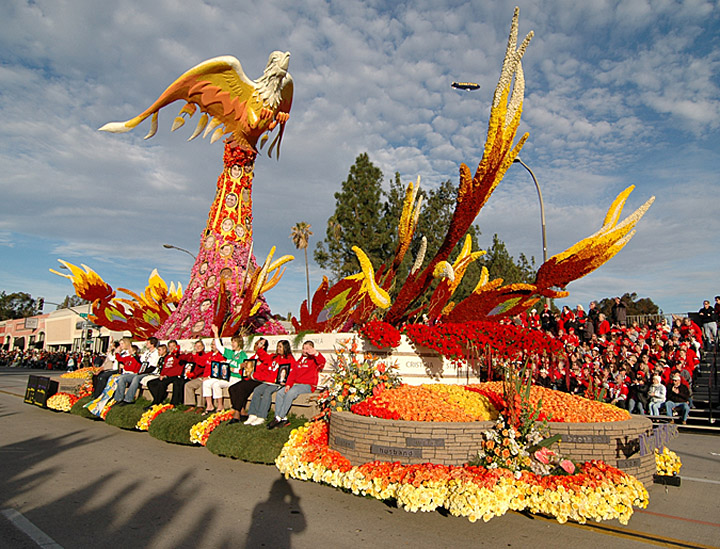
"New Life Rises," the 2010 Donate Life Rose Parade float, which won the Theme trophy.

You’ve worked on two Donate Life floats for the Rose Parade. You donated hundreds of hours to help create incredible, inspiring, giganto floral sculptures, even arranging for a “flora-graph” (shouldn’t it be a “Cora-graph”?) to honor Bob’s heart donor, Tim Baptista, on the 2010 float. That float, “New Life Rises,” won the Theme trophy, and Connie and Shirley traveled to Pasadena to be with you for the parade. Viva tres amigas!
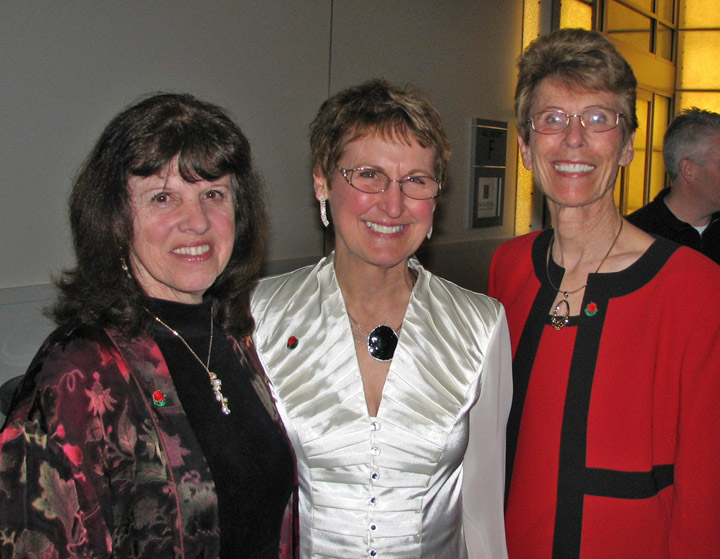
 

Tres amigas (from left): Connie, Shirley and Cora

Now, in this window of healing time, you get to practice letting other people do things for you. “That’s hard for me,” you said on the phone. “I’m the one who does things for others.” And you will. You are. The neighbors who show up to help or bring food are repaying your many kindnesses over the years. Dick is about to travel to SoCal and hang out with you for several days, be your “go-fer” because you are, he says, “a good person of the earth. She’s Cora.” I wouldn’t be surprised if Bronco shows up with a dog biscuit for you.

This is love in action, and it’s good to let it wash over you now and then like a baptism of healing river water.

I say this as one who finds it difficult to practice patience, especially in healing. I, too, am used to doing, not sitting, giving rather than receiving. But I once heard someone say that if we don’t learn to receive as gracefully as we give, then we’re missing a big part of the circle. And we’re not allowing others to reap the gifts of their own giving.

So this is your time to rest and receive, heal and practice patience, acknowledge the gifts as they arrive. Soon you will be back on both feet, striding confident and strong through the world as you always have.

We love you, Ms. Cora, as do your buddies on the river, as you love all of us. Just wait till next summer when, nicely healed, you’ll take to the mighty Colorado again. Third time—like the first two—will be another charm.
Posted in Uncategorized | 1 Comment

What we learned in kindergarten

Evan Mendonsa is five years old, and he has just completed his third week of kindergarten. He is beyond excited about school. “It’s fun!” he enthuses with the big grin of a shiny new student. He can recognize a few words in one of his books from school—cat, my, a, the—and he can perform what I think is one of the niftiest “jokes” I’ve ever seen.

I should be clear: Evan calls it a joke. I think of it more as a pantomime. I’ll try to explain in words what really should be captured on video. 

Evan begins by standing, feet planted firmly under him. “Firecracker,” he says, then folds his hands in prayer pose in front of his chest and undulates them upward like a swimming fish. When his hands are over his head, he claps them. Then he separates his hands and, fingers wiggling, mimics a shower of fireworks cascading to the ground as he says, “Ahhhhhh!” 

This cracked me up so much, I had to see him do it again. Then again. The third time I joined him. And the fourth. A couple of hours later, when his grandmother, who is my BF, requested one more round of “Firecracker,” he complied and had a roomful of grownups—most of whom have seen this way too many times—laughing. We are easily amused.

Much of this took place in my BF’s bedroom tonight. Earlier in the day she’d gotten out of bed and showered and dressed, something she doesn’t often have the strength to do these days. Then, with assistance from her daughter Jena, as well as her husband Ron, and Evan’s parents, Andy and Tiff, my BF Georgann made dinner for the first time in weeks. Good cucumber salad and chicken, beef and broccoli and cauliflower. Wonderful potato wedges golden from the oven. Fresh Roma tomatoes from the garden. All very healthy.

She continues to struggle, my BF, with the effects of her carcinoid tumors. She is very tired and sleeps much of the time. She is taking new medication to help disarm the carcinoids and quell their very annoying symptoms, but she struggles to have a regular daily life. It is not the first time I have called her a superhero, but she is, though she will deny that.

So it was that we had a lovely family dinner with her kids and grandkids. I got to sit next to her granddaughter Cine at the dinner table, and though she wasn’t much interested in dinner tonight, Cine looked at me at one point and said, “I can hear you chewing.”

I smiled down at her. “Am I chewing with my mouth open?”

“Nope,” she said, “just crunching.”

I pointed out that she, too, could crunch on her bread or broccoli, and Cine grinned a magnificent four-year-old grin. I grinned back and winked at Jena, her mom.

These are the people who keep my BF going these days—Ron and Jena, her primary caretakers (though Cine and Sam the dog and the two cats are big live-in helpers, too). Andy and Tiff and Evan come down the hill from El Dorado Hills frequently, too. This makes Georgann very happy. She is never more content than when she has a house full of her people around her.

After dinner, though, she retreated upstairs to lie down again. I followed her up there, and we had ourselves a girl chat for a couple of hours. Eventually Jena drifted in, then out, to referee the kids. Ron came and anchored a wall. Andy showed up and laid down on the bed near his mom. Tiff took a place on a bed corner. Sam came in with his red ball. The kids, fresh from a bit of a dust-up, appeared. There we all were, surrounding Georgann, as if she were the center of the universe. Which right now she pretty much is. 

She wears all this adoration pretty well, but I know that she will sleep well tonight. I’m pretty sure we pooped her out by the time we left about 9.

I drove home thinking about Robert Fulghum’s wonderful little book, “All I Really Need to Know I Learned in Kindergarten.” The title piece is mostly a list of amusing and poignant things, such as, “Say you’re sorry when you hurt someone,” “Share everything,” “Wash your hands before you eat,” “Play fair” and “Take a nap every afternoon.” I wondered what things will be on Evan’s list from his kindergarten experience.

My favorite item on Fulghum’s list is, simply, “Flush.” Though I must say that I’m also quite fond of this one: “When you go out into the world, watch out for traffic, hold hands, and stick together.” I think that’s one of the most brilliant literal and metaphorical pieces of advice ever.

Evan will learn some of these things and many others in kindergarten this year. Next year it will be Cine’s turn. Jena’s taking science classes in college now, looking to be a pediatrician some day. Tiff wants to go to school to be an ultrasound tech. I’ll be in school forever—or at least until I retire. 

But we learned again that most important of lessons tonight outside a classroom, at the bedside of someone we love who is the center of our universe: that family is everything; that love is, as the Beatles said, all there is; and that this gathering around Georgann is, in a sense, holding hands and sticking together. She is the campfire that draws us. We bask in her love for us all.

And we are grateful.

Posted in Uncategorized | 7 Comments

Clifford

It’s been nine and a half years, almost, since he died, and though I wrote a book of poetry called Companion Spirit about his continued presence in my life since then, it still sometimes surprises me when he turns up.

Like Monday morning, for example. I awoke with that feeling that he and I had just been talking, having a good conversation in some lovely spot. I had no idea what we talked about, but his presence was as warm, as comforting, as the summer quilt atop me. I could feel his presence, barely hear his voice as morning pulled me into wakefulness. A visit with my best companion spirit always feels like that.

So it was that, before a shower, before yoga with Pamela in my back yard, I went to my office and retrieved a round hat box. Two years ago when my niece Lauren moved in, I had deposited these items in that hat box for safekeeping. Now that Lauren has left to make her own life in her own apartment, the medicine cabinet in her bathroom is vacant.

I knew what I needed to do. Right then. 

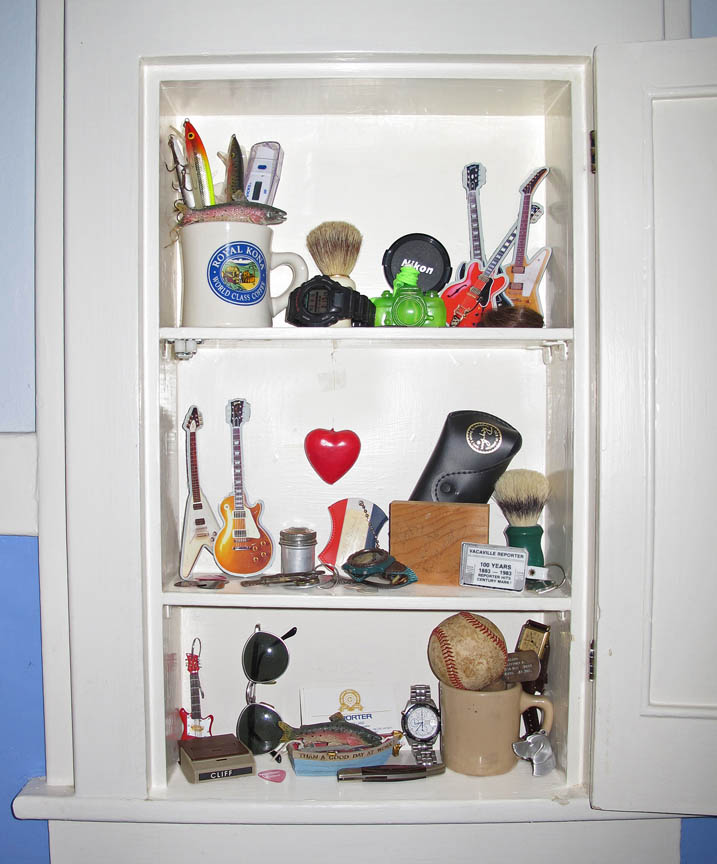
I opened the hat box and took out the treasures, one by one: a scuffed hardball; his last coffee cup; a small key ring with two skeleton keys from his old family home; the last bits of his graying hair; fishing lures, guitar picks, two shaving brushes, a luggage tag, four watches, his sunglasses, a pocketknife, his Coast Guard dogtag, and a square block of wood that he signed, “First cut on new table saw. Love, Cliff.” He did that because I asked him to.

I gathered up all these little tokens of him and put them in the old wooden medicine cabinet because that was his bathroom for so many years.

Clifford's cabinet

It seemed an appropriate place for an impromptu altar. I’ve wondered over the years how many guests go into that bathroom, open the medicine cabinet (c’mon, you’ve peeked in medicine cabinets in other people’s houses, haven’t you?) and are startled by what they see. If they look carefully, they’ll see his business cards from The Reporter, the newspaper where he worked for twenty years. They’ll see a half dozen little guitars—five of them magnets, one an ornament—because he played the guitar in his later years. I imagine him wailing out rhythm behind great lead guitarists in his heaven. He’d like that.

I hope that his heaven has good old dogs and calm fishing holes and a fine woodshop for furniture making in it. I hope there are ripe wine grapes all the time to crush and bottle, as well as heady hopes to make beer. I hope that his heaven has all the best things of his last lifetime, including some of his favorite people, as well as the dogs and cats that preceded him. And I hope that if we do get other lifetimes, his next one is much easier, with a strong, healthy heart, and simpler path. He so deserves that. He put up with me for more than seventeen years of marriage, and I did not make it easy.

I still miss him, and when I do, I can again go to the medicine cabinet, open it and pick up, say, the baseball or one of the guitar picks or his dogtag. And the companion spirit instantly blooms in my heart, in my head, saying something like, “Now Toots…” He’s still my old friend, one who knows me better than most, and he’s still in my life. It was a great surprise to learn that—the dead loved ones return when we need them or want them, too. They’re never very far away, it turns out. And if we’re very quiet and still, as in sleep or meditation, they make themselves known.

I am grateful—beyond grateful—for everything Clifford Ernest Polland gave me and continues to give me. Not the least of which, even from that place just beyond the veil of what I think of as “here,” is his undying love.

Posted in Uncategorized | 5 Comments

The end of summer

Traveling home from Canada is always bittersweet, partly because it means vacation is over and partly because I’m looking forward to getting home to (this is embarrassing) my cats. I know they sit around waiting for me, looking for me. I have this on good authority—not just from the cats themselves. But my across-the-street neighbor Sonya who takes care of my cats (thanks, Sonya!) tells me that they do. I believe her because when she’s gone, her cats have looked around for her when she’s gone, racing to the door as I open it and then shrinking back when they realize I’m not her.

So as Dick and I drove down from Vancouver Island, we made stops in Washington and Oregon to visit with friends who, like us, once worked for The Sacramento Bee newspaper. I left (OK, was laid off) long ago, in the mid-1980s, and had the shortest tenure of, well, just about anybody who’s ever worked there. Dick had the pleasure of a 40-year career (39 of them with The Bee and a most memorable year in Honolulu at the Star-Bulletin) in journalism before he retired.

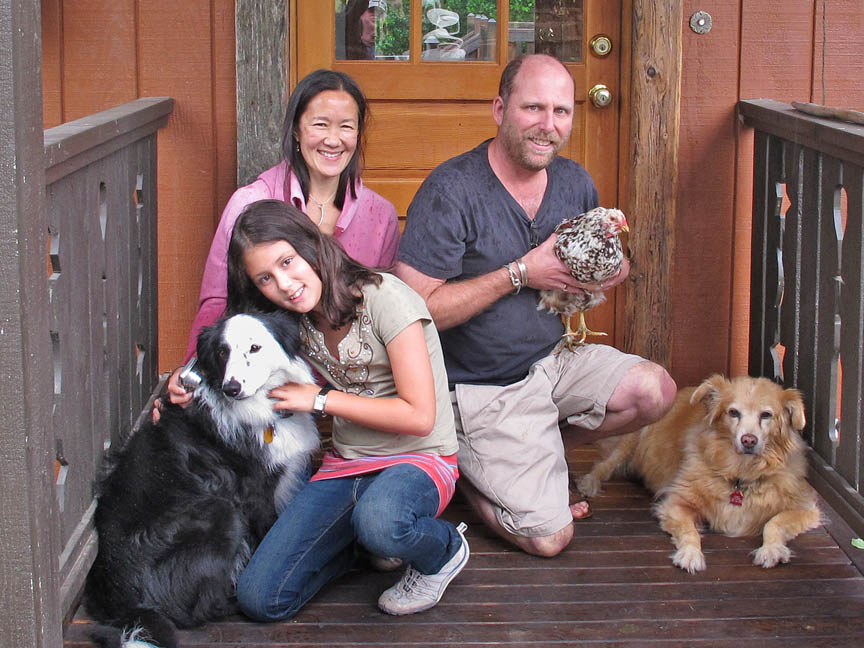
Our Washington friends, Edie Lau and Jon Williams, ace reporter and photographer/page designer, respectively, amazed us years ago by moving around the country to different newspapers, trying to find a niche. They lived separately for years, even after they married, trying to find the right paper. They eventually came back to Sacramento at the same time to work at The Bee. But now they have found an even better life in Poulsbo, Washington, for themselves, their daughter Riis, their two dogs, Comet and Georgia, and six chickens. 

When we first visited them not long after they’d moved to Poulsbo, where Jon found work on a small newspaper, we were impressed with all the work they’d done on their new home—especially in creating a garden and Jon’s incredible woodwork inside and out. The second time we visited, we were charmed by the Lau/Williams flock of chickens who, while they produce eggs, are more family than food source. Edie told me on this visit that as the girls age, the question of what to do with them arises. Do you let them move gracefully into their chicken dotage or do you put them on the table? 

Edie and Jon say they don’t know the answer to that one—their girls are not that old yet—but I can tell you, especially when we saw Jon holding Kiev, one of their Russian Orloffs—I think the girls will live long, happy lives between their coop and their back yard until they gracefully exit through natural means.

Edie Lau and Jon Williams with daughter Riis, dogs Georgia (left) and Comet (right) and hen Kiev.

Except maybe not poor Kiev, who is, quite literally, hen-pecked by her roommates. She has lost feathers; she is made to sit on all their eggs, to brood, even though there is no chance the eggs will hatch. (A rooster is not in the stars for this flock.) 

Still, Kiev seemed to perk up a bit when the family launched a brief search after she’d gone missing in the yard. Jon picked her up, and though Kiev struggled a bit (hens are apparently not good lap pets), she tolerated his attentions and posed for a nice family portrait.

Jay Mather and Diane Russell in Sisters, Oregon

Our friends Jay Mather and Diane Russell live in Sisters, Oregon, and they don’t have chickens—though they do have two cats, Luna and Noir. They left Sacramento only a few years ago, too, and have made a lovely home and yard in the high desert of Oregon. They, too, are both retired (Diane from UC Davis), something I envy even more as I face the onslaught of school again. Jay, a Pulitzer Prize-winning photographer, still shoots for fun, as Dick does, and is an avid bicyclist and woodworker. Diane is a great cook and gardener. Together, they are creating an oasis of peace and serenity there in Sisters. 

This is all to say that there is life after newspapers, though I certainly didn’t think so when The Bee gave me the heave-ho twenty-five years ago. We journalists go on; we even thrive out in the “real” world or, if we’re lucky, in retirement. I worked for other media outlets and enjoyed them before falling into teaching journalism and writing full time. I am grateful for that, too. Sometimes it takes us a while to find our place in the world, that comfortable spot where we know we’re meant to be. Some people never do find that spot.

So I’m still thinking of poor Kiev, the hen-pecked hen, the low girl on the totem pole of her flock, who apparently gets shooed back into the coop to sit on everyone’s eggs. Someone’s gotta do it, after all. Someone’s gotta sit and do the job no one else wants to do. And sometimes, to us non-chickens, it looks like Kiev is under duress when, really, she’s the zen one, meditating to her chicken mantras, knowing she’s right where she’s meant to be.

Posted in Uncategorized | Leave a comment

Starfish and surfers

A word or two about surfing in British Columbia.

Some of you are probably thinking what Dick and I thought a decade ago when we learned about this: Surfing in British Columbia? Isn’t that like water-skiing in Death Valley? Like doing Olympic-style curling on a lava field?

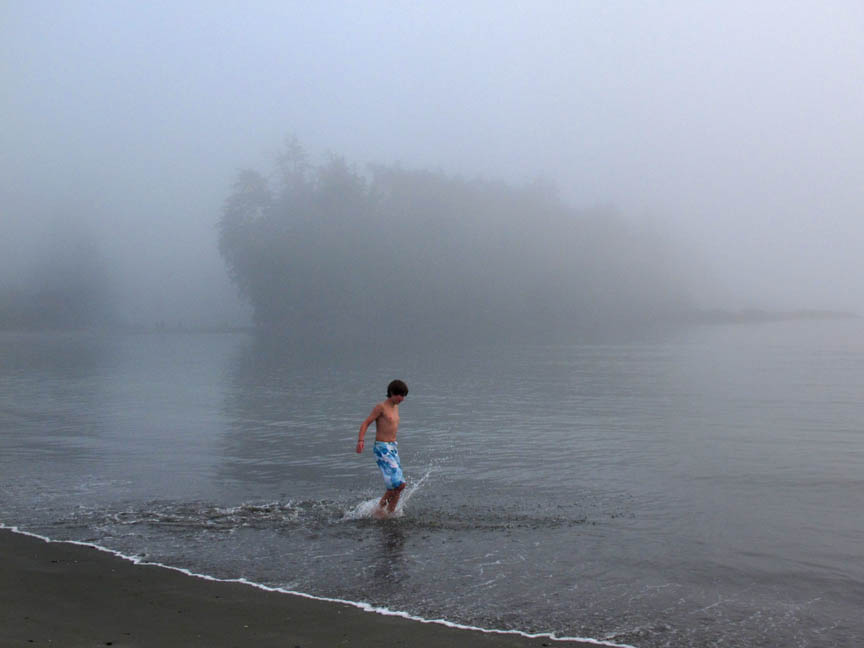
For example, take this exchange with a young woman working in a Victoria café. I said we had just come from Tofino on the upper west coast of the island where it had been foggy all week. That would make it pretty much all of August so far.

“Perfect surfing weather,” she told me.

“Yeah, if you’re an Antarctic penguin,” Dick said later.

I smiled politely, trying to see if she was kidding. She wasn’t.

“I’ve always wanted to try that,” she said. “But it’s hard to get up there at the right time of year.”

“Summer?”

She nodded. “It’s the best time.”

Well, sure. In the winter the waves roll in so ferociously people go up to Tofino on purpose to watch the wicked storms. But the “best time” is a relative concept. To British Columbians, it’s the only time they can surf in Tofino, really.

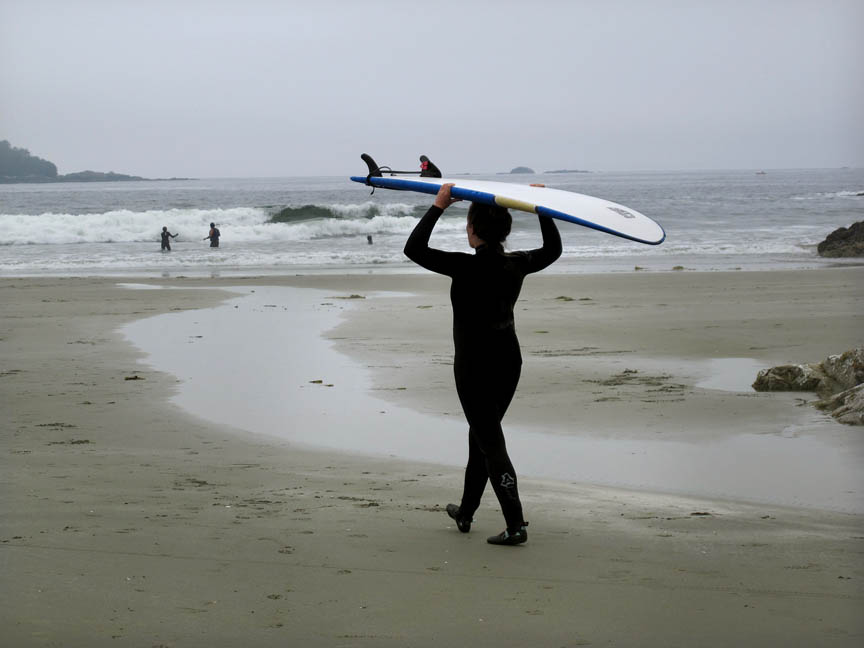
Surf sister on Chesterman Beach, Tofino

We are not accustomed to seeing surfers all in black wetsuits, hoods, booties and gloves. The surfers we watch—sometimes on ginormous waves in January on the infamous North Shore of Oahu—are clad in board shorts and not much else. When they hang ten, they hang ten toes, not booties.

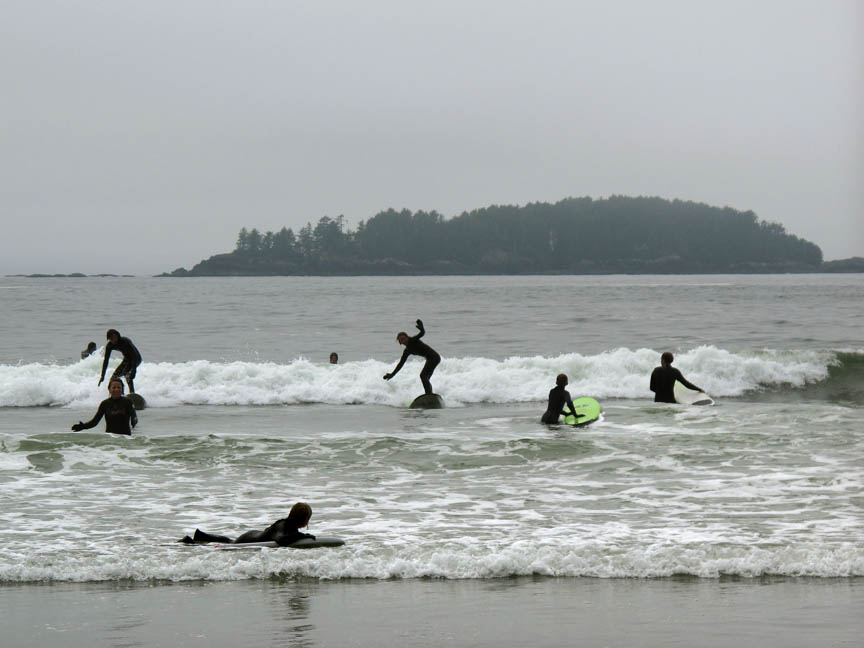
This is not to say that West Coast surfers (which is what they call themselves in Tofino) are weenies. Far from it. But most of the ones we saw were definitely beginners. There was a lot of sitting and stomach paddling. And when one brave penguin tried to rise to his or her feet on a board, it was a quick up-and-down move.

You should understand that Dick and I, who are non-surfers, admire surfers of all sizes, shapes and abilities. We think people who can balance on boards on moving waves are brave, if not crazy. We like to watch.

Which we did this past week on beaches up and down the Tofino coastline. While no one was exactly shreddin’ it (meaning tearing up the waves to Hawaiians and surf geeks), we gave them high marks for sheer toughness.

Surf lessons on Chesterman Beach, Tofino, B.C., in August (aka "Fog-ust").

Though they do look like penguins as they toddle out on these long, flat stretches of packed sand to get to the water. Penguins carrying surfboards.

Yesterday we had lunch at the Wickaninnish restaurant on Wickaninnish Beach. This is not to be confused with the very upscale Wickaninnish Inn, whose restaurant The Pointe, we also dined at this past week. The Wick restaurant on Wick Beach is in Pacific Rim National Park, which makes up a big stretch of the Tofino peninsula. Up and down beaches like Chesterman and Long Beach and Wickaninnish, the fledgling penguins in surfing classes take to the frigid waves with their oversized boards. They are as funny to watch as real penguins, and just as serious.

I should point out that in all fairness, they do have some sunny days in Tofino (four of them, usually in July), and if you look at websites, you’ll see those sunny-day surfing-in-Tofino photos. It can happen.

But we also walked a chunk of Wick beach at low tide to see what marine critters were hanging around. As a kid I grew up next door to Sue Lester, who desperately wanted to be a marine biologist for much of her young life. Sue taught me a lot about fish and marine life, and one thing I’ve always remembered is that it’s bad form to tickle a sea anemone lounging around with its tentacles unfurled in a tidepool.

“You’re making it think it’s got food,” Sue would chastise me when I did this.

But I used to love tickling the anemone. Their pale green tentacles feel a bit sticky and soft, and with their bellies up, so to speak, they look like a cat ready for a tummy rub.

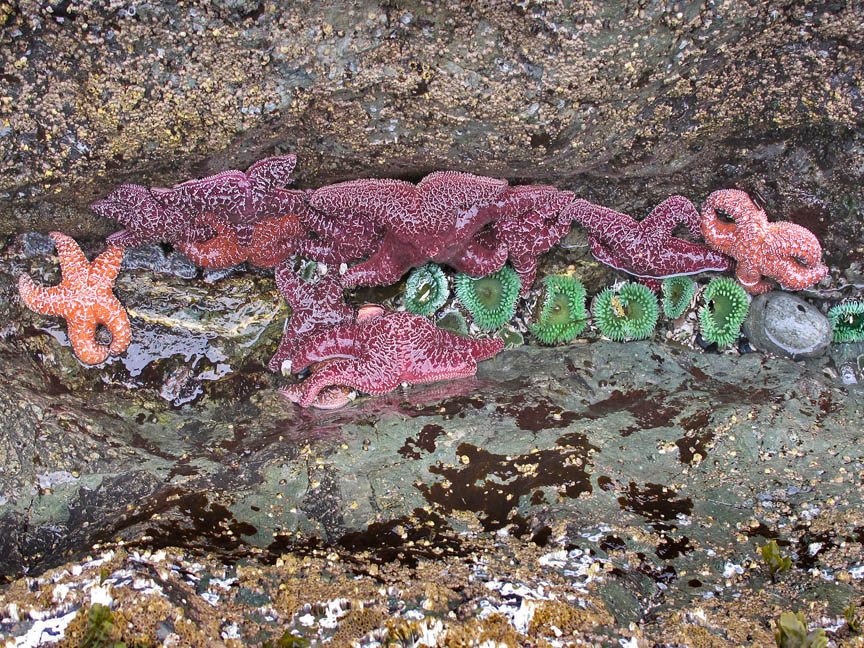
Anemone report: The anemones at Wick Beach are very happy cats. There are, roughly, a kabillion of them on and around the rocks at low tide. Even when you’re walking on sand, you’ve gotta be careful not to step on the babies that are as tiny as nickels. But they grow. Some get to be as big as softballs.

(Sue, if you’re reading, I did not tickle any anemone on Wick Beach. Not one. I just admired them.)

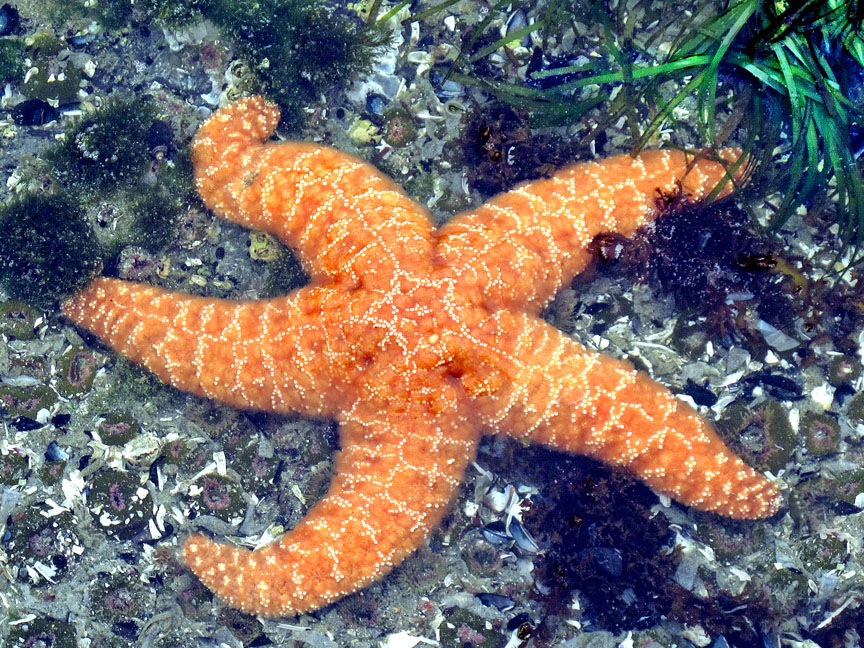
And if the anemone were happy cats, the starfish were sleeping puppies, some sprawled over each other like litter mates.

Happy anemone and seastars on Wickaninnish Beach.

One seastar arm tossed across another seastar’s back, orange over plum-coloured, mashed onto rocks so tightly you couldn’t pry them off with tire irons. Not that you’d want to. (Though we did find dead, dried-out stars on a log in Campbell River. They didn’t get there on their own, I’m afraid.) They’re so pretty in their natural habitat. I petted a couple of star backs, but they don’t react like anemones. They play possum really well, sleeping on like contented puppies with full bellies.

This comprises a happy day for me: Watching penguin surfers on foggy beaches in British Columbia, eating a nice lunch inside a nice restaurant, walking the tidepools to see thriving anemone and seastars. And, finally, retreating to a nice hotel where I stayed up late into the night, fine-tuning the novel like a word mechanic, adding details and deleting superfluous words and redundancies.

The big news (the lead, which, yes, I am burying) is that I am done with this novel. It’s been reworked three times now, and I’m calling it finished at long last. The next challenge is to find it a home, a Real Publisher who will bring it into the world, preferably in Canada where it is set, where my fictional characters live and work and love—in my mind, at least, and on paper, too.

Thanks to all of you who have been so supportive of my journey into this novel, into this world of Ocean Falls, for the past (can it be?) five summers. I seem to only work on it during my brief summers, and it’s taken what feels like forever. But it’s ready now for the eyes of the Canadians who have helped me with it. And a publisher—please, God—who will give it a good home and bring it into the world.

Fingers crossed—here we go!

Posted in Uncategorized | 4 Comments

Fog-ust and floribunda

Dick loves this name of this family of roses. He says it with great enthusiasm on the last two syllables—flori-BUNDA! We are amazed by the array of plant life in Tofino, B.C. It is a rainforest, after all, but still…. roses? Don’t they need sun and warmth—actual heat—to grow well? Not here. Flori-BUNDA!

We have learned a thing or two about coastal B.C. rainforest plants, which has been helpful as I put the finishing touches on my novel set in (wait for it) coastal B.C. Every time we’ve been in Tofino, high on the wild west coast of Vancouver Island, we’ve experienced typical rainforest weather. That is to say, fog with brief bouts of weak sun breaking through thick clouds. In June, July and August this place feels like San Francisco in the summer. And, as Mark Twain reportedly said, the coldest winter he ever spent was a summer in San Francisco.

When we left sunny Victoria for equally sunny Campbell River, halfway up the east coast of Vancouver Island, we hoped we might see the same bright sky in Tofino.  And on our second day, we did get some sun. Dick has the pictures to prove it. But most of the time it has felt like we were walking around inside a damp gray sock. Fortunately, we like damp gray socks and have spent a lot of time in them in the years I’ve been working on this novel.

The locals in Tofino have a name for this month in their area: Fog-ust.

Not everyone minds "Fog-ust" in Tofino.

It’s not really summer—July is summer, if they’re lucky. Fog-ust is what happens when warmer weather in the sky meets the cold water of the ocean. We have seen sun in Tofino, fortunately, in June and July. We did not know about Fog-ust before. We do now.

Mind you, I consider myself a lizard. I long for sun and bask in it whenever possible (though nowadays, far away from my years on a lifeguard chair and teaching swimming lessons, with SPF 30 or higher on). My idea of a great vacation runs to places like, oh, any Hawaiian island. But in most of the past eleven summers now Dick and I have migrated north for a time, like the geese. Even though it requires more clothing than I like to wear at this time of year, I have become a big fan of northern climes—Alaska on one memorable trip and more frequently western Canada.

Ocean Falls, B.C., where my novel is set, is reputed to be the wettest spot in western Canada, getting 140-plus inches annually. The first time we saw Ocean Falls, aboard a small paddle wheeler called the Empress of the North, the town relaxed under full sun till 10 p.m. on a summer night. We couldn’t get off the boat, so we saw what we could from the deck and decided to go back the next summer.

Ocean Falls, though on the mainland of B.C., is accessible only by boat or floatplane, and when we returned the following summer to do research for five days, we arrived in rain and stayed in it for the duration. The clouds settled over the mountains, smothering them like wool blankets, and if we hadn’t seen it sunny, we would’ve never believed the huge mountains existed. We walked the town—or what’s left of it, including the old paper mill that was the reason the town was created in the early 1900s—with borrowed wellies and umbrellas, having to return to our room in what had been the bank building to dry off the camera with my blow dryer.

But what we learned that first trip was, among other things, how green Ocean Falls is. Green with sprigs of pink and orange flowers in summer. So green you feel like you’re breathing in all permutations of it, from chartreuse to deep forest. Though I’d ask locals the names of plants and trees, I didn’t get the all answers I needed. For the past four days in Tofino, noticing how similar the plant life is there to that in Ocean Falls, I finally learned names.

The Tofino Botanical Gardens are a marvel. Created by George Patterson a dozen years ago, it’s a 12-acre site of everything that can grow in a coastal rainforest zone. (Tofino gets 130 inches of rain a year!) Dick and I walked around with George’s extensive guide to the gardens, me writing down names of things and questions to ask George later, and Dick doing what he does best, photographing.

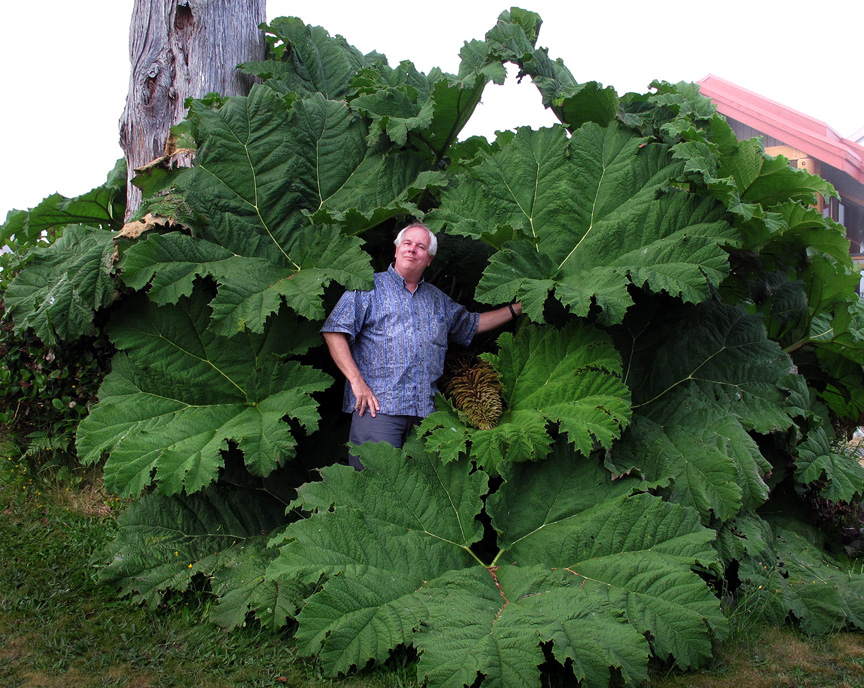
I learned that the tall green stems with pink flowers bursting out that line the road between the townsite of Ocean Falls and the housing area of Martin Valley are fireweed. I learned that the huuuuuge, “man-eating” plants with leaves almost as big as a child’s wading pool are not called Audrey II (“Little Shop of Horrors,” remember?) but gunnera. Someone should add gigantica to the name, too.

Dick and Gunnera gigantica

They’re Chilean rhubarb, and they’re non-natives, and apparently they spread like crazy. I learned that pretty much any herbs you can name will grow there and pansies, too. And surprisingly, lavender and roses do well, too. You need to grow tomatoes and squash in a greenhouse (they still require longer stretches of heat), but potatoes and carrots and lots of lettuces love the damp weather. 

Of course, the growing season is about three months long, if you’re lucky, but hey—gather ye nasturtiums while ye may, along with the crocrosnea (tall-stemmed, scarlet lily-like blooms) and calendulas and just about any kind of berry, including native salmonberries, which bears are very fond of. This is all important in Ocean Falls, the novel, where my 17-year-old main character grows her first garden.

And scattered throughout the Tofino Botanical Garden are all kinds of surprises. Rhododendrons everywhere that must look like they’re putting on a party when they bloom in the spring. Gigantic red cedars (the B.C. tree) that can live 1,000 years and have girths a giant sequoia would appreciate.

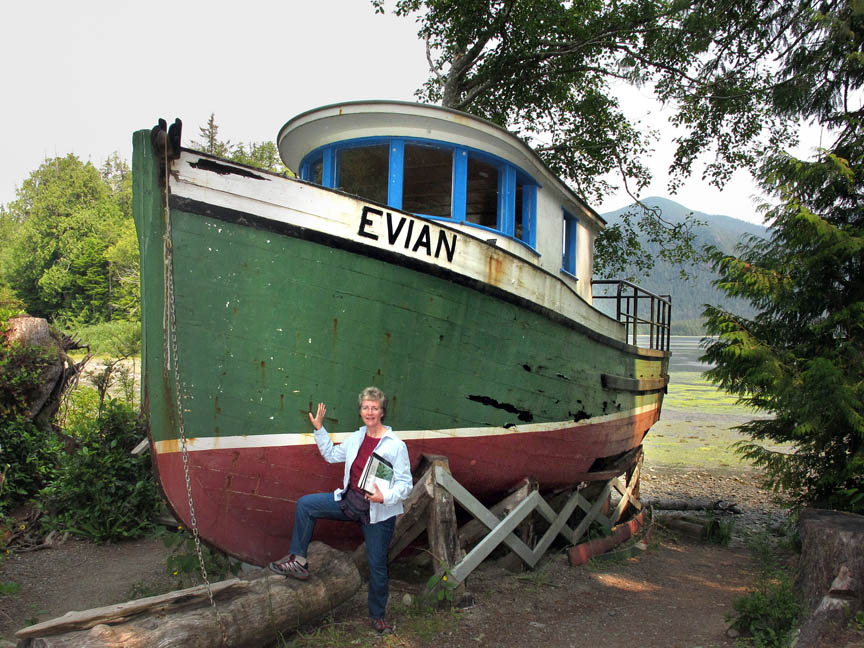
She's a fine old thing... and the boat's not bad either!

There’s a 37-foot wooden salmon troller called the Evian that’s hauled up out of the sea near the mudflats. Visitors are allowed to climb into and look around.

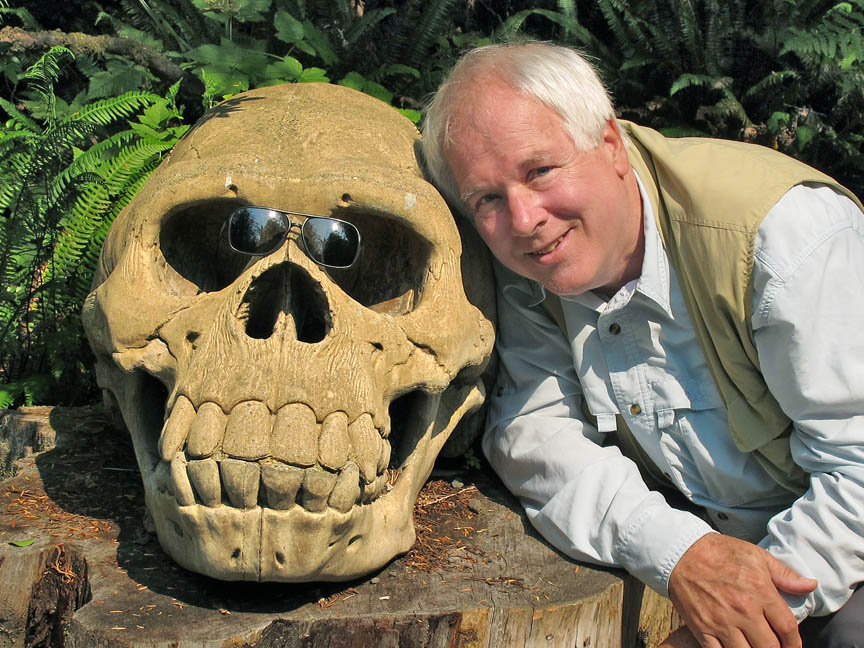
We loved the surprises of garden art. Tofino Man, for example, is pretty nifty.

(From left) Tofino man and Sacramento man

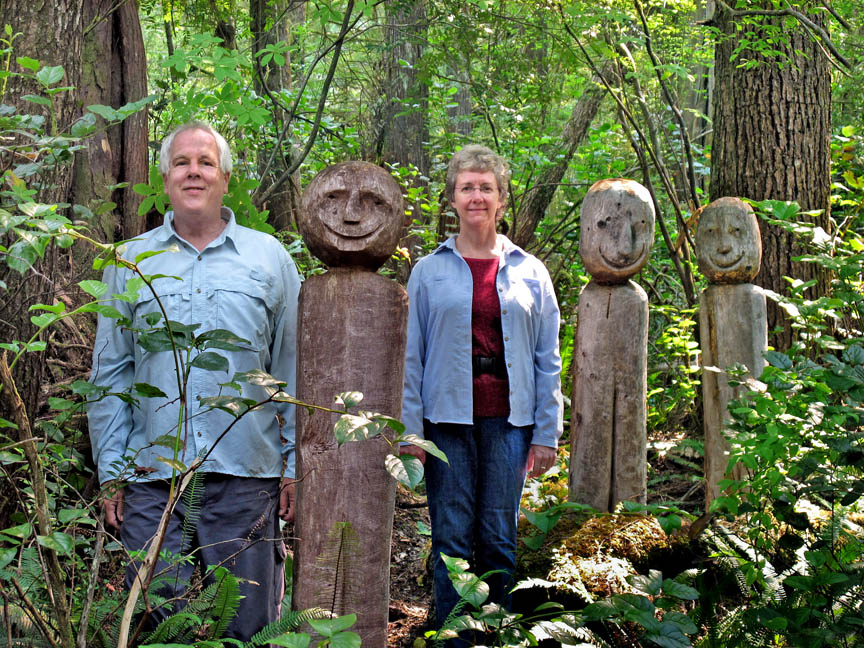
He was “discovered” in the digging of the garden. And we loved the unusual gazebo and Storytelling Hut created by Jan Janzen. In fact, my favorite art pieces in the garden are the forest spirits that stand just outside the Storytelling Hut. I love their simple forms, their happy smiles. They remind me of people I know. 

We saw it all under soft gray skies, perfect light, Dick says, for pictures of floribunda and other blossoms. It was fine that the sun didn’t shine much. As George Patterson writes in his guide to the garden, “Most of our rainfall occurs in winter, but spring can be damp, the fall is rather moist, and summer is not dry.”

I love that. I’m using it in the novel. Thanks, George, for the incredible gift of touring your garden and your time to answer my questions. Even in Fog-ust, it’s an incredibly lovely place to spend an afternoon, soaking up the green, breathing in a B.C. coastal rainforest.

Rainforest people

Posted in Uncategorized | 2 Comments

A few of my favourite (Victoria) things

You may note the Canadian spelling above. As soon as I hit the border, I am compelled to add the letter “u” to words that do not require it in the U.S.—like “colour” or “harbour.” Also the letter “s” must be exchanged for “z” in words like “civilised” or “recognise.” 

It’s a “when in Rome” kind of thing, really. And I’m happy to do it. Because once I get to Victoria, there are some “must-do’s” on my list, especially around the Inner Harbour.

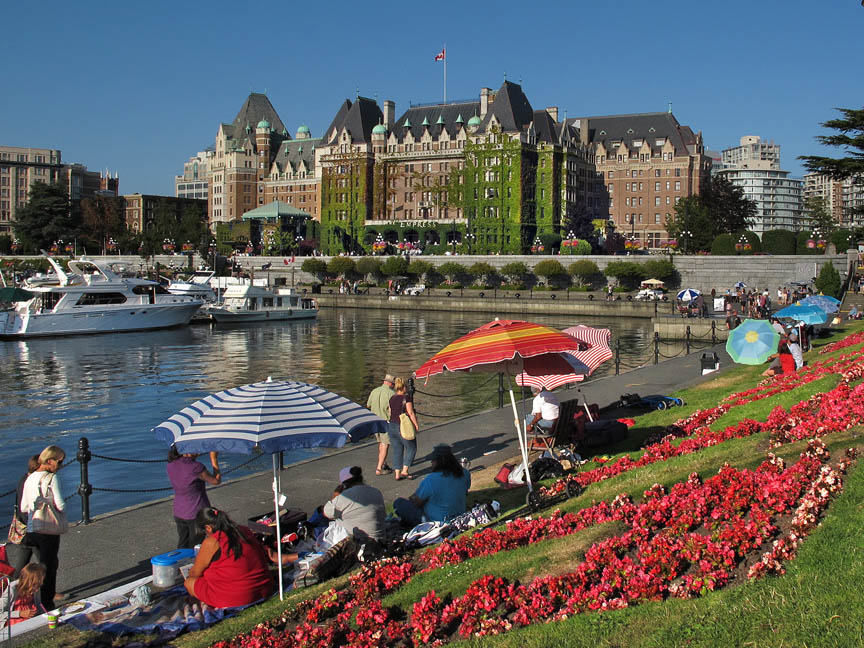
The Empress Hotel on the Inner Harbour, Victoria, B.C.


I must admire the grandeur of The Empress Hotel, the grande dame and centerpiece facing the harbour.

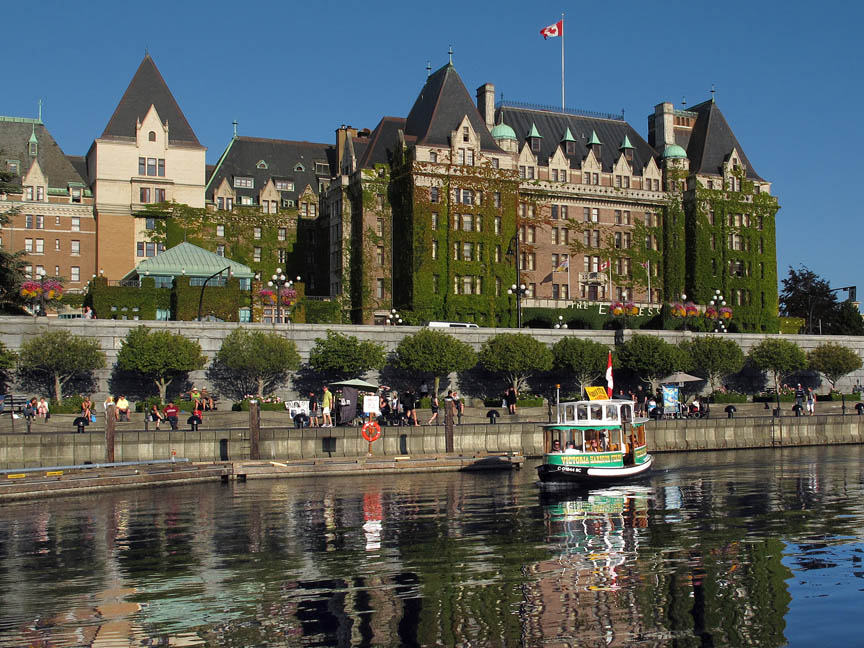
I also love the little water taxis, the Victoria Harbour ferries, that zip around like busy bees, dodging bigger boats and ferries, as well as the float planes taking off and landing. How they coordinate so well amazes locals and visitors alike. You can take a water taxi up into the Gorge and get a water-level view and a good bit of local history from the very knowledgeable captains.

The water taxis of the Inner Harbour—a cute little ride.


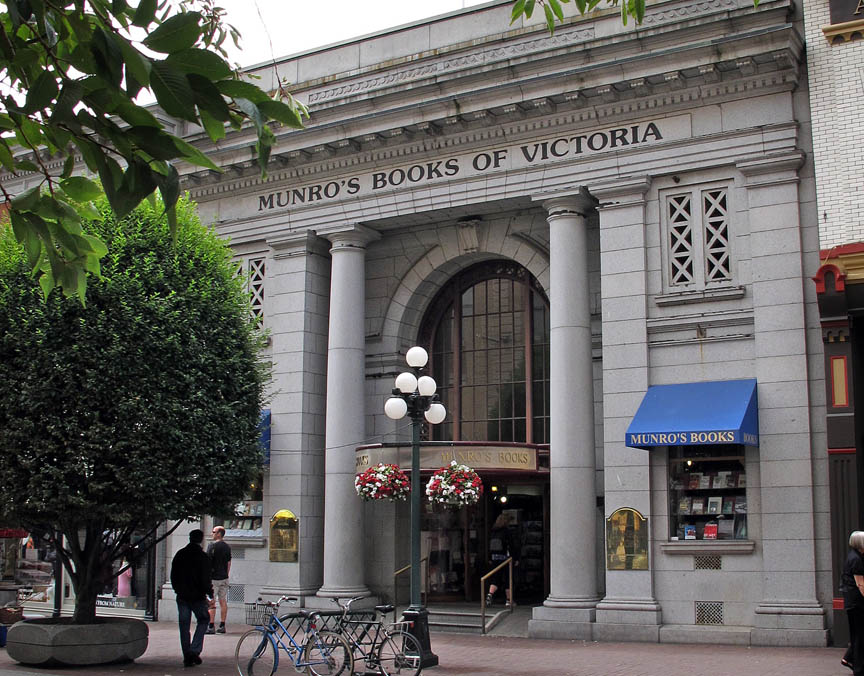
Also high on my Victoria list are the two M’s: Murchies and Munro’s, cheek by jowl on Government Street. Murchies, home of fabulous tea, and Munro’s, wonderful bookstore, are places I can spend waaaaaayyy too much time and money. They are staffed with kind and knowledgeable salespeople who have mastered the delicate art of being helpful without being oppressive. And I love walking into Munro’s. It’s like a Victorian bank on the outside and a lovely library inside. Plus, if you give them money, they let you take the books home forever.

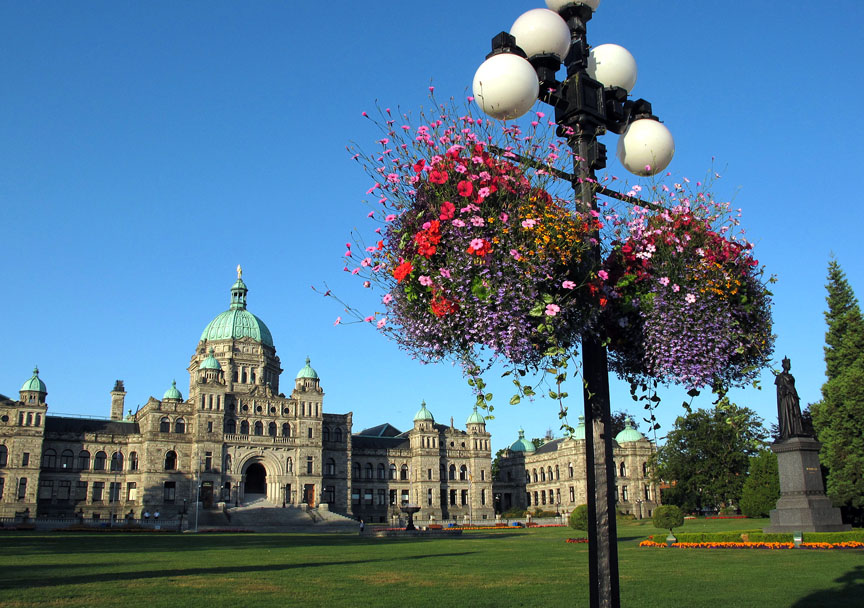
Another one of my favourite things  is to oogle the Legislative Assembly building (aka Parliament) because it’s so much more stately than anything in the states. It reeks of England—in fact, it is a replica of the English Parliament building. And every night at dusk (which in the summer is about 9:30 p.m.), thousands of bulbs wink on and light up the place.

As if that weren’t enough, you can go inside the Legislative Assembly building for a free tour and walk the same halls that Queen Elizabeth does when she pops over for visits. (Canada no longer “belongs” to England, but it does maintain close ties, especially to British Columbia. Jolly good, I say.)

The Legislative Assembly building of British Columbia


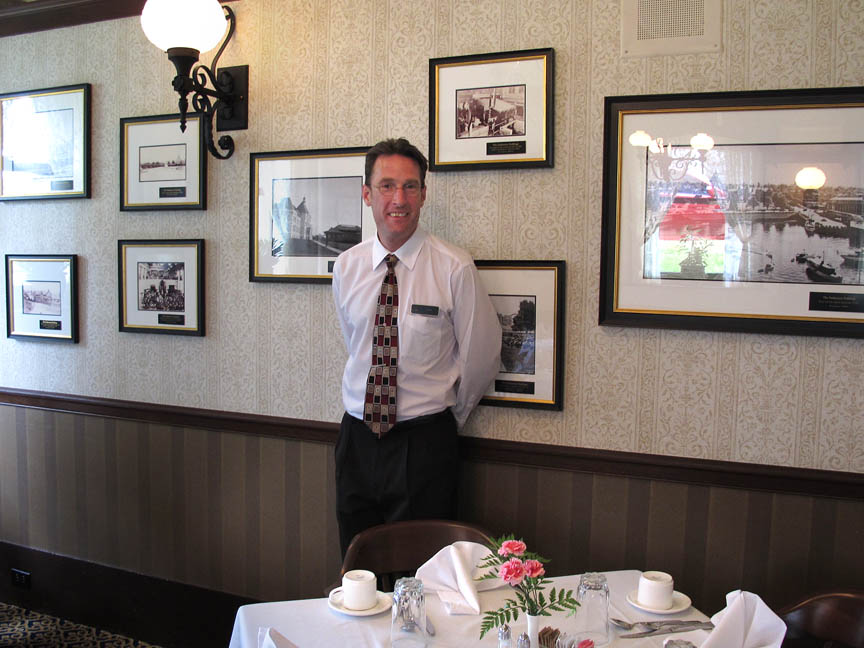
But you and I (as rowdy Americans even) can make our way to the basement to the Legislative Dining Room and have breakfast, lunch or tea in wood-paneled splendour, with the faces of long-dead members of Parliament looking down on you from period photographs. Love the shrimp sandwich, by the way.

We also love the dining room because of Mur Meadows, waiter and playwright, a charming man who regales diners (only if they ask, of course) with tales of his current projects.

Mur Meadows, waiter and playwright extraordinaire


 His play, “The Return of Love,” is not only available online but also available free to theater groups that wish to perform it.

I’ve already written about my favourite tea room, the James Bay, but I’ll also give a little shout-out to our favourite fish and chips place, Barb’s, on fisherman’s wharf. It’s an easy walk from the Inner Harbour, or a quick ride in a water taxi. You eat outdoors, under a tent, right on the dock, and we are quite fond of the halibut and chips combo. It is not cheap, greasy fish and chips, but high-quality stuff. 

If you’ve been to Victoria, I imagine you have your favourite spots, too. What are some of yours? Toss a comment this way, and I’ll add them to my list, too!

Posted in Uncategorized | 1 Comment

Nanaimo Bars

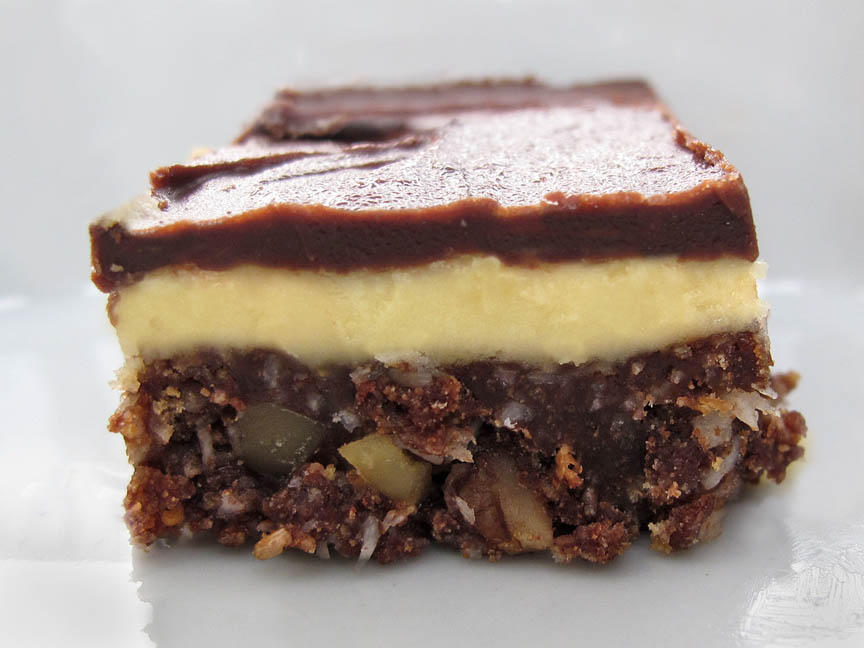
There may be finer desserts in the world, but since my first trip to Vancouver Island in 1999, I will kill for a Nanaimo Bar.

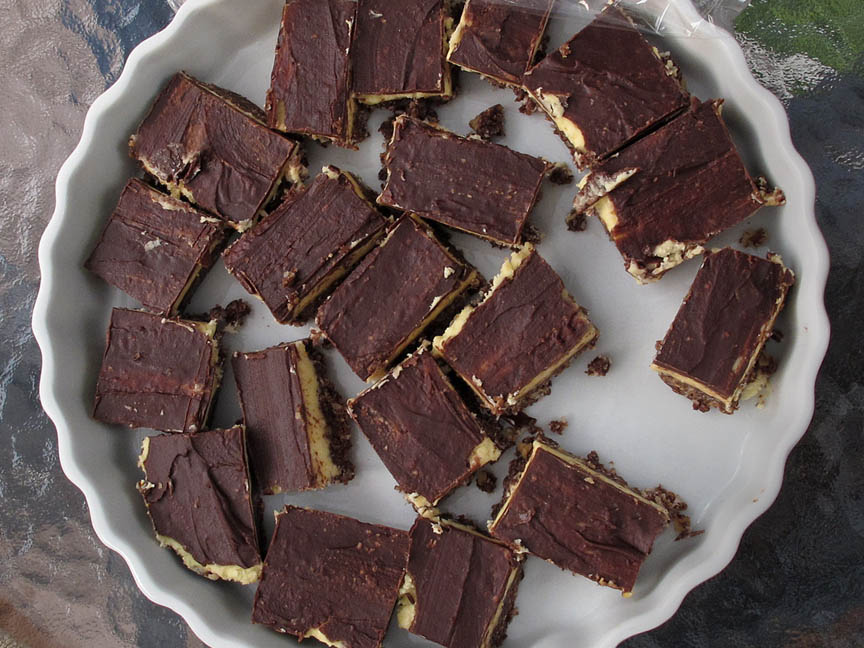
They are unheard of in the U.S., much like hard cider, which Canadians also love. But as far as I’m concerned, Nanaimo Bars ought to be in every cafe in the U.S. They should be as ubiquitous as brownies, another bar made in pans. They are sinful, and you can feel your arteries clogging up just looking at them, since they are pretty much all butter and chocolate. A small, rich square goes a long way.

Louise Rayer Johnson's Nanaimo Bars!

When people ask me, “What’s a Nanaimo Bar?” I say this: It’s a triple-layer bar made in a 9×12 pan with a bottom layer of cocoa, graham cracker crumbs, coconut and almonds, a middle layer of pretty much solid butter and a top layer of pretty much solid chocolate. You assemble the layers, put the pan in the fridge to harden, cut the resulting dessert into small pieces and stand back. You hear some serious moans of pleasure coming out of people mmmm’ing and ooohhhh’ing over Nanaimo Bars.

Tonight, Louise Rayer Johnson hosted the Schmidt siblings and some of her family members as part of the 50th anniversary when the two families gathered on Vancouver Island. Louise, bless her, made Nanaimo bars. Though I’m not eating much sugar these days, I sat there and nibbled on two tiny bars, doing my best to make them last as long as possible. Happy tastebuds! My mouth was aching with pleasure.

Mmmmm! Nanaimo Bar!

No one knows exactly how Nanaimo Bars came to be. Both Wikipedia and the Nanaimo city website (yes, it’s the second largest city on Vancouver Island) say that a Mabel Jenkins from Cowichan Bay submitted the recipe to the annual Ladysmith and Cowichan Women’s Institute Cookbook. This cookbook was sold in the early 1950s in the region as a fundraiser. It became popular in many of the province’s households, especially in company towns and was sold in many of the coffee shops on Nanaimo’s Commercial Street. Tourists in the region, especially U.S. tourists on pleasure boats came to refer to these as “Nanaimo Bars.”

Other unconfirmed sources say the recipe dates back to the 1930s when it was known as “Chocolate Fridge Cake” (they’re not baked, just assembled and set to cool in the refrigerator).

Anyway, it doesn’t matter. Nanaimo Bars are as much a part of Canada now as the maple leaf, and I say, “Bravo!” Bless Canada and Mabel Jenkins and perhaps the other unnamed progenitors of what has become my favorite dessert. And thank you, Louise, for your very fine Naniamo Bars!

(Big hint: It’s the custard powder in the center layer that makes all the difference. Hard to find in the U.S., but an important ingredient. I bought mine online.)

——————

Nanaimo Bars

Bottom Layer
½ cup unsalted butter (European style cultured)
¼ cup sugar
5 tbsp. cocoa
1 egg beaten
1 ¼ cups graham wafer crumbs
½ c. finely chopped almonds
1 cup coconut

Melt first 3 ingredients in top of double boiler. Add egg and stir to cook and thicken. Remove from heat. Stir in crumbs, coconut, and nuts. Press firmly into an ungreased 8″ x 8″ pan.

Second Layer
½ cup unsalted butter
2 Tbsp. and 2 Tsp. cream
2 Tbsp. vanilla custard powder
2 cups icing sugar

Cream butter, cream, custard powder, and icing sugar together well. Beat until light. Spread over bottom layer.

Third Layer
4 squares semi-sweet chocolate (1 oz. each)
2 Tbsp. unsalted butter

Melt chocolate and butter over low heat. Cool. Once cool, but still liquid, pour over second layer and chill in refrigerator.

Posted in Uncategorized | 2 Comments

Reunion in Campbell River

So the reason Dick and I have driven up to Vancouver Island to be here for the last weekend in July is, as I mentioned in an earlier post, to come to a family reunion. Actually, it’s a two-family, international reunion—the Schmidts from the United States and the Rayers from Canada.

The story, as told by Audry Rayer, who died in 2008 at age 95, goes something like this:

In 1939, Audry and her husband Len Rayer were onboard a ferry between Washington state and Victoria, B.C. It was wartime for Canada, though the U.S. would not enter World War II for another two years. The ferry traveled through the islands off the coast of Canada, dropping passengers along the way. When there were few passengers left, the Rayers heard a call over the ship’s public address system instructing all passengers to go to the lifeboats. The crew was preparing and lowering lifeboats, and the passengers were being ignored. The Rayers went to a lifeboat and found another couple there—Christoffer and Elizabeth Schmidt from Sacramento, Calif. 

Audry loved this part of the story: “We didn’t know what was going to happen, if we were going to have to pilot the boat or not. My husband looked at Mr. Schmidt said, ‘Do you know anything about boats?’ And Mr. Schmidt said, ‘No, I’m an accountant.’ And my husband said, ‘Well, I’m a mechanic, but I don’t know anything about driving boats.’ ”

Both couples were mightily relieved when it turned out they were involved in a lifeboat drill. They laughed, shook hands and went their separate ways once the ferry dropped them all in Victoria. 

The story would have ended there if not for an odd coincidence. A couple of days later, Audry was in her local butcher shop when she saw the couple they’d met at the lifeboat walk by outside. She ran outside and said, “I’m the woman you met on the boat!” They all laughed to meet each other again by chance, but Audry took even more decisive action. She invited the Schmidts to her home for dinner. That was the beginning of a friendship that has spanned two generations and has lasted to this day.

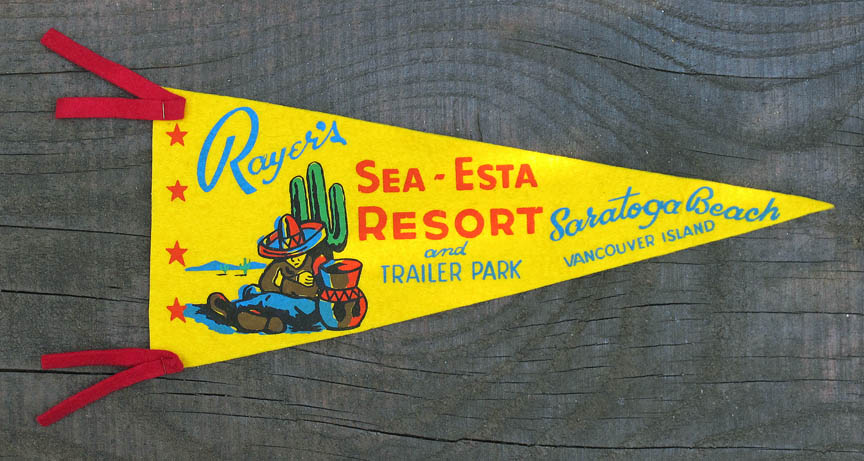
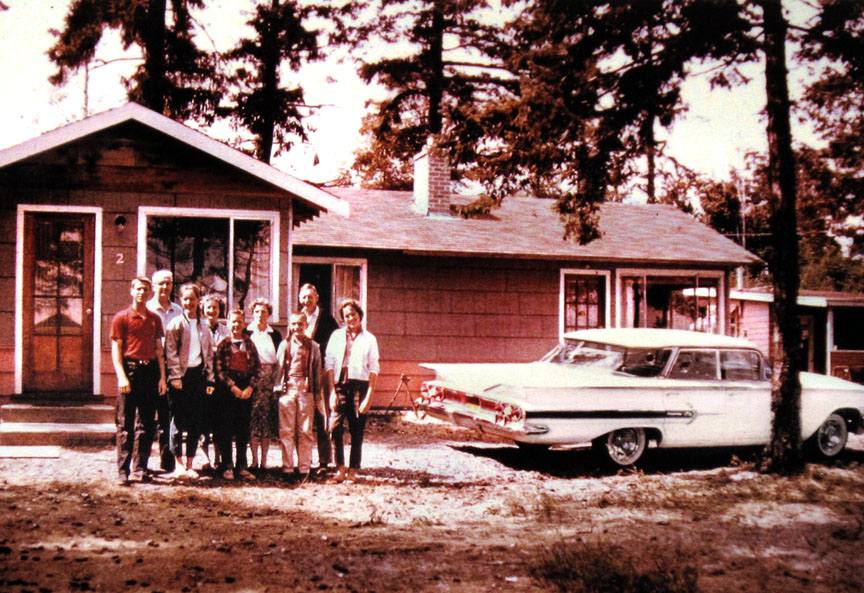
In the summer of 1960, the Schmidts and their three children—Dick, 17; Margery almost 13; and Stephen, 11—drove the family’s new Chevy Impala from Sacramento to Saratoga Beach on Vancouver Island, just south of the small town of Campbell River, to visit the Rayers. There were no interstate freeways, and the road to Campbell River was a two-lane highway. The children still remember that trip as a remarkable one. The family climbed Mt. Lassen and saw the capitals of Oregon and Washington. They marveled over the Parliament building in Victoria. And the Schmidt kids met two of the Rayer kids—teenagers Louise and Murray at their parents’ oceanside campground, the Sea-Esta in Saratoga Beach.

At the Sea-esta... (from left) The Schmidts— Dick, Christoffer, Margery, Elizabeth and Stephen—and the Rayers—Audry, Murray, Len and Louise. And the Impala!

Louise remembers being intrigued by the oldest Schmidt son, Dick, a blond, blue-eyed California boy who thought it might be fun to try swimming off Vancouver Island. Dick recalls that he lasted less than five minutes in that frigid ocean water. He signed a copy of his high school graduation photo to Louise, which she still has. 

 The elder Schmidts and the Rayers remained close for the rest of their lives—the Rayers made the long drive from Saratoga Beach to Sacramento for Dick’s wedding. Even after Len, Christoffer and Elizabeth had died, the Schmidt kids continued to travel up to Campbell River to visit Audry until her death.

So that’s why we’ve all gathered in Campbell River at Louise and her husband Bill’s house to commemorate the 50th anniversary of that trip north. It’s the 71st anniversary of the ferry trip that brought the two families together.

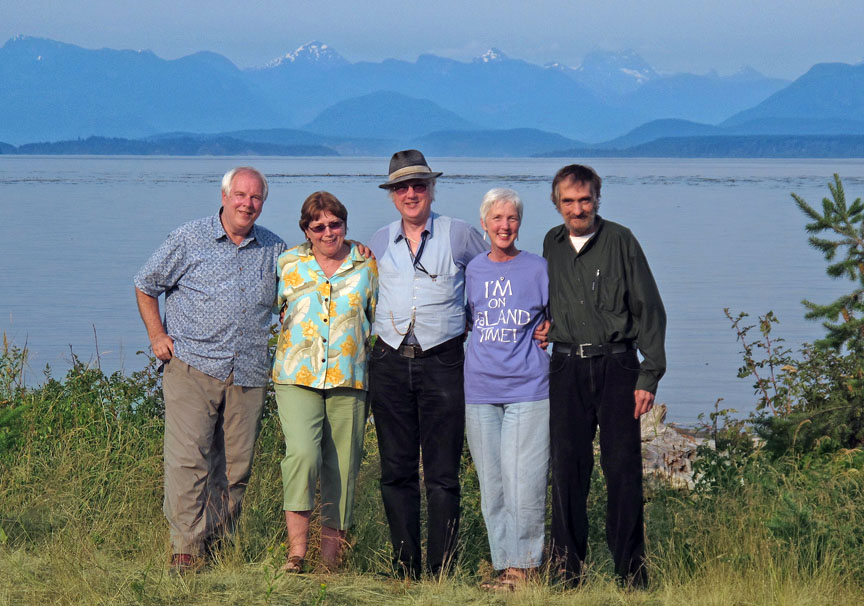
The Schmidt and Rayer kids, 5o years later: (from left) Dick Schmidt, Louise Rayer Johnson, Steev Schmidt, Margery Schmidt Thompson and Murray Rayer.


Tomorrow we will all go to Saratoga Beach to see the Sea-Esta. It’s still there—not the same, Louise says, but still there. We will take photos of these grownup “kids,” as we did tonight at Louise and Bill’s house when they hosted us for dinner. Stories and particulars of the present-day families are being exchanged each time we see each other. 

And I imagine that the spirits of those four who met in the lifeboat are hovering around, too. I hope they are as delighted as their offspring by this longtime connection that spans the end of one century and the beginning of another, this international friendship that, with luck, may last another generation.

Posted in Uncategorized | 2 Comments

Emily and me

I have dreamed in my life, dreams that have stayed with me ever after, and changed my ideas; they have gone through and through me, like wine through water, and altered the color of my mind.   —Emily Brontë

Emily Jane Brontë and I share a birthday today, though she was born in Thornton, England, in 1818, and I was born in Long Beach, California, 140 years later.

Using the pseudonym Ellis Bell, Emily published Wuthering Heights in 1847, which is considered one of the greatest love stories of all time, though she never had a lover. I’ve been working on a novel for—Lord help me—six years with more than one love story in it (between a teenager and the only town she’s ever known, primarily), and I have had my share of lovers. (Thank you all!)

I do not mean to compare myself to Emily or Charlotte or Anne, that trio of writing sisters, though I, too, wrote as a child and have concocted plenty of poetry as well as prose. But I do have an affinity for Emily, who had only one novel published in her lifetime. But what a novel! What a tragic love story of unresolved passion between Catherine and Heathcliff. How it ruins him and everyone he touches. 

Emily said she dreamed much of the novel, something I find myself doing this week as I travel again in British Columbia where my novel is set. I dream about my characters, one sign that they’re “real,” thriving people, alive in my head, at least, which gives them a great chance of coming alive on the page. It is easier to dream my fictional people when I’m in their actual land. It is easier to write about their place when I have the smell of B.C. cedar in my nostrils; they are not the same as, say, Lake Tahoe pine trees.

So on my birthday I find myself halfway up Vancouver Island in the small town of Campbell River, here for a reunion of Dick’s siblings and the Rayer siblings, whose parents became friends during a lifeboat drill on a ferry between Washington state and B.C. in 1939. (Another good story!) Campbell River is a town that has learned in recent weeks that its paper mill, like the one in my novel, is about to be closed for good. This is the town, in fact, where many of the real-life people of Ocean Falls migrated to work in the mill here, the one that is now closing.

Fact and fiction lie a heartbeat apart. So much of what writers need to express is often more smoothly done as fiction; so much of what lies beneath the surface of fiction is fact. Yet I hate it when people ask fiction writers, “What really happened?” As if the telling of any story doesn’t make it real. As if “making it up” makes it any less true.

I doubt that Emily Brontë had any idea that Catherine and Heathcliff and their story would outlive her. I have no idea what will happen to my novel, but it doesn’t matter. I’m writing the book for me, most of all, because it’s been a fascinating process to research and write and craft it. If, like Emily, I’m lucky enough to have “Ocean Falls” published, and it turns out to be my only novel, great. I will have told a story I wanted to tell.

That’s what good stories do—alter the color of your mind—whether you’re writing or reading them. 

Happy Birthday, Emily Jane, from Janis Linn, your younger writer sister by nearly a century and a half… 

Write on!

Posted in Uncategorized | 6 Comments