Pomes

I should say here that while I consider myself a reasonably “serious” poet, I play with poetry a lot. I think of the goofy, not-so-serious ones that I write as “pomes.” Dorothy Parker called hers “doggerel.”  These are the snippets that show up in the writing group or in whimsical moments. They are not meant to be great, profound pieces of poetry, full of fresh language and original metaphor, just exercises done for fun.

In my experience, poets can burn out from the self-imposed pressure of having to write “good poems.” To mess around with words in a metaphorical sandbox, throwing some up in the air and seeing where they land, calling that a “pome”—that’s some of the great fun of writing.

Here’s a pome that came out of the last meeting of my Saturday writing group. I brought paint chips with some nifty names and shared them. Some people wrote about particular colors or memories associated with those colors. I wrote a list pome using some of the names I liked best. Love the sounds of these colors!

Paint chips

First hear the greens:
Etna Green
Wine Bottle
Jalapeno
Tousled Grass
Dancing Leaf
Go-go Green
Mist-ify
Whispering Pines

Then play the blues:
Bay City Blue
Wine Country Twilight
Half Moon Bay
Biloxi Blues
Lone Wolf
Sonoma Sky
Tahoe Blue

Toss in a whisper of Cascade Gray
A creamy First Ascent
The adobe of Amber Stone
And the dirt brown of Earth Bed

Listen to the purples hum:
Eclectic Plum
Prairie Purple
Mystic Grape
Plumes
Beach Blanket

And the pinks:
Sing So Sweetly
Rich Confection
Love’s Token
Crushed Berries

Finishing on a high note:
Jazz!

Posted in Uncategorized | 2 Comments

Julie’s birthday

Last Friday, July 15, would have been the 94th birthday of one of my dearest dead loved ones.

I knew this as I sat in a big chair in the Kaiser chemo suite with my friend Judy Parke, who was sleeping on a gurney as her infusion of Herceptin flowed into the port in her upper right chest. I often tell Judy that she’s the poster girl for metastasized breast cancer, particularly every three weeks when we spend time in the chemo suite. I go with her to the infusions as often as I can. It’s a good opportunity to visit. She talks, and I scribe, writing down what’s been going on for her in her journal.

Last Friday, I watched Judy sleep since afternoons are her nap time. Usually her infusions are in the mornings. Robert, the rare male chemo nurse, turned off the lights in the cubicle, brought Judy two blankets, and she curled up and drifted off, her bright orange hair peeking out from the white blanket covering most of her. I wrote in her journal about the latest news: a new lesion in her brain, a trip to the ER that didn’t go well. She’s been doing this dance for four years—the cancer had spread to her liver and bones—and yet she’s still here after a mastectomy and a combination of Western medicine and alternative treatments. A walking miracle.

That’s when I thought about my friend Julie, another woman I’d known with carrot-colored hair and cancer. How appropriate that I was spending part of Julie’s birthday in a chemo suite with another friend battling cancer. She would have said, “Honey, there are no accidents.”

They didn’t know each other, but Julie and Judy have more in common than their hair color and me. They have both fought the good fight against a powerful disease. And when I think about what has sustained these women, it comes to two things: faith and perseverance. Each has had an unwavering belief in God. Each has been fearless about pursuing treatments that took harsh tolls on her body. Each has resolved to live as long as possible.

During the last six months of Julie’s life, I spent one or two afternoons each week in her home, giving her son Bobby a bit of respite from his caretaking duties. I was happy to be there, soaking up as much time as I could with a woman who was like a second mother to me. I remember wondering aloud if I was practicing for cancer later in my own life.

“Oh, honey, no,” Julie said. “This isn’t your disease. But you’re going to be around it a lot.”

I didn’t question that statement. Julie believe many things, stated them as unequivocal fact. I was never quite sure what to think. Toward the end of her life, as she was caught in that hazy, morphined place between this world and the next, she was touching my hair and whispering, “pretty.” Then she looked into my eyes with her piercing blue ones and said, “Honey, you’re an angel.”

When modesty pushed protests from my lips, she shook her head. “It’s not a compliment,” she said. “It’s a job description.”

Julie died in 1998 after her long battle with rectal cancer. She half-joked that the cancer resulted from trying to poop out two ex-husbands. Julie was a holistic health nurse—in fact, she was one of my mother’s first holistic health teachers in the 1970s at UC Davis. She worked for an M.D. named Carl Simonton who had people with cancer practicing meditation and visualization to help them heal. A good number of patients did, solidifying Julie’s belief that mind, body and spirit work together to produce miracles.

To me, Judy is one of those miracles—still here, fighting the good fight, using every means she can find… including more than one angel. I am honored to be one of them.

Posted in Uncategorized | Leave a comment

Blue bunion

One morning at the AWA training in Alamo, I woke up with this in my head:

Throw out the bad
and keep the rest.
In the heart of the good
lies the very best.

I don’t usually dream in rhyme or wake up with poems, though I envy people who do. And this seems a bit trite to me as a piece of poetry. But I do love the sentiment. It’s not original, and now I’m trying to see if I inadvertently swiped it. (I don’t think so. It’s not turning up on Google anyway.)

What I’m learning again is that words, images, lines show up for us if we’re open to receiving them. Certainly writing groups and good prompts help, but I find that if I sit quietly—sometimes in meditation, sometimes at stoplights—and I request an image, it comes. (See “Requesting the Poem” under the “Poems” page of this blog for more on that.)

Sometimes images show up because we throw words up in the air and see how they fall down around us. My colleague Chris DeLorenzo introduced me to a fun exercise that plays with words to create unusual adjective/noun combos. Try this:

• Sit in a circle with a friend or two or three, and give each person two 3×5 cards. (The more people, the more fun the exercise!)

• Ask each person to write six nouns (people, places or things) on one card—it’s more fun if they’re interesting nouns, not just “dog” or “cat,” though those certainly will work.

• Then ask each person to write six adjectives (descriptive words that are typically paired with nouns) on his or her other card. Don’t try to make the adjectives match the nouns. Again, fun adjectives make things more lively.

• Then have everyone place their noun cards in their left hands and their adjective cards in their right hands. Tell them, “Extend each arm to the person next to you in the circle, and hand your noun card to the person to your left and your adjective card the person on your right.” (You do this, too!)

• Each person ends up with two cards of new nouns and new adjectives. Tell them to start making lists of unusual noun/adjective combos from the words they’ve been given. Play with the words so they have intriguing pairs to choose from. The funnier/wilder, the better. “Kinky tractor.” “Chartreuse roller skate.” “Playful granite.”

• Have each person share, say, three of their combinations aloud. Encourage people to write down the ones they’d like to borrow.

• So now, from the big list of nouns/adjectives, write into one of the combos. Or perhaps play with several of them in a poem.

This frees up our logical brains in ways they don’t necessarily want to be freed. It loosens the often too-tight writing muscle and gets us to play in the sandbox of vocabulary, to mix metaphors. It reminds us that writing is fun, dammit, and we take it much too seriously.

Here’s a poem that arrived at the Alamo training after we all shared some of our pairings. I bet you can easily spot the funky combinations. Have fun! Don’t stifle the laughter!

Blue bunion

Point me toward that playful skyscraper.
Watch me step out with intelligent ankles,
frenetic toenails and one blue bunion
in my satisfied shoes.

I carry an altruistic horseshoe
and an indigo flystrip for luck.

Let me take this city
armed with angry chocolate, sassy tofu
and a rude Maybelline lipstick.

For I am a mischievous roller skate
and one sexy zucchini (though some
might call me an inept Jelly Belly
full of strident baloney).

I am a pearly caterpillar,
a tall rolling stone of twirled rhinoceros.
I am hot Kleenex, baby,
into which I blow a virtuous booger.

Posted in Uncategorized | Leave a comment

At the AWA training

It is almost 10 p.m., and I’m sitting outside an old carriage house in Alamo, Calif., typing away on my computer. I can access the wi-fi out here, and a very friendly pale orange kitty named Rusty (he’s faded rust) energetically rubs against my left arm and the laptop as I write. I am a sucker for friendly kitties, so this is not a problem, though I came out here to work on a poem.

I anm here in my new role (as of last year) as an instructor of new group facilitators for Amherst Writers and Artists (see the Prompts section across the top of my blog). My colleague Chris DeLorenzo and I are training a dozen women in the finer points of leading writing groups in this method. We live and train in what truly was once a carriage house–two of the former horse stalls are bedrooms and the living room is where carriages used to be housed.

Since last November, I have participated in four AWA trainings—two of them here in Alamo at this gorgeous Westminster Retreat Center—up against hills faded yellow with summer grasses and old, old oaks crouched on the steep slopes. I have come to quite like this place and its solitude. Behind us, a good hiking trail winds up Las Trampas mountain. I took it to the top last fall, but I have not yet had time to do so on this visit.

Chris and I spend our days with these dozen women—all of whom will make terrific facilitators—allegedly teaching them. But in fact, as with all collaborations, they are teaching us, too.

What I see again as these new group leaders try their wings in practice sessions is how bright and talented people are, how well they flourish when encouraged and given good attention. I also learn new ways of saying things to writing groups that I’ve said in the same old ways. There are a hundred ways to thank people for their writing, to hold a safe space for writers, to offer a prompt and close the circle when it’s time to end. I am learning from these students who are also good teachers. I am grateful.

Rusty has leaped off the bench now and has gone on to prowl the night. This morning, one of the cats here left a field mouse for Melissa, the manager, near the manor house up the hill where we take our meals. I wonder what treasures, what gifts Rusty and his mates might find in the night. I am eager to see what gifts wait for me—as we say in AWA, what stays with me, what is strong—as the last two days of the training unfold.

Posted in Uncategorized | 2 Comments

Oops!

In the last post, “New poems,” I included a poem that I’ve put up on the blog before. Those with sharp eyes might note that this is a revision of that earlier poem. If you click onto the blog itself, you’ll see a new poem there called “Grow.” And there are still other new poems under the “Poems” heading across the top of the page.

Posted in Uncategorized | Leave a comment

More new poems

I thought I might put up a few of my new poems written at the recent conference I attended. I’ll offer one here, and if you click through to the blog itself, look across the top of the page, click on “Poems.” There you’ll find “New poems.” Click on that, and you’ll find four new poems of mine.

Thanks for reading!

——-

Grow

Your death, when it finally arrived,
was not wall after wall of crashing waves,

but a single body blow—
air leaving me so fast

I had to sit down.
I counted my heartbeats,

tried to reel in breath
with your bamboo fly rod,

the one on which you’d snagged
your first fingerling trout.

I still have the picture pinned
to our kitchen bulletin board—

your teeth like stars behind
broad lips, shades blotting

your eyes, the spotty fish
gleaming in your palm.

I saw you let it go, saying,
Grow. As I cast for air,

I felt your steadying hand winding
the line, the leader, the caddis fly,

the same hand that stroked my thigh
before sleep. I heard the rumble

of your voice, Great gams, Toots.
And, as the laugh

lurched up my throat—
breath.

Jan Haag

Posted in Uncategorized | 1 Comment

The Healing Art of Writing conference

So the thing is… (one of my favorite prompts!)

…this week I’m attending The Healing Art of Writing conference in San Rafael—actually on the park-like campus of Dominican University—with my friend and AWA facilitator Terri Wolf, living the pseudo college life. Dorms, three meals a day that require a credit card-like thing (what happened to meal tickets?), walking around campus in search of wi-fi spots (not easy to find, which seems odd for a college campus—we hear say they’re concerned about poachers) so we can email our daily poems in for printing. It’s all a bit more difficult than our cushy, well-ordered lives at home, but that’s part of the adventure of it.

There are two tracks—prose and poetry. The prose writers (like Terri) bring a piece of up to of 13 pages for their group of eight or nine folks to read. They review two pieces each morning. The poets must turn out a new poem each day (no pressure!), and every poet gets a 10-minute critique of that poem. All group are led by guest faculty, some of whom turn out to be Big Time Writers.

Like today, my poetry group was graciously led by Jane Hirshfield., a Berkeley poet whose latest book of poetry, After, is one of my favorites. She wrote a great book of essays about poetry called Nine Gates: Entering the Mind of Poetry. She’s been featured in two Bill Moyers PBS specials, and her poems end up in The New Yorker and The Atlantic, as well as in The Best American Poems. She is a Major League Poet.

Yesterday, the poet who led our group was not in the same league—at least not in her approach to leading a critique session. Her bio says she is known for writing “disturbing, edge and provocative” poetry and prose, and that’s an accurate description. The challenge yesterday was that in her role as group facilitator, she was very brusque and efficient, and so the group was, too. I felt like my poem got kicked around by an unruly soccer team. Admittedly, mine was a very rough poem; it turned out (surprise!) to have some confusing parts, so it probably deserved some kicking. But an AWA-style review, it was not.

Today, Jane (we all felt we could call her “Jane”) sat her lovely self down at one of the tables and instantly changed the tenor of the room. She explained how she likes to run critique sessions—10 minutes per poem; the poet reads then has to remain silent until the end; the group takes a “Quaker moment” of silence to digest the poem before jumping in; she speaks last but does guide the discussion, and she likes to offer specifics about where to trim and what to add, if anything. Then she flashed her sweet smile, and we were off.

My poem was first, and after the day before, I was ready for the group to Let Me Have It Again. I was prepared for Jane to do the same. It happened so fast I didn’t have time to get nervous. I was pushed into the pool; I had to swim. But the nicest thing happened: They liked it. Jane liked it. Jane called the poem “terrifically successful” and “a pleasure to hear.” I felt myself get a little squishy at that.  She said the poem was “beautifully ordered” with “acute observations” and “all kinds of interesting language.” They all offered helpful suggestions, especially Jane, who, it turns out, is one of the best editors I’ve ever seen. She knows exactly what should come out to make it the tightest poem possible.

I left the room a few inches off the ground, trying not to jump up and down hollering:

“JANE HIRSHFIELD LIKED MY POEM!”

In fact, I kinda did at lunch with Terri, who grinned and said, “Of course, she did.” She’s a good friend, Terri Wolf.  She spent a lot of yesterday reviewing a very shitty first draft of a poem and helping me spiff it up. Then I had to put it away and start over again—we’d kinda beaten the life out of it. The start-over version is much better, but I’m not sure the poem will see the light of day.

Here’s the lesson for me today: Jane said to one of the poets around the table about reworking her poem, “I think you’ll know how to turn the wheel and give it another spin, or thank it for being a good exercise and put it in the drawer. It depends on how magnetized you are about the poem. If you are, keep working on it. If not, let it go.”

I love this. It reminds me that it’s OK to appreciate much of what we write as simply exercise for the writing muscle. Not every poem or journal entry or story is successful. That’s not only permissible, it’s necessary to get to the next piece of writing that might be more successful. It’s wonderful to look at piece and say, “That’s OK for now. On to the next.” And then, move on.

I needed to hear that today. My poem from the first day’s critique may be one of those “on to the next” poems.  I do not have to beat it up, thinking I’m actually spiffing it up.  I can let it go.  It doesn’t mean the topic isn’t worth pursuing; it means it’s not necessary to chase after it today.

Also, it’s important to feel comfortable with the person who’s leading any writing group you’re in. The first poet who led our group probably has people who adore her style, but she didn’t resonate with me. Remember that Pat Schneider says you want to find a facilitator who makes you want to write more. If one makes you want to write less, it’s time to find a new group. Jane makes me want to write more.

And Jane Hirshfield liked my poem. Just in case you missed that.

You don’t have to like the poem, but here it is, with most of the group’s, including Jane’s, suggestions in it:

Night watch

From my bed, I hear it—
soft plump of a furry body dropped,
tiny nails scrabbling to flee,
a pounce. I sigh, tap on the light,
feel my feet hit hardwood.

She sits, head bowed,
looking at her downed prey
curled into a C. I can see it
breathing hard, imagine
the staccato of its heart.

As I reach for a towel to scoop
up this possum-playing mouse,
hoping to return it to the night,
it springs, scurries behind the bookshelf.

The cat looks up at me.
“Your fault,” I hear her think.
“You’re right,” I say.
We both study the wall of books.
She settles down for the night watch.

I know how this ends.
I go back to bed, lie there, knowing
one heart will stop beating in my house tonight,
knowing I cannot save this one little life,
as I could not save yours.

Jan Haag

Posted in Uncategorized | 5 Comments

You will grow

In the words of the immortal Elisabeth Kübler-Ross:

“You will not grow if you sit in a beautiful flower garden, but you will grow if you are sick, if you are in pain, if you experience losses, and if you do not put your head in the sand, but take the pain as a gift to you with a very, very specific purpose.”

Let me add: You will grow, too, if you write it out, all the goods and bads, the uglies and the pretties, if you create characters (fictional or non—it’s up to you) who leap off the page and into the imaginations of readers, or if you craft poems that elicit emotion in those lucky to read them.

Let the pain, yes, and the beauty, too, the miracle of “being alive and knowing it, too” (as writer Tess Slesinger said) fuel you, move you to do what you’ve longed to do, what scares you, what will feed you in the deepest ways imaginable. Take up the pen and leap.

But write it down, as Rumi said, “so others will understand the passage.” No one can tell the tale quite like you, in your own original, authentic voice.

Write it. Down.

(Elisabeth Kübler-Ross quote from http://www.ekrfoundation.org/quotes)

Posted in Uncategorized | Leave a comment

“I’ve always wanted to be a writer…”

… the woman in line behind me at Subway said today.

I turned and looked at her, wondering what had marked me. I didn’t know her; we had not spoken. I did not sport ink-stained fingers (I love that Ralph Fiennes does in the lead role in “Shakespeare in Love”). I was not wearing my sweatshirt that says, “English Major—You Do the Math.” (Really.) I was not near the car with its “GUD WRTR” license plate.

Then I realized that under my arm I had tucked a notebook and a pen clinging to the spiral binding. Why I brought it into Subway, I don’t know. I was heading out again as soon as they finished making my foot-long tuna. (And by the way, if you’re in the vicinity of 37th and J streets in Sacramento, stop in. This is my favorite Subway—lovely people, super efficient and fast!) But I didn’t have the notebook open. I wasn’t writing.

The woman, 50-something with dark hair, was gazing longingly at my green notebook. I smiled at her and actually, for once, thought about my response. My usual one is something like, “You are a writer…” and then I go into my song and dance about how everyone can write, is born with creative genius, how the term “writer” is not reserved for the privileged or the published, that writers are not just dead white guys with Big Names and Major Novels, blah, blah (thank you, Pat Schneider, not only for the Amherst Writers and Artists method, but that philosophy and those words, too!).

Today I said, “What makes you think you’re not a writer?”

She blinked and said, “Because I’m not writing.”

Ah, Pat has an answer for that, too. “You’re always writing,” I said. “Every time you speak, you’re writing on the air. Every time you tell someone a story about your day, you’re writing that story aloud. You write all the time.”

The woman looked down at her shoes, shook her head. “But I’m not writing any of that DOWN,” she said, hitting the last word with a verbal hammer.

Now I really had to make a decision—go into full-bore, writing counselor mode, which I can do in an instant, or offer some impolite comeback like, “So write it DOWN!” But I had to tell one of the young women at Subway what veggies I wanted on my tuna (lots of green peppers, a few onions, olives, pepperoncinis, salt and pepper, spinach), and I had to go to Trader Joe’s and buy food for my Saturday writing group, and….

What I was really thinking was: How do these people find me? and There are no accidents.

So I said, “Are you serious? You really want to write?”

And the woman looked me in the eye and said, “Yes.”

“What’s stopping you from grabbing a pen and a notebook,” I waved my green one in my right hand, “and starting?”

She shook her head and said what I’ve heard a thousand times: “I’m afraid it won’t be very good.”

And I said, “If you don’t get it out of your head and on paper, how will you know?”

She narrowed her eyes. “Are you a writer?”

“Yes,” I said. “I am.”

“What have you published?” she asked.

I sighed. I hate this question. Not that I haven’t published, but I am not Big Time Published in most people’s eyes. Still, yes, I have lots of articles and history as a journalist and a small book of poetry and a novel-in-progress, and yes, I’m a writing teacher. But you tell that to someone who wants to be a writer, and they’re either intimidated as all get-out or they think you’re bragging. Some want to take a class with you.

“That’s not important,” I said, channeling Pat a bit. “What’s important is that I’m a writer because I write. That’s all. Not because I’m published or not published. Not because I know how to spell or use commas correctly. I write shitty first drafts so I can clean them up and write better second ones. Most of what I write stays in here”—I waved the notebook—”and never sees the light of day unless I share it with other people, usually other writers.”

I looked at her quite seriously. “And that’s all it takes to be a writer,” I said.

Then I turned to the young woman behind the counter who was already putting exactly the right veggies on my sandwich. (They know me well.) She looked up at the woman who was asking me questions and said, “She’s a very good writer,” which was a nice thing to say because, as far as I know, she hasn’t read me. Still, I’ll take it. I smiled at her.

The woman behind me said, “So all you have to do to be a writer is write?”

“Yep,” I said.

“I just have to start?”

“Yep,” I said. And then I did what I often do. I gave her my card and invited her to email me if she wanted to talk more or find a writing group or a class. She left the store smiling, thanking me, waving.

I think this is one of my reasons for being on the planet. Not to work toward world peace or fix the broken political system or feed the hungry even. Though, now that I think of it, encouraging people to write their art out, one word at a time, could help with all three of those things. I’m here to remind people that they are writers, to put notebooks and pens in their hands, or urge them to pick up laptops, give them a prompt and go. Read aloud if they like in safe environments with supportive listeners.

And I’m also here to, as Anne Lamott says so brilliantly in her terrific book on writing, Bird by Bird, get my own work done. (She’s the one who has a great chapter in that book on “shitty first drafts” that I mentioned earlier. She’s funny and right on about all things having to do with writing. I highly recommend it.)

Because if I’m a writer, I have to write. So do you. It’s just a matter of sitting down with notebook and pen or laptop and fingers and putting the words down, one at a time, bird by bird. We chase the words down the page, whether they’re prose or poem, and see what they have to tell us. We’re often surprised by what appears. We didn’t know we knew that. We didn’t know we were that smart or funny or clever or—oh, yes—dumb.

But we write stuff down to find out what we’re thinking. And that, for me, is the biggest surprise and joy of all.

Posted in Uncategorized | 1 Comment

Ah, the photo

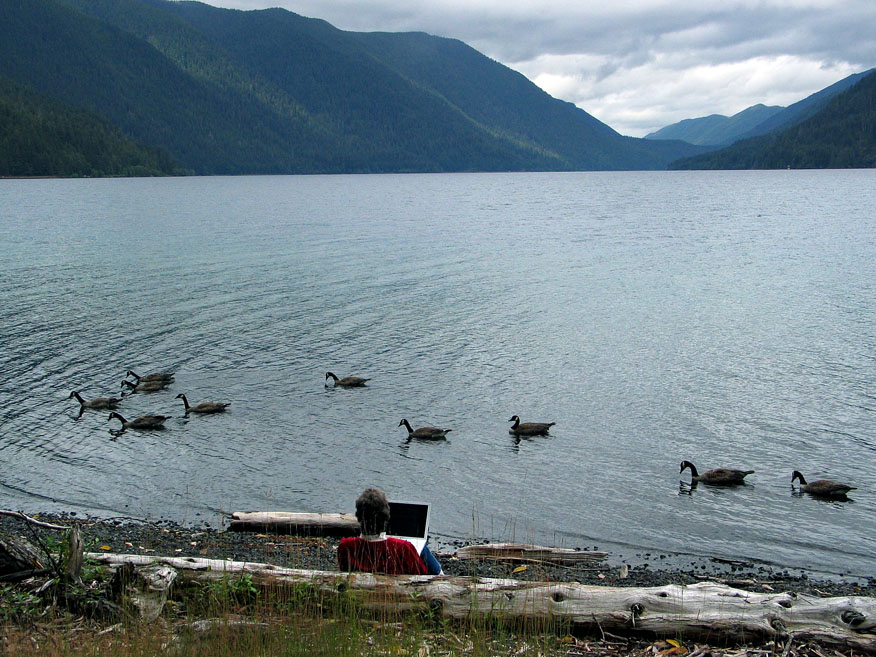
A little shout-out to my guy, Dick Schmidt, for the fabulous work on the photo at the top of the blog. (I’m learning, in blog-ese, that this is a “header photo.”) Yes, it’s me, working on my novel at Crescent Lake, Washington, west of Port Angeles. The lake is part of the Olympic National Forest and is on the highway that leads to the little town of Forks, Wash., made famous by vampires… at least the ones in Stephanie Meyer’s Twilight books.

Dick and I have spent a fair amount of time in recent summers at Crescent Lake in cabins around the the 100-year-old lodge. The lodge is the only wi-fi’d place in this portion of the Olympic National Park, so folks go there in the evenings to check their email and so forth. I went there, often after 9 p.m., after the late diners and drinkers and checkers players had retired for the night, to write on the enclosed porch that looked out on the lake.

Crescent Lake is far enough north that it doesn’t truly get dark until after 10 p.m. in the summer, so that many nights, I’d sit on the lodge porch writing about Ocean Falls, B.C. (another place surrounded by trees, mountains and water), watching the light play on the lake, as you see in the photo.

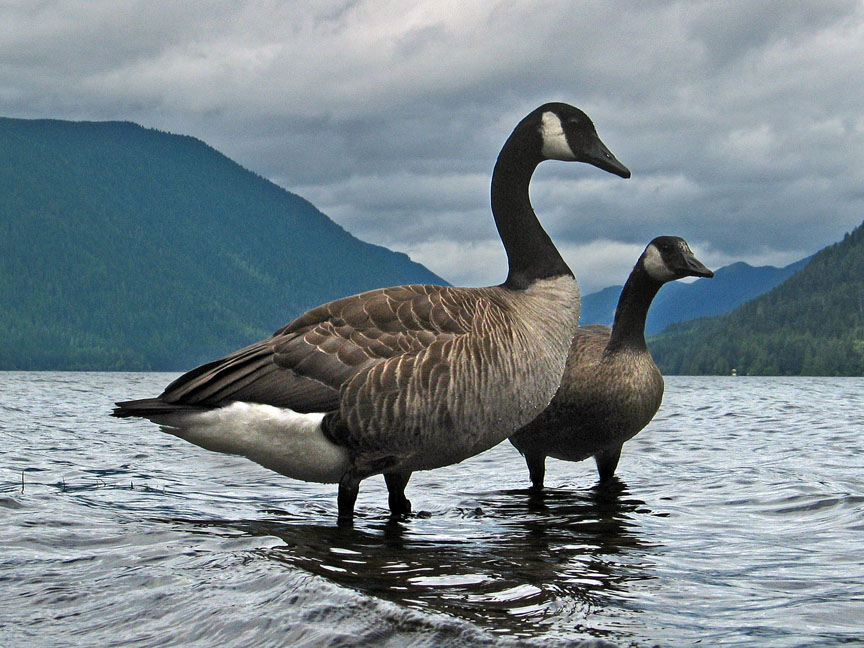
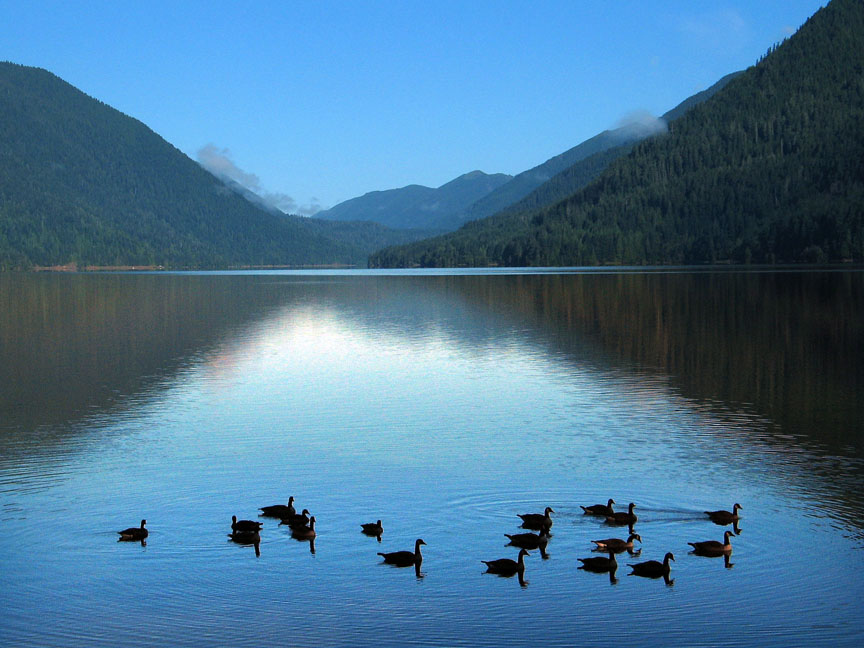
It’s been a perfect place to work. In fact, the Crescent Lake resident flock of Canada geese inspired me to write a section in the novel about geese influencing my 17-year-old protagonist’s synchronized swimming team.

The Crescent Lake flock, early morning, summer 2005 (photo by Dick Schmidt)

Ever watch geese paddle around? They’re as much of one mind in the water as in the air. They’ll often bob, butts up, at the same time, and pop up again as a group. They fly in a V-formation because their flapping wings create an uplift for the bird following. If a bird falls out of a V-formation, it feels drag and resistance going it alone and quickly gets back into formation. When the lead goose gets tired, it rotates back into the wing position and another goose flies point.

And I love this about geese: The ones at the back of the V honk to encourage those up front to keep up their speed. If a goose is sick or is wounded by a gunshot, two geese fall out of formation and follow the bird down to help and protect him. They stay with him until he is able to fly or until he is dead. Then they launch with another formation or catch up with the original group.

Me writing with the Crescent Lake Canada geese (photo by Dick Schmidt)

Dick is my point goose. He has supported the birth and development of this novel for six years. He goes with me on research and writing trips, shoots photos and helps with research, and falls back to rest with me when I am flagging. He believes in this novel as much—and sometimes more than—as I do.

He had to do a bit of PhotoShop manipulation of this image to get the window and lake and me in the same horizontal sliver for the header’s format, but let me assure you—it’s all real. I really was there writing and editing. It really looks like this… when it’s not raining, which is does quite a bit at Crescent Lake.

I couldn’t have a better image for myself as a writer than this one. Even from here, I see the geese on the lake, the dock jutting into the sherbet-tinged water. I feel the pen in my hand, my hand on the page. Thank you, Dickie.

(Information about geese from Parish Publishing, New Canaan, Conn., provided by Connie Johnstone, Director of Spiritual Care, Kaiser Medical Center, San Jose)

Love the geese! (photo by Dick Schmidt)

Posted in Uncategorized | 5 Comments