Fog-ust and floribunda

Dick loves this name of this family of roses. He says it with great enthusiasm on the last two syllables—flori-BUNDA! We are amazed by the array of plant life in Tofino, B.C. It is a rainforest, after all, but still…. roses? Don’t they need sun and warmth—actual heat—to grow well? Not here. Flori-BUNDA!

We have learned a thing or two about coastal B.C. rainforest plants, which has been helpful as I put the finishing touches on my novel set in (wait for it) coastal B.C. Every time we’ve been in Tofino, high on the wild west coast of Vancouver Island, we’ve experienced typical rainforest weather. That is to say, fog with brief bouts of weak sun breaking through thick clouds. In June, July and August this place feels like San Francisco in the summer. And, as Mark Twain reportedly said, the coldest winter he ever spent was a summer in San Francisco.

When we left sunny Victoria for equally sunny Campbell River, halfway up the east coast of Vancouver Island, we hoped we might see the same bright sky in Tofino.  And on our second day, we did get some sun. Dick has the pictures to prove it. But most of the time it has felt like we were walking around inside a damp gray sock. Fortunately, we like damp gray socks and have spent a lot of time in them in the years I’ve been working on this novel.

The locals in Tofino have a name for this month in their area: Fog-ust.
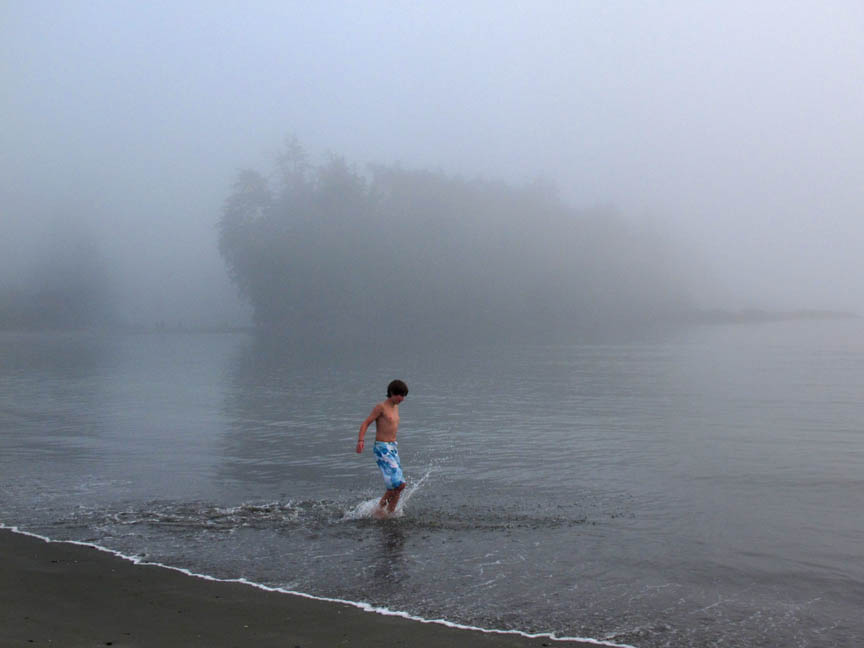
Not everyone minds "Fog-ust" in Tofino.

It’s not really summer—July is summer, if they’re lucky. Fog-ust is what happens when warmer weather in the sky meets the cold water of the ocean. We have seen sun in Tofino, fortunately, in June and July. We did not know about Fog-ust before. We do now.

Mind you, I consider myself a lizard. I long for sun and bask in it whenever possible (though nowadays, far away from my years on a lifeguard chair and teaching swimming lessons, with SPF 30 or higher on). My idea of a great vacation runs to places like, oh, any Hawaiian island. But in most of the past eleven summers now Dick and I have migrated north for a time, like the geese. Even though it requires more clothing than I like to wear at this time of year, I have become a big fan of northern climes—Alaska on one memorable trip and more frequently western Canada.

Ocean Falls, B.C., where my novel is set, is reputed to be the wettest spot in western Canada, getting 140-plus inches annually. The first time we saw Ocean Falls, aboard a small paddle wheeler called the Empress of the North, the town relaxed under full sun till 10 p.m. on a summer night. We couldn’t get off the boat, so we saw what we could from the deck and decided to go back the next summer.

Ocean Falls, though on the mainland of B.C., is accessible only by boat or floatplane, and when we returned the following summer to do research for five days, we arrived in rain and stayed in it for the duration. The clouds settled over the mountains, smothering them like wool blankets, and if we hadn’t seen it sunny, we would’ve never believed the huge mountains existed. We walked the town—or what’s left of it, including the old paper mill that was the reason the town was created in the early 1900s—with borrowed wellies and umbrellas, having to return to our room in what had been the bank building to dry off the camera with my blow dryer.

But what we learned that first trip was, among other things, how green Ocean Falls is. Green with sprigs of pink and orange flowers in summer. So green you feel like you’re breathing in all permutations of it, from chartreuse to deep forest. Though I’d ask locals the names of plants and trees, I didn’t get the all answers I needed. For the past four days in Tofino, noticing how similar the plant life is there to that in Ocean Falls, I finally learned names.

The Tofino Botanical Gardens are a marvel. Created by George Patterson a dozen years ago, it’s a 12-acre site of everything that can grow in a coastal rainforest zone. (Tofino gets 130 inches of rain a year!) Dick and I walked around with George’s extensive guide to the gardens, me writing down names of things and questions to ask George later, and Dick doing what he does best, photographing.

I learned that the tall green stems with pink flowers bursting out that line the road between the townsite of Ocean Falls and the housing area of Martin Valley are fireweed. I learned that the huuuuuge, “man-eating” plants with leaves almost as big as a child’s wading pool are not called Audrey II (“Little Shop of Horrors,” remember?) but gunnera. Someone should add gigantica to the name, too.
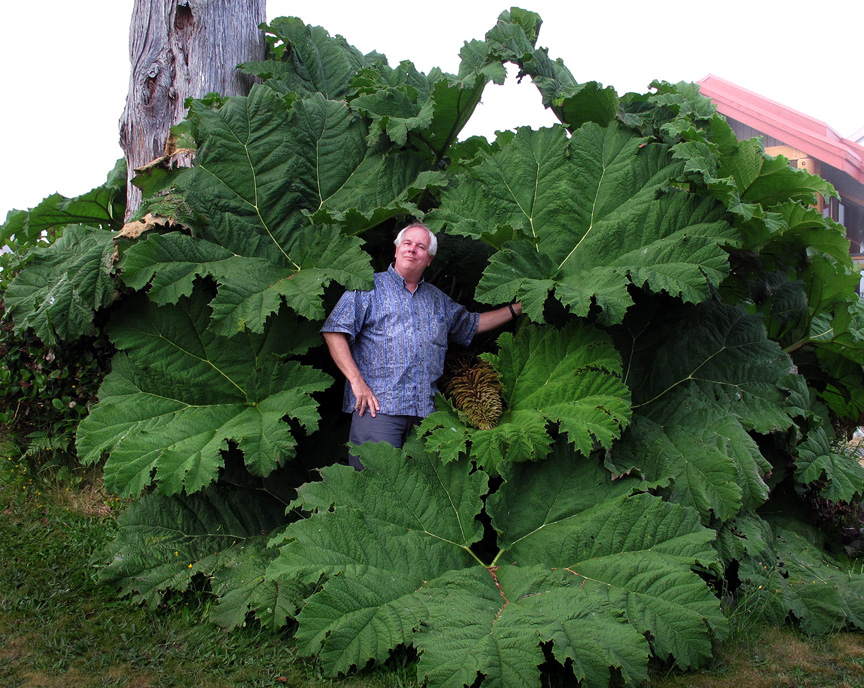
Dick and Gunnera gigantica

They’re Chilean rhubarb, and they’re non-natives, and apparently they spread like crazy. I learned that pretty much any herbs you can name will grow there and pansies, too. And surprisingly, lavender and roses do well, too. You need to grow tomatoes and squash in a greenhouse (they still require longer stretches of heat), but potatoes and carrots and lots of lettuces love the damp weather. 

Of course, the growing season is about three months long, if you’re lucky, but hey—gather ye nasturtiums while ye may, along with the crocrosnea (tall-stemmed, scarlet lily-like blooms) and calendulas and just about any kind of berry, including native salmonberries, which bears are very fond of. This is all important in Ocean Falls, the novel, where my 17-year-old main character grows her first garden.

And scattered throughout the Tofino Botanical Garden are all kinds of surprises. Rhododendrons everywhere that must look like they’re putting on a party when they bloom in the spring. Gigantic red cedars (the B.C. tree) that can live 1,000 years and have girths a giant sequoia would appreciate.
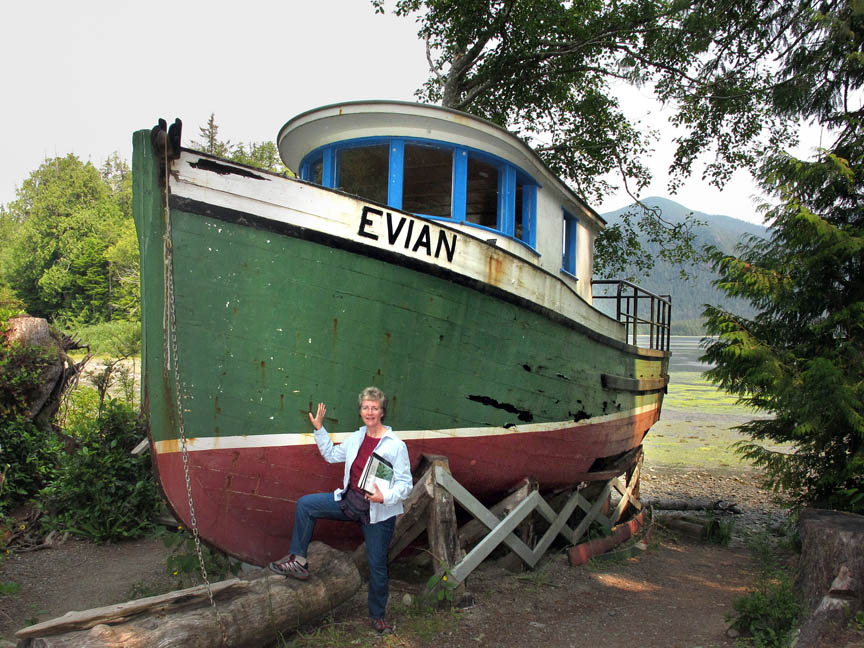
She's a fine old thing... and the boat's not bad either!

There’s a 37-foot wooden salmon troller called the Evian that’s hauled up out of the sea near the mudflats. Visitors are allowed to climb into and look around.

We loved the surprises of garden art. Tofino Man, for example, is pretty nifty.
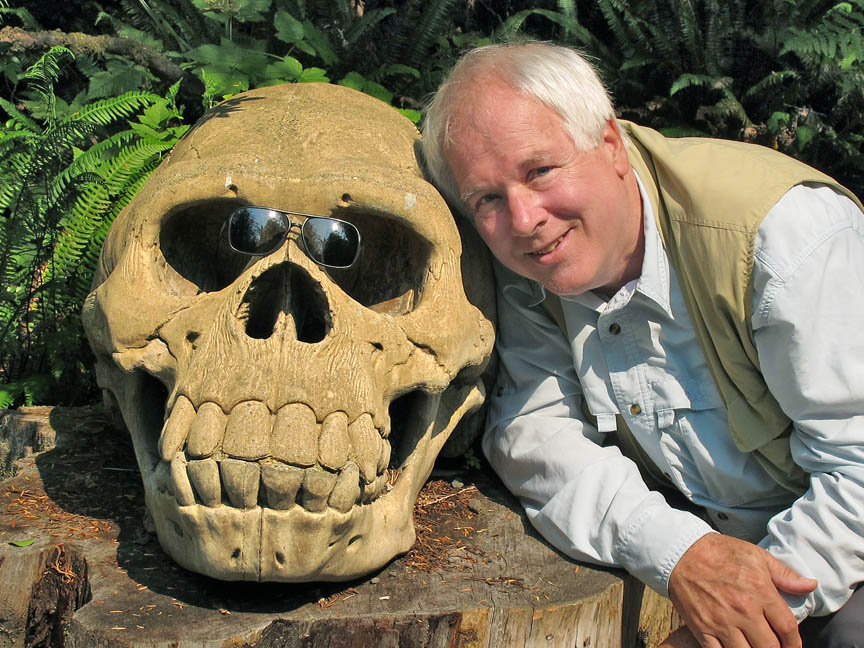
(From left) Tofino man and Sacramento man

He was “discovered” in the digging of the garden. And we loved the unusual gazebo and Storytelling Hut created by Jan Janzen. In fact, my favorite art pieces in the garden are the forest spirits that stand just outside the Storytelling Hut. I love their simple forms, their happy smiles. They remind me of people I know. 

We saw it all under soft gray skies, perfect light, Dick says, for pictures of floribunda and other blossoms. It was fine that the sun didn’t shine much. As George Patterson writes in his guide to the garden, “Most of our rainfall occurs in winter, but spring can be damp, the fall is rather moist, and summer is not dry.”

I love that. I’m using it in the novel. Thanks, George, for the incredible gift of touring your garden and your time to answer my questions. Even in Fog-ust, it’s an incredibly lovely place to spend an afternoon, soaking up the green, breathing in a B.C. coastal rainforest.
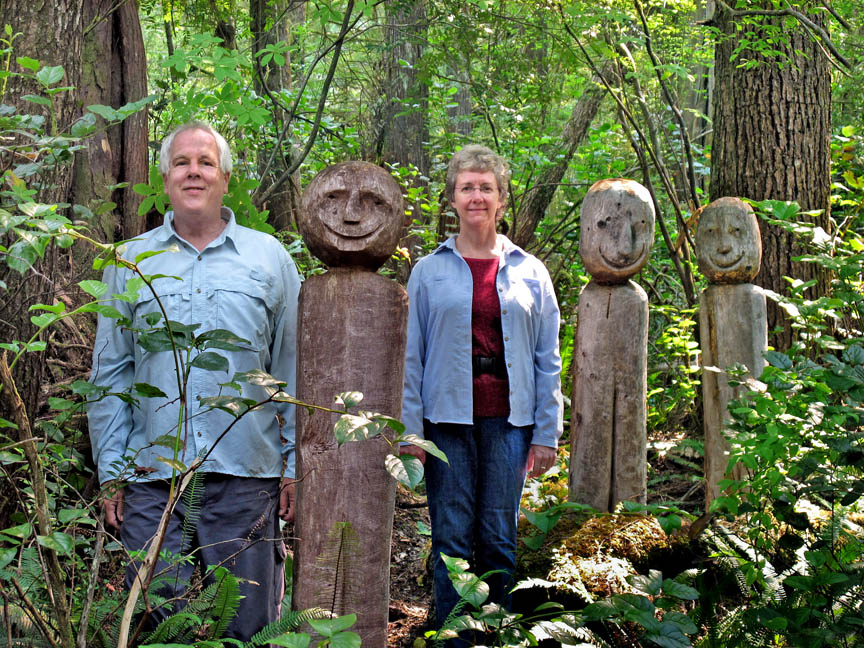
Rainforest people
Posted in Uncategorized | 2 Comments

A few of my favourite (Victoria) things

You may note the Canadian spelling above. As soon as I hit the border, I am compelled to add the letter “u” to words that do not require it in the U.S.—like “colour” or “harbour.” Also the letter “s” must be exchanged for “z” in words like “civilised” or “recognise.” 

It’s a “when in Rome” kind of thing, really. And I’m happy to do it. Because once I get to Victoria, there are some “must-do’s” on my list, especially around the Inner Harbour.

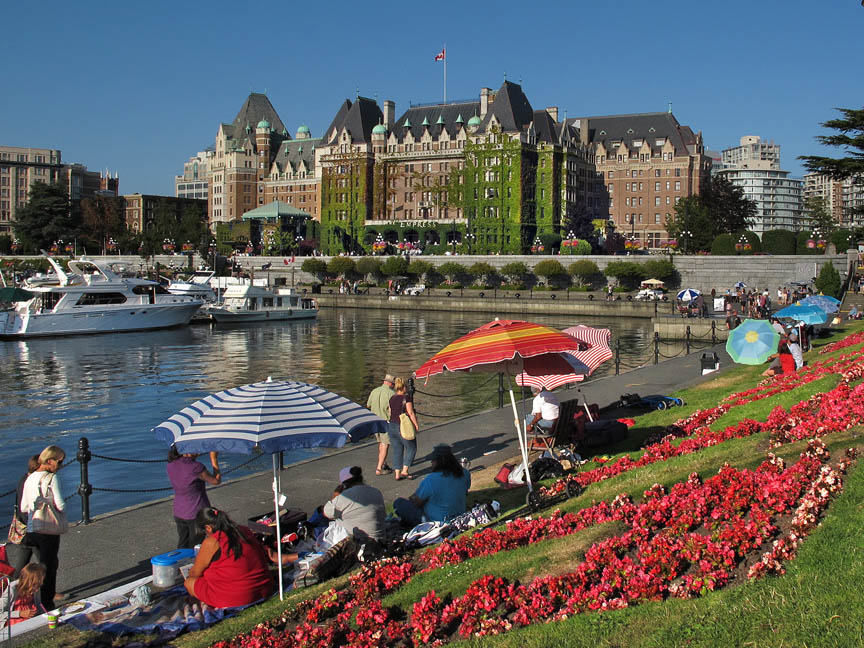
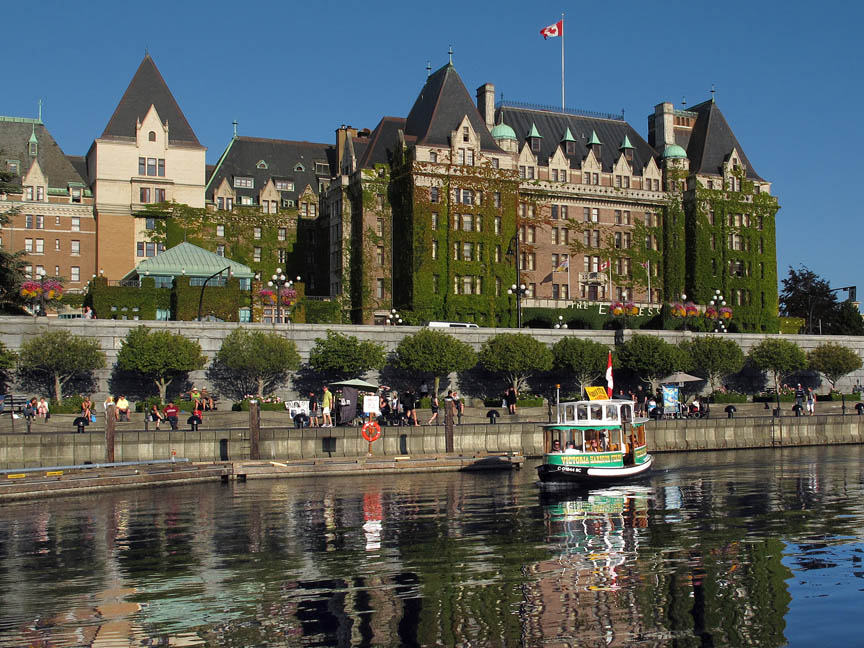
The Empress Hotel on the Inner Harbour, Victoria, B.C.


I must admire the grandeur of The Empress Hotel, the grande dame and centerpiece facing the harbour.

I also love the little water taxis, the Victoria Harbour ferries, that zip around like busy bees, dodging bigger boats and ferries, as well as the float planes taking off and landing. How they coordinate so well amazes locals and visitors alike. You can take a water taxi up into the Gorge and get a water-level view and a good bit of local history from the very knowledgeable captains.

The water taxis of the Inner Harbour—a cute little ride.


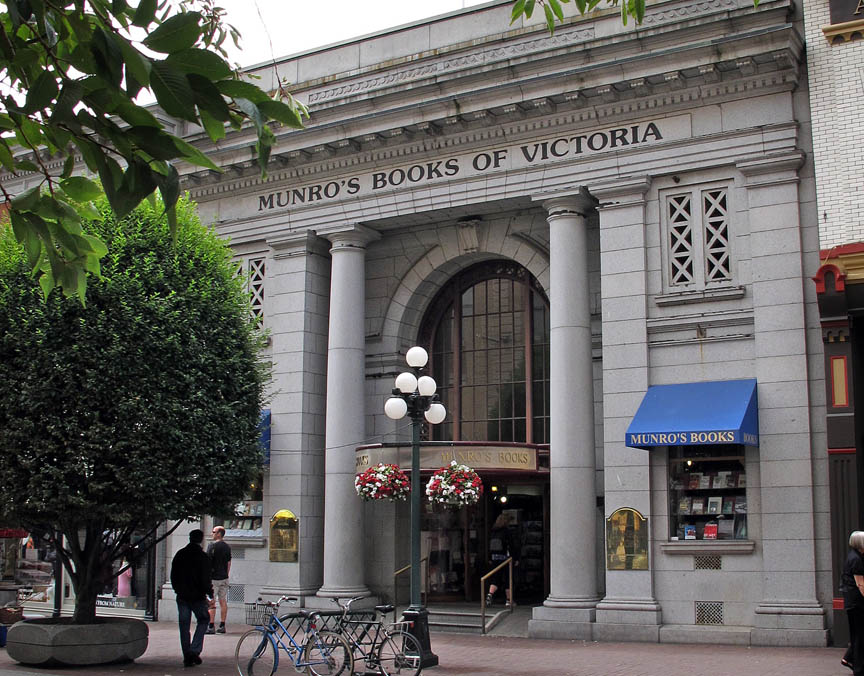
Also high on my Victoria list are the two M’s: Murchies and Munro’s, cheek by jowl on Government Street. Murchies, home of fabulous tea, and Munro’s, wonderful bookstore, are places I can spend waaaaaayyy too much time and money. They are staffed with kind and knowledgeable salespeople who have mastered the delicate art of being helpful without being oppressive. And I love walking into Munro’s. It’s like a Victorian bank on the outside and a lovely library inside. Plus, if you give them money, they let you take the books home forever.

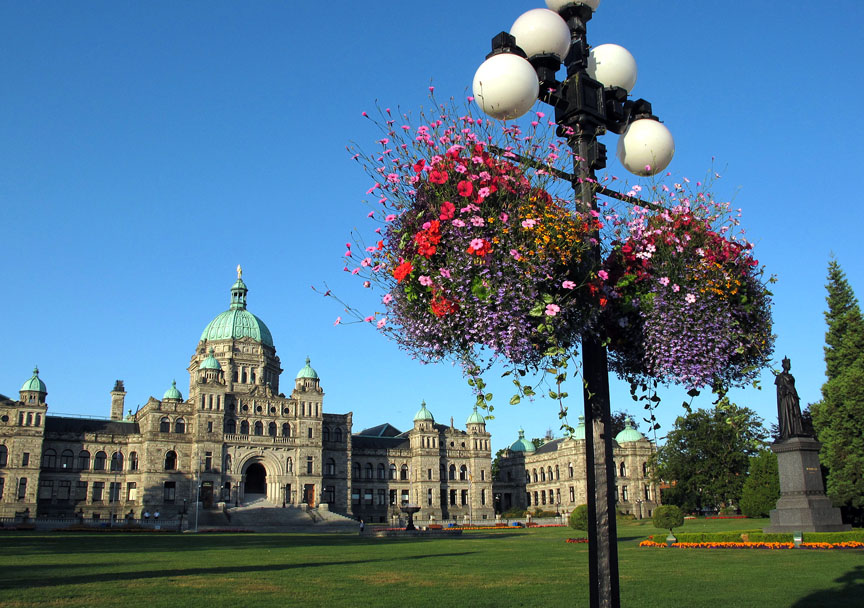
Another one of my favourite things  is to oogle the Legislative Assembly building (aka Parliament) because it’s so much more stately than anything in the states. It reeks of England—in fact, it is a replica of the English Parliament building. And every night at dusk (which in the summer is about 9:30 p.m.), thousands of bulbs wink on and light up the place.

As if that weren’t enough, you can go inside the Legislative Assembly building for a free tour and walk the same halls that Queen Elizabeth does when she pops over for visits. (Canada no longer “belongs” to England, but it does maintain close ties, especially to British Columbia. Jolly good, I say.)

The Legislative Assembly building of British Columbia


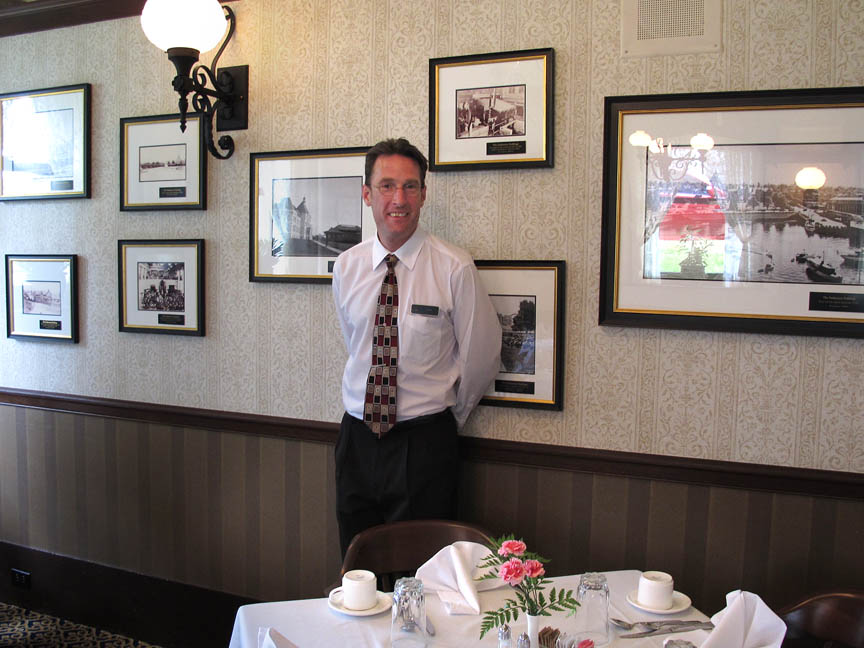
But you and I (as rowdy Americans even) can make our way to the basement to the Legislative Dining Room and have breakfast, lunch or tea in wood-paneled splendour, with the faces of long-dead members of Parliament looking down on you from period photographs. Love the shrimp sandwich, by the way.

We also love the dining room because of Mur Meadows, waiter and playwright, a charming man who regales diners (only if they ask, of course) with tales of his current projects.

Mur Meadows, waiter and playwright extraordinaire


 His play, “The Return of Love,” is not only available online but also available free to theater groups that wish to perform it.

I’ve already written about my favourite tea room, the James Bay, but I’ll also give a little shout-out to our favourite fish and chips place, Barb’s, on fisherman’s wharf. It’s an easy walk from the Inner Harbour, or a quick ride in a water taxi. You eat outdoors, under a tent, right on the dock, and we are quite fond of the halibut and chips combo. It is not cheap, greasy fish and chips, but high-quality stuff. 

If you’ve been to Victoria, I imagine you have your favourite spots, too. What are some of yours? Toss a comment this way, and I’ll add them to my list, too!

Posted in Uncategorized | 1 Comment

Nanaimo Bars

There may be finer desserts in the world, but since my first trip to Vancouver Island in 1999, I will kill for a Nanaimo Bar.

They are unheard of in the U.S., much like hard cider, which Canadians also love. But as far as I’m concerned, Nanaimo Bars ought to be in every cafe in the U.S. They should be as ubiquitous as brownies, another bar made in pans. They are sinful, and you can feel your arteries clogging up just looking at them, since they are pretty much all butter and chocolate. A small, rich square goes a long way.

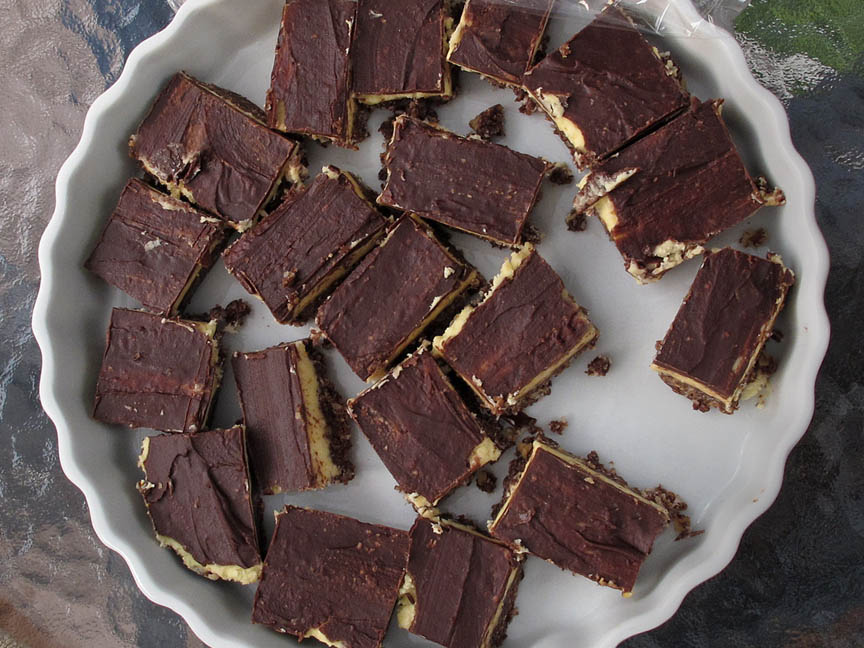
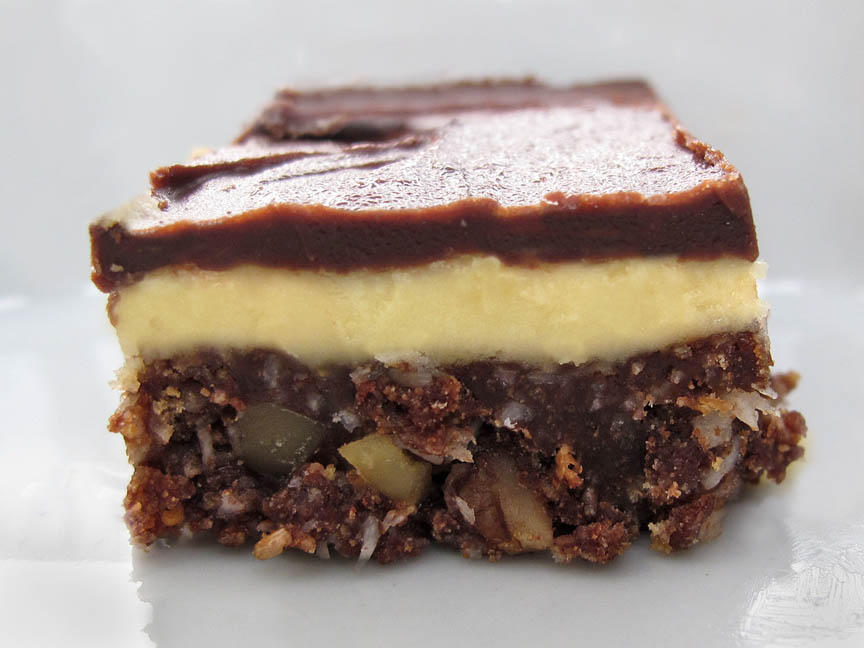
Louise Rayer Johnson's Nanaimo Bars!

When people ask me, “What’s a Nanaimo Bar?” I say this: It’s a triple-layer bar made in a 9×12 pan with a bottom layer of cocoa, graham cracker crumbs, coconut and almonds, a middle layer of pretty much solid butter and a top layer of pretty much solid chocolate. You assemble the layers, put the pan in the fridge to harden, cut the resulting dessert into small pieces and stand back. You hear some serious moans of pleasure coming out of people mmmm’ing and ooohhhh’ing over Nanaimo Bars.

Tonight, Louise Rayer Johnson hosted the Schmidt siblings and some of her family members as part of the 50th anniversary when the two families gathered on Vancouver Island. Louise, bless her, made Nanaimo bars. Though I’m not eating much sugar these days, I sat there and nibbled on two tiny bars, doing my best to make them last as long as possible. Happy tastebuds! My mouth was aching with pleasure.

Mmmmm! Nanaimo Bar!

No one knows exactly how Nanaimo Bars came to be. Both Wikipedia and the Nanaimo city website (yes, it’s the second largest city on Vancouver Island) say that a Mabel Jenkins from Cowichan Bay submitted the recipe to the annual Ladysmith and Cowichan Women’s Institute Cookbook. This cookbook was sold in the early 1950s in the region as a fundraiser. It became popular in many of the province’s households, especially in company towns and was sold in many of the coffee shops on Nanaimo’s Commercial Street. Tourists in the region, especially U.S. tourists on pleasure boats came to refer to these as “Nanaimo Bars.”

Other unconfirmed sources say the recipe dates back to the 1930s when it was known as “Chocolate Fridge Cake” (they’re not baked, just assembled and set to cool in the refrigerator).

Anyway, it doesn’t matter. Nanaimo Bars are as much a part of Canada now as the maple leaf, and I say, “Bravo!” Bless Canada and Mabel Jenkins and perhaps the other unnamed progenitors of what has become my favorite dessert. And thank you, Louise, for your very fine Naniamo Bars!

(Big hint: It’s the custard powder in the center layer that makes all the difference. Hard to find in the U.S., but an important ingredient. I bought mine online.)

——————

Nanaimo Bars

Bottom Layer
½ cup unsalted butter (European style cultured)
¼ cup sugar
5 tbsp. cocoa
1 egg beaten
1 ¼ cups graham wafer crumbs
½ c. finely chopped almonds
1 cup coconut

Melt first 3 ingredients in top of double boiler. Add egg and stir to cook and thicken. Remove from heat. Stir in crumbs, coconut, and nuts. Press firmly into an ungreased 8″ x 8″ pan.

Second Layer
½ cup unsalted butter
2 Tbsp. and 2 Tsp. cream
2 Tbsp. vanilla custard powder
2 cups icing sugar

Cream butter, cream, custard powder, and icing sugar together well. Beat until light. Spread over bottom layer.

Third Layer
4 squares semi-sweet chocolate (1 oz. each)
2 Tbsp. unsalted butter

Melt chocolate and butter over low heat. Cool. Once cool, but still liquid, pour over second layer and chill in refrigerator.

Posted in Uncategorized | 2 Comments

Reunion in Campbell River

So the reason Dick and I have driven up to Vancouver Island to be here for the last weekend in July is, as I mentioned in an earlier post, to come to a family reunion. Actually, it’s a two-family, international reunion—the Schmidts from the United States and the Rayers from Canada.

The story, as told by Audry Rayer, who died in 2008 at age 95, goes something like this:

In 1939, Audry and her husband Len Rayer were onboard a ferry between Washington state and Victoria, B.C. It was wartime for Canada, though the U.S. would not enter World War II for another two years. The ferry traveled through the islands off the coast of Canada, dropping passengers along the way. When there were few passengers left, the Rayers heard a call over the ship’s public address system instructing all passengers to go to the lifeboats. The crew was preparing and lowering lifeboats, and the passengers were being ignored. The Rayers went to a lifeboat and found another couple there—Christoffer and Elizabeth Schmidt from Sacramento, Calif. 

Audry loved this part of the story: “We didn’t know what was going to happen, if we were going to have to pilot the boat or not. My husband looked at Mr. Schmidt said, ‘Do you know anything about boats?’ And Mr. Schmidt said, ‘No, I’m an accountant.’ And my husband said, ‘Well, I’m a mechanic, but I don’t know anything about driving boats.’ ”

Both couples were mightily relieved when it turned out they were involved in a lifeboat drill. They laughed, shook hands and went their separate ways once the ferry dropped them all in Victoria. 

The story would have ended there if not for an odd coincidence. A couple of days later, Audry was in her local butcher shop when she saw the couple they’d met at the lifeboat walk by outside. She ran outside and said, “I’m the woman you met on the boat!” They all laughed to meet each other again by chance, but Audry took even more decisive action. She invited the Schmidts to her home for dinner. That was the beginning of a friendship that has spanned two generations and has lasted to this day.

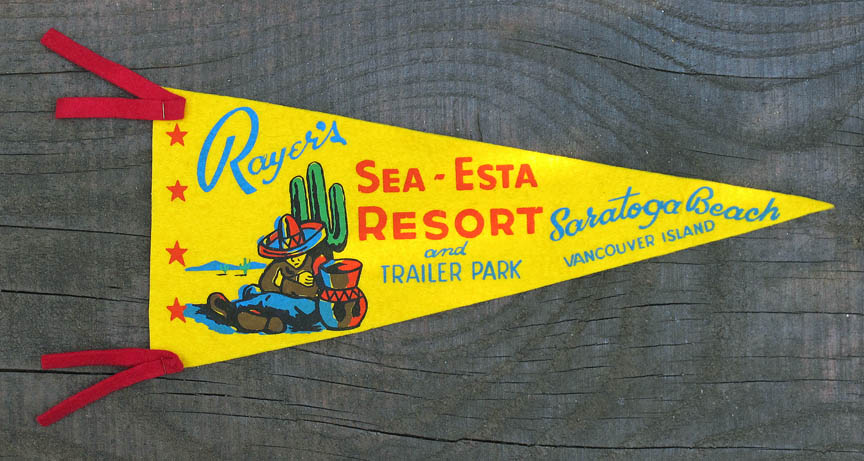
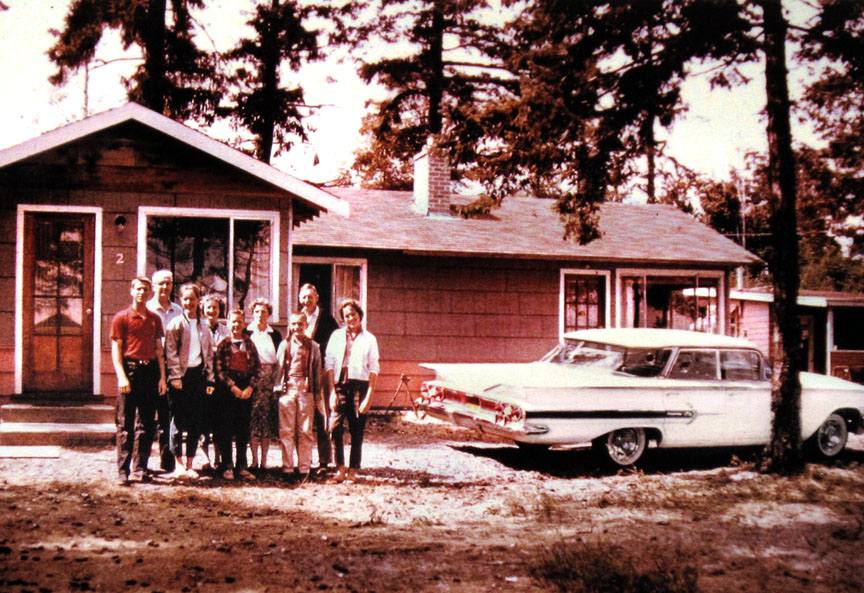
In the summer of 1960, the Schmidts and their three children—Dick, 17; Margery almost 13; and Stephen, 11—drove the family’s new Chevy Impala from Sacramento to Saratoga Beach on Vancouver Island, just south of the small town of Campbell River, to visit the Rayers. There were no interstate freeways, and the road to Campbell River was a two-lane highway. The children still remember that trip as a remarkable one. The family climbed Mt. Lassen and saw the capitals of Oregon and Washington. They marveled over the Parliament building in Victoria. And the Schmidt kids met two of the Rayer kids—teenagers Louise and Murray at their parents’ oceanside campground, the Sea-Esta in Saratoga Beach.

At the Sea-esta... (from left) The Schmidts— Dick, Christoffer, Margery, Elizabeth and Stephen—and the Rayers—Audry, Murray, Len and Louise. And the Impala!

Louise remembers being intrigued by the oldest Schmidt son, Dick, a blond, blue-eyed California boy who thought it might be fun to try swimming off Vancouver Island. Dick recalls that he lasted less than five minutes in that frigid ocean water. He signed a copy of his high school graduation photo to Louise, which she still has. 

 The elder Schmidts and the Rayers remained close for the rest of their lives—the Rayers made the long drive from Saratoga Beach to Sacramento for Dick’s wedding. Even after Len, Christoffer and Elizabeth had died, the Schmidt kids continued to travel up to Campbell River to visit Audry until her death.

So that’s why we’ve all gathered in Campbell River at Louise and her husband Bill’s house to commemorate the 50th anniversary of that trip north. It’s the 71st anniversary of the ferry trip that brought the two families together.

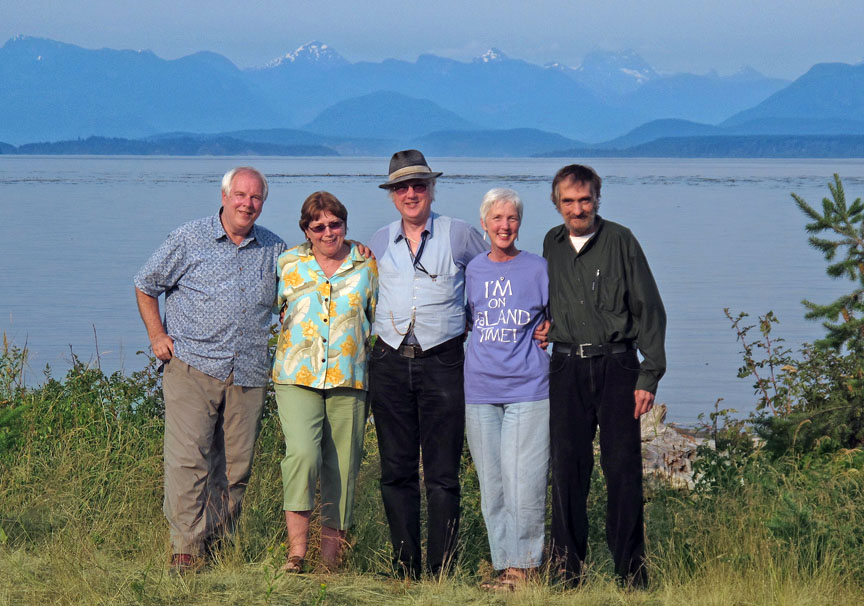
The Schmidt and Rayer kids, 5o years later: (from left) Dick Schmidt, Louise Rayer Johnson, Steev Schmidt, Margery Schmidt Thompson and Murray Rayer.


Tomorrow we will all go to Saratoga Beach to see the Sea-Esta. It’s still there—not the same, Louise says, but still there. We will take photos of these grownup “kids,” as we did tonight at Louise and Bill’s house when they hosted us for dinner. Stories and particulars of the present-day families are being exchanged each time we see each other. 

And I imagine that the spirits of those four who met in the lifeboat are hovering around, too. I hope they are as delighted as their offspring by this longtime connection that spans the end of one century and the beginning of another, this international friendship that, with luck, may last another generation.

Posted in Uncategorized | 2 Comments

Emily and me

I have dreamed in my life, dreams that have stayed with me ever after, and changed my ideas; they have gone through and through me, like wine through water, and altered the color of my mind.   —Emily Brontë

Emily Jane Brontë and I share a birthday today, though she was born in Thornton, England, in 1818, and I was born in Long Beach, California, 140 years later.

Using the pseudonym Ellis Bell, Emily published Wuthering Heights in 1847, which is considered one of the greatest love stories of all time, though she never had a lover. I’ve been working on a novel for—Lord help me—six years with more than one love story in it (between a teenager and the only town she’s ever known, primarily), and I have had my share of lovers. (Thank you all!)

I do not mean to compare myself to Emily or Charlotte or Anne, that trio of writing sisters, though I, too, wrote as a child and have concocted plenty of poetry as well as prose. But I do have an affinity for Emily, who had only one novel published in her lifetime. But what a novel! What a tragic love story of unresolved passion between Catherine and Heathcliff. How it ruins him and everyone he touches. 

Emily said she dreamed much of the novel, something I find myself doing this week as I travel again in British Columbia where my novel is set. I dream about my characters, one sign that they’re “real,” thriving people, alive in my head, at least, which gives them a great chance of coming alive on the page. It is easier to dream my fictional people when I’m in their actual land. It is easier to write about their place when I have the smell of B.C. cedar in my nostrils; they are not the same as, say, Lake Tahoe pine trees.

So on my birthday I find myself halfway up Vancouver Island in the small town of Campbell River, here for a reunion of Dick’s siblings and the Rayer siblings, whose parents became friends during a lifeboat drill on a ferry between Washington state and B.C. in 1939. (Another good story!) Campbell River is a town that has learned in recent weeks that its paper mill, like the one in my novel, is about to be closed for good. This is the town, in fact, where many of the real-life people of Ocean Falls migrated to work in the mill here, the one that is now closing.

Fact and fiction lie a heartbeat apart. So much of what writers need to express is often more smoothly done as fiction; so much of what lies beneath the surface of fiction is fact. Yet I hate it when people ask fiction writers, “What really happened?” As if the telling of any story doesn’t make it real. As if “making it up” makes it any less true.

I doubt that Emily Brontë had any idea that Catherine and Heathcliff and their story would outlive her. I have no idea what will happen to my novel, but it doesn’t matter. I’m writing the book for me, most of all, because it’s been a fascinating process to research and write and craft it. If, like Emily, I’m lucky enough to have “Ocean Falls” published, and it turns out to be my only novel, great. I will have told a story I wanted to tell.

That’s what good stories do—alter the color of your mind—whether you’re writing or reading them. 

Happy Birthday, Emily Jane, from Janis Linn, your younger writer sister by nearly a century and a half… 

Write on!

Posted in Uncategorized | 6 Comments

James Bay

Dick and I have been coming to Victoria, B.C., so regularly now for the last decade that as soon as we exit the MV Coho, the ginormous car ferry that brings us from Port Angeles, WA, across the pond to Canada, we check into our hotel room and head out for tea.

Not the high-falutin’ one at the Empress Hotel. No, we take tea at the James Bay Tea Room, a block behind our favorite hotel (the Royal Scot, with its fiberglass, kilt-wearing bear in front) that sits kitty-corner behind the Legislative Assembly building… aka Parliament. It really does look like the original in London, so it makes sense that it would have an English-style tea room nearby. 

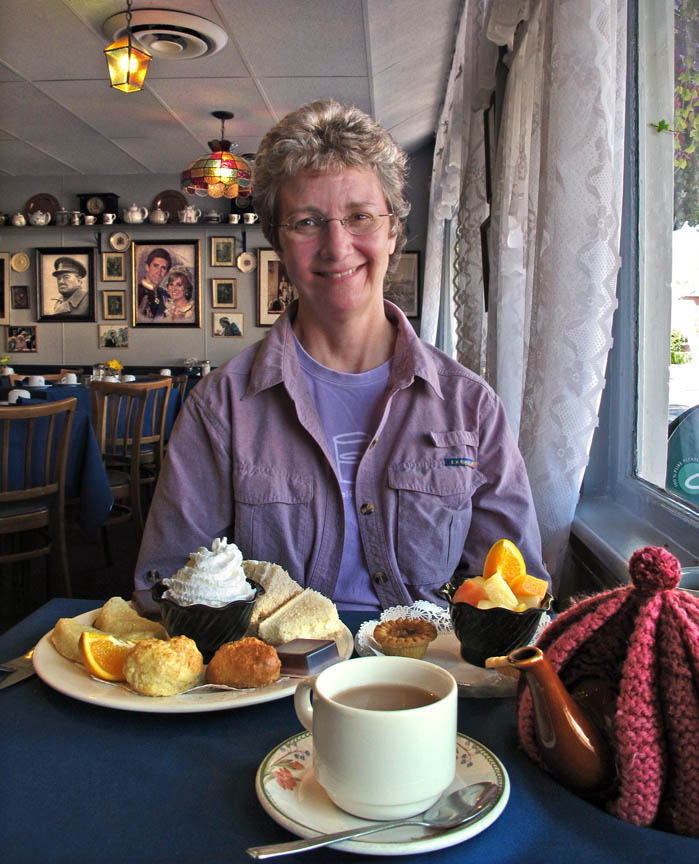
I remember being lured inside the James Bay Tea Room by the promise on the white board under the black and white awning of “full tea service.” I hadn’t had that since I was in England in the late ’80s. Dick and I went inside to the tinkle of a tiny bell and were struck by the simple square room lined with photos and portraits of the royal family from the Duke of Windsor and his brother, King George, to lots of images of Queen Elizabeth and even more of Prince Charles and Princess Di.

The James Bay tea service and me.

(Someone has grudgingly, it seems, added a photo of Charles and Camilla on their wedding day in a low spot on the wall.) On a high shelf sat brass plates and cups, cherished teapots, pewter trays and geegaws. Small tables with blue tablecloths and proper napkins waited patiently. The only thing missing was a waitress with a Cockney accent.

We go now for the tea service, including scones and tarts and clotted cream, about 4 to 5 p.m., meant to tide over hungry folks until the evening meal, about 9 p.m. Dick likes the shrimp sandwiches and the Coke. Me, I’m all about the tea and brown and white bread triangles of egg and tuna salad, as well as those tarts and scones. It’s not that the food is all that great—it just feels like England to me. England and Mollie and Barbara and Jim.

I had the great good fortune of going to England in 1978 on a college trip that dreary January with a Sacramento States professor of English history named Dr. James Straukamp. My friend Gina and I sat in his Tudor/Stuart history class in the fall of 1977 and came to love the older, balding former priest who wore funny plaid ties and tasseled loafers. He had been a Jesuit priest working on his Ph.D. in London, so he knew his stuff. Jim was wickedly smart, esoteric and funny, and when he announced he was taking a group of students to London for two weeks over the winter break, I immediately signed up.

I’d never been east of Lake Tahoe at that point. But I’d been saving my summer job money from my lifeguarding/swim teacher/synchronized swimming coach gig, and my parents allowed me to use it for the Big Trip. Since the group was departing from Los Angeles, it was decided that I would head down a couple of days early and stay with my godmother, Jo Corbin, and her partner, Dr. Ella Mae Sanders, whom we all knew as Sandy. It had never occurred to me that they were a couple until Jo and I had a conversation about two English friends of hers she thought I should visit over several free days on my trip.

“You’ll love Mollie and Barbara,” Aunt Jo told me sitting on their big sofa in the living room. “They met a girls’ school years ago. Mollie taught art and maths, and Barbara was the headmistress. Mollie is still an artist—a very good painter.”

I drank this in for a bit. Then Aunt Jo said, “They’re not a couple—they’ve just lived together for years.”

That was when I realizes that Jo and Sandy were a couple, not just roommates, though we never mentioned it again.

The funny thing was that Mollie and Barbara—I came to understand in following years after my first visit with them and subsequent visits they made to my parents’ house—were also a couple. They may not have had a romantic relationship, but they kibbitzed at each other like old married people and knew everything there was to know about each other. 

I adored them almost immediately because they welcomed me, sight-unseen, into their Tudor-era, thatch-roofed cottage a few hours outside of London. I slept on a feather bed that was so soft it felt like a cloud and had to duck under the timbers of the doorways to make sure I didn’t bump my head. They trotted me around their part of the world to see, among other things, Cambridge (I immediately wanted to transfer there) and taught me to drink shandies—lemonade and beer. I didn’t take to shandies, but I did to tea. Not the drink persay, but “tea” as an afternoon meal. I’d never heard of clotted cream, but when I first plopped a spoonful into my teacup and tasted it, I was hooked. I’d never seen a scone or slathered jam (not jelly) on a tiny muffin-like thing, but I was an eager learner. 

I felt like I’d fallen into Shakespeare and both Brownings and every English author I’d ever heard of—but with cars and, thank god, toilets. That, plus the fact that Straukamp was a walking encyclopedia of all things English, and he could read the Latin in all the churches, and he took us to Winchester Cathedral where, I realized, I was standing on the very spot where Jane Austen was buried. I never wanted to leave. 

Mollie knitted me a “woolie” that I still have, though it doesn’t fit very well, and she and Barbara introduced me, the budding writer, to the essays of George Orwell and the poetry of Rumi. They took me to old bookshops where I bought my first copy of a book published in 1889. For two pounds, as I recall. Mollie and Barbara seemed ancient to me at the time—they were probably in their late 60s when I met them. Yet they were funny, very smart and well-read, and they changed my life.

They are both dead now, as is Aunt Jo. Jim Straukamp is still living in Sacramento with his longtime partner Bob (long ago giving up the church for the love of a good man, Jim used to say). But he is struggling with Alzheimer’s and, I understand from a mutual friend, his brilliant mind is no longer accessible. He changed my life, too.

So this week when I sat in the James Bay Tea Room, I raised my cup and silently toasted those dear friends who gave me England and so much of the person I became. They fostered a writer and a budding Anglophile.

And Victoria, the closest place to Sacramento that feels like England, brings me close to them all. I bet I wouldn’t have to look too far to find a pub that could make me a shandy. Mollie and Barbara and Jim would all approve.

Posted in Uncategorized | 2 Comments

Powell’s

I admit it: I am nutty about books. Spending time in a rockin’ bookstore ranks right up there for me with Jik Jak ice cream at Burr’s (chocolate with a hint of cinnamon and nuts). Or noodling around on the marimba, figuring out songs I used to know years ago. Or singing loudly in the car. Oo! Or having my feet massaged. These things give me pleasure and make me feel alive in the best possible way.

So when Dick and I realized that we had some extra time built into our traveling schedule around Portland, I dipped a tentative toe in the water. “Welllllll,” I offered. “We could maybe make a stop at Powell’s.”

It is a measure of how much this man loves me that he barely paused before he said, “Yeah, we could do that.”

On my 40th birthday, we were in Portland, and Dick gave me what might just be the best present of all time: a day at Powell’s. A whole day in a three-story bookstore that sprawls over a square block. Not just any bookstore—one of the best on the planet, a self-proclaimed City of Books. John Balzar, writing in the LA Times, said, “There is simply no place in America like Powell’s. No bookstore is so big or so meticulously organized, and none has such a psychic hold on so large a community.” Or on me.

And Dick said on my 40th birthday when he surprised me with a full day at Book Heaven, “You point; I buy.” It was better than Disneyland. Once inside, I became so absorbed and lost in the stacks I had to take breaks, my eyes got so buggy looking at and through books. We zipped out for lunch and dinner and probably spent a total of nine hours in there before I gave up. 

It was not just that I got to buy any books I wanted. It was that Dick understands that places like Powell’s are cathedrals of literature to me, the best kind of libraries because you get to keep the treasures forever, if you like. Yes, I have too many books and not enough bookshelves. But I don’t keep every book that comes into my life—only the most special ones. Really. Words are what I play with, what I coax out of others, what I breathe—so amazing bookstores and libraries hold special magic for me.

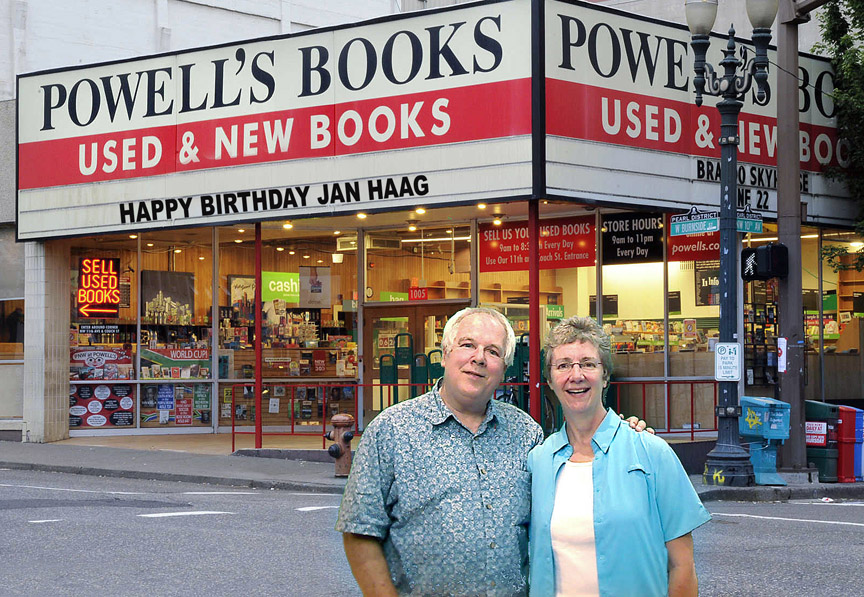
So here we are at Powell’s, where they’ve set up a nifty little green screen that you can pose in front of, and a nice young man takes your photo that he will email to you. (How high-tech is this?!)

Dick and Jan in front of the green screen.


We spent “only” an hour and a half at Powell’s on this visit. That’s when our free parking space was going to turn into one that required money—no big deal, really. We coulda popped for parking. But we were traveling, and Dick knows well that I need some kind of deadline, or I could spend the night in Powell’s.

So I started in the Green Room, which is where the cashiers live, looking through books on sale and found two paperback copies of “Fluke” by Christopher Moore, which I couldn’t find anywhere, even on Amazon, for heaven’s sake. And since I’d given my copy away and I really needed another one, well, there were two. I put in my plastic basket new hardbacks of a few old P.G. Wodehouse books because the editions are just so lovely, and I’m a huge Wodehouse fan. I picked up a 1950s edition of To the Lighthouse because Virginia Woolf has inspired a missing chapter in my novel. I chose a few obscure literary journals because I like obscure literary journals. I oversee one myself.

I was happyhappyhappy for those 90 minutes in Powell’s, and Dick was happy because he says he likes to see me happy. It is one of the best birthday presents I could have in anticipation of my day, Friday, July 30. I will be 52, which is what I’ve been telling people for most of the past year. For some reason, 51 just feels like an odd number. (It is an odd number, Jan…) I’ve been saying, “I’ll be 52 on my next birthday.” And here it almost is.

Running my hands over the spines of books in a tremendous bookstore was a great way to begin this year’s celebration. Thank you, Dickie!

Posted in Uncategorized | 7 Comments

Headwaters

On our way north to Canada, Dick and I stopped in Mt. Shasta, the small town that sits 3,600 feet up the flank of the great white mountain the native people once called Uytaahkoo.

Shasta the mountain last erupted about 200 years ago, but geologists consider it “dormant,” which means it will erupt again. Every drive I’ve made north, I like to stop in that cute town and drive up to the high school, from which there’s a gorgeous view of the mountain. I look up at the second highest volcano in the United States (14,179 feet tall) and wonder if someday that town will be like Pompeii, buried under a pyroclastic flow of lava.

That sounds rather morbid, I know, but Dick and I are fascinated with volcanoes and feel lucky to live so close to such a big one. We also love going to the Big Island of Hawaii and spending time at Kilauea, which has been erupting continuously since 1983. I’m kinda nutty about rocks, big and small.

This time in Mt. Shasta, however, besides admiring the mountain (far less snowy than when I saw it in early June), we wanted to visit a spot Dick hasn’t seen in fifty years—the headwaters of the Sacramento River. In the summer of 1960, Dick’s parents and their three kids made a long driving trip to Canada to visit friends on Vancouver Island. Dick recalls his dad stopping in Mt. Shasta to show the kids the origins of California’s longest river, one of two that flowed through their hometown.

Dick remembers taking pictures of Big Springs and being told that it took fifty years for the water to work its way through the lava and come out in the Mt. Shasta City Park. He no longer has those photos, but it seemed appropriate that since we’re returning to Vancouver Island this summer to commemorate that trip and reunite with family and friends there that we also look at the place our river begins.

It took us awhile to find the park out of town to the north. When we got there, it was obvious we’d found the right place—not just because of signs that said, “Headwaters,” but because we saw at least a dozen people walking to and from them with containers for water.

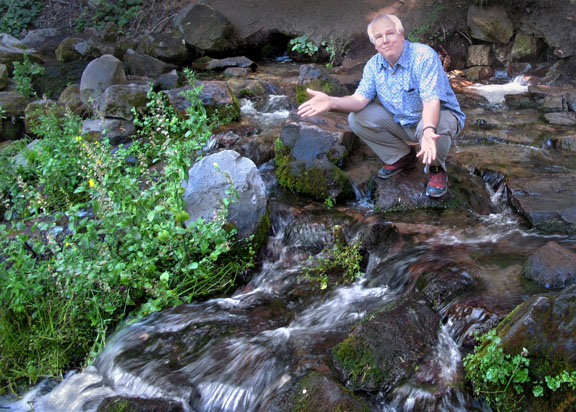
Dick at the headwaters of the Sacramento River in Mt. Shasta City.


We stood and looked at the springs gushing out of dirt—no pipes at all—making a small pond that pools and then falls into Big Springs Creek. We, too, collected some water and drank it—cool, clean, very clear. Dick took photos of what we realized is the first waterfall of the Sacramento River. And it struck me that the water we were now drinking began as snowmelt about the time the Schmidts stood on the same spot fifty years ago. 

I pointed this out to Dick, and we smiled, thinking of his parents, Elizabeth and Christoffer, and their three children, wondering what they might have experienced here on a summer’s day in 1960. One of them only remembers taking pictures that day. He did that again, as a tribute to the power of a great mountain and the powerful love of a small family, both of which live on in rock and memory.

Posted in Uncategorized | 6 Comments

With a little help from…

It takes a village to get me out of town. I’m not kidding. Actually, yesterday it took my driver, three good women and the Army Corps of Engineers to get me out of town. Well, one of its core members anyway.

After spending much of my summer of doing Other Work (aka Not Teaching at My College), I am finally off on vacation, driving up to Canada with my guy and traveling buddy Dick. I have to leave town to stop working—or at least stop working on Other People’s Projects so that I can work on My Own. I really like working on Other People’s Projects—it’s why I do them—but I have a novel that’s been waiting for almost a year for some finishing touches. So when I travel—especially to British Columbia where my novel is set—I finally do My Own.

This is so exciting I wiggle like a happy puppy at the thought of it.

But first, in the week preceding departure, I decided to: have lunches, coffees or dinners with seven different friends; spend time with the BF in the hospital; help clear out parts of our journalism trailer at school so it could be used as part of a huge track event; feed cats in at least two locations daily; take a friend who suffered a stroke nine years ago out for lunch and a haircut; led the last Saturday writing group session for the summer; attended a Suttewriters/AWA Sacramento picnic; hosted a friend overnight; went to a play; attended an 80th birthday luncheon; got my hair cut; worked out details for planting part of my front yard with my brother-in-law; bought new bookshelves at IKEA with my nephew and his housemate, and packed.

No wonder I’m so tired.

And when I have so many things on my mind, so many balls in the air as I juggle, it’s no wonder that once I leave for a trip, something gets forgotten at home. Usually it’s easy to replace—toothpaste, tennis shoes, vitamins—or do without. But last night, as Dick and I sped up I-5 after having quick deli sandwiches for dinner at Granzella’s in Williams, Calif., an hour from Sacramento, my excited heart plummeted to my shoes.

We’d just passed a billboard that said something about birth certificates. I didn’t read the whole thing, but I caught that part. And I thought, “Hey, I don’t need a birth certificate, I’ve got a brand new passport.” And that’s when I had that sinking feline (imagine a cat curled into a bathroom sink)—uh, oh. Big uh, oh.

Because that shiny new passport that I’d applied for just at the end of the school year was resting comfortably in a file drawer at home in Sacramento—a good 90 miles away.

Since 9/11, you can’t get into Canada with a U.S. driver’s license. You have to have a legit passport. I know this. I’ve been to Canada pretty much annually over the past decade. That’s why I had to renew the old passport.

I gulped before I said it out loud: “Oh, shit.”

Dick looked at me. “What?”

“Oh, shit,” I said, not wanting to believe I had done something so stupid. I thought fast—if I had someone FedEx me the passport, could we still make the ferry from Port Angeles to Victoria Monday morning? Nope, probably not.

I looked at Dick, the man who has driven me and paid for all these trips to fly me around the Pacific northwest and British Columbia to research and write this novel. The man who has loyally taken photos in heavy downpour and rare 95-degree heat of the former paper and pulp mill town of Ocean Falls, which we reach by float plane from the end of Vancouver Island. The man who has stood by not only this but also just about every offbeat, hair-brained project I’ve gotten myself (and often him) involved in since 1992.

“I forgot my passport,” I finally said.

Dick, who is the kindest soul I know, just said, sounding very disappointed, “Oh, Janis.”

We drove north for a few more minutes as I speculated aloud about how to fix the situation, discarding the FedEx idea, among others. Finally, I knew: I was gonna have to ask for help. I was gonna have to look stupid in front of friends who would be happy to help me… if I would just ask.

This is hard for me. For some reason I was born with a gene that makes me think it’s my job to Be There for others (see previous post). I get paid to Be There for others as a professor and advisor at my college. Yet again and again, I’ve had occasions when I simply need a little—or a lot—of help from my friends. And I have the best friends who are so eager to help, friends who would love to do favors for me, friends who think they owe me favors, though I can’t imagine why they think that.

And that’s when three women and the Army Corps of Engineers came in. As Dick exited the freeway and headed back south again, I called my across-the-street neighbor and Cat Care Goddess, Sonya, and told her. Asked her to go into my office and retrieve the passport. Which she did, finding the new one, not the old one. I thanked her a bunch of times, and she said, as she is wont to do, “No problem.” Sonya even offered to meet us someplace with the passport, blesséd friend that she is.

But I had already called my friend Timi (who is a she) and asked, “So what are you up to this evening?”

Timi, who has lent me her Lake Tahoe “cabin” (really a lovely three-bedroom home with in-laws’ quarters), on more occasions than I can remember so I could both get away for a bit and work on the novel, said, “Not much. What do you need?” (I love Timi.)

It turned out Timi, her husband Rick (who is a Major League Guy with the Army Corps of Engineers) and their youngest daughter Jessica were between their home and a storage unit schlepping stuff. I explained my predicament, then asked if I could prevail upon them to pick up my passport from Sonya, then meet Dick and me at the Sacramento Airport gas station with it.

“No problem,” Timi said.

“I hate to ask…,” I began.

“Are you kidding?” Timi said. “I owe you a hundred favors.”

I could not, for the life of me, think of one. “Really?” I said, thinking of the lovely cabin on the west shore of Lake Tahoe.

“Absolutely,” Timi said. And we settled on a time when Dick and I could race back down I-5 and meet them at the airport.

We did, they did, and after Timi handed me the passport as she, Rick and Jessica sat in their very full Honda Passport, I handed the passport to Dick, who put it safely with his in the little blue pouch he carries for such occasions.

I thanked Timi, Rick and Jessica profusely, of course, as I had Sonya on the phone. They drove off toward Sacramento, and Dick and I took off to spend our first night of this journey in Redding.

I am grateful for the kindness of these people who help me in ways that seem simple to them and hugely profound to me when my dwindling number of marbles get scattered. They help me retrieve the marbles, put them in a protective pouch, send me on my way. I would not be who I am without them. Without all of you.

As they say in Hawaii, mahalo nui loa. Thank you all, so very, very much.

Posted in Uncategorized | 1 Comment

Being there with custards

So the BF and I were having a conversation the other day—she tucked into yet another hospital bed and me sitting on the foot of that bed—about a book she wants to write. “It’s about being there,” she said, making me think of the 1979 movie starring Peter Sellers. “You know—being there for people, people being there for you.”

She said this on her third day in the hospital last week. She’d landed there because of continuous vomiting, partly caused by an infection and partly caused by the oral meds she was given for the infection. Back in the hospital, hooked up to an IV and infused with the right drugs, she was starting to look and feel better. I was there for her, yes, but then, she was there for me, too. Ours has always been a nicely reciprocal relationship. Without even trying, really. It’s one of the reasons we’re BFs. It’s easy.

“Well, yeah,” I said. “It’s what we do.”

“But the book would be about ways people are there for others—ways that work, ways that don’t,” she said.

“Ways that don’t?” I asked.

She pushed her round tortoise shell glasses up her nose. She looks a little bit like a female Harry Potter in those glasses, only with auburn hair. It’s very cute. “Like when people send me emails saying, ‘Call if you need anything.’ Or ‘Let me know when you’d like to have lunch.’ ” She snorted. “As if.”

This makes sense only if you know how sick the BF has been—so many days in so much pain she could barely move from bed to bathroom and back again. And she’s not the type to call for help outside her own family. Many of us are not that type. But many more of us, when we get the news of someone who is ailing or lost a loved one, are spectacularly unsure about what to do.

“It seems to me it depends on the person who needs someone to be there,” I said. “For example, I love it when people bring food or cook for me since I’m not so good at that.”

The BF smiled at me. Years ago, she asked me, not unkindly, “How do you feed yourself?” when I called to ask her how to scald milk. I was making custards for the first time, and the recipe said “scald,” and I wasn’t sure what that looked like. The BF said it was when the hot, steamy milk in the saucepan had a bit of scum on top—or at least, that’s how I remember it.

It was 1999, and I was making custards for my guy Dick’s mommy, Elizabeth, who was in her final stages of life. She made wonderful custards, Dick told me, so I asked her about them. She said she had just followed the recipe that had come with her new G.E. electric range when the family moved into a new home in 1952. I borrowed the book from Dick’s sister, Marge, and asked her advice, too. (I have long said that I will eat anything Marge Thomspon puts on a plate—she’s a fabulous cook!) I photocopied the recipe, and resolved to make Elizabeth her own custards. I even used her 1950s custard cups.

I’ll never forget the look on Elizabeth’s face when I brought in the custards in their small white baking cups with plastic lids. Very proper. Very (as the Canadians spell it) civilised. Elizabeth was hardly eating anything then, her little 88-year-old self shrinking into the sheets. A week earlier she had talked me through the recipe, but when I arrived with them, she looked as surprised as a little girl getting her first bicycle. “Custards?” she said. “For me?”

Well, yes. For her. And that tiny woman ate two of them, practically inhaling the creamy vanilla bites. Ladylike to the end, she savored the custards and dabbed at her mouth with a napkin. As her granddaughter Rebecca liked to say, “You’re so cuuute, G.” (the G. standing for “Grandma”). She was, too.

So it was with her own custards that I was able to be there for Elizabeth, one of the team of family angels who hovered around her in her final days. She died peacefully—faded away, really, not sick at all—one late night after I’d sat at her bedside reading marked passages from her Bible to her. I still feel honored that I was the lucky last one to sit with her.

“Let’s ask people how they’ve been there for others,” said the BF the next day in the hospital. She sat up in bed, slurping one of the custards I’d brought her. She got to go home that afternoon, too—I like to think the custard helped a bit, though I supposed one shouldn’t discount good antibiotics and anti-nausea meds.

“Let’s ask them how others have been there for them,” she said. “What’s been helpful? What’s not been helpful?”

So we’re asking, the BF and me: How have you been there for others? How have others been there for you? Give us (as Jeanie Keltner, one of my favorite English teachers, said to one of my grad school classes) “ankadotes.” Talk story to us. You can do this in the comments section of the blog or in email form. We really want to know.

In the meantime, here’s Elizabeth’s recipe for custards. They’re easy—I promise. Make them for someone you love. They have magical healing properties.

Elizabeth Schmidt’s vanilla custards
(from the recipe book that came with her new G.E. electric range in 1952!)

6 servings                                 8 servings
2 ¼ cups milk                          3 cups milk
3 eggs                                         4 eggs
1/3 cup sugar                           1/3 cup sugar
¼ teaspoon salt                      ¼ teaspoon salt
1 teaspoon vanilla                   2 teaspoons vanilla
sprinkling of nutmeg             sprinkling of nutmeg

Scald milk in saucepan. Break eggs into 1 point measuring cup or small pitcher. Beat slightly with fork. Add sugar, salt and vanilla extract. Blend. Add scalded milk slowly to egg mixture while stirring constantly. Mix well. Pour mixture into custard cups. Sprinkle nutmeg over top of each custard.

Place custard cups in deep baking pan filled with a half inch of water. Bake at 350 degrees for 30-35 minutes. Remove cups from pan. Let them cool. Refrigerate.

Posted in Uncategorized | 5 Comments