Happy anniversary

It is significant only to me now, but 27 years ago today I married for the first and only time in my life.

Clifford Ernest Polland married me on a cold but clear Saturday in a friend’s living room in Farifield, Calif., before all of about 25 people.
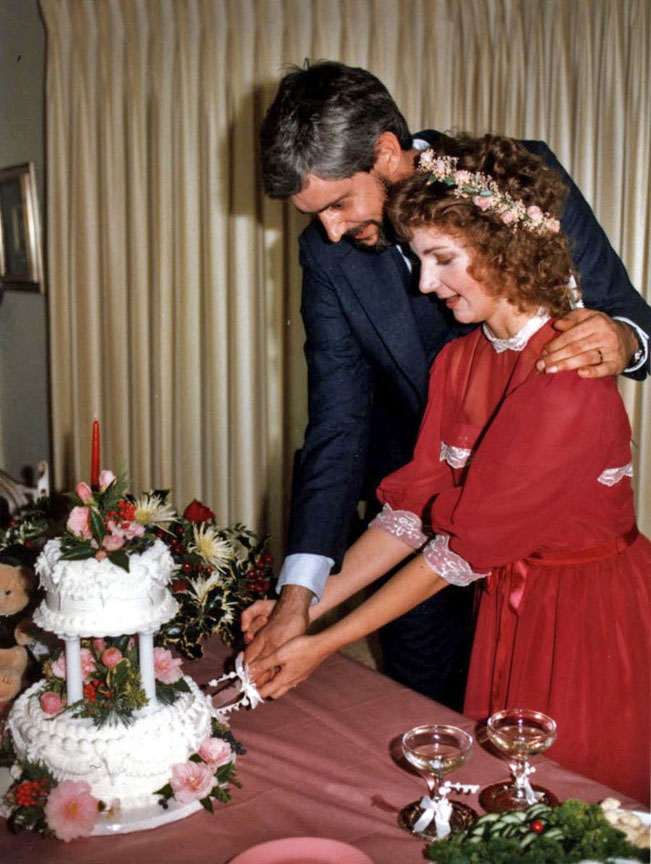
Cliff and Jan, December 17, 1983

He joked for years that he thought we were going to a movie, but instead I insisted he wear a suit, dragged him before a minister, and the next thing he knew, there were rings and vows.

“Oh, well,” he’d say. “You got me.” And he’d wink.

The truth was that we married partly to buy our first house together. We used his Cal Vet loan, one of his military benefits from his service in the Coast Guard, and Cal Vet wouldn’t count my income unless we were married. We looked at each other when we learned this, and I shrugged.

“I guess we better get married then,” I said.

He shrugged, too. “OK,” he said. And that was that.

The truth was we were planning to be together anyway at that point. I knew I was marrying my best friend on Dec. 17, 1983, and he knew it, too. Though it was a relationship complicated by his ill health and my frustration with that fact, and though we ended up living separately, we never divorced.
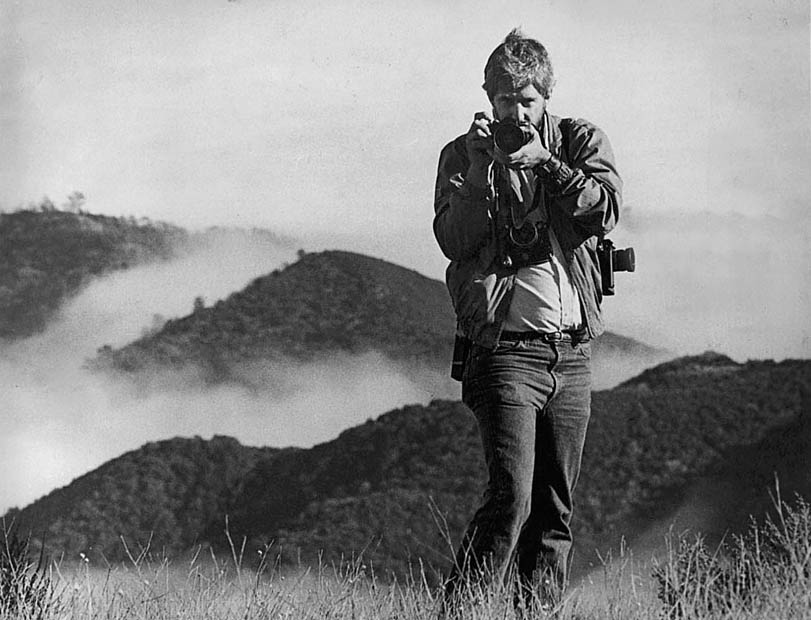
Cliff on assignment for The Vacaville Reporter.

We were made into family the day we married, and we were each grateful for that. He was the stable, centered, thoughtful, kind man I’d always wanted. I’m not sure what I was to him exactly.

But he loved me until he died, even after I broke his heart and told him I couldn’t live with him any longer. “I’ll help you move, Toots,” he said, and he did. I moved about a half mile away and came back to our house on weekends to walk the dog. Eventually I came back to our house, and he moved to Winters to be closer to The Vacaville Reporter, where he worked as a photographer for 17 years.

The year after we married, he got a shiny new aortic valve to replace his faulty one, which bought him 17 and a half years of life. (He used to joke that if evolution really worked, he’d have died long before.) Eventually, he blew a gasket, as he had predicted he might, suffering a bleed deep inside his brain that could not have been prevented. Artificial valves require huge amounts of anti-coagulants to prevent clotting, and he was on enough of them to kill an elephant, he used to say.
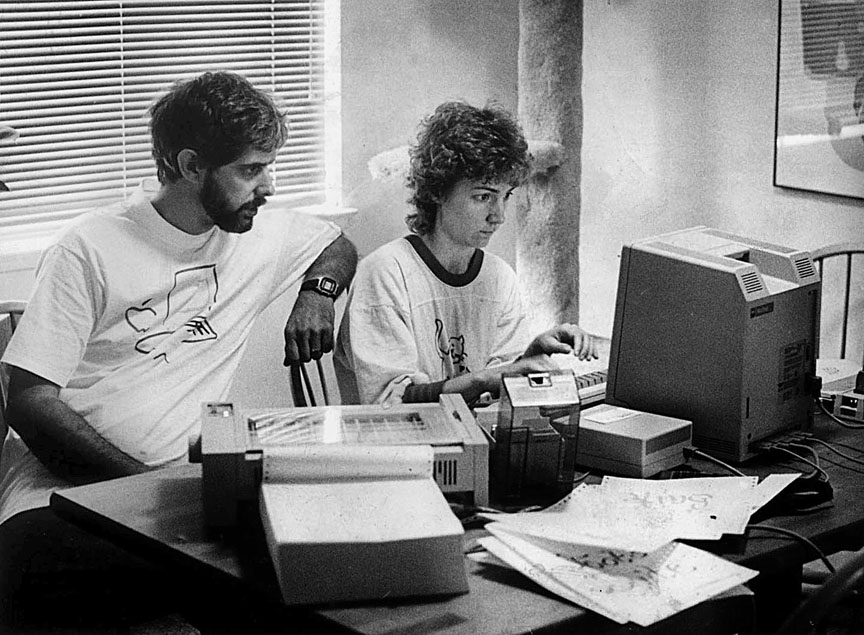
With our first Mac—all 512K of it—in our dining room in Davis, Calif., 1984.

In many ways, he was my elephant–almost 6-feet-5, a full foot taller than I–kind and gentle with a huge heart. Literally. His heart had grown to three times its normal size by the time he died since it was never completely repaired. He had a leaky mitral valve, too, which caused his heart to swell and swell.

I think that heart grew so big because he had such a huge capacity for love and forgiveness. He was a generous soul—not just to me, but to so many people whom he befriended and loved.

For years after he died, I carried the thought that on some karmic level it might be my fault–I’d broken that heart after it was fixed, and it never recovered. But with time, I learned that Cliff never really went away, that he has been my companion spirit. All I have to do is think of him, and he’s instantly hovering around me. I wake some mornings, knowing I’ve just been with him somewhere, talking, maybe watching him fly fishing in a lovely stream. He loved to fish.
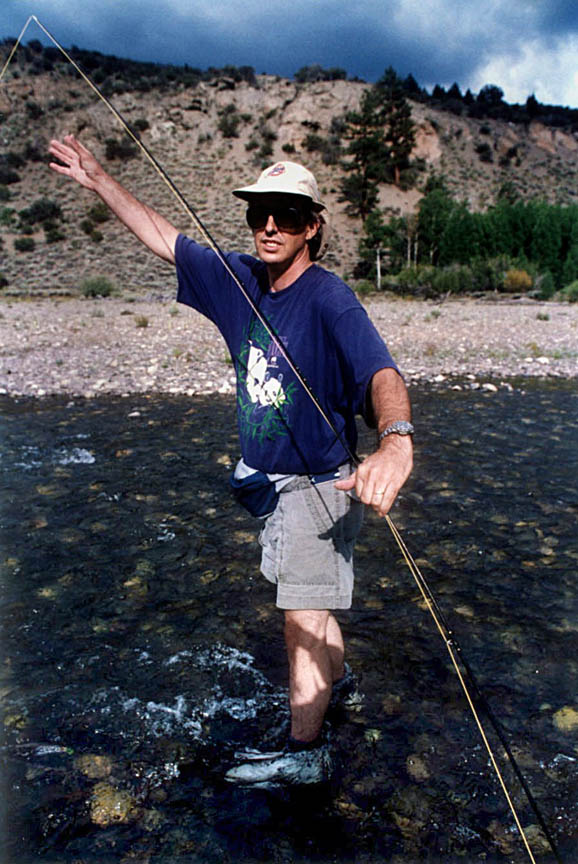
When people ask if I miss him, almost ten years after he died, I always say yes. But the truth is he never left me, and I am grateful. I have my house and much of my lovely life because of him. I can say that yes, I was once married to a terrific man, who was my best friend and teacher, though I did not appreciate him as much as I should have when he was alive.

I do now.

Happy anniversary, Clifford.

Posted in Uncategorized | 2 Comments

Welcome to the world, baby girl

One of the great joys of my life was my 29th birthday, which was when my sister Donna made me an aunt for the first time. Lauren Michelle Just was born six weeks early, and I like to think she did so for me. That day I held my new niece in my arms and whispered in her teeny ear: “Hi. I’m your Aunt Jan. You’re going to love me. I’m going to buy you things.”

Today that baby girl graduates from Sac State with a bachelor’s degree in anthropology. Aunt Jan is so proud.

But on Dec. 9, I got to hold another brand new baby girl, and even though I’m not technically her aunt (though her great uncle is my sweetheart), it was all I could do not to whisper in her little ear, too. But I figured that was her Aunt Rebecca’s job.

So here’s what I really said to her when I got to hold her: “Welcome to the world, baby girl!”

I’m not the only one, of course. Her very proud parents, Christina and Mitch, must be whispering all kinds of things to her.  They are two of the loveliest people I know–both inside and outside. Christina will miss her own Sac State graduation this weekend. She has done something few women do in the same month–give birth to her first child and complete a master’s degree in English.

“That’s pretty remarkable,” I told her the day after the baby was born. Christina and I were taking a little walk–not because she wanted to, but because she was told she had to get up and walk at least four times that day… the day after she had a Caesarean section, for heaven’s sake. I understand why that’s important, but really. The woman had just had a baby, for heaven’s sake.

Still, C. is a trouper. She was out taking what had to be very painful steps. “Yeah,” she said. “It’s been a big month.”

“And look at the door prize you get to take home,” I said. “Way adorable.”

C. grinned. “Isn’t she?”

We got back to the room where father and daughter were waiting for Mommy to return, and C. asked Mitch to change the baby’s diaper. He looked stricken. I smiled. Dick smiled.

“I can help with that,” I said. It’s been a while since I changed such a teeny diaper on such a teeny person, but what an honor. 

Mitch laid the baby in the plastic baby-holding box that passes for a bassinet in hospitals, and I retrieved a teeny diaper. The poor little girl wailed as we unwrapped her like a little burrito, and I removed her (yes!) wet nappie. She had just eaten, after all. Mitch held his baby’s head as I worked on her other end, trying to be quick about it but also trying to make sure the sticky parts didn’t stick to tender baby flesh.

Then Mitch wrapped up his baby burrito again and handed his daughter to me. Such an honor to hold someone barely a day old. Aunt Jan was so happy. I floated around for the rest of the day.

Now that baby is all of a week old, home with her parents, the little princess who has to be adored by relatives who drop by to oogle her and hold her. Every child should be so doted on, I tell you, so lucky to have so many grownups delighted to see her.

We’re so glad you’re here, little one!

Posted in Uncategorized | 1 Comment

Gingko

If you read the previous post, you might be interested to know that after I wrote it, I walked down the street to my neighbor’s to pick up more downed gingko leaves, and I saw an older man out raking. I introduced myself and said I was his neighbor and a teacher at Sacramento City College.

He looked surprised, this man with soft eyes, and said, “I’m Byron Patterson. I taught English at American River College for 26 years.”

How about that? Another English prof! I taught at ARC for a year in the mid-’80s, and I told Mr. Patterson that.

He shook his head and smiled at the coincidence (though my late friend Julie was fond of reminding me that there are no “coincidences”).

It turns out that yes, he planted the tree many years ago (he’s lived in his house for 32 years; I’ve lived in mine for 23… inverted numbers!), and he often curses the tree this time of year because, he says, “It’s so messy.”

“Yes,” I said, “but so beautiful.” Still,  I’m not the one who has to rake up all that gold on the ground.

Then I handed Mr. Patterson an envelope that contained the poem I wrote for him about his tree:

Gingko

Look—
thousands of little yellow fans
artfully arranged on crewcut grass
just before Thanksgiving.
For twenty-three seasons, I have
watched this neighbor’s tree
leaf greenly each spring,
weather the furnace of Sacramento
summers, then shudder itself
into its bright yellow sweater
come fall.

Now the gingko relaxes into
what is coming, lets go,
sends each fan waltzing its way
groundward like so many pieces
of scallop-edged origami.

As families turn to the table
fat with turkey and stuffing,
I come to the gingko every year
with plastic bag in hand
to retrieve those last spots
of sunshine, bound for glass bowls
spread around my house,
enough to last me
through winter.

———–

Long live Mr. Patterson and his great gingko tree!

Posted in Uncategorized | 2 Comments

Fall

I do this every fall now. I did it years before I started leading writing groups that required prompts. I’d go out in the neighborhood—sometimes even stopping by the side of the road if I saw lovely specimens—and load up a plastic bag with leaves fresh off trees—delicate, fan-shaped gingkos, star-shaped maples, serrated ones that look like blood-letters… anything in the process of migrating from light green to dusty yellow to red-bronze. I’d pick up spiky seed pods and snip red berries off pyracantha. I’d disdain the crunchy ones that every year fall from my gibogus sycamore in the back yard because they’re not pretty. One day they’re green, the next they’re a whiny yellow, and then—whump!—they’re toast on the ground. Mulch, as Margaret observed today in the writing group.

She mentioned this after I’d spread out a small collection of leaves and pods and berries on a blue tarp on a table in the middle of the room. My prompt today was  “fall,” which seems highly unoriginal, given the obviousness of the season. But it’s a season long in coming. We’ve had the most glorious Indian summer that’s lasted, with a few chilly days here and there, into November. It was in the mid-70s at the beginning of last week. This is rare for Sacramento. Yesterday it started raining—serious, cold, freakin’ winter rain. I put what I considered a writerly spin on the prompt: Write about fall, the autumnal season, I said, or “fall” as a verb, or the concept of falling.

Margaret, who is new to the writing group, teased me. “You brought your mulch?”

“Yep,” I said. “Carefully chosen mulch. Maple leaves the size of saucers. Spent seed pods like blasted open stars. Halves of walnut shells the squirrels left behind. Gingkos from my neighbor’s gorgeous tree down the block.”

Every year, right before Thanksgiving, that gingko busts a gut, bursting into yellow and tossing off its little fans. I walked down there yesterday to retrieve some of those leaves and noticed a light in the window. To my embarrassment, I don’t know this neighbor—though I have seen an older man working in that narrow front yard, raking those leaves.

I should leave him a note one day, I thought, thanking him.

 ————

Dear Neighbor:

For twenty-three years now, I have watched your lovely gingko tree leaf greenly every spring, weather our hot Sacramento summers, and shudder itself into its bright yellow sweater come fall. I love this time of year when your gingko sends its sunny little fans floating to meet the crewcut grass below it.

For twenty-three falls, I have stopped by to pick up a couple dozen of the discarded fans. Yesterday, they were spotty with the day’s raindrops, every one of them washed clean. I put them in a plastic bag and took them home. Sometimes I place them in glass bowls to shine some of the last of the year’s color before winter sets in. Or I take them to school, spread them on a blue tarp in a classroom and invite writing students to pick them up, along with other treasures of fall… bronze-y maple leaves, spent, spiky seed pods, red pyracantha berries.

My students love the objects of fall. They write beautifully about them.

This is just to say thank you. Perhaps you were the person who planted this tree long ago, who dug the hole and set the little sapling to its life task. Certainly you tend and nurture it now.

This is just to offer my gratitude for the gingko’s annual gift—always at Thanksgiving—of thousands of sunshine-y fans that always make me smile.

With deep thanks—

Your neighbor,

Jan Haag

Posted in Uncategorized | 2 Comments

Permission granted

I wrote this on the ninth anniversary of the Sept. 11, 2001, terrorist attacks, at the beginning of Rosh Hashanah, the Jewish new year, on the first day of my Saturday fall writing workshop. We’d had a six-week summer hiatus, and people came back to write and share, as giddy as little kids to see their school chums again. 

I gave this writing prompt: Take the piece of cardstock in front of you and a marking pen (any color you like; feel free to decorate!), and write these words on it: Permission granted. Sit with that for a minute or so, then pick up your pen or go to the computer and write. What do you need permission to do? What have you been waiting for so you can proceed with something that you want to do?

This is what I wrote:

Everything is permitted.

Everything is permitted.

Everything is permitted.

Everything is permitted in the imagination.

Everything is permitted on the page.

Yet we pause, the pen hesitates over the paper, as we do when standing on the edge of the pool, nervous about diving in. We long for the soothing water but fear that immediate shock of submersion, of the abrupt change in temperature. We wonder if we’ll survive, if this time we’ll be able to come up for air.

Well, yes, we will. I sit here as a writer, like all of you, and I tell you with every bit of faith and years of practice, yes, we will come up for air. We will find things in the depths that surprise and scare us, that slap the breath from us like big ocean waves. But we float. We float, people, and our heads find the water’s surface, our faces turn toward the sky, our mouths open, and we breathe—long inhales, gulps of gratitude. Then we swim, long, languid strokes that get us to a place some distance from where we started.

We breathe, and we write—or draw or paint or compose music, or perhaps all of the above. We dive down again, on purpose, looking for pearls we didn’t know were inside us. We bring them to the surface, hold them in our hands; we are surprised by their luster, their simple beauty. We are astonished that we found them.

We sometimes need permission to dive deeper, need encouragement in the form of others writing with us, listening to us, reminding us of what they hear that is strong, what stays with them. It is easier to go in the water with a friend, always wise to swim with a buddy.

So welcome back, my buddies, to this body of water in which we swim, dive, surface, breathe. Not that you need it—you never have, never will—but you have my permission to get wild and wonky on the page, to weep or wail, to toss away inhibitions and dance. You have permission to let your pens skate between the lines or let your fingers fly over the keyboard, making your own music. You have permission to sing the words as you make them up, to hold up the pearls you have retrieved from the deepest parts of yourselves, to admire them or throw them away.

Everything is permitted on the page.

Posted in Uncategorized | 3 Comments

Takin’ a tumble

Ms. Coralee Hoffmaster Johnson of Cerritos, California—this is for you, darlin’.

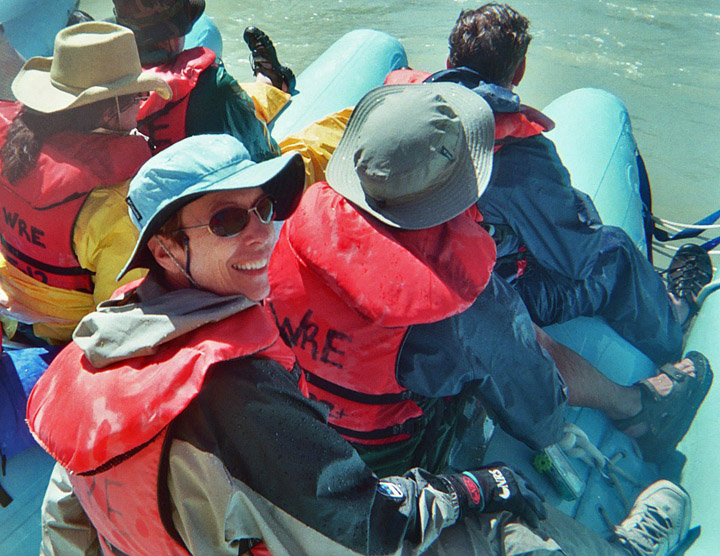
Cora on the mighty Colorado River, 2005


I know that this week you had planned to find yourself on a small raft on the Colorado River with two of your closest women friends—Connie and Shirley. You, the three widows, who’ve each lost a husband in the past couple of years, had signed up for the biggest, baddest, most beautiful river trip around—188 miles of some of the fiercest whitewater and most incredible scenery on the continent.

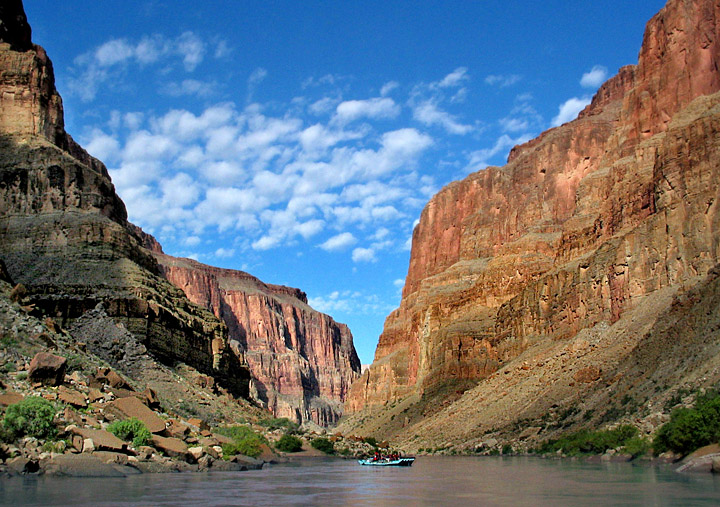
A lovely summer day on the Colorado River, deep in the Grand Canyon. (Photo/Dick Schmidt)


You asked Connie and Shirley to join you, the veteran, on this expedition with a well-known river company and expert guides. This would have been your third trip down the mighty Colorado, and it is not a trip for wimps. I know—after your first river trip, you raved about it so much that Dick and I did one, too, with the same rafting company. It was a change-your-life excursion—for me, at least. Dick had been down that river twice before in the late ’70s and early ’80s, and he wanted me to experience it, too. You’re a different breed of human coming off the Colorado after rollercoastering over whitewater and drifting along the lovely peaceful parts surrounded by some of the oldest rocks on the planet. The word “phenomenal” doesn’t do it justice. And in how many places in the world do you get to see dark Vishnu schist and salmon-pink Zoraster granite? Very few.

You and your late husband Bob, with his transplanted heart, signed up for your first Colorado River trip together in 2004.

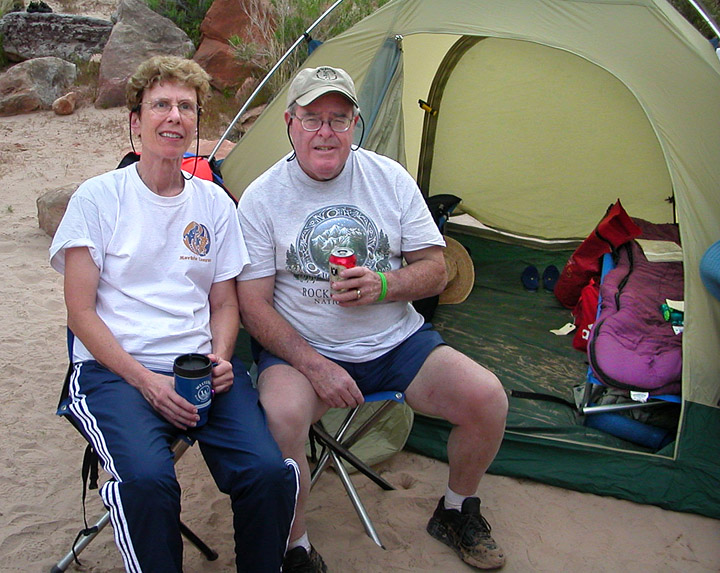
Cora and Bob Johnson at a campsite on the Colorado River, 2005.


You two went again the following year. And now you wanted to show it to your buddies.

Five days before you were to leave for the river trip, you took a different kind of trip. You collided while playing with Bronco, the neighbor’s yellow lab whom you walk several times a week for exercise and companionship. “I felt a pop in my ankle, and I fell,” you wrote in an email. “I knew right away this was not an ordinary turn of the ankle, and I asked one of the neighbors to take me to the ER.” 

There you got the bad news: You had fractured the tibia tip in your right ankle, which is now encased in a knee-to-foot cast.

“The ER doctor told me that there would be no way that I could take the river trip,” you wrote. “I almost started to cry as I couldn’t believe my ears. What? Me not go?”

We can only imagine your disappointment and sadness, even as you said bravely on the phone tonight, “It could have been much worse.”

And you added, in your usual forthright manner, that this sitting around with your foot up was a “pain in the butt. Literally. I’m sitting too much.” (That made us laugh.) And I said something that was perhaps a bit irritating, too—or at least not something you might be ready to hear. “Out of difficulties like this come gifts,” I said. “It’s the ‘when-one-door-closes’ phenomenon.”

You experienced this tenfold after Bob died, eight years and one month after his transplant. Neighbors, friends and family appeared immediately to offer comfort and assistance as you rebuilt your life as Ms. Cora, not so much Mrs. Johnson anymore. Though you miss Bob, you’ve charted an incredible course into your future. One of your most impressive accomplishments—besides being an ambassador for Donate Life, a national organization that promotes organ, eye and tissue donation—is as a float builder.

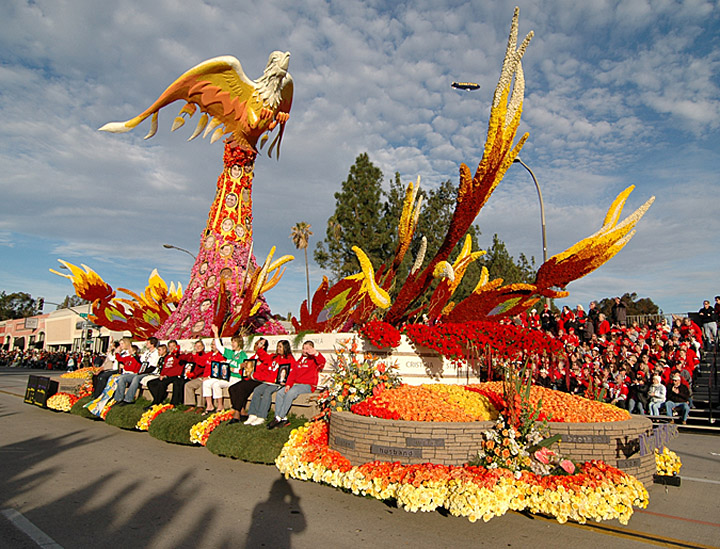
"New Life Rises," the 2010 Donate Life Rose Parade float, which won the Theme trophy.

You’ve worked on two Donate Life floats for the Rose Parade. You donated hundreds of hours to help create incredible, inspiring, giganto floral sculptures, even arranging for a “flora-graph” (shouldn’t it be a “Cora-graph”?) to honor Bob’s heart donor, Tim Baptista, on the 2010 float. That float, “New Life Rises,” won the Theme trophy, and Connie and Shirley traveled to Pasadena to be with you for the parade. Viva tres amigas!


Tres amigas (from left): Connie, Shirley and Cora

Now, in this window of healing time, you get to practice letting other people do things for you. “That’s hard for me,” you said on the phone. “I’m the one who does things for others.” And you will. You are. The neighbors who show up to help or bring food are repaying your many kindnesses over the years. Dick is about to travel to SoCal and hang out with you for several days, be your “go-fer” because you are, he says, “a good person of the earth. She’s Cora.” I wouldn’t be surprised if Bronco shows up with a dog biscuit for you.

This is love in action, and it’s good to let it wash over you now and then like a baptism of healing river water.

I say this as one who finds it difficult to practice patience, especially in healing. I, too, am used to doing, not sitting, giving rather than receiving. But I once heard someone say that if we don’t learn to receive as gracefully as we give, then we’re missing a big part of the circle. And we’re not allowing others to reap the gifts of their own giving.

So this is your time to rest and receive, heal and practice patience, acknowledge the gifts as they arrive. Soon you will be back on both feet, striding confident and strong through the world as you always have.

We love you, Ms. Cora, as do your buddies on the river, as you love all of us. Just wait till next summer when, nicely healed, you’ll take to the mighty Colorado again. Third time—like the first two—will be another charm.

Posted in Uncategorized | 1 Comment

What we learned in kindergarten

Evan Mendonsa is five years old, and he has just completed his third week of kindergarten. He is beyond excited about school. “It’s fun!” he enthuses with the big grin of a shiny new student. He can recognize a few words in one of his books from school—cat, my, a, the—and he can perform what I think is one of the niftiest “jokes” I’ve ever seen.

I should be clear: Evan calls it a joke. I think of it more as a pantomime. I’ll try to explain in words what really should be captured on video. 

Evan begins by standing, feet planted firmly under him. “Firecracker,” he says, then folds his hands in prayer pose in front of his chest and undulates them upward like a swimming fish. When his hands are over his head, he claps them. Then he separates his hands and, fingers wiggling, mimics a shower of fireworks cascading to the ground as he says, “Ahhhhhh!” 

This cracked me up so much, I had to see him do it again. Then again. The third time I joined him. And the fourth. A couple of hours later, when his grandmother, who is my BF, requested one more round of “Firecracker,” he complied and had a roomful of grownups—most of whom have seen this way too many times—laughing. We are easily amused.

Much of this took place in my BF’s bedroom tonight. Earlier in the day she’d gotten out of bed and showered and dressed, something she doesn’t often have the strength to do these days. Then, with assistance from her daughter Jena, as well as her husband Ron, and Evan’s parents, Andy and Tiff, my BF Georgann made dinner for the first time in weeks. Good cucumber salad and chicken, beef and broccoli and cauliflower. Wonderful potato wedges golden from the oven. Fresh Roma tomatoes from the garden. All very healthy.

She continues to struggle, my BF, with the effects of her carcinoid tumors. She is very tired and sleeps much of the time. She is taking new medication to help disarm the carcinoids and quell their very annoying symptoms, but she struggles to have a regular daily life. It is not the first time I have called her a superhero, but she is, though she will deny that.

So it was that we had a lovely family dinner with her kids and grandkids. I got to sit next to her granddaughter Cine at the dinner table, and though she wasn’t much interested in dinner tonight, Cine looked at me at one point and said, “I can hear you chewing.”

I smiled down at her. “Am I chewing with my mouth open?”

“Nope,” she said, “just crunching.”

I pointed out that she, too, could crunch on her bread or broccoli, and Cine grinned a magnificent four-year-old grin. I grinned back and winked at Jena, her mom.

These are the people who keep my BF going these days—Ron and Jena, her primary caretakers (though Cine and Sam the dog and the two cats are big live-in helpers, too). Andy and Tiff and Evan come down the hill from El Dorado Hills frequently, too. This makes Georgann very happy. She is never more content than when she has a house full of her people around her.

After dinner, though, she retreated upstairs to lie down again. I followed her up there, and we had ourselves a girl chat for a couple of hours. Eventually Jena drifted in, then out, to referee the kids. Ron came and anchored a wall. Andy showed up and laid down on the bed near his mom. Tiff took a place on a bed corner. Sam came in with his red ball. The kids, fresh from a bit of a dust-up, appeared. There we all were, surrounding Georgann, as if she were the center of the universe. Which right now she pretty much is. 

She wears all this adoration pretty well, but I know that she will sleep well tonight. I’m pretty sure we pooped her out by the time we left about 9.

I drove home thinking about Robert Fulghum’s wonderful little book, “All I Really Need to Know I Learned in Kindergarten.” The title piece is mostly a list of amusing and poignant things, such as, “Say you’re sorry when you hurt someone,” “Share everything,” “Wash your hands before you eat,” “Play fair” and “Take a nap every afternoon.” I wondered what things will be on Evan’s list from his kindergarten experience.

My favorite item on Fulghum’s list is, simply, “Flush.” Though I must say that I’m also quite fond of this one: “When you go out into the world, watch out for traffic, hold hands, and stick together.” I think that’s one of the most brilliant literal and metaphorical pieces of advice ever.

Evan will learn some of these things and many others in kindergarten this year. Next year it will be Cine’s turn. Jena’s taking science classes in college now, looking to be a pediatrician some day. Tiff wants to go to school to be an ultrasound tech. I’ll be in school forever—or at least until I retire. 

But we learned again that most important of lessons tonight outside a classroom, at the bedside of someone we love who is the center of our universe: that family is everything; that love is, as the Beatles said, all there is; and that this gathering around Georgann is, in a sense, holding hands and sticking together. She is the campfire that draws us. We bask in her love for us all.

And we are grateful.

Posted in Uncategorized | 7 Comments

Clifford

It’s been nine and a half years, almost, since he died, and though I wrote a book of poetry called Companion Spirit about his continued presence in my life since then, it still sometimes surprises me when he turns up.

Like Monday morning, for example. I awoke with that feeling that he and I had just been talking, having a good conversation in some lovely spot. I had no idea what we talked about, but his presence was as warm, as comforting, as the summer quilt atop me. I could feel his presence, barely hear his voice as morning pulled me into wakefulness. A visit with my best companion spirit always feels like that.

So it was that, before a shower, before yoga with Pamela in my back yard, I went to my office and retrieved a round hat box. Two years ago when my niece Lauren moved in, I had deposited these items in that hat box for safekeeping. Now that Lauren has left to make her own life in her own apartment, the medicine cabinet in her bathroom is vacant.

I knew what I needed to do. Right then. 

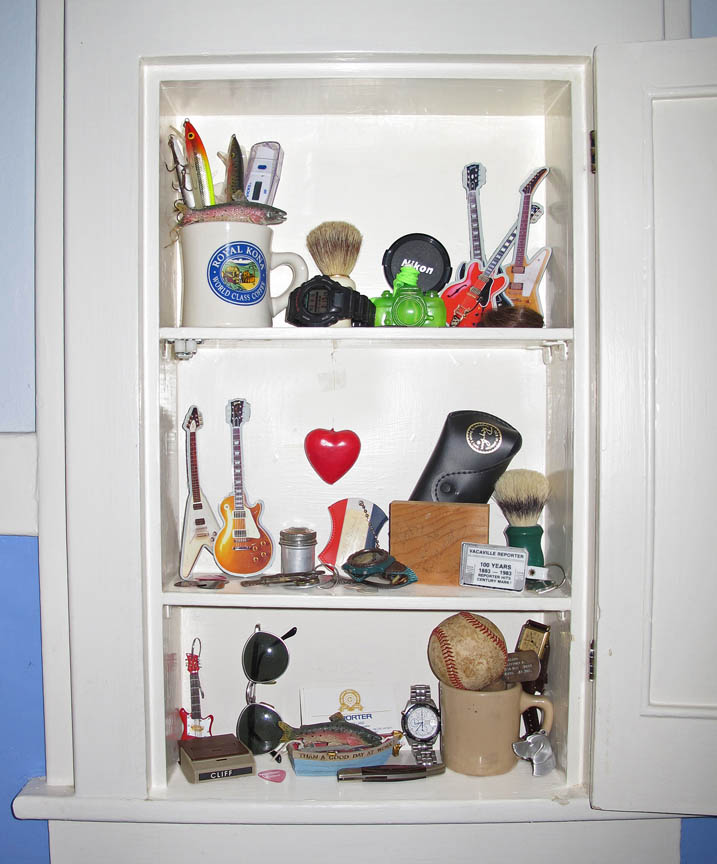
I opened the hat box and took out the treasures, one by one: a scuffed hardball; his last coffee cup; a small key ring with two skeleton keys from his old family home; the last bits of his graying hair; fishing lures, guitar picks, two shaving brushes, a luggage tag, four watches, his sunglasses, a pocketknife, his Coast Guard dogtag, and a square block of wood that he signed, “First cut on new table saw. Love, Cliff.” He did that because I asked him to.

I gathered up all these little tokens of him and put them in the old wooden medicine cabinet because that was his bathroom for so many years.

Clifford's cabinet

It seemed an appropriate place for an impromptu altar. I’ve wondered over the years how many guests go into that bathroom, open the medicine cabinet (c’mon, you’ve peeked in medicine cabinets in other people’s houses, haven’t you?) and are startled by what they see. If they look carefully, they’ll see his business cards from The Reporter, the newspaper where he worked for twenty years. They’ll see a half dozen little guitars—five of them magnets, one an ornament—because he played the guitar in his later years. I imagine him wailing out rhythm behind great lead guitarists in his heaven. He’d like that.

I hope that his heaven has good old dogs and calm fishing holes and a fine woodshop for furniture making in it. I hope there are ripe wine grapes all the time to crush and bottle, as well as heady hopes to make beer. I hope that his heaven has all the best things of his last lifetime, including some of his favorite people, as well as the dogs and cats that preceded him. And I hope that if we do get other lifetimes, his next one is much easier, with a strong, healthy heart, and simpler path. He so deserves that. He put up with me for more than seventeen years of marriage, and I did not make it easy.

I still miss him, and when I do, I can again go to the medicine cabinet, open it and pick up, say, the baseball or one of the guitar picks or his dogtag. And the companion spirit instantly blooms in my heart, in my head, saying something like, “Now Toots…” He’s still my old friend, one who knows me better than most, and he’s still in my life. It was a great surprise to learn that—the dead loved ones return when we need them or want them, too. They’re never very far away, it turns out. And if we’re very quiet and still, as in sleep or meditation, they make themselves known.

I am grateful—beyond grateful—for everything Clifford Ernest Polland gave me and continues to give me. Not the least of which, even from that place just beyond the veil of what I think of as “here,” is his undying love.

Posted in Uncategorized | 5 Comments

The end of summer

Traveling home from Canada is always bittersweet, partly because it means vacation is over and partly because I’m looking forward to getting home to (this is embarrassing) my cats. I know they sit around waiting for me, looking for me. I have this on good authority—not just from the cats themselves. But my across-the-street neighbor Sonya who takes care of my cats (thanks, Sonya!) tells me that they do. I believe her because when she’s gone, her cats have looked around for her when she’s gone, racing to the door as I open it and then shrinking back when they realize I’m not her.

So as Dick and I drove down from Vancouver Island, we made stops in Washington and Oregon to visit with friends who, like us, once worked for The Sacramento Bee newspaper. I left (OK, was laid off) long ago, in the mid-1980s, and had the shortest tenure of, well, just about anybody who’s ever worked there. Dick had the pleasure of a 40-year career (39 of them with The Bee and a most memorable year in Honolulu at the Star-Bulletin) in journalism before he retired.

Our Washington friends, Edie Lau and Jon Williams, ace reporter and photographer/page designer, respectively, amazed us years ago by moving around the country to different newspapers, trying to find a niche. They lived separately for years, even after they married, trying to find the right paper. They eventually came back to Sacramento at the same time to work at The Bee. But now they have found an even better life in Poulsbo, Washington, for themselves, their daughter Riis, their two dogs, Comet and Georgia, and six chickens. 

When we first visited them not long after they’d moved to Poulsbo, where Jon found work on a small newspaper, we were impressed with all the work they’d done on their new home—especially in creating a garden and Jon’s incredible woodwork inside and out. The second time we visited, we were charmed by the Lau/Williams flock of chickens who, while they produce eggs, are more family than food source. Edie told me on this visit that as the girls age, the question of what to do with them arises. Do you let them move gracefully into their chicken dotage or do you put them on the table? 

Edie and Jon say they don’t know the answer to that one—their girls are not that old yet—but I can tell you, especially when we saw Jon holding Kiev, one of their Russian Orloffs—I think the girls will live long, happy lives between their coop and their back yard until they gracefully exit through natural means.

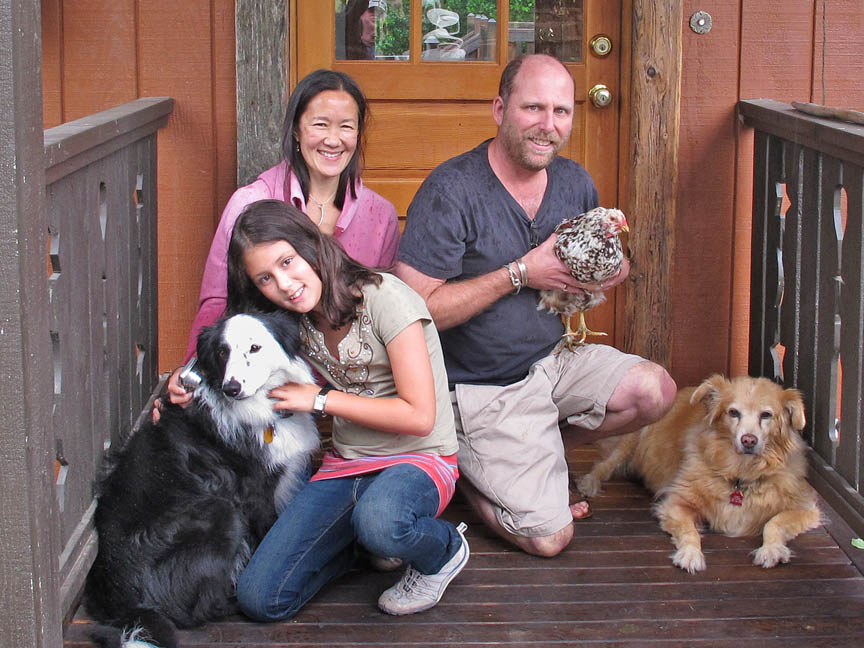
Edie Lau and Jon Williams with daughter Riis, dogs Georgia (left) and Comet (right) and hen Kiev.

Except maybe not poor Kiev, who is, quite literally, hen-pecked by her roommates. She has lost feathers; she is made to sit on all their eggs, to brood, even though there is no chance the eggs will hatch. (A rooster is not in the stars for this flock.) 

Still, Kiev seemed to perk up a bit when the family launched a brief search after she’d gone missing in the yard. Jon picked her up, and though Kiev struggled a bit (hens are apparently not good lap pets), she tolerated his attentions and posed for a nice family portrait.

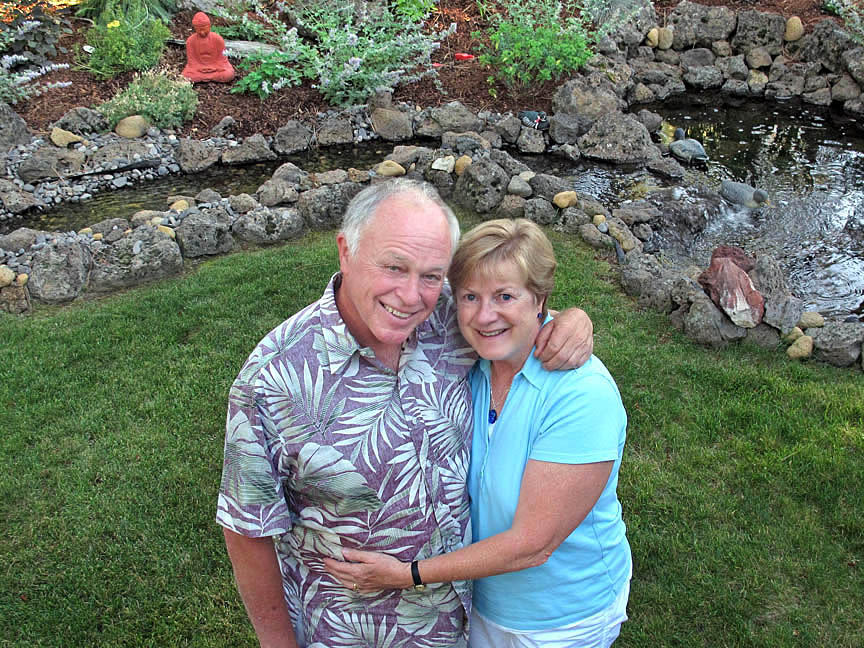
Jay Mather and Diane Russell in Sisters, Oregon

Our friends Jay Mather and Diane Russell live in Sisters, Oregon, and they don’t have chickens—though they do have two cats, Luna and Noir. They left Sacramento only a few years ago, too, and have made a lovely home and yard in the high desert of Oregon. They, too, are both retired (Diane from UC Davis), something I envy even more as I face the onslaught of school again. Jay, a Pulitzer Prize-winning photographer, still shoots for fun, as Dick does, and is an avid bicyclist and woodworker. Diane is a great cook and gardener. Together, they are creating an oasis of peace and serenity there in Sisters. 

This is all to say that there is life after newspapers, though I certainly didn’t think so when The Bee gave me the heave-ho twenty-five years ago. We journalists go on; we even thrive out in the “real” world or, if we’re lucky, in retirement. I worked for other media outlets and enjoyed them before falling into teaching journalism and writing full time. I am grateful for that, too. Sometimes it takes us a while to find our place in the world, that comfortable spot where we know we’re meant to be. Some people never do find that spot.

So I’m still thinking of poor Kiev, the hen-pecked hen, the low girl on the totem pole of her flock, who apparently gets shooed back into the coop to sit on everyone’s eggs. Someone’s gotta do it, after all. Someone’s gotta sit and do the job no one else wants to do. And sometimes, to us non-chickens, it looks like Kiev is under duress when, really, she’s the zen one, meditating to her chicken mantras, knowing she’s right where she’s meant to be.

Posted in Uncategorized | Leave a comment

Starfish and surfers

A word or two about surfing in British Columbia.

Some of you are probably thinking what Dick and I thought a decade ago when we learned about this: Surfing in British Columbia? Isn’t that like water-skiing in Death Valley? Like doing Olympic-style curling on a lava field?

For example, take this exchange with a young woman working in a Victoria café. I said we had just come from Tofino on the upper west coast of the island where it had been foggy all week. That would make it pretty much all of August so far.

“Perfect surfing weather,” she told me.

“Yeah, if you’re an Antarctic penguin,” Dick said later.

I smiled politely, trying to see if she was kidding. She wasn’t.

“I’ve always wanted to try that,” she said. “But it’s hard to get up there at the right time of year.”

“Summer?”

She nodded. “It’s the best time.”

Well, sure. In the winter the waves roll in so ferociously people go up to Tofino on purpose to watch the wicked storms. But the “best time” is a relative concept. To British Columbians, it’s the only time they can surf in Tofino, really.

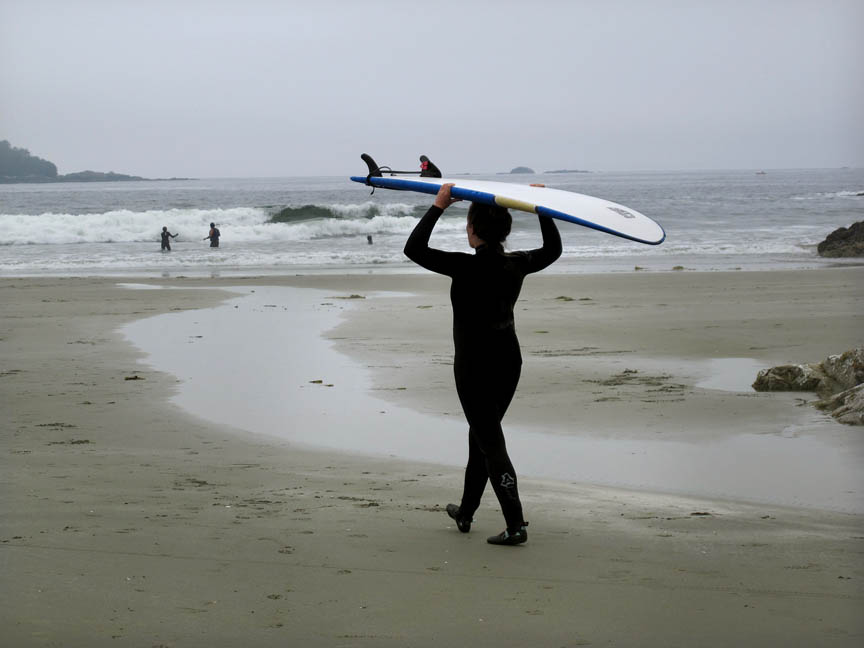
Surf sister on Chesterman Beach, Tofino

We are not accustomed to seeing surfers all in black wetsuits, hoods, booties and gloves. The surfers we watch—sometimes on ginormous waves in January on the infamous North Shore of Oahu—are clad in board shorts and not much else. When they hang ten, they hang ten toes, not booties.

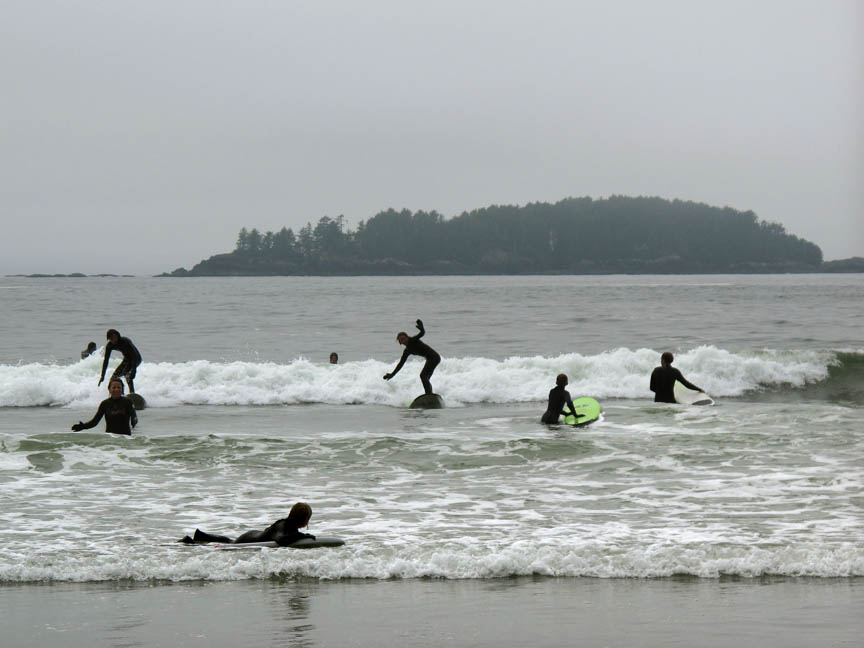
This is not to say that West Coast surfers (which is what they call themselves in Tofino) are weenies. Far from it. But most of the ones we saw were definitely beginners. There was a lot of sitting and stomach paddling. And when one brave penguin tried to rise to his or her feet on a board, it was a quick up-and-down move.

You should understand that Dick and I, who are non-surfers, admire surfers of all sizes, shapes and abilities. We think people who can balance on boards on moving waves are brave, if not crazy. We like to watch.

Which we did this past week on beaches up and down the Tofino coastline. While no one was exactly shreddin’ it (meaning tearing up the waves to Hawaiians and surf geeks), we gave them high marks for sheer toughness.

Surf lessons on Chesterman Beach, Tofino, B.C., in August (aka "Fog-ust").

Though they do look like penguins as they toddle out on these long, flat stretches of packed sand to get to the water. Penguins carrying surfboards.

Yesterday we had lunch at the Wickaninnish restaurant on Wickaninnish Beach. This is not to be confused with the very upscale Wickaninnish Inn, whose restaurant The Pointe, we also dined at this past week. The Wick restaurant on Wick Beach is in Pacific Rim National Park, which makes up a big stretch of the Tofino peninsula. Up and down beaches like Chesterman and Long Beach and Wickaninnish, the fledgling penguins in surfing classes take to the frigid waves with their oversized boards. They are as funny to watch as real penguins, and just as serious.

I should point out that in all fairness, they do have some sunny days in Tofino (four of them, usually in July), and if you look at websites, you’ll see those sunny-day surfing-in-Tofino photos. It can happen.

But we also walked a chunk of Wick beach at low tide to see what marine critters were hanging around. As a kid I grew up next door to Sue Lester, who desperately wanted to be a marine biologist for much of her young life. Sue taught me a lot about fish and marine life, and one thing I’ve always remembered is that it’s bad form to tickle a sea anemone lounging around with its tentacles unfurled in a tidepool.

“You’re making it think it’s got food,” Sue would chastise me when I did this.

But I used to love tickling the anemone. Their pale green tentacles feel a bit sticky and soft, and with their bellies up, so to speak, they look like a cat ready for a tummy rub.

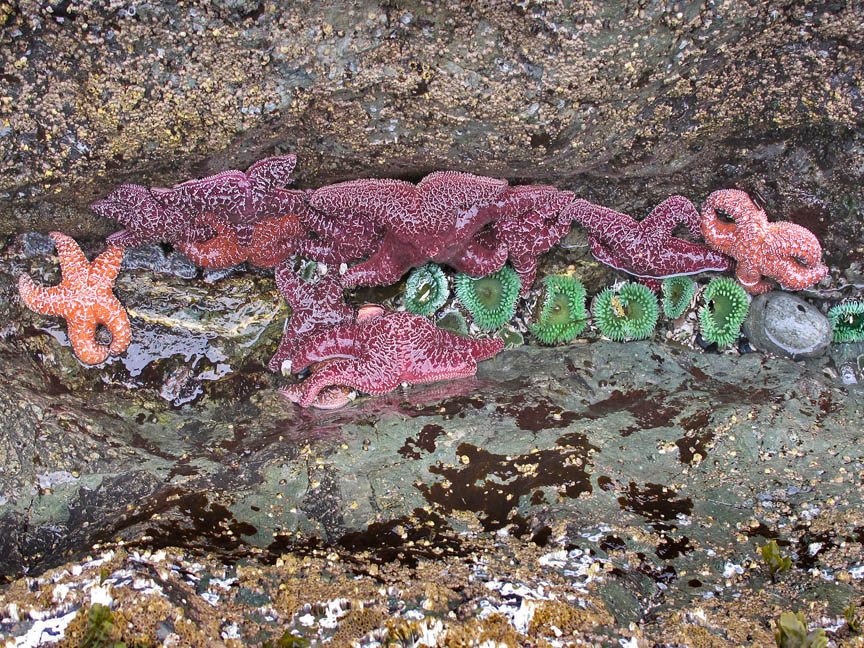
Anemone report: The anemones at Wick Beach are very happy cats. There are, roughly, a kabillion of them on and around the rocks at low tide. Even when you’re walking on sand, you’ve gotta be careful not to step on the babies that are as tiny as nickels. But they grow. Some get to be as big as softballs.

(Sue, if you’re reading, I did not tickle any anemone on Wick Beach. Not one. I just admired them.)

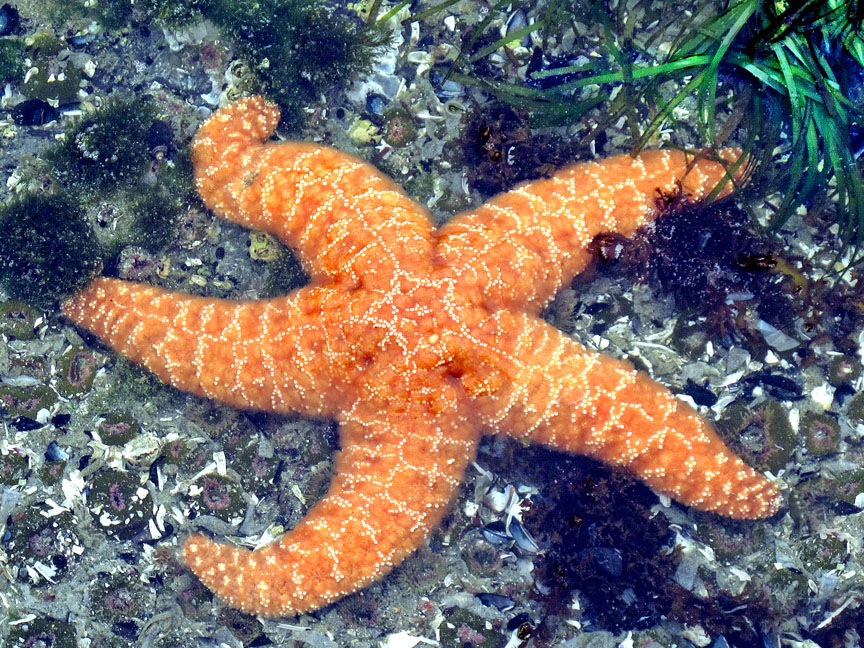
And if the anemone were happy cats, the starfish were sleeping puppies, some sprawled over each other like litter mates.

Happy anemone and seastars on Wickaninnish Beach.

One seastar arm tossed across another seastar’s back, orange over plum-coloured, mashed onto rocks so tightly you couldn’t pry them off with tire irons. Not that you’d want to. (Though we did find dead, dried-out stars on a log in Campbell River. They didn’t get there on their own, I’m afraid.) They’re so pretty in their natural habitat. I petted a couple of star backs, but they don’t react like anemones. They play possum really well, sleeping on like contented puppies with full bellies.

This comprises a happy day for me: Watching penguin surfers on foggy beaches in British Columbia, eating a nice lunch inside a nice restaurant, walking the tidepools to see thriving anemone and seastars. And, finally, retreating to a nice hotel where I stayed up late into the night, fine-tuning the novel like a word mechanic, adding details and deleting superfluous words and redundancies.

The big news (the lead, which, yes, I am burying) is that I am done with this novel. It’s been reworked three times now, and I’m calling it finished at long last. The next challenge is to find it a home, a Real Publisher who will bring it into the world, preferably in Canada where it is set, where my fictional characters live and work and love—in my mind, at least, and on paper, too.

Thanks to all of you who have been so supportive of my journey into this novel, into this world of Ocean Falls, for the past (can it be?) five summers. I seem to only work on it during my brief summers, and it’s taken what feels like forever. But it’s ready now for the eyes of the Canadians who have helped me with it. And a publisher—please, God—who will give it a good home and bring it into the world.

Fingers crossed—here we go!

Posted in Uncategorized | 4 Comments