When it’s your birthday month, gifts show up daily—often a photo card emailed with some version of your face (so many years of face to choose from) on it.
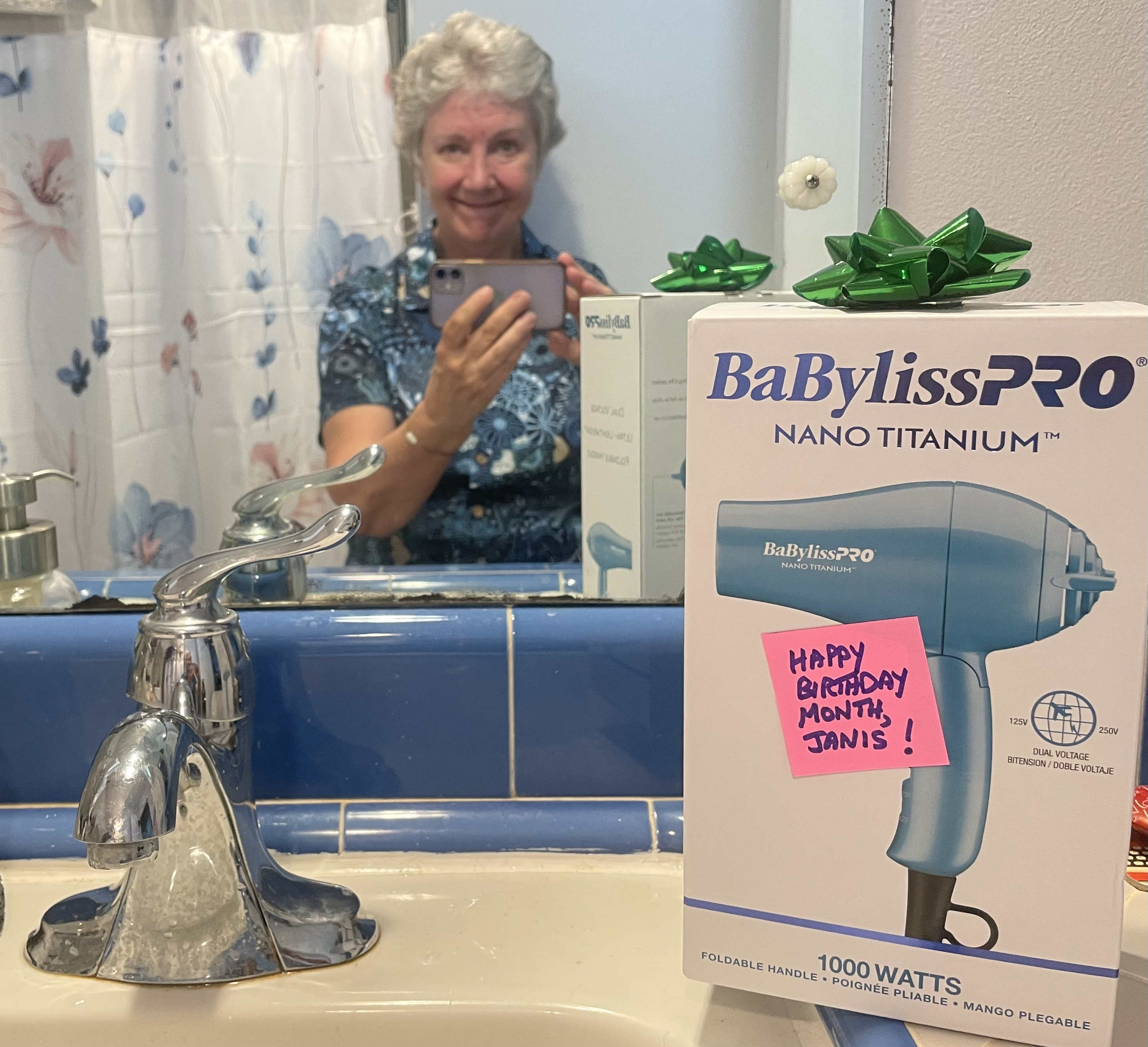
And one day you come home to find a box with a bright blue hair dryer waiting for you, the older one having lost its high speed, to which you can relate.
Because this is what he does, the man who says he loves you in a hundred ways: He makes sure you have your favorite hair dryer—two of them— at his house and yours,
all the hot air you’d ever need, with your smile on electronic cards that remind you how long he has loved your aging face, how long you’ve loved his, the best gift of all.
…sometimes it is necessary to reteach a thing its loveliness, to put a hand on its brow of the flower and retell it in words and in touch it is lovely until it flowers again from within, of self-blessing…
—Galway Kinnell, from “St. Francis and the Sow”
•••
All the years I stood before students in classrooms, I reminded myself
that I was not their ultimate teacher— though I doled out assignments and grades.
And, if I remembered, I’d say that my job was to teach best what I most needed
to learn—often nothing about writing or putting out a newspaper or publishing
a literary journal, not how to write an essay or a poem or make a photograph.
The best teaching, I learned, is often what what we reteach ourselves—that we have
voices worthy of the page, even if we imagine that we don’t. That our words
matter. That we are lovely beings, coming just as we are to the world,
to the table, to sit with each other and listen, as someone reads,
and we watch them flourish from within, giving us the great gift
of themselves, which now becomes part of ourselves, a sweet blessing
as we hold their words gently, listening to each other as we
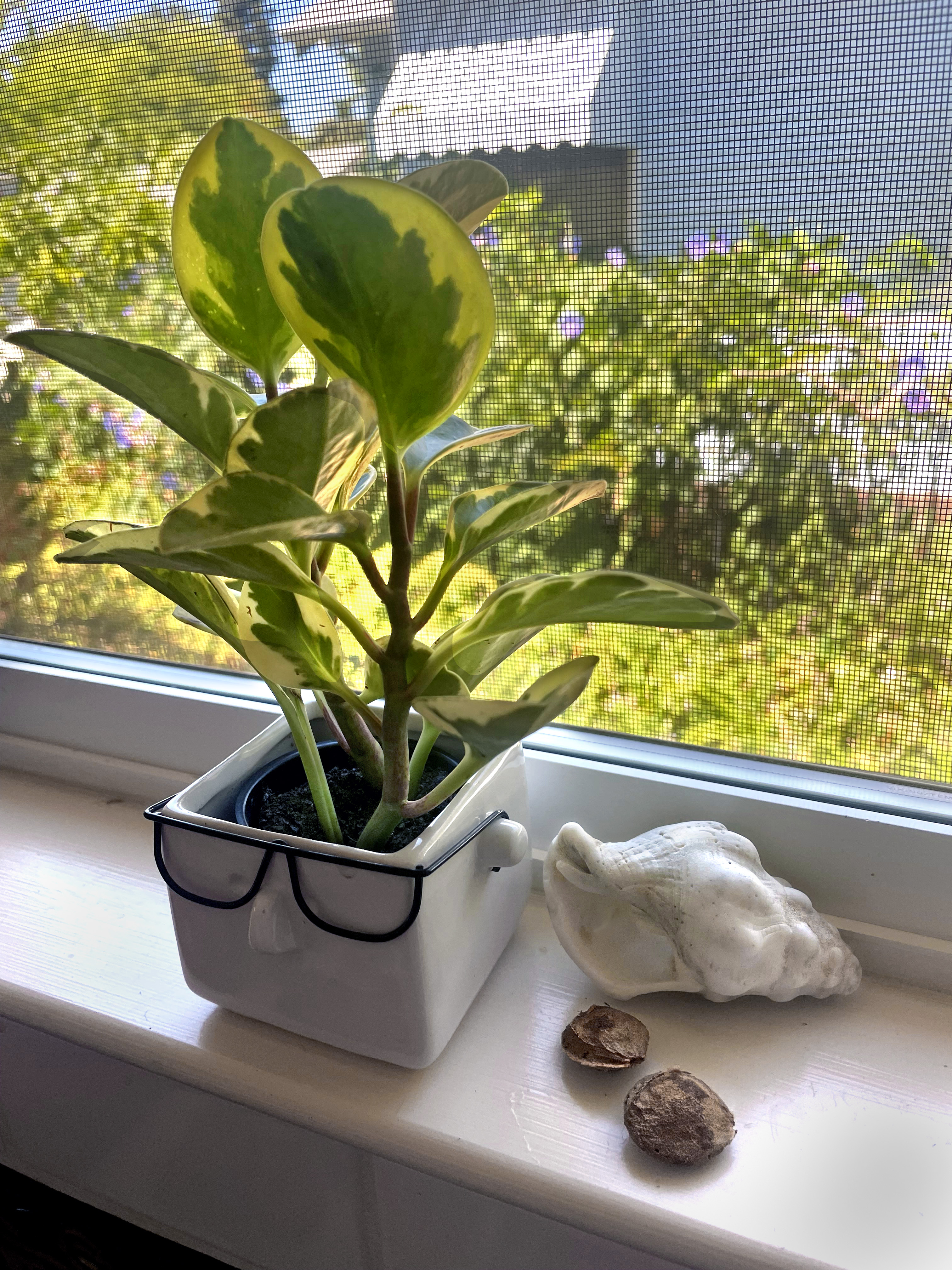
Odd things appear on the kitchen windowsill— this week two apricot pits that, if I had a compost pile, should go there, or perhaps tossed with the loose tea in the flowerbed where the rangy volunteers might find some sustenance in my leavings.
I watch the golden pits dry more each day, skeletal ovals that produced something luscious from Gail’s tree in the backyard where we gather to exercise on Tuesday mornings, this place of abundance that she and Amy have made together.
I savored those apricots, wanting to bite into them at their peak of sweetness, feeling their gold fuzz on my lips, not imagining that a week later I’d still have the essence of what made them, pearls from people who share what grows around them, whose arms, to my surprise, open upon my arrival, and mine open, too.
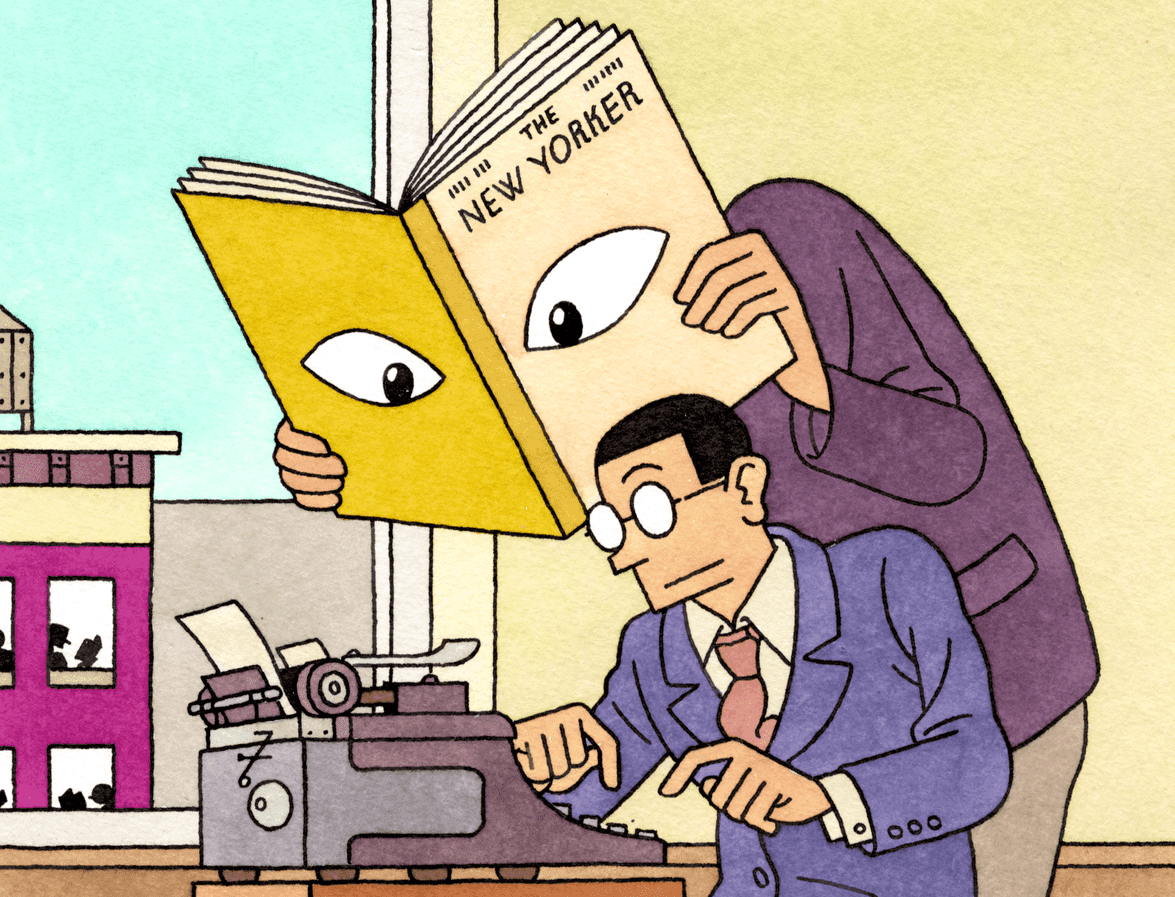
I wish I could have been there a century ago, sitting in what I imagine was your decidedly un-hip apartment, you brainstorming from a sprawling, padded armchair, your wife Jane at the typewriter—the two of you birthing a magazine with input from assorted writer and artist friends.
I fancy myself among your hip crowd, which, of course, you did not call yourselves, because you weren’t yet the literati of New York, the ones anyone who was anyone wanted at their parties.
I’d have given anything to sit next to Mrs. Parker, as you called Dorothy, even if she hit me with one of her zingers, and listen to Mr. Benchley joyfully trade clever lines with Mr. Woollcott. And over there, quietly in the corner, Andy White, the wizard of short essays, still decades away from penning Charlotte, the spider, and his beloved Katharine, the sterling fiction editor, who shaped some of the best writers of the 20th century.
And if, by some chance, I could have had a word with you, I’d have asked if there might be a spot for me on your soon-to-be beloved New Yorker, the magazine destined to weather a whole century, the best of the best,
whether you could foresee it or not, your dream come true, one that so many of us admire to this day.
Sincerely yours,
Jan Haag
•••
Harold Ross (a high school dropout-turned-newspaperman from Colorado who read dictionaries and Fowler’s “Modern English Usage” for pleasure) founded The New Yorker magazine with his wife and co-editor Jane Grant (the first woman reporter in The New York Times city room) in 1925. That was after Ross had been to war and edited the Army’s Stars and Stripes newspaper, after which he served as editor of three other New York magazines.
The New Yorker thrived under Ross’s leadership until his death in 1951, becoming a source of in-depth reporting, political and cultural commentary, fiction, poetry and humor, which it maintains to this day.
A departure for today… instead of a poem, a reminiscence of our friend and former Sacramento Bee colleague Walt Wiley, who died July 13. Sending much love and gratitude to him and to his many loved ones, especially his devoted family.
•••
I cannot quite wrap my head around two facts: that next month it will be 20 years since Walt Wiley, one of the best journalists ever to pound a typewriter, retired after about 37 years as a reporter and columnist for The Sacramento Bee. And the fact that his old journalistic friends like me must now put a -30- around Walt’s name—the newspaper code for the end of a story.
Walt Wiley died in Sacramento at age 86 on July 13.
I am certainly not one of Walt’s oldest buddies or colleagues, though I met him when I worked at The Bee as a copy editor in the early 1980s. And I was not a regular at the too-early breakfast gatherings Walt and other former Bee folks (Steve Gibson as well as my partner Dick Schmidt, among others) convened in the last 15 years or so at the Tower Café and Café Bernardo—though I did make periodic appearances as a former “girl reporter” (my term that made them laugh; these thoughtful feminists would never have used such an chauvinistic phrase).
Walt Wiley, Steve Gibson and Dick Schmidt at Tower Cafe, Sept. 24, 2019
But I was a great admirer of Walt’s writing, especially in his Roads West days, when he’d travel through western states looking for unusual stories and even more unusual people to profile for The Bee. And in Walt’s last three years at The Bee, writing a weekly column that consisted of smallish “items,” I was delighted to be one of his sources when the well was running, if not dry, then low.
Walt compared his job to the Greek myth of the boulder-pushing fellow named Sisyphus, telling former Bee colleague Bob Walters that a columnist must start rolling the rock up the hill every Monday, only to find it at the bottom the next week.
I was teaching journalism and advising the student newspaper at Sacramento City College when Mr. Wiley (as I loved to call him) would ring me at my old-fashioned desk phone and say, “Haag? Wha’cha got goin’ on out there? I’m suckin’ wind here.”
This never failed to make me laugh, knowing that he needed another item or two for his column, as he checked in with sources all over town who might have just the right tidbit. I was delighted when I could offer him some campus-based ideas.
Naturally, I invited him to the college every semester to talk to my journalism students, who loved his Texas twang that Walt never quite lost, along with his great stories. In return, they’d share some of what they’d dug up on campus—and quite a number of those pieces became items in Walt’s column.
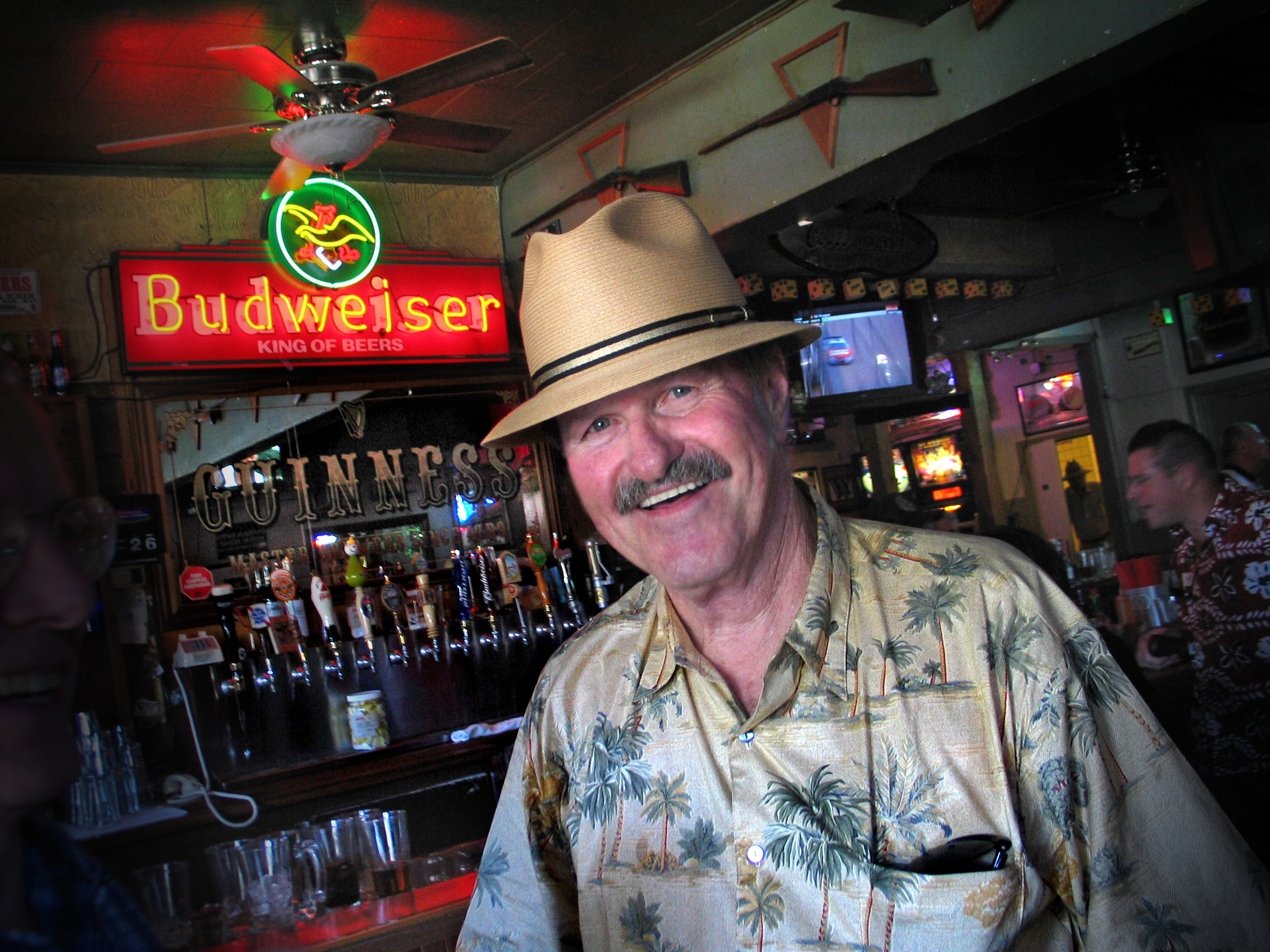
Walt Wiley at his retirement luncheon at The Zebra Club, Aug. 26, 2005 / Photo: Dick Schmidt
So it was, when Walt’s last column ran in the Bee on Sept. 1, 2005, I was surprised and touched to find my name in a who’s who list of local folks who had offered him potential items from time to time. I can’t recall a journalist printing the names of people who’d offered those precious snippets of information—some of which worked for his column, some of which didn’t—but there was Walt naming more than 20 of us.
I’d been a journalist at newspapers, an international wire service and a magazine, and I’d never thought to compile a list of sources, much less to thank them publicly. But that’s the kind of classy guy Walt Wiley was.
He was also a fine writer, as well as a careful reporter, though he pooh-poohed that. From a story he freelanced to The Bee eight years after Walt retired about spending a summer as a volunteer campground host at Lassen Volcanic National Park:
“…My last day on the job a German shepherd ventilated the back of my blue jeans (and the underlying flesh) just as I was preparing to head home.”
That’ll make you want to read on, right? (Also “ventilated” is a pretty nifty verb.) I also got to hear Walt read when, on many occasions, he trudged up the steps to an old midtown loft where I hold writing groups, and he sat in and wrote “for fun.” The quotes are his. Like many reporters of his era, Walt wrote for food, for a paycheck. He didn’t generally write “for fun.” But he did now and then because someone urged him to, knowing he had great stories he’d never had published.
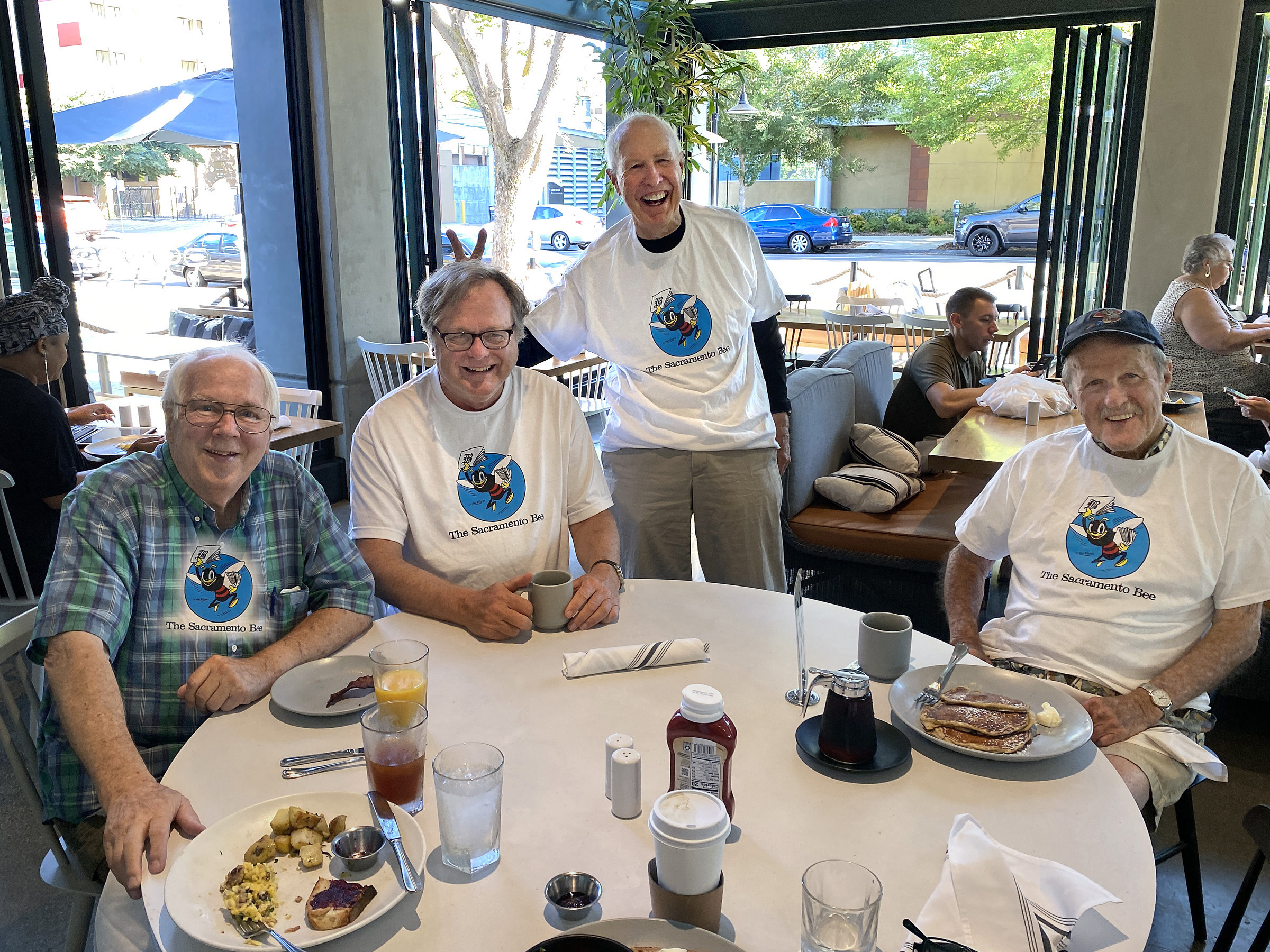
Retired Sacramento Bee staffers (from left): Dick Schmidt, Bill Lindelof, Steve Gibson and Walt Wiley, Sept. 24, 2019
I published a couple of them in a small chapbook I put together annually for the people who write with me. Walt didn’t think much of his pieces, though he got a kick out of being included with (and I think this surprised him) some excellent writers. It was certainly not his pinnacle as a writer, but it reminded him that he wasn’t done as a writer, that he still had words to put on pages.
I never stopped reminding him of that, no matter how much he “pshaw”d me. And that’s how I’ll remember Mr. Wiley—as a fine writer, as a careful, responsible reporter, as a gentle man of great character and humor. May his great voice (suckin’ wind or not) live on.
Walt Wiley and Steve Gibson, Orphan Café, April 10, 2013 / Photo: Dick Schmidt
Perhaps it’s the tree of my dreams grown larger, the horizontal branches that cradled me now softened by memory.
Or is it the dreaming tree, that long gone, leaning oak in my childhood back yard? I have known many other trees,
loved plenty of them—whether visiting and giving them a friendly pat or living near these vertical neighbors
photosynthesizing carbon dioxide and water into oxygen to formulate the very air we breathe. They stand
in my front yard, summering— the great Japanese maple and the little green fans shimmering on the gingko.
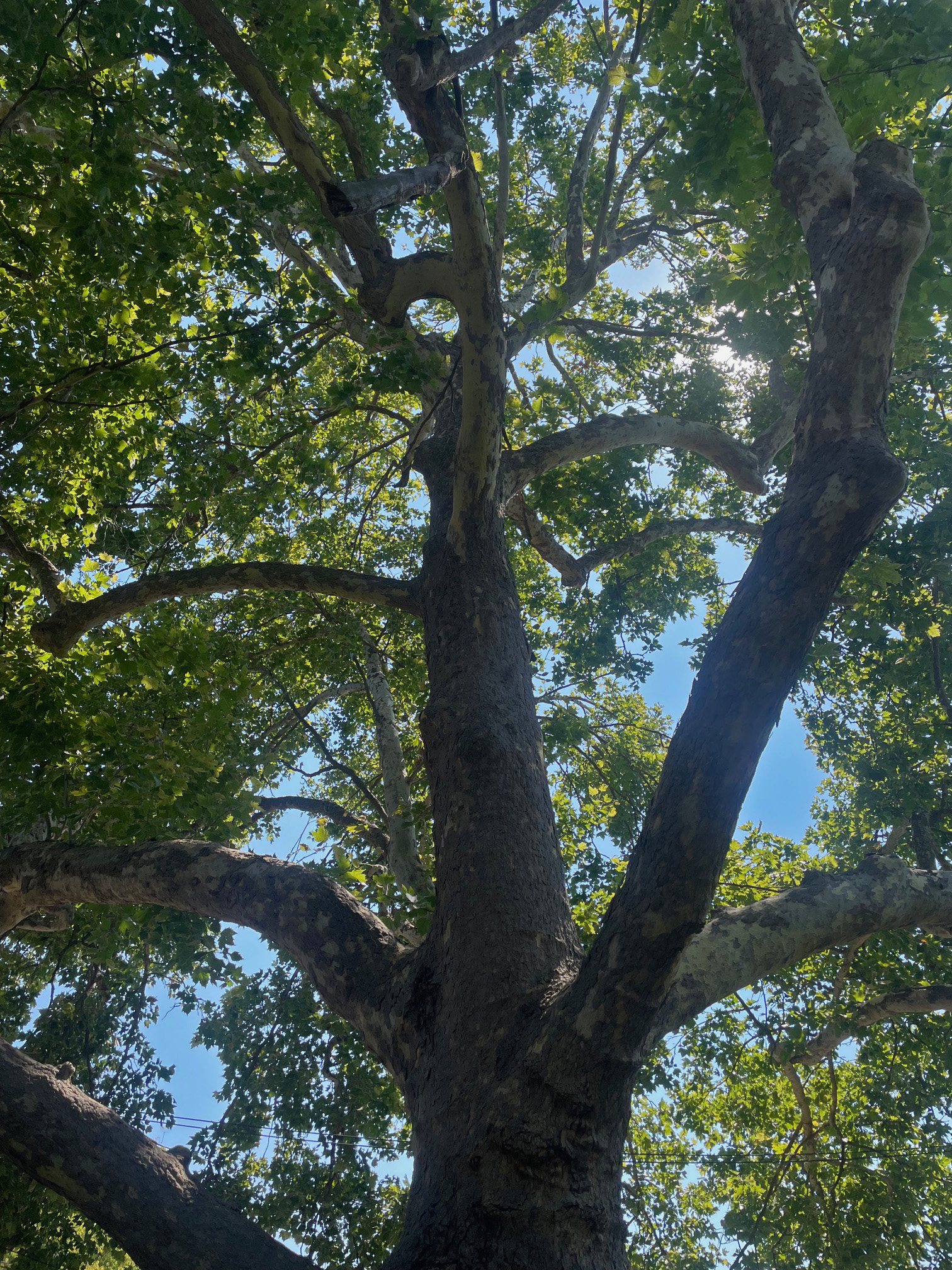
I love to tarry beneath the towering sycamore in the back, its umbrella of shade lingering over two houses.
It is the great-grandmother of the block, one of our oldest ancestors, having lived here far longer than we have.
And the neighboring sycamores, too, planted in front yards up and down street after street, dreaming
their arboreal dreams, shading us as they have for nearly a century, when this city was much younger.
We hope they survive us. We hope they continue to hold up the sky.
•••
Remembering Julia Ellen Cook Behrman Portz, born this day in 1916—mentor, friend and spiritual teacher— who taught me the finer points of meditation while sitting in a great oak tree in her back yard.
The backyard sycamore fully foliaged / Photo: Jan Haag








 Güd wrtr