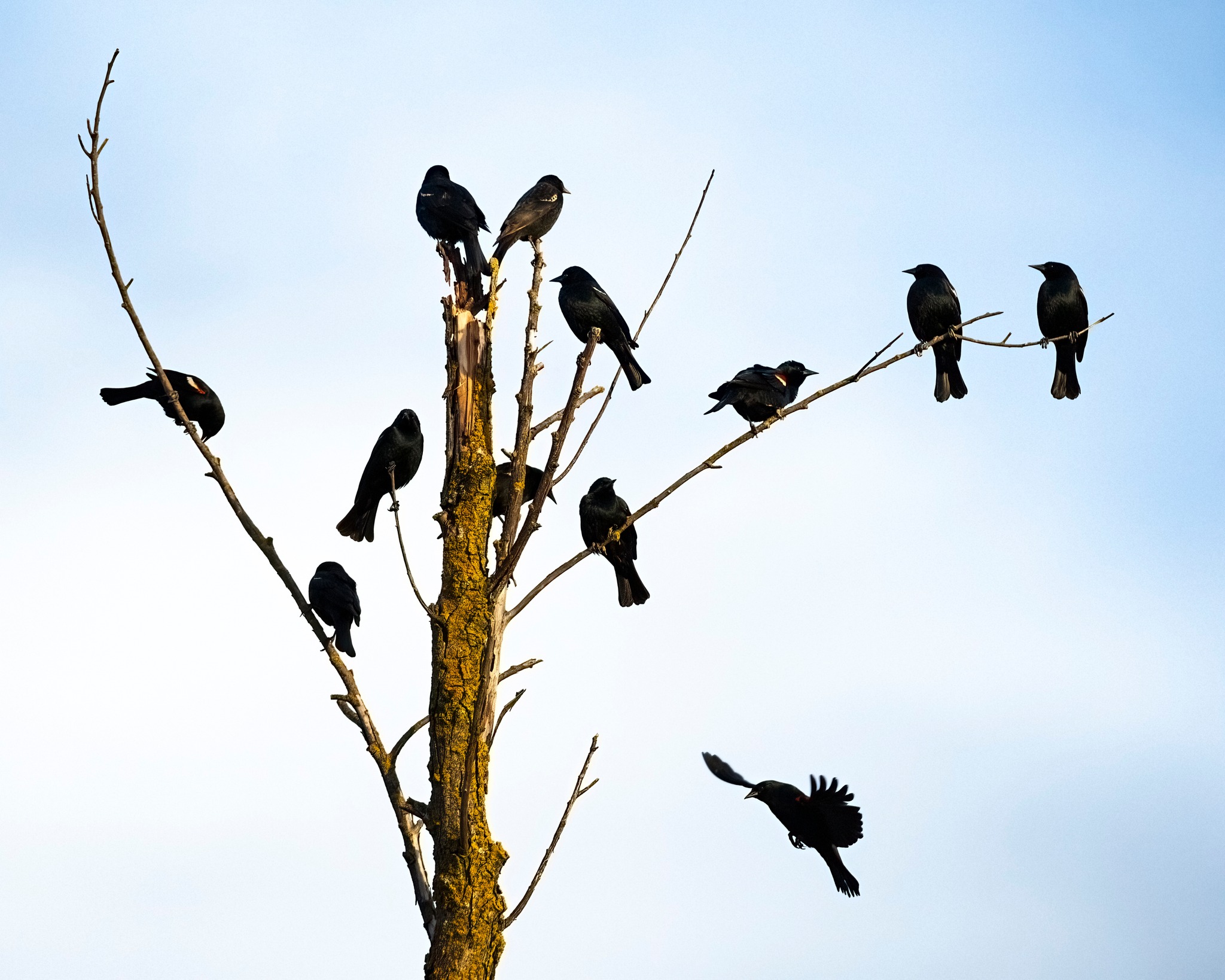
1. Yes, they have red on their wings, but they are not red-winged blackbirds.
2. Only breeding males look this glossy, this fancy, all spiffed up for the ladies.
3. They may sing in the dead of night, but they don’t have the same lovely voices as their red-winged cousins.
4. They’re found in marshes and adjacent fields.
5. Once they bred in immense colonies in natural freshwater wetlands of California’s Central Valley.
6. In the 19th century flocks could consist of hundreds of thousands of tricolored blackbirds.
7. Their numbers—like the birds themselves diving for insects—have plummeted.
8. Since then the population has declined from several million to fewer than 200,000.
9. Because so much of their marshy habitat has been lost, they are endangered.
10. Because they now often nest in fields where grain is grown, harvesting can destroy tens of thousands of nests.
11. But hope is the thing with feathers, after all, and birdfolk report seeing tricolored blackbirds flying in weed-filled fields set aside by farmers.
12. Take these broken wings and learn to fly.
13. All your life, you were only waiting for this moment to arise.
•••
Thanks to Sir Paul McCartney for the best blackbird poem/song ever.
You can see a one-minute video of a recovering tricolored blackbird colony in a weed-filled Central Valley field here.
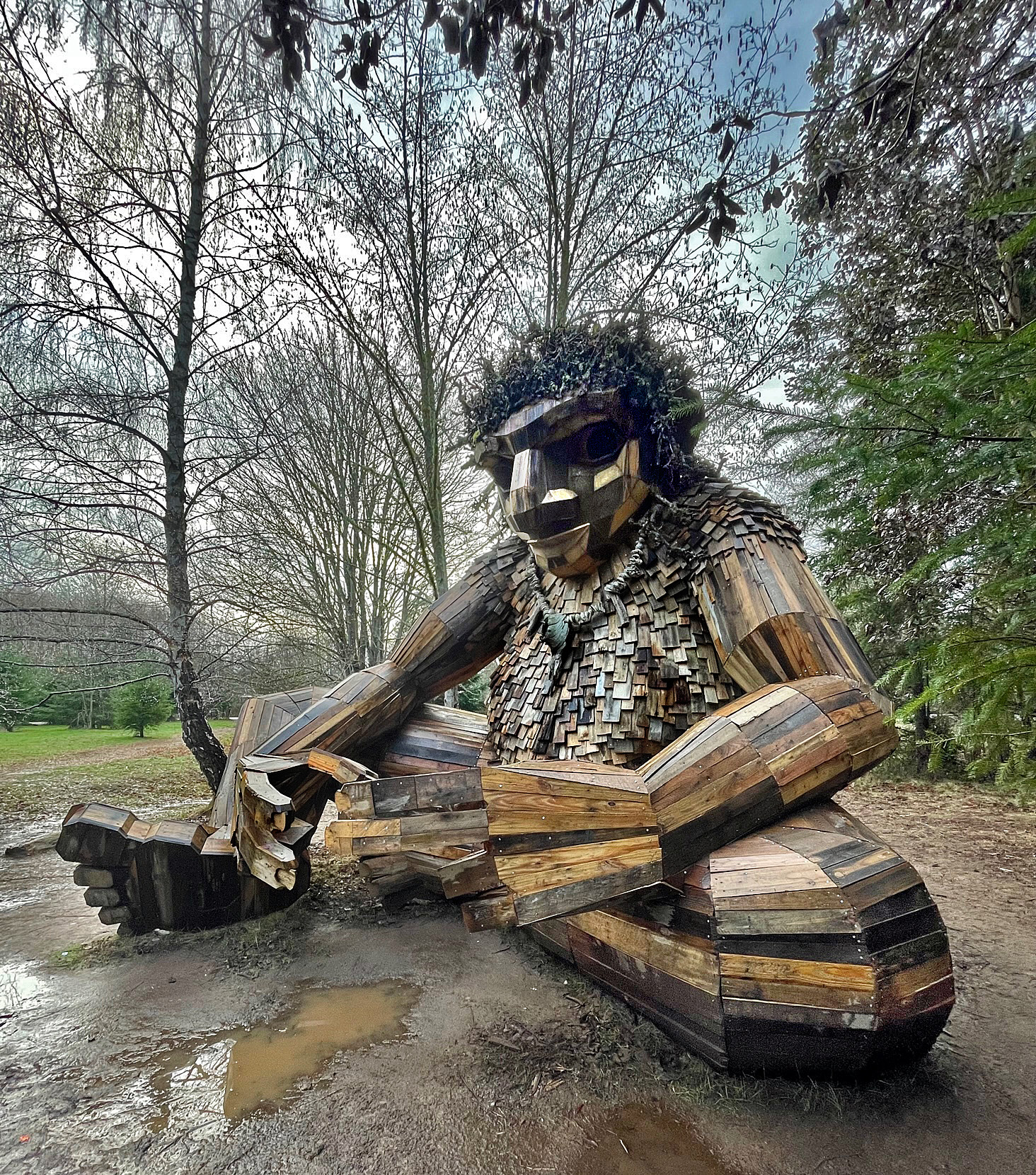
She’s a storyteller, Pia, sitting in a forest glen on an island where someone I loved once lived.
My best friend, writer/storyteller, would admire curly- haired Pia sitting serenely amid the trees,
a sweet smile on her face, her large hands ready to embrace anyone who steps into them.
Which I do as another writer/ storyteller friend takes a photo of us,
we story spinners here and gone,
wide-eyed in wonder as this whimsical being, sitting quietly, holds so much peace in her gentle, giant hands.
•••
Pia the Peacekeeper lives on Bainbridge Island, Washington, and was built over seven days in August 2023. She’s made entirely of recycled materials by Danish artist Thomas Dambo, who has done more than 100 giant troll sculptures around the world. She is one of six Dambo sculptures in the Pacific Northwest.
You can watch a two-minute time-lapse video of her construction here.
You can learn more about Pia the Peacekeeper and the other PNW trolls here,
Pia the Peacekeeper built by Danish sculptor Thomas Dambo (Photos: Jan Haag / Terri Wolf)
It is all very well to survive the abundant months of the spring and summer, but in winter, we witness the full glory of nature’s flourishing in lean times.
—Katherine May, from “Wintering”
•••
And so I winter, here in a place where they have winter, unlike my place, which has, at best, a half-pint version,
except in times of great drenches, which continue to cut swaths through my home turf two states south,
while up here in the mizzle of the Pacific Northwest, winter lands mostly gray and chilly, except for the day
of my arrival when it lived up to its rainy reputation. It is, it turns out, a good place for wintering. To quell
throbbing head and straining throat brought on by the Big Bad Bug, I go commando in the hot tub
twice a day because the last round of this virus taught me that a good sit in sultry water
can quell symptoms enough to make one feel downright normal. Even in winter.
Now I relish the quiet—birds at the feeders go about their business with so little fuss
it’s as if someone switched off their voices. Meanwhile, the greater world conducts its
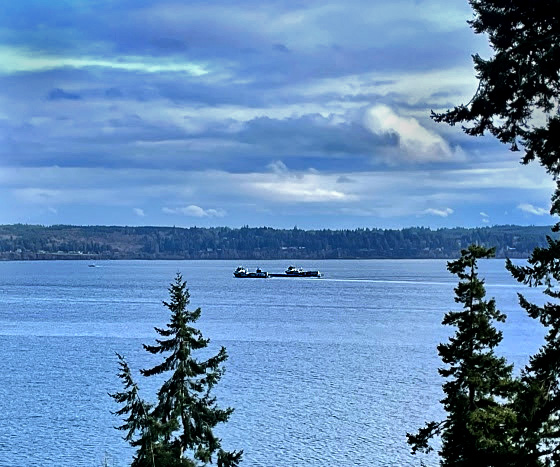
missions: a submarine under heavy escort by weapons-laden destroyers, accompanied
by a tug and small guideboats, lumbers up the canal outside my window, where
eventually, I’m told, it will submerge and head into the darkness of the coldcold sea.
Which makes wintering on land so much more appealing, waiting for what I can’t
control to pass, oddly content, watching muted light dance softly on ship-generated
wake, noticing tiny greening bits arising on the brown-tipped butterfly bush, as,
high up on their patient, slender branches, the alders must be sprouting similar buds,
me down here, marveling that I’m here to see it.
Submarine escort up the Hood Canal / Photo: Jan Haag
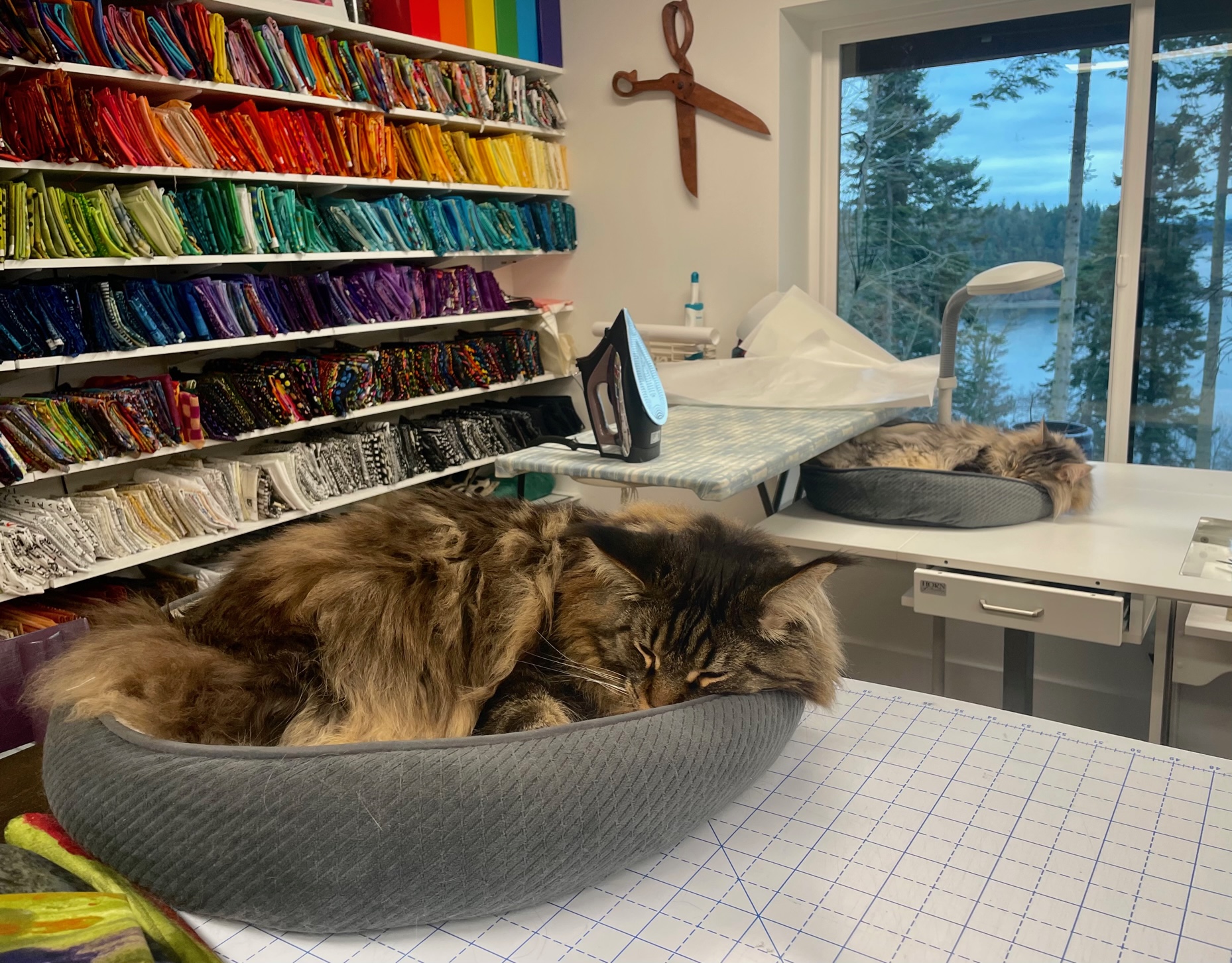
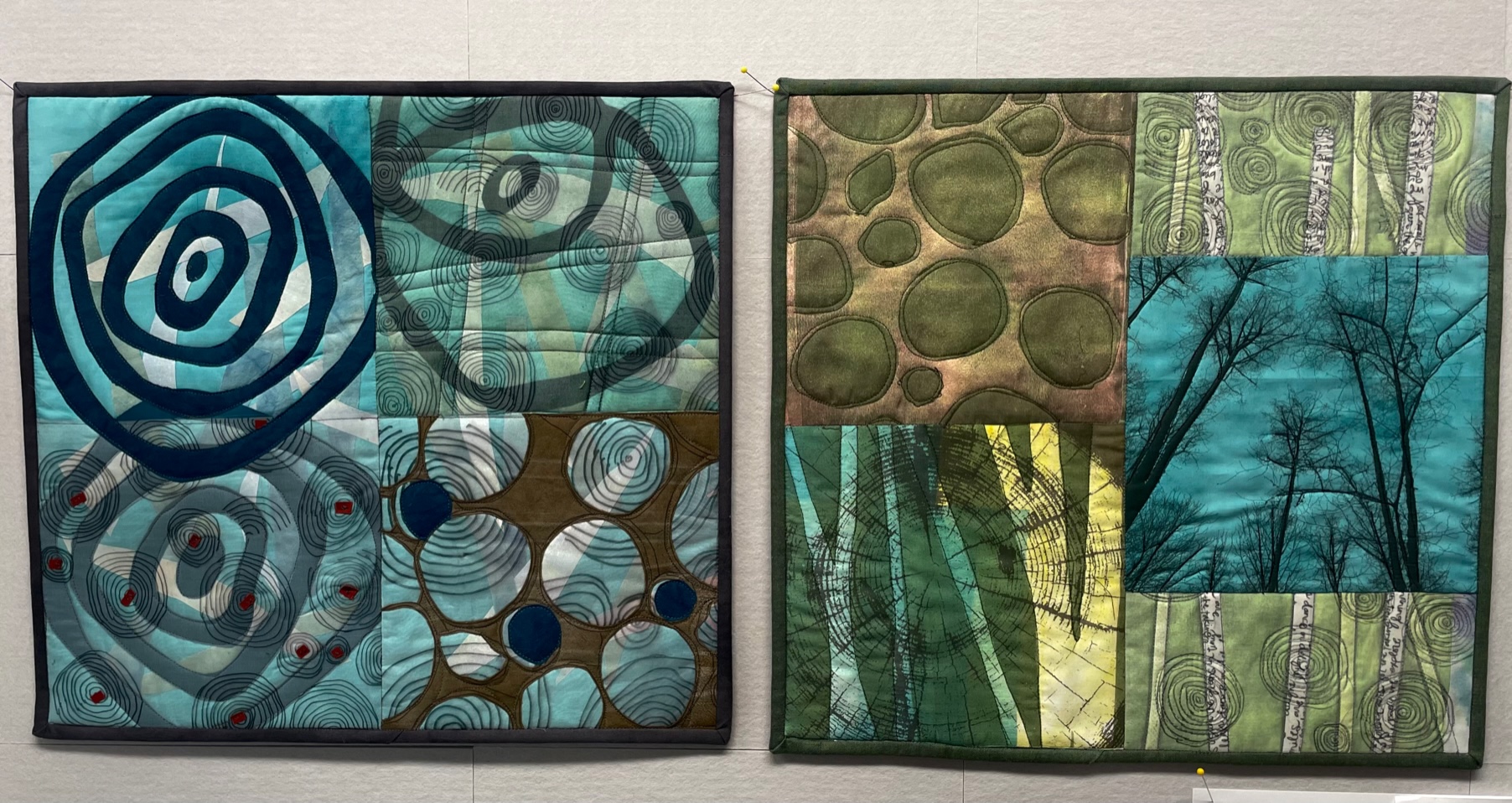
Issac Newton never envisioned a color wheel like this: yards of fabric folded into neat squares,
lined up horizontally on seven shelves, slender volumes of possibility nestled together in a
full-spectrum rainbow—red, orange, yellow, green, blue, indigo, violet. Two more shelves
of patterns, top and bottom, call to Terri as she pauses, runs her fingers over ones
that call to her, looking for the next right piece. Amid such a wealth of material,
I ask, how does she choose? It’s like finding the right word for a poem, she says.
You pull something out, unfold it, consider it, refold it, tuck it back.
Eventually, the right one chooses you, though perhaps not in that moment.
Sir Issac, who figured out the color spectrum in 1704, arranged the hues
in a circle to show which follows which, and which complements which,
a man who understood the permutations of in between, of locating, say, the just
right shade of blue, as Terri finds in a piece of cloth before her. She will cut it, stencil
tree rings onto the fiber, sew slender strips reminiscent of alders wintering
outside her large studio window onto the new square, which will become
a quarter of a larger square. If I look closely, the scent of sleeping trees rises with
words embedded in the textile alders’ trunks, forming a tiny found poem:
leaves dance in delight, joy awaits with morning, shine light for all to see.
may meaning shower pure love on you— precious, beautiful life.
Terri Wolf sews an alder tree-inspired piece of fabric art, the second in.a series of six panels, in her studio in Port Ludlow, Washington / Photos: Jan Haag
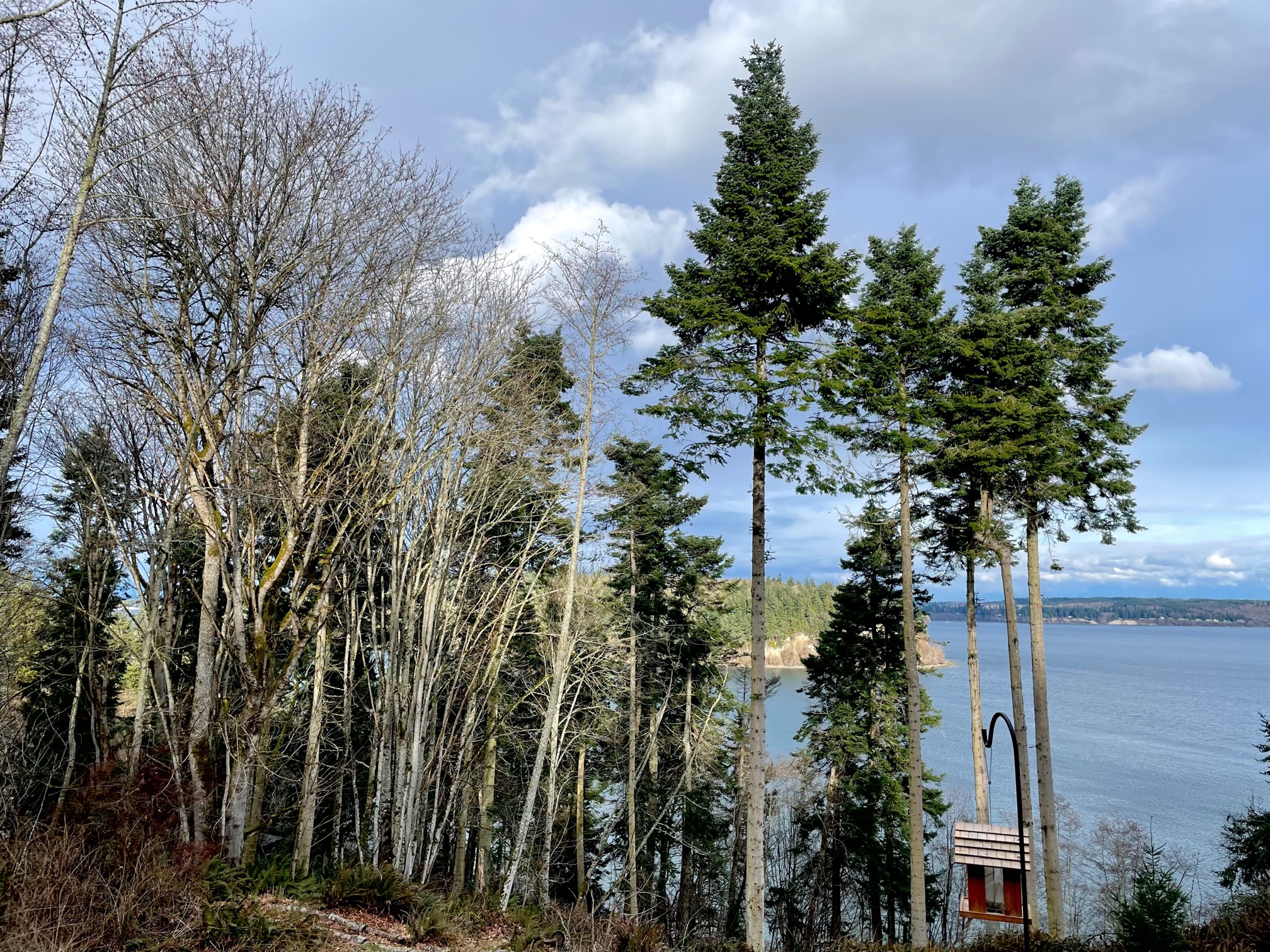
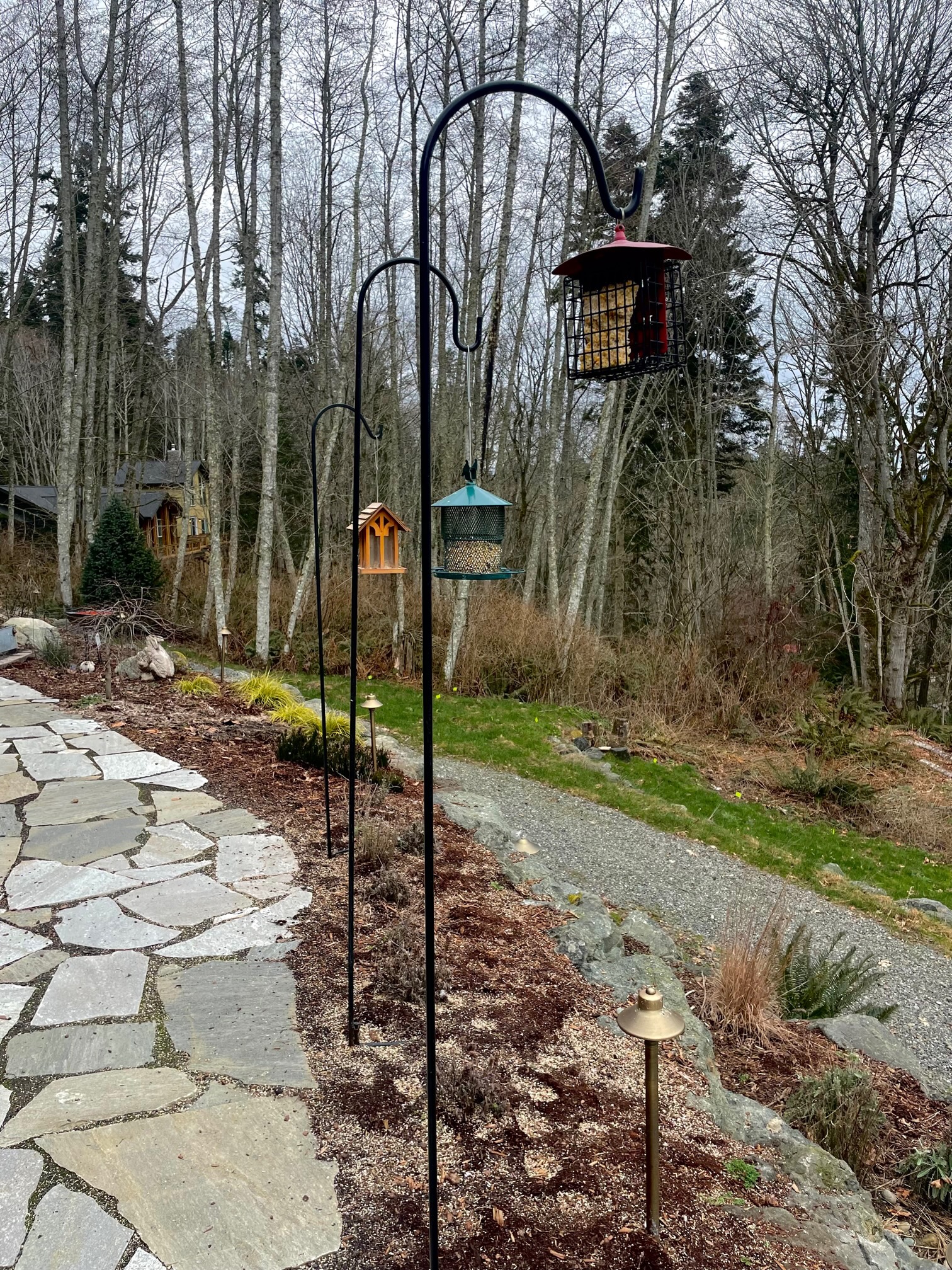
Al’s bird feeders are diligently attended by all manner of small-winged neighbors I see from behind the glass. He has left all five full for the wee birds who flit like butterflies, land, peck and flee, making it hard to see them clearly, much less identify them.
At times like this I wish for the knowledge and experience of my birding friends, who might pronounce one “nuthatch” or “junco”’ or “wren” or “finch.” I manage “bird” or perhaps “tiny, flitty bird.”
Even looking for their likenesses online, I cannot tell—they’re here and so quickly gone. Maybe this one is Sparrow and that one Chickadee. Terri saw Flicker yesterday.
As if it matters. I imagine the birds don’t care who’s who as long as there’s room on a feeder for their winter-cold feet.
Terri and I watch the seed line slowly sink in each feeder, which Al will refill upon his return. I so admire these humans’ commitment to the birds intently watched by Dewy and Quince, the ginormous cats, from their permanent indoor perches.
The birds don’t seem ruffled by the presence of potential predators. Perhaps they know they’re safe from teeth and claws on the other side of the glass.
Or perhaps they’re supremely confident that their quick movements will keep them safe, relieved to find food on the coldest days, these bird-size containers of sustenance thoughtfully refilled with plenty to last them into spring.
Al’s bird feeders, Port Ludlow, Washington / Photo: Jan Haag








 Güd wrtr