for Georgann (Taylor) Turner March 1, 1951–August 17, 2021
“Dinner and books,” you dubbed our best friend dates, and while the restaurant might change, it had to be somewhere in the vicinity of the bookstore— you picking me up in the mini van that doubled as kindertransport for your second set of kids, first fostered, then adopted. The baby seat in the back rattled without Maggie in it, too quiet without Max lisping his way through a song or Emma looking out the window, Ron at home with them all.
This was your escape, and I got to be part of it.
The food didn’t matter; books did. We’d cruise rows of shelves like barflies on the hunt, searching for the just-right specimens to take home for the night, and perhaps, if it worked out, to keep for a long time.
As we added volumes to the growing bundles in our arms, we’d find each other in the stacks, you asking, “Have you read this?” You thought I’d read everything. But I was not the one who wintered with Dickens, summered with Austen, your paperbacks so well-thumbed I bought you new crisp-paged versions to give the veterans a break. And while you heartily thanked me, years later, I found them pristine on your shelves, realizing your preference for softer, familiar friends.
It stands vacant now, that store we circled like sharks. Who’d have thought such an institution could disappear? That you’d be flattened by cancer surgery, followed by a decade of pain, the metastases chasing you two states north because, you said, you didn’t want to die in Elk Grove.
And you didn’t. You’ve hung on all these years, rewriting the definition of Stage 4, stubbornly putting the lie to “terminal” in your rental house by Oyster Bay where the tides ebb and flow twice daily, where Ron mostly tends to you, the kids grown, though Maggie and hers live with you. You delight in your granddaughters, relay their latest antics when I can get you on the phone.
Now you tell me that you’ve fallen again, acquired a new shiner. “It’s a real beauty,” you say. Then, “You should come soon. I have a bookstore I want to show you.”
And though I don’t know if that shop lives in your head or in your town, or if you could stand for an outing to buy books you can no longer read, it doesn’t matter.
“Yes,” I say into the ether between us. “Yes, I’ll come.”
Published in Friendship, vol. 3 of the Lifespan series, Pure Slush Books, July 2021
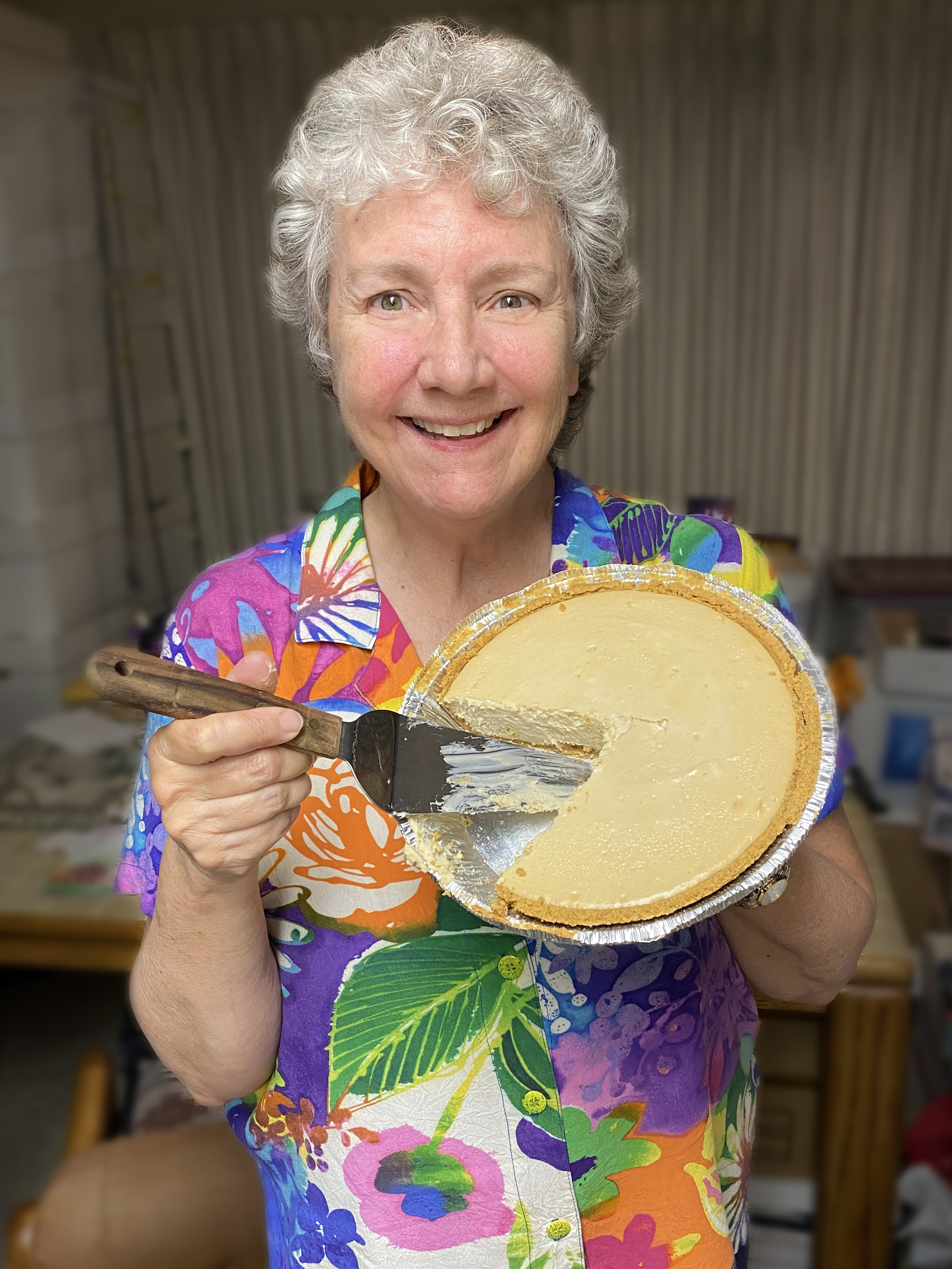
Because she requested it for her 90th birthday party at the end of this week, and because she completes nine decades on the planet today (happy birthday, Ma!), I am practicing cheesecake.
My sister asked our mother what kind of cake she’d like for her party, and she immediately said, “Cheesecake.” And while I know that I can buy cheesecake in any number of places, I decided I’d learn to make it.
This is because Marge Thompson, my de facto sister-in-law (Dick’s sister), who makes the best cheesecake I know, said, “It’s easy.” I’ve long said that I’ll eat anything this woman puts on a a plate. She’s been whipping up cheesecake for decades based on Helen Miniaci’s recipe from a 1950s church cookbook. She gave me a photocopy of the recipe, which immediately stumped me.
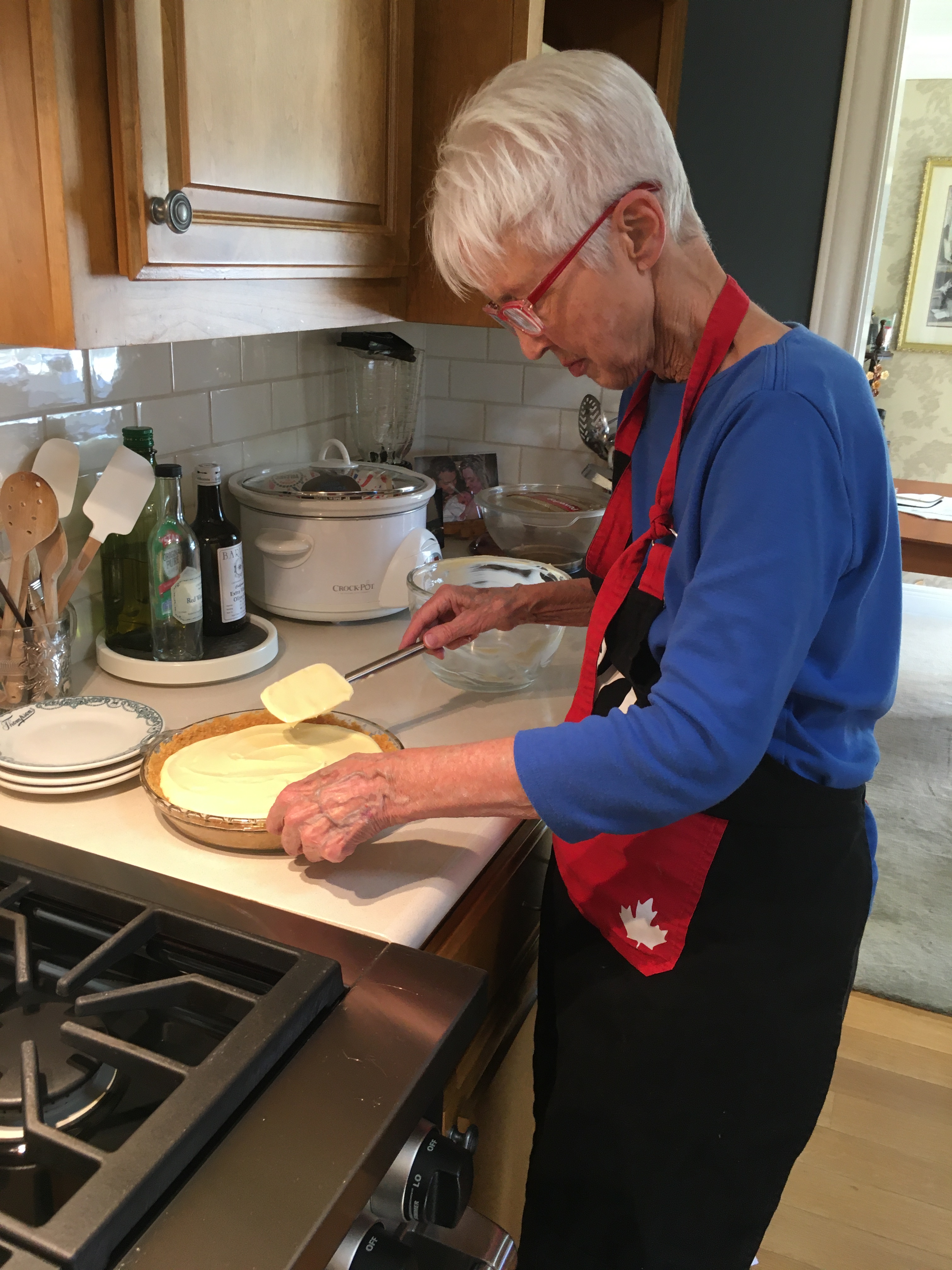
Marge Thompson putting her fine touch on the cheesecake crust.
It begins: “Crust: Crush 16 graham crackers fine…” I did, and it didn’t look like nearly enough to cover a 9-inch pie plate. Then: “Mix: 4 small or 2 large packages of Philadelphia Cream Cheese…” Wait—small? large? I saw only one size at the grocery store. What’s that translate to in ounces?
I asked Marge on the phone. “You know,” she said, “two blocks of cream cheese.”
“Are there two blocks in the little box?” I asked.
“No, just one,” she said.
“But it’s a big block,” I pointed out. “Is that enough?”
Pause. I could hear her rummaging in what turned out to be her fridge. “Noooooo, I don’t think so,” she said. “I generally use two of them.”
“So that’s 16 oz. total then?” I said. I’m not a numbers gal, but if you give me ounces, I can usually make that work.
“I think so,” she said. “I just do it the way I do it.”
That’s when I knew I needed to watch her make Mitchell’s Favorite Cheesecake. And R. agreed.
Mitchell was Marge’s oldest child, Rebecca’s (known as R. in the family) big brother, who, when asked always requested his mom’s cheesecake. To Marge, it was Helen Miniaci’s cheesecake, but Mitch and Rebecca knew better: It was their mom’s. And it was The Best Cheesecake Ever.
“It’s easy, very simple,” Marge always says when someone brings it up. She can do it by heart, but she still has Mrs. Miniaci’s recipe close at hand. I tried it at home alone, making the fatal error of using (horrors!) low fat cream cheese and sour cream, and it was a runny mess. (“Yeah,” Marge said, when I told her, “that’ll do it.”) I couldn’t get the graham cracker crumbs to set with the amount of butter in the recipe, so I added more, and it still didn’t set properly.
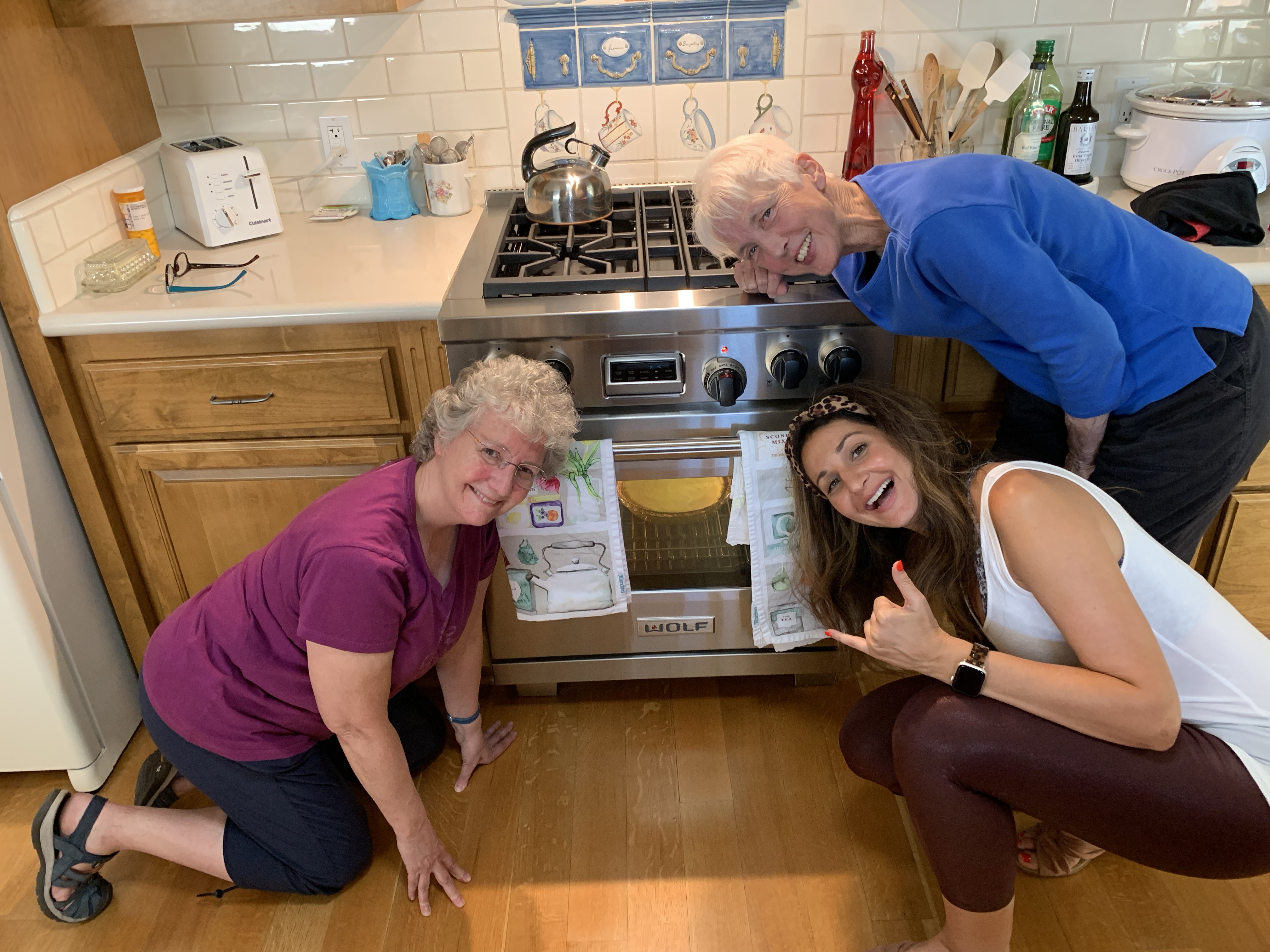
So R. and I decided to get some tutoring from the Cheesecake Goddess herownself in her own kitchen, no less. R. took direction from her mother as I watched, photographed and took notes. This was after I’d tried two other cheesecake recipes on my own—one using premade crust (very easy) and another with a springform pan and five eggs (for me, fancy). Marge thought so, too. Her recipe calls only for two eggs.
And she’s right—it’s easy, once you see her do it, as Rebecca and I asked dumb questions. Like when she rinsed the 1/2 teaspoon measuring thingie out after I squeezed a bit of fresh lemon juice in it for the pie filling. “Oh, you do that so there’s no lemon in there to curdle the cream. Because you need the teaspoon to measure the vanilla.”
Well, we did. She probably just tosses in a perfect splash.
Marge coaches Rebecca in cheesecake.
Mitchell died three years ago at the much-too-young age of 43, and we all miss him terribly, especially his wife Christina and daughter Ella. I imagine that there hasn’t been a cheesecake his mother has made since his death that hasn’t brought Mitch into her mind. He was certainly with us as we practiced cheesecake.
R. followed the recipe to the letter—well, her mother’s instructions—penciling notes onto Mrs. Miniaci’s recipe.
“It’s really a pie,” Marge said more than once, especially as she pressed the graham cracker crust mixture into the pie plate. “Cheese pie.”
“Yeah, but that doesn’t sound as good as ‘cheesecake,'” R. observed.
“But it does taste superb,” I said, a veteran of many a Marge cheese pie. R. agreed.
Once assembled, the cheesecake/pie went into the oven, and 25 prompt minutes (“Do not over bake!” warns Mrs. Miniaci’s recipe) later emerged to cool on a wire rack (“Gotta get me a wire rack,” I muttered to R) as we oohed and ahhed and inhaled its velvety smell.
Today at Marge’s house they can dig into the cheesecake. We all know what it tastes like—creamy heaven on a fork. It really is the best. Mitchell was right.
And Ma, it’s coming to a party just for you this weekend.
Thanks to Margery Thompson, Cheesecake/pie Goddess!
Marge the Cheese Pie Goddess and her proteges.
Margery Thompson’s cheese(cake) pie (“Because it’s really a pie,” Marge says, based on Helen Minaci’s recipe)
Heat oven to 350°
For crust (mix in 9-9.5-inch glass pie plate): • 1 cup graham cracker crumbs • 3-4 tablespoons melted butter • 2 tablespoons sugar
(Press into plate so that crust goes up sides of plate nearly to the rim. Plate doesn’t need to be greased; “there’s enough butter in there so it doesn’t stick,” Marge says.)
For filling (in a large glass or ceramic bowl)
Beat with hand mixer or food processor until very creamy, almost runny: • 16 oz. (2 8 oz. packages) of full fat cream cheese (“low fat doesn’t set up properly”) • ½ cup sugar (“basic white sugar is smoothest and easiest to whip”) • 2 eggs (“add one, beat into mixture, then add the second egg”) • ½ teaspoon lemon juice (“no pulp; tart lemons are best”) • ½ teaspoon vanilla
In separate, smaller glass or ceramic bowl, beatwith hand mixer or food processor until very creamy, almost runny: • ½ pint (“half a pint container; you don’t have to measure”) sour cream • 2 tablespoons sugar • ½ teaspoon vanilla (“rinse lemon out of measuring spoon first to avoid curdling the cream”)
Smoothing the batter into the crust.
Fold sour cream mixture into cream cheese mixture “sloooowly to avoid air pockets” using rubber spatula to gently turn the sour cream mixture into the cream cheese.
Pour into crust, smoothing “gently so it doesn’t pull up the crust” on the sides of the pie plate. (Optional from Mrs. Miniaci: Sprinkle graham cracker crumbs on top.)
Bake 25 minutes (“Do not over bake!” warns Mrs. Miniaci). Remove carefully from oven and cool on a wire rack till completely cool (“a good four hours”) before covering with plastic wrap and putting in the fridge. Allow to chill in fridge at least overnight (“24 hours is better”). Can be refrigerated for up to two days before serving.
Optional: Serve with a berry topping (frozen or fresh).
Everyone says that, I chuckle, but not if you’re as cooking impaired as I am.
You make good brownies, you point out—you, who when you feel up to it, rise and head for the kitchen, and, in a frenzy of cookware and ingredients, turn out meatloaf and couscous salad and so much more, filling two fridges and freezers because you still want to feed your people.
From your residence on the sofa, you offer, Let’s get the ingredients, and we’ll practice cheesecake.
I don’t say, But you’re sleeping 23 hours a day. You can’t stand for more than two minutes, and you’re throwing up hourly. You’re in so much pain and on so many opioids you make Michael Jackson look like a teetotaler.
Instead, I say, That’d be fun, but you can just talk me through it.
By way of answer you reach for the TV remote, which about half the time you remember how to use, and search for the Food Network. Miss Brown will show you how, you say, and I assume that you’re hallucinating again.
I don’t say, Now you think you have friends on TV?
But you find her, Miss Kardea Brown, correct me on the pronunciation of her first name—Car-dee-ay—and start looking through episodes to find me a cheesecake lesson. And you do, after multiple attempts and stutters through cableland, and we watch this Southern chef in her home kitchen make chocolate cheesecake (you can leave out the chocolate if you want, you say) while I take notes.
Afterward you say, You can find all this online, you know.
I didn’t, I say, and you grin at me as I ask a dumb question: What’s this lemon zest business?
You’re gonna need a zester, you say.
What’s a zester? I ask because I must have missed Kardea’s lesson on that.
And, by way of explanation, you struggle to sit, wincing, breathing hard, then swing your legs around to plant your feet on the floor, sigh. Before I can protest, you rise, and I reach for you, swaying.
Follow me, you say, shuffling toward the kitchen, your favorite room in any house you’ve ever lived in.
I trail you, arms outstretched, ready to catch your depleted self, 15 pounds lighter than last month on the scale at the cancer center, as, wobbly but determined, you head directly to the drawer with the magic zester, retrieve it and wave it at me. It looks, my late furniture-building husband would say, like a mini wood rasp.
You need one of these, you say, reaching for a lemon in a blue bowl on the counter, one birthed from your tree on the deck. And you stand with me one last time at a kitchen sink, demonstrating, before handing me the zester caked with lemon rind.
Your turn, you say, coaching as you have long done—the one who taught me to properly iron a shirt, to soothe your screaming foster child, who guided me through potatoes from mashed to baked, who insisted that I read all of Austen and then all of Dickens, your favorites—positioning my hands just so on both fruit and instrument, nodding as we stand in late afternoon light soaring over Oyster Bay, absorbing this, the most tender of lessons.
You have traveled too fast over false ground; Now your soul has come, to take you back.
Take refuge in your senses, open up To all the small miracles you rushed through.
Become inclined to watch the way of rain When it falls slow and free.
Imitate the habit of twilight, Taking time to open the well of color That fostered the brightness of day.
Draw alongside the silence of stone Until its calmness can claim you.
Be excessively gentle with yourself.
—John O’Donohue
Excerpt from “For One Who is Exhausted,” from “To Bless the Space Between Us: A Book of Blessings,” 2008, Doubleday
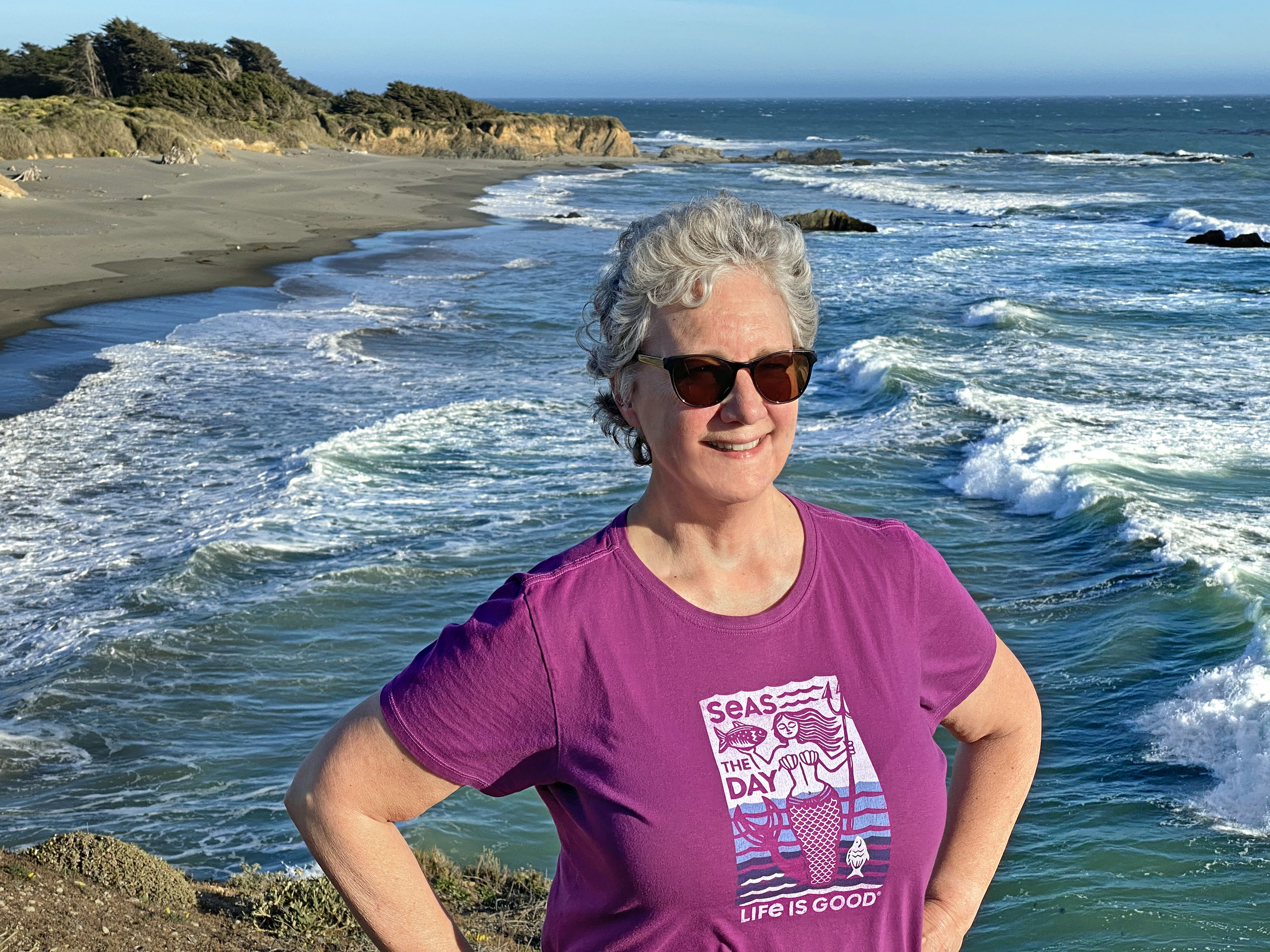
As usual, Dick had the right idea—soon after my last semester of teaching to migrate west to the stretch of ocean that has calmed and healed what ails us again and again. Ten miles of bluff he teasingly calls South Gualala, just below the little town that pronounces itself (as you see on magnets and T-shirts) Wah-la-la.
A perfect place to begin to sink into retirement, to sleep and eat and read and dream for a week at The Sea Ranch, in Casa Pacis, the House of Peace.
Yes, we love Hawaii, but our retreat for decades on this side of the Pacific is here, and our favorite place to rent is a small house on a meadow with an unimpeded view of the ocean near Walk-on Beach. (Thank you, Klaus and Gundi!)
When people have asked what I plan to do in retirement, I’ve said (not really joking), “Sleep through June.” Though that’s not entirely true, Dick knew I’d need to rest and recover from the past 14 months of near nonstop work to recreate myself as an online writing professor. So much energy went into what I knew was my last year of work, but I don’t regret it: This old dog learned a lot of new tricks, as I’ve written before. Nonetheless, I felt as if I was stumbling into the after, as we all are, considering the what-comes-next and releasing expectations.
I’d always planned to retire the summer I turn 63, and that’s what I’ve done happily, but oh, I’ve keenly felt the need to “draw alongside the silence of stone/until its calmness can claim you.”
That’s the best part of our time in Casa Pacis—the ability to walk the blufftop trial, look out at the great Pacific which, even wind-tossed and choppy, as it has been for our last few days here, offers a calm we find harder to access at home.
The late Rev. Harvey Chinn used to tell his flock (of whom Dick was one) that successful retirement means that you wake up every morning with nothing to do, and by the time you go to bed at night, you only have half of it done.
Since I have long had summers of practice retirement, I know what that means, and I look forward to a lot more of it. I told retired folks for years, “I aspire to your status,” and now I’m so statused, another phase of this lucky, lovely life. Now I get to sink in to this way of being, take up friends on their offers of congratulatory lunches and walks, be excessively gentle with myself.
Which we all need to do in the after.
Here’s what I aspire to now: to remember excessive gentleness with self and others; to walks and yoga and gentle exercise to keep me upright and relatively balanced on my two feet; to time with friends and loved ones, including caring for those who need assistance; to delighting in unexpected treasures that appear before you, often at your feet; to time away to recharge because even in “retirement,” I have things to happily occupy me (a bit of gardening, writing, leading writing groups, publishing others).
And to promise myself not to get over busy, caught up in things I don’t want to do, to learn again that saying a polite “no, thank you” is perfectly OK.
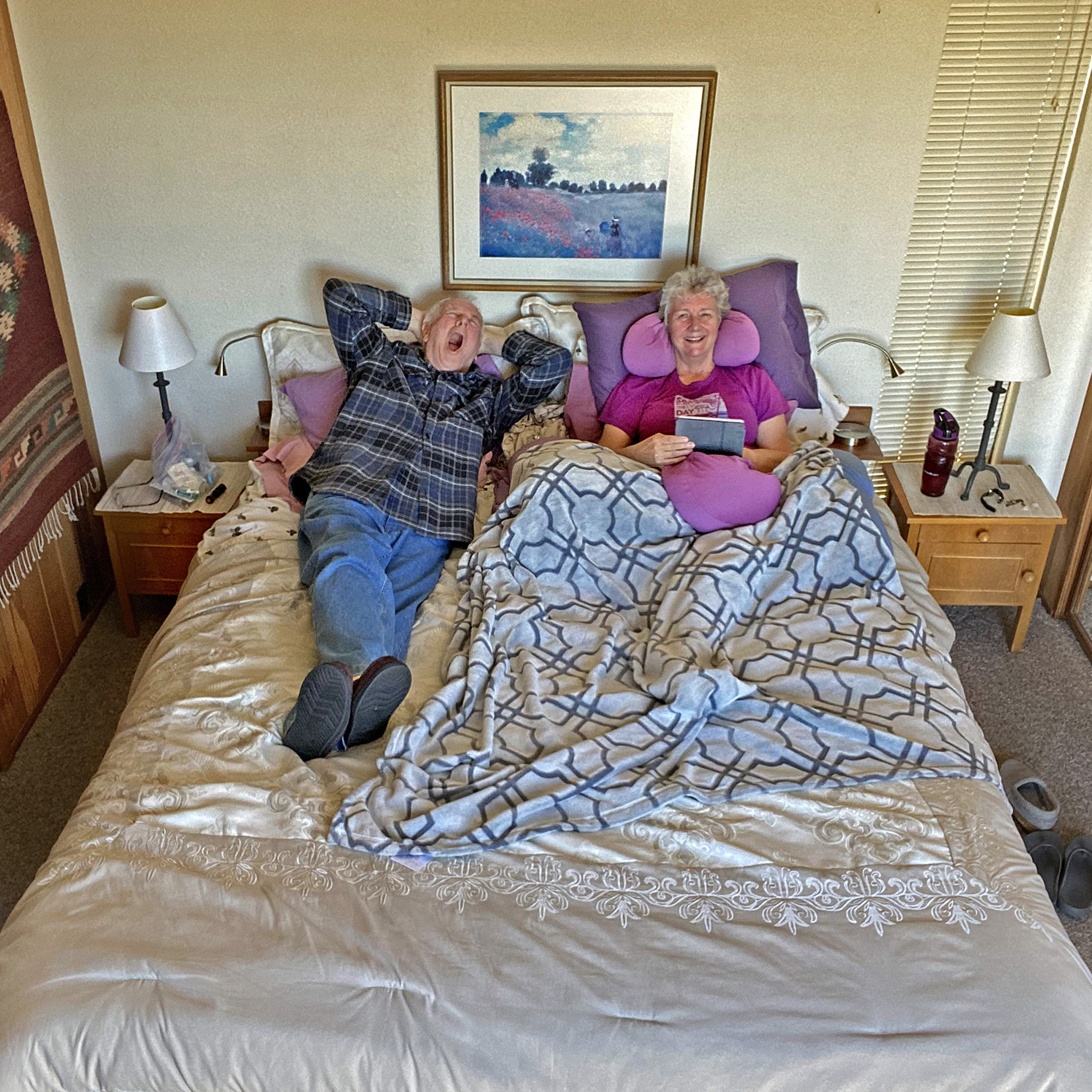
Oh, and take time every day to lie down and read/doze/whatever. Which we’ve faithfully practiced every day here at Casa Pacis. Because, as Dick says about naps, they’re easy, they’re healthy and they’re free. (He’s had a lot of practice at this, having been retired since 2003.)
Here’s to more of that and sweet, unexpected treasures in the days, months, years to come.
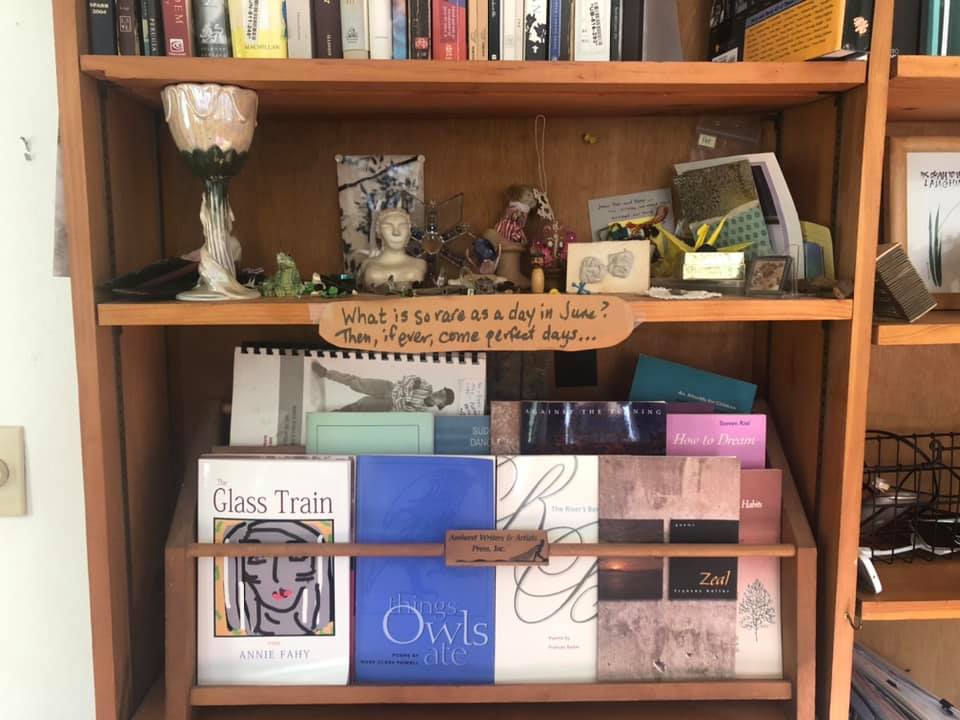
Pat Schneider’s home office, Amherst, Massachusetts, 2017
She lived as a fire and went as a coal on the hearth, yearning for more tinder until there was not one single thing left but the ash of her body and the curling smoke of her will, rising up finally and at last in peace after such a long and beautiful conflagration. It is her first birthday after death. She is leaning on the everlasting arms. Or more likely inspiring the everlasting arms to write. Happy birthday, dear fiery Mom. “What is so rare as a day in June? Then, if ever, come perfect days.” [James Russell Lowell] We love you.
—Bethany Schneider on Facebook about her mother, Pat Schneider, June 1, 2021
(for Pat)
Though you lived near it, the Pacific was not your ocean for most of your life, you Midwestern transplant to the Atlantic,
who deeply admired rivers and streams, arteries flowing seaward. How many visitors did you take to your favorite cemetery
hard by the Connecticut River, to walk among the revered dead, imagine their lives based only on names and dates?
Catharine, wife of Robert, 1779 Thankful, wife of Nathaniel, 1783
Now your stone in another cemetery bears your name atop your beloved’s, he who followed you into mystery
four months after your departure — no “wife of,” no “husband of,” though you two were that and more.
And on the 87th anniversary of your birth, almost a year after your death, I walk the western edge
of the continent, the Pacific peaceful for the moment, temporary occupant of Casa Pacis — house of peace —
as I turn the tiller into the wind. You would cheer this new direction, remind me that
a poet needs time and space to stoke the fires, let the white heat of the muse burn us into ash.
As I stroll the damp shore — white lace surf scalloping black sand — your voice surges, retreats with the foam:
“Enjoy these perfect days, regardless of the weather, so many precious hours with your beloved.”
Thankful, I look to him nearby, smile my silent promise to the horizon in this sea of serenity, forever and ever,
amen.
At The Sea Ranch, Sonoma coast, California, June 1, 2021, on what would have been Pat Schneider’s 87th birthday
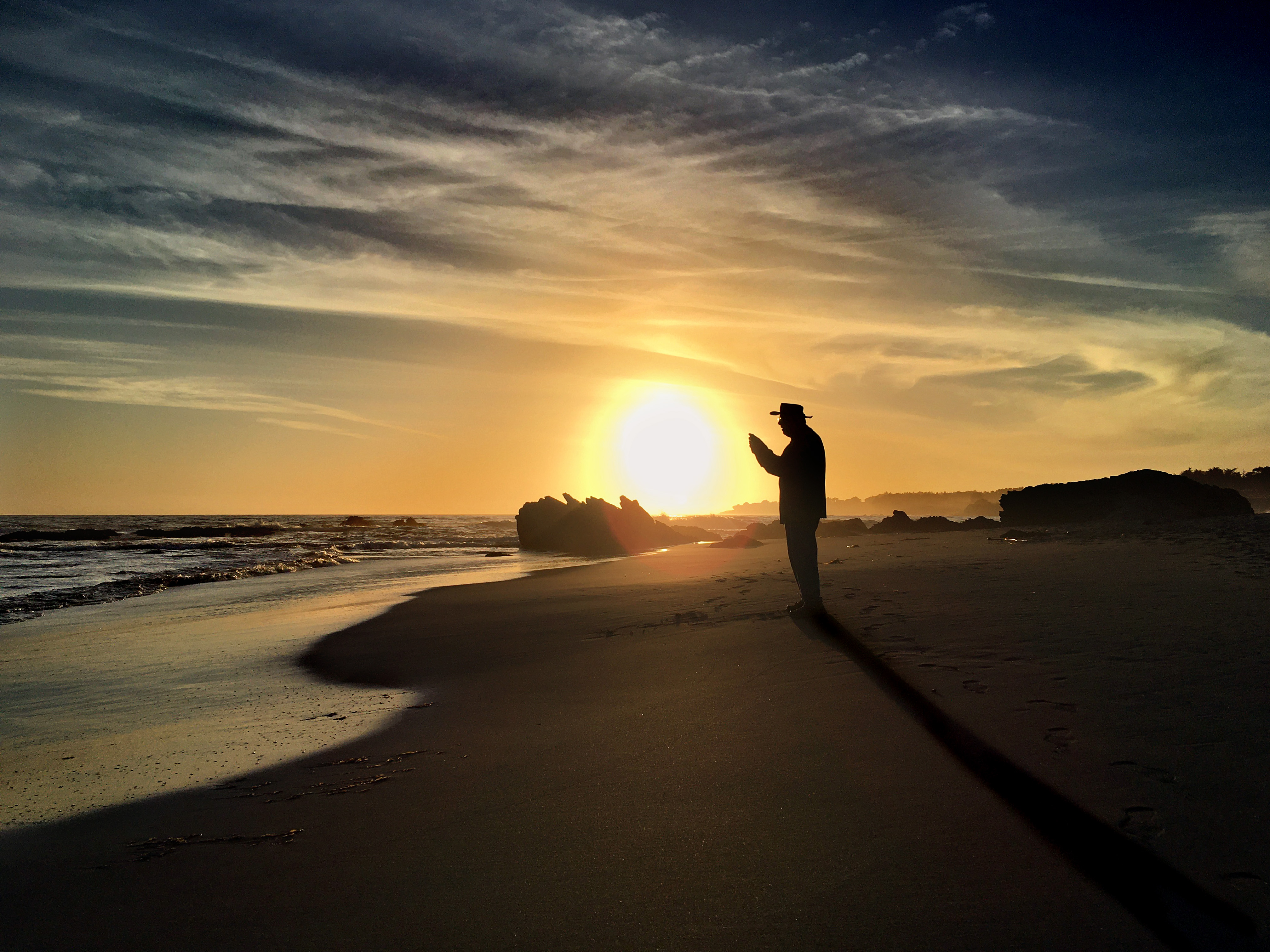
Dick Schmidt photographing at Walk-on Beach, The Sea Ranch (Photo by Jan Haag)
This requires math and, as a writing teacher, I do not math. But let’s give it a go, shall we? Give it the old college try, as they used to say.
Taught my first class in 1984—so that’s (counting on fingers) 37 years. But a couple of those years—maybe three semesters?— I didn’t teach, so let’s round that off to 35 years, since there’s no question that I have grown rounder over three-and-a-half decades.
Of those 35 years I taught full time for (finger counting again) 28 years. No fewer than five classes, usually more, each semester, so let’s offer a conservative guesstimate of an average of 20 people in each class, which would amount to (no need for fingers!) 100 students a semester.
That’s 56 semesters multiplied by 100 students (again, no fingers!) for a total of 5,600 students over those years, but let’s round up to, say, 6,000 plus or minus a few hundred.
I think of those students now, having lugged home home boxes of old class files, as I sort through them one by one, fingering roll sheets for the last time, noting names and final grades, before I hand each file to a 20- something former student sitting cross-legged on my living room floor, who takes each file, uses her slender fingers to remove paper clips and stray metal before carting so many slivers of trees outside to the big blue recycling bin.
I want to say at the end of my final finals week as a professor that I am sitting in my living room with thousands of my former students, that their faces line up before me in classroom-straight rows, that I can envision them all. But I can’t—their smiles and voices and words long lost.
Except for the one before me and others like her in recent years, so bright and young, at the beginning of everything. And as I hand her another file, I study her face, try to memorize it, tuck it in that heart space labeled cherish where, with luck, I can count (without fingers) on keeping it there (along with other beloveds) for the rest of my time.
By my rough estimate I have attended no fewer than 24 graduations in my lifetime. Four of those were mine, if I count the eighth grade ceremony where I sang a warbly version of “Bless the Beasts and the Children,” which was big in 1972, outfitted in a yellow polyester mini dress that hit me mid-thigh, the shortest dress my mother had ever allowed me to wear. I got dragooned into that by my eighth grade homeroom/English teacher, Mr. Rolicheck, the giant, thin man with the mostly shaved head and a graying goatee, who made me rewrite every paper I ever handed him because, he told me when I summoned the nerve to complain, “You have potential, Miss Haag.” I didn’t ask, “Potential for what?” but I knew the word and was pleased that he thought I had it.
At my high school graduation I thumped through endless repetitions of “Pomp and Circumstance” in the percussion section of the band, where I’d played three other graduations, but this one clothed in my first ill-fitting cap and gown. I gave up on the cap, which did not fit well (they never do, mortarboards, a word I learned at commencements) and went flying the first time I struck the tympani I was playing. As I recall, a kind trumpet player in the row in front of me retrieved it and handed it back to me. When it was time to call graduates’ names, I abandoned the tympani and went to stand in line right behind Carol Guild—she the last of the G’s, me the first of the H’s.
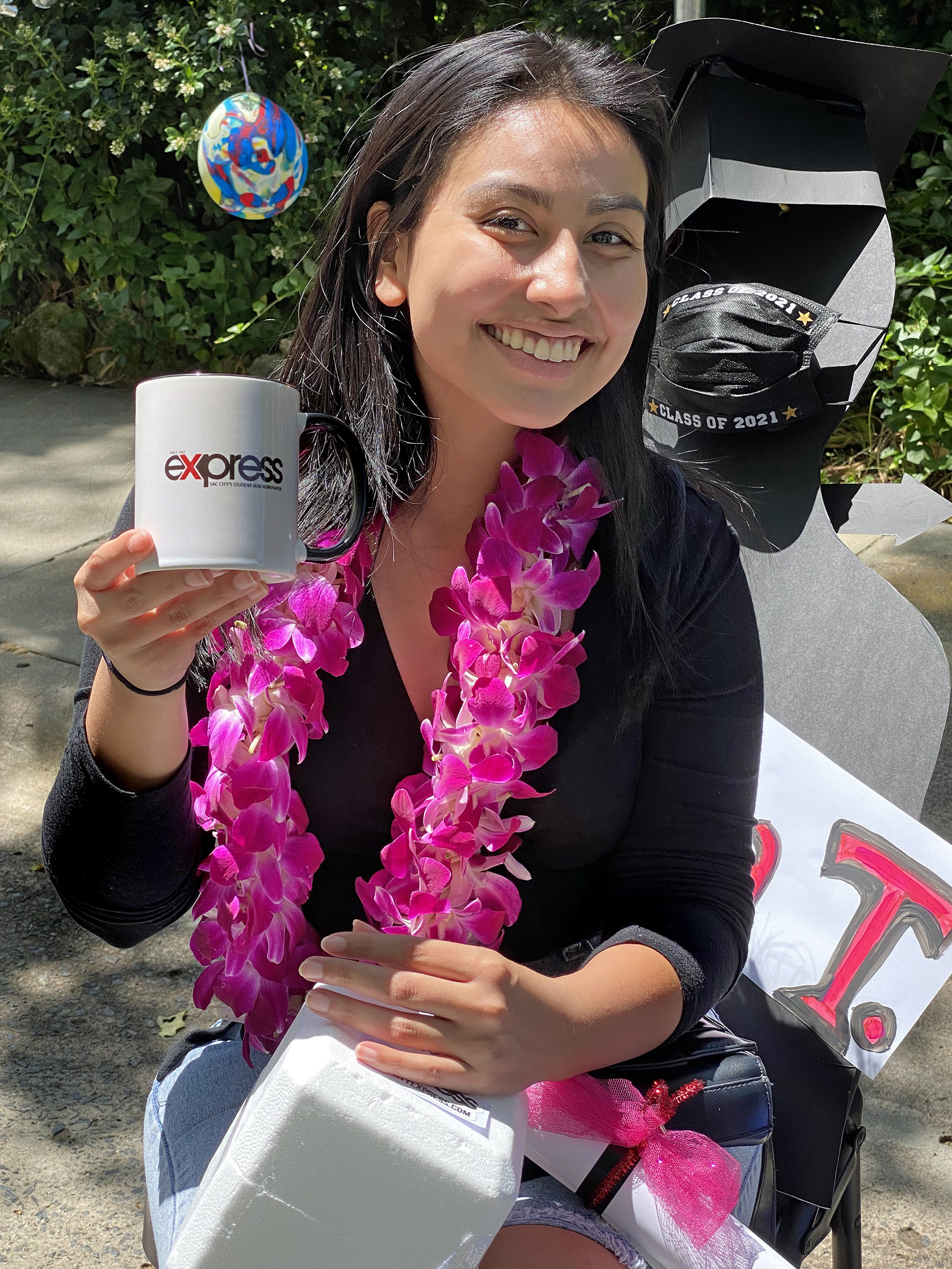
Express features editor Amaya Torres, 2021 SCC graduate
I attended my college graduation, sort of, though cap- and gown-less covering it for the paper I was leaving as editor-in-chief, preferring not to get caught up in a ceremony with literally hundreds of graduates on a football field, instead taking notes on speeches and racing back to the newsroom to bang out a story on the trusty manual Underwood that had been my boon companion for a year. I should say that I technically was not allowed to graduate with the Class of 1980 because I was six units shy of two bachelor’s degrees, having gotten incompletes in two journalism classes thanks to my nonstop work schedule on the paper. I was lucky I didn’t flunk out that year. It took me two years while working at my first two newspaper jobs to make up those incompletes, and after I did, my diploma arrived in the mail.
I did attend the football field ceremony with hundreds of graduates when I completed my master’s degree a decade later because my mother said that since she’d paid for all this education, the least I could do was go through the ceremony so she could sit in the stands as a proud parent. She had a good point, and she and my father braved the masses to watch me walk across the stage from a great distance. By this time I was married and the editor of a regional magazine, but I dutifully obeyed. My good friend and graduate adviser in journalism presented me with my diploma cover onstage, a nice moment. I never did find my parents in the crowd afterward.
Then, becoming a college professor myself, I was compelled to throw on a rented cap and gown and parade into the football stadium with other faculty and then sit like honorific black crows in the stands as the graduates paraded across the stage to receive their diploma covers and their relatives filled the stands, hooting and honking loud devices. While I was delighted to see students graduate, and the powers that be worked to keep the proceedings mercifully brief, I always went home with a raging headache.
So I learned that instead of gowning up, I could volunteer with other staffers to don a burgundy polo shirt embroidered with Sacramento City College in gold and help graduates in the gym figure out how to put on their regalia (another fancy word for “outfit,” I told many of them), including special gold or red, white and blue cords to indicate different honors, and bobby pin their caps to hairdos certain to be smashed by them.
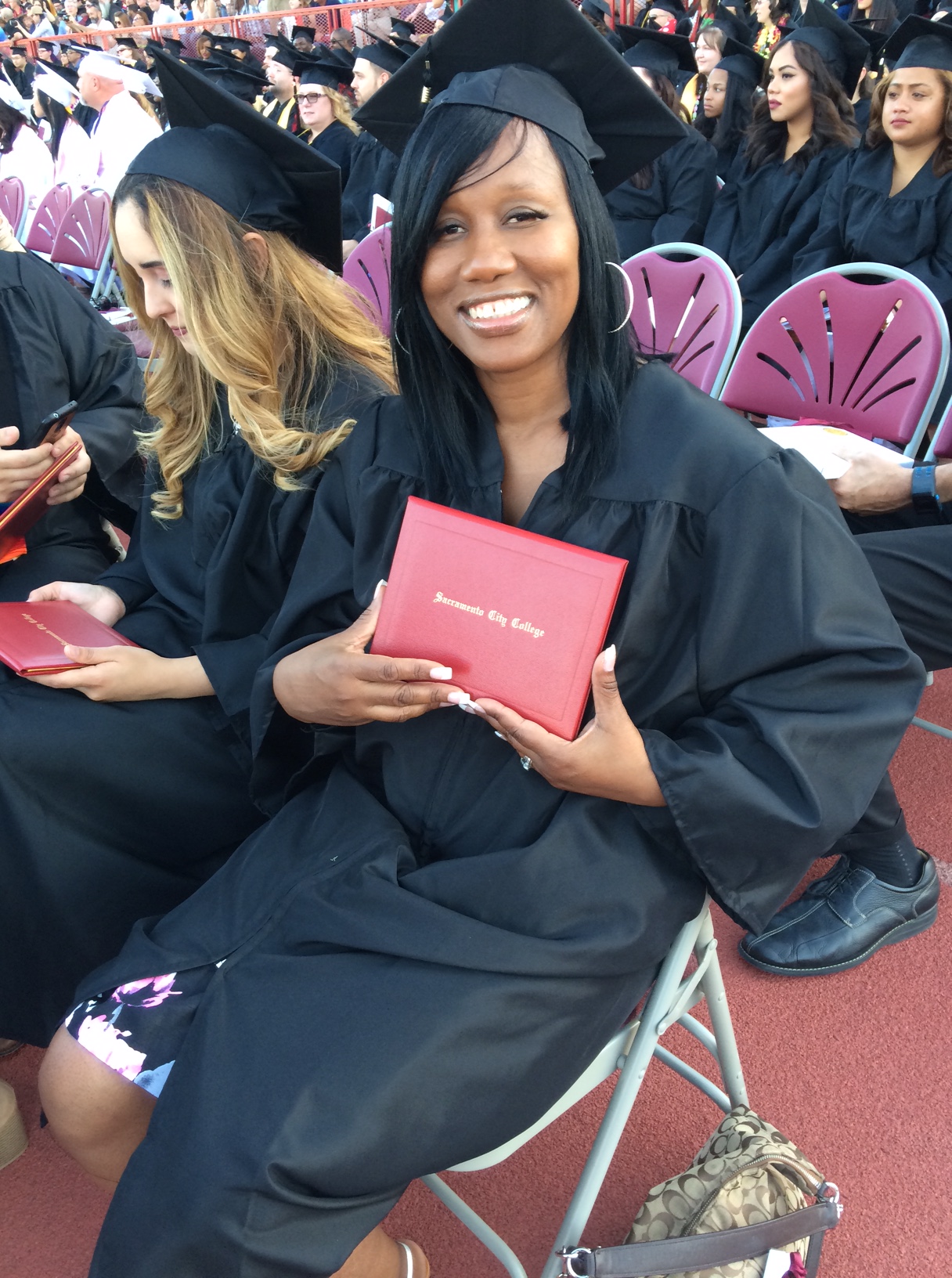
In 2016 I was asked to escort Sandra Jefferson, who has limited vision, to her seat and then be ready to walk her to the stage. I’ll never forget her face or her proud husband Anthony. As she sat in a folding chair on the track, I sat near her behind a small retaining wall, out of sight of most spectators, and ran to Sandra’s side when it was time for her to walk the stage. As we did so, she whispered to me, “Just get me there and point me in the right direction. I can walk across the stage myself.”
Sandra Jefferson
Once I got her there, we paused just before her name was read. “Where do I go?” she asked.
“See that man in the center of the stage?” I asked.
“Which one?” Sandra asked.
“The tall Black man,” I said. “That’s the president of the college.”
She looked surprised. “We have a Black president?”
“Yep,” I said. “Head for him,” and Sandra did.
I met her on the other side of the stage holding her diploma cover in one hand.
“I didn’t know we have a Black president,” she said, beaming. As I escorted her back to her seat, Anthony in the stands roaring her name, she delivered a perfect queen’s wave with one hand, lightly holding my left elbow with the other.
It was, I told people, the best graduation ever.
Then came 2020, the year the whole world shut down. When commencement time came, no one commenced in our community college district. I found myself envious of places that held drive-through graduations, and I vicariously watched people waving signs at decorated cars holding graduates, some capped and gowned, chauffered like celebrities.
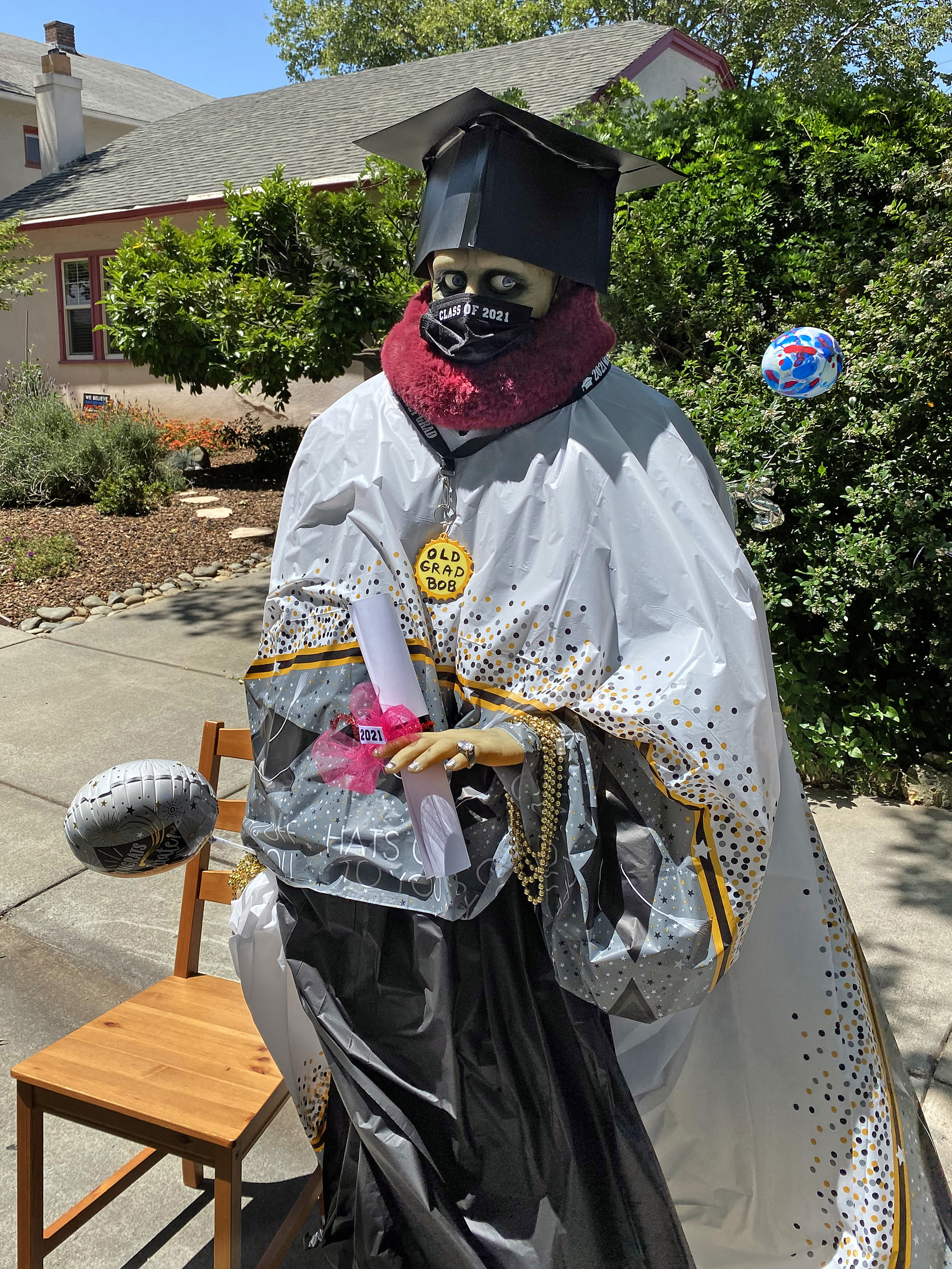
Old Grad Bob
My next door neighbor Christine, who regularly decorates her front yard for holidays and occasions, put up some Class of 2020 signs. I told her that I loved them since my graduating journalism students who had toiled on the college news site would have to do so without ceremony. “Let’s give them one!” she said, and with that, the first Santa Ynez Way Curbside Commencement was born.
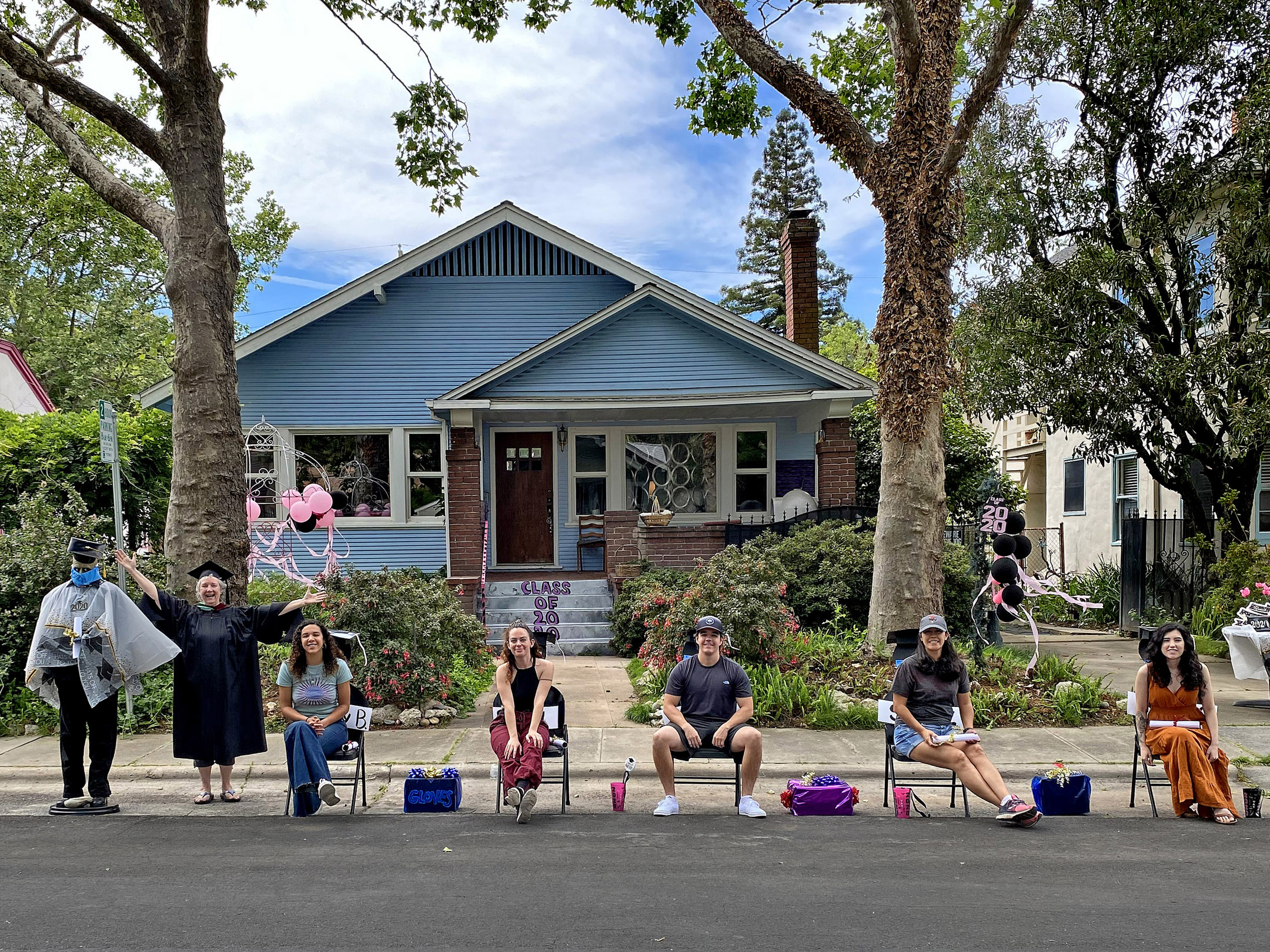
Christine added more graduation decorations and set five folding chairs at the curb, each with a silhouette of a graduate and that graduate’s name on it. She dressed up her 6-foot-tall manikin (formerly The Man, lately Old Bob) in his own cap and gown.
I invited the six graduating Express editors to come over one afternoon, donned the proper cap and gown I had finally bought in my waning years as a professor, and celebrated their accomplishments both academically and journalistically. Rose, Dani, Sarah, Ben, Kelsey and Sydney arrived, greeted each other after not having seen each other in person for a couple of months, sat in the chairs bearing their names and grinned for photos.
“Best graduation ever,” I pronounced.
2020 Express editor grads: (from left) Old Grad Bob, Jan, Kelsey Brown, Danielle McKinney, Ben Irwin, Sara Nevis and Rose Vega
And it was. Until this year, the second annual Curbside Commencement, which I used as an exercise in English usage. “Why can’t we call something the ‘first annual’?” I teased them in the email invitation, thinking that if they didn’t know the correct answer, I’d rescind the invitation. Casey, the Express editor-in-chief, responded first: “Because something can’t be annual until it’s held at least twice.” I’d asked Christine if she’d be willing to set up her lovely curbside commencement one last time—this time for me, too, since, I pointed out, I was at last graduating from community college.
“I thought you were retiring,” she teased.
“Same thing,” I said.
And Christine outdid herself again, setting up chairs and silhouettes bearing the names of Tony, Amaya, Casey, Shayla and Jen. She made popcorn for them and delivered in little bags, along with 2021 graduation rubber ducks, and she again painted her front porch steps for the occasion. Old Bob—now Old Grad Bob—again made an appearance, in appropriate regalia. This time, my Express co-adviser Randy Allen came, along with Dick, so we had two former Sacramento Bee photographers shooting the event, I pointed out to the students, some of whom came with parents or spouse.
Express co-advisers: Randy Allen and me (photo by Dick Schmidt)
They brought me flowers and gifts; I gave them mugs with the Express logo on them. We hugged and talked and had to move out of the street when cars came. No one honked, but many people waved.
“Best graduation ever,” I told my now-former students, and they agreed.
2021 Express graduating editors, from left: Jen Lum, Amaya Torres, Casey Rafter and Tony Rodriguez (We missed you, Shayla Merene!)
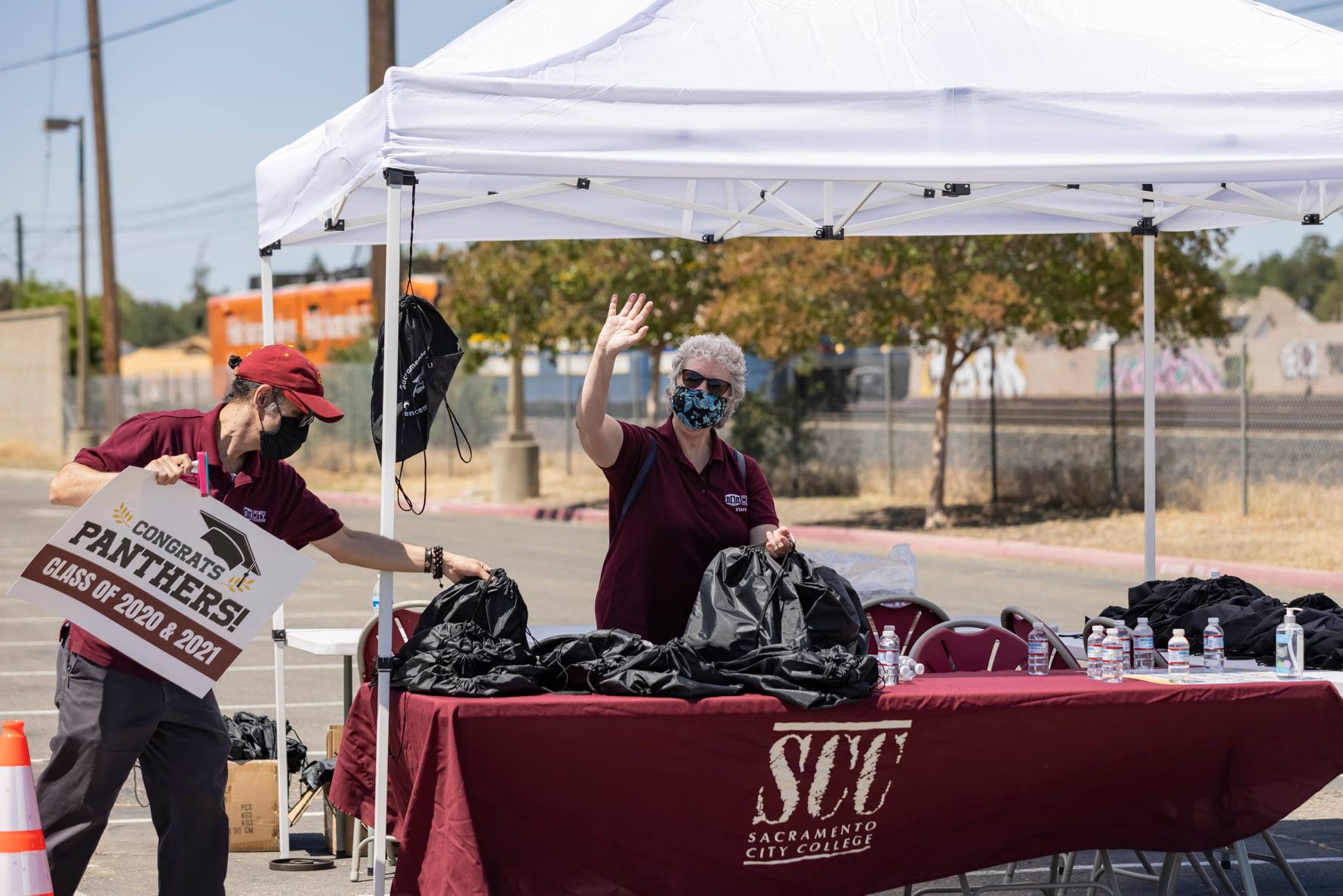
But there was one more. Sacramento City College organized (a huge undertaking) a drive-through commencement in its huge parking lot on campus to honor both the 2020 and 2021 graduates. Some 400 students RSVP’d.
Me at the swag table (photo by Sara Nevis)
Donning my SCC polo shirt one last time, I volunteered and was assigned to the farthest point the drivers would hit—the swap table. There I met four other colleagues cinching nylon bags containing SCC logo stuff, ready to hand out. We worked to peppy music blaring from speakers—not a trace of “Pomp and Circumstance,” which is, truth to tell, more a dirge than a dance.
And, given the last year, we all deserve to dance.
SCC faculty and staff hand out swag to the drive-through grads.
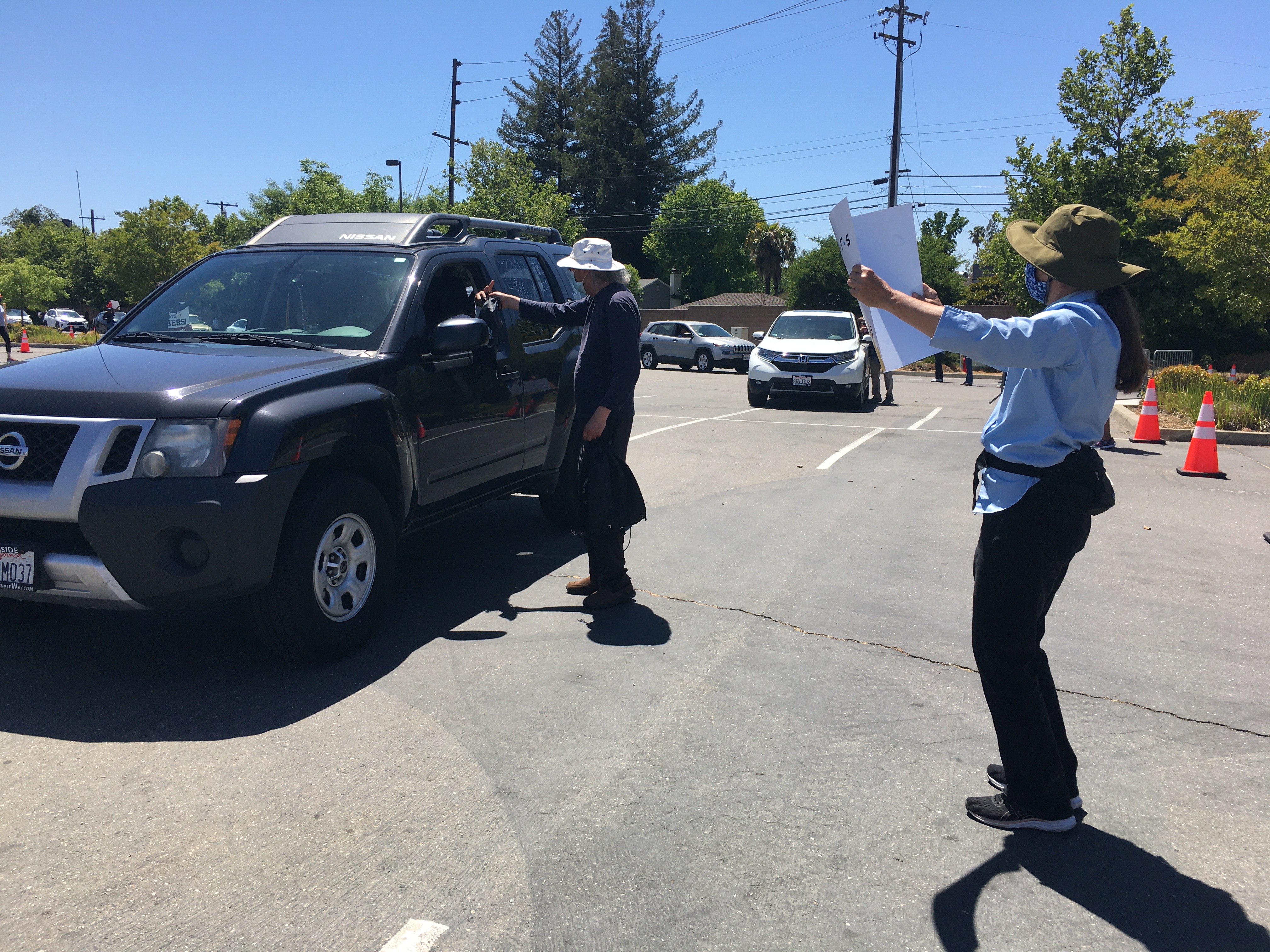
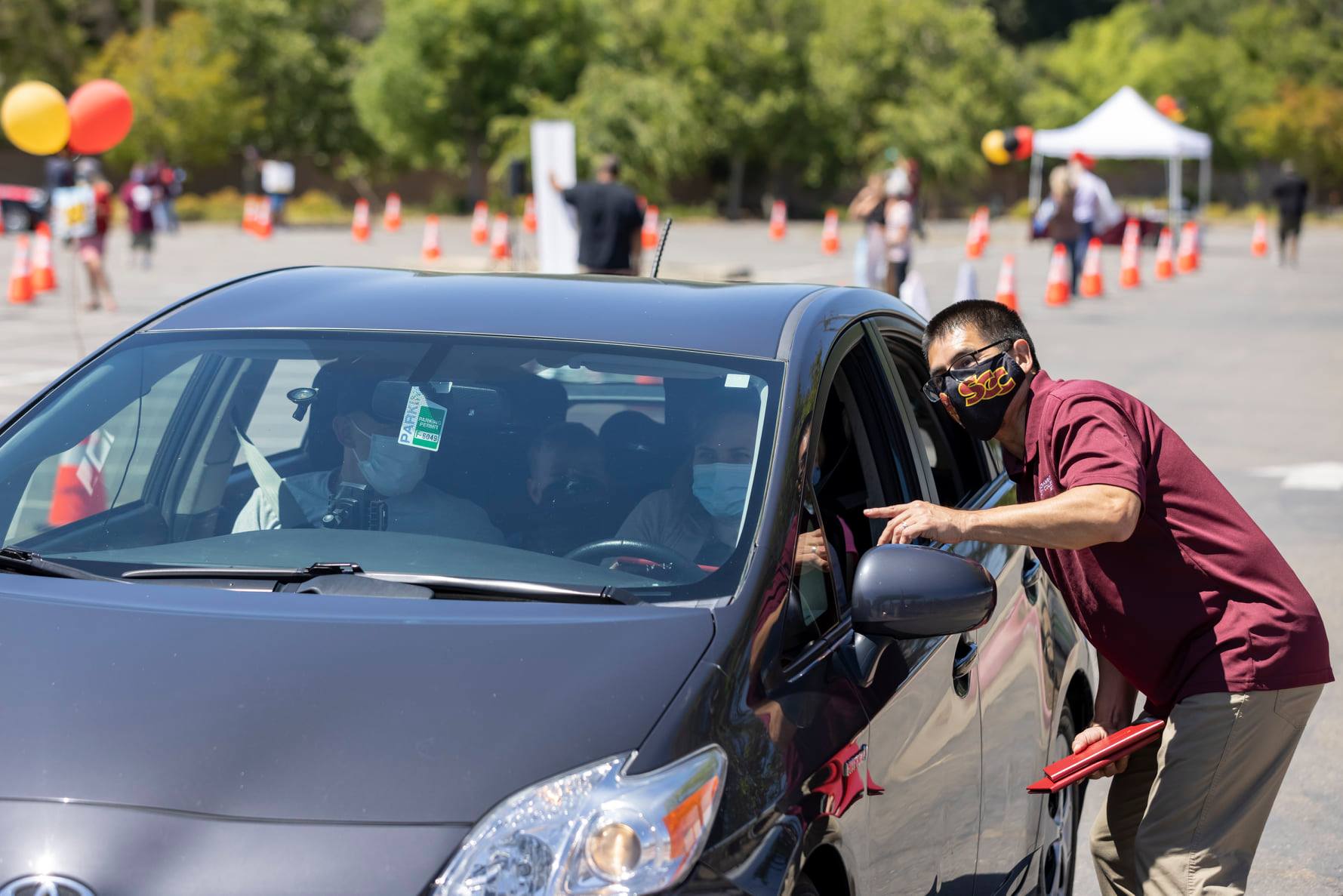
As my colleagues held congratulatory signs, the students convoyed through the big, empty lot just as I’d seen others do on videos—some in caps and gowns, some driving, some being driven. One graduate arrived in a huge old RV filled with well-wishers—a graduation party bus—and she hung out the window to gracefully receive her swag bag. One young man walked beside his family as they drove the route.
One young woman sat atop her family’s car as they slowly drove the coned route, waving at everyone as if she were the grand marshal of a parade—which, in a way, she was.
Former Express photo editor Sara Nevis photographs the 2021 SCC drive-through commencement.
Finally, to see people in person, happy people, masked, yes, but out in public and celebrating. I spotted one of last year’s journalism graduates—now transferred to Sac State who’d just finished a reporting project for students for The New York Times, about to begin a photo internship for The Sacramento Bee—hired to shoot the commencement. I greeted the pregnant public information officer who had been so helpful to the Express students when they couldn’t reach sources typically found more easily on campus. The vice president of instruction came to give me a goodbye hug; when he was a young English prof, we started the college literary journal together. And I went to the president, handing out those blank diploma covers, and thanked him for his availability to the Express during these extraordinary times, not to mention his leadership of the college I’d called home since 1989.
Sacramento City College President Michael Gutierrez at the 2021 drive-through commencement. (Photo by Sara Nevis)
He thanked me for my years at the college, said I would be missed, and hugged me twice, putting the cherry on the top of my already tall sundae.
(Photo by Sara Nevis)
And with that, after my shift ended, I strode across the parking lot toward Hughes Stadium, taking in its great Roman numerals indicating its origin in 1928, when it was “the largest of its kind in the United States.” I thought of the long lines of graduates I’d watched snaking toward the stadium before each ceremony, the crush of humanity emerging afterward, of delighted students chalking up their first degree of higher education—with luck not their last. So many of them the first in their families to attend college.
(Photo by Sara Nevis)
I hope it will be ever thus in the years to come. For each of those students, past, present and future—best graduation ever.
Graduated (aka retired) from community college at long last! (Photo by Dick Schmidt)
It seems as if in March 2020 we all got swept into a fast-moving stream at the same time the world shut down—an oxymoron if there ever was one.
Go home, stay home, figure out how to teach from home, but without your school computer or old-fashioned paper files (or newfangled electronic ones unless you thought to download them onto a thumb drive) or resources except for these online tools you’ve never used before. Here—we’ll give you a quickie seminar on how to put up your course materials online and use Zoom. You’ve never used Zoom? You have but only as a participant? Well, here are the basics. Tell your students that attending classes is optional for the rest of the semester but that you’ll try to hold them on Zoom. If you can figure out Zoom. Oh, and spend the summer putting all of your classes online to teach over the next academic year. Which will be your last because you’ll retire in May 2021.
And, by the way—no one ever said—you’ll never set foot in your college office to work again. In fact, you’ll never see your students in person again for the next two-and-a-half semesters.
No one said that because no one knew. And I have to say that I was certainly not alone in that rocking, leaky boat. Every teacher I knew was jammed in there with me. I have the kindest and most patient dean (thanks, Robin!), but she, like all of us, was at a loss, yet daily responded to the anguished cries of her professors trying to Make It All Work.
That we did Make It All Work Somehow still stuns me… not least me who had liked the idea of creating asynchronous courses that students could do without attending class but had never done the work to create them.
I have now. And weirdly, I’m glad I did, even though it took a hell of a lot of work for one academic year. I’d decided a few years ago that I’d retire about the time I turn 63, which will be at the end of July. That it would come at the end of one of the most tumultuous moments in history, of course, was a surprise.
So for each of the past two semesters I’ve taught seven classes—five of them synchronously on Zoom at regular class times, and two asynchronously where I never saw the students, just communicated with them through email and other electronic means. One of those classes was the Express (former newspaper, now news site) where the editors and staffers saw each other only onscreen in small rectangles and had to figure out how to cover a campus that most never went to yet still had a lot going on. And they did so with professionalism and compassion, two of the most important qualities in journalists.
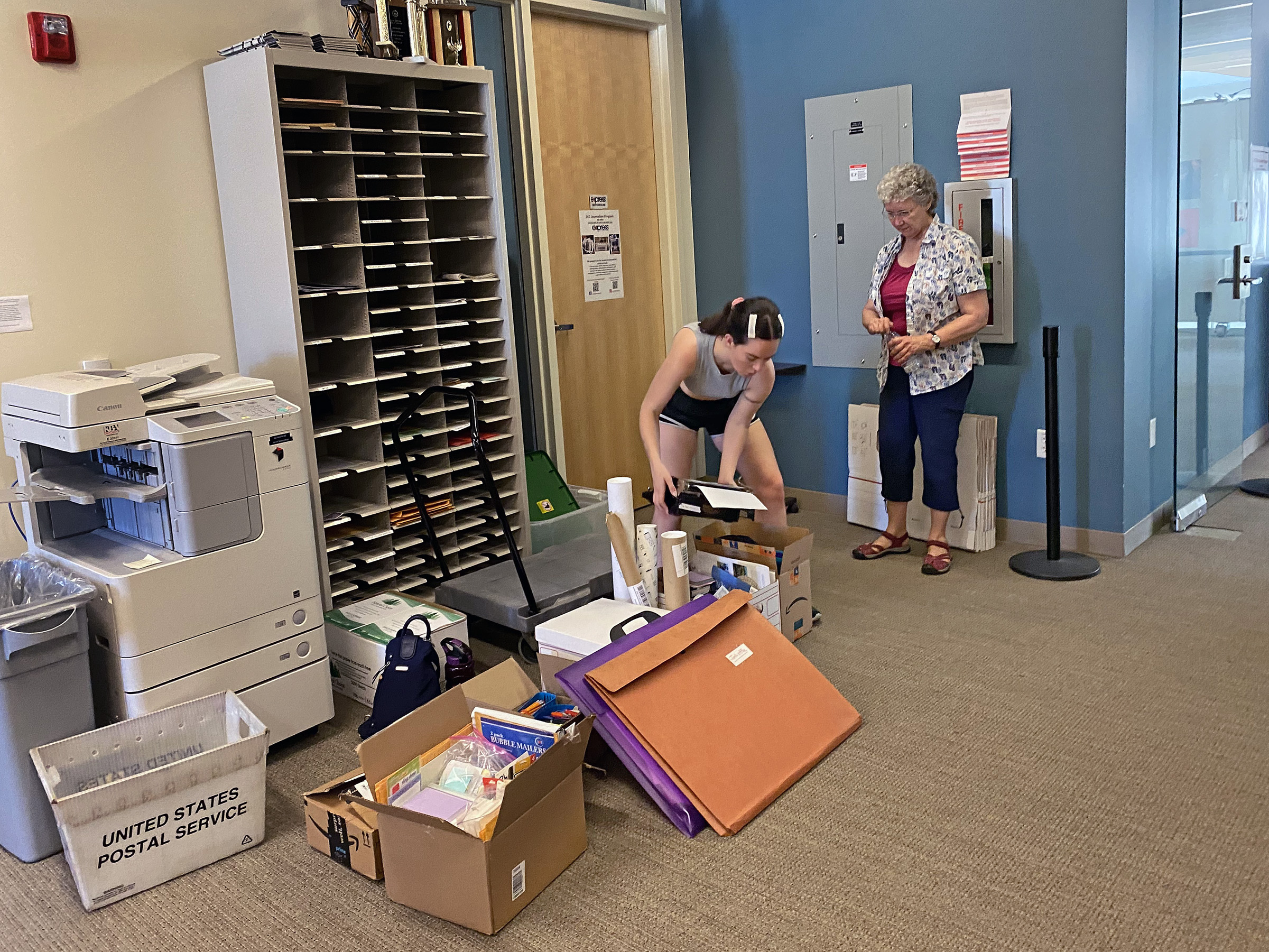
In the midst of all this, I realized that I needed to clear out my school office, though we weren’t supposed to be in the building. And that began a number of stealth visits to gather up those old-fashioned paper files to bring home and discard—because there’s no one on campus to empty the recycling bins or wastebaskets. I knew one thing: I couldn’t do it alone.
And this is when I looked around and made one of the smartest moves of my academic career: I hired a former student to organize my life.
For decades people have asked if I’ve had a student assistant or a grad student to help me, and my response has long been, “I’m the student assistant.” So no. Doesn’t work that way for most community college professors. Divisions, sometimes departments and often offices have paid student help, but I didn’t. Occasionally I’d pay friends or former students to help me grade papers, but I usually did it all. That was my job, and while I loved it, it got to be too much after a whole lot of years.
But Danielle McKinney came along and saved my bacon.
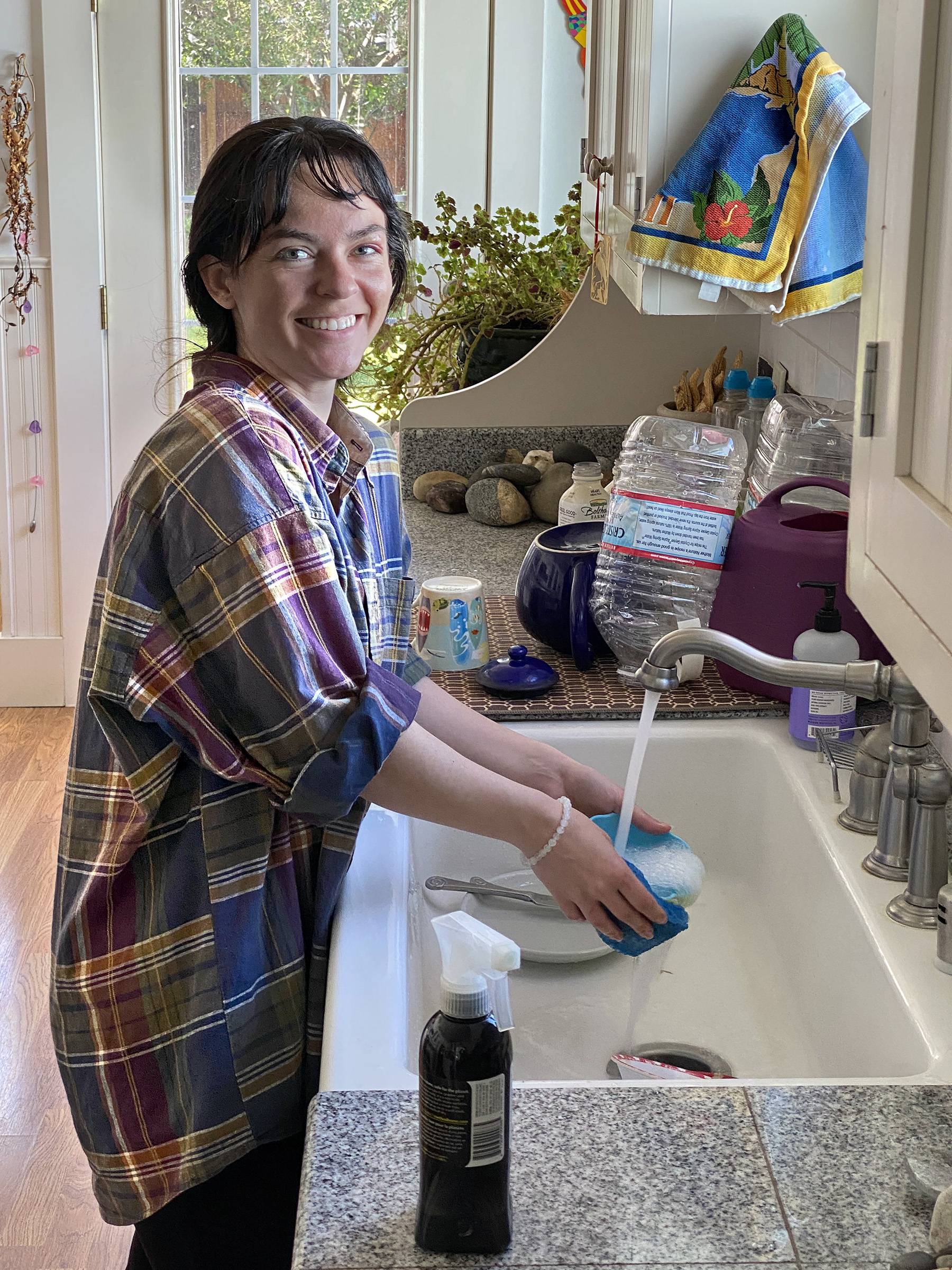
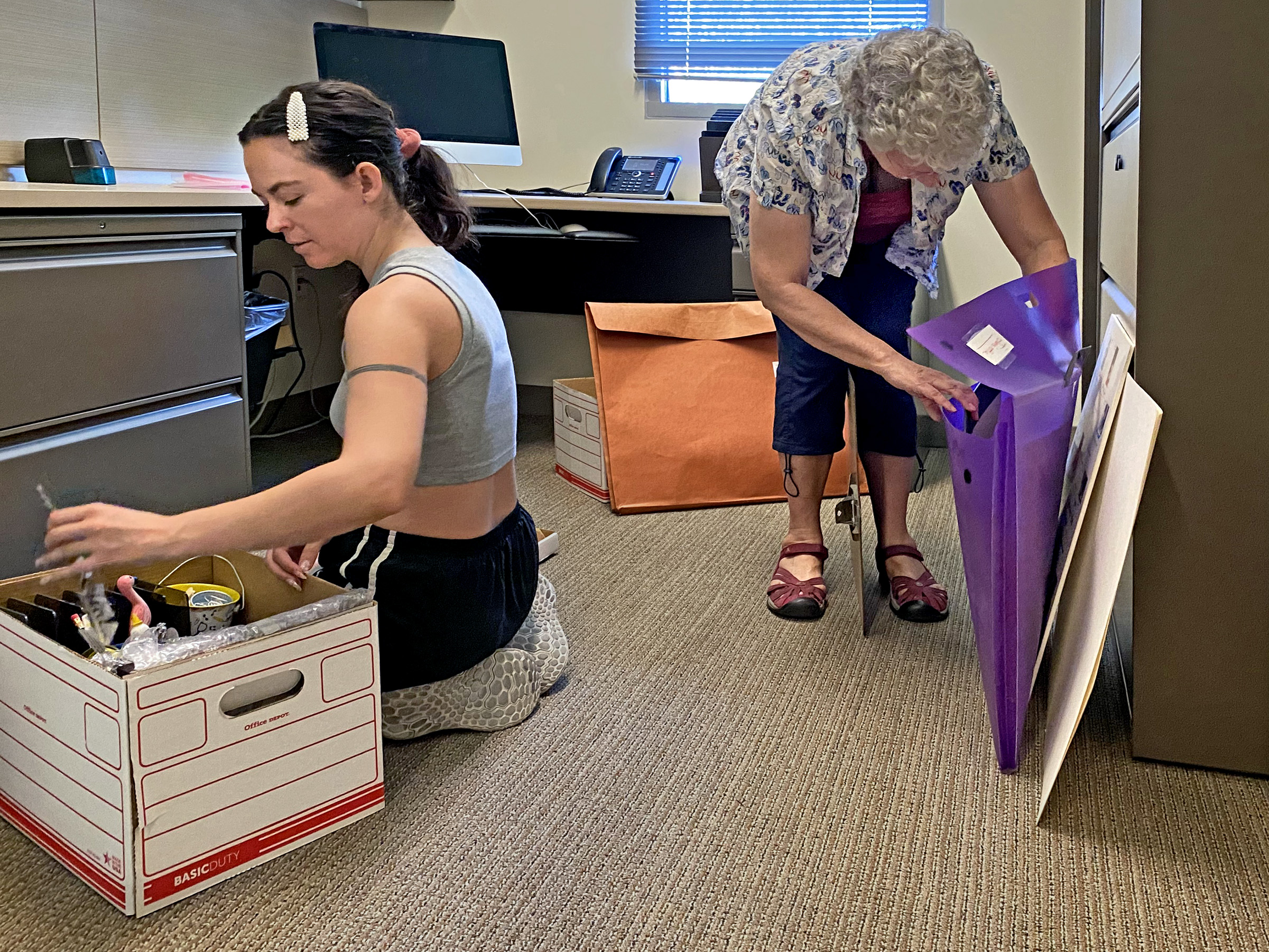
Danielle McKinney (left) packin’ me up.
Not long ago Dani was an Express co-editor-in-chief with her good buddy Rose Vega, and over the past year I hired the two of them to assist me—Dani as general home office/life organizer and Rose to moderate my online Writing as a Healing Art class. Now both Sac State journalism majors, these two have shown extraordinary patience with this old dog as she’s had to learn new tricks.
I’ve long been proud of the fact that my late husband and I were early Macintosh adopters in 1984 (his farsighted idea; I said, “But I’ve got a typewriter”). Dick bought me a new iMac for my home office last spring, but the computer sat looking expectantly at me in its lovely box for months. It was all I could do to teach not at all well on my older Mac laptop. I just couldn’t face setting up a new computer. I knew it would ask me questions I didn’t know the answers to. And I was exhausted trying to figure out things I didn’t have the answers for.
Dani, who had been slowly but surely helping me reorganize last spring, said in June, “Let’s set up your iMac.” And though she hadn’t done exactly that, because she’s 26 and so smart, she figured it out with no apparent angst. And suddenly I was back to using a 21.5-inch screen instead of a 13-inch one. Which made all those little Zoom rectangles bigger. Which made Zooming so much better! Who knew?! (Everybody but me!)
So after last summer’s clean out of my home office to purge and rearrange files in my three large filing cabinets and the installation of a new backyard shed that could hold the thinned-out papers, I knew it was time to tackle the school office.
Once again, Dani came to the rescue. We did it in stages, in between classes and office houring online, bringing home the paper files first, opening boxes in my living room—me on the sofa, Dani on the floor. Me handing her papers to recycle, Dani pulling paper clips off them and hauling things to the big blue bin on the driveway.
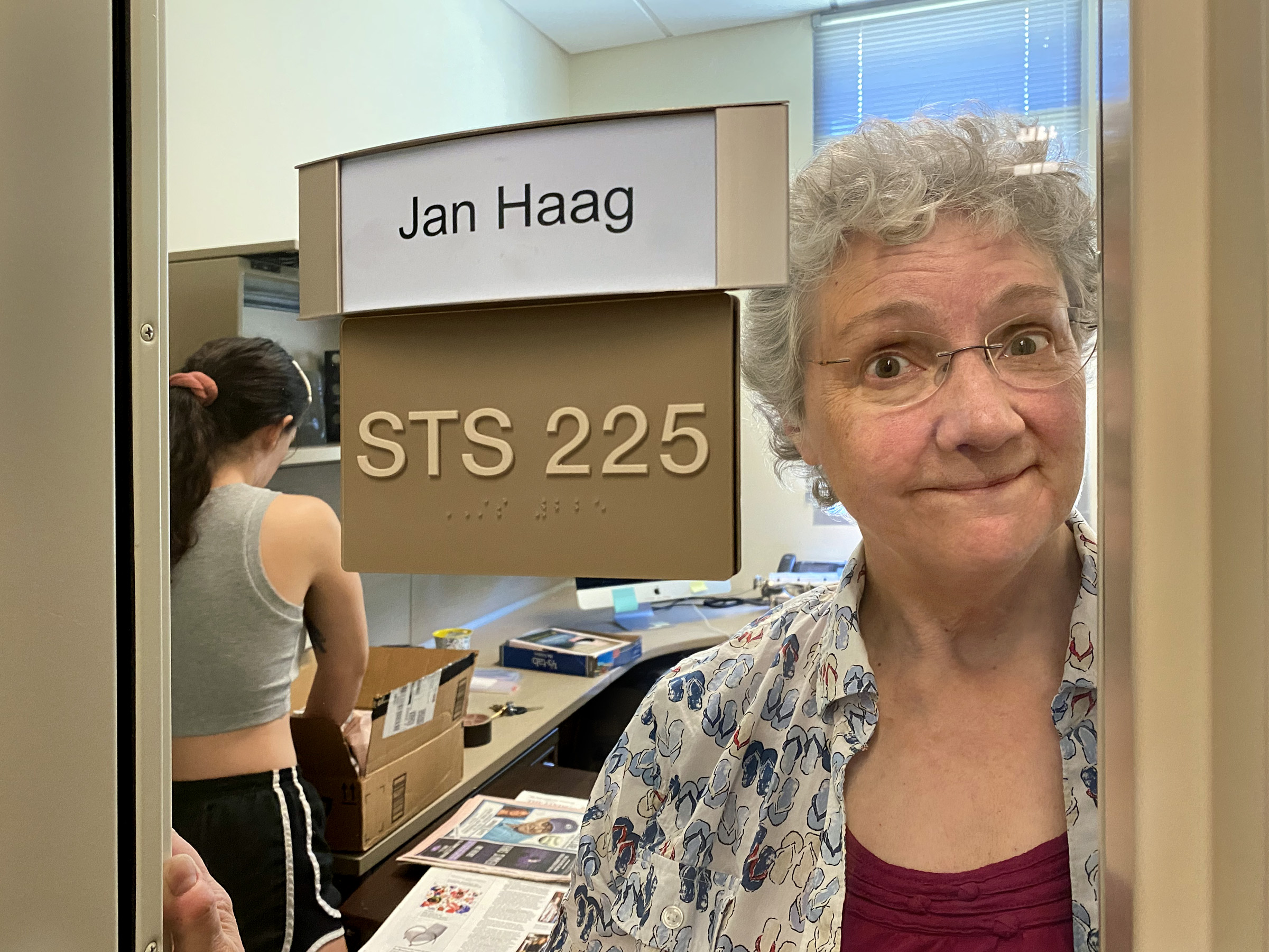
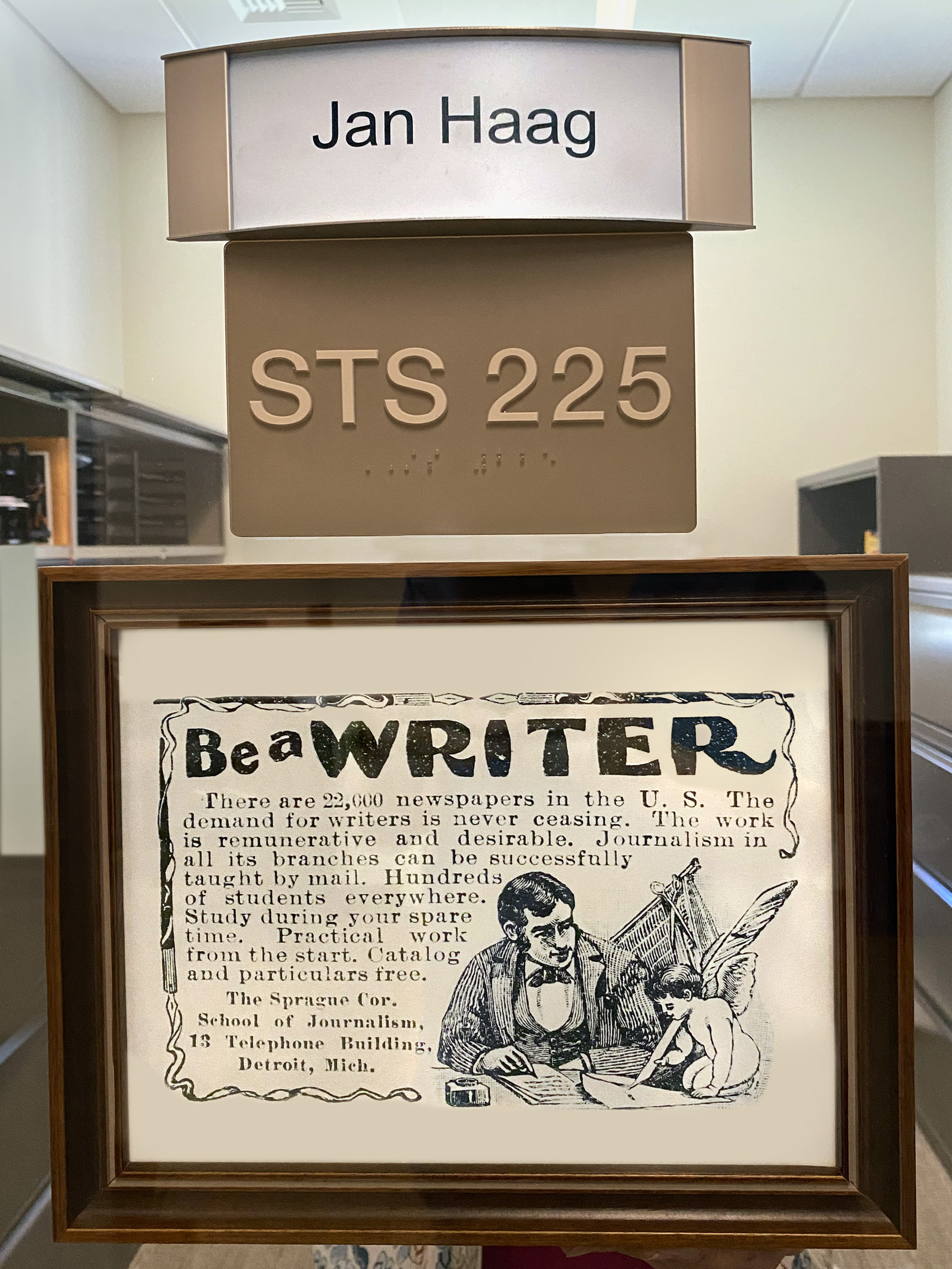
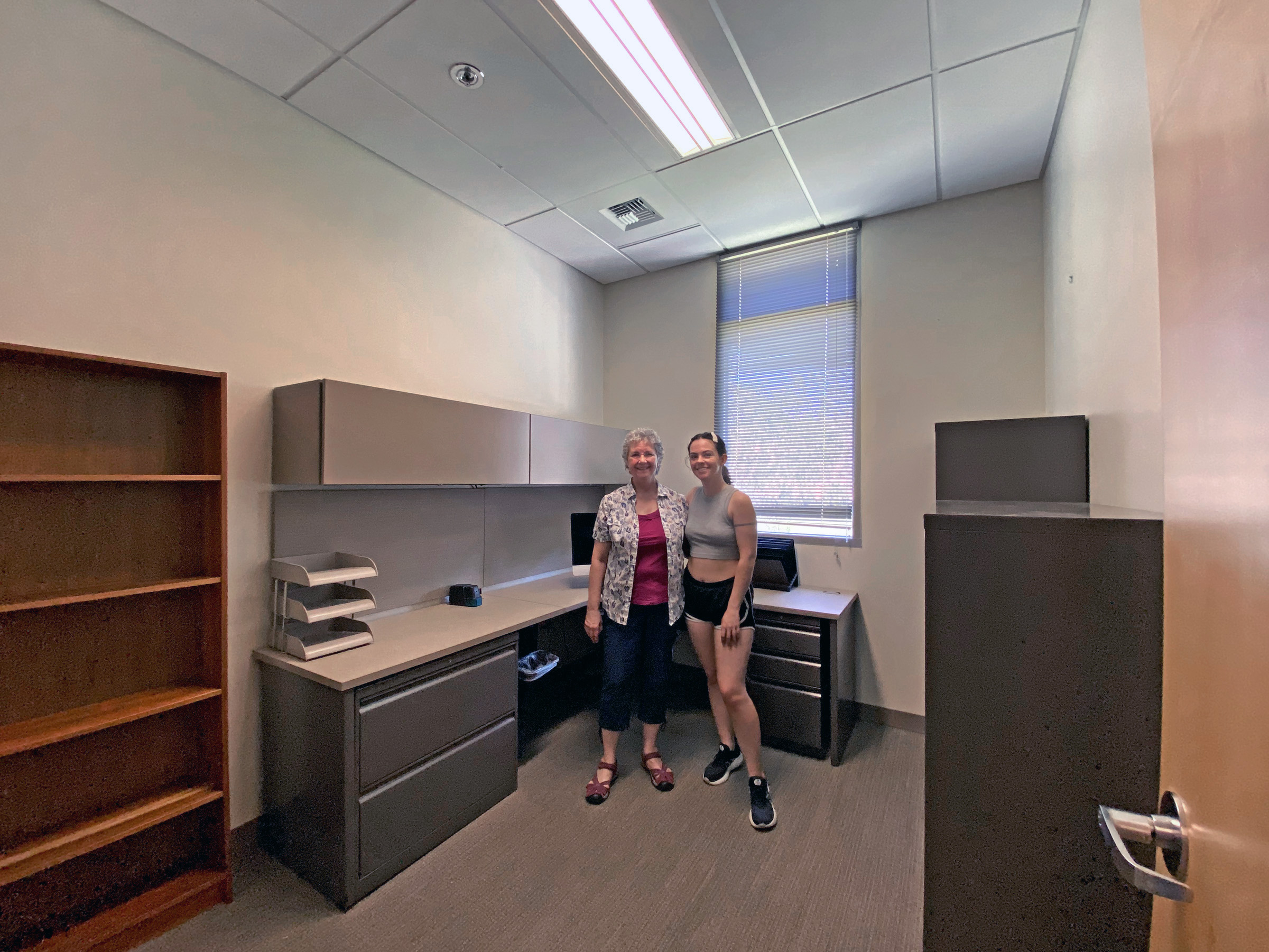
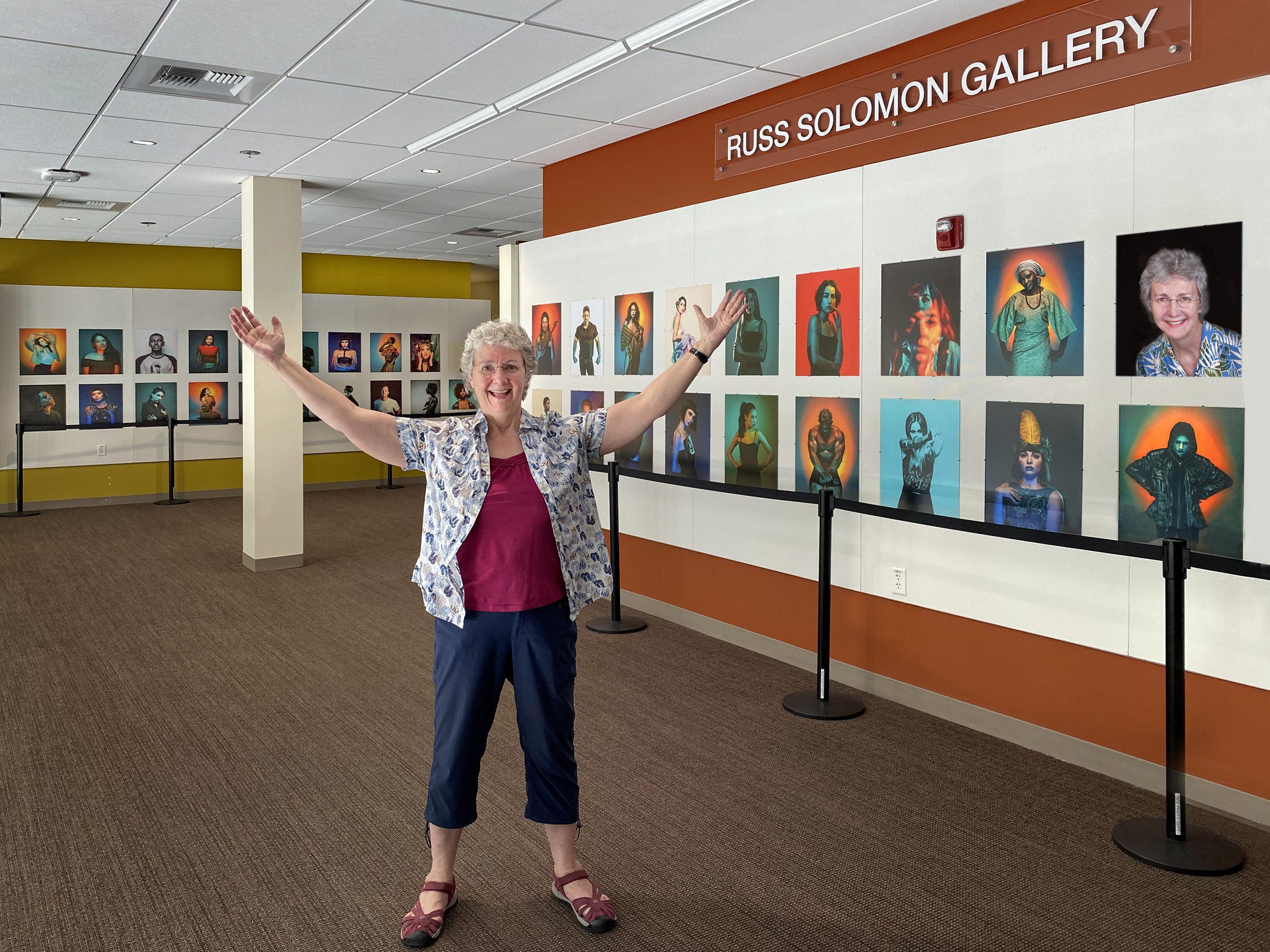
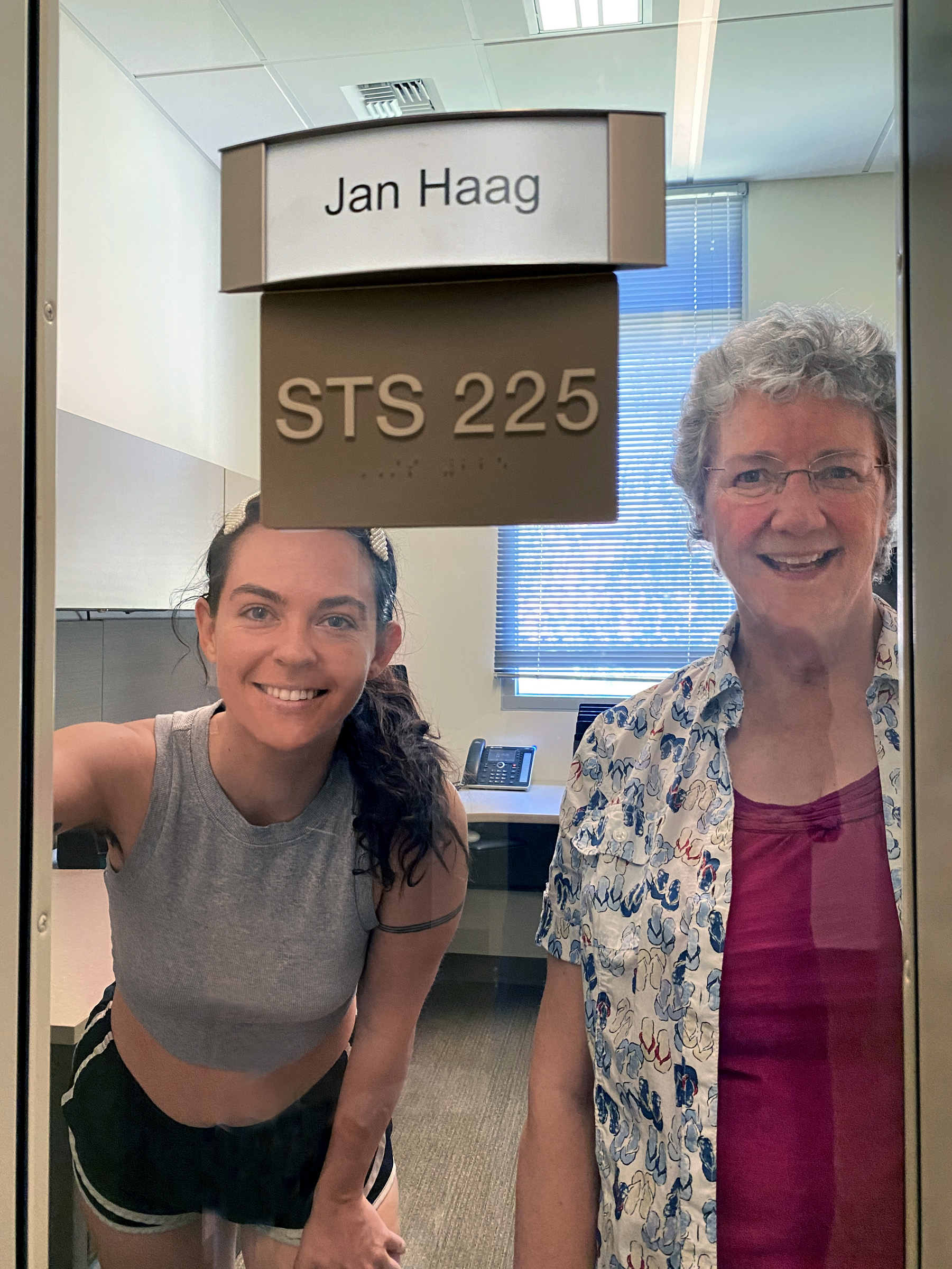
Over the last couple of weeks we’ve finished the clean out of STS225, my Sac City home since the summer of 2015 when the journalism department moved out of the old trailer we’d occupied for 20 years and into this brand, spankin’ new building with the photo department.
As photo department chair Paul Estabrook said, “It’s like photo and journalism were going steady all these years, and now we’ve finally moved in together.” It was exactly like that. And it’s been a terrific partnership.
But now it’s time for me to leave the building.
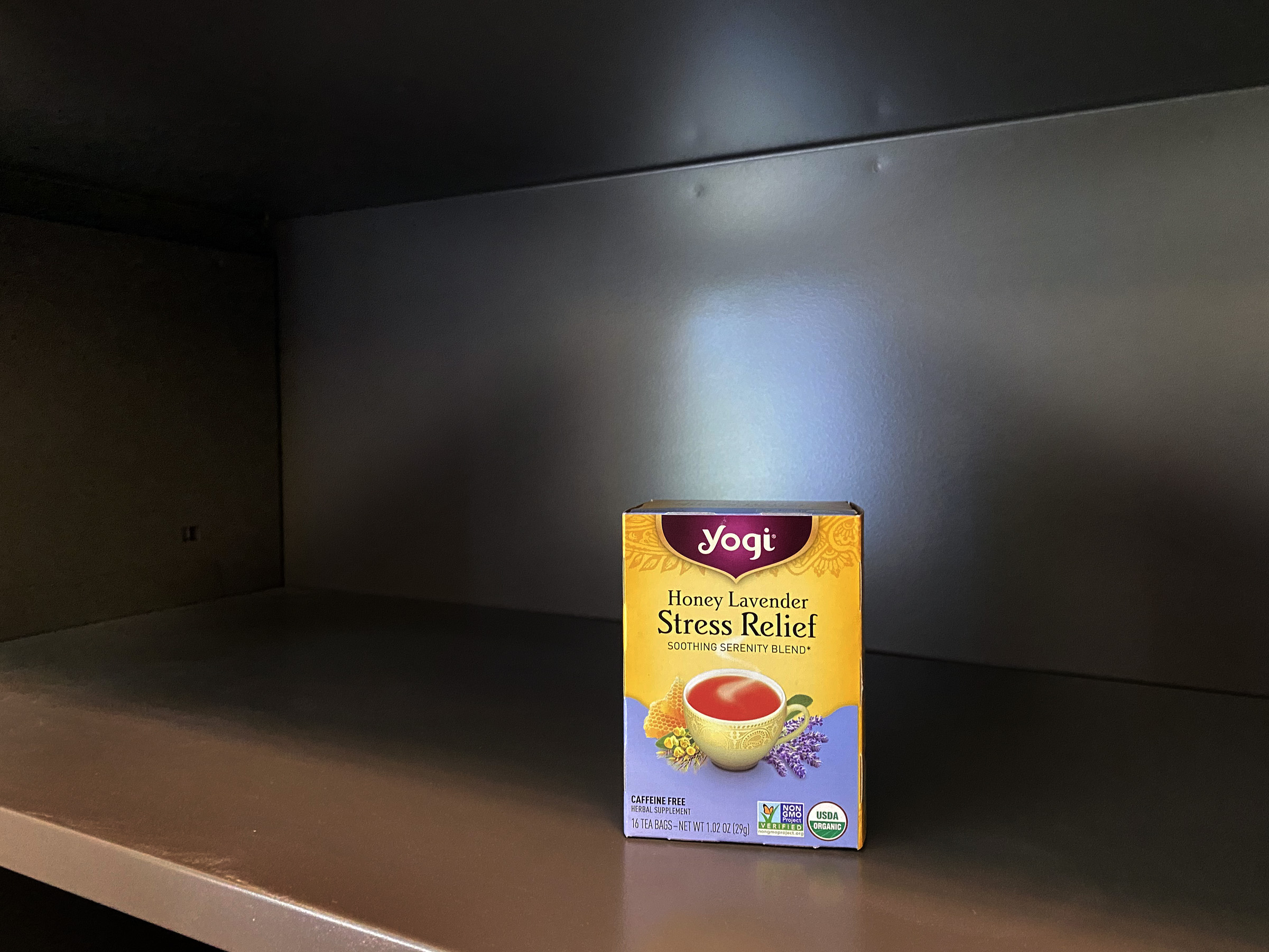
So I did, with a kind photographer in tow to mark the occasion. (Thanks, Dickie!) Because of the steadying presence of Dani and Dickie, I managed not to blubber my way through it. And I have the satisfaction of knowing that I’ve left my office cleaned out, though I know the powers that be will need to come in and thoroughly sanitize it for the next occupant. (Jon Hanson, I left you some of my favorite tea and my trusty pencil sharpener since I already have its twin at my house.)
Weirdly, I may have done some of the best teaching of my career over the past two-and-a-half semesters. Not that I taught journalistic/writing skills more effectively. But I think I became more compassionate and understanding as students had their lives falling apart around them, many in far worse ways than mine. I can’t count how many students got sick, how many family members of my students got sick, some who died, so many who lost jobs and homes and loved ones. Every time a student asked (via email, of course), “Can I have an extension on this assignment?” I said yes. Every time a student wanted to talk by phone or Zoom, I made that a priority. I did some of the best amateur counseling (as does every teacher) of my career during this pandemic.
This was my silver lining. That and a whole lot of new tech skills.
I believe that, if we’re smart, we all remain lifelong learners, and I’ve had the great good fortune to learn so much from so many people—not least my students and former students. I know I’ll continue to do so from home, using the Zoom skills and others I’ve acquired over the last year as I lead writing workshops and publish other people’s books and work on my own.
And Dani and me? Our partnership continues. We still have work to do sorting and tossing. She’s up for the challenge, and I am most grateful, as I am to Sacramento City College for giving me a home for three decades and all kinds of students to teach me what I most needed to learn.
So we’re really tired of the masks, right? We figure we’ve done our time in them, bunches of us have been vaccinated, or we’ve got our immune systems functioning well. Enough with the masks already.
I think this every time I get out of the car maskless and have to go back to the car to retrieve one. I try to remember (all this time and I still forget) to leave one hanging around my neck like a little pandemic scarf so I can just pull it up when I’m heading into a store or going to be around people.
But like most everyone else, I’m done with the mask. As one of the people who writes with me bemoaned early in the pandemic, It’s bad enough you’re telling me that I need to isolate myself from the world. When I’m out in it, even walking a trail, and I see you coming toward me, I can’t see your face, your smile.
I find myself still smiling at people underneath my mask, a reflex. Not because I have to but because it’s what I do. I hope they can see my smile in the lines around my eyes, which I’m pretty sure have deepened in the last year.
My partner Dick, who has a hearing impairment, finds it even more difficult to hear soft talkers behind their masks. Put them behind Plexiglas, and he often has no idea what they’re saying. It’s beyond frustrating.
But what if the masks have something to teach us? What if, in the wearing of actual masks—not only to potentially protect ourselves but also as a kindness to others, not knowing if we could be contagious—we’ve had to drop our metaphorical masks? Certainly we’ve all at various times in our lives donned masks to project an image or hide one or protect ourselves. I like to think that now, when we pull down our literal masks, we’re so delighted to see each other (as I’m observing in people sitting at restaurants nowadays) that we won’t feel we have to keep the metaphorical ones so firmly in place.
Many people have been incredibly honest about how painful life has been during the pandemic, how much has been lost—not least in illness and deaths. Some of my students have not been shy about venting their frustration with online learning, with having to stay inside, with all the things they’re missing. They dropped their masks some time ago. My teaching colleagues, like me, have been in near-constant worry about the quality (or lack thereof) of our instruction, how we can’t do what we usually do, and are the students learning anything? The phrase “lost year,” especially bandied about in education, makes us cringe. We have spoken open and honestly about these things, including to our students.
But over this lost year, I have listened to the stories of people who write with me and my students, and I have sat with their pain and frustration, their grief and loss, and thought, There we are, all of it on the table, no holding back, this is how it is. And, as I’ve pep-talked more than one student, It won’t always be this way. This will end. Some of them have believed me. Sometimes I could believe myself.
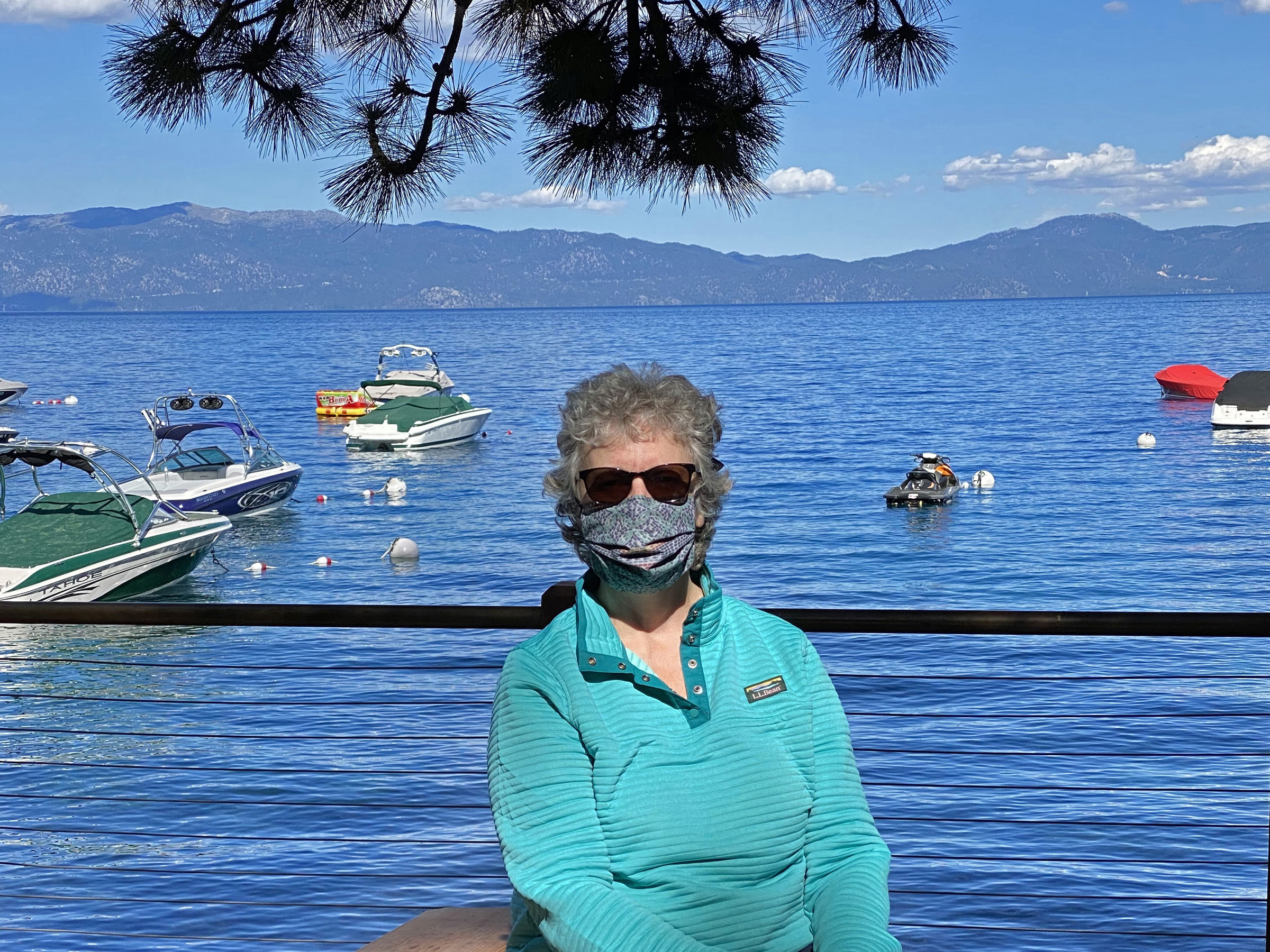
I look at my cloth masks now, the ones made by my friend Julie Woodside early in the pandemic. Like most of us, I’ve acquired a number of masks, including some hardy paper ones, but I still like hers best—bright cloth masks with wires to bend over the nose (a must for us perennially fogged-up glasses wearers) with stretchy ties that go around the head and neck.
Just a couple of weeks ago one of my Julie masks went missing. It must have dropped out of the car or my little backpack when I wasn’t looking, and, when I discovered this, I was bereft. I have other Julie masks, but that one was one of my favorites, and I have thanked it and its brethren for helping to keep me and others safe over the last year. Many of us dedicated mask wearers have not suffered colds or flu, not to mention avoided the big, bad virus.
In addition to handwashing and maintaining that 6-foot distance, masks have kept us safe. I find that wearing one outside these days helps keep the spring pollens from tickling my throat. But when we drop the masks, once and for all (and dear God, let that happen soon), let us remember not to remask our emotions and reactions. Let’s show our real selves and delight in others doing the same. Let’s allow those smile lines to crinkle with genuine joy.
I’ll keep my Julie masks for some time as a reminder of the loving care we took to protect ourselves and others. Maybe even after the allergies pass, I’ll don one again voluntarily in the next cold and flu season.
It won’t always be this way. This will end. Everything does. Especially us.
Before that end, I promise to revel in the sight of other people’s smiles, give tight hugs and keep my metaphorical masks put away.
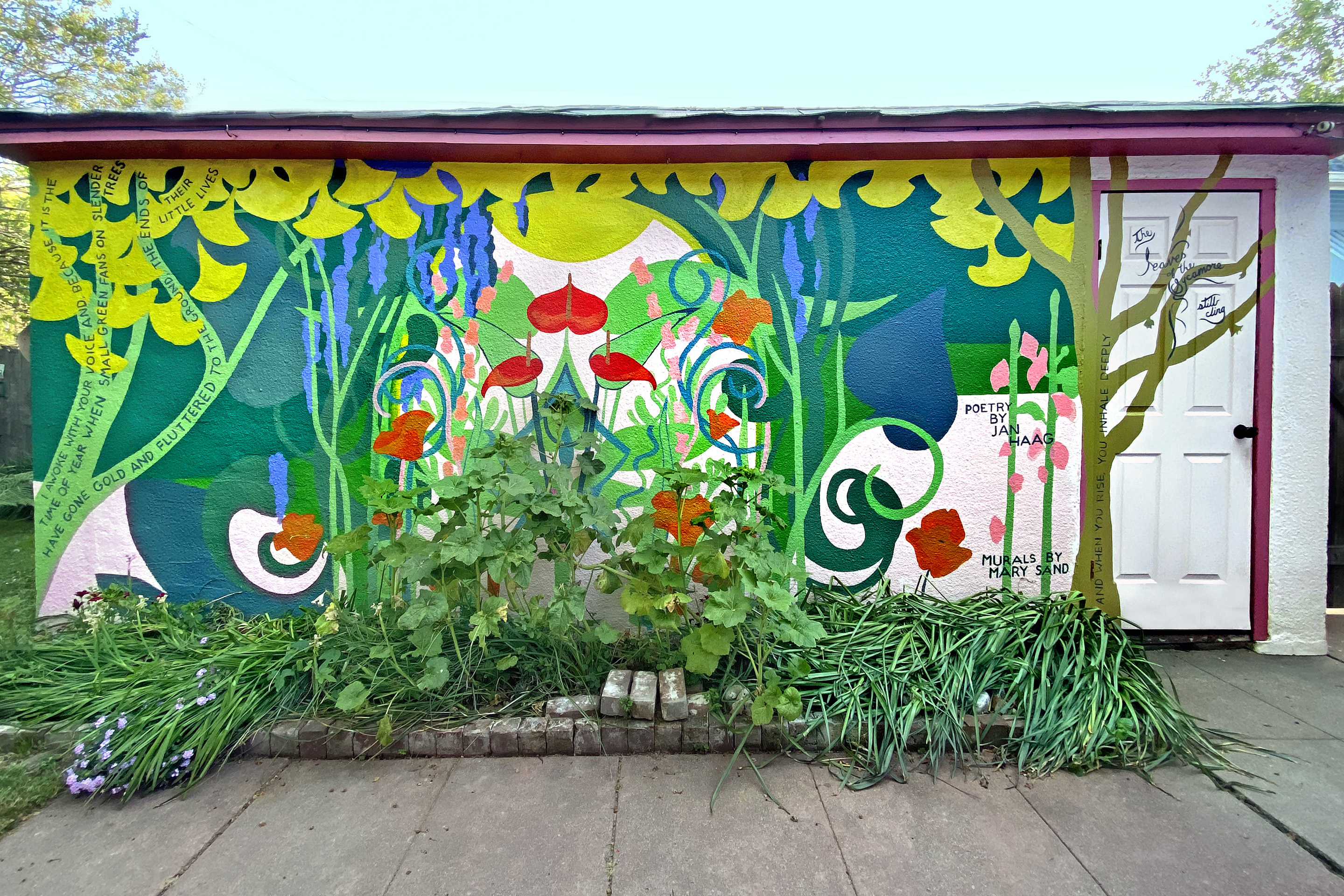
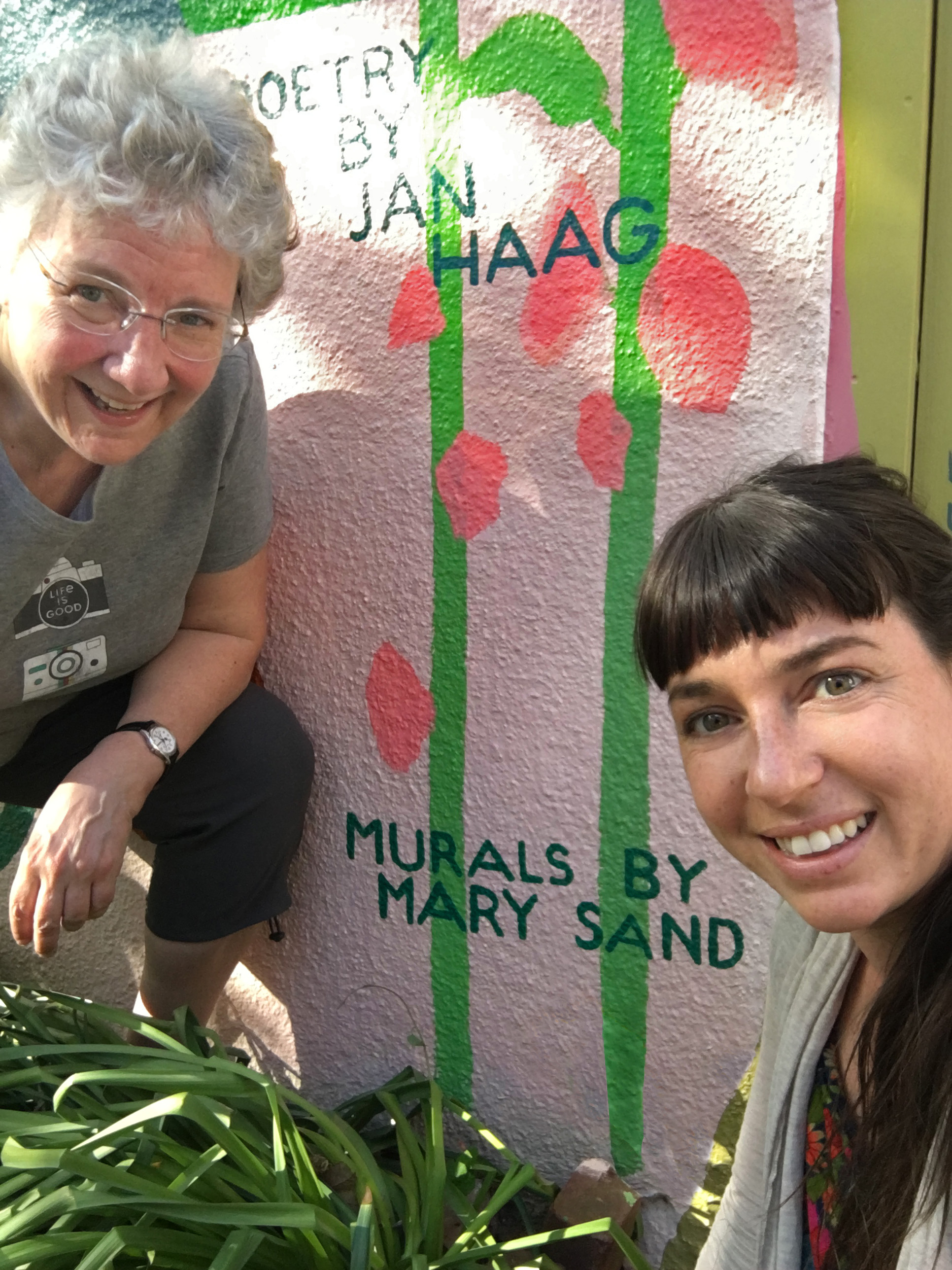
Every morning I walk into my kitchen and look out the window of the back door to see Mary’s murals smiling at me. I didn’t know murals could smile, though I knew they could make me smile. But I swear these painted gardens on the north wall of my 100-year-old garage and the one on the shed in the back yard seem to grin in the spring sunshine.
Mary’s garden on the garage
For six Fridays in a row, Mary, Mary-not-at-all-contrary-Sand has been painting more permanent flowers in my life, and I’m just delighted with the results. As I said in an earlier post:
I have long admired Mary’s art, since she was my student on the college newspaper, the graphic design goddess who laid out the paper when we still had a paper and magazines both journalistic and literary that could be held in the hands. She’s a multi-talented artist, Mary, who sat on the big blue tarp on the ground, her brush dabbing one color of paint into another in the big roller tray, transforming from forest green to purple to aqua.
(You can see earlier incarnations of the big mural here.)
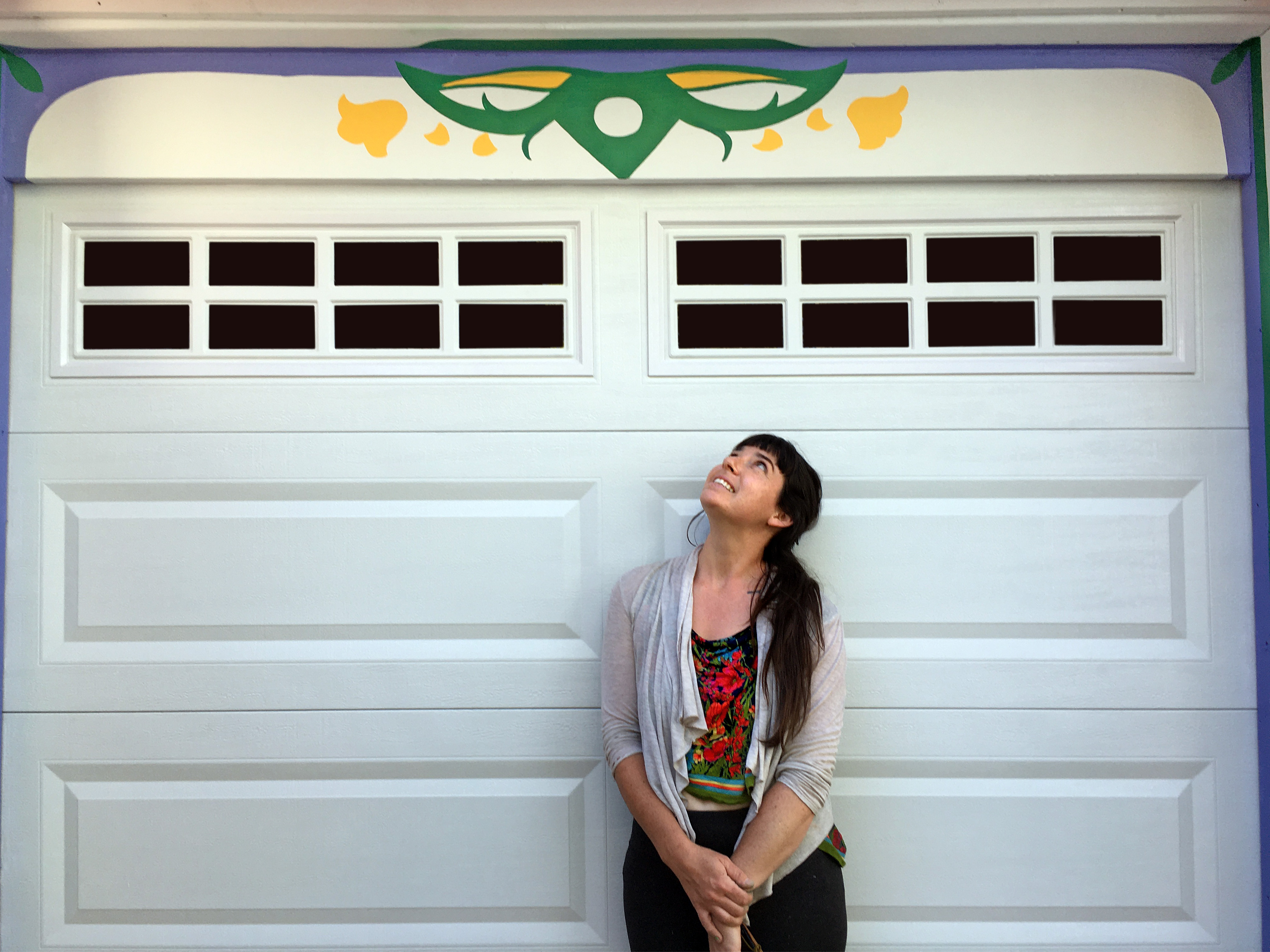
But wait! There’s more! After I had a new garage door installed, Mary added touches around it, too:
Mary’s garage ornaments
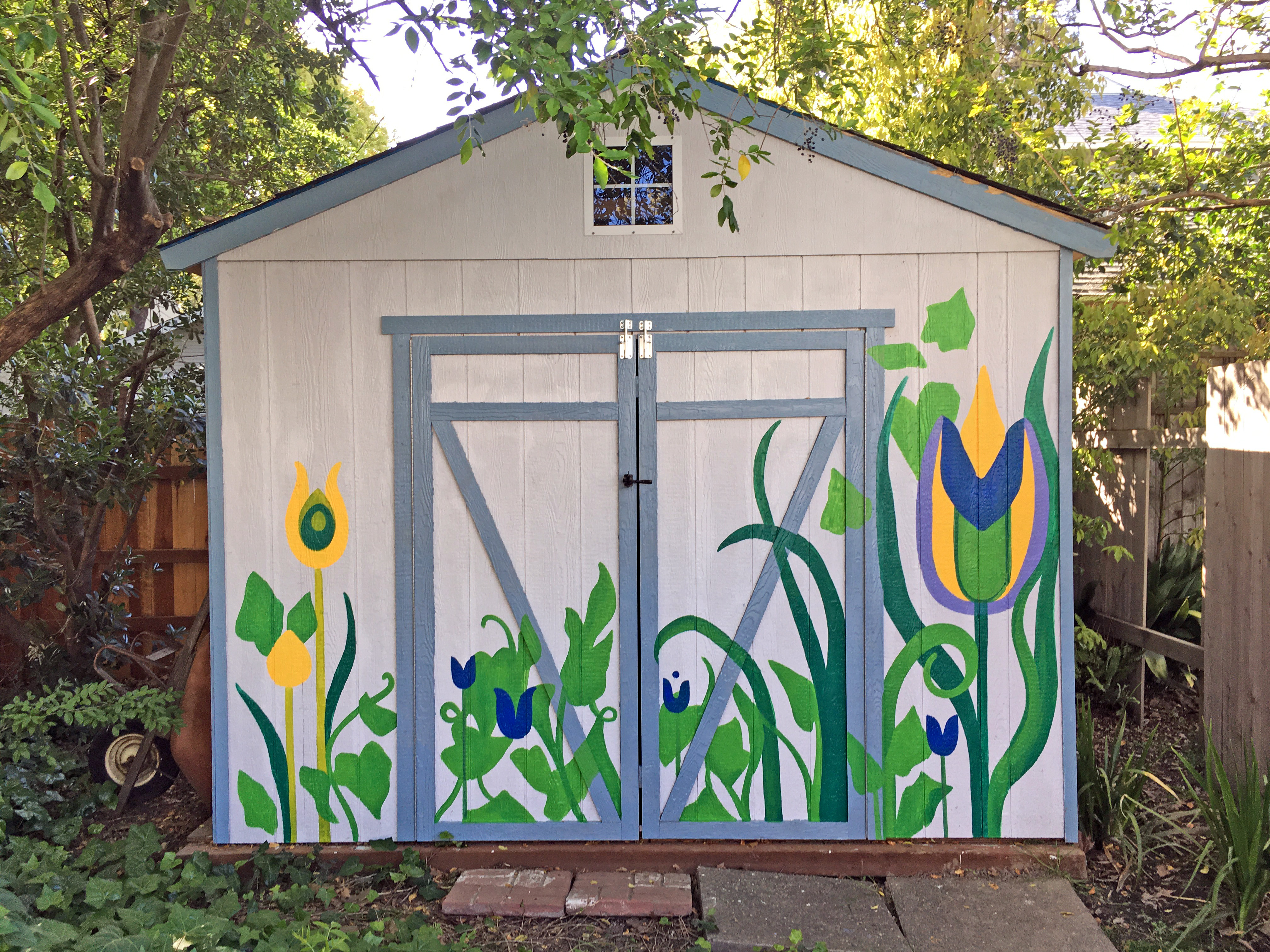
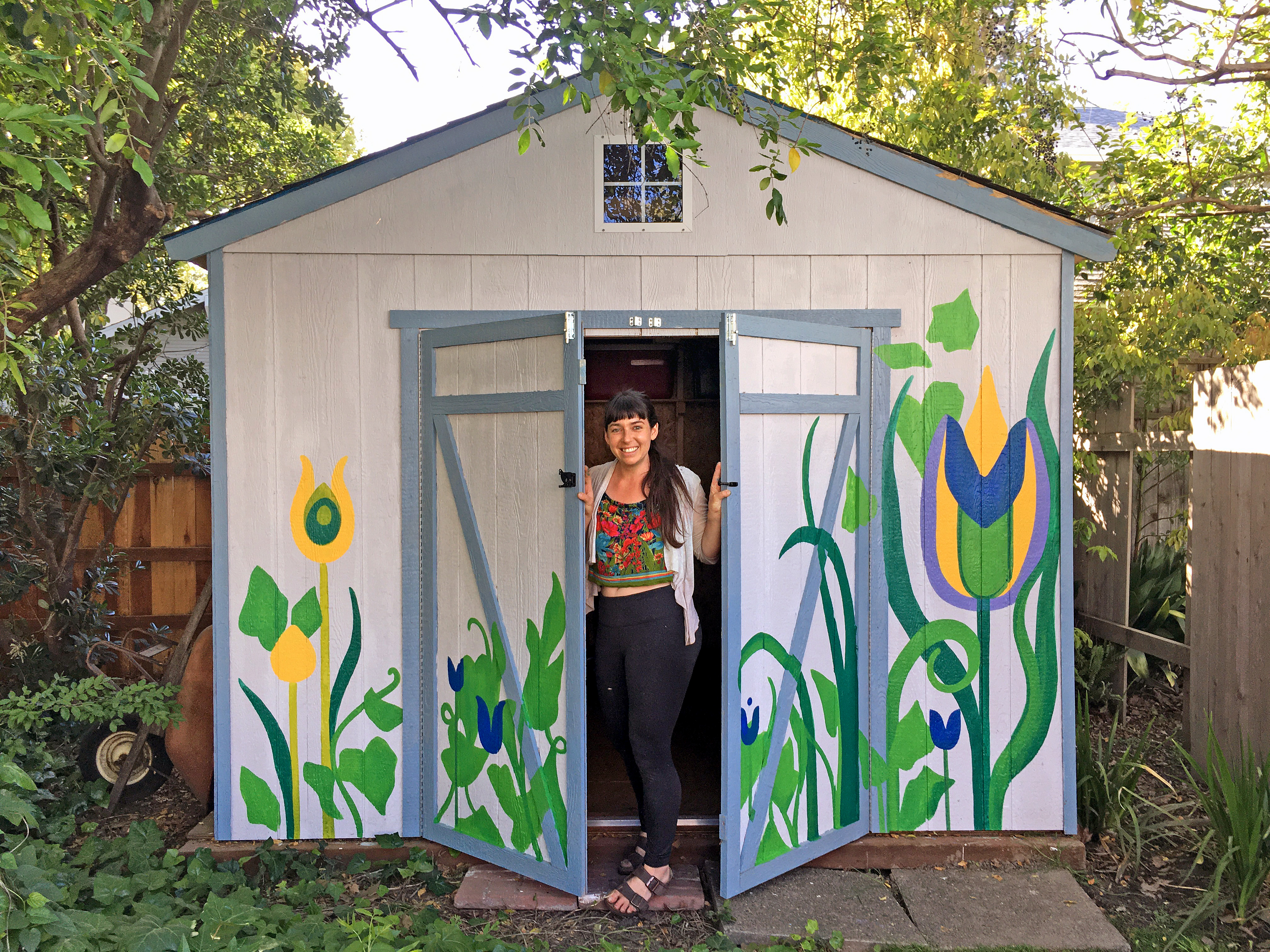
And she added fanciful tulips to the new shed out back as well:
There aren’t words enough to say how this delights me, bringing home the talent of one of my former Express newspaper students, one who design actual, physical newspaper after newspaper—not to mention a couple of Mainline magazines and a literary journal, Susurrus—and taught basic page design to many student editors. In a way I hadn’t really envisioned before, this helps wind up my career as a full-time college writing professor with an artistic bow.
It reminds me of the thousands of students who’ve sat in my classes, toiled on the paper and other publications, many of whose names and faces are lost to me. Mary’s generous spirit and compassionate heart remind me of so many people who watched me figure out how to teach new classes and try different ways of approaching the teaching of writing, whether in composition classes or journalism or creative writing.
This past year of teaching virtually has demanded all that I have and more. It’s certainly made me question my capability as a teacher, as it has so many of my colleagues who have persevered, trying to give their students the best possible instruction.
I could not have done my job without the help of colleagues like Rose Varesio and Timi Poeppelman, who taught me the ins and outs of Zoom and Canvas, as well as that of my dean, Robin Ikegami, of Language & Literature and her staff, Man Cheung and Candy He, who have been endlessly patient with me. I am deeply indebted to my Express co-adviser Randy Allen, who is Just the Best. And I so admire my students over the past two-and-a-half semesters, especially the ones on the Express, who have redefined—along with journalists around the world—what it means to report and photograph during a pandemic.
Such a fun collaboration! Art completely of Mary’s design with some of my words.
How do we carry on in times of deep strife? With a great deal of lovingkindness, to put it mildly. I have been the beneficiary of much of that in my life, and I like to think I’ve returned a good deal of it into the world, too.
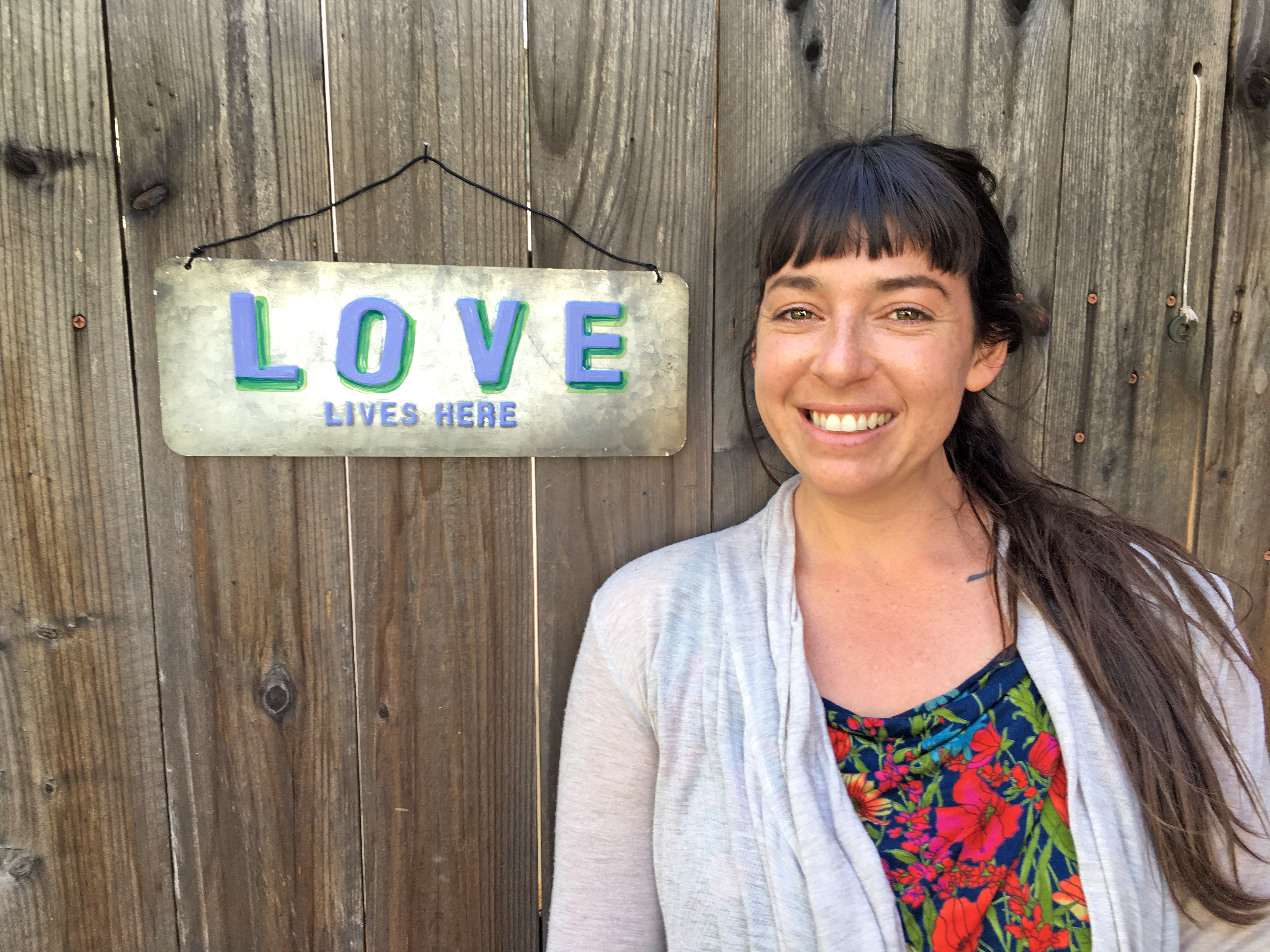
But looking out at these fanciful flowers—the ones now blooming in my yard and the forever ones on stucco and wood—reminds me that, as the song says, love is all there is. All you need is love.








 Güd wrtr