(#17 in the Annie series)
So in a previous life, at a high school pool in a galaxy far, far away, I had a several-summers-long career as a swimming instructor, lifeguard and synchronized swim team coach. I often tell people that’s where I learned to teach, and it’s true. If you could keep 10 squirmy kids occupied on the side of the pool, each taking turns to push off and swim to you, and return them intact to their moms (it was all moms in those days) after a half hour, despite the fact that you’d been accidentally kicked/bitten/groped/spat at by those kids, then you were well on your way to a teaching career. If you wanted one.
I did not at the time.
I did, however, love to swim. My mom enrolled me in Greta Andersen’s swim school in Southern California, when I was 3. Mom recalls that I initially did not take to the water. Later I learned that kids at about 3 figure out that they can drown, and an innate fear takes over. Sometimes it’s best to let the kid wait a year or so and then attempt swimming lessons. Others, though, swim right through this phase and onto swim teams.
I was in the former category. But my mom, because she and my dad were avid water skiers, wanted to get her daughters acclimated to water as soon as possible. She remembers that the teachers at Greta Andersen’s (herself a former Olympic gold medalist) were a bit rough in their methods, plunking kids underwater, much to their surprise and, in my case, horror. We generally avoided that in my pool days, letting kids take their time, coaxing them to blow bubbles on top of the water and gradually going lower till they felt comfortable blowing those bubbles underwater.
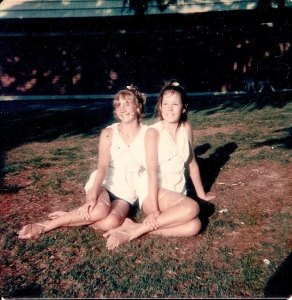
Jan and Irene, duet partners in costume, circa 1974.
I don’t remember any of this, fortunately. By the time I got to Roseville High School pool, an 11-year-old joining the synchronized swim team, I’d completed all the Red Cross swimming lesson levels and was very comfortable in the water—more so than on land where I could be (still can be) quite klutzy. And though I was far from the best synchro swimmer on the Aqua R’s (for Roseville), I had a blast learning the underwater stunts and participating in water ballet routines to music, especially with my duet partner and good buddy, Irene Mahan. I spent my days as a water safety aide, helping the older instructors teach lessons, my nights on the synchro team, and, when I was 16, I became one of those instructors and assistant coaches myself.
Teaching was the furthest occupation from my mind. I wanted to be a Journalist. Preferably traveling the world and writing about exciting happenings. Teaching sounded like the dullest profession on the planet. Who would want to teach for a living?
Those who know me know the punch line to this joke: I do. And though I got my (small) day in the journalistic sun, working for small papers, a bigger one, one international news service and a magazine, I did not travel the world exactly, though I did get around the western U.S. a fair amount. And along the way I got to dust off those teaching swimming chops to teach a journalism class or two or sometimes four at a university and in community colleges, and I quite liked the teaching thing, after all. By 1993 I was a full-time professor at one of those community colleges, a job I still hold today.
I have a lot of (former) little kids (and some big ones) to thank for that at Roseville High School Pool in the mid-1970s. They taught me a lot about patience and meeting people where they are instead of where you think they should be.
It doesn’t matter if someone is of an age to be able to do a head-down crawl the length of the pool. If that someone is still afraid to put her head underwater, it ain’t gonna happen. It’s the teacher’s job to work (often slowly, with incredible patience) to help that someone get to a comfortable level in the water… for that someone. Everyone’s level is different.
Teaching, I still remind myself, is a process of beginner’s mind, as the zen practitioners say—remembering what it was like when you didn’t know how to do whatever it is you’re teaching. About not having expectations. About seeing the best in every student. About accepting students where they are in the moment you’re with them, knowing that can and will change. And then being patient with that, too.
This is harder than it sounds, as anyone knows who has tried to teach anyone else anything. Which is pretty much everyone. We are all teachers; we are all students.
==========
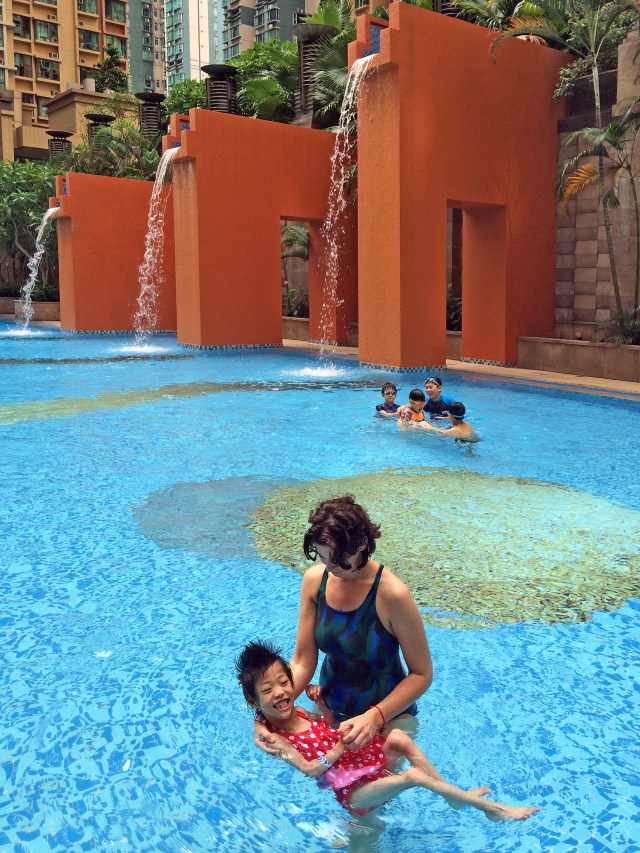
The great thing about watching Annie get in a swimming pool for the first time with Nikki and the next time with me was that we had no expectations of where she should be—and literally where we were was pretty fabulous. In the big pool at Liberté, the Macphersons’ huge apartment complex in Kowloon. Liberté’s pools are worthy of Hearst Castle, and actually, I think William Randolph would be envious of these pools. Though there is no huge statue of Venus rising from her shell, there is an indoor and an Olympic-sized outdoor pool, the latter of which has three waterfalls people can stand under and get a pounding massage. There is a long warm pool (not as hot as the hot tub) for soaking tired muscles. There are diligent young lifeguards who must have been pinching themselves to stay awake on their towers. It’s so quiet and peaceful in the mornings, I figured the heat and humidity must be lulling them to sleep.
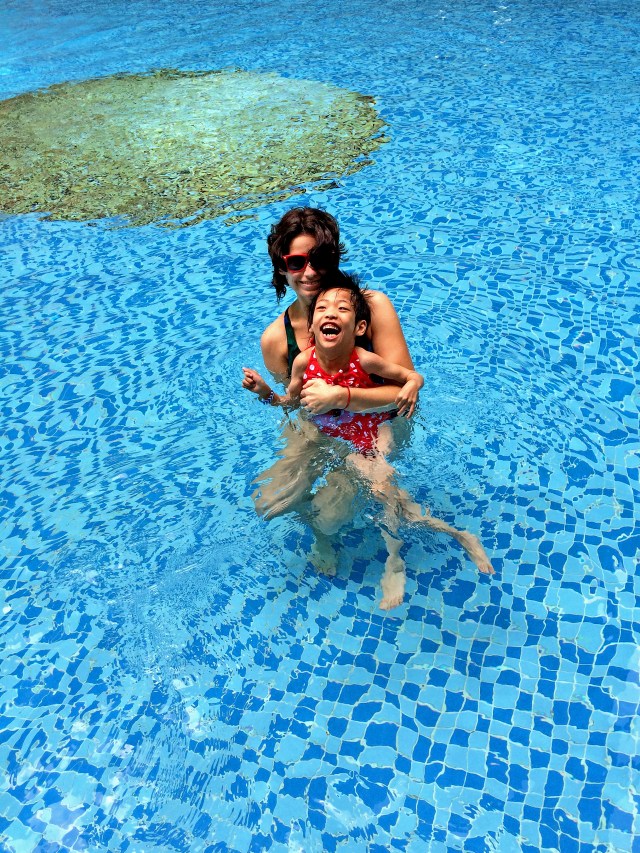
We, on the other hand, were rarin’ to go. And by “we,” I mean Annie. Nikki had brought the only bathing suit among us, so we got Annie a red suit with white polka dots while in Guangzhou. I elected to stay dry and take photos, and I’m so glad I did. Because, well… look:
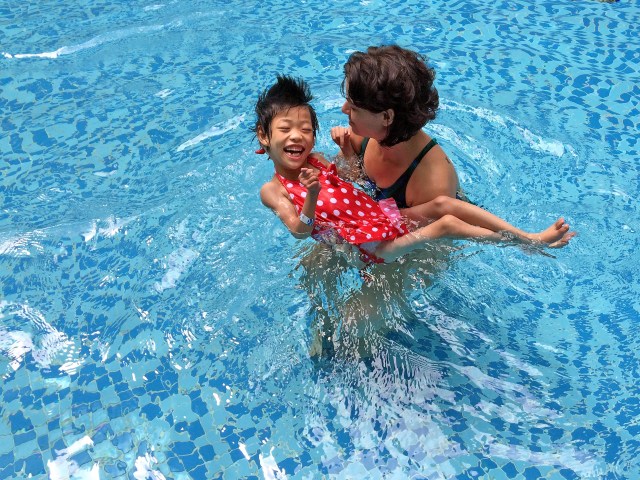
Annie took to the water like the proverbial fish. There was nothing about it she didn’t like, even laughing like crazy when Nikki took her under the huge waterfalls (after plugging Annie’s nose and covering her mouth). But we learned that Annie likes being dunked, doesn’t mind getting her head wet at all. And, like a lot of other little kids I saw in my swim-class days, she has to be reminded to close her mouth before she goes underwater… she’s laughing that hard.
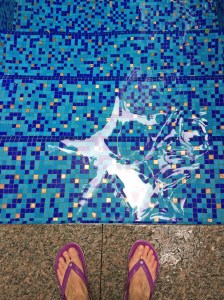
Ayi Jan’s flip-flop feet on the edge of the warm pool.
Look at this pool, by the way. I stood there, taking photos, feet on the top step of the warm pool, torn between having pool envy and wanting to take photos. Good thing I didn’t have a suit. This would’ve been the stuff of dreams for my young synchronized swimming self. Irene and I would’ve had a great time doing our routines in this gorgeous pool.

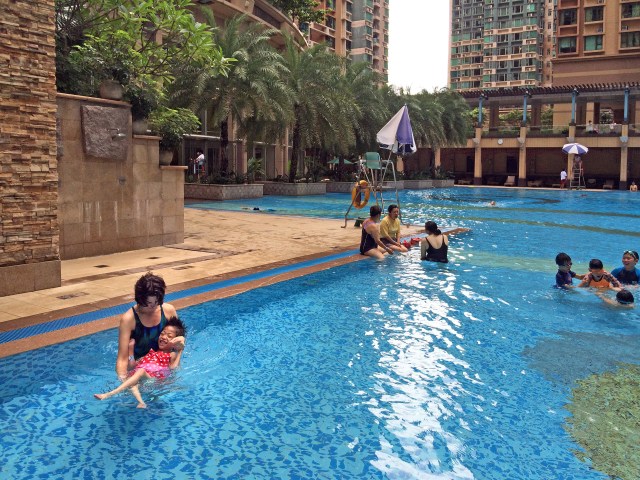
Although the big pool was warm, Annie’s teeth began to chatter after a fairly short time in the water (this kid has absolutely no body fat). Fortunately, this complex has a warm pool behind the main pool, in addition to its actual hot tub, so Nikki took Annie in the warm pool with jets spouting water below the surface. I love the artfully placed heliconia hanging over the pool, too… yes, it was real.

In the warm pool, as we had hoped, not only was she a happy kid… Annie’s limbs also relaxed. When I took her in the water the next day (after borrowing Nikki’s suit), in less than ten minutes Annie’s legs uncrossed. Her arms, usually bent at a 90-degree angle at the elbows, lengthened. We put her feet up to the warm jets, and she giggled as her feet relaxed. She did not want to leave that pool, and I couldn’t blame her. In the water, she’s weightless, free to move as she likes. Her bound-up body is no longer bound by spasms, made heavy by gravity. She floats like a winged thing riding a thermal high in the sky.
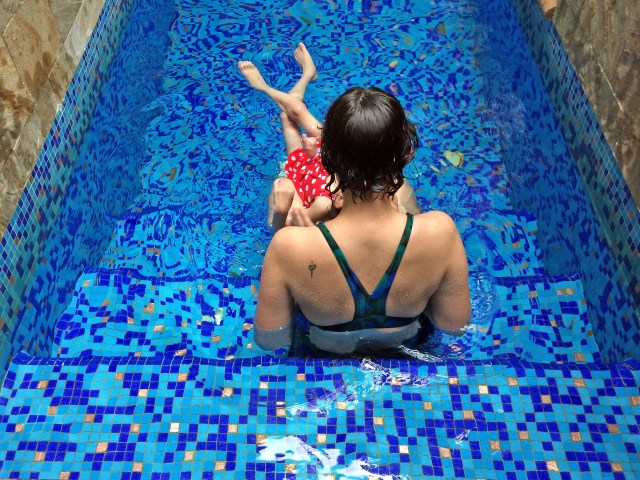
We had suspected warm water therapy would be good for Annie, and this was proof of that. Nikki and I each had Annie in the warm pool for a good half hour. We were prunes coming out of there, all wrinkly on our palms and bottoms of feet, but we had never seen a limp-noodle Annie before. Now we know that it’s possible to get her that relaxed, Nikki’s going to be looking for hydrotherapy for Annie in Sacramento, for sure.
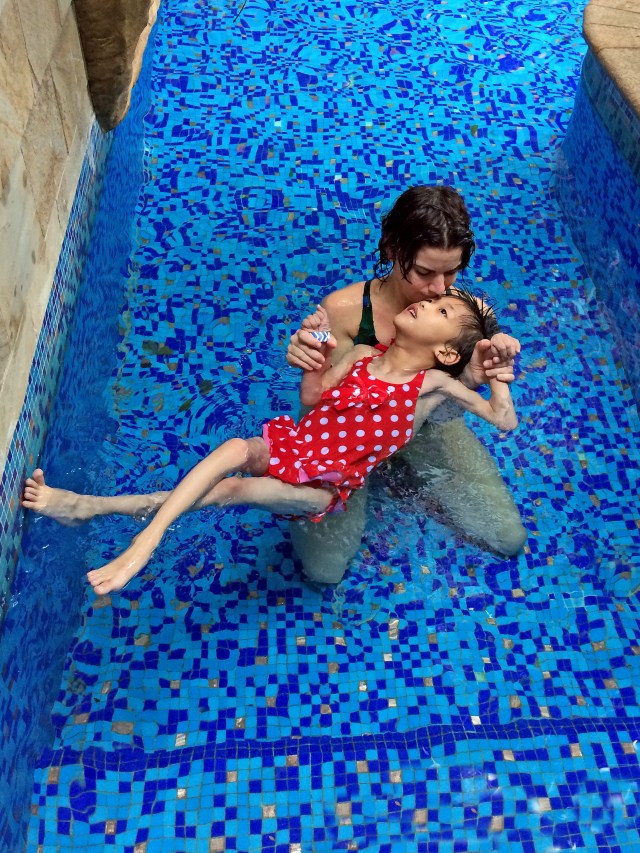
Is this the sweetest photo of these two, or what? Might be my very favorite from the whole trip… mother and daughter, happy and relaxed in warm water.
Here’s wishing them many more sessions in warm pools and many warm moments like this one… in and out of the water.

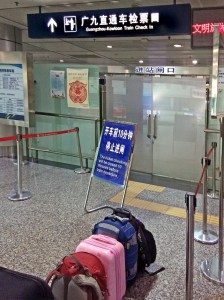

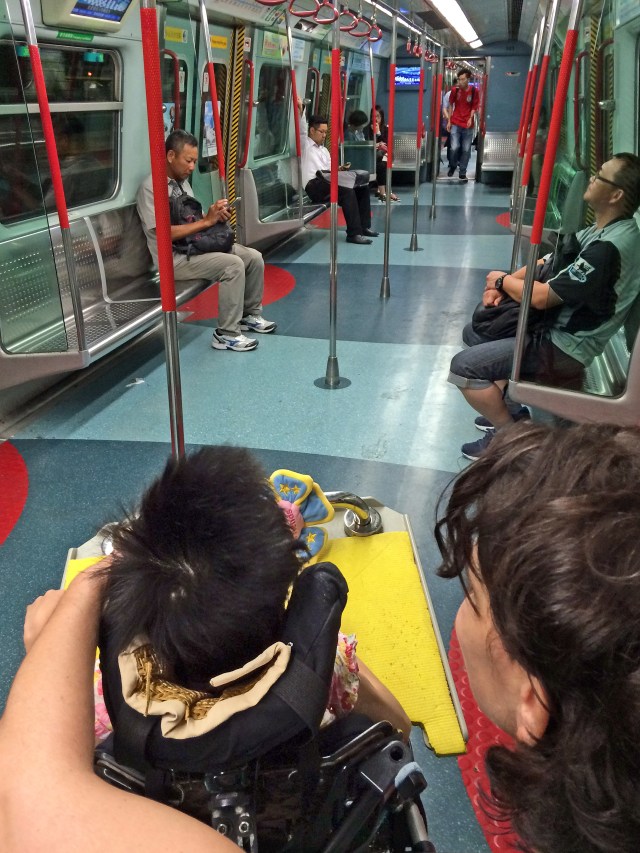
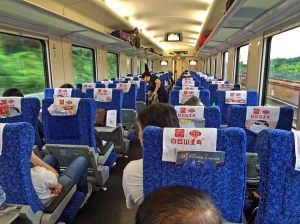 But a kind attendant let us move to another car where we could sit right in front of where the chair had to park. One attendant did suggest that we could stand for the three-hour trip in the space between the cars, but Nikki put her foot down at that. We got seats in a less-crowded car, and Annie spent part of the time in her chair and part of it lying down on two seats with Nikki. I sat in front of them, two seats all to myself. It felt quite spacious.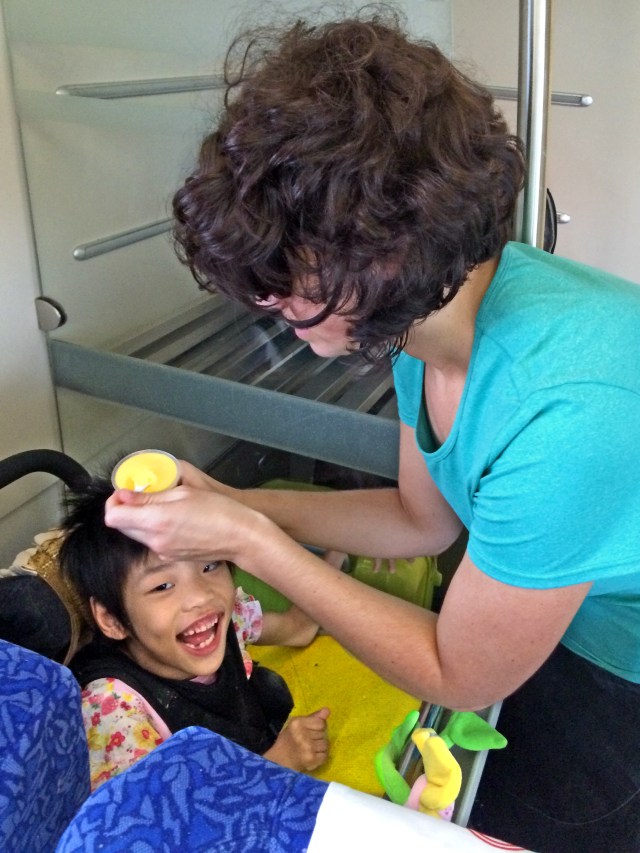



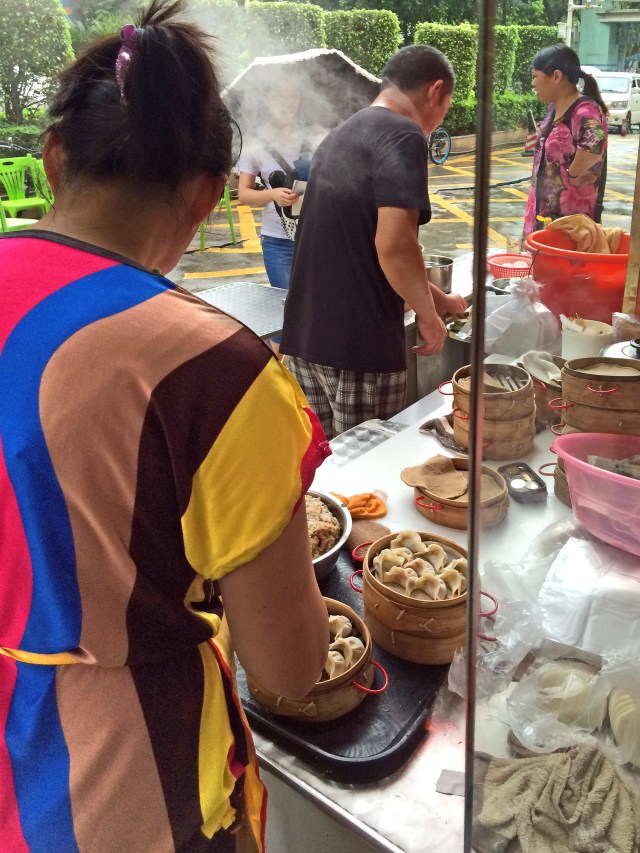
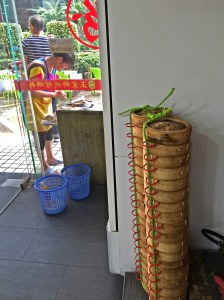 She puts the dumplings into circular bamboo baskets, and a man puts each basket into the steamer. I couldn’t tell how long it takes to cook, but I imagine not long, and you have fresh, steaming dumplings. You pick them up with your chopsticks (no forks or knives here), and you transfer that warm bundle to your mouth, which explodes with happiness because THIS is what dumplings should always taste like. This has completely redefined “dumpling” for me. This is change-your-life food, and it is, without question, one of the best things about my Chinese experience.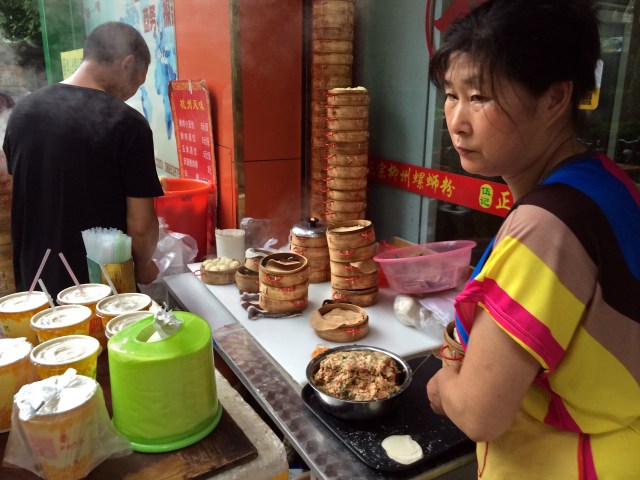
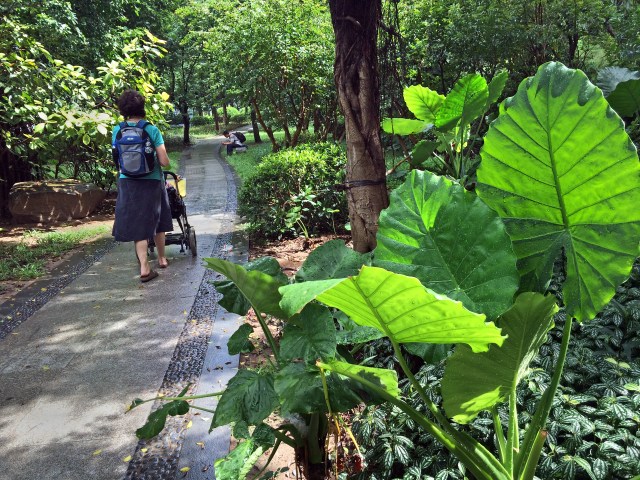
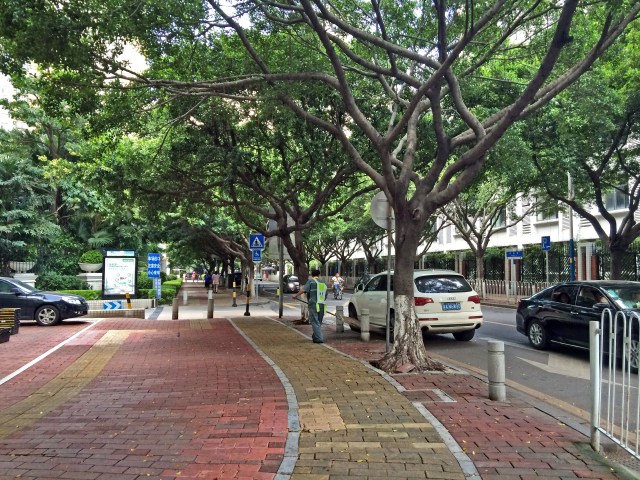
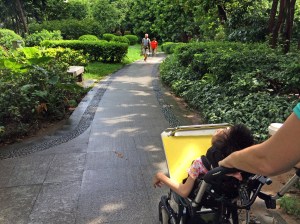 But in between the morning pourdowns, we walked under blue sky, fat clouds and sun. After we’d crossed a major road with eight lanes of traffic moving in two directions, we found a nice little narrow garden area where Nikki pushed Annie, and I followed, taking photos. “The Chinese love their gardens,” Nikki says, taking an opportunity to plant something green wherever possible, and this is a particularly nice one.
 It struck me after we came back to our room after our stroll, as we crammed our belongings into our bags, that today we leave China, all of us possibly never to return. We will spend the last part of our trip as we spent the first part: in Hong Kong staying with Nikki’s friends, Anne and John MacPherson. It’s so nice of them to host three of us in their tiny apartment. But for now we still have to leave Guangzhou, maneuver another train station, feed and change Annie on the train, get the subway to John and Anne’s. I cannot think of all that at once. As my mother likes to say, “You can only eat an elephant a bite at a time.”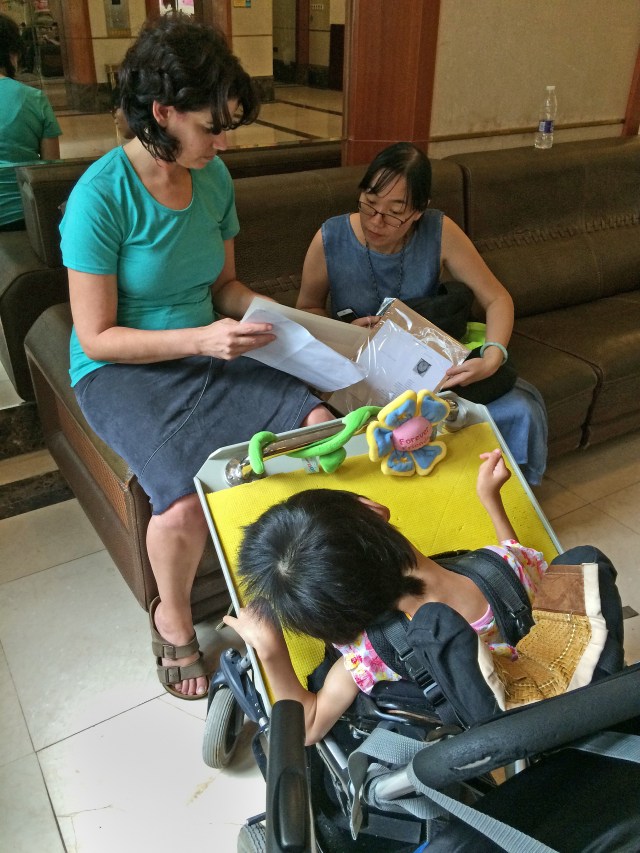



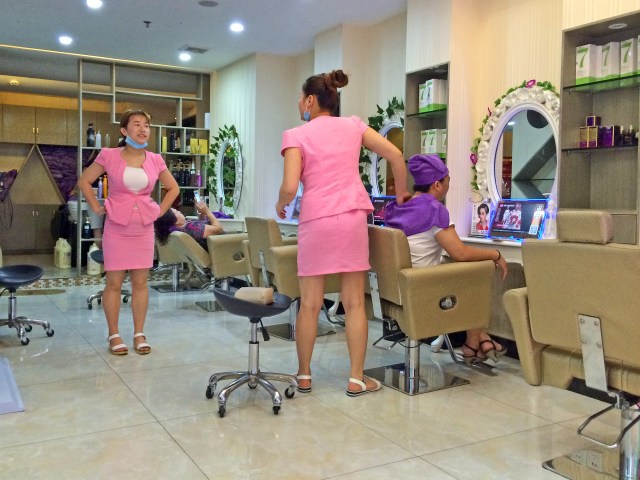
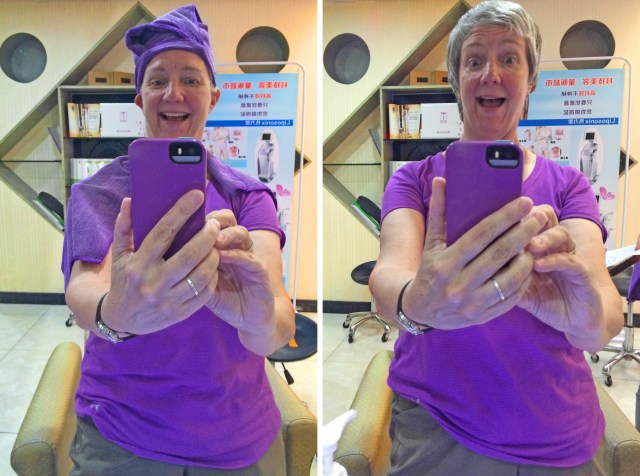
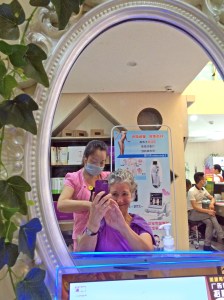 have fingers of steel and, since I was alone and no one spoke English, I could not figure out how to say, “Lighten up, wouldja?” The woman thumbing and digging into my skull would occasionally say, “OK?” and because I didn’t know how to say “gentler” and I’d forgotten how to say “no”—and I only knew those words in Mandarin and they speak Cantonese in Guangzhou—I just said “OK.” My head kind of ached in a good way when she stopped, though, and the sore spots I hadn’t known were there until she mashed them were not as sore. Maybe, I thought, there’s something to this tough-love massage, which I am not used to.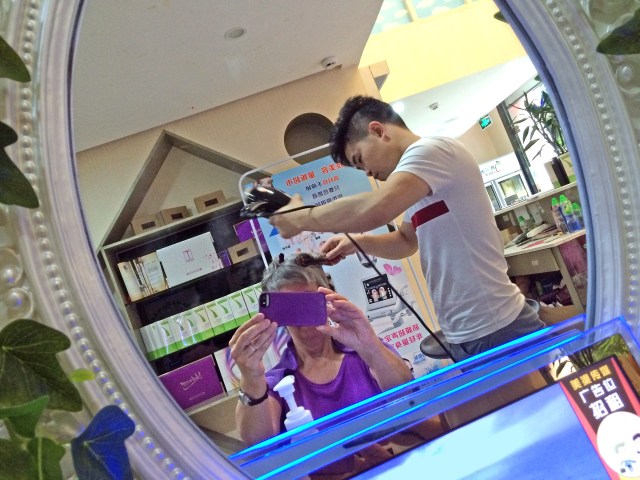





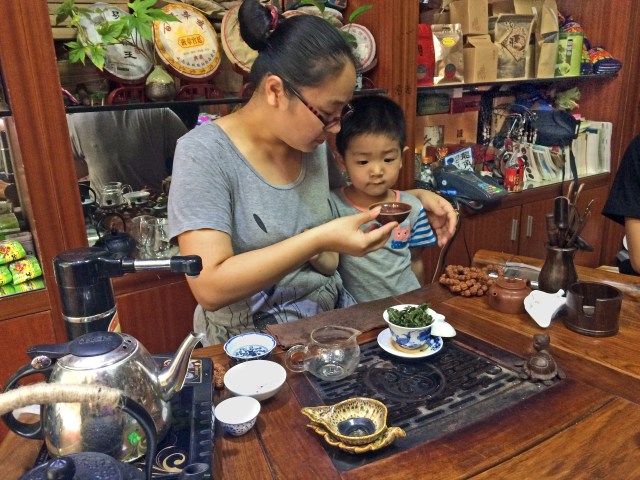
 We started with tie guan yin, one of the great classes of tea, which is known, according to the list, “for its cancer preventative and intelligence stimulating properties.” It’s a very mild tea, very pale at first. I learned that Chinese tea is properly prepared by pouring more water over the tea, which darkens with each pour. The tea lady also used a specific pot for a specific tea and began the procedure by pouring hot water over the pot, which apparently, if I correctly understood the tea lady’s pantomime, makes the pot smooth and lovely over time. She used very little tea to scoop into the pot and strained it with a ceramic strainer before pouring it into a clear glass container. The colors of the different teas ranged from flaxen to the color of a coconut husk. One was the palest green. From there, she poured it into our cups and hers.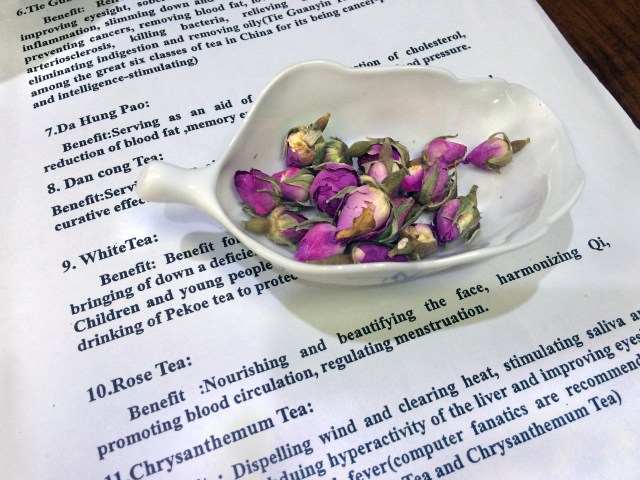


 I also bought three lovely ceramic tea containers. In all, I spent 800RMB, which surprised Nikki when I told her (she’d gone down the street to get us lunch to take back to the room). That’s about $119, not inexpensive, but lovely tea from a kind tea lady who asked polite questions about Annie and told me about their 6-year-old daughter, who was at school that day. Summer vacation is about to start—it’s two months long here—and I imagine she’ll have both kids with her in the shop, their daughter and their energetic boy who wants to ride his scooter, and whose father played with him as we sampled tea.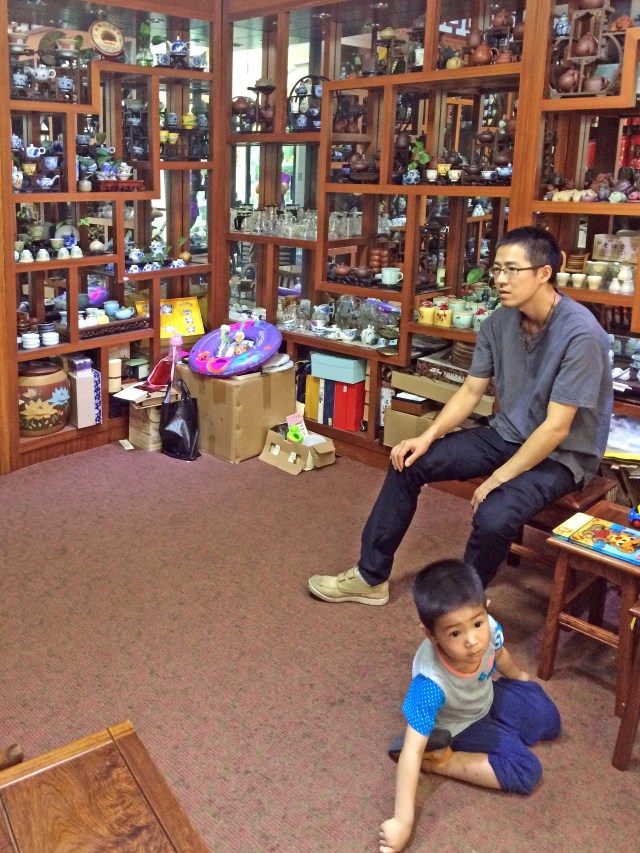



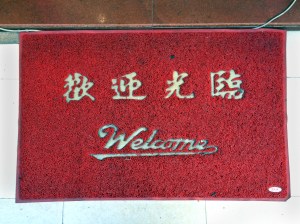 Guangzhou (population about 13 million, the third-largest city in China) has a history that dates back about 2,200 years (also from Wikipedia, which I consider a not-bad source, especially if you consult the footnotes at the ends of entries that lead you to better sources). So we arrived deep into the night in Guangzhou (pronounced Gwan-jo), the capital of Guangdong (formerly called Canton) province, south of Hunan province (where we were in Changsha) and just north of Hong Kong, where we began and will end our trip.