Changsha walkabout

•IMG_9741aC

(#7 in the Annie series)

Here’s how China has changed, Nikki says, in the four years since she was last here:

—There’s not nearly as much smoking in public as there used to be. Typically, only men smoke and fewer seem to be. Also there are “no smoking” signs in a lot of places, including restaurants and hotels and at elevators.

—Likewise, you don’t see people spitting on the street as much. Or dog poop on the street. Or people (usually men) just taking a piss on the street or in a corner.

—You find more western, pedestal-style toilets, though Nikki prefers to use the squatty potties (my term) that amount to a porcelain hole in the floor, which are more sanitary, she says. Otherwise, women climb on top of the pedestal and squat anyway. TMI, right?

China is still hotter than snot, though, in summer with humidity of the sort that leaves you noodle limp the moment you leave an air conditioned space. And not all public spaces (particularly restaurants) pop for A/C. They have big fans that move around the hot air, and locals seem fine with that. I can’t believe I’m envious of Sacramento, which this week is sporting 105-degree days. We say this as if we know otherwise, but many of us Californians don’t know the difference: But it’s a dry heat. Right now I’d love me some dry heat.

If on this journey I have had Chinese food forever redefined for me, I now also have a new definition of “hot.” In weather and in food. (Hunan loves its chiles!) My privilege as a white, college-educated female professor comes blaring at me here, too. I understand now why so many people in the world think of Americans as “rich.” We are, by comparison. I have a whole house to myself (though I will have a new housemate and a new cat by the time I get home). I own a car and drive myself to work at a college each day. I am beyond fortunate, and while I know this very well because there are plenty of people who have far less than I in my very city, it’s even more obvious in China.

•IMG_9597a

Annie in Changsha Skypes with her grandparents in California.

Also, closer to my very city, Nikki’s parents (who live in Camino, a good hour from Sacramento) got to meet Annie today via Skype. She got to hear her new grandparents’ voices and see them in fuzzy images from 7,000 miles away, which continues to seem like a miracle to me. They all sounded delighted to meet each other.

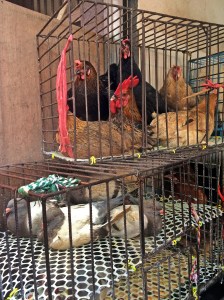
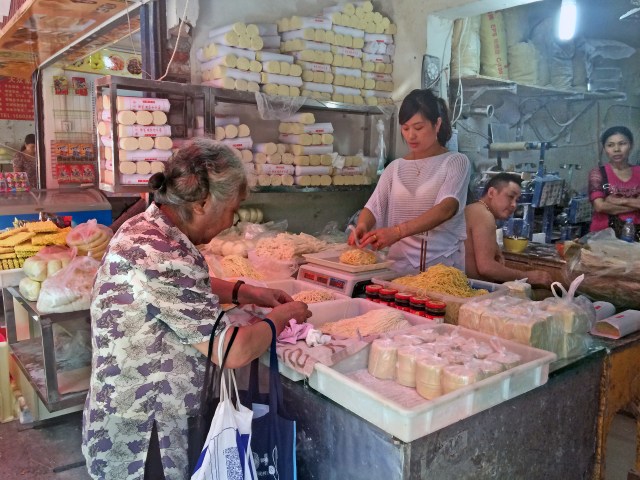
•IMG_9609aAfter the chat with her folks, Nikki took Annie and me out to the local street market, not far from the super market, to see the sights. There, down side streets, under apartment buildings with bars on the windows and balconies, the street vendors lay out their wares in a tradition so timeless you can imagine the meat guy’s grandfather hanging parts of animals on hooks for people to peruse and buy.

•IMG_9626aC

Live fowl and frogs at the market.

You can envision earlier generations presenting the live chickens and pigeons, the live frogs and crawdads and fish, ogle the greens and red of new chiles spread on the ground to pick through and take home for dinner.•IMG_9628aC

•IMG_9610a

The noodle shop

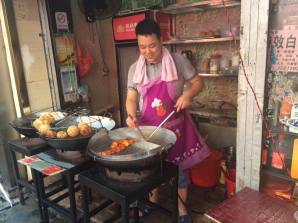
frying donuts

The doughnut man.

I loved the doughnut guy, though I’m pretty sure he wouldn’t recognize that designation. He was a youngish man standing behind two vats of steaming oil, plunking in hanks of dough and retrieving them, cutting them into smaller pieces and offering them in a paper tray to passersby. We had stopped so Nikki could give Annie some juice on that steamy afternoon (as they all are in summer). I looked behind us, saw the doughnut guy, who gave me a nice smile.

“What’s he making?” I asked Nikki, who looked up from Annie’s juice box.

“Fried dough,” she said. “Doughnuts. They’re usually pretty good. Try some.”

Though I generally avoid sugar, the smell convinced me, and I gestured to the doughnut man that I wanted to buy one of the little paper trays. He smiled again and said something in Chinese. I looked to Nikki.

“Fifteen,” she said.

“Fifteen RMB?” I said. That’s about $2.

“Yep,” she said.

So I withdrew the cash from my shoulder pack and gave it to the man, who gave me a paper tray with a slender pointed stick protruding from a piece of fried dough. I bit into it. Heaven. I don’t know what it was—there was nothing fancy to it—but it was, in that moment, the best version of a doughnut I’d ever eaten. On a blindingly sweaty day amidst hundreds of Chinese in a street market.

•IMG_9614a

The tofu shop

I tore off a tiny piece for Annie. “Doughnut?” I said to her now that she was finished with her juice. As if she understood me, she flashed her big Annie grin, opened her mouth. I popped in the bit of fried dough. She had her usual wide-eyed chewy look, and as the piece worked its way to the back of her mouth, she swallowed and then opened her mouth again. I popped in another piece.

•IMG_9613a

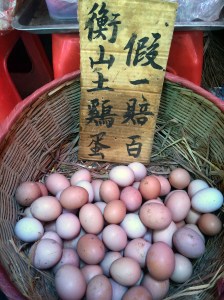
Keeping all the eggs in one basket.

“Good stuff, huh?” I said, and Nikki, who didn’t want any doughnut, laughed. We all did as I took bites and gave Annie bites until we continued walking down the street looking for an indoor pharmacy. Nikki wanted more sleep medication, which you can buy over the counter in China (apparently you can buy just about any drug you want over the counter in China). We found it at the second pharmacy we went to, where a kind man behind the counter came out and gave Annie a lavender balloon on a stick, which earned him a big Annie grin of appreciation.

Annie makes a friend

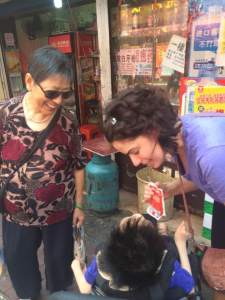
Annie makes a friend.

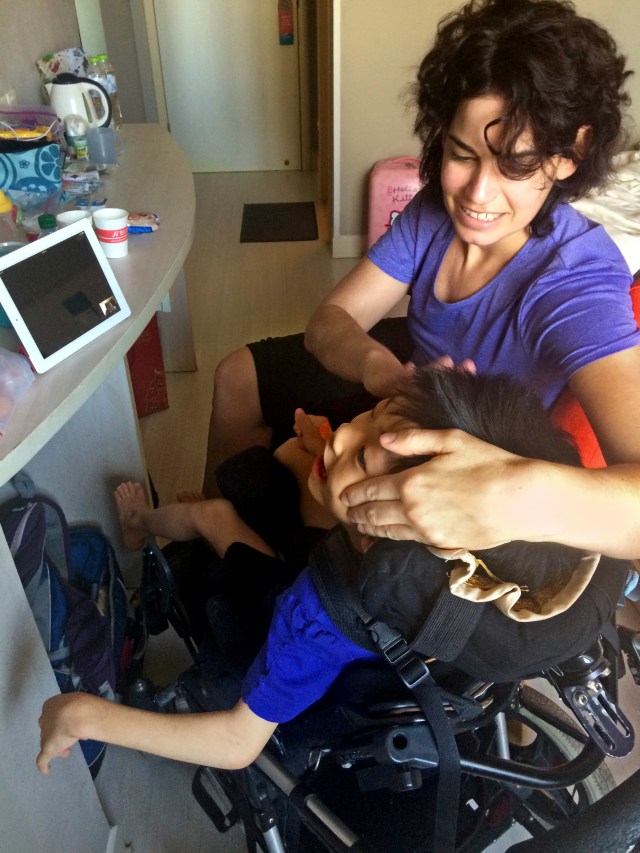
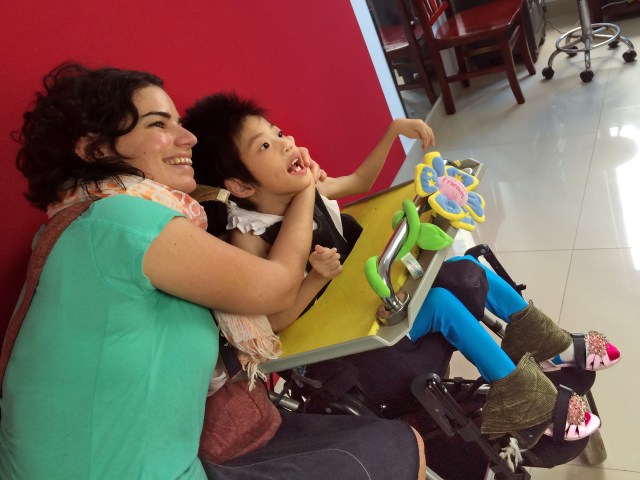
And as we came out of the pharmacy, an older woman with kind eyes came toward us on the street. We’d gotten used to the looks of puzzlement from many people, of shock and disgust from others. I knew that people in China were not used to seeing a physically disabled child in a wheelchair. But this woman came toward Annie and greeted her in Chinese. Annie lit up, and Nikki talked to the woman a bit. She bent down to talk to Annie a bit more. Whatever she said pleased Annie, who chortled. Annie had made a friend.

Nikki said later that the people who approached us, who asked nicely about Annie, were likely to have had experience with people with disabilities before. “Maybe they had a child with a disability, or someone in their family,” she said. “Or a friend.” We saw their interest as one of compassion, of friendliness, unlike the people who would pass by saying things in Chinese that Nikki could understand—things Nikki didn’t want to repeat to me. These things annoyed Nikki to no end, and a couple of times, she’d say things in Chinese to let them know she understood. But mostly—and this must have taken supreme acts of self control—she held her tongue.

•IMG_9660a

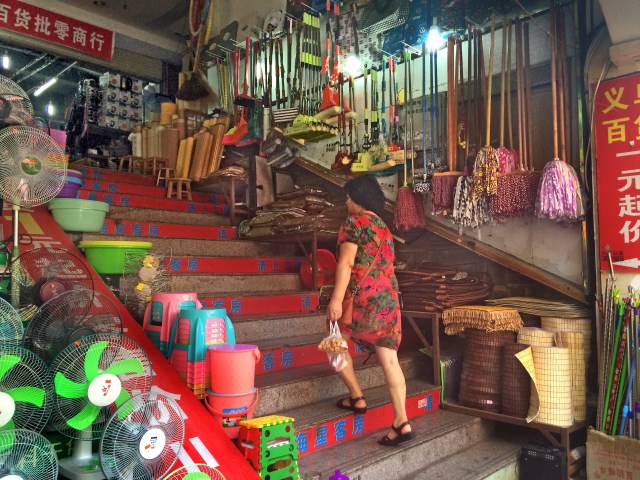
The housewares store

This is how life will be now. Some people will be unkind; some will be curious. Others will look away; some will ask questions. It’s gonna be exhausting dealing with all that. And I’m sure there will be times when Nikki is not going to want to have to educate people about cerebral palsy and how it affects her daughter.

•IMG_9677a

Nikki, Annie and the noodle man

But the doughnut man, the nice woman who stopped and chatted—these are our people. As was the noodle guy who runs the small, modest shop behind our hotel. Nikki had gotten noodles from him before—lovely, melt-in-your-mouth noodles and broth that have forever spoiled me for store-bought ramen. And when we came back with Annie, he seemed happy to see Nikki and also said hello to Annie and me. She ordered for us all, and he set to work.

“I’m going to ta•IMG_9673ake her back to the room,” Nikki said to me, which was a good idea given the heat.

I knew what to do, though neither of us spoke the other’s language. “I’ll pay him and bring back the food,” I said.

“Perfect,” she said, and she explained this plan to the man before she and Annie wheeled away to our hotel around the corner.

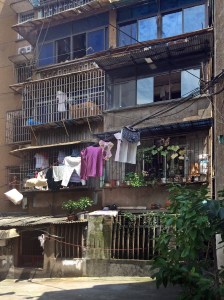
I stood there in the alley looking up at the apartments with the barred windows (is that to keep people in or from falling out?), at the laundry hanging on lines from so many windows. In this all humidity, I wondered, does it ever dry? How long does that take?

•IMG_9686a

The noodle shop

And in about ten minutes, the noodle man came and got me, beckoned me inside to load up our noodle bowls with chiles or pickled veggies or onions. I put some of each in Nikki and Annie’s bowl, just the onions in mine. He grinned at me and fastened plastic lids onto the bowls for me.

It struck me again: We are all one in spirit, but we are not all the same. Not all Chinese are unkind about difference, any more than all westerners are compassionate toward it. But a genuine smile reaches beyond language and borders and imagined boundaries. And we, in this small corner of a huge country, have someone traveling with us who has the best smile, who opens doors and hearts in ways she can’t begin to know. Are we lucky or what?


Posted in Bringing Annie Home | 5 Comments

You’ve got a friend in me

•IMG_9794a

Listening to music before breakfast.

(#6 in the Annie series)

We began our Wednesday when Wendy came to pick us up in the same clean van that took us to get Annie two days before. There was a different driver, but he drove with the same carrying-precious-cargo finesse as the first driver. Wendy had learned that we needed to go back to the Civil Affairs Center to retake Annie and Nikki’s family portrait. The first one was done against a red background, which seemed very China-ish to me. Apparently, it was supposed to be done against a white background.

•IMG_9812a

Retaking the Cardoza family portrait.

This did not thrill Nikki, but the paperwork was still in progress—we had a couple of days before Annie’s Chinese passport and visa came through—so she wisely did not want to rock that boat. But we also had appointments that morning to visit the two facilities that have housed Annie since she was given up when she was about a year old—the Butterfly House hospice where she spent her first three years and The Lighthouse, the ICC orphanage, where she has spent her most recent three years. Wendy was most apologetic for adding another stop to the agenda, but it wasn’t her fault, we assured her.

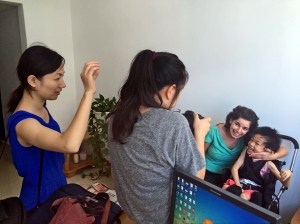
So after changing and feeding and dressing Annie earlier than any of us wanted, we met Wendy and the van driver and obediently returned to the same third floor office where Annie and Nikki’s first portrait was taken. Mother and daughter posed against a white background for a second family portrait with me, the documentarian, taking photos of their photo shoot.

•IMG_9821a

Nikki and Annie visit The Butterfly House, where Annie was nursed back to health.

We bid Wendy farewell for the moment, and then the nice van driver took us the Butterfly House, which is in the same building as the Welfare Center, the Chinese orphanage as well as convalescent and old folks’ home. Lyn Gould and her husband Alan and helpers have transformed one of the floors into a bright, welcoming space that receives ill or dying children. Lyn is an English nurse, and she has brought the idea of palliative care to a place that typically doesn’t offer such services. Though Butterfly House has relocated to a new floor since Annie was a resident and Nikki volunteered there, it felt familiar to them both. This was where they met in 2010, not long after Annie was brought in, though only one of them remembers this.

•IMG_9829a

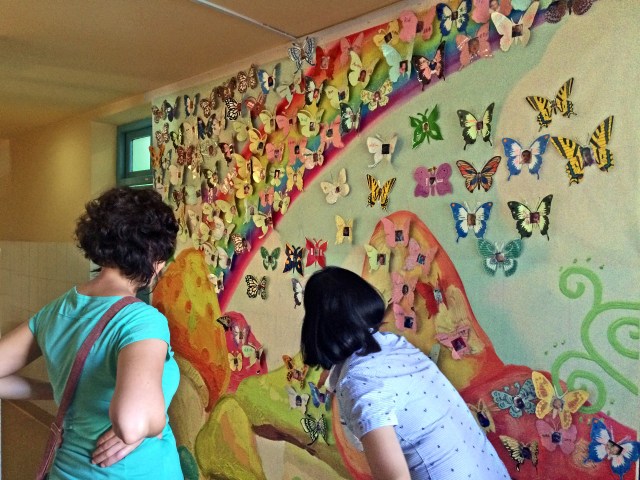
The butterflies decorate the wall at the Butterfly Children’s Hospice in Changsha.

Unfortunately, Lyn and her other nurse, Katie Hill, both of whom are Nikki’s good friends, were in England during our visit. Still a few kind women showed us around, and we got to see some of the butterflies currently in residence. One, a little five-month-old girl, laid very still with a feeding tube the size of a rice noodle snaking into one nostril. Another, a four-year-old boy with a heart condition, played happily on the floor with a young volunteer from England. And without anyone saying so, I knew that if these children were here, they were not expected to live long.

But neither was Annie when she was brought here in 2010, small and starving, bound up with her spastic muscles. Lyn and Katie and Chinese nannies and volunteers saved Annie, and it was meaningful to see where she’d come from. Not all their butterflies survive (that’s why it’s called Butterfly Children’s Hospice), and Annie is a huge success story.

•IMG_9834a copy

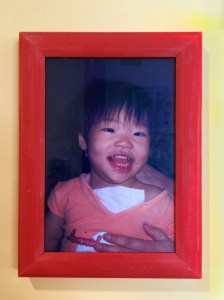
A much younger Annie.

I watched her carefully to see if she recognized some of the adults who gathered round her chair, exclaiming over how much she’d grown. She grinned her fabulous Annie grin, and it seemed that she did. Her photo is still on a bulletin board—a much smaller Annie, a chubbier Annie with big cheeks and longer hair. (Nikki doesn’t love Annie’s current haircut, which sticks straight up; neither does Lucy, who asked The Lighthouse staff not to cut Annie’s hair, but they did. It leans toward the punk, as if she’s rocking an early David Bowie look.) In the photos she looked happy, flashing the same bright smile, and she seemed delighted to see the people there now, who were equally happy to see her. It’s a happy place, the Butterfly House.

We couldn’t stay long since we had an 11 a.m. appointment at The Lighthouse, Annie’s most recent home. We went to retrieve more medication, since she’d come with none and Lucy was not given much. The idea was that Nikki would receive a month’s worth since she wasn’t sure when she could see a pediatrician once they returned to Sacramento. But we also wanted to see more examples of the physical therapy Annie had gotten, and Lucy invited us for lunch. Nikki told Annie where we were going and that she could also say goodbye to her friends.

That may have been our biggest mistake.

•IMG_9839a

Staff at the Lighthouse, including her ayi (third from left) greet Annie as she returns for a visit.

Lucy and other staff members met us at the front door, as excited to see Annie as she clearly was to see them. The Lighthouse building is an older facility, not nearly as bright and lively as The Butterfly House, but clearly staffed with people who love these kids, each of whom has a disability. On the second floor we got to see the computer room where Lucy holds class, crammed with wheelchairs and kids on perhaps eight older computers. One girl in a chair had control of only her chin to operate the computer. “She used to have more movement,” Lucy told us later, “but now she’s like this.”

This broke our hearts, but it made clear what happens to kids who don’t have the benefit of ongoing professional physical therapy and treatment. They deteriorate, and if they’re not adopted, they stay at The Lighthouse as adults or transfer to the Welfare Center. It’s a dismal life. That’s why Lucy told Nikki there’s nothing for Annie in China, that she needs to come to California to have a hope of a better life, of more mobility, to go to school, to learn English and perhaps go to college, become a professional one day.

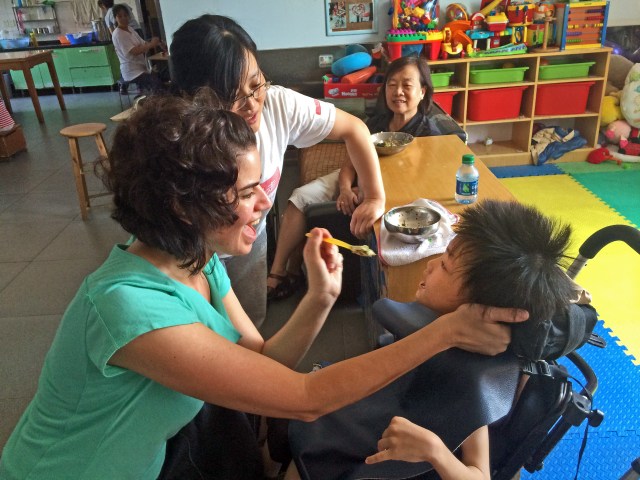
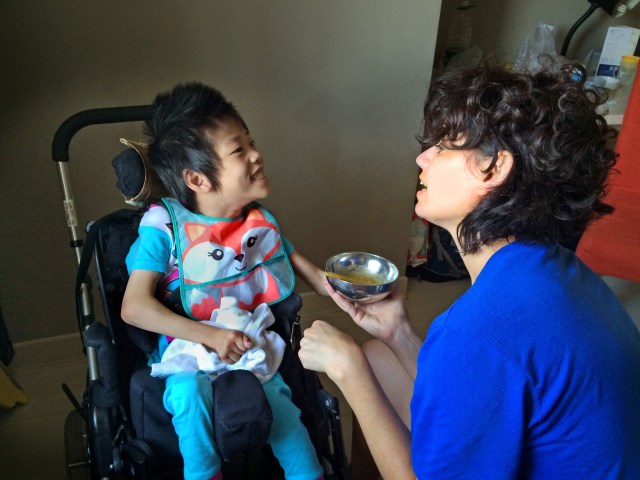
•IMG_9860aAnnie ate it all up—literally—as one of the Chinese care-ers (as they’re called) fed her a heaping bowl of rice and showed Nikki a more helpful feeding technique. We were also shown specifically what kinds of exercises they’d been giving Annie daily and the standing frame she was placed in to let her be truly vertical for a few hours each day. Because she has no head control (though Lucy said Annie used to until recently) and she can’t sit up unaided, Annie was doomed to a horizontal life until a couple of volunteers several years ago raised the money to buy her special wheelchair.

Nikki got more medications from a nurse downstairs just before we left, and many people—staff and kids—crowded around to say goodbye to Annie. She smiled, but as we wheeled her outside and Nikki and the van driver lifted her chair into the van, Annie set up a howl of protest. And we immediately understood: She thought she was going home to The Lighthouse, not home with Nikki. All the preparation the good people at The Lighthouse had done to get Annie used to the idea of adoption was gone in an instant.

It was a tense ride, major rage spilling out of this small, thin person the whole way. By the time we got her back to the hotel, Annie was still howling, red in the face and truly pissed. I imagined her thinking that she’d been double-crossed by these two foreign ladies, and she was not to be mollified. Nikki laid Annie on the bed and sat with her, talking, trying to calm her, to no avail.

Nikki and I looked at each other with oh, shit, what have we done looks as a child we barely knew sobbed out her broken heart in front of us. The rage turned to pure sadness and back to outrage again. It was painful to listen to. And it went on and on and on. I wanted to crawl into a corner and cry myself, and I was pretty sure Nikki did, too.

After almost two hours of nonstop Annie wailing, Nikki asked me to go to the super market (two words here, in English, on the green neon sign on the top of it) and buy some candy for Wendy, our translator. Wendy was the one who took me to the super market Monday to pick up some Annie supplies we needed—diapers, yogurt, juice—and has been so super helpful that we wanted to give her a gift. (We hadn’t thought to bring one from home.) Lucy had suggested chocolate, so I went in search of something nice. It was a relief to leave that room packed with sorrow and upset, get into the hot elevator and let the furnace of a Changsha afternoon hit me in the face.

Before I went outside, though, I found a place to sit just off the lobby on one of the stairs that leads down to the dining room. Shaking and distraught, I just had to hear Dick’s voice. We’ve been gone seven days, and I hadn’t called him, though we’d been corresponding through texts and emails. I had signed up for an international phone plan for $30, but it also cost a buck a minute. That’s not why I hadn’t called. I didn’t want to sound like I was whining. I chose to make this trip, after all. I knew it would have its challenges.

I figured it would be about 12:30 p.m. in Sacramento, and I dialed Dick’s number, hoping he’d be there. He answered on the third ring, and just hearing his “hello” made me cry. He is my rock and cheerleader, and while I know he’d been cheering us on from afar, it was not the same as talking to him daily. And I’d had some trouble sending texts and emails to him for reasons neither Nikki nor I could fathom. I turned the phone off and on a lot, hoping to rejigger the thing into connecting with China Mobile. It doesn’t always work. It’s China, Nikki reminds me.

“Janis!’ he exclaimed.

“Dickie!” I hollered back. “Is it OK to call you now?”

“Sure,” he said. “What time is is there?”

“3:30 p.m. Thursday the 22nd,” I said. “What time is it there?”

“It’s 12:30 a.m. Wednesday,” he said.

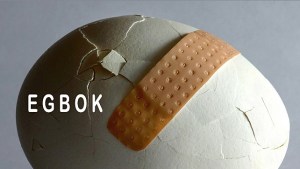
•EGBOK chinaI had not done the math right—California is 15 hours behind China time—but it didn’t matter. Dick, my lifeline, was there. I could hardly talk for the sobbing. I poured out the difficulties of our day and cried, and he said all the right things, especially EGBOK: everything’s gonna be OK. I remembered my little card he’d made for me with a cracked egg bearing a Band-Aid with the EGBOK inscription on it. I was carrying it in my little tummy pack with my passport. If I ever needed an EGBOKing, it was today.

“I know it’s just a hard day, and it’s gonna get better,” I told him between tears, “but Nikki and I are just so tired and feeling it, and she’s miserable. Annie’s sobbing out her little broken heart, and we wonder if we’ve made it worse by taking her back to see her friends. But we got some good information at The Lighthouse—better positions for feeding Annie and physical therapy stuff and her medications.”

I went on and on, and he listened, and I cried some more and began to feel the heaviness in my heart lift, and that made me cry more because how lucky am I to have this amazing man loving me and supporting this wild notion from so far away? Way lucky.

So I talked for a good half hour (“It’s gonna be an expensive phone call,” he said. “I don’t care,” I said, and I didn’t. This is therapy, after all, and a buck a minute is cheap therapy), And after we hung up, I dried my tears and went back up the stairs and down another set of stairs into the lobby and out into the walloping heat of a Changsha summer afternoon.

(What I wouldn’t learn until later is that Annie eventually calmed down, and Nikki said they’d had a good talk, Nikki explaining what was going to happen—including rides on trains and an airplane—selling the whole concept of coming to live in California directly from mama to daughter. And Annie seemed to understand, Nikki said, so that by the time I came back to the room, they were both smiling and playing one of the games on the iPad together.)

As I made my way to the grocery store, about five city blocks away, I felt a little lighter for the talking. I reminded myself to pay attention, that the big danger is crossing the street—traffic is crazy and pedestrians do not have the right of way here—but Nikki had shown me how to cross the big street in two shorter sections, taking refuge under an overpass jammed with parked cars. I was in search of unrefrigerated yogurt we could take with us the next day on the train to Guangzhou and chocolate we could leave behind for Wendy. China does not have fancy chocolate, but Nikki suggested that I might find Almond Roca or Dove’s.

I crossed the big street in two sections and then across another side street (“cross when other people do,” Nikki had advised, and I did) and made my way across a corner parking lot jammed with well-used motorbikes. It looked as if they might be for rent. On every corner men sit on motorbikes, a mini taxi service, ready to ride people to destinations.

I went up the store’s concrete steps (no ramp) and pushed through the long, thick, vertical strips of plastic that serve as the front door to the store and within three steps found myself in front of a tall air conditioner. I stood there for a little bit, cooling, and then went in search of chocolates. Fairly easily I found the chocolate aisle and there was the Dove’s, so I grabbed a decent-sized container and a kids’ container of M&Ms in one of the cartoon images of the talking candy.

The yogurt, however, proved elusive. I could easily find the refrigerated kind, but Nikki had specified the unrefrigerated version. I located the familiar cartons of milk in all kinds of flavors (again, doesn’t need to be kept cold) and juices, but could not find anything that looked like kids’ yogurt on the shelves. I wandered for a good half hour, even asked a clerk who had no English, and I didn’t know the Chinese word for “yogurt” (should’ve asked Nikki before I left).

I sighed, frustrated by all the products I didn’t recognize, grateful for ones that also had English on them. It had been a tough day. I was not going back without the damn yogurt. I would find a way. It had to be there. And just as I was about to fall back into despair—over a broken-hearted orphan we were about to transport by train and plane back to a strange land, over my own ineptitude—a miracle. A voice in my head I know so well it might be my own, which, in a way, it is after all these years:

Turn around, Toots.

It was Clifford’s voice, my companion spirit, my husband who died in 2001. I feel him often, but it’s rare that I hear him. In, of all places, a Chinese grocery store at the end of a series of aisles looking at what seemed to be large boxes of juice.

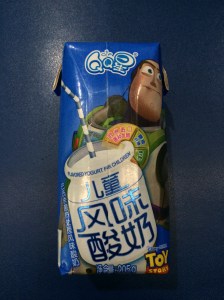
IMG_0336-Buzz Lightyear

Buzz Lightyear to the rescue!

I did an about face and there, stacked at the end of an aisle of cookies (Oreo seems to be a universal word), Buzz Lightyear’s goofy face grinned up at me from a large blue box. More juice, I thought, but then I peered more closely and saw Woody and Jessie on the front of the box, too, and the words: “Flavored yogurt for children.” I almost burst into tears right there in the store. I couldn’t tell what flavor it was (we’d heard that Annie likes strawberry), but I didn’t care. Dick had helped earlier; now Clifford and “Toy Story” saved me.

You’ve got a friend in me, indeed.

I hefted one of the big blue boxes with nice plastic handle and walked to the checkout counter, a silly grin spreading across my face. I had the chocolate, two kinds. I had, in my wandering a found a pair of child’s nail clippers for Nikki to use on Annie (she’d tried my big ones last night, and they didn’t work). I hoped I would understand how much to pay. And I walked up to a completely open checkout stand, a woman watching me as I unloaded my little blue bag that Nikki had gotten the day before when she purchased new clothes and sandals for Annie.

It came to 131.7 RMB (renminbi, Chinese currency), less than $20. I hauled out 131 RMB and proudly presented it to the checker, who pointed to the .7 on the screen. I found another single RMB and gave it to her and got back 30 cents in three small bills worth 10 cents each. Success!

I put my purchases in my bag (apparently they don’t do that for you) and walked through the long, vertical plastic flaps back into the afternoon heat, feeling triumphant. I could feel both a thankyouthankyouthankyou and an EGBOK rising in my throat. And there on the hot, busy street I said them aloud several times with great gratitude.

And without even trying, as I walked, I sang to myself, channeling a little Randy Newman:

You’ve got a friend in me
When the road looks rough ahead
And you’re miles and miles
From your nice warm bed
You just remember what your old pal said
Boy, you’ve got a friend in me
Yeah, you’ve got a friend in me

By the time I got back to the room, Annie and Nikki had had a good talk, Nikki said, and they were smiling at each other again. Peace had been restored.

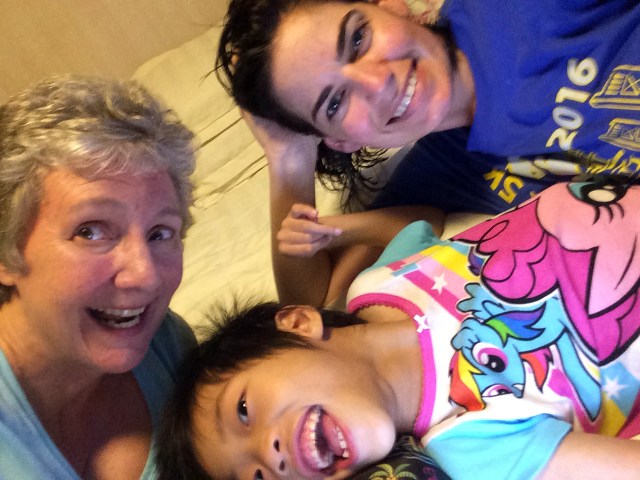
And later that evening before bedtime we took a selfie, all three of us, relieved that the storm had passed, knowing that when that rough road comes, we can call on our companion spirits and reassure each other (sing it with me):

You’ve got a friend in me.

•IMG_9868a

Posted in Bringing Annie Home | 15 Comments

Tomorrow

•IMG_9544a

Annie eats her first breakfast with Mama.

(#5 in the Annie series)

To be honest, when I learned that Nikki was going to adopt Annie, and I decided to accompany Nikki to retrieve this child from a place called Changsha, China, I did not automatically think of the musical. Which is weird because I love “Annie.” (My family and I adored the cast album with Andrea McArdle, the original Annie who could really belt out a show tune.) It was only when Dick said, “She’s little orphan Annie,” that I made the connection. I wasn’t sure if Nikki would love this reference.

Nevertheless, I began practicing Annie’s big number in the shower:

The sun’ll come out, tomorrow,
Bet your bottom dollar there’ll be sun.
Just thinking about tomorrow clears
Away the cobwebs and the sorrow
Till there’s none.

When I’m stuck with a day that’s gray and lonely,
I just stick out my chin and grin and say,
The sun’ll come out tomorrow,
So you gotta hang on till tomorrow
Come what may

Tomorrow, tomorrow
I love ya tomorrow,
You’re only a day away.

I do this in the shower because, although I come from people who are fine singers, mine is not the best voice. Still, I do love to sing… alone, in the car, in the shower. Everyone sounds good in the shower—great acoustics in that small tiled space where inhibitions have been thrown to the wind, along with your clothes. So I just sing my heart out. I wasn’t sure I had all the lyrics right—it’d been a long time since I’d sung them—but I decided that now was time to get them down again, emblazoned in my fading brain, because if ever a kid named Annie had a song, this was it.

So the day after Nikki adopted Annie, we were all having a rough day. She was experiencing lots of gas and bloating and discomfort, poor thing. We were going nuts with unanswerable questions: Are we feeding her the wrong stuff? It’s what we were told was her usual diet: noodles and rice soup and tofu, some small bits of meat and veggies, yogurt (which is the consistency of milk here). She’s also gotta be under tremendous stress and have separation issues, right? And Nikki says kids with CP have digestive issues. But it’s painful to watch Annie try to work on a bowel movement—she’s gasping and crying, and we feel like big meanies here. Is it always this way for her? What should we do or not do to help?

So while Nikki went out to do some shopping (for sandals to replace the dress-up shoes she came in, as well as some new T-shirts and shorts), Annie and I stayed in the hotel room. I went into major Aunt Jan Distraction Mode, looking at some of the kids’ programs Nikki put on her iPad, which is really now Annie’s iPad. She had some simple kids’ games—one consists of bubbles floating up from the bottom of the screen; you reach out and touch the bubbles on the screen and they pop. She had already started to understand this concept the day before when Nikki pulled out the iPad during the long wait at the bank. One game has different shapes and colors that float on the screen—you touch them and they say things like “purple star!” And that same game puts what look like big piano keys in different colors on the screen, and when you touch them, lo and behold, they play an octave.

As she laid on the bed on her side, Annie’s eyes glued to the iPad, I guided her little clenched left fist to the screen and helped her touch the shapes and the piano keys. Big smiles. Giggles. So I played the keys at random, making up spontaneous little songs. She chortled and snorted. We’d heard she liked music, but she liked even more that I sang along to it.

Thus encouraged, I sang her song:

The sun’ll come out, tomorrow,
Bet your bottom dollar there’ll be sun.
Just thinking about tomorrow clears
Away the cobwebs and the sorrow
Till there’s none
.

Her black eyes riveted to mine, she stared at me and made little Annie noises that until that moment I hadn’t recognized as anything but noises. But as I sang, her voice got louder and in a similar rhythm, and I realized that she was vocalizing. She was singing along.

X2 aunt jan annieC

Aunt Jan and Annie sing along to music on the iPad in Changsha.

“Are you singing?” I asked, as if she could understand English.

She grinned at me, her open-mouthed, many-toothed Annie grin and squawked at me. I kept singing and she did, too, and when I stopped, her face fell. So I started again:

The sun’ll come out, tomorrow…

Big smiles, very happy child, so I sang it to the end, complete with the big finish, the Annie in front of me cackling with her big grin:

Tomorrow, tomorrow
I love ya tomorrow,
You’re always a day away
.

I went thrAnnie red dressough the whole song at least five times, circling back to different verses here and there, too. Great audience, this kid.

I admit that I am hugely tickled that Annie loves her song—who doesn’t love an appreciative audience? Nikki likes “Tomorrow,” too, and looks forward to showing Annie the movie when they get home. And we both hope that someday she can sing it herself, belting it out with all the Broadway bravado of, well, Annie. She’s certainly got the music in her.


Posted in Bringing Annie Home | 8 Comments

Annie’s people

(#4a in the Annie series)

This post is from the blog of Butterfly Children’s Hospices, the people in Changsha who first cared for Annie when she was found in such bad shape. It’s deeply moving and really gives the scope of her seven years and how far she has come. I’m flattered that they used some of my photos to tell this story. Thanks, Butterfly Hospices!

Here’s the link if you’d like to see it on the Butterfly Hospices site: http://butterflyhospice.org/annies-people/

Annie4

Our blog has been giddy with good news recently. It seems this is a season of restoration for many of our children. Robert is home in the States, Jack is meeting his family soon, and Sabrina, Katelyn, Charlotte and Calvin have all been matched with loving families. And there is another former Butterfly home in the States – our precious Annie is now a daughter!

Annie came to us in dire straits. Her body was pulled so taut with spasms that her ankles curled back and touched the back of her head. Our staff were afraid – how do you touch a child who is pulled and contorted and tight as a bow string? They didn’t know how to reach the little person inside that stricken body. They were scared she would snap if they tried.

Annie very sick-BHouse

Later it became hard to imagine that our Sunshine Annie was ever that same terrified girl. Once she was fed and loved with her spasms were controlled, we learnt that she was outgoing, funny and warm.

Annie-BHouse-being fed

She was cheeky and clever, drawn to people and excitement. She was the girl who loved being tickled and always wanted to go faster!

Annie-chair

She was kind too – she didn’t complain when smaller children were getting attention but waited for her turn.  She delighted people with her mega-watt smile, and gave everyone an extra special reason to hurry to work. It was always easy to love Annie.

Annie hoodie

Eventually Annie moved into the care of International China Concern. They continued working with her on communication and other life skills. She was loved and settled. Life was good enough. But  Annie still didn’t belong to anyone. Everyone she met loved her, but eventually they all went home. Volunteers would return to their work or studies, travellers would board a plane, even her ayis had to clock off sometimes. Annie’s heart was overflowing with love, but she needed somewhere that love could settle forever.

The story of how Annie and her mama became family is not ours to tell – enough to say it was full of twists and turns. It involved searches for apartments, files locked and released, heartache and celebration. Annie’s mama is a therapist who has spent years working in China. She flew to her daughter on prayer and hope, with the support of her dedicated family and an awful lot of planning. She is fiercely committed to her girl, and in this for the long haul, right from Day One.

And it was a long haul – but finally, after much planning and working, it was time. Annie’s Mama crossed the ocean to bring her daughter home. It was a beautiful, joy-drenched occasion. This is the moment they officially met.

Annie meets Mama

Together Annie, her Mama and her aunt explored the city, read, played, laughed and got to know each other.

Annie laughs with Mama

Annie & Mama walk

They moved on to Guangzhou for Annie’s visa, before taking the big flight home to the USA.

Annie & Mama portrait

When they arrived, they were met by more love – adoring grandparents and friends were at the airport to greet them and rejoice with them.

Annie's family

Finally Annie belongs – these are her people. And we are so happy.

Posted in Bringing Annie Home | 2 Comments

Annie

•IMG_9354a

(#4 in the Annie series)

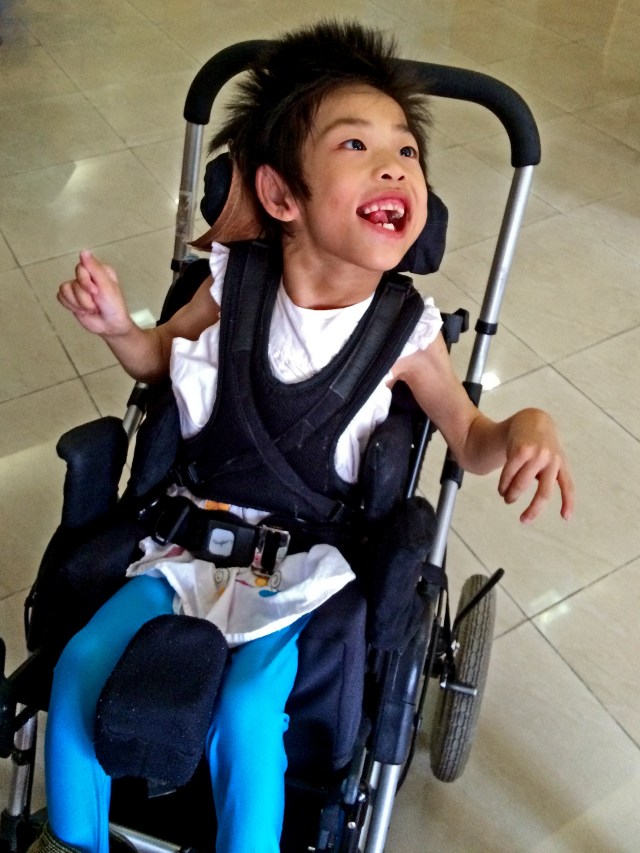
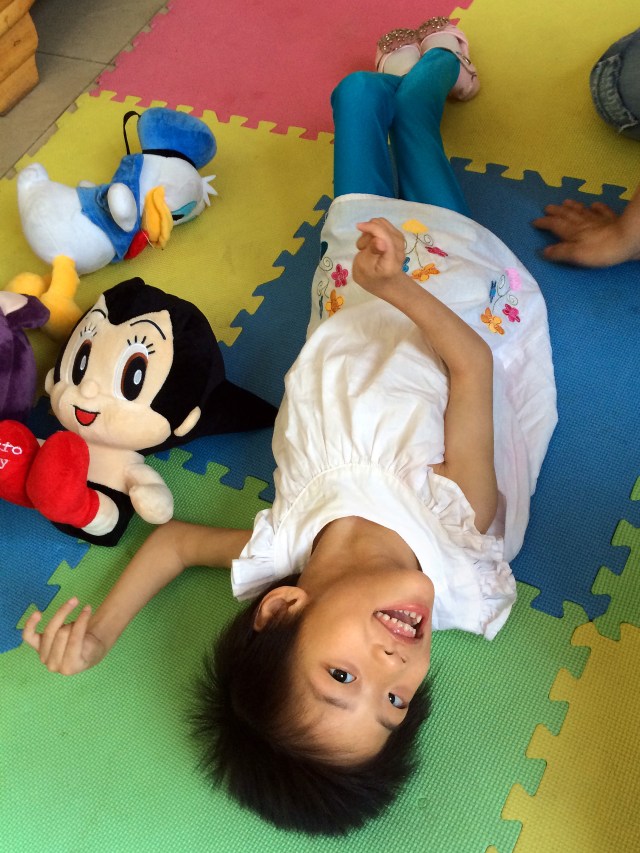
She was up at 6, as she has been every day for the past three years at The Lighthouse, the International China Concern (ICC) orphanage in Changsha, Hunan province, in south-central China. Her ayi (Chinese nanny and the word for “auntie”—pronounced “i-ee”) had gotten her up, wiped her face with a wet washcloth and dressed her in her going-away outfit—a pair of turquoise long pants with a sleeveless white blouse-dress with embroidered flowers on it, as well as a pair of shiny pink sandals with a sparkly fake flower on each of them. Her ayi would have lifted Annie into the child-size wheelchair specially made for her several years ago. They would have put Annie and her chair into a vehicle for the ride to the civil affairs office where Annie would be delivered to a woman who has spent the last four years preparing to bring a Chinese child to Sacramento.

And when her ayi wheeled Annie into the third floor reception room of the civil affairs office, Nikki Cardoza became a mother. It was June 20, 2016, and two lives were changed forever.

•IMG_9364aC

Annie with her ayi from The Lighthouse and Nikki.

Nikki’s eyes got big and a little watery when she saw Annie wheeled in. She’d last seen Annie four years ago, just before leaving China as an ICC volunteer. Nikki spent 10 years volunteering to help orphaned kids in China and for three years supervised short-term volunteers for ICC in Changsha and Hengyang. She knew she wanted to adopt a Chinese child when she came back to Sacramento in 2012 and, as a single person, set about doing so. She had to do three major things: complete her bachelor’s degree (in government at Sac State), get a job (working for an education lobbyist) and buy a house (a condo in Sacramento’s Greenhaven area). Then, she told me, she wanted to go to China and adopt a child.

I remember taking her out to eat when she came home, and in my memory she told me then that she wanted to adopt this little girl named Annie, who was then about 3 and had cerebral palsy. Nikki says she didn’t know which child she specifically wanted to adopt at first, but when she saw Annie listed on the ICC website as a candidate for adoption, she knew this was the child for her. Nikki had been at Butterfly House, the hospice, when Annie arrived in 2010, then in very bad shape.

So to see the two of them look into each other’s eyes—Annie from her wheelchair, Nikki bending over to greet her daughter—was the sweet moment that I had traveled nearly 7,000 miles to see.

“Hello, Annie. I’m really happy to see you,” Nikki said in Chinese.

Annie’s ayi was saying, “Are you happy to see Mama?”

Annie grinned and made a sharp “ah” sound, which is her version of the Chinese word for “yes.”

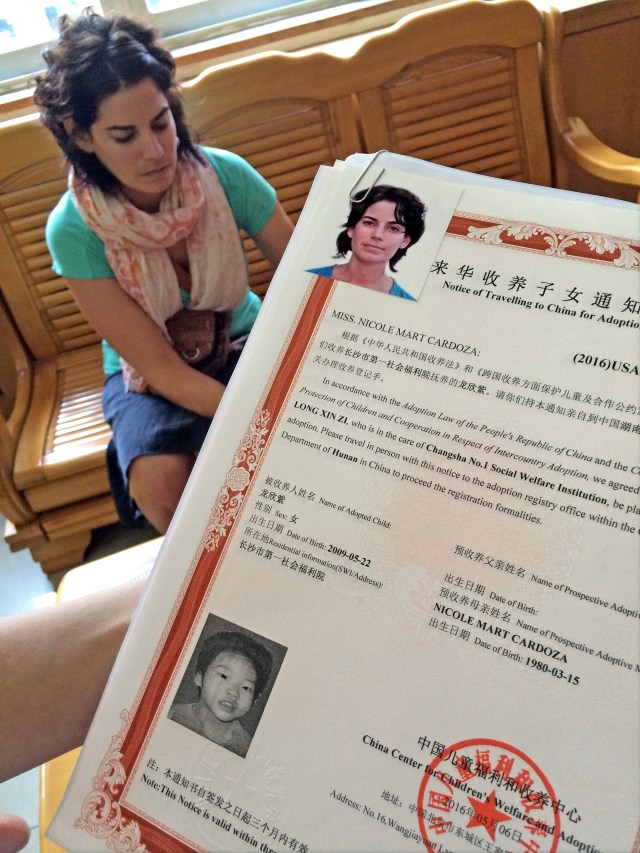
•IMG_9371aCWhen she was found abandoned on the side of a busy Changsha street on May 22, 2010, the state welfare center gave Annie the name Long Xin Zi. She’s been known as Zi-Zi (roughly pronounced zuh-zuh), her Chinese nickname by her Chinese nannies. Her last name, Long, is given to honor the year she was thought to be born, the year of the dragon. It was decided that she was about a year old, so her birthday is May 22, 2009, but no one truly knows when she was born or who her parents were.

She was dying then, a tiny thing unable to eat, and the Chinese welfare center shipped her to Butterfly House, a hospice founded by Nikki’s good friend Lyn Gould. It was Lyn and another nurse, Katie Hill, as well as volunteers, who saved Zi Zi’s life and named her Annie, who figured out how to feed the little one gone rigid with cerebral palsy. That’s where Nikki met Annie. She lived there for about three years and then, because she was not dying, was transferred to The Lighthouse.

•IMG_9390a

Nikki, Annie and Ayi

My iPhone was burning up with all the photos I shot of the adoption proceedings that took nearly five hours. We spent a long time with Annie’s ayi, a motherly woman who talked to Nikki a lot about Annie’s schedule, food preferences and medications. They got Annie out of her chair, put her on a thick mat on the floor and moved Annie into her favorite sleep positions (propped up on her side) and exercise positions (on her tummy so she can practice lifting her head). I took notes as Nikki asked questions and Wendy, the translator, translated exceptionally well. (We were deeply impressed with Wendy, who is from Changsha, went to university here, majoring in tourism, and used to work for the civil affairs office. Now a mother herself of a 7-year-old boy, Wendy translates for English-speaking adoptive families.)

•IMG_9407a

Ayi demonstrates proper positioning for sleep and rest for Annie.

We moved to a different room to complete the paperwork where Nikki and Annie had a photo taken against a red backdrop (is that by government decree?). The photographer suggested taking Annie out of the wheelchair, which Nikki wisely nixed. “They don’t want her to look disabled,” she said, crouching by the wheelchair, her face near Annie’s.

•IMG_9492a

Posing for the formal family adoption photo.

China always wants to put its best foot forward, to save face, Nikki says. People with physical disabilities are rarely seen in public here.

Wendy took Nikki and Annie to the bank next door to the civil affairs office, where Nikki had to pay her adoption fees, and we got a lot of puzzled looks from patrons, some of it stink-eye, as they say in Hawaii. People clearly had no idea why that odd-looking child strapped into the wheeled contraption was with two foreigners, both of them white women. People with disabilities are hidden here; kids often die young from malnutrition or maltreatment, Nikki says. There is absolutely no future for someone like Annie in China. That’s not to say that people aren’t compassionate here (look at the Chinese nannies, among others), but we westerners who think that people like Annie can have productive, happy lives are odd to most Chinese.

•IMG_9418aCThe bank also took far longer than we are used to because it was not as if you wait in line for a teller. You take a number and sit. And sit and sit and sit, in this case for a good hour. This apparently is not unusual. A kind man let Nikki go in front of him after he watched us interact with Annie in her chair. Even after the wait and Nikki paid her fee, Wendy waited for a receipt for another 15 minutes.

“Everything is difficult in China,” Nikki says. “Nothing is easy. You can’t just run an errand.”

•IMG_9504aC

Playing a game on the iPad.

She also frequently says, “That’s China,” about things that seem odd or don’t make sense to us. Yet she loves China and its people. I asked her on the plane what she loved most about China, and she said, “I have to think about that.” It occurred to me that’s not because Nikki doesn’t feel great affection for the place but because she doesn’t know where to start. And I thought again how amazing she is—to work in this country for a decade (though, to be fair, some of that time was in Hong Kong, which is “not China,” as everyone tells me, and a much easier place to live), spending time with dying kids at Butterfly House, traveling throughout the country with volunteers, doing missionary work, too.

Neither of us had eaten breakfast, and by the time we got back to our hotel with Annie, it was 2:30. Wendy kindly took me to the grocery store down the street to buy diapers (Annie didn’t come with any), bananas, yogurt, milk and apple juice for our new roommate. I could not manage a Chinese market without help (almost no English on packages), so Wendy  hailed a taxi and we rode the five blocks to the market. It was my third Chinese version of Mr. Toad’s Wild Ride, and I heeded Nikki’s advice to close my eyes and not look. (The van driver who took us all to and from the civil service center drove very smoothly and gently, taking into account his special passenger in the wheelchair.)

•IMG_9346aC

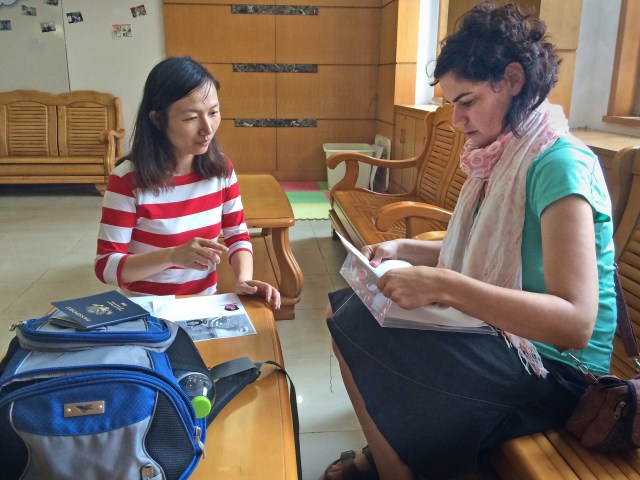
Translator Wendy and Nikki go over adoption paperwork before Annie arrives.

I assured Wendy that I could walk back to the hotel by myself—she had to go pick up her son by 4—and made my way up Chegnan Avenue in the thick air feeling very accomplished. Though it wasn’t far and I wasn’t hiking up any major hills, I still had to stop a couple of times under trees that provided only thin shade and rest a bit. I think the only times I’ve sweated this much were when I was in a steam room. On purpose. There is no need to apply daily face moisturizer here.

But I came back to room 601 to find Nikki and Annie and Lucy, who is a teacher at The Lighthouse, Annie’s computer teacher, actually. Lucy is from Singapore but has volunteered for ICC for 20 years. She plans to retire and return home next month. She brought Annie’s medications that had been forgotten earlier. While we were still at the Civil Affairs Center, Wendy had called ICC and told them about the missing medications. Lucy volunteered to bring them to our hotel. She’d been waiting for us in the hotel lobby for two hours.

•IMG_9518a

Lucy and Nikki

Lucy was patiently going over the meds—for sleep, for relaxing the muscles, for seizures—with an overwhelmed Nikki. She and Lucy worked together; they’re old friends, which was just what Nikki needed. Lucy, with her patient voice and long experience with Annie, could reassure Nikki in ways no one else could in that moment. I wanted to hug Lucy.

And Wendy called to say that she’d found an easier way to purchase train tickets for the trip to Ghangzhou on Friday. (There sometimes is an easier way to do things in China, if you know whom to ask.) She found someone who would go buy the tickets for a small fee so we wouldn’t have to get to the train station and do so.

•IMG_9471aC

Getting reacquainted.

We felt delivered by two unexpected angels—Wendy and Lucy—as well as the kind, thoughtful van driver and the young man who went to buy our train tickets. I am reminded of this again and again: Help always arrives when you need it.

And after Annie’s nap and a painstaking round of spooning mashed-up pills into her tight-lipped mouth, Nikki went downstairs and got food from Quan Deli where we’d eaten at the night before. It’s our place, we decided. It’s right here, it’s easy, and it’s good. Never have simple noodles and vegetables, rice and soup tasted so good.

•IMG_9485aC2

Ayi feeds Annie yogurt—a favorite!

So we took turns eating our dinner at the long desk in the room, Nikki stopping to feed Annie bits of noodles and rice and meat, me standing behind Annie in the chair, holding her floppy head more or less straight so she could eat without choking. It is a tiring procedure for all of us, and we greatly admired Annie’s ayi who could shovel yogurt so quickly and efficiently into Annie’s open mouth with one hand holding her chin and the other pressing her forehead back into her wheelchair. We have a lot to learn about how to feed this child, among many other things.

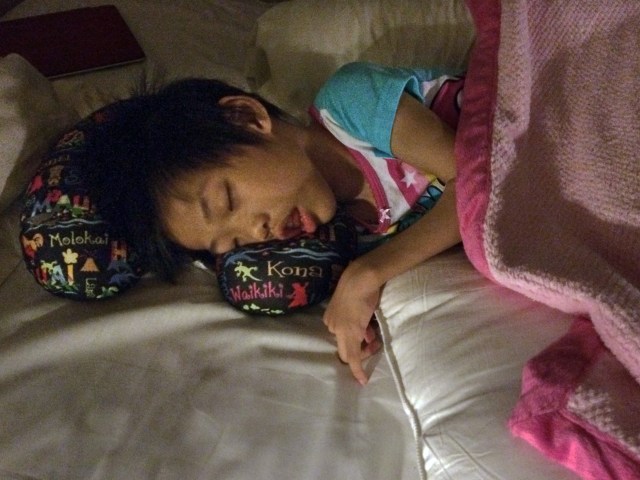
•IMG_9527aCWe are all exhausted by 8 p.m., and Annie is propped on her side in Nikki’s bed, eyes closed, mouth open, her head cradled by my squishy neck pillow decorated with brightly colored Hawaiian words on it. Nikki is very close to sleep, too. Tomorrow I will point out to Nikki one of my favorite Hawaiian words on the pillow—ohana. It means family. Annie, who has had fine ohana of caretakers and volunteers in China, has a new family eagerly awaiting her arrival in California. Nikki has enlarged her family by one, by extraordinary means. She does not see herself this way, but I do—as one of the heroines of this story, scooping up this princess with the fancy shoes to deliver her to a future of possibilities unavailable in her native land.

The other heroine, of course, is the strong little girl who survived and thrived against heavy odds with the help and love of many people, both Chinese and foreigners—Long Xin Zi, now Rosie Suzanne (Annie) Cardoza—asleep on her new mama’s bed, dreaming, I hope, very sweet dreams.

•IMG_9530aC


Posted in Bringing Annie Home | 10 Comments

Yeah Come

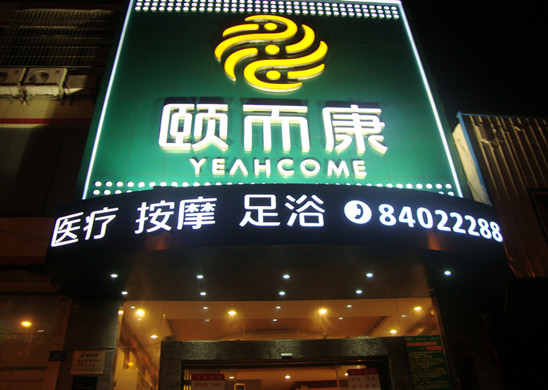
yeah come sign night

(#3 in the Annie series)

Climbing the highly polished marble stairs, Nikki and I could hear them before we saw them: “Ni hao!” (Hello! Welcome!), and as we rounded a corner for the second set of stairs—three ladies in white uniforms looking like nurses or people who practice the healing arts, greeted us, big smiles across their lipsticked faces, and my first thought was… in this heat with the makeup? How do they keep it from sliding off their faces?

Welcome to Changsha, Hunan, China, where it was now dark and still 90ish degrees with 80ish percent humidity. The outdoor temperature and wetness here do not change, though the degree of indoor air conditioning varies, depending on where you are.

But there was no time to mull that further because the trio of Chinese women was approaching the two tall (to them) foreigners getting taller with each rising step. And after more rounds of greetings, Nikki said, “Yep, this is the place,” and I was amused that its English name translated to the Yeah Come massage center.

It was going on 9 p.m. on a Sunday, and if I didn’t know better, I’d think we were either about to ask for something that in our country is highly illegal or maybe showing up for Botox injections.
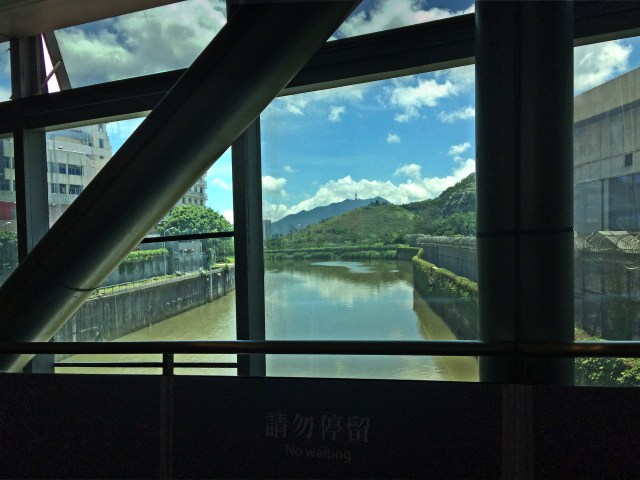
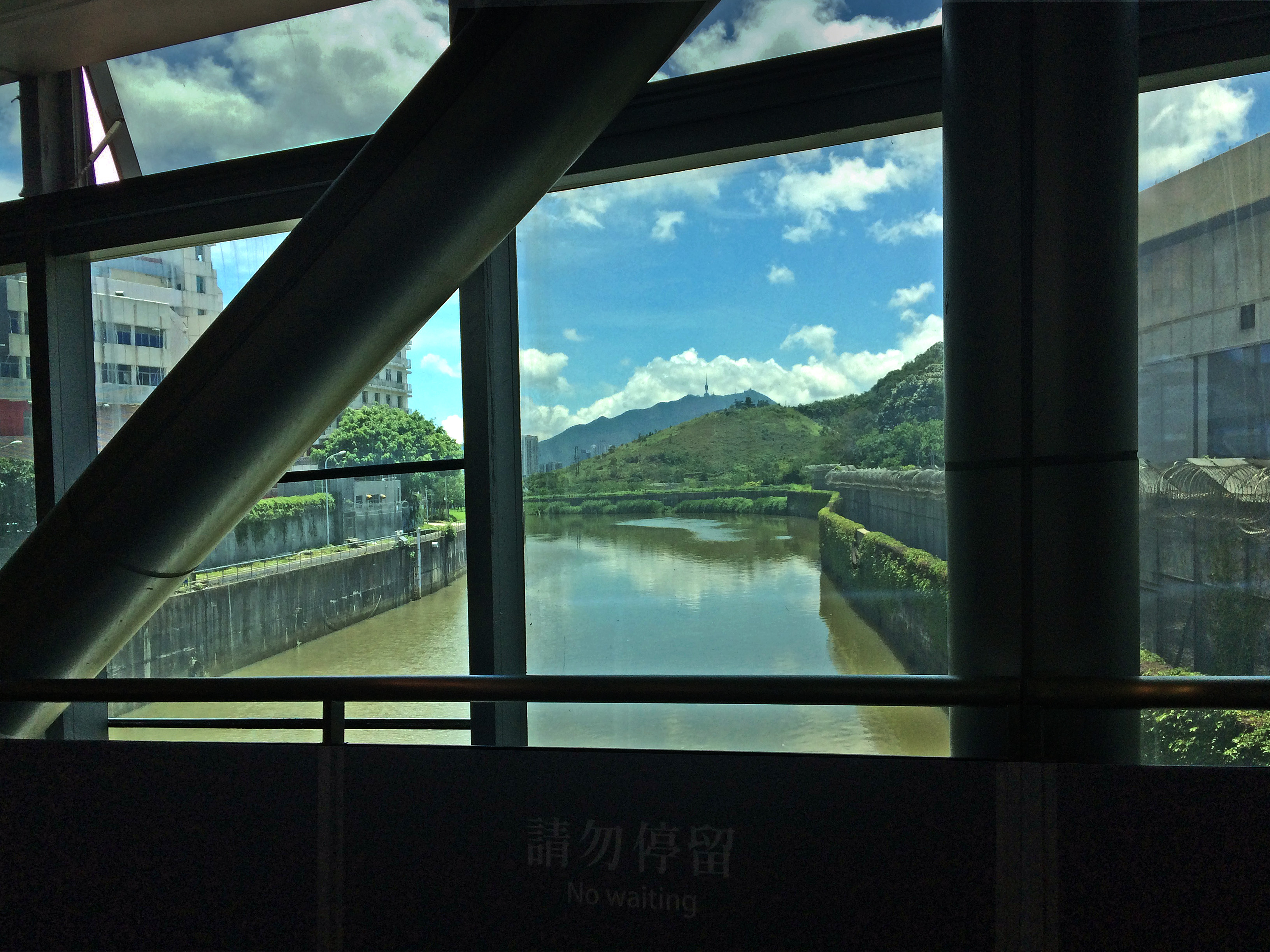
The Shenzhen River separates Hong Kong from China—you walk across it.

The Shenzhen River separates Hong Kong from China—you walk across it.

But it was our second full day in China, and we had that afternoon walked across the border from Hong Kong into mainland China, over the Shenzhen River because that’s how it’s done, handing our passports and travel forms to impossibly young looking border officials behind plexiglass who did not so much as smile at one sweaty foreigner giving them a chipper “Ni hao.” (That would not have been Nikki, who knows better and just gave them her passport.)

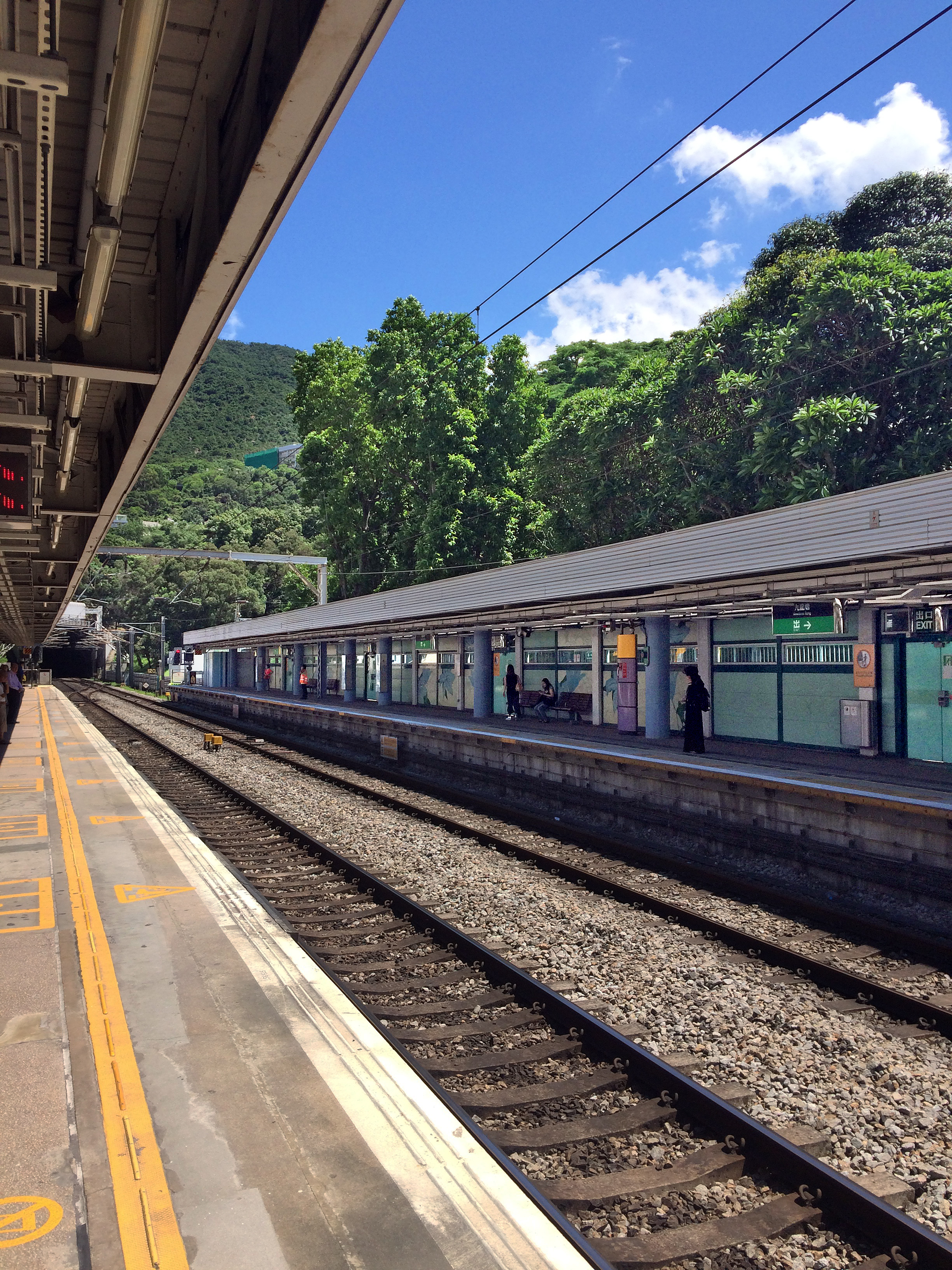
This was where we were to board another series of subway and light rail (sometimes above ground, sometimes below) trains, changing lines a couple of times, and these were clearly not as well cared for as the Hong Kong subway cars. This is where I began to learn that Hong Kong and China really are, always will be, two different countries. I hadn’t understood that. Nikki had said that she could tell the difference between Hong Kong Chinese and mainland Chinese people, and I was beginning to, too. It seemed that there were more mainland Chinese, for one thing, and the men looked either very young or prematurely old with bad teeth, and there was something about them I couldn’t quite identify, and it wasn’t their luggage or what they carried, but there was the feeling of—and I don’t know the Chinese word for this—conformity, of being herded into these massive clots of humanity moving toward a single target—the opening doors of the train. We saw knots of people in Hong Kong, too, but those people, often young couples with small children or teens with their friends, every one of them carrying the iPhones that are made in factories in their country, seemed… I don’t know… more prosperous, more hopeful, more free somehow. And I figured that was my imagination going 300 miles an hour, as fast as the bullet train, as I took my first walk-through in a Communist society, in the most populous country in the world, and I had to allow for my own biases and western misperceptions as much as anticipate theirs about me.
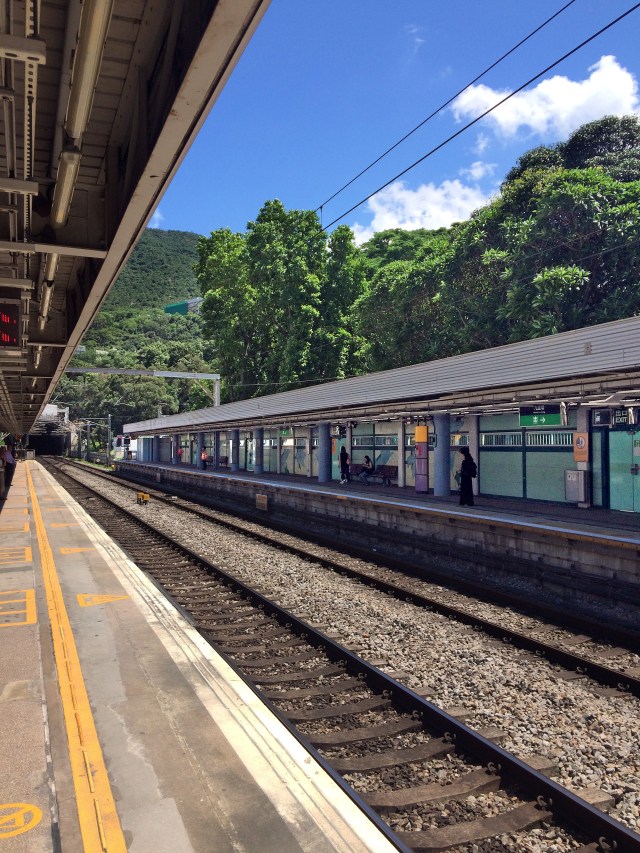
Leaving Hong Kong for China via train.

Leaving Hong Kong for China via train.

It was on one of the subway cars, after Nikki and I rolled on with my rolling backpack and her wearing her huge orange packer’s pack, that a young man got up from his seat and offered it to me. Nikki had told me this might happen, which was why I shouldn’t get my hair colored before we left, that some kind Chinese person would see me as an elder and give me his seat. And there it was, on the second full day in China, which was really the third since we’d lost one night on the plane winging its way west over the international dateline. He smiled at me as he stood, and Nikki said, “Take it,” so I did, sliding into a smooth seat next to a young couple with two children on their laps, the mom holding tight to a little boy with an iPhone in his hands, his eyes glued to the screen where a cartoon airplane zoomed around a pastel sky. I smiled at him and his mom, and she smiled shyly at me and said something in Chinese to her son, and I wondered if it was something about the old while lady parked next to them. He looked up at me and showed me his screen. I smiled, nodded and said, “Xiexie,” which is pronounced “shay-shay,” and means “thank you” because that’s one of my Chinese words I was practicing this day, as we moved deeper into mainland China, we moved closer to Changsha, where Annie lives, and the place we will be taking her away from forever.

And when we exited the train in Shenzhen, we walked into that wall of heat, the kind Nikki had tried to describe to me at home in what we Sacramentans think of as summer—“Think Mississippi in summer,” she said—and I tried, but I’ve never been near Mississippi in any season. Still, I imagined bodies with permanent trickles of sweat running down their backs and glistening, red faces. And that’s what we became in an instant, thrust by the power of a hundred, then two hundred, then who knows how many hundred Chinese, a river of humanity flowing their way into air so thick you could drink it, but you didn’t want to because the first breaths tasted foul, left a sourness unlike any I’d known on the tongue.

I began putting together similes in my head (damn writers). It felt as if I were breathing underwater, oven-like, humid subtropical, so much water vapor in the air you can taste it. I could feel my already curly hair curling more, my skin shedding the water from my very cells, my personal humidity rising from feet to forehead. The moist air felt heavier, but, according to meteorologists, it’s not—it’s actually lighter than dry air.

I looked at Nikki and said, “Whoa,” and she nodded. “Right?” she said because it felt stuffier and hotter than Hong Kong. I knew that Nikki hadn’t felt humidity like this for four years, since she left China for the final time, after what became a decade as a volunteer with a couple of different Christian organizations, including one that operates orphanages where Nikki was in charge of short-term volunteers, ferrying them from place to place on trains like this one and bigger, faster trains like the one we were to board for a 3 p.m. departure.

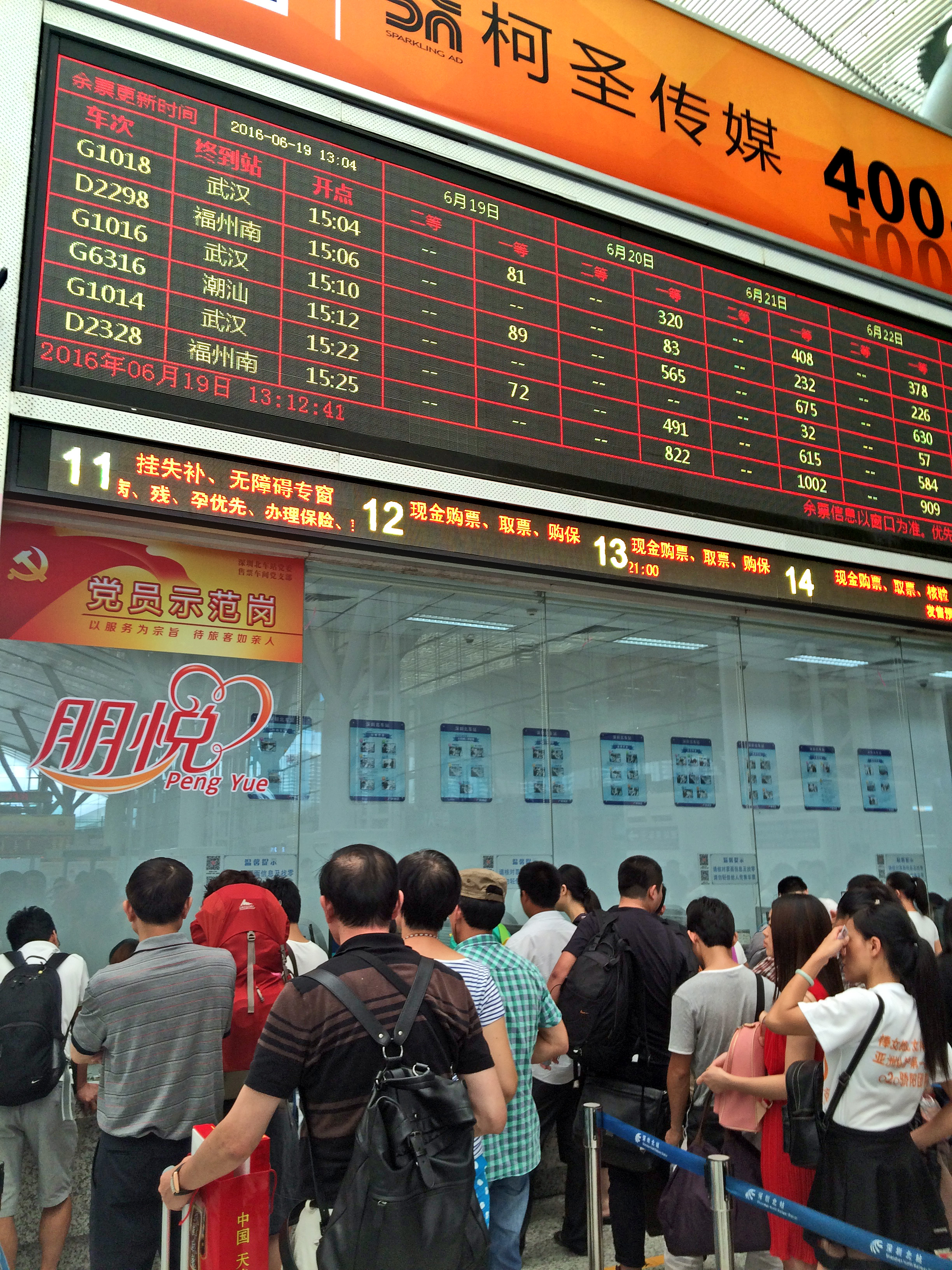
Coming down the escalator (lots of escalators in Chinese rail stations, I’m learning), mashed in between people who in no way looked alike but who resembled each other ethnically, more hundreds of sweating, luggage-toting people, we could see the huge train station unfolding before us, half open to the sky under a many-stories tall curved overhang and a vast, open area uncovered and more glass and still edifices that looked as if they’d been built for the Olympics or some grand purpose (they weren’t—this is the modern train station in China). And we were delivered to the area where there were ten windows with dozens of people lined up to approach each one, but Nikki, who reads and speaks Chinese, couldn’t tell which one to go to, left me with the luggage and want to another, less populated line to ask where we should be.

This was one of the unnerving parts of the day—being left with our luggage as Nikki went off to find out something we needed to know. I am not prone to panic, but I have to say that my stomach jumped around a bit until she returned—I know I will have to do things in this place where I don’t speak the language or know where to go, but she is my lifeline here. In the underground maze of the Hong Kong subway, changing lines and different platforms, even when she wasn’t immediately sure which way to go, Nikki’s level of confidence is what keeps me from freaking out. I am a strange organism in this place where all the other organisms know their places and move in what seems to me well-coordinated patterns to get where they want to go.

But on this occasion she returned fairly quickly and said, “We get in this line, and then go through there to line 11.” She shook her curly head. “I had to ask him three times what line we were to stand in once we got through this one. ‘Through there,’ he said” (and Nikki was speaking Chinese to him).

“Yes, but what line?” She mimicked herself.

“Through there,” she gave his line.

“But what LINE?” she insisted.

“Oh. Eleven,” he told her.
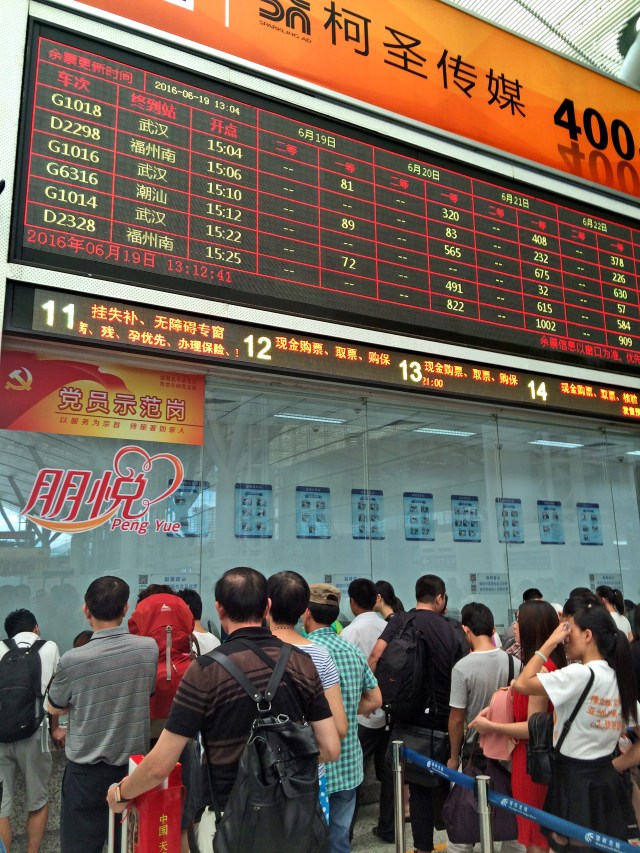
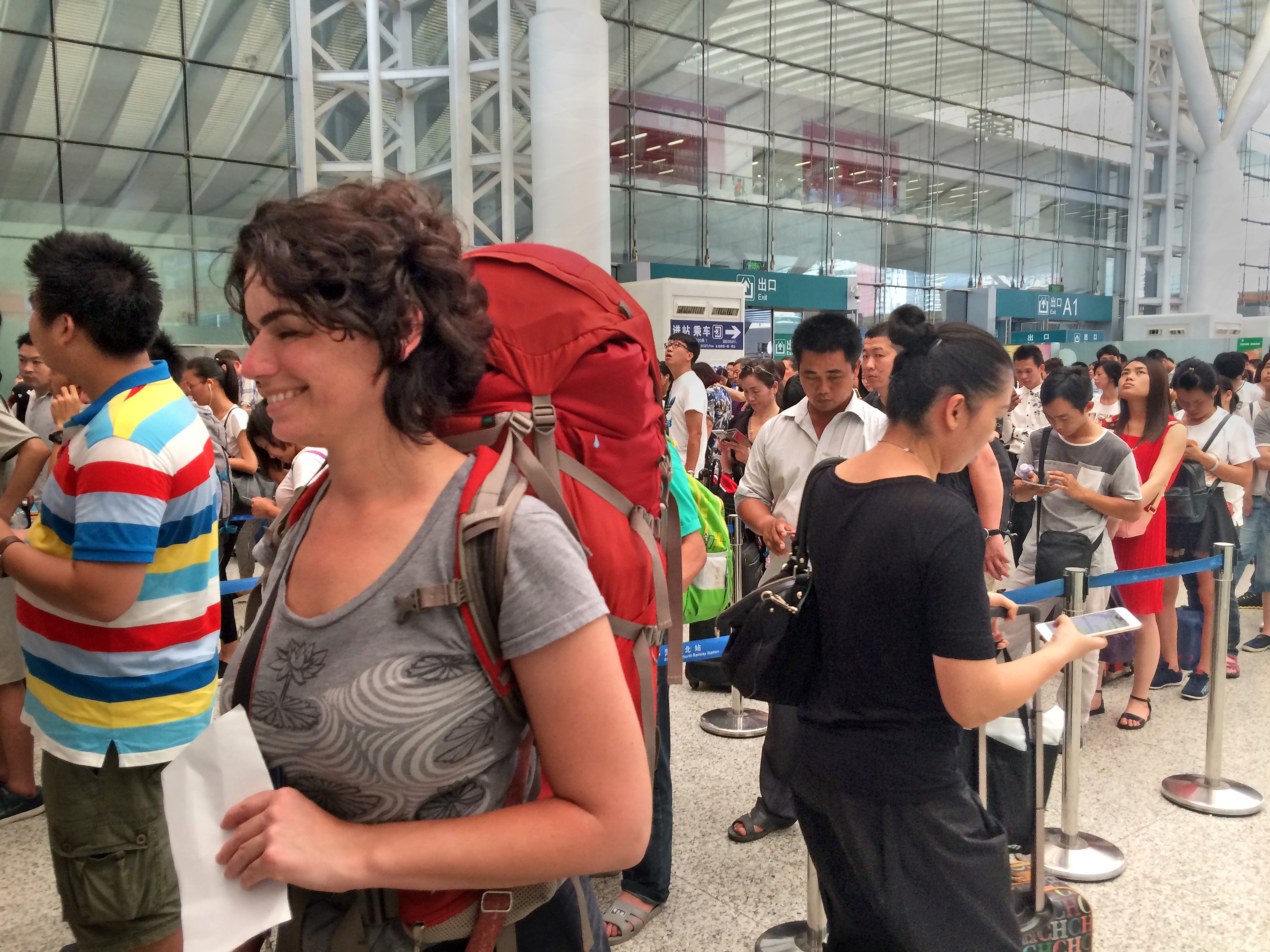
Nikki (orange backpack at left) waits in line to pick up our train tickets.

Nikki (orange backpack at left) waits in line to pick up our train tickets.

So after showing our passport and travel papers to the 13-year-old girl (she looked that young anyway) in the Plexiglass box (who at least had a small fan pointed at her spotless blue uniform, offering small comfort, I imagined), we went into that area and found Window 11. We stood behind only two other people—an older woman with hair dyed a color I’ve seen on Madonna—roughly the color of a bruised plum, sort of purple-y Crimson—and that woman was at that counter for (I timed it—26 minutes) haranguing a beleaguered looking man who, translating Nikki explained, wanted to go to a station in Guangzhou this train didn’t go, but she couldn’t understand the man who was speaking Mandarin to her Cantonese.

He turned the screen around so the woman could read what he was trying to tell her, and she stood there and argued and waved bills at him as if that could change the route of the trains in this station. Another man, clearly agitated behind Nikki, shouted, “Hurry up!’ This made Nikki smile because we were thinking it, too, and it was sososo hot in that pocket of the station, not a breath of air, and I finally had to excuse myself and take my little rolling backpack for a walk, hoping that a slight breeze might waft my way, which it didn’t, but I felt better for the walking and bad for Nikki stuck at the front of that hot line.
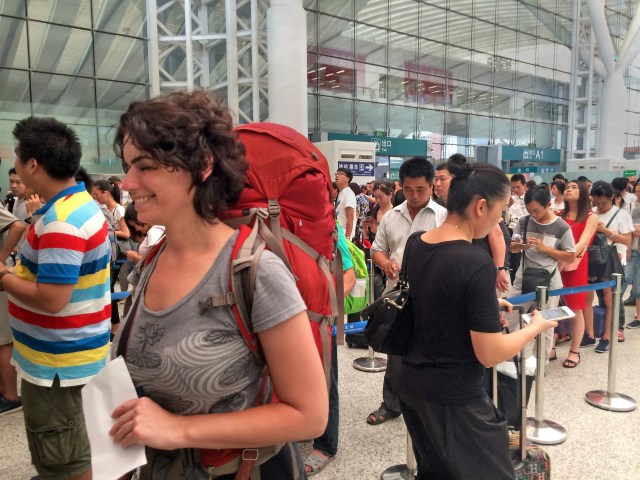
•IMG_9270aI circled back a number of times and the woman was still there, yelling, gesturing, and Nikki stood behind her with her tall rusty orange backpack rising behind her head, the very picture of patience, though I knew she wanted to use that big orange backpack to body check the woman, get her out of the way so Nikki could complete our simple transaction that would put us on the train to Changsha where, I hoped, Annie knew that her new mama was coming for her tomorrow.

The woman finnnnnallllllly got done, and Nikki was at that window in a single step, glowering at a young man who looked as if he was ready to cut in front of her. The young man stepped aside and Nikki stepped up, and she was done with her transaction as it should have been, in less than three minutes. And even at a distance I could see her backpack moving toward me, forward motion now, after being stationary far longer than was comfortable, and she had two small train tickets in her hand.

“Now to go through security again,” she said, so we made our way to THAT line.

“What are they checking for? Weapons? Explosives? Are they trying to keep people safe?”

We had been through three scanners where we had to put all our bags on conveyor belts for officials to allegedly look at.

“Nothing,” Nikki said. “It’s another way of asserting their authority, of keeping people in line.”

And there they were, the people of the People’s Republic of China, thousands of them—and us, too—in yet another line making its way slowly someplace that would lead to the next line and the next. And I thought then that Communist China was fast losing its charm, despite the impossibly young “guards” wearing their official uniforms.

But we got through that scanning business again and we were finally in the vast waiting area of the train station. We stood there for a bit, looking around, and Nikki pointed to a sign in Chinese on the second level. I didn’t recognize the characters, of course, but I did recognize the red and white sign with an old white guy’s face on it.

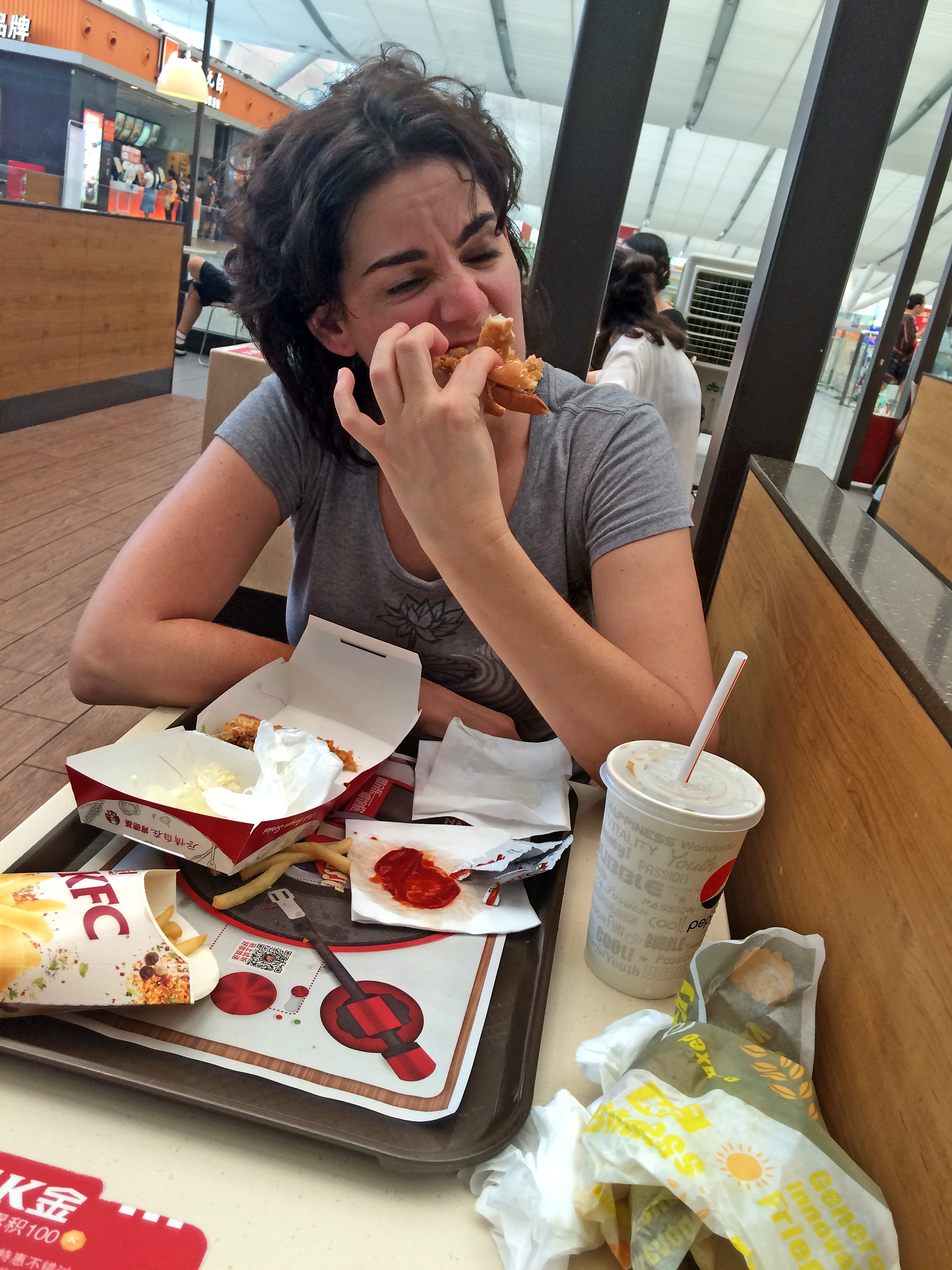
KFC'll do in a pinch—the Shenzhen train station.

KFC’ll do in a pinch—the Shenzhen train station.

“KFC,” she said, and though I really don’t care for KFC, it was lunch time, and in this place because I only eat and drink what Nikki says I can, Nikki knew that this was reasonably dependable food, so we rode the escalator, ascending into an even stuffier place because heat rises, after all. But we made our way to the KFC seating area and easily found seats for us and our luggage near a big, slowly turning fan. It was not cool, but at least it provided an occasional swish of breeze before returning us to China’s regularly scheduled program of moistness. And Nikki went off to buy chicken sandwiches and fries and a Sprite with rare crushed ice made with boiled water for us, and I once again was fussing with my money belt inside my pants, trying to discreetly put away the Chinese hundreds we’d gotten at the moneychangers just over the border, which seemed like a week ago, though it had been about an hour.

And she returned with lunch, and we sat there, trying to catch our breaths, each of us reaching for some kind of medication (Excedrin for me) to stave off symptoms associated with the condition of too-freeping-hot that were already hitting us. We ate and rested until Nikki realized it was almost 2:30, and our train was leaving at 3, so we leapt up, quickly gathered our belongings, and I followed a hustling Nikki back down the escalator, the air temp decreasing a few degrees with every foot, which did not make the air any less oppressive but at least felt different. Then the challenge was where to go, which platform, and I followed Nikki, walking fast now, looking for someone to ask, and she found him, at a counter under a sign marked “Enquiry” and he told her A5, which it turned out was printed on our tickets, but we hadn’t recognized that as our gate number, jammed, as it was, between other symbols in Chinese.

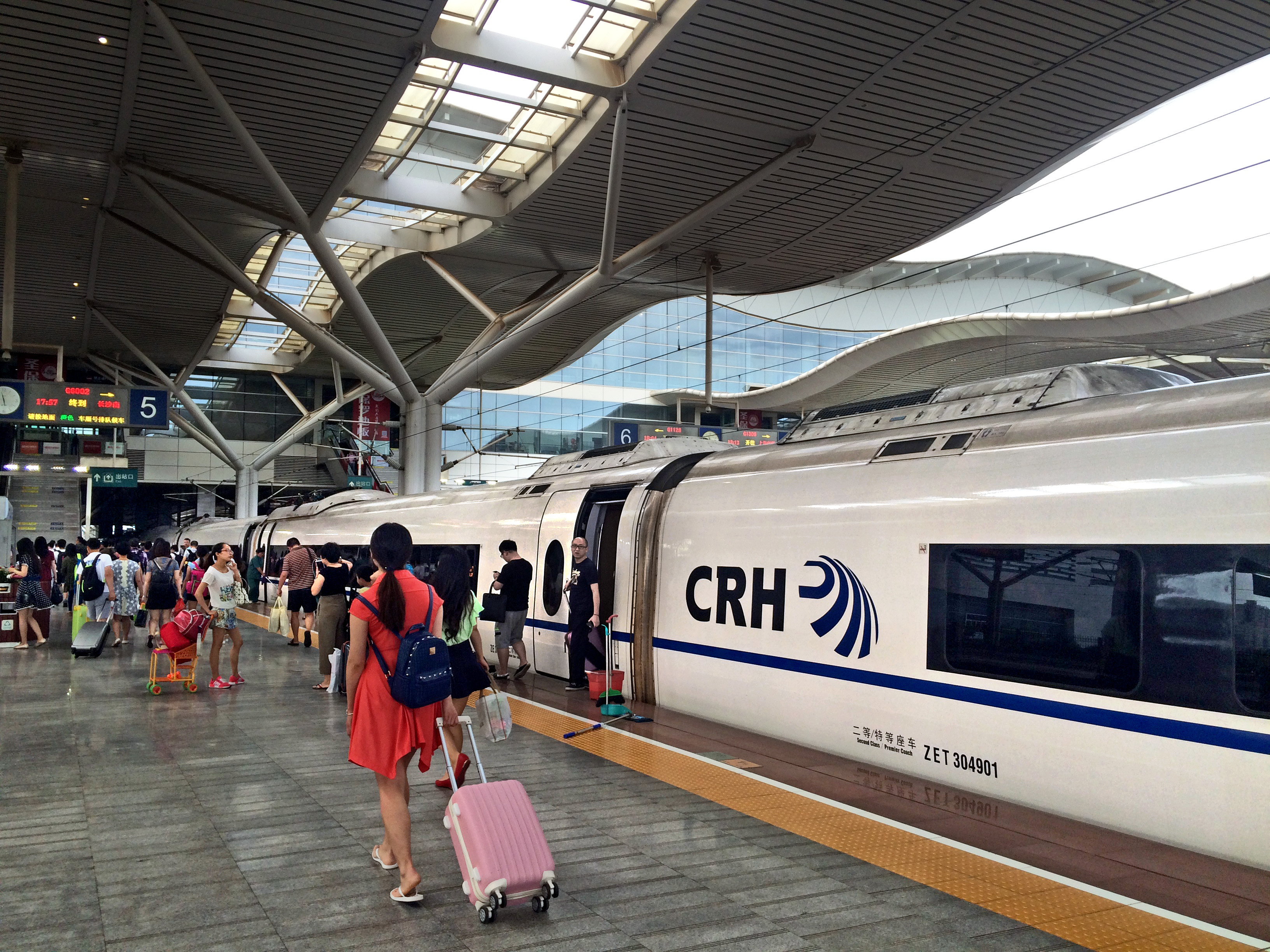
And we got to A5, breathing hard and sweating harder, and stood in yet another line, jammed with travelers. And at a certain time the teenaged station workers in their uniforms began letting people put their tickets into a slot in a turnstile, which popped out the ticket and opened two triangle-shaped pieces of metal that came together like pieces of a camera lens. We walked through the now-open barrier, then took another escalator and another, and there was the train platform and next to it a beautiful steel bullet of a train
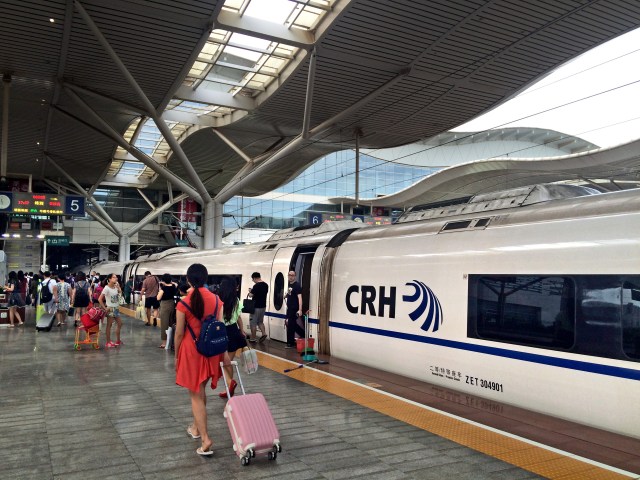
Boarding the fast train to Changsha.

Boarding the fast train to Changsha.

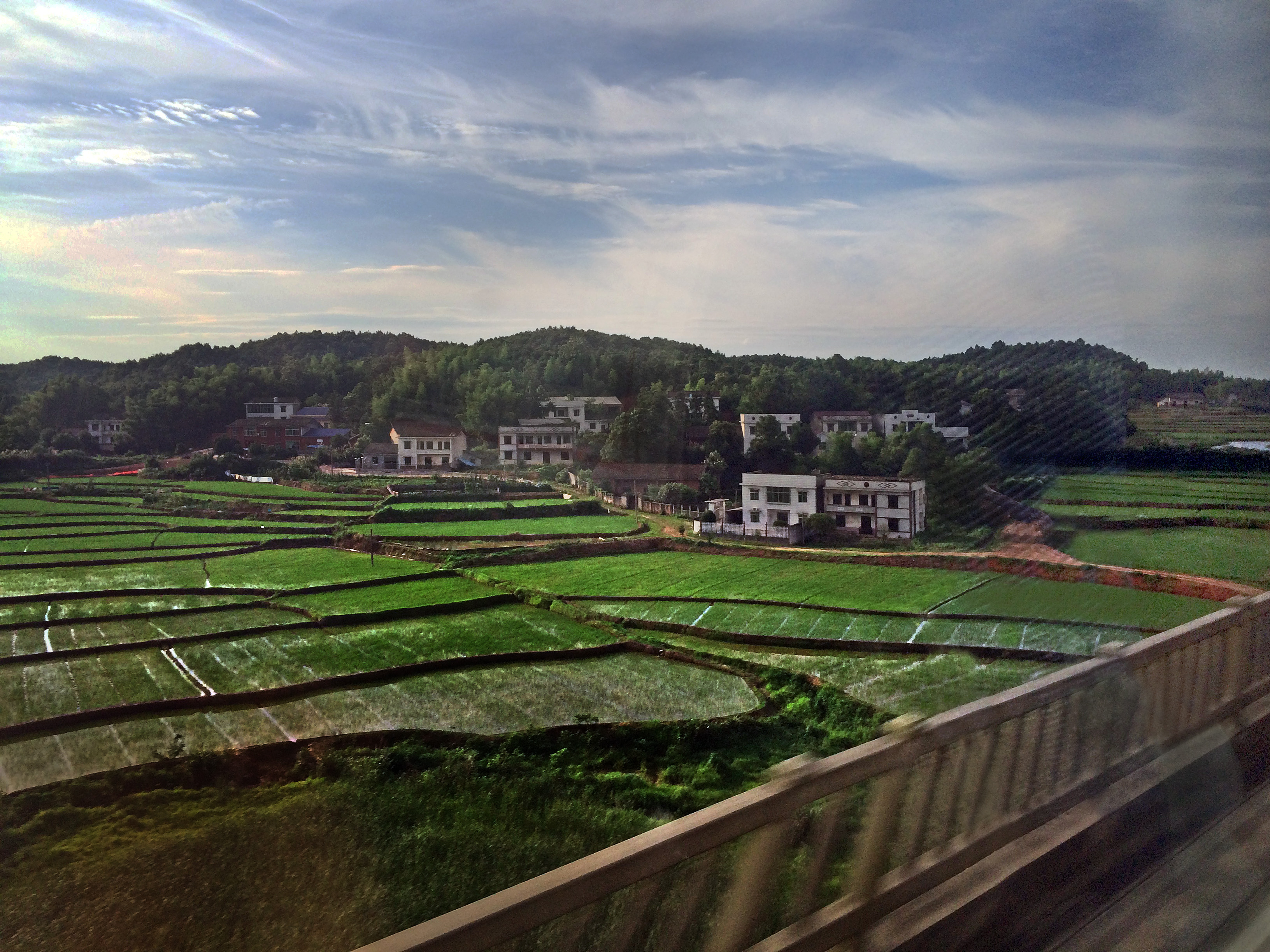
where we had to find Car 1 and our two seats, 6D and 6F, where we would sit and watch a big swath of city give way to countryside, then city again, the back to curving rice fields and foothills and tall mountains that got taller and more interestingly shaped as we went, as the bullet train took us to Changsha and Annie.
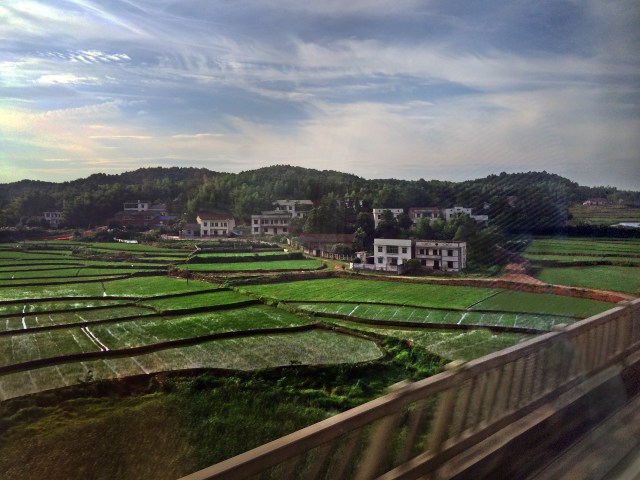
Rice fields and foothills give way to mountains on the way to Changsha on the fast train.
Rice fields and foothills give way to mountains on the way to Changsha on the fast train.

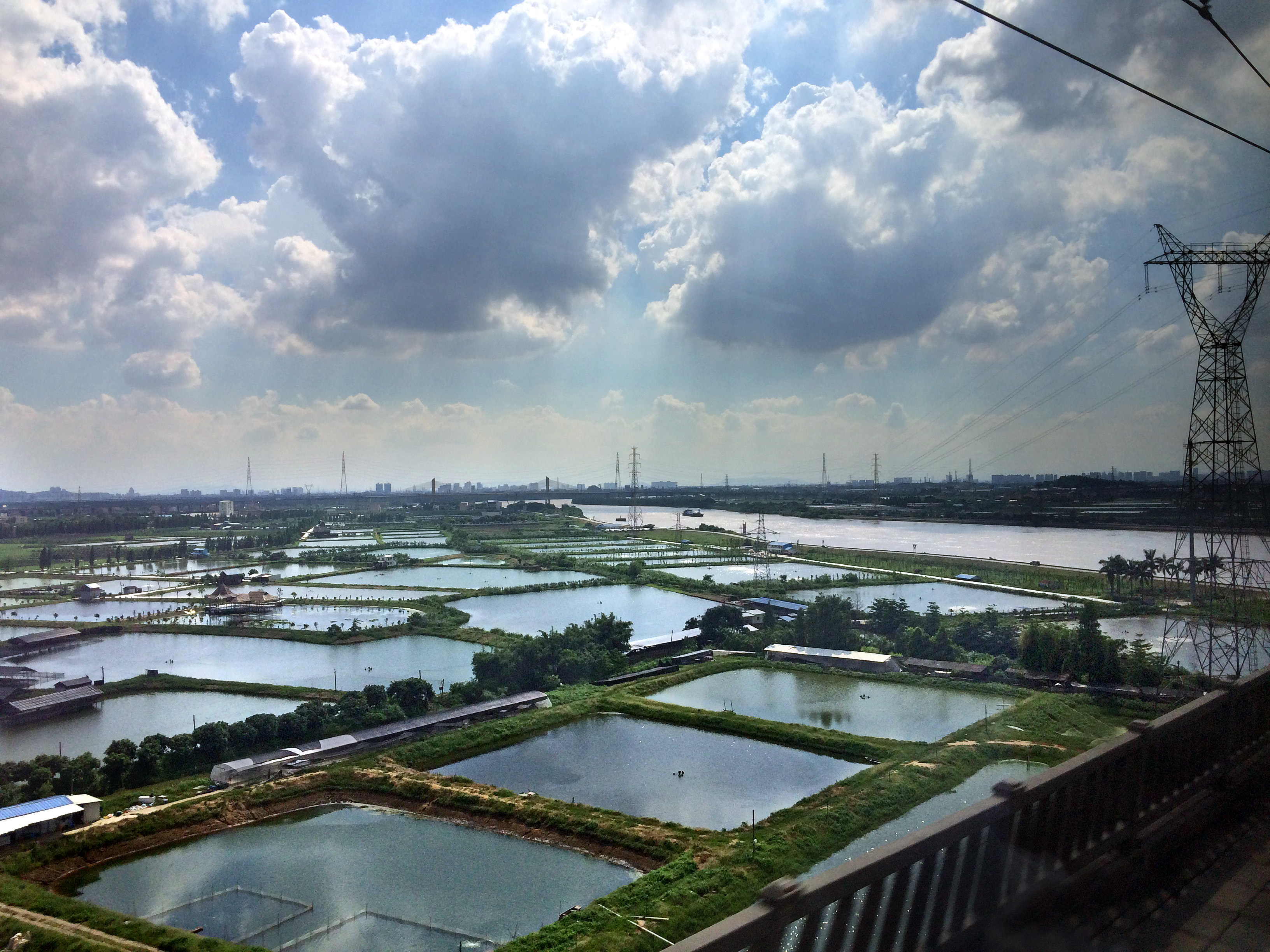
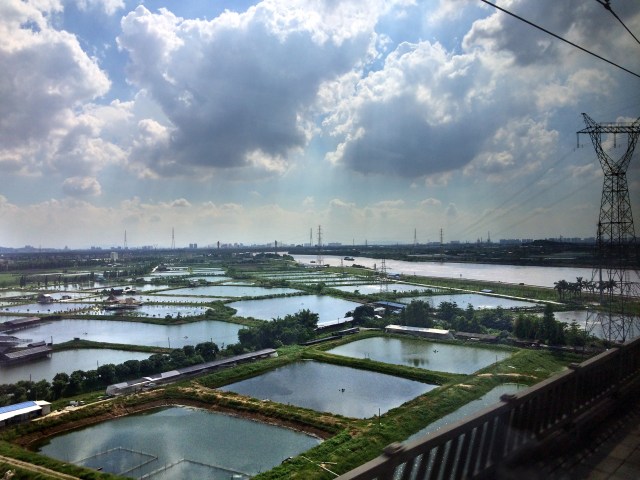
Fish ponds and a great rivers from the fast train to Changsha.

Fish ponds and a great rivers from the fast train to Changsha.

After we arrived in Changsha, took our first holy-god-hope-we-survive-this taxi ride to our hotel and had dinner at Quan Deli, a restaurant that Nikki loves (and has already redefined good Chinese food for me) at the base of the hotel, Nikki said it was time for massages. That’s why we were climbing the stairs to the Yeah Come massage place where two ladies with kind smiles and dressed in white like angels led us to a room that had three massage chairs in it with large ottomans for feet and legs.

This, apparently, is the Yeah Come way—they put you in a room with a closed door, offer you hot tea with ginger and a piece of dried fruit, kindly request that you take off your shoes and sit back. Clothes stay on, but you will have face and head massage, then neck and upper back, then your feet will get the most pampered they’ve ever been with a combination of acupressure (what pressure!) and thumb digs and long strokes down the bottoms of your feet, and you can feel the tension of traveling 7,000 miles to get here, to this city, to take on a new person and bring her 7,000 miles in reverse to a new life none of you can quite imagine, except that by this time tomorrow Nikki will be two, will always be thinking of Annie first, and yes, dammit, we deserve these massages.

So, eyes closed, you drift into second person, no longer thinking as “I,” but as some amorphous “you” and listen to Nikki talk to the two massage therapists softly in Mandarin as one of them kneads that place in your left foot exactly where it broke a few years ago and it’s still tender, but you breathe through it and feel something almost liquid draining out of your sole, and you smile at that thought, the double-entendre of spirit and what has carried your for almost 58 yeas now, your good feet, and oh, after a while you can’t even feel that foot—it has floated off into the netherlands, but you don’t care how you’ll walk back to the hotel. The tastes of the good dinner at the restaurant Nikki loves—the wide rice noodles with cucumber and peanut sauce, the exquisite dumplings that are precisely what dumplings should taste like, the smokey puer-eh tea that not only tastes yummy but is reputed to be so good for you, the flaky, pita-like bread rounds on which you placed thin strips of cooked beef dragged through hoisin sauce… all that marinating happily in your belly, moving through your digestive tract as it should.

You are well fed and pampered now, you comparatively rich American women, and you are so grateful after the day you’ve had, after arriving in Changsha in the late afternoon to again, more humidity and the long snakes of lines winding around as if people were waiting for a ride at Disneyland. And it turned out that you did indeed climb into Mr. Toad’s Wild Ride in a not-exactly-clean taxi through the streets of Changsha, dodging and weaving other vehicles like a sinuous, slithering thing, Nikki in the front seat talking to the man in Chinese, who didn’t want to take foreigners in his cab because they’re too much trouble and who, Nikki thought, was pretending not to know where the hotel was, even though she showed him the business card with the address and a little map on it. After one near-miss with a large white van in the “lane” next to us, Nikki said, “You might want to close your eyes,” and you did, because to look ahead or to either side out the windows triggered every panic nerve in your body.

And after getting checked in to Room 601 in the Jin Jiang Hotel (which Nikki calls the Motel 6 of China), the two of you unpacked as best you could (no closet, no drawers but a place on the wall to hang things), giving Nikki the bigger bed that she will share with Annie and you the twin against the wall next to the bathroom, but it’s clean, if small, and it’ll work for three people and a wheelchair. After that and your good dinner downstairs at the Quan Deli
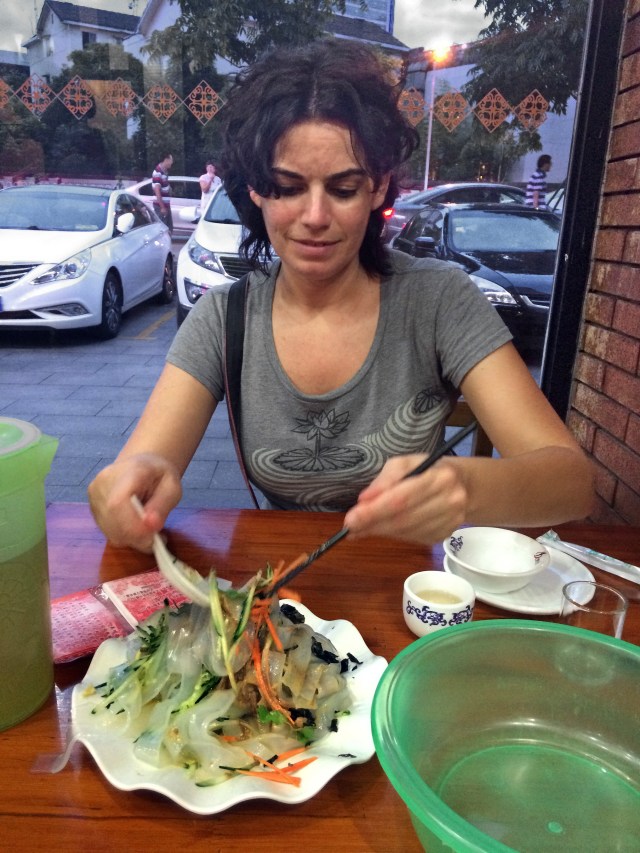
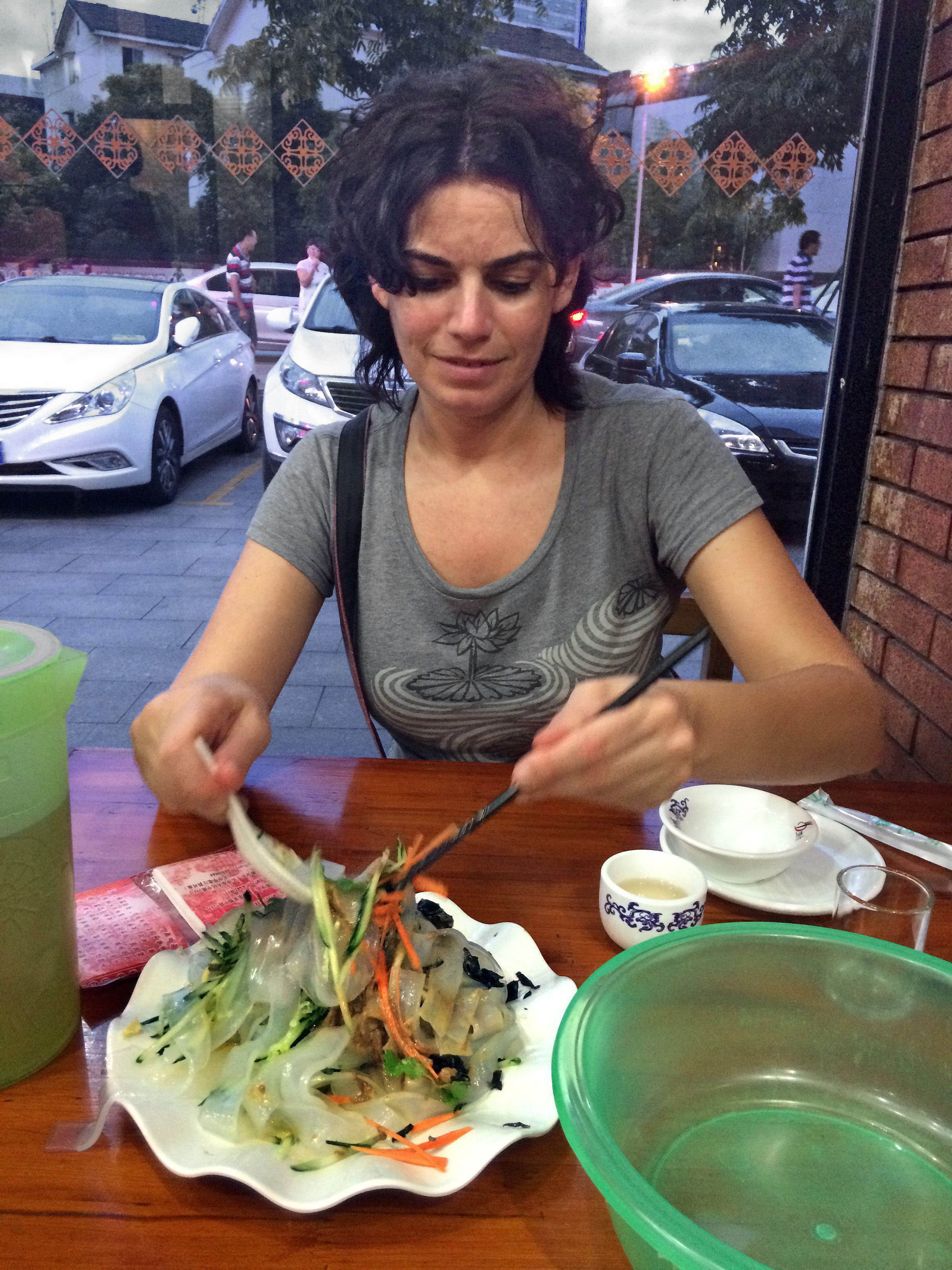
Nikki serves us dinner at the Quan Deli in Changsha.

Nikki serves us dinner at the Quan Deli in Changsha.

where Nikki carefully studied the menu as though she was memorizing it (she was really trying to remember what she liked and what the symbols meant—her Chinese, after all, is four years rusty), after ordering and inhaling such good food, now you have literally given yourselves over to these women who held your foreign feet in their hands, who are massaging away the dreck of travel, the blanket of tension and anticipation that has been hanging over you for months, over Nikki for years.

yeah come interiorAfter working on your heads and feet, the women with their powerful hands have you turn over and take off your sweaty T-shirts, put your arms into backless, long-sleeved tops, put your faces in holes on the now-reclined tables, and, gently unhooking your bras and tucking the straps under your armpits, they lotion up their hands and begin, with long, sure strokes, surfing your backs, sending every worry, every doubt, every bit of stress and strain it had taken to get here, to this city, this very room, down your backs, where it drips down your legs and off your feet like blessed, healing water.

When you finally sit up after 90 minutes, you feel woozy with relaxation, still not entirely in your bodies, coming halfway back from a meditation so deep you’ve drifted into a place that is hard for you to reach on your own, that place of peace where everything is OK, better than OK, that floating, glorious place of no place exactly, where the body has gotten out of the way and the spirit rocks on the surface of whatever you think of as you, mindbodyspirit all aligned for once, pure bliss.

You wonder, is this enlightenment? If not, it feels darn close.

You got yourselves returned to you today, put back in your bodies again by two Chinese women with some of the best professional hands that have ever touched you. You have been restored, and after a good night’s sleep, even more renewed, you will go out into Changsha tomorrow and meet Annie. Nikki will become a mom, and you will get to witness the moment after which nothing will ever again be the same for these two. A thousand blessings bestowed after a thousand tears, two lives forever changed, for better or for worse. You have great faith that it will be far better than worse.

Posted in Bringing Annie Home | 6 Comments

Hong Kong, part 1

•IMG_9233a

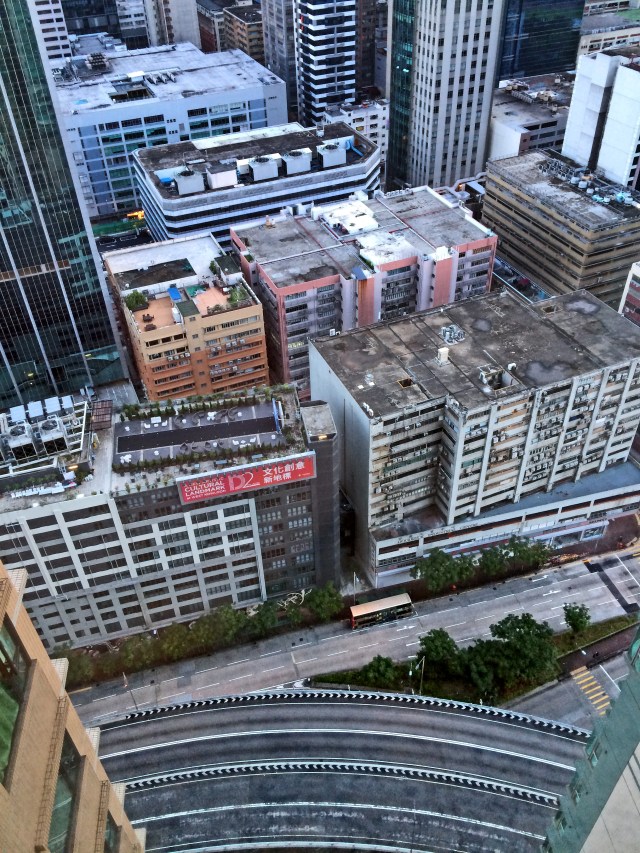
Part of the Kowloon peninsula from one of the guest bedrooms at the Macphersons’.

(#2 in the Annie series)

So after Nikki made the statement that Hong Kong is emphatically NOT China, I got to see a bit of Hong Kong… for less than 24 hours, but we’d be back at the end of the trip. That bit of a day was enough to make me think, “Ahhhhhh… Hong Kong.” Because although I had nothing Chinese to compare it to (yet), HK (as the locals call it) clearly is a cosmopolitan city with many tall buildings and much to see and do among its small islands and part of the mainland.

But it is NOT China, as the Hong Kong-ians (?) will tell you. (I just looked up the right term—it’s Hong Kongers or Hong Kongese.) Having been a British territory for 156 years, Hong Kongers drive on the left side of the road, which makes it tricky for a Yank like me when crossing the street. This is not a problem for Anne and John Macpherson, Nikki’s friends who so graciously hosted us at the beginning and end of our trip at their cozy and lovely apartment on the Kowloon Peninsula. They’re from New Zealand, where they also drive on the left.

But Anne and John don’t drive in HK for the same reason many people don’t—it’s expensive to keep and park a car, and the public transport is so good, no one has to drive. So the next thing I learned about HK is that you can get anywhere you want to go via the MTR (Mass Transit Railway), which carries 1.6 billion passengers a year, according to a 2015 CNN story. It runs about 20 hours a day over 218 kilometers and carries more than 5 million passengers daily.

IMG_0604 copy

Riding the MTR in Hong Kong

Including us—from Airport Island (where the planes land and take off) to Kowloon, via above-ground and underground trains. And, according to Robert Cervero, a UC Berkeley professor of city and regional planning quoted by CNN, “Hong Kong’s MTR is one of the best designed, best operated and most successful metro systems in the world.”

I didn’t read this quote until I returned to Sacramento (a city not known for its mass transit system), but I was even more impressed. Apparently the MTR has a 99% on-time record, too. And it costs an average of $1 per trip, which you pay for using the Octopus card. You buy a card and  put  money on it, then place your card on a reader to enter a station. It’s so fast and convenient—and you can use the Octopus card at stores and restaurants, too, to buy food or bottled water or whatever you want.

So right there, Hong Kong gets my vote for Most Efficient Way to Move Loads of People and Buy Stuff.

We changed our American money to Hong Kong dollars, bought bottles of water (we are to consume nothing but bottled or boiled water on this trip). We got to John and Anne’s new place, a series of very tall highrises called Liberté, after 9 p.m. HK time after a long day of travel that was really two days because we lost one going ahead in time—15 hours ahead in time. But that was OK, Nikki told me, because we would get the day back on the way home. Nikki used to work in Anne and John’s neighborhood, and I was dazzled that although she hadn’t been there in four years, she could still find her way around with only minor hesitation and much sign-reading.

(Have I mentioned that Nikki is impressive for many reasons? This is just one of them.)

Anne and John Macpherson are friends of Nikki’s from a HK church they all attended called The Vine, where John worked for many years with refugees and asylum-seekers. Anne came to HK to teach and now coordinates English language programs at several schools. They’ve been in HK for 13-and-a-half years and love it, though they do miss their home and grown children in New Zealand. One of those children, Cat, is currently hiking the Appalachian Trail in the U.S., and the Macphersons have a map of the trail on the side of a bookcase, marking Cat’s path as she walks.

•IMG_9239a

The Macphersons’ light and lovely living room in Kowloon.

Even though their apartment is tiny by American standards, it has three bedrooms, and the Macphersons graciously loaned Nikki and me each one of them. They are each no much bigger than a compartment on a train, big enough for a twin bed, a small desk and cupboard (closet). The bathroom is just big enough for the tub/shower, a potty and a small sink/counter area. The kitchen is a small square off the long rectangle of a main room. It’s all very efficient and tidy with astonishing views of the city and the mountains beyond.

Anne asked if we were hungry, and though Nikki demurred, I was starving. So John whipped us up some scrambled eggs and tomatoes with yummy bacon, which was for me the best late dinner ever. Then we could go to bed and sleep, finally, which we hadn’t been able to do on the plane. Nikki wanted to leave for the train station by about 1 p.m. the next day, a Sunday.

•IMG_9255a

Nikki Cardoza, Anne Macpherson and John Macpherson.

That gave us time for a good visit in the morning with Anne and John and a walk in the bright sun and (I thought) terrific humidity to one of Nikki’s favorite little restaurants where we had more eggs and bacon. A nice waitress who spoke only Chinese talked with Nikki, who ordered for all of us—it turns out that Nikki has a great deal of experience with Mandarin, which proved to be a huge advantage throughout the trip. But the challenge is that many people in HK speak Cantonese, which Nikki doesn’t know. So figuring out eggs and coffee and tea was a bit of a challenge, though it all worked out just fine.

It was good that we ate well since we had to gather up our luggage and make our way through HK on the MTR, then transfer to a train that would take us to the Chinese border. We would walk through customs (out of HK, into China) and through a covered walkway across the Shenzhen River to get into China’s fifth largest city of Shenzhen in Guangdong province (formerly known as Canton). From there we would take the train to Changsha in Hunan, pick up Annie, then return to Guangdong’s main city of Guangzhou to complete Annie’s U.S. paperwork.

•IMG_9237a

Kowloon from the Macphersons’ living room window.

So we bid Anne and John a fond farewell (aloha!), knowing that when we returned to their apartment in less than two weeks, we’d have Annie in tow. They wished us well, safe travels and good luck along with their hugs.

“Let’s go get your daughter,” I said to Nikki as we made our way back to the MTR to begin the journey north.

“Yeah,” she said. “Let’s.”

Posted in Bringing Annie Home | 2 Comments

EGBOK

J taking plane photo

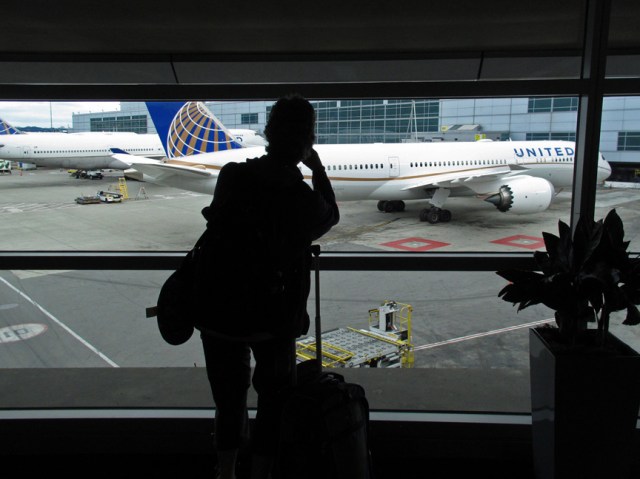
Jan takes iPhone photos of the United Airlines planes lined up at SFO. One of them will take Jan and Nikki to Hong Kong. (Photo/Dick Schmidt)

(#1a in the Annie series)

Friday, June 17, 2016, 4:51 p.m. California time

We are aboard a big ol’ jet airliner, Nikki and I, as we have been for two whole hours, but it feels like at least four, and we have eaten lunch—Korean chicken and rice with quinoa salad… not bad for airline food—and they have played a whole movie, “Zootopia,” which Nikki and I talked through, even during the little bit of ice cream served at the end of the meal (Haagen-Dazs vanilla bean).

J&N open trunk

Jan Haag and Nicole Cardoza: Hong Kong-bound (Photo/Dick Schmidt)

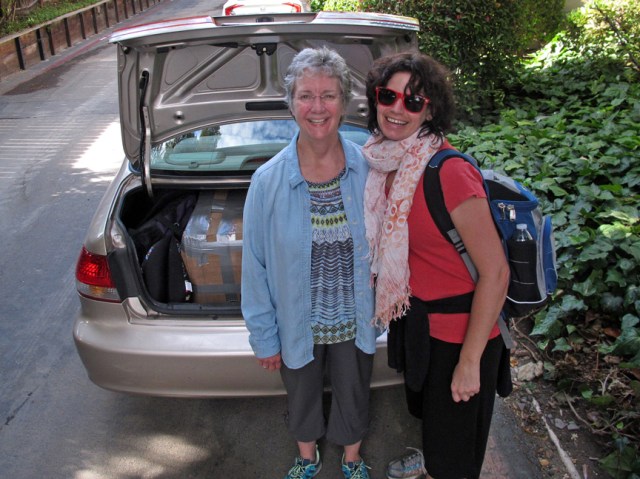
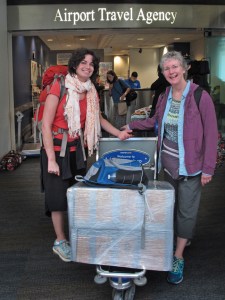
My partner and best friend Dick Schmidt drove us to the San Francisco aero-puerto this morning after a night when neither Nikki nor I got much sleep. We are traveling light—lighter than I’ve ever traveled for a bit more than two weeks away—with one small rolling backpack for me and Nikki’s soft orange hiking backpack as our checked luggage and a small bag each for us. Oh, and a ginormous box with a car seat and soft things to prop up the small child we will be bringing back on the plane with us.

J&N& box airportWe got that box shrinkwrapped at SFO (I had no idea you could do that) and checked it with our luggage, too. We boarded the plane in the third boarding group and, after a couple of hours, we have settled in for a 13-hour ride. At the end of this long journey is an overnight in Hong Kong, then a fast train into China, all the way to Changsha, where Nikki will adopt a 7-year-old girl named Annie, who will train with us back to a city called Guangzhou and then to Hong Kong, and who will return with us on a plane much like this one in 16 days.
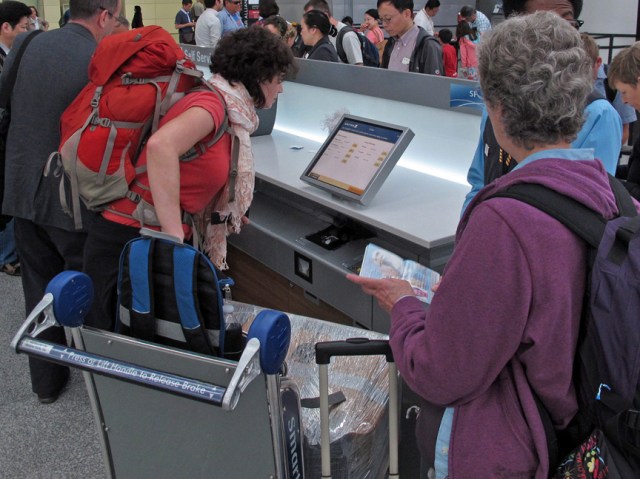
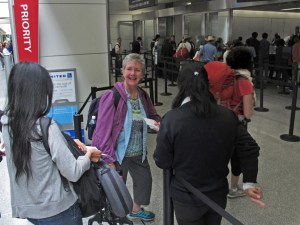
We have each visited the bathroom at the aft of the plane, not very far behind us in row 51, and our male seatmate in the window seat got up then, too, and now we are settling in for what could be a bit of a nap for Nikki, though she is struggling to get comfortable, with one knee up, wrapped in her navy blue airplane binkit, after putting her tray table down and seeing if she can get her head on it. She can’t. No adult can squeeze into these tight rows. The plane has no more room—leg or arm—than the planes Dick and I fly on to Hawaii, but fortunately, the person in front of me is not trying to lean back.

“You don’t want to let them do that,” Nikki told me as we were getting settled, and I can imagine her piping up and telling that person NOT to recline. She is not easily intimidated, which I love about her. I feel as if I’m in the company of a mama bear ready to defend her cub. And though I am not the cub—Annie is—Nikki will Not Be Messed With. I like that about her.

And it does not escape me that when we make this flight home (a whole hour shorter coming back—“only” 12 hours), we will be accompanied by a new someone coming to a new country with her new mama. I cannot quite wrap my head around that.

So Nikki’s listening to her podcasts on her phone, and I’m typing because why not? I’m still getting used to the iPad and it’s small keyboard. It’s a freepin’ long flight, and we still have a good 10-plus hours to go here. Nikki says it always feels longer going than coming, which makes sense to me—even on a driving trip it seems to take forEVER when you’re enroute and not nearly as long on the return.

We had a fair amount of turbulence earlier, even as we ate. This is why Nikki hates to fly, why she goes rigid as adrenalin courses through her, why I held her hand as it bumped us around. I sat in my middle seat thinking/pleading/praying to the gods of airplanes, “Find some smooth air, guys,” and I could tell that they were working on that from the way my head expands the slight elevation changes that a plane makes at 30,000-plus feet. It feels as if the top of my head is coming off, and I can get a wicked headache at altitudes of tens of thousands of feet. But I took a couple of aspirin early in the flight hoping to forestall that, and so far, so good.

The pilot(s?) found some smooth air, though it took a while, and Nikki loosed her grip on my fingers, and I remembered then why I’m here: for support. This trip is so not about me, not vacation or sightseeing, though I’m sure I’ll see plenty—just not what most Westerners come to China for.

This is a Very Different Trip, and in a way, though I’d never have the courage to do this, I’m dazzled by my friend Jodi Angel, who is traveling through Southeast Asia right now, has been for a couple of weeks, not speaking any of the languages in the countries she’s having a Grand Experience. She’s posting on her blog (jodiangel.com) amazing pieces of writing that are part memoir and part adventure tale. I feel like my stuff will be so much blah blah, and I want not to blah blah. This is a Very Big Thing that Nikki is doing. But Jodi’s getting tattoos—one from a renegade Buddhist monk—and riding scooters all over the countryside and climbing through one of those tunnels the Vietcong hid in during the Vietnam War. I am the observer here in a middle seat on an airplane heading for Hong Kong. Then we take a train into China.

And here is one of my first lessons about this place: Hong Kong is not China.

“Really?” I said to Nikki. “Don’t the Chinese think it is?”

“Yeah,” Nikki said, “but people in Hong Kong don’t.”

hong kong night

Hong Kong at night (Kowloon, actually) from the window of my guest bedroom at Anne and John Macpherson’s.

Even though Hong Kong is an island, it also extends to the mainland (the Kowloon Peninsula and the New Territories) and was a British territory for 156 years. In fact, the anniversary of the “handover” as the Brits called it, or the “return,” as the Chinese call it, is July 1, 1997. This year marks the 19th year that it has been officially part of China. Many people feared that Hong Kong would be absorbed into Communist China like steam from a rice bowl fades into the air. But in fact, Hong Kong is more like a dumpling in a bowl of broth—it continues to be an island unto itself. Not just Hong Kong Island, but Kowloon and the New Territories, too. And, it turns out, life has pretty much gone on as usual since the takeover.

“You’ll see the difference, though” Nikki promises. “China is verrrry different than Hong Kong.”

The way she says it, it doesn’t sound like a good thing.

Here’s another thing I’m learning: I can type on the iPad and listen to music I downloaded from iTunes at the same time. I am so grateful to Marquita for helping me acquire the iPad in the last two weeks—my first! I’m what Apple considers an early adopter. Cliff and I bought our first Macintosh in 1984, the year they were released. I’ve had nothing but Macs ever since. But Dick bought me the iPad, and my mom is paying my expenses for this trip, and I am feeling so very well supported at the moment, 32,000 feet in the air, zooming toward China about 500 mph, according to the screen in front of us.

So now I’m listening to “An American in Paris,” which now is keeping company on the iPad with James Taylor and Dan Fogelberg and Mary Chapin Carpenter and (because he’s a good friend and his music makes me smile) Antsy McClain and the Trailer Park Troubadours. I figure if I’m going so far away I should have some comfort music to keep me company.

The sentimental stuff can also make me cry. I choked up this morning when Dick came to get me—after having had very little sleep, the anxiety rising in me to high-tide level. I spent several hours lying down, trying to sleep, chewing on the news that Amy the agent has “released” both my friend Katie McCleary and me on the eve of my departure, which means we no longer have an agent trying to sell our novels. I kinda knew was coming so I shouldn’t be surprised, and I’m not, really, but dang, that stings a bit. Thirty-plus rejections means I guess she can’t sell “Ocean Falls” to a variety of publishers. We got close once, and then the publisher’s European home office closed down the American branch. “Self-publish,” Amy suggested, which is what I’ve been coming to for a while.

But I can’t think about that now. I’m on my way to freepin’ China, fergawdsake, taking the journey of a lifetime with a friend whose life is about to change in the most major way. In a few days, Monday, June 20, Nikki becomes a mom for real. She spent 10 years volunteering in China and Hong Kong; she speaks what she calls passable Mandarin, and she knows these places well. Hong Kong is just the jumping-off place. On Sunday we take a fast train (about three hours) north to Changsha in Hunan province to pick up Annie (where they speak Mandarin and where Nikki volunteered for a year with the home office of the orphanage where Annie is now), then train back south to Guangzhou in what used to be called Canton (where they speak Cantonese, which is very different than Mandarin, Nikki says) to do the paperwork with the U.S. consulate. Then train it again southward to Hong Kong for a couple of days and then home.

Easy-peasy. I hope.

Nikki checks in

Nikki checks in for the Hong Kong-bound flight. (Photo/Dick Schmidt)

After her year in Changsha, Nikki moved to another city, Hengyang, where she oversaw short-term orphanage volunteers. She did that for another two years before she came home. I recall taking her to lunch after she returned and saying that she needed to do three things—finish her degree at Sac State, get a job and buy a house—and then she was going back to China to adopt a child. In my memory I recall that she mentioned Annie. She says that she didn’t know then who she was going to adopt, but she had her eye on Annie, who at that time was not on the list for adoption.

“I need to finish my degrees,” she said, which she did [a bachelor’s in government from Sac State], “and get a job” [for a lobbyist who deals with education issues], “and I need to buy a house [a condo in the Pocket area].”

jlh bye bye

Bye-bye (a Chinese phrase, too, it turns out)! (Photo/Dick Schmidt)

That was four years ago, and Nikki has completed all three of those major life tasks, plus raised thousands of dollars to adopt Annie, who finally did come up for adoption and who is now 7 years old. I am in awe of Nikki, who is currently trying to find a way to sleep with her head propped up on my travel pillow on the airline pillow on her tray table, this woman who couldn’t get a haircut before she left, so she’s going curly, longish and shaggy, this fearless woman who astonishes me and who will continue to, I know, over the next two weeks. I need to stay in that place of awe and astonishment. I want to be a good kokua (“helper” or “one who accompanies” in Hawaiian), one who is in service to this project, who is here to document it, yes, but also to help make it easier, if possible.

I have kokuas going with me in spirit, too, of course, many people eager to see Facebook posts. And I am deeply grateful for the support of my mother, Darlene Haag, who, when she heard that I was going to launch into this adventure, offered to pay for it all. Thanks, Mom!

And now Dan Fogelberg is singing to me through the magic of teeny earplugs and an iPad:

Once in a vision I came on some woods and stood at a fork in the road.
My choices were clear, but I froze with the fear of not knowing which way to go.
One road was simple acceptance of life; the other road offered sweet peace.
When I made my decision, my vision became my release.

My Grandma Keeley was the one who introduced the concept of EGBOK to my sister and me when we were young. It means “everything’s gonna be OK,” and it, more than anything else, is my life mantra. Dick embraces this, too. In fact, I am carrying Dickie’s little credit card-sized EGBOK card with its photo of a cracked egg with a Band-Aid on it, in my traveling tummy pack inside my clothes. It holds my money and passport and this EGBOK, which he gave it to me this morning—I’m missing him already. This feels like a big stepping off point into the unknown, and if I’m feeling that, what must Nikki be feeling?

Everything’s gonna be OK, indeed. Oh, what a time we will have, what we are already having. As Antsy McClain says in one of his songs, “Just hang on tight and enjoy the ride.”

Exactly!

hong kong arrival

Hong Kong arrival—skipping over a day and landing in a new time and place.

Posted in Bringing Annie Home | 10 Comments

Heebie-jeebie

Chinese flag

China—here we come!

(#1 in the Annie series)

It’s that time again, the day before I leave for a big trip, only this time it’s a Really Big Trip, to the other side of the planet, the farthest I’ve ever been from home. So that makes it Super-Duper Heebie-Jeebie Day, a single day and a wake-up call from being driven to San Francisco and getting on a big ol’ jet airliner to take me so far awaaaay, as Steve Miller sang.

Only this is not about me—it’s about Nikki, as you know, if you’ve been reading along up till now, and her daughter-to-be Annie, who will be picked up in Changsha, China, by this coming Monday. After four years of waiting and working to be able to adopt Annie, Nikki will become a mommy for real in a few days. That kind of puts my puny little anxiety about the trip in perspective. It really does.

And people show up to say just the right things at the right time—some of them from China, like our friend Leilani Hu, former Sacramento Bee photographer, now an attorney for the state. She was born “at sea,” as they say, as her parents were on a ship coming from China to San Francisco. Her father was a diplomat, and Leilani (named for the popular Hawaiian song, “Sweet Leilani”) made her appearance enroute to his job in New York. Last night she and I had a good phone conversation about China, where she lived in the ’80s for a while, and has been a number of times. She’s not been to Hunan province, where Nikki and I are going, but Leilani, who grew up in the U.S., is perhaps the most Chinese person I know. She said her parents used to tell her that she wasn’t really American; she was Chinese. She never knew what they meant until she went to China and saw people who not only looked like her but had similar characteristics, the way they walked and talked and acted. “I AM Chinese,” she told me on the phone, which was exactly why I wanted to talk to her.

And then, today, Dick and I had lunch at Burr’s Ice Cream with our friend Laura Chun, another former Bee photographer who is now a designer, and Laura’s daughter Ellis. They live in San Francisco with Laura’s husband/Ellis’ father Greg Urquiaga. Laura’s parents are from China, so like Leilani, she is also a first-generation American kid. She is another good touchstone for me.

IMG_9173

Ellis Urquiaga and her mom, Laura Chun Urquiaga, at Burr’s. (Thanks for lunch, you two!)

And then, after I came home and was practice packing Nikki’s small rolling backpack I’ve borrowed for this trip, the doorbell rang. There was Pat Smith, my former boss (also at The Bee) with a bag of perfect-for-the-trip accessories. She is Aunt Pat to a lot of people, and she and Leilani (dear friends for decades) have traveled more of the world than I am ever likely to. She always knows the right things to say… and bring: lots of tissues, hand sanitizer wipes, hand lotion, a bag of almonds and a lovely book of Chinese prose poems by Lu Hsun—all in a bag with a typewriter on it. She so gets me!

PBS China gifts

Aunt Pat’s Let’s Go to China package (thanks, Pat!)

China, it turns out, is not only the world’s most populous country (1.38 billion people) and uses 45 billions chopsticks every year (thank you, National Geographic Kids), it also pops up often in the U.S. So much of what we buy is, of course, made in China, as well as things we drink. Last night over a quick dinner at Dos Coyotes, this the house brand of iced tea: China mist teaI have no idea if this tea is really from China, but there is that saying about all the tea in China, so maybe, right? I will be drinking that Chinese tea in China for the first time during the year of the monkey. (Apparently one of the things you can say to people as a way of greeting them this year is: “I wish you lots of luck for this Monkey year. 祝你猴年大吉”)

People have asked if I’ll see the terra cotta warriors (no, they’re in Shaanxi, farther north than we’ll be) or the Forbidden City (no, that’s in Beijing, even farther north) or the Great Wall (also in the north). I will not see some of the most famous things in China (it’s a huuuuuge country), but everything I see and hear, smell and taste will be new to me. I will get to eat real Chinese food and ride a bullet train and do things I can’t begin to imagine. That’s great because that’s what an adventure is all about.

Most important, I get to spend time with a dear friend. it’s a real honor to go along on this journey as Nikki’s kokua (“helper” in Hawaiian). As our friend Laura Martin said, I get to see a family be born. And that’s the magic in this adventure.

China, here we come!

Posted in Bringing Annie Home, Uncategorized | 8 Comments

Paper weight

“But the thing worth doing well done
has a shape that satisfies, clean and evident.”
— Marge Piercy, “To Be of Use”

You confront the back bedroom, the one next to yours, where you have stuffed books and prompts for the writing groups for the past four years, since the niece who occupied the room moved out with her boyfriend. They have a house in Lincoln now, a whole house, and you can’t imagine fitting her entire life into a 10×20-foot bedroom in a house built in 1922. Actually, her room (you still think of it as Lauren’s room) was built as part of the addition in the 1950s when the original owners decided two bedrooms and one bathroom were not enough. They reconfigured the house into a three-bedroom, two-bath, which you have just refinanced and cannot believe how much it is allegedly worth.

It’s still not enough space to hold all your stuff, and therein lies the challenge.

Because now you have someone else coming to occupy Lauren’s room, so now you think of it as April’s room. (It has also served as Andy’s room and Richard’s room and Rebecca’s room, good short-term housemates all.) You have 10 days remaining before April’s bed arrives and with it two of her friends to set it up. She will turn up a few days after that. You have spent much of the last two months daydreaming about how you’ll move out two-thirds of the books and all the prompts and even clear off ten whole bookshelves for April—and don’t forget you’ve got to do something with the stuff in half the closet.

IMG_9100You took an initial stab at the books a couple of months ago—the ones in towers, once organized in a system you can no longer remember, the ones stacked atop the shelves that you swear have reproduced when you were not looking. Which ones must you keep? Which ones might you need? After that initial burst, inertia took over. Overwhelm took up residence in that room and throughout the house. It was all too much.

But because April arrives in June, after several days away at the coast, sleeping and breathing in more clean air than your lungs have known in months, you tackle The Room, which has somehow taken on capital letters.

And you have made progress, going through all the books in the house because it turns out that the whole organism is a puzzle—you find one book on a famous journalist and because the journalism books are in your office, you have to find room on that series of floor-to-ceiling shelves. But to do that means you have to look critically at those books. Do you really need “An Editor on the Comstock Lode”? No, you do not, so it is consigned to an ever-growing pile of sturdy boxes marked “donate” that once held reams of copy paper or into smaller bankers’ boxes, which you can lift, even full of books.

Here’s the thing that’s been hanging in your mind like a dusty cobweb for months: How do you decide what stays and what goes? And where does the stuff that’s to go… go? Is it all donated to the Friends of the Library Book Den? Is it put into boxes and stored? If so, where? You have a basement of boxed books you sent down there when Lauren came to live with you. You have not seen their spines or touched their pages in a good five years. You can argue that if you haven’t looked at them in that long, they could all be given away, and that would be fine.

But, some bit of your conscience argues, that would be like sending an animal you’ve lived with for years to the pound. Even if you don’t like him very much, he’s been around a long time. He is not easily disposed of.

So you make an executive decision not to go into the basement at all. You will deal with the books that live on shelves, stacked atop bookcases, on smaller tables, the jumbled towers of books. You will figure things out from here, you decide grimly.

The writing prompts, you tell yourself, are easy. They’re in large purple plastic tubs, and they can be moved to the loft where you hold your writing groups. Except for the prompts that aren’t in the purple plastic tubs, the ones scattered among the books. Those will need to be collected and put… somewhere.

Once again it comes to you that things have gotten a little out of hand.

Half of your king-size bed in the next room has stacks of books on it, too. So does the long dresser—covered with stacks of books and one long row of them pushed against the wall. IMG_9101Various cats have peed on some of these books over the years for reasons you cannot fathom, and you have sighed, retrieved them, sprayed them with anti-pee-cat spray, let them dry and put them back. Still, you pull them out, and every so often you feel the grit of dried cat urine on one of them, and your blood pressure rises, and you apologize to Mary Oliver or Billy Collins or whichever poet has taken the brunt of a long-dead kitty’s annoyance. Out loud, you say, “I’m so sorry, Mary,” or “That damn cat did it again, Billy.”
And once again you wonder how the book situation has crept up on you.

It’s not as if you don’t give away books. You do. All the time. But clearly you bring in more books than you send out, which has led to this unfortunate predicament. (You swear the poetry books are mating in the night—they multiply like flies in there. How else to explain four copies of the same anthology that once published one of your poems?)

Then, an unexpected savior appears in the form of the college boyfriend who blows into town to continue the massive job of cleaning out his parents’ small house in a nearby suburb. You have periodically helped him with this major project over the past year after his mother’s death. He shows up every couple of months, you drive him out to the rural area that at its best can be described as “the sticks,” and you proceed to go through room by room of the house of a woman who had, you swear, more Catholic books and saint statuary than the Vatican. And Beanie Babies. Thousands of them—literally. You come home and convince yourself that your house is under far better control, but you are grateful to his late mother for distracting you from the task at your house. You, the non-Catholic, add to your life two of her statues—one of a bowed-head Mary with sculpted gown that hangs gracefully to her feet; the other a gowned angel, head bowed, reading a book. She feels like your angel.

The college boyfriend declares on this visit that this is it—everything goes this time. The house must be cleaned up once and for all to put on the market. As is. And then he drops a big piece of news at your feet like a dog with a ball.

“I’m getting a storage unit,” he proclaims one afternoon as you schlepp stuff out to the rented Dumpster at his parents’ house. “In your neighborhood.”

This intrigues you. He originally intended to give away or donate or dump everything. You ask where, how much it costs, where do you get a lock, how often can you go in and out, whom do you talk to, and what does it cost again? He explains it all to you, tells you about Linda, the site manager who has run the place for 23 years, and you feel as if you were just thrown a ring buoy as you bob around in choppy water. It’s not exactly a rescue, but it helps you float.

So the next day you call Linda as you look at the computer and see that the storage place is exactly 1.8 miles from your house. You mention the college boyfriend. You tell her that he said she had a 5x10x10 space on the second floor—unheated, unairconditioned, unlighted, too, it turns out—and could you see it? Sure, she says, come on by, and you arrange a time to see her the next day.

IMG_9098

April’s room in process.

This turns out to be the last day of the month, which is perfect—that’s when people come and go. She’s got a couple of options for you, $97 a month, and ignoring the math about what that adds up to annually, you decide that renting 50 square feet of space that soars 10 feet high—a big closet, really—makes sense. You’ll take it, you tell her, and she shows you how to work the lock (you’re not very good with locks) and where the big cart lives and where the elevators are so you can move in your boxes with some ease.

And as you sign the papers for the smallest piece of property you’ve ever rented, something rises in your heart because you know you will be back the next day with your boxes of keepers.

You stay up till 3 a.m. going through books. Somewhere around midnight it occurs to you that you have for years gone about this process all wrong. With the clarity of a deadline looming, you realize that the question you must ask about each book is not, will I need it, or have I read it? You should be asking yourself (and you feel very Oprah about this), Does it bring me joy? There’s a book about that, right? Do I own it? When I hold each book, do I feel that I need to have it near me? Does it add something kind or meaningful to my life? Do I consider this book a close friend? You decide that if you’re ambivalent about it or have no feeling about the book, it can go. It doesn’t need to be stored. But if you feel strongly about it, want to hug it, then it needs to stay on a shelf near you. If you feel less strongly but still fondly about a book—your old Girl Scout and synchronized swimming manuals, for example—you sideline it for storage.

Something shifts inside you, and in the middle of the night you fairly quickly fill five boxes of give-away books and a dozen more boxes for storage, wishing those numbers were reversed. But still. And by 3 a.m., back aching, eyes fuzzy, you see evidence of progress. Shelves are emptier; stacks are smaller. You can see great swaths of space on the 10 shelves you’ve set aside for April.

IMG_9097

The departing records and a late friend’s Michael Jackson record player.

You realize that you can let go of those two long shelves of old vinyl records—except, of course, for the Carpenters, Herman’s Hermits, Dan Fogelberg and Bread LPs. Those were your very first albums; they are old friends. They bring joy and meaning to your life. Even if you don’t have a turntable to play them on. They can live in your office down the hall.

You glance at the clock, take some aspirin for the aches and sleep for about six hours, then rise and begin schlepping book boxes to your Honda, which is not large, but will hold a good 15 boxes if you stack them correctly. You stack them correctly, and by 10 a.m. you are at the gate with your new gate code on a business card, punching in numbers and asterisk and pound sign into a keypad. You locate the cart for schlepping. You remember where to park the car, load the cart with half the boxes (you have only so much oomph in your arms, after all), punch the elevator button and head to the third floor.

IMG_9099

Ten shelves almost clear!

You struggle to open the little lock, which opens with a key, not a combination, but it’s a tricky arrangement, and it takes a bit of jiggling to convince it to give way. It does, and you open your storage space—B455—and there is your 5x10x10 plywood-lined closet awaiting your boxes.

You find yourself smiling as you load in the first boxes, empowered in an I-am-woman kind of way, happy to have cleared some space in your house and in your mind. You have bought yourself time and space, and how often do people get to do that? You realize that you do not want to pay rent on a closet forever, but for now this solves a problem. You can see yourself bringing the boxes up from the basement and going through them, making similar toss-and-keep decisions. You resolve to do so soon. You decide to ask April, the newly minted MFA poet, to help you, though you suspect that she hangs on to a few extra books, too.

Done for now, you even get the lock to close without too much fussing. I can do this, you think, and that stretches your smile even wider.

Tomorrow, you decide, you will take the donate boxes to the Friends of the Library Book Den. On the drive over you will thank those books out loud for their place in your life, leave them with good cheer in the hands of kind volunteers, people who also love books, and drive away a little less burdened, having made space in your life for a someone you love who needs a safe place to land, who will do so in less than a fortnight, there in a room full of your closest friends.

(Thanks to Kelly Cunningham for suggesting the title for this piece.)


Posted in Uncategorized | 4 Comments