Go and sea

I had to stop and think: How long has it been since I walked away from my “to do” list and all the “haftas”? How many weeks? Months? Ah… since December. Kauai with Dick. One of Dick’s best qualities is that he takes me to lovely places where we don’t have to do anything we don’t need or want to do. There we recharge the depleted batteries. We sleep a lot. As my friend Pat Schneider says about going on a writing retreat, you should spend much of the first three days just SLEEPING. We all need more sleep, more rest, more down time.

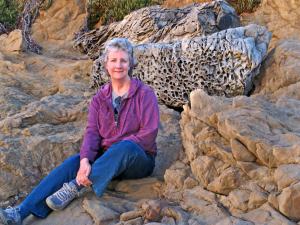
Which is why I am thanking my dear Dick Schmidt for taking me again to the north coast of California, specifically to The Sea Ranch at the top of the Sonoma County Coast for five days of R&R. How much R&R? This is me after lots of sleep and reading whatever I wanted to read and long, brisk walks and good food (lots of fresh fish and clam chowder!):

jlh on moonrocks

When Dick showed me this photo, I thought, “Oh, THAT’s what I look like when I’m not stressed, when I’m done teaching, when summer begins.” I seem to forget this. And this year has brought some big changes and challenges for both Dick and me, from the loss of a dear loved one for him to a super-busy academic year that included my last semester (for a while) advising the student newspaper at my college. How to wrap the mind around what’s coming at us whether we like it or not?

I have a Life Is Good T-shirt that has an anchor on it and says, “Go and sea.” This is a good reminder for me to go to the places within and without that restoreth the soul, to take time to power down and spend time with someone I love and who loves me. And who feeds me really well, too. (Did I mention three kinds of clam chowder, just to test them all?)

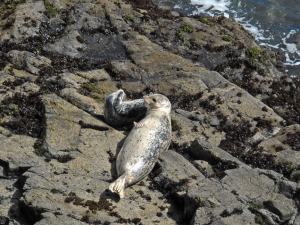
mom baby sealThe harbor seals on the north coast really understand how to rest. They haul out on warm rocks for many hours a day, especially the mothers with babies, and they just sleep. It helps when the weather is lovely—not-too-hot, not-too-cold kind of lovely. Just the right amount of breeze, as it was when we were there.

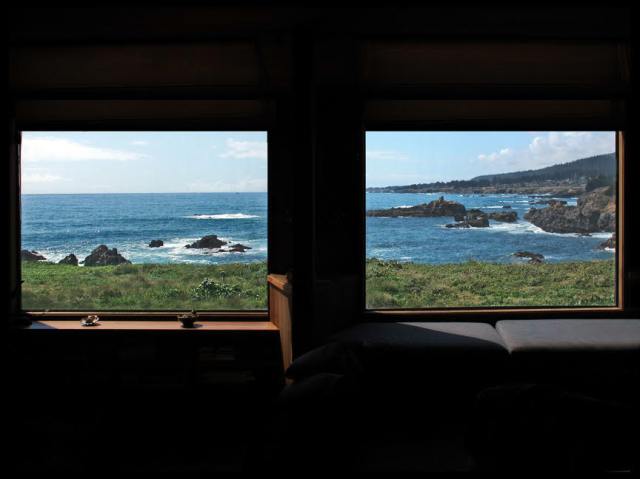
Look at this view. Breathe it in, as I got to do for five days. Is that peaceful or what?

Zohman living rm view

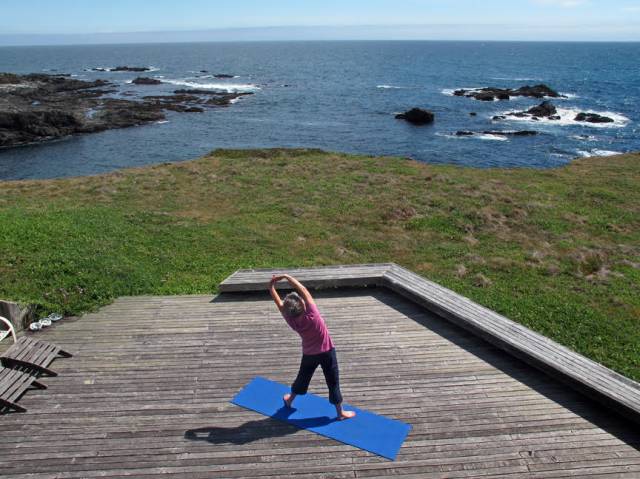
Time to stretch, to unwind. Yes. I know how lucky I am to be able to do this. To go and sea. Yes. I am beyond grateful. Yes.

jlh yoga on Zohman deck

It is on this rugged coastline under bright skies that my molecules settle again after being scattered like salty mist. Where the peace of the sea returns myself to me. Where I am reminded of what is possible out there and in here.

It doesn’t have to take a major change of scenery to do this. I find that I can recharge with a walk in a lovely park or spending time with someone very dear. Changing my surroundings, even for the length of a walk or a few hours with a friend, changes my attitude.

This summer I wish for you some serious soul-restoring time, to dive into possibility, to grant yourself the space to go and sea.


Posted in Uncategorized | 2 Comments

Turning the tassel

Every other year at my college I am required to don cap and gown for graduation. The faculty parade between two lines of students about to earn their associate degrees and enter our historic football stadium. We line up on either side of the track, and the soon-to-be-graduates march in to “Pomp and Circumstance” as we applaud for them. I love this part.

The next part not so much. After the graduates are seated in folding chairs on the track, the faculty traipse up to the bleachers where we sit with increasingly sore posteriors for the rest of the ceremony. It’s a speedy 90 minutes, which is great for a commencement, but really, sitting there on display with my mortarboard falling off my head is never my favorite part.

Years ago when the College Relations department used to put on graduations, I volunteered in my off years with other classified staff folks (i.e., the people who really make the college run smoothly) to help. My favorite part was to work in the South Gym where the graduates gather, put on their caps and gowns, need help and bobby pins (mortarboards should come with Velcro) and ask, “Which side does the tassel go on?” (The right, by the way, while they are still candidates for graduation.)

Somehow I stopped doing this when graduation became the job of the folks in Admissions and Records, which makes sense because they are the people who keep track of who has completed the proper classes and requirements for an associate degree. But I looked upon attending graduations as a chore.

Last year, to try to get myself in a better mood about it,  rather than renting a cap and gown, I bought my own regalia for the first time in my professorial career: a substantial gown with all the folds and gathers, a proper cowl in the right colors of my university (green and gold satin) rimmed by the color of my major (crimson for journalism), and a mortarboard in the right size with elastic that actually stayed on my head. I felt very well outfitted at last. Still, I missed helping with it all.

So this year when the email arrived seeking volunteers, I jumped at the chance. At least three of our journalism student editors were set to graduate, and I wanted to be there for them. So I signed up, collected my nifty maroon polo shirt with the Sacramento City College logo and “staff” designation on it and showed up at the appointed time in the South Gym.

For a while I stood outside the gym as students arrived with their gowns over one arm, mortarboard in hand. There some of my colleagues in matching polo shirts had rolled out a long sheaf of butcher paper bound for a time capsule on which students could sign their names and leave a message behind. I was directing traffic, pointing out spots where students could sign their names when I heard someone say, “Jan, can you help this lady?”

This lady, it turned out was Sandra Jefferson, who was with her husband Anthony. They arrived looking nervous, which is not unusual for people at this point. “Sure,” I said, though I didn’t know what I would do.

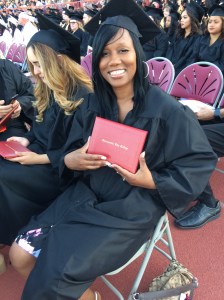
Sandra Jefferson-1

Sandra Jefferson

They came over to me and explained that Sandra had limited vision. She was concerned that she wouldn’t be able to see where she was supposed to go. She needed to follow someone who could be with her through the ceremony while her husband went to sit with family members in the bleachers.

She was tall in her spiky heels. She grinned down at me. I liked her bright smile and we chatted a bit. She explained that she was legally blind, could only see light and shadow (“I see in black and white,” she said).

Immediately I thought of my college boyfriend, Curtis Richards, who is also legally blind. He was the first man I lived with the year I was the editor of the college paper and he was the managing editor. He still teases me about this, but I learned from him, among other things, to always put the cap back on the toothpaste and never put a clear glass in the sink. He’d knock it over and not be able to see the broken glass. He also rode a bike to school. Occasionally he’d run into something, but he always got back on and kept riding. I saw a similar kind of determination in Sandra Jefferson.

“I didn’t think I could do this,” she said. “I couldn’t imagine how I’d be able to figure out where to go or when.”

Anthony, also a tall person, looked down at me. “Jan will help you,” he said.

“Yep,” I said. “That’s what I’m here for.” Though until that moment, I hadn’t known that.

While we waited, I filled out the card that she would hand to the announcer who would read her name and major before she crossed the stage and shook the hand of the college president. “Sandra Lee Jefferson,” she instructed me. “Sociology.”

Sandra decided to change her shoes, trading her stilettos for flat sandals with sparkles on them pulled out of her purse. “Good idea,” I said. “You don’t want those heels getting stuck in the grass or on the track.”

“I love my heels,” she said.

“And you look great in them,” I said, knowing what kinds of obstacles lay ahead, “but the sandals will be easier. I promise.”

When the announcement came to do so, we lined up in the gym, me in my polo shirt behind a tall guy in his cap and gown, then Sandra behind me. “I can follow you,” she said, “if you don’t get too far ahead of me.”

So it was that, for the first time in the 23 years I’ve been a full-time professor, I processed with the candidates for graduation, not with the faculty. I must have looked out of place in my polo shirt, and I thought more than once that if I’d known I’d be doing this duty, I could’ve brought my snazzy cap and gown.

We lined up in two rows facing each other, and the faculty paraded toward the stadium. I told Sandra who was walking by, and when I saw the sociology teachers, I told her. “Professor Miller!” she hollered. “It’s me, Sandra!” And bless, Nich Miller, he waved back at her. I told her that he did, too. She beamed.

Once inside the stadium, the professors lined up and the students walked through. I got some funny looks from some people who had no idea why I was walking. “You graduating, Jan?” one called to me.

“In a way, yeah!” I called back and heard Sandra laughing behind me.

I led Sandra to a folding chair at the end of a row so it would be easier for her to make her way to the stage. I knelt next to her for a time and told her that I’d be nearby, but that I’d go sit at the edge of the track by the bleachers until she needed me. I took photos of her and sent them to her from my phone, then I sat during the speeches and tweeted photos.

I looked at my colleagues up in the bleachers. They chatted with each other and applauded when the names of students they knew were called. But I was so happy to be where I was, in the midst of things, with a real job to do.

After the speeches, which were mercifully short, it was time for Sandra to stand up from her seat and line up to walk up the ramp to the stage. “Tell me what’s going on,” she said, and I explained how people were lining up and moving toward a ramp that went to the stage.

“You’ll walk up the ramp to the president,” I began.

“What’s he look like?” she asked.

“He’s a tall black man,” I told her.

“Really?” she said, surprised.

I said, yes, and that our previous president was an African American woman. She beamed at that. “I never knew that,” she said, and it occurred to me that while we don’t usually refer to people by their racial designations or skin color, for Sandra, who is black, that information can be helpful. And, in this case, inspiring.

As we walked toward the ramp, my plan was to peel off and meet Sandra on the other side of the stage. But just as she started to walk up the ramp, Sandra touched my shoulder. “Go with me,” she said.

And so it was that, for the first time at Sacramento City College, I walked up the ramp with a graduate, smiling at Michael Poindexter, our interim president, who looked surprised to see me. I stepped aside. He shook Sandra’s hand and put his arm around her, posing for the photographer who takes pix of all the grads. He said, “Congratulations, young lady,” and she giggled. Then I stepped around them, said to Sandra, “I’m right here,” and walked ahead of her down another ramp and around to her seat.

I stayed nearby until everyone had received a diploma. Then the president asked the graduates to stand, turn around and wave to people in the stands. “And now,” he said, “you can move your tassel from the right to the left, signifying that you are now graduates of Sacramento City College.”

He didn’t say this, but it’s called “turning the tassel,” always a big moment in a commencement. The graduates cheered, and Sandra raised one hand over her head to wave to her family in the stands. My eyes clouded with tears.

It was one of those priceless moments when I didn’t want to be anywhere else.

Earlier as we waited in the gym Sandra had told me that she hopes to transfer to Sac State, but she hasn’t applied yet. The idea of the big university scares her. “How will I get around?” she asked. “I’m afraid I’ll get lost.”

And that’s when I told her about Curtis, who got around just fine at big, old Sac State with limited vision. “He even rode a bicycle,” I told her.

She said, “Weren’t you scared for him?”

I said honestly, no, I wasn’t. “He’s the kind of man who can do anything,” I said. “And you’re the same kind of woman.”

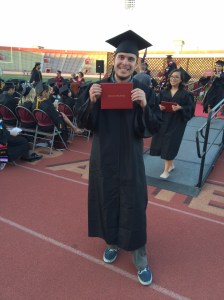
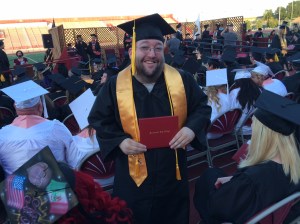
She grinned at me and gave me a hug. Her husband Anthony came down to the track after the ceremony and hugged me, too. I took photos of Robin and Tyler and Daniel, too, my student editors-now-graduates and collected hugs from them, too. It was freepin’ awesome.

Robin AF Swan

Robin AF Swan

Tyler Heberle

Tyler Heberle

Daniel Wilson

Daniel Wilson

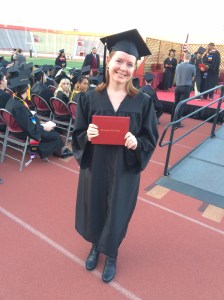
So although I do love my new cap and gown, I decided that I’m never going back to sit in the stands with the faculty. I want to be in the thick of things every year with the staff and the students. I was as happy as any of those graduates in Hughes Stadium, energized by the fact that I get to do this—teach at this college, watch some of my students and a whole lot of them who feel like my students accomplish a great thing. I was as proud as any of their family members for them.

And, best of all, I got to meet Sandra and Anthony Jefferson. He, by the way, needs to take an English composition class in the fall. He says he likes to write, and he’s gonna sign up for the one I’m going to teach. Whaddya know?


Posted in Uncategorized | 2 Comments

I’m going where?

To China. Hunan, China, actually, which has not been on my bucket list, to tell you the truth. I toyed with the idea of heading there some years ago when my friend and former student, Nikki Cardoza, ensconced herself as a volunteer for ten years (a whole decade!) in China, most of that time living in an orphanage, caring for sick and dying children, as well as some with disabilities. She’s that kind of big-hearted person.

During her China years Nikki would come back to Sacramento once a year for a little R&R, and I’d take her to lunch or dinner to catch up. She was living on practically nothing, which she claimed was easy to do in China. All she wanted was some new T-shirts since her old ones were (and I believe I’m quoting her accurately) “covered in baby barf.” Besides caring for kids, she’d shepherd around volunteers who came from all over the globe to help at the orphanage. They’d work for a while, then she’d tour them around Hunan a bit.

“You should come to China,” she’d say. “I can show you around.”

I’d say, yes, that would be an adventure, wouldn’t it? But I tend to gravitate toward easy travel, restorative travel. The California coast. Canada. Hawaii. And though I actually do work in Hawaii (editing guidebooks… best editing gig of my life), it’s hard to claim that I’m suffering. (I’m so not.) So, with one thing and another, I just didn’t get myself to China to see Nikki.

About four years ago Nikki returned to Sacramento. When she first came back, I took her out to feed her, and she said, “I have to do three things. I have to finish my bachelor’s degree. I have to get a job. And I have to buy a house.”

I looked at her serious eyes under her dancing curls. “And then?” I said because I knew there was more.

“And then I’m going back to China to get Annie.” Her smile broadened.

“Annie?” I said, imagining that Nikki had fallen in love, which she actually had.

“There’s a little girl in the orphanage named Annie,” Nikki said without a trace of irony. “I want her to be my daughter.”

Annie was then three-ish or so. The orphanage folks didn’t really know, as Annie had been abandoned under an overpass and brought to them. She came, as a lot of the kids do, without a birth certificate, so they gave her a birthday on the day she was found: May 22, 2009. They guessed she might have been a year old then.

“That’s great!” I said.

“There’s one thing,” Nikki said. “Annie has cerebral palsy.” She let that sink in for a few seconds. “She doesn’t walk, and she’s in a wheelchair. Her speech is a bit garbled. But I think that with therapy here, she’ll make good progress.”

I nodded, thinking that there could be no better parent to bring a Chinese girl with a physical disability to the United States than Nikki. She is fearless, never afraid to speak her mind and stand up for the underdog. Still, there are not many people who would do this. She doesn’t think of herself as extraordinary, but I do.

And true to her word, Nikki has finished her degree (at Sac State, in government), gotten a job (working for a lobbyist) and bought a house (a condo in the Pocket area). Now she’s going back to China for Annie.

And so am I.

About six months ago, when it looked as if the adoption was finally going to happen, Nikki asked me to go with her, to lend a hand on this journey. And, to my surprise, I said yes. I started looking up things about China on the Internet. Nikki gave me Chinese phrases to learn with phonetic spellings. I’ve been singing “Tomorrow,” the song from “Annie,” in the shower. It seems like it’s her song.

So on June 17 we will fly to China, which at 13 hours will be the longest direct plane flight of my life. We will land in Hong Kong, stay with some friends of Nikki’s, then train to Hunan province, to Changsha, more precisely, where Nikki will retrieve her daughter, who is seven-ish now. We will take care of paperwork with the Chinese government and then with the U.S. government, head back to Hong Kong and fly home. All in a couple of weeks.

We got together last night for dinner and talked about it. Though there is more paperwork and cost involved than for any of her other trips to China, Nikki is as calm as if she were bound for, oh, say, Hawaii to lie on the beach. I am excited, a little nervous as we head to a place that will be hot, humid, smoky and loud, a place of very hard beds and very hot food. None of those things is on my bucket list. Clearly, this is not my typical kind of travel. It’s a trip with a mission.

I feel that I’m getting a ringside seat at a different kind of birth. (Nikki calls me her birthing partner; there’s a baby shower for her this weekend.) I’m getting to watch a family be born in a place in the world I would not go otherwise. I get to be Aunt Jan again (a role I cherish) to a new small person I already adore, as does her mother-to-be. I plan to open my heart and eyes and take it all in, allow myself to be surprised by the sights and sounds and, yes, smells of one of the oldest civilizations on the planet. I plan to be awed by it all. Even the smelly parts, the loud parts.

The sun’ll come out tomorrow… so you gotta hang on till tomorrow… come what may…

I will write about it here as we go along, Nikki and Annie and me. Stay tuned.

Posted in Uncategorized | 10 Comments

Eleven rules for writers (whether you think you are or not)

  1. Keep your hand moving, said writing guru/wise woman Natalie Goldberg. Don’t stop. Don’t edit. Just keep your hand moving.
  2. I add: Or keep your fingers typing if you have them poised over the keyboard. Don’t stop. Don’t edit. This is difficult for those of us who edit in our sleep, who have spent years penciling others’ boo-boos because we are teachers or editors or bosses or people who think we know better.
  3. This applies to our own writing, which we feel it necessary to criticize and apologize for because it’s never as good as we’d like it to be. Never as good as it was when it flitted across our minds like a fast-flying bird—so fast we can’t identify it by name.
  4. Your job—my job, every writer’s job—is to catch the words as they fly by, snatch them out of the air like a frog grabs a low-buzzing bug, swallow them, let them flow out of our fingers onto the page/screen/envelope/napkin—whatever means is handy to capture them.
  5. This is not to say that the words are caged, that they belong only to you. They are wisps of thought, after all, free to blow off the page, if they wish. You are free to discard them later, if you wish. But not now.
  6. Now your job is just to grab those words, slap ’em down with great force or set them gently on the page like small white feathers floating from the sky—the words will tell you what is needed in that moment of their aborning.
  7. Because then you remember—I remember—that there are no rules here except to be gentle with yourself—myself—as the words fly by, as they are snagged and recorded.
  8. Because every one of them is a gift, to be treated kindly, to be held gently in your cupped hands, never criticized or apologized for. Because they came to you—to me—just now, for a purpose we may not know. But they came. They came.
  9. We love them. We thank them for coming.
  10. We have faith that they will always arrive, that there is an endless supply of them, that they are just the right words, the right feathers, always and always.
  11. Amene.


Posted in Uncategorized | Leave a comment

Guru to you, too

It’s been a long time since I blogged, and, looking at this site, which is now being transformed into my website, too, I’ve been thinking what I always think: Why?
I write every week in my writing groups. I could post stuff. I need to post stuff.
So I’m posting stuff today mostly to thank Corinne Litchfield for transferring all kinds of stuff from my old website to this one. We’re not done yet—we’re just getting started—but I have hopes that I can work on my own website… with Corinne’s guidance.
I don’t know about you, but I have always needed a guru to guide me through new stuff. (The word technically applies to a spiritual teacher, but I find that I often gain some spiritual insight from whatever I’m being taught.) Though I love to read, adore reading, can’t wait to get back to the book(s) on my bed for my before-sleep reads, I don’t seem to absorb well enough by reading to tackle new things with any degree of confidence. Especially technical things.
But if someone sits down and SHOWS me, well, then I am willing to start hiking up my own learning curve (which sometimes, I swear, is vertical).
Yes, I’m a teacher. I show others how to do stuff all the time, or at least give them information they can use. But I have found that knowledge of AP Style and punctuation does not help with a lot of stuff in life. You need to know about semi-colons, though, and I’m your gal.
Thus, the guru. Currently, this is Corinne who made me a nifty website on another platform more than a year ago. She has that fearless spirit I lack when it comes to social media and putting stuff online. She just sits down and Figures Stuff Out that bamboozles me.
For example, I just had to email Corinne and ask her how I get into WordPress to make a new post. (In my head, I’m hearing my own nagging voice, “If you did this more often, Jan…” Yeah, yeah.) She emailed back in minutes (from her mobile device, of course) and gave me the quick tech answer. Which is why I’m in her debt.
This reminds me, too, of my first computer guru, the one who convinced me that I could actually sit down in front of a screen with a blinking cursor and make it do stuff I wanted it to do.
I had a math teacher in high school who tried his best to teach me to write a computer program and he had a student aide who worked hours with me after school on said programs (not to mention on the basics of algebra and geometry, which still elude me). No dice. It didn’t take.
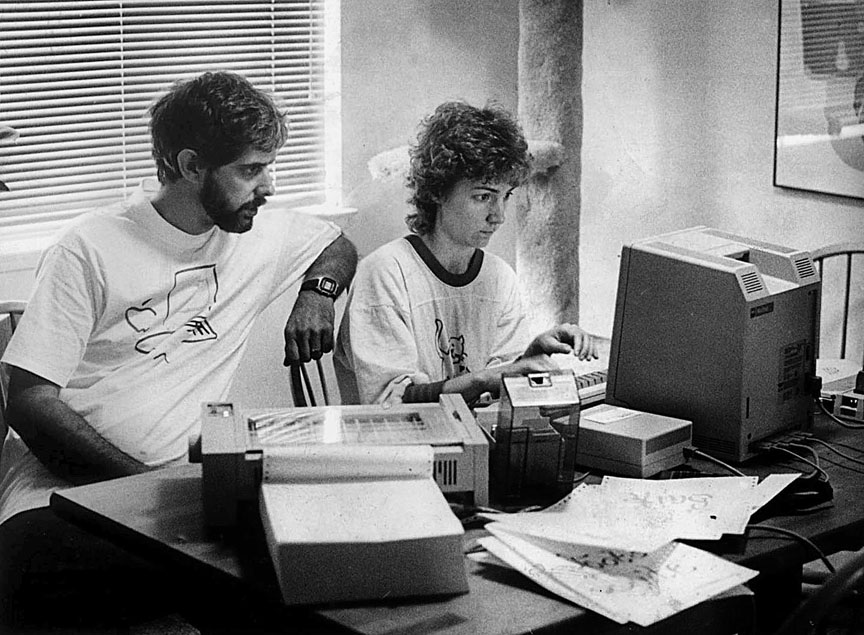
But the tall man who married me, the one who insisted we buy our first Macintosh computer (for $3,000!) in 1984, saying, “It’s gonna change your life, Toots”—he was my first computer guru.

Cliff and Jan and the new Macintosh, 1984, Davis, California

Cliff and Jan and the new Macintosh, 1984, Davis, California

I continue to be grateful to Cliff every time I open my laptop at home or sit down to my snazzy iMac on my desk at school. He did not listen to my protest, “But I’ve GOT a typewriter.” He was waaaaaay ahead of his time, technologically speaking, and he convinced his small newspaper to let him set up a digital darkroom before bigger papers did. It surprises me now to realize that he was 30-something when he was doing this. “You’re gonna put out newspapers on Macs someday,” he said, and I thought he was nuts. Guess how my students put out their newspaper in our snazzy new computer lab these days. Yep, on grown-up, bigger Macs that could, I swear, fly.
Cliff had deep, as my friend Georgann says. He got the Steves (Jobs’ and Wozniak’s) vision while I was wearing bifocals, as Butch Cassidy says in the movie. He also was imparting spiritual wisdom (though he wouldn’t have seen it that way) as he sat patiently by my side, enduring my wails when I’d lose something on the screen or have to be shown again how to print something on the old tractor-fed paper coming out of the box into the dot-matrix printer.
He got me, and he loved me anyway, and I continue to be grateful for that. (Thank you, Clifford. I can’t believe you’ve been gone 15 years.)
So I smile when I have to email Corinne to ask something simple because, as I tell my mass media students, who can’t believe this, that it seems just like yesterday when I first used email, well, now I’m the older one who is lost, technologically speaking.
I am grateful for my gurus, all of them, who have come along just at the right times to teach me what I need to know or remind me of what I used to know. And for the spiritual hand holding that comes with it all. Really, that’s the best part.

Posted in Uncategorized | 8 Comments

begin

(poem for a new year)

blessedly
empty calendar
pages stretch
before you

seemingly
endless time
categorized
in small boxes

and you
resolve again
to fill the boxes
thoughtfully

with more wanna
than hafta
more smiles
than grumbles

shorten the
to do list
unburden
the 365
days ahead
that you can
easily overfill

because you
are not
guaranteed
that number
any number
of days
of breaths

because the
date of your
eventual
passing is
not marked
on a particular
box

because all
we need
to do now
is smile
sincerely
say thank you
sincerely
feel the pulse
of this new
day that
beats within

and
breathe

Posted in Uncategorized | 14 Comments

Kalikimaka Man

e-2382 sharing the lightCR

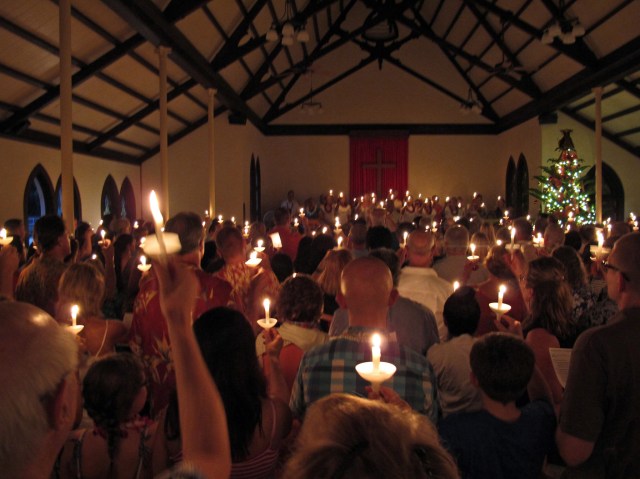
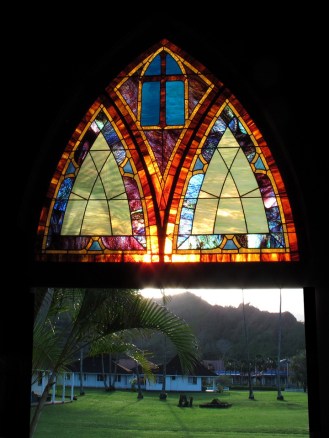
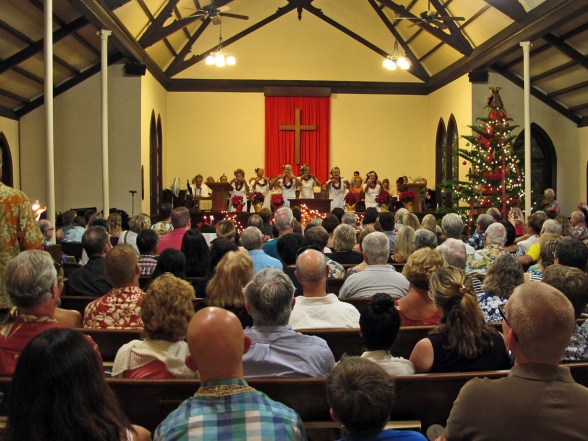
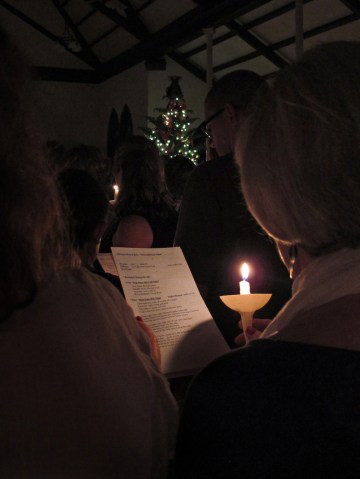
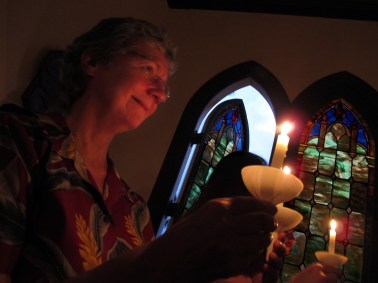
Christmas Eve 2015, Wai’oli Hui’ia Church, Hanalei, Kauai (Photos by Dick Schmidt)

It was Kalikimaka Eve on the north shore of Kauai, which looked like most winter days do—sunny, mid-70s, the air sparkling clean after two days of on-again, off-again showers. My partner Dick and I had been on the island for eight days, glad to escape our busy mainland lives, happy to spend Christmas in a place we love.

Since we arrived on the north shore, we’d planned to go to the little green church in Hanalei for a 5:30 p.m. Christmas Eve service. Nobody sings hymns in Hawaiian like the people in that church. We go every time we’re on Kauai, getting up (for us) early for the 10 a.m. service on Sunday because where else are you going to meet a kahu (reverend) named Alpha Goto who shows up in a lovely aloha shirt and is likely to deliver his sermon barefoot?

This church (the fifth incarnation of it on this spot) was one of the original Christian churches founded by missionaries who traveled nearly 6,000 miles from their homes on the east coast of the United States in the early 1800s. According to the church website, William and Mary Alexander arrived in 1834 and erected a pole and thatch meeting house next to where the current church stands. Depending on whom you talk to, the missionaries delivered a mixture of good (Jesus, for one thing, and a written Hawaiian language that led to one of the most literate populations in the world) and bad (discouraging the hula as well as insisting that unmarried people shouldn’t have sex ) to the Hawaiians.e-2337 church windowCrv

I’m mostly a cultural Christian myself, having grown up in a nominally Protestant family, one that rarely went to church because a., my parents said they couldn’t find a minister they wanted to haul out of bed and listen to on any given Sunday, and b., my father claimed he could pray just fine mowing the lawn. My sister and I showed up at church on Girl Scout Sundays when our troop went and, on occasion, when we traveled to Southern California to visit our Auntie Lo, who was a faithful attendee and often organist/pianist for her nondenominational community church.

I figure that our parents, who certainly exemplified most Christian principles but didn’t label them as such, did us a favor by not having religious restrictions and dogma to overcome later in life. Though I was baptized as a baby in Auntie Lo’s church, I grew up without church or a church family, which seemed fine to me.

But Dick was raised in the Evangelical United Brethren Church, which merged with the Methodists in the 1960s, and his parents  were religious churchgoers and believers. Dick’s mother played the organ and piano; his father sang in the choir. They both gave time and money and love to their church, which Dick still attends and contributes to, in no small way to honor his parents.

And it was Dick who 20 years ago brought me to Hawaii, which is his second home in many ways. The place resonates deeply with me, not the least the little Kauai hamlet of Hanalei. The first time Dick drove me over the one-lane bridge, past the taro fields that lead to the little town, something in me settled in my chest in a way I’ve seldom felt. When I try to describe it (as I’ve often done in the past two decades), all I can say is that it felt like coming home. It still does, every time. And, just before you leave the town to head to the end of the road on the north shore, you pass the little green Hau’oli Hui’ia Church. I’ve loved this little church ever since I first stepped inside. The Mission House behind the church, which was restored in the 1920s by descendants of missionaries, offers one of the nicest tours in all Hawaii, the story of the people who lived there lovingly and kindly told.

So this Christmas Eve Dick and I arrived at the little green church 40 minutes early, thinking the place would be packed to the rafters. We got in line behind about 20 other early folks. I saw an older man in a Mele Kalikimaka aloha shirt standing a bit behind the line, and I wasn’t sure if we should stand behind him.

I smiled and said, “Excuse me, are you in line?”

He glared at me, “Of course, I’m in line.”

Surprised by his tone, I tried to keep mine light. “Thank you,” I said, and he turned his back. Maybe he’s having a tough day, I decided. Maybe he’s not feeling well.

As he walked in the vestibule ahead of us, a man who was handing out programs and candles said to the Kalikimaka Man in front of us, “Where’s your wife?”

He shot back, “She’s dancing,” waving up at the altar with one hand and collecting his program and candle with the other.

He’s local, I figured, and probably annoyed with the tourists clogging up his church. Not without good reason. Because not long after we settled near the back of the church, the place started filling up, and by 5, they’d dragged out folding chairs and put them at the ends of the pews. At the end of ours, a family of at least eight people settled in, some of them in the pew in front of us, the teenagers in the folding chairs. A nice young lady with long, dark hair, a short skirt and legs up to her neck sat beside me. She reminded me of Dick’s niece, Rebecca, who had lived with me for a while when she was in college.

“Hi,” I said, grinning at her.

She met my eyes and “hi’d” me right back.

Before the service Kahu Goto announced that everyone should have a program because the words to all the hymns were in there—in English and Hawaiian. “We want to teach you some Hawaiian,” he said. And, he added, everyone should have a small candle and holder.

I looked up at the rafters of the old wooden church. It wouldn’t take much to set it aflame. The kahu, of course, knew this and said he’d light the first candle from one of the large ones on the altar, then pass the light to someone who would pass it to another and so on around the whole church. He cautioned us all to be careful in passing the flame from person to person, which struck me as good spiritual advice, too.

“We’ll have some gentle movements we want you to follow with the candles as we sing,” he said. “Do them gently and mirror us—don’t think you should move to the left because we are up here. Just follow what you see.”

The choir, which typically sits in the front pews and strums ukuleles on Sundays, was up on the altar, the ladies in white dresses and the men in white aloha shirts. The Wahine Hula group wore green and red leis with their white dresses. One of the ladies had bright white hair and wore a white, high-necked, missionary-style dress. She had kind eyes, and I hoped that she might be the wife of the Kalikimaka Man.

The kahu got the service rolling, and a woman standing next to the grand piano sang a nice version of “Mary, Do You Know?” From then on the pattern went: Bible reading, hymn in English and then in Hawaiian, then a reflection by someone in the congregation, then a time of silent prayer. e-2351 wahine hulaCRThe Wahine Hula ladies danced simply and beautifully during the offering to “Mele Kalikimaka Huihui.” The hymns were classics: “O Come All Ye Faithful,” “It Came Upon a Midnight Clear,” “Silent Night,” “Joy to the World,” “Away in a Manger.”

With all those people in the house, the voices swelled up to those old rafters and cascaded down us like the warm, friendly rain that had begun falling outside. Next to me, I heard the sweet voice of the long-legged girl and the young man next to her, whose warm bass resonated in my chest. I smiled as I listened to them.

e-2408 silent night candleCRNear the end we got to “Silent Night,” the first three verses in English, the last one in Hawaiian. I had pulled out a tissue before the service started because, I swear, all my dead loved ones show up for that song—my Irish Catholic grandpa and his Christian Scientist wife, my grandma; the Lutheran grandparents (who worried that I’d convert when I married a lapsed Catholic); Auntie Lo, who played piano and organ by ear, even after she collapsed near the end of her life and returned much diminished but could still play music she’d known for a half century; the Jewish uncle who was really my father’s best friend from their Army days, who took my sister and me to our first “real” deli for pastrami and dill pickles; Julie, my fairy godmother when I was a young journalist still in need of mothering, whose voice is still loud in my head; my father, who died in 2004 and whose voice I don’t often hear but I sense that he’s around; and, of course, Clifford, the lapsed Catholic who loved me with a quiet devotion to the very end. I could hardly sing for the tears because at times like this I feel surrounded by the spirits of so many I knew and so many I didn’t—all our angels and Dick’s companion spirits have joined us by then, too.

I just stood there in that darkened church with probably 300 people, each holding a candle, and let the tears flow—there’s no stopping them then, especially during the Hawaiian verse:

Po— la ‘i e, Po— kama-ha’ o,
Ma-lu-hia, Ma-lama-lama,
K ma-kua — hi’ne a-lo-ha e,
Me ke kei-ki, He-mo-lele e.
Moe me ka mu—luhia la-ni,
Moe me ka mu—luhia la-ni

We huddled in the darkened old church, stranger next to strange — “friends waiting to happen,” as my friend Antsy McClain sings in one of his songs — and all seemed right with the world. Throughout the service I had offered prayers for people I know who are suffering, who are in physical and emotional pain right now, thinking of each of them, wishing them peace and ease. I prayed my most frequent and fervent prayer for peace, white healing light and safety for all beings everywhere. And it felt in that moment as if everyone in that small church sent similar wishes to the heavens, too.

When the service was over, as people were depositing their candles and programs in the vestibule and went out into the now darkened night where soft rain blessed every head, Dick moved toward the altar to take photos. I made my way across the church to the Kalikimaka Man. I smiled as I moved toward him, and he looked at me, clearly not sure why this strange woman was approaching him.

“I thought I heard you say as you came in that your wife was dancing tonight,” I told him.

His face softened. “Yes, she was.”

“It was beautiful,” I said. “The ladies did a wonderful job.”

His smile spread across his face like sunlight. “Thank you,” he said.

e-2369 jlh candleCR

I smiled back and nodded as he moved toward the door. I turned toward the altar where the dancers were gathered, perhaps gearing up for the next service.

I hope his wife is the sweet-faced, white-haired lady in the high-collared dress, I thought. Or whoever she is, that he is proud of her and she of him. I hope that they are kind to one other. I hope they have a very Mele Kalikimaka.


Posted in Uncategorized | 9 Comments

I don’t miss all the muss and fuss about the bird, but I do miss you

(for the Pollands)

You rose at 6 a.m. to see if the damn thing was finally defrosted, the decapitated hen with her big breast leaking fluids into the sink like an old radiator,

too heavy for me to lift, you could one-hand it and pull out giblets from its rear, run it under cool water to rinse off whatever needed rinsing,

plop it on the chicken-wire tile counter of our old kitchen and set to work, trussing its legs, applying olive oil and butter and spices,

while I, still sleepy, tore up stale bread in the big black-and-white speckled roasting pan where the turkey would rest, throwing in sage and onions,

giblets simmering on the stove, you adding olives and walnuts and Jimmy Dean sausage for texture because, your people believed,

stuffing should be more than just sage-y bread, and you were right—your stuffing was the best—but it took us a good two hours to get that bird in the oven,

so by 8 we were exhausted, especially in the days when you were so sick or recovering from having your chest sawed open and your ribs cracked,

not unlike the poor bird, but you insisted, as you laid down on the sofa for just a quickie nap, there was nothing poor about turkeys,

the dumbest creatures put on earth, and you would know—your family raised them on the ranch in Rescue, all six kids pitching in to feed turkeys

and water turkeys and scoop turkey poop and chase skunks out of the turkey houses because they could cause a stampede,

and you’d end up with a bunch of dead birds—because, again, you liked to emphasize, turkeys were the dumbest fowl ever, no brain in those tiny heads,

short lives for a reason, eat that good breast meat, chew on a fat drumstick and OK, be thankful for that dumb bird who now tasted good,

and I knew that you didn’t miss the turkeys one bit, but I knew you remembered those tough years

of early mornings and late nights on the ranch, endless work to be done, all six of you kids crammed into two bedrooms,

when there was Grandma next door in the little house, and Mom and Pops, her making her hand-sewn curtains and clothes, him making his tomato wine,

who were all gone by the time I came into your life, so I would never know them, only I did, in a way,

from the stories you and your siblings told around our table on Thanksgivings, all of you having long ago flown the coop in Rescue,

all of you grownups with jobs, some with spouses and families, you with your repaired heart ticking away, growing larger and larger each year,

your own life destined to be shorter than any of us wanted; we gobbled your turkey and your stuffing, Annie’s cranberry sauce on Grandma’s dishes,

and, after the huge meal, I stood over our old sink, scraping plates next to one of your siblings, listening to the rest of you

in the dining room telling tales of the time when…—you survivors of that ranch, those people, that long-ago life. I hear your voices still,

every Thanksgiving, and I want you to know: I am grateful.


Posted in Uncategorized | 9 Comments

Lakebed

The year I graduated from high school the country wrapped itself in the flag for the nation’s bicentennial. Everything turned red, white and blue in 1976. I turned 18 in July and began college after Labor Day. I voted for a Georgia peanut farmer in my first presidential election in November.

My family lived on the west side of Folsom Lake in a modest home my parents purchased a decade earlier. The summer after we moved in, my father hitched our small boat behind his blue Chevy and drove it up the curvy slope to the state park entrance. Then he and my mother plopped my sister and me in the big blue lake and taught us to waterski.

By 1976, we were serious water people. Summers found my sister and me lifeguarding and teaching swimming at the pool in town. Evenings after work, Dad would drive the boat, and we’d ski into late sunsets.

But that summer we couldn’t waterski. The lake level had dropped and kept dropping. We’d watched several dry years wither the lake to a trickle. Folsom Dam, built in the mid-1950s to keep Sacramento from flooding, stood like a towering wall with too many gaping mouths, the spillways through which water had once passed.

I wrote a story for a journalism class that fall and learned that the lake hadn’t been so low since the dam was built.

This year that lakebed is nearly as empty as it was in 1976, and I think of my father, a Korean War veteran who put up the flag for every holiday, who died in 2004. He began preaching the gospel of conservation in the mid-’70s.

“Shut off the tap while you’re brushing your teeth,” he’d advise. “Turn off lights when you leave the room.”

He stopped stringing Christmas lights outside. We started recycling newspapers, bottles and cans. We carpooled in ever-smaller cars.

“We have to,” he’d say. “We’re using up our resources. We don’t do water well in California—we either have too much or too little.”

If my father were here, on the brink of the U.N. climate talks, he’d be dismayed to see the Earth in such a precarious position. He didn’t consider himself an environmentalist, but he understood climate change long before we knew the term.

I can hear him now: “It’s the only planet we’ve got. We have to take care of it. It may already be too late, but we’ve got to try harder. We’ve got to do better.”

(published in the Sacramento News & Review’s Letters to the Future series)

http://www.letterstothefuture.org/letter/55/lakebed/

Posted in Uncategorized | Leave a comment

Shots fired

FROM THE NEW GLASS-WALLED STUDENT SERVICES BUILDING AT SACRAMENTO CITY COLLEGE, A JOURNALISM INSTRUCTOR EXPERIENCES CAMPUS GUNFIRE.

 Sacramento Magazine | November 2015

By Jan Haag

Four p.m., the second Thursday of a new school year, barely September on the campus I’ve considered mine for more than a quarter century. I sit in my new office in the new Student Services building at Sacramento City College. It still feels foreign to me, as though I’ve begun a new job, as if I don’t quite know my way around yet. I have moved across campus from the old “temporary” building where I spent two decades teaching journalism and advising the student newspaper and literary journal to this new glass, steel and brick structure.

I am an old fish in a new bowl, relearning how to swim.

Journalism shares the second floor of the STS building with the photography department. After several years of going steady, we’ve now moved in together, jokes the photo department chair, who was once our student on the campus newspaper. (Yes, I’ve been doing this a long time.) It is a unique pairing at Sac City, long known for turning out nationally known photographers and accomplished writers and editors.

I sit before my brand new iMac in our office suite. Out in the general area sits Vienna, the news editor of the print version of the Express, and beyond her in his new office, photography professor Randy works at his computer. I’ve been thinking for a half hour that I should head home but, as always, there is so much to do.

Suddenly, on my computer screen, a Facebook post pops up from a colleague.

“Sac PD is reporting shots fired at City College. If you’re there, take cover.”

My old news instincts kick in. “Randy!” I holler as I head out my office for his. “Sac PD says there’ve been shots fired on campus.”

As I reach his doorway, I see Randy at the screen, searching in the electronic way we all do now. How times have changed, I think. Once upon a time we’d have been on the phone. Now we’re looking at Twitter feeds and Facebook posts.

“It seems to be over by the softball field,” Randy says.

I go back to my computer and start searching, too. “At least two people shot,” I read.

I hear Randy walking toward the glass door that leads to our second floor landing. He’s moving fast, a long lens on his Canon, a photojournalist to the core, ready to go find the news and make pictures of it.

“You’re going out there?” I say, before I can stop myself. I was married to a news photographer; my longtime partner is one of Randy’s former Sacramento Bee photo colleagues. This is what they do—they run toward the fire, not away from it.

“Yep,” he says, whooshing through the big glass door.

Then I focus on Vienna, sitting in the office area, working on a computer, her cell phone to her ear. She’d been working on stories for our first print edition. She’s also a producer for Channel 13, and she appears to be on the phone with her newsroom.

Sitting near Vienna is Steve, the college district’s locksmith, who has been in our area rekeying one of our new doors. He’d been here the day before, too, explaining to me that institutions have to make choices between security and accessibility. “That’s the problem,” I’d said. “I don’t want to work in an institution.”

So now we sit, encased in our institutional glass building, and I am suddenly aware of how vulnerable we are. Before we are even told by officials that we should “shelter in place,” I know that we are birds in a clear cage, sitting ducks, should someone come along with a gun. I had thought of this before, spending 20 years in what was essentially a trailer across campus. Anyone could’ve easily walked up the ramp or the steps and barged in with a gun. Fortunately, it never happened, but I thought about it every time the news reported another school shooting.

Too many, too many.

Still, the former news service reporter inside me clicks in. I’m texting with Kris, our online Express editor who’s off campus, working with other student journalists, getting updates from them, talking about sources and what to post and where.

Vienna appears at my office door. “I want to go out there and see what’s going on,” she says.

She’s a grown-up, but she’s also my student, and I allow myself to say I am nervous about her proposal.

Steve stands up. “I’ll walk with her,” he says. “We’ll be OK.”

Vienna perks up and I blink. “Uh….” I begin, but they’re already heading for the door.

“Be careful!” I yell after them, thinking duh… as if they wouldn’t be. Thinking I can’t lose another student to a violent death. Thinking what if there’s someone out there on campus with a gun and an itch to use it?

Randy returns, maybe 15 minutes after he walked out. I whirl in my chair. “Did you get to the scene?” I ask.

“Oh, yeah,” he says, heading for his computer. I follow him.

Within a few minutes I see an image of someone on the ground under a blue tarp, someone dead, with cops talking off to the side of the photo. That person whose name I don’t yet know lies in a staff parking space next to the softball field, not 20 yards from Sutterville Road. Someone has died on our campus, and my heart falls, my gut twists. This has never happened here before.

Now it has.

I turn back to my computer, to monitor the tweets and posts and messages on my phone, and to respond and tweet and post myself, a long-ago reporter turned into a 21st century journalist, pressed into service because of a crisis.

============

I’ve lost three students this year: Maui, Emma and, we learn the next day, Roman Gonzalez. He wasn’t my student, like the other two, but he was our student. Though we later heard that this was possibly a gang-related shooting, I cannot help but mourn for this young man. He was killed and two others were wounded, and yes, one of those two was arrested on a parole violation and later released. It would be easy to say, well, they brought it on themselves. It would be easy to say, see? We weren’t in danger, most of us. They weren’t after us. The scenario we’ve all been fearing didn’t come true.

Yet.

Four weeks later to the day, I was again in my office when Randy told me about reports from Oregon that perhaps 10 people were killed and more wounded at Umpqua Community College in Roseburg. I shuddered, especially after I learned that the gunman had committed his carnage against a class of English composition students, killing eight of them and their teacher. The day before, we’d heard, an angry student hit one of our own English professors during class.

But the day the shots were fired at my school, as I sat in my office—as Vienna and Steve made their way near the scene and where she did a live report with her station—I thought of our journalism and literary journal student Maui, a fine writer and very capable copy editor. She had taken her own life in April, in tremendous physical pain, not wanting to deal with it any more. I thought of Emma, our lovely Express photo editor, 20 years old, jogging in Seattle in July, struck by a train as she crossed the tracks. And now this young man.

Roman Gonzalez shouldn’t have died. But he did, after a fistfight quickly escalated into a knife fight and then someone—a someone who walked to the street and disappeared—shot Roman, who was our student. Who, I like to think, was trying to better himself through education, as are all of our students.

Too, too much loss and sorrow.

And too, too much uncertainty. The not-knowing hours are the hardest during a crisis. Not having a lot of information about the situation, a lot of pseudo-information flying around in the ether of cyberspace. Not having official word from administrators—that would come much later, when they knew more. Eventually, after locking us in for a time, campus police returned to our building, looking stern, to tell people they could leave but to head for the perimeter of campus—don’t go through the center—to their cars, to light rail, to go home.

Randy and Vienna and Steve and I stayed till 7:30 p.m., a good hour after we were told we could leave. I later learned that the college president and public information officer were there until 1 a.m.

We all had so many unanswered questions. We didn’t begin to have all the 5 Ws and the H we teach our newswriting students to find. We had three whos, but no names of anyone. We had a what—shots fired, people shot, someone dead—and a where, our college, and a when, a bit before 4 p.m. Thursday, Sept. 3, 2015. But certainly no why or how, as there rarely is in a breaking story. Those details come later. Sometimes.

And so, after the students had gotten stories and quotes and photos on the website, on Twitter and Facebook, those of us on campus went home, though the students continued to monitor sources and post updates and text each other until midnight. Already we’d heard that counselors would be available on campus for the next two days for people to come and talk. There would be a gathering on the quad the next morning with the district chancellor and college president speaking.

============

When I walked out of the building into the dimming light on the day everything changed, I walked along Freeport Boulevard, under the great redwood trees, many of which were planted as saplings in 1926, when the campus was brand new. Twenty-six of them stand, some almost a century old, tall and magnificent in front of the college. My sandals crunched on the browned and downed pine needles, geometrically arranged by nature under those trees.

Now we are one of those schools, I thought. Now we are on a list of colleges where violence took place and someone died.

In the coming days our student journalists would be applauded for their quick and careful reporting. The president of the college would come to class and thank the staff for that, even buying them pizza. She would weep a bit as she talked to them after days of supporting her campus, being strong, comforting others, the epitome of compassion and grace.

We are united by tragedy, all of us.

And on the day Roman Gonzalez died on campus, walking to my car, I stopped, struck by that thought. For some reason I looked down. There, atop the rusty pine needles lay a single black feather, new and intact, on a sturdy, pointy quill. I bent and picked it up because I like feathers. Because at other times in my life, I have found lovely feathers literally strewn in my path. It never feels coincidental. It feels like a blessing.

I picked up that feather, perhaps dropped by one of the watchful crows that caw their way through Sacramento skies, and I went to my car, the last one in the parking lot, and I went home.

Posted in Uncategorized | 7 Comments