nine

love wins

he and him
she and her
they and them
ze and hir

hand in hand
lip to lip
arm wrapped
in arm
they rejoice
they celebrate
all over a union
the president says
grown a bit
more perfect

on the same day
in a small
southern town
nine black birds
fly over a
white-steepled
church where
inside
its occupants
mourn
as they forgive
the one who
trespassed
against them

amazing grace

love wins

Posted in Uncategorized | 8 Comments

Rangerette

I’m working on a series of short (you might say even micro) fiction pieces, 1,000 words or less, which is a challenge for me. This is one of the little pieces with fictional narrators, each in a different voice. This story arrived during a writing group after considering a postcard of the Rangerettes doing their famous super-high kicks. 

Now that you ask, I couldn’t kick that high when I started. Like everything else about being a Rangerette, it takes practice—lots of practice. When I first came to college, I never imagined I’d come all the way to Kilgore, Texas, from my little podunk town in Oklahoma, I’d watch the girls perform at the games. I admired their white cowboy hat and boots, their cute short skirts. I couldn’t fathom how a girl could kick like that and keep her hat on—even with a chinstrap.

But I started practicing in my dorm room, doing splits up against the wall—only when I was alone. I was a cheerleader at my high school (go, Broncos!), but the Rangerettes are another class of cat, as my daddy likes to say.

I couldn’t believe it when, at the third tryout in two weeks, they picked me to be one of three rookie Rangerettes. Within five days I had my own uniform—cute blue skirt, short cowgirl boots (“not cowboy,” I was told), tight red undies and yes, the famous hat. “That’s what makes a Rangerette a Rangerette,” says Carol Ann Greenway, our team leader.

She gives all us girls HE-double-toothpicks if our hats slide back on our heads. They have to stay on straight and flat (bobby pins!)—or as Carol Ann says, “Stee-ray-aht and flay-aht.” She has the funniest south Texas drawl, that girl.

But honestly, she runs us around like a drill sergeant—especially us RITs (Rangerettes in Training). “Stee-ray-aht-en that back, Shelley Marie,” she hollers at me, “or I’ll put a yardstick down your speye-in. I don’t want to see slouching when you’re on the fee-yuld at halftahm under those big ol’ lie-ahts with thousands of cheering fay-ans.”

And when we link arms, standing next to each other in line for our perfectly synchronized high kicks, there’s Carol Ann barking, “Higher, girls! I want the sky to see the soles of your boots!”rangerettes20

My roommate, Jolie Lee Cutter from Lubbock, a studious girl with a face—my father would say—like a board fence behind her round glasses, snorts when I tell her about Carol Ann and the high kicks.

“That girl just wants people to get a good look at your coochies,” she says. “It’s demeaning to women.”

Well, that set me up on my high horse, let me tell you. I straightened my spine without the aid of a yardstick and told Jolie Lee, “For your information, our coochies are not on display. We wear red swimsuit bottoms, and we make sure we are always,” I have to pause and take a deep breath, “spic and span down there. All people see is a leg—well, 12 of them—up in the air for a flash of a second and then another flash of leg.”

“Upper thigh, actually,” Jolie Lee puts in. “Leading to your coochie.”

I plow on. “Would you call what the Rockettes do at Car-nee-gie Hall demeaning?”

Jolie Lee pushes her glasses up higher on the bridge of her nose and looks goggly-eyed at me. “Yes, I would,” she says. “There’s more to you and the Rangerettes and the Rockettes, for that matter, than your nice legs and fancy dance moves, Shelley Marie. I don’t expect you to see that, but I do hope you’re not like so many of the girls who come here to college to earn their MRS degrees.”

She narrows her eyes as mine widen. “You have a perfectly good brain, and I think you should put some important information in it.” She taps the book she’s reading and holds it up. “Tudor/Stuart England,” it says on the cover the color of ripe cherries. “Something you can use someday when you can no longer kick your lovely legs with your white boots over your head.”

I want to throw words back at her like, “And Tudor/Stuart England—whatever that is—is important information? How’re you gonna use that someday, Jolie Lee?”

But as I sit on my bed, legs crossed in front of me, elbows on my knees, stretching, I feel my lower lip hanging open. No one has ever told me that I have a perfectly good brain. Not that I can remember anyway. I’m more used to comments about my pretty little head from my daddy, like, “Don’t worry your pretty little head over that, darlin’. Let us men deal with that.” “Us men” being him and my three brothers, who are always thought of as the smart ones in my family.

Jolie Lee shakes her head at me—the frizzy one containing her perfectly good brain—and goes back to Tudor/Stuart England, and I am left… I don’t know, but I bet there’s a good big word for it… with my own perfectly good brain wondering what I should do with it.

One thing I’m gonna do—I’m going to the library tomorrow and find out about Tudor/Stuart England. Is that a place or a person, do you suppose?

Posted in Uncategorized | 4 Comments

Love letter to a trailer

Dear P-26/T-3:

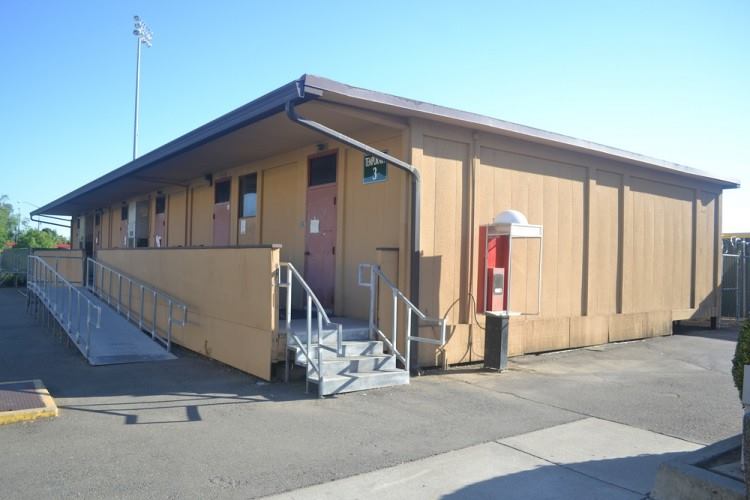
Back near the end of the last century, when the journalism department moved out here, you were called P-26—“P” for “portable”—though you’d been on this spot for a long time by then. That confused Ginny McReynolds and me, who at the time made up the entire journalism department faculty of City College. Did that mean there were 25 other portables on campus? We could maybe find eight or 10 others at that point, including the one next door, which was P-25 then. P-25 and 26 had been used as the campus child care center for I don’t know how long before the kids got their own brick building to the north of the portables.
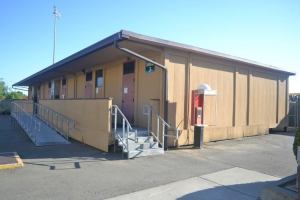
T-3 (formerly P-26), the journalism department at Sacramento City College for the past 20 years. (Photo/Gabrielle Smith)

T-3 (formerly P-26), the journalism department at Sacramento City College for the past 20 years. (Photo/Gabrielle Smith)

I will never forget walking inside you for the first time. Ginny and I looked around, amused at the inner doors with the knobs two feet from the tops so little hands couldn’t reach them. And, in the large room on the north end of the building, along the west wall, three small, close-to-the-floor potties sat like flower pots. We could imagine little butts on them and some erstwhile teacher saying, “Flush!” We joked that we should keep the potties and use the room as a darkroom—the receptacles for developer, fixer and washing prints were already installed.

Ginny, who was hired in 1986 to replace Jean Stephens—the retiring journalism prof who’d run the department for 29 years—had first occupied Jean’s former lair behind the bookstore, then located clear across campus from you.

By 1993, when I was hired full time, the journalism department and Express newspaper had moved to a portable behind the tennis courts where the roof regularly got thwacked with green balls. (The tennis courts have since been relocated.) We were out there for a few years in a single square room with an office for Ginny and a darkroom, but no office for me, when someone came up with the idea of parking us in you, on the edge of a literal parking lot between the new baseball stadium and the 1928 football stadium. It did not take long to hear the occasional whomp of a home run hitting your roof. We immediately felt at home.

You were a temporary location, we were told, till permanent space could be found for the journalism department. And somewhere along the line, your designation was changed to T-3 and your next-door neighbor to T-2.

Now, a good 20 years later, we are about to leave you and move into that promised permanent space across campus, back, ironically, to the same spot where Jean Stephens ran the Pony Express. The name got shortened to the Express in her time, and we currently have two journalism/photo profs who toiled on the Express as students in that space—one of Jean’s (Randy Allen), one of Ginny’s (Rachel Leibrock)—so for them, this move will be like returning home.

Only home looks nothing like it used to. In fact, it’s a brand new space—the new Student Services building’s second floor, designed just for the photo folks and us. Instead of an odd-shaped little one-story building, we’re moving into a state-of-the-art, everything-sustainable-and-oh-so-environmentally-perfect, photo-studios-with-floor-to-ceiling-windows, sparkling-classrooms edifice. It’s gorgeous. I find it amusing that photo department chair Paul Estabrook (who led the charge to bring our programs together) was once a student photo editor on the Express with Ginny and me.

Yes, I have been teaching that long. Ginny went on to become a dean at Cosumnes River College and recently retired from that position. Dianne Heimer came to be the second full-time journalism/English professor and is our current department chair.

The new building reminds me that you, dear trailer, have not been perfect. But, I’m happy to say, who among us is?

For years, when it rained, water would soak Dianne’s office floor. The custodians would bring in huge, noisy fans to dry it out, forcing Dianne to temporarily relocate elsewhere because she couldn’t hear in there. It wasn’t the roof that leaked—turned out to be the siding—but it finally got fixed two winters ago, and storms (more rare now) just aren’t the same… thank goodness.

You have only one toilet—a regular one, not the sturdy industrial types found in bathrooms all over campus. It can be, shall we say, a bit delicate. A plunger stands at attention in the bathroom, and I tell all my students at the beginning of a new semester to alert me if there’s a problem—it can take quite a while for custodial help to arrive, especially at nights and on weekends (and we do work then).

“Be nice to our potty,” I say. “I’m good with a plunger, but don’t make me have to prove it.”

Despite all that, we have loved our autonomy on the edge of campus. It’s been a perfect place for student journalists to practice their craft. People asked us recently as the photo and journalism profs all attended the ceremony for the dedication of the new Student Services building, “Won’t you be happy to get out of that trailer?” And Dianne and I smiled and said how lovely the new space is, how teaming up with photo will ensure the viability of our small journalism department, how great it will be for our student writers and photogs to work together and take classes in these related disciplines.

And all that is true.

But I have made no secret of this, dear trailer: You have provided a haven, a safe space not only for us teachers but also hundreds—easily thousands— of students, journalism and English, graphic design, photography and creative writing. We will miss you. Deeply.

You have watched the construction of literally hundreds of issues of the Express newspaper and other publications back in the days when we printed stories and headlines on strips of copy and waxed and trimmed them and slapped them onto large paper pages. When black and white film was processed in the darkroom built just for us (the tiny toilets were removed, after all). When photos were printed under the bright lights of enlargers and images brought to the surface of slick photo paper in baths of developer, fixer and clear water. When those photos were transformed into images called halftones made up of thousands of tiny dots that were also waxed and trimmed and pasted up along with the words on the slanted boards that still live in the south end of this building.

I am stunned to realize that we did all that, Ginny and Dianne and me, along with terrific part-time instructors and student assistants. What amazes me more is that wetaught people how to do all that, which is now done on computers and sent electronically, magically, to the same printer in Galt, which still delivers old-fashioned newspapers to us in bundles that Expressers deliver around campus via an old shopping cart.

It still astonishes me, this mix of the old and the new, that permeates everything we do.

As a young adviser, I brought a new campus literary journal to be produced out here, and you have served as the home of most of the 21 editions of Susurrus, now advised by other, younger colleagues. And more recently you’ve overseen the gestation of at least a dozen issues of Mainline magazine—what we consider the journalism department finishing school.

You, old friend, have seen a lot of birth and some death, I’m afraid. I once crawled under you to retrieve a dead cat, which led to the formation with my now-retired colleague Holly Kivlin across campus of the Sacramento City Kitty Committee (one year we took 38 non-feral cats off this campus and found them all homes). I was sitting in my office on a March morning in 2001 when I got a phone call informing me that my husband had died. And in the last month one of our students on both the Express and Susurrus staffs took her life.

We have experienced a lot, old thing, celebrated and mourned as a family. And we humans who’ve toiled here have aged along with you. I was 22 years younger and 20 pounds lighter when I came to work on this campus. You have been here for me—a consistent rock in my life—and offered shelter to so many people who have found their voices on the page and gained professional skills to last them a lifetime.

The cats will stay—ferals don’t move unless their shelter is taken away—and I will trot out here to feed them until I can persuade some truly temporary occupant to help with the feeding and watering.

One of the cats, a small gray female named Haroshea, often waits for me on weekends. She appears on your front porch from her hiding place under your belly and sits silent, watching. I think of her as your eyes and ears, sitting a quiet vigil. I will pay regular visits until I’m sure that you and the cats are in the good hands of others—or until you are taken away permanently, like your former next-door neighbor, T-2. When the bulldozer came to tear it down, I couldn’t be here. That wasn’t even “my” building. I hope I’m long retired and these cats long gone if that ever happens.

This is a love letter of gratitude to you. Others may see you as an old metal box the color of aging mustard, but we know how well you’ve sheltered us all these years. It seems silly—even to me—to grieve for an old trailer, but I have learned that home shows up for us in odd forms, that when we infuse a place with lovingkindess, the place gives it back to us—just as people do.

So as the semester ends, it’s time to get moving. I will clean out lots of paper, including old issues of the Express, and things I should’ve let go of years ago. (I have found a good home for the trusty red IBM Selectric.) Dianne and I will pack up and move across campus to our lovely new digs with a smile (“There’s no crying in baseball,” as Tom Hanks so memorably said in “A League of Their Own”).

Thank you, dear trailer, for everything, for being, as they say in Hawaii, puu honua, a place of refuge to me and mine. And the cats.

With love,

Jan

Posted in Uncategorized | 10 Comments

After a long absence… rain

(a love poem to precipitation)

For two days the sky has slowly clouded,
scrunched its face like a toddler winding up
for a tantrum, finally spitting petulant drops
at us, and the miracle of puddles and wipers
beating a steady cadence on the windshield
and the gratitude we had promised
to the heavens if only…
has given way to irritation.

We are a parched people who have
forgotten what it is to be wet.

We slip, we swear, we shake ourselves
and our umbrellas like dogs when we come
inside. We are surprised by the viscosity
of soil that yesterday gasped with dust
under foot, now turned scary slick.
We have forgotten how to drive
under anything but bright blue skies,
and already, we long for sun.

Oh, disciples of drought,
denizens of the dry:
Step outside without coats or umbrellas.
Feel yourselves pelted, even pummeled
by the seemingly endless rain,
summon to your lips a wet prayer
shaped to your most urgent need,
and let it radiate through ever form
of thanks you can muster—

because this is a gift like so many others,
coming at just the right time,
seeping into your skin,
moistening your hard shell,
washing away the stains and sorrows
all the way down to your bones.

Posted in Uncategorized | 6 Comments

Beginning

Because that’s what a new year does—
offer the clean slate, present the fresh calendar,
the new four-digit number that causes you
to shake your head and say, how can it be…?
The sense of time not so much passing
as racing, even more than the annual
notation of your birth—

and you, here on the brink, feel compelled
to make good, start over, resolve
(whether you say it or not):

This year will be different.

Of course, it will—with no help from you.
The months and days wear the same
names and numerals; the seasons
dress themselves in familiar clothes,
repeat in their reliable order.

Yet no two are the same.

Look closely. If you must resolve,
promise to find one new piece
of awareness every day—
within or without, one just out
of your line of sight, on the periphery,
that sound or color or thing
that makes you turn your head,
widen your eyes, attune your ears.

Yes, that. Only that.

Begin.

Posted in Uncategorized | 5 Comments

I meet my grandmothers in antiques shops

I meet my maternal grandmother in antiques shops. Nearly every one that sucks me in—though I try to avoid them—holds pieces of her china (Desert Rose) or her silverware (Washingtonia) or cut glass bowls with sugar cubes and delicate silvery tongs, or crystal teardrops that once hung from glittering chandeliers. Or tall secretaries with their open writing desks wearing faded green felt, perfect for penning a quick missive. Or a large divan, a Louis XIV replica, with plump, ivory damask cushions that Grandma covered with a pale green sheet so Grandpa’s pipe ashes wouldn’t soil the material.

And I look around, half expecting to see a small-boned woman with piercing brown eyes and the whitest hair, perfectly coiffed, a large topaz ring on a hand gnarled by arthritis, her white pocketbook that matches her low pumps, permanently attached to the crook of an elbow. The one who gave me EGBOK: Everything’s gonna be OK. The one who lived by the credo, “Old age is not for sissies.”

But no.

I walk around a corner and I meet my paternal grandmother in milk glass chickens with painted red beaks and black beady eyes. Their top halves come off to reveal empty bowls that my sister and I used to fill with marbles. That was the grandma whose mother was born in Sweden, the grandma of tiny meatballs painstakingly rolled by hand and counted, browned in an iron skillet, then baked in a casserole dish, for some reason. The grandma of brownies and apple pie and almond windmill cookies (the latter bought at the store). The grandma, who with Grandpa, loved to watch Lawrence Welk every Saturday night, sitting behind TV trays in the den, getting up during commercial breaks to make brown cows for my sister and me—a funny name, we thought for root beer floats.

I meet them both in needlepoint wall hangings and pillows. In glass slippers and ceramic ladies head vases. In doilies and tea towels. In plates with tiny flowers seemingly watercolored on tender china.

I am not the only one who meets her ancestors here. I hear other browsers say, “My grandmother had one of those,” or “Those were my mother’s dishes.” Women trace their histories through the belongings of the women before them. Perhaps men do, too, but they are more unusual specimens in antiques shops. We are mostly female, moving slowly, casting our gazes over tables loaded with treasures, pricking at our memories, shelves filled with someone else’s stemware, someone else’s dolls, someone else’s somethings that have ended up here, now called antiques.

One of my grandmas, the one who had her own antiques shop for a time and who worked in others, said items had to be a hundred years old, at least, to be considered antique. Other stuff was just old stuff.

I meet my grandmothers—born 115 and 120 years ago, respectively—as antiques and, now past my own half-century mark, I recognize them as treasures I failed to see with much younger eyes.

Posted in Uncategorized | 8 Comments

Yosemite

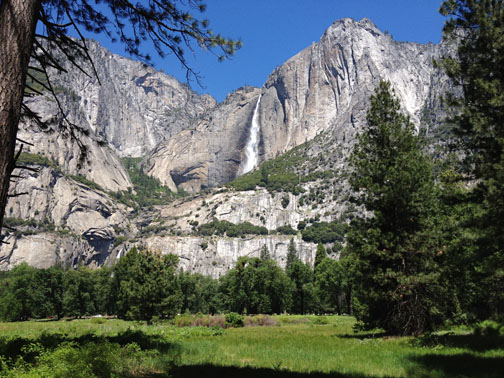
Yosemite Falls

Yosemite Falls

If I’m in Yosemite, it means it’s the end of May, and school’s out for summer (sing it with me!).

This year it also means I’ve completed my 21st year as a full-time writing professor… and before Sacramento City College hired me to teach journalism and English, I’d never spent more than four years in the same gig. That’s what journalists do—move from job to job, city to city, war-torn country to war-torn country. Only I didn’t cover wars or big time stories. I was pretty much a small-potatoes reporter on a few newspapers, one now-defunct wire service and a magazine. I love journalism; my heart rate picks up when I’m around presses churning out copies of fresh newsprint. But it is, as an old newspaperman told me when I was in my 20s, a young person’s job. At some point you don’t want to cover another city council meeting or legislative hearing or try to find a new kind of feature story at the State Fair. You’re done.

I was fortunate to find my way into teaching when I was in high school—at Roseville High School pool, to be specific, up to my chest in chlorine’d water, coaxing scared little kids off the side and encouraging them to float on their backs (a very scary prospect) or (even scarier) blow bubbles, face down, and kick and stroke like mad in something that resembled swimming. I also got to coach synchronized swimmers, having been one myself. A decade later, a former college professor of mine handed me a journalism class to teach—filling in for a professor who had to leave five weeks into the semester because of a death in his family—and I found a second profession I loved.

That was 1985, and I’ve been hooked on teaching writing to college students ever since. I knew that my primary job was—as with the little kids learning to swim—convince people that all they had to do was let go and trust that they could do this. (And maybe know where to place a thesis statement or a lead and oh, I don’t know, some commas maybe.) Lucky me, I got the full-time job in 1993; I have colleagues who have been part-timers forever, flying from classroom to classroom trying to cobble together a living. They work harder than I do for far less money.

Still, as people are wont to do, I moan and groan my way through the school years, generally loving my job but finding some weeks downright demoralizing (don’t we all?). Sixty-hour weeks’ll do that to ya. But unlike a lot of people I know, I get these amazing breaks in the form of a couple of months off here, a month off there, and that makes all the difference.

For some years now my dear fella has taken me—practically moments after I walk with my fellow faculty members into the stadium for another graduation—to Yosemite, which this year celebrates its 150th anniversary. On June 30, 1864, while occupied with the Civil War, President Abraham Lincoln signed the Yosemite Grant Act, “establishing Yosemite Valley and Mariposa Grove as the first protected wild land for all time,” according to the National Park Service website. In 1890 land surrounding these two tracts was declared a national park, and in 1906, thanks to the efforts of John Muir and President Theodore Roosevelt, it all became Yosemite National Park.

You cannot be here on a late spring evening, in the middle of a great meadow, as we were tonight, looking up at the cathedral of rock walls surrounding you, and not be grateful to those people—or the ones who carry on the work of protecting this place today. We feel so lucky to spend time in Yosemite Valley, looking up at Yosemite Falls in one direction, to Half Dome in another, feeling the peace of it all. Even in a national park where thousands congregate, at the end of each day it gets very quiet here. You can roll out your yoga mat in Leidig Meadow, as I did this evening, not far from a young buck munching tufts of grass, and put your body into mountain pose and tree pose, do a little sun salutation as it sets behind the towering wall of granite. And be grateful, so grateful, for this lucky, lucky life of mine.

Posted in Uncategorized | 5 Comments

Bomb Day

(for RDS)

In my family December 7 was celebrated as my grandparents’
wedding anniversary, 1921, long before most Americans
had heard of Pearl Harbor, before bombs whistled
from the sky, unleashing unholy destruction upon
far too many across the planet, ending with unspeakable
acts that decimated cities full of people going about
their business, loving, living their lives.

As a child I saw photos of the aftermath—sunken ships
in Hawaii, London rubble, Germany destroyed,
skeletal survivors, the ghostly image on concrete
of one person incinerated in Hiroshima.
Who was foe? Who was friend? In the words
of my father, who killed and was nearly killed
in Korea in a conflict that was not his:
“You can’t imagine.”

But I did and I do, on this day heavy with memory.
I conjure an image of that young and slender
couple, Ed and Ann, marrying that winter in a tiny
church outside Chicago. I put snow on the ground,
her in a wool coat with fur collar, wishing her
dead mother was there, hoping her father would
arrive sober to give her away. And I see her groom,
tall and strong, neither of them having a glimmer
of what would bless them—two children,
four granddaughters, 
a half-century marriage—
and what would pursue 
them, scar them—
the Depression, the second 
world war,
the son sent to Korea and returned
forever wounded.

Now I, the third granddaughter, see you,
someone else’s hoped-for son, born under the shadow
of that world war, decades later, on this same day
near the end of the same century. We sit in a car
parked by a levee on a frosty winter night.
You tell me you love me, a different kind of bomb.
I feel the heat of that explosion, one that will upend
my world, change the course of our lives, bring
us together, tear us apart and put us back together.
You can’t imagine, I think now, what comes
of a love like that, of old wounds, of misdirections.
You can’t say thank you enough.

Posted in Uncategorized | 6 Comments

Matt Rivers & Delta Breeze

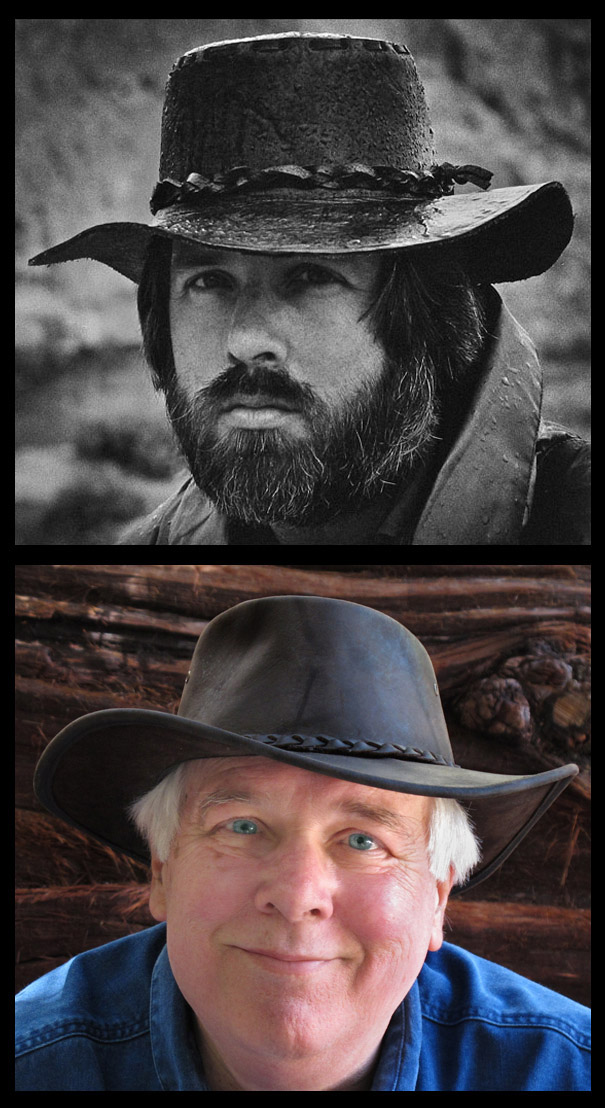
Once upon a time, many years ago, a dashing mountain man named Matt Rivers came riding into town, swung his lean, bearded form off his horse, and, walking past a young woman named Delta Breeze, tipped his hat and said, “Ma’am.”

Matt Rivers, then and now

Matt Rivers, then and now

It was love at first sight for both of them.

Matt Rivers

Matt Rivers on the trail.

They’ve since had many adventures together, Matt showing Delta the high country he admires just a tad less than he admires her (or so he says). He has walked her through high mountain meadows and watched deer eating sweet grass across rivers thick with grass just under the surface. He has shown her long ribbons of waterfalls and bubbling geysers and volcanoes oozing lava in national parks. He has settled her into Jeeps and driven her to long stretches of island beaches with shipwrecks just offshore.

She has returned the favor by taking him to exotic lands like Ocean Falls, British Columbia, and Winters, Calif.

Though he has other lady friends he admires a great deal and has squired them on various travel adventures, all these years later Matt Rivers still invites Delta Breeze to share his bedroll now and again. He has just turned 70, and his mountain-man, horse-riding years are behind him now. Still happy to get out on the trail, Matt and Delta recently took themselves to the North coast of California to celebrate his completion of seven decades on the planet.

There they had a fine old time, walking a bluff top trail in Sonoma County overlooking the great Pacific Ocean, looking for bits of shells in fine gray sand, talking story and generally enjoying each other’s company.  They made their way to one of their favorite spots where old redwoods lean their heads in to each other and a trickle of a creek turns into a small waterfall in the deep forest. They found sunsets to watch and got out the old Kodak to take snapshots for their photo albums. And at night they sat outside and watched the distant light of stars set against an inky palette as a bitty fingernail of a moon marched its way down to the horizon and disappeared.

If you’re very lucky, like Delta Breeze, when you’ve loved someone for a very long time who is also your best friend, you find yourself on the edge of the earth now and then saying thank you out loud to the ocean and the sky and the stars. You realize that every moment you have together is precious, and you remind yourself that you must appreciate those moments in the here and now.

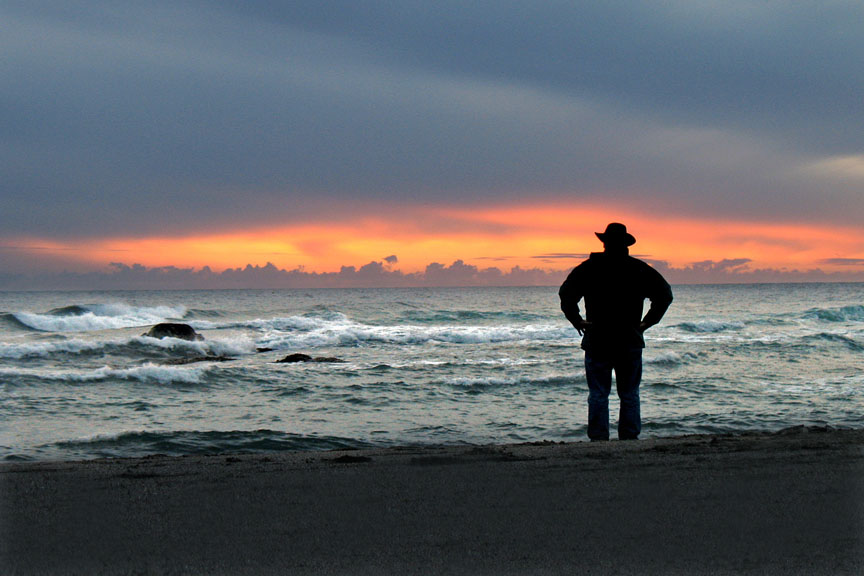
Matt Rivers takes in a Sonoma Coast sunset.

Matt Rivers takes in a Sonoma Coast sunset.

You know how fortunate you are to have had Matt Rivers ride into your life and tip his hat to you. And you do not hesitate to say, “I love you,” and “Thank you, good sir.” No, you don’t.

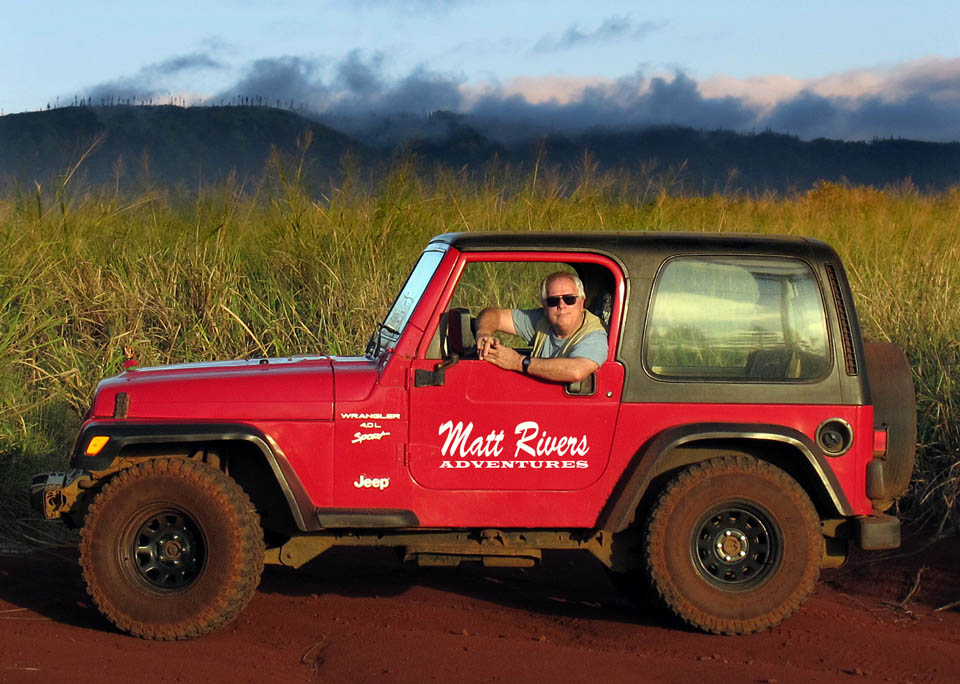
The man and his Jeep, ready for adventure

The man and his Jeep, ready for adventure

Posted in Uncategorized | 6 Comments

Two dolls, one scarf = a whole lotta love

She is amazing, my BFF. I’ve always said so. To be truthful, I’ve often also said that she is crazy, particularly around the time she decided to take in three special needs foster kids, whom she later adopted. All as a single parent. And then a very nice man fell in love with her and married her. They have raised those three kids together for almost two decades. He qualifies as amazing in my book, too. But that’s another story.

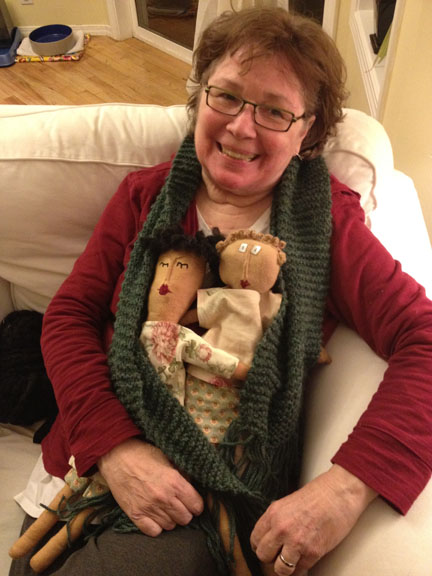
My BFF with the scarf and dolls she made for me.

My BFF with the scarf and dolls she made for me.

She’s amazing at the moment because she has been living with cancer for four years, and it makes her very sick. But she rises like a phoenix out of the flames, battling great pain, and she does incredible things. Before my visit this week, she cooked for two days–pot roast and soups and stroganoff. And then we spent the first two days together with her daughters, busily doing stuff. Then she had to rest. But so did the Lord after six days of creation. It’s understandable.

Then she rose, flapping those phoenix wings, yesterday at 5 a.m. to catch a 6:40 a.m. ferry to the Big City across the water for a day at the Seattle Cancer Center Alliance. I went with her (see my previous post, “I could learn to sleep on ferries”), and we had a lovely, though tiring, day that ended with the BFF getting an A+ on her CT scan. Which means that there are no new tumors and the ones that are there aren’t getting any bigger. Which in the world of living with cancer as a chronic disease is a super-duper, ace of a report card.

And (bonus!) from all floors of the SCCA, you can look out on Lake Union and see the houseboats, one dark one that is—according to the BFF, and I believe her—the same houseboat where Tom Hanks lived in “Sleepless in Seattle.” Which is one of my favorite movies. (Thank you, Nora. We miss you. We really do.)

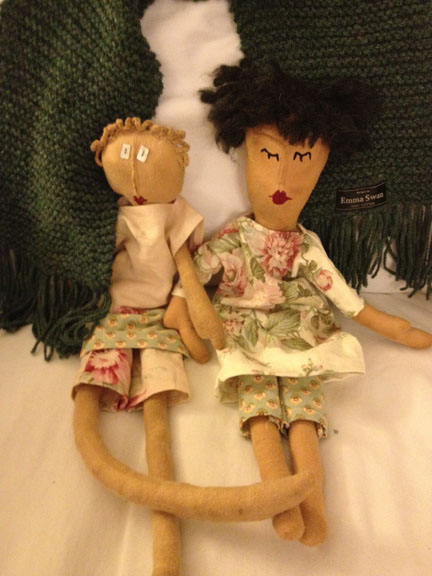
Dolls and scarf by Emma Swan (aka my BFF)

Dolls and scarf by Emma Swan (aka my BFF)

While in Seattle, we also did two things we really enjoy: ate good food and cruised a good bookstore. The food was breakfast at the Skillet Diner where (I am not making this up) I had scrambled eggs with bell pepper and onion and (hang on) fried chicken. And it was GOOD, as was the BFF’s pancake sandwich with an egg over medium in it. Also spicy potatoes with onion. We decided we could live at the Skillet Diner. Or maybe we’ll tag along after the truck that moves around the city like a couple of panting dogs.

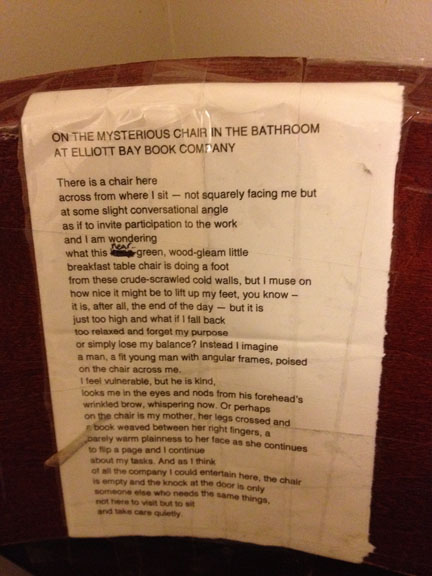
We also hung out in the new (to me, anyway) Elliott Bay Books, which, when I was last there, was (hello!) by Elliott Bay. It is now up on 10th Avenue, which makes it harder for tourists like me to find, on a not very snazzy block in what looks to be an old warehouse, but oh, it’s nice inside–very roomy and a poetry section that is three stacks wide. I love me a deep poetry section. It is also the only bookstore I’ve ever seen where someone has taped a typed poem to the back of a chair in the bathroom. You can sit or stand and read the poem, as I did.

Poem on a bathroom chair

Poem on a bathroom chair
at Elliott Bay Books

We shopped and bought and then sat in the E.B. cafe and drank tea. Just like old times when we used to cruise a bookstore after having dinner together in Sacramento. We went back to the cancer center for a doctor’s appointment and a shot that helps keep those tumors at bay, and then we caught the ferry home.

Also over the past several days she has knitted me a new scarf the color of the forest on the island where she lives. She is sending me home with two new dolls she made. One has frizzy black hair that sticks out from her head like Roseanne Roseannadanna. (Thank you, Gilda!) On my last night in her house, she made apple upside down cake, and though I try to avoid sugar, I had some because, well, the BFF made it. It was, not surprisingly, wonderful. I will eat anything that woman puts on a plate.

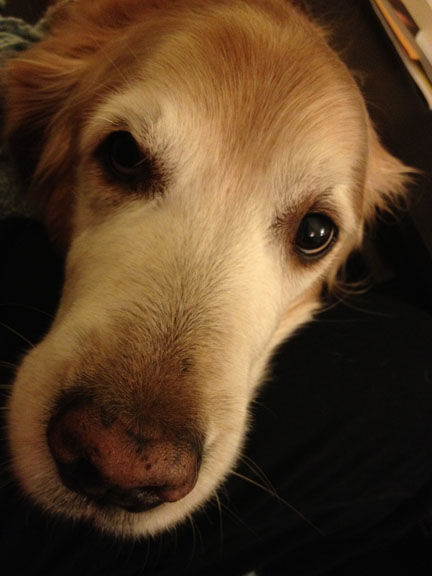
Sam

Sam

Though she has been very sick since July, the BFF has had more of her poetry and nonfiction published in the last year than most writers I know. She has held writing groups and encouraged people who never thought they had anything to say to write it down and read it aloud. More than one person has told her that she has saved a life by helping writers find their voices.

maggie & emma

Maggie and Emma
(photo by Maggie!)

While I have been on her island, she has lent me her big dog Sam for a lovely walk on the beach and two gorgeous daughters who call me Auntie Jan. She is sending me home today with good books and, always, her undying love. Which is really the best anyone could ask for.

Thank you, BFF, for a wonderful visit. You are my hero for so many reasons. Right now it’s the apple upside down cake. Or maybe the scarf. Or the talk story time. Or maybe all of it. Take your pick.

Posted in Uncategorized | 5 Comments