To the Chinese mother…

…who gave up a daughter found under
an overpass in Changsha, Hunan province,
May 22, 2009

She will never know the name you gave her
or the date you pushed her into the world,
though deep in her cells she holds a glimmer
of you and her father; in some dream time
she feels you still, perhaps your arms around her.

And you must have wanted someone to find her,
left, as she was, under an overpass where people
bicycled and walked and motorbiked. Someone
must have heard her cry and found her, picked up
her half-moon body, bent from birth,
her heels almost touching the back of her head.

Someone knew where to take her—
to a place of butterflies—
where some children morph into spirit
while others burst from their cocoons and thrive,
and your daughter thrived. She grew,
hands clenched and ankles crossed, and she grinned
her megawatt smile and people fell in love with her,
the little one someone named Long Xin Zi,

Joyful Purple Dragon,

taller now and called Annie by her new mama
who brought her to a far-away land where
the summers are hot but not humid,
winters are cold but not frozen, where she will
go to school and learn a new language and continue
to thrive, to be the best Annie she can be.

And she will achieve things you could not imagine for her,
though she will not know your name or the stories
of your people. Her new mama will make sure she keeps
her Mandarin as well as acquiring English, that she
remembers paper-thin rice noodles and yummy dumplings.

She will retain China in her bones.

And your daughter will close her eyes
and dream you every night, as you dream her—
she is with you always, thankful for every miracle
bestowed, not least her emergence
from the cocoon of you.

—Jan Haag

(#22 in the Annie series)

•IMG_0013aC copy

Posted in Bringing Annie Home | 14 Comments

You’re never fully dressed without a smile

•IMG_0216a

Rosie Suzanne Cardoza… aka Annie.

(21st in the Annie series)

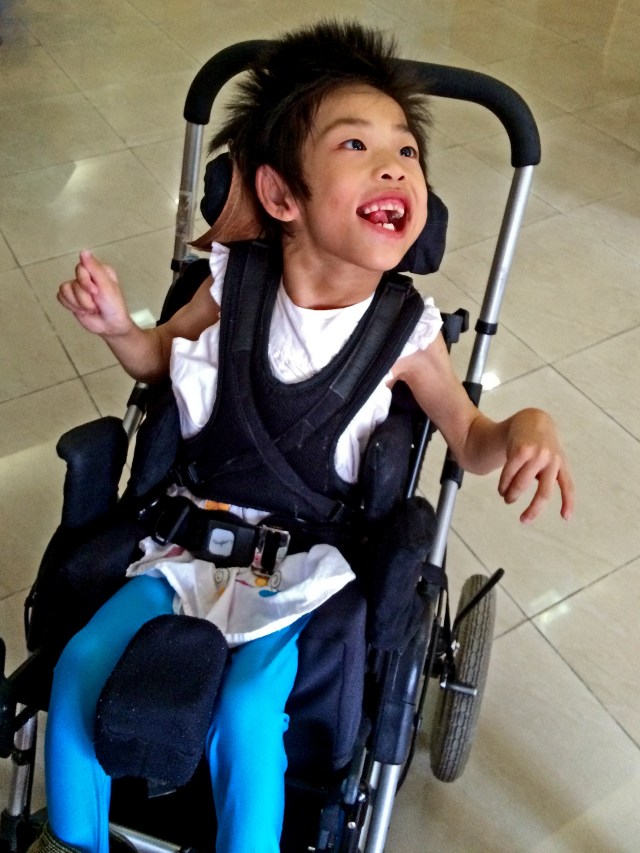
Sure, “Tomorrow” is one of her “Annie” songs, but it was not until I came home and looked at all the photos that I realized Annie’s real theme song might be this one. Just look at that megawatt smile, as the Butterfly House folks wrote in her scrapbook.

•IMG_9371aC

Annie on the day she came to Nikki, June 20, 2016, Changsha, Hunan, China.

And boy, do these lyrics to “You’re Never Fully Dressed Without a Smile” fit this Annie:

Hey, hobo man,
Hey, dapper dan,
You’ve both got your style,
But, brother, you’re never fully dressed
Without a smile!

•IMG_9794a

Annie enjoys cartoons on the iPad, Changsha, Hunan, China.

Your clothes may be beau brummelly
They stand out a mile,
But, brother, you’re never fully dressed
Without a smile!

•IMG_9741aC

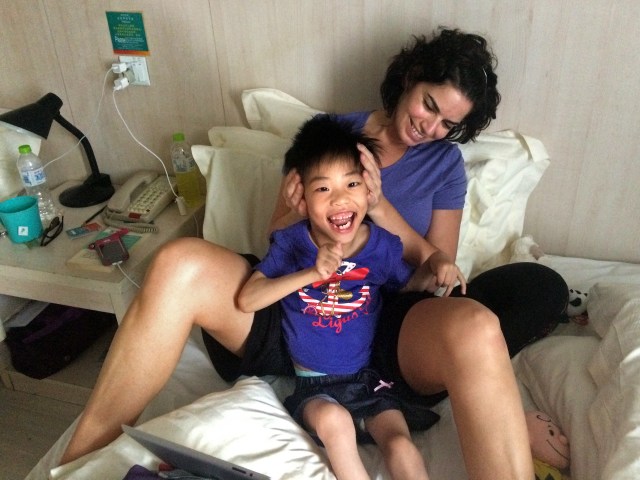
Annie and Nikki Cardoza, Changsha, Hunan, China.

Who cares what they’re wearing
On Main Street or Saville Row?
It’s what you wear from ear to ear,
And not from head to toe,
That matters.

•IMG_0154a copy

Annie playing one of her favorite iPad games.

So, senator,
So, janitor,
So long for a while.
Remember you’re
Never fully dressed,
Though you may wear your best,
You’re never fully dressed
Without a smile
Smile!
Smile!

•IMG_0142a copy

Annie and Nikki Cardoza, Changsha, Hunan, China.

Despite all she’s been through, despite the challenges that await her, Annie’s bright-eyed optimism shines through and, according to all who’ve known her, this is what has been evident since she was found and brought to Butterfly House six years ago. Her strong spirit is clearly what has sustained her, what has helped her survive and grow to be 7 years old and a new American citizen.

She is one of only 18 Butterfly House children who have been adopted by their “forever families,” as they call them. (Butterfly Hospices, at their two locations in China, have cared for 170 children over the past 10 years, 104 of whom “have passed away peacefully in their ayis’ or nurses’ arms,” according to Katie Hill, head nurse at Butterfly House in Changsha.) Annie has beaten tremendous odds, this little survivor… and her infectious attitude of gratitude and joy makes everyone who meets her smile, too.

Nikki Cardoza is my hero for so many reasons. Adopting Annie is just one of them. Nikki’s can-do spirit and determination are exactly what will serve Annie so very well. Nikki is one of the strongest, kindest, most loving people I know—and a very good writer who has an incredible memoir to set down on the page… when she gets more than a few minutes to breathe. It is hers and Annie’s story to tell one day. I feel so lucky that I’ve gotten to share a bit of their new life together and record it here.

It’s been my honor and my privilege to go along on this journey of a lifetime—for Nikki and for Annie and, it turns out, for me, too. I wouldn’t have missed it. Not for all the tea in China!

•IMG_0453a

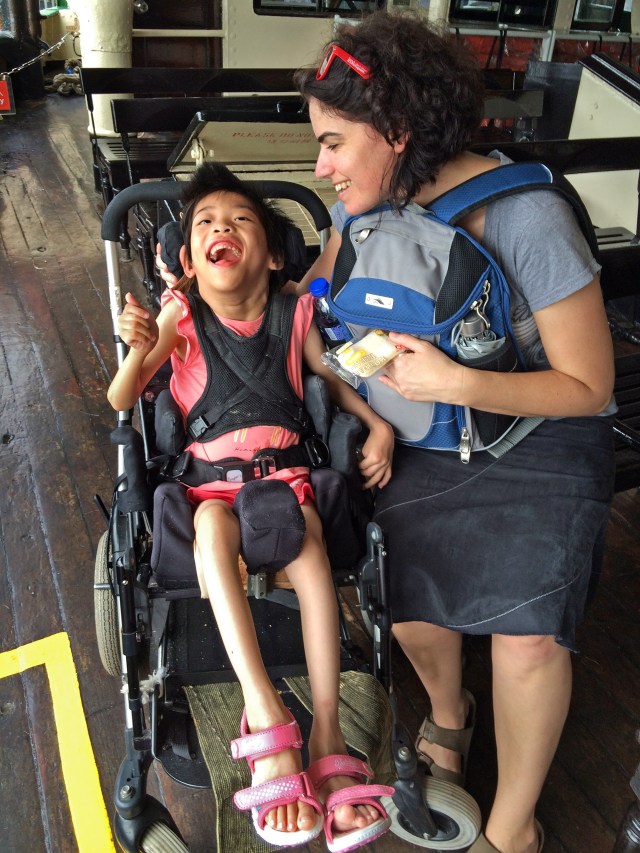
Annie and Nikki ride the Star Ferry, Hong Kong.

Posted in Bringing Annie Home | 9 Comments

Going home


•IMG_0782a

On the way to the airport.

(#20 in the Annie series)

I want to be one of those people on an airplane who plugs in earphones, clamps a U-shaped pillow around the back of their necks and dozes off instantly. Without even reclining the seat because to recline these days in coach means that the back of your seat is in someone else’s lap. Not cool.
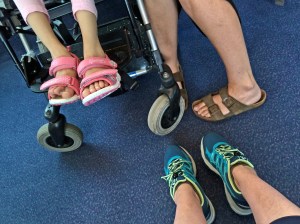
•IMG_0780aTo put it mildly, I am not one of those people. I don’t recline, but I don’t sleep either. Sometimes I doze on a plane, if I’m lucky. But lack of sleep is par for the course on this trip. Honestly, I can’t begin to add up the number of hours I didn’t sleep. I don’t want to know. And Nikki, I’m sure, has had far less sleep than I have, what with turning Annie over every few hours in bed or getting up to change Annie’s diaper.

This has been one of the biggest challenges for all three of us: not enough sleep. And I was prepared for an even bigger one: the plane trip home with Annie.

Here’s the lead, as they say in the newspaper world: It was easier than we thought it would be. And harder in ways we didn’t expect. But there was assistance given, by both seen and unseen helpers, all along the way.
•IMG_0795a

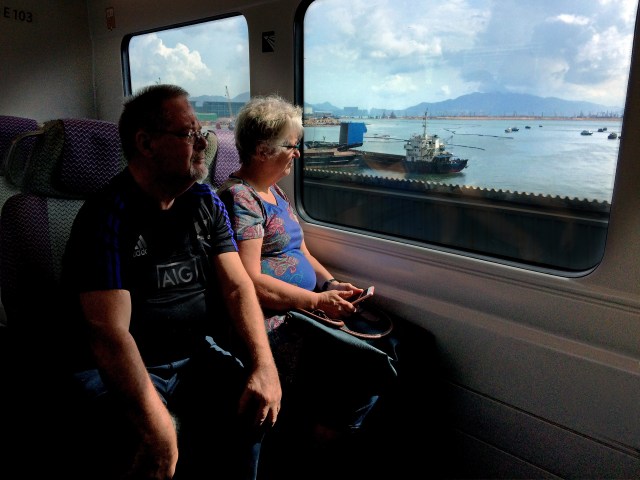
The Macphersons on the MTR on the way to the airport.

First, our best seen helpers. John and Anne came with us to help us haul all our stuff, which was a great kindness on their part because we are, after all, leaving with more stuff and one more person than we arrived with.

Second, we got whisked through security because Nikki had brought for Annie a big pouch of applesauce/juice that was larger than allowed on a plane—over 3 ounces. She told the ticket agent this, who frowned. “Unless you have juice boxes with straws on the plane, I’m going to need this for my daughter,” Nikki said firmly.

•IMG_0812aSome fussing ensued, which involved getting a supervisor and repeating the story again. The upshot was that the supervisor would walk us through the security area explaining this special need for someone with special needs. Front of the line, take off the shoes, put them in the plastic bins, throw our stuff on the conveyor, walk through the beepie thing. Nikki and Annie walked around, then Nikki got wanded, as they say, to make sure she wasn’t carrying anything more deadly than a pouch of applesauce. Annie got through scot-free. Nobody searched her.

Clearly, the wheelchair can be an advantage at times.

Next, because we were traveling with someone in a wheelchair, we got to board early in the “passengers requiring extra assistance or time” category. Nikki wheeled Annie down the jetway to line up behind an older woman in a wheelchair. She had to lift Annie from the chair so an attendant could take it and stash it in the luggage compartment after attaching a red tag that read “fragile.”

I had all our carry-on luggage, Nikki carried Annie, an attendant followed us with Annie’s carseat, and we made our way back to row 47, all three of us, to install the carseat next to the window.

•IMG_0758a

Annie’s car seat with nifty head holder… John helping to prepare Annie for her first plane ride.

I should add here that Annie can’t sit up unsupported. The night before at the Macphersons’, Nikki had pulled the carseat from its box (which we had left in Hong Kong with Anne and John) and put Annie in it for the first time. Nikki had bought a nifty device made by a woman with a child with a disability that hangs over the back of the seat. It has fabric that wraps around the occupant’s face, Velcros under the chin, and keeps the head up straight.
•IMG_0762a

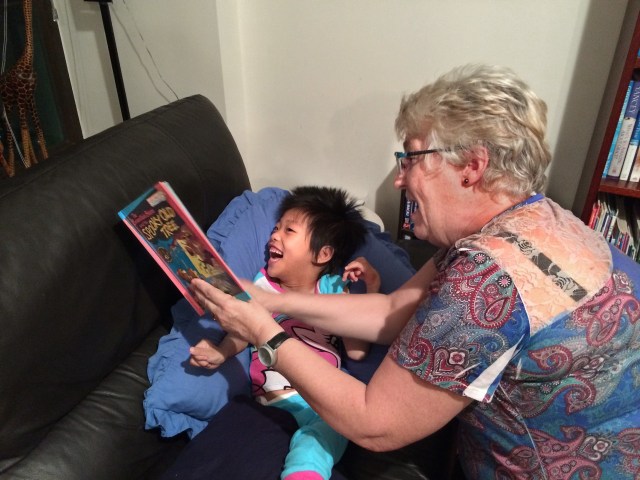
Auntie Anne reads a funny story to Annie the night before we leave Hong Kong.

“Where has that been hiding?” I said as Annie’s supported head faced forward in the seat—no flopping, not requiring holding by anyone else. I was thinking how helpful that nifty device would have been at meal times.

“It was here in the box with the car seat,” Nikki said, and we exchanged a rueful glance. “I didn’t think to bring it.”

Ah, well. Live and learn. The best part was that Annie looked perfectly comfortable in her car seat. I had envisioned having to stuff towels and clothing around her to prop her up in it, but no, she was strapped in just fine, though her long legs hung down quite a bit.

That was the challenge for getting Annie to fit in her carseat in row 47 on the 747 that took us from Hong Kong to San Francisco on a 12-hour flight. Annie’s long legs sticking straight out and the lack of leg room. We were not in an exit row or one of those with extra leg room, so she was really jammed in there, her head held up by the fabric device.

But to our surprise she loved it. She seemed comfortable with the plane and the takeoff (which Nikki hates but talked to Annie as it happened… brave Nikki!). Annie seemed happy to eat in place. And she got a kick out of her bright yellow headband with the smiley face on it that has imbedded earphones so she can listen to music.

•IMG_0816a

All that worked well for about five hours—through the first meal, Nikki feeding part of hers to Annie, who had already sucked down one of the verboten applesauce packets.

“This is great!” I enthused, and Nikki grinned at me. Could it be possible that we could get through a 12-hour flight unscathed?

Well, not exactly, no. Almost precisely at the five-hour mark, Annie began wailing. She’d been out of her car seat and laid on our two seats for a diaper change, but Nikki had put her back in the car seat. Annie was done. Major unhappiness, her pissed-off holler ricocheting around the cabin. Attendants came by asking urgently, “Can we do anything?”

No, we said, not unless you can get us to a place where she can lie down.

They couldn’t. The flight was full, every seat occupied. Nikki was talking to Annie, trying to calm her down. Annie wasn’t having it, probably thinking, Get me out of this chair! The people in front of us were half turned around, trying to see what was going on.

Nikki told me later that she said to Annie in Chinese, “Look, we are on an AIRplane with a LOT of people. You are disturbing them. I will try to make you more comfortable, but you need to TELL me what you want, not just scream. We have to be quiet around all these people.”

Much to her amazement (and mine, after she told me), Annie quieted down. She told her mother that she wanted to get out of her seat, please. I moved so Nikki could kneel on her seat and take Annie out of hers. Nikki put Annie on her lap and gestured for me to sit, Annie’s legs across my lap, where she see could both of us and watch the attendants walk by.

She was fine.

But clearly, she needed to lie down and rest, maybe even sleep, and the only way to do that was to put her across our two seats (we were not moving the car seat—it had no place to go). That meant I had to stand. Which I did. For about three-and-a-half hours altogether.

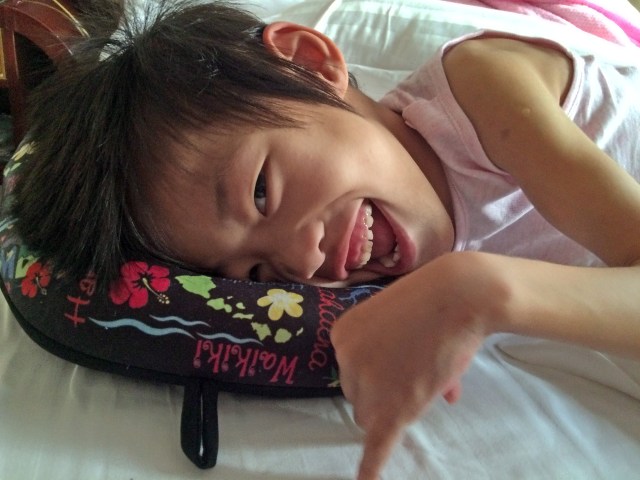
With a little time, Annie fell asleep on our seats, my Hawaii neck pillow meant for the plane under her head. (It’s hers now anyway, along with my purple plastic spork I travel with. Joyful Purple Dragon needs a purple spork, right?!) Nikki could sort of perch in the empty space created by Annie’s curved body, but it was in no way comfortable for Nikki. I took my iPad to the back of the plane. There was no place to sit. I tried sitting in one of the attendants’ jump seats, but one came along and told me that I was not allowed to do that. I asked if there was a place I could sit since a little girl was sleeping on my seat, and the attendant shook her head firmly. “We’re full,” she said, which I already knew.

So I stood at the back of the plane, trying not to be in the way of people waiting for the bathroom, trying to read one of my iPad books standing up. That worked for a time, but I was literally falling asleep on my feet when something caught my eye. I was standing behind the last row in the plane where two people were watching the same movie on each of their iPads. I didn’t know what it was, and I couldn’t hear the dialogue, but it had Meryl Streep in it with a horrible long hairdo, braided on one side as an aging rock’n’roller and some ’80s rock guitarist who looked vaguely familiar and Kevin Kline as this straight-looking lawyer-type. Oh, and Meryl Streep’s daughter, Mamie Gummer, whom I love just for her name.

When the people in front of me finished watching the movie, it popped back to a screen of United Airlines in-flight entertainment options. Oh! I thought. I have that app! (I don’t have many apps on the new iPad, but I have that one because Nikki had told me before the trip to download it.)

30-ricki-and-the-flash.w1200.h630

Meryl as Ricki (courtesy of TriStar Pictures).

So I “closed” my book (in the tablet sense) and poked the United app and got to the “in-flight entertainment options” and looked for a Meryl Streep movie, and there it was: “Ricki and the Flash.”

Hot spit.

I didn’t care if it was the worst movie in the world. It had Meryl Streep and her daughter in it, and there was rock music that might keep me awake. I hit the little icon that takes things from the two vertical lines (the “pause” button, as I think of it) to the sideways triangle (the “play” button to me), and I watched all one hour and 41 minutes of that movie.

Here’s my synopsis:

Meryl Streep is, as I intuited, is this aging rocker. Rick Springfield, an actual ’80s rocker, plays Streep’s guitar-playing boyfriend in the band, and Kevin Kline is her ex-husband who has raised their children after she, aspiring musician, ran off to pursue the rock’n’roll lifestyle. Which basically has gotten her to a regular gig with her band, Ricki and the Flash, at a dive bar in L.A. When her daughter (played by Streep’s real-life daughter, Mamie Gummer) falls apart after her husband leaves her, Ricki goes back to Indiana to the house of her ex-husband and his second wife (Audra Macdonald, who doesn’t sing, darn it) to try to help their daughter.

I have to say that I enjoyed it a lot more than I thought I would. Good music, a sort of happy ending. Meryl Strep is amazing—she apparently learned to play guitar for this movie, and she does it convincingly. But then, Meryl Streep (who has transformed herself for just about every role she’s every played—Karen Von Blixen in “Out of Africa” and Julia Child in “Julie and Julia”—could read the phone book, and I’d find that riveting.

Mostly the movie helped me forget how tired I was, except that I eventually retreated to the rear galley, which had been abandoned by the attendants for a while, where I put the iPad on the stainless steel counter and leaned much of my upper body on it to watch the movie. If I could’ve laid down on the floor of the plane, I would have.

As we traveled backward in time through the night, I read and watched things on the iPad. I sat on the cold floor behind the last row of seats for a while. And as we bumped through the sky from time to time, I thought about turbulence and how it didn’t seem to faze Annie.

She gets jostled all the time. She’s not moving herself through space. She’s not in control, never is in control; she has to trust that whoever is pushing her in her chair or carrying her is capable and won’t drop her or run her into anything. And she does. She is now trusting this new mama who came such a long way to collect her.

Somehow Annie already knows that her new mama is there for her, for all happy moments and the bumps along the way, kind of like Meryl Streep in the movie, who comes back for her daughter when she hits a rough spot. We all hit rough spots, and they often make us stumble and sometimes fall. So what? We let others help us to our feet, and we keep going. The great thing is that Annie is moving—she’s typically happy to be moving—even when powered by something, someone else. And she has more trust and faith in her slender 7-year-old body than many people.

With that I got up off the floor of the plane and saw on the digital screens in the cabin that we were nearing San Francisco. I went back to our seats, and Annie was awake. She grinned at me. Nikki smiled, too, blearily.

“We’re almost there,” I said.

Nikki nodded and said to Annie in English, “We’re almost home.”

============

6296 customs tv monitorCR

Those waiting for travelers first see them on the monitor in the customs waiting area.

We are the last ones off the plane, as you are when one of your seatmates uses a wheelchair. Much to our consternation, the “fragile” sign placed on the chair’s aluminum before it was taken to the baggage compartment apparently wasn’t heeded. When it is returned to us at the jetway, the wheelchair has been mashed a bit. It’s a couple of inches shorter on one side than the other. Annie lists heavily to the right when she’s put in it.

Nikki is understandably upset, and, after getting through customs (a relatively quick process, much to our exhausted relief), we wait around a United counter as Nikki files a damage claim. They offer to have someone unbend the chair, but we’d have to wheel across the airport to have this done.

“The frame is bent on the wheel,” Nikki points out. “I can’t get this chair across the airport.”

It feels as if this part is taking forever. Annie is hungry, we’re all tired, and all I want is to get out of there and find Dick, who I’m sure is waiting for us, and Nikki’s parents, who I hope are waiting for her and Annie. This last half hour is for me the most excruciating of the trip, harder than standing for more than three hours, harder than all the heat and lack of sleep and every challenge we’ve met along the way.

I am on my last nerve. I love these two, and I am so glad I took this journey with them, but I want Dick to pick me up and take me someplace and feed me, after which he will drive me home as I doze in the car. I want to go home to my own bed and sleep for a month.

At last Nikki is done filing her claim, and we make it over the final hurdle. I am pushing the luggage cart; Nikki is pushing Annie. And when we finally wind around to the waiting area where our loved ones wait for us, my sweet man is out there taking photos of us on the video screen. He can see us walking toward him, this journey almost completed.

6304 clearing customsCR

And when two large doors open automatically as Nikki pushes Annie through them, there he is, my dear Dickie, camera in hand, and I happily relinquish all photographic duties back to the (retired professional) photojournalist in my life and give him a big hug and a kiss. I can’t remember when I’ve been so happy to see him waiting for me.
6385 annie gets snackCRv

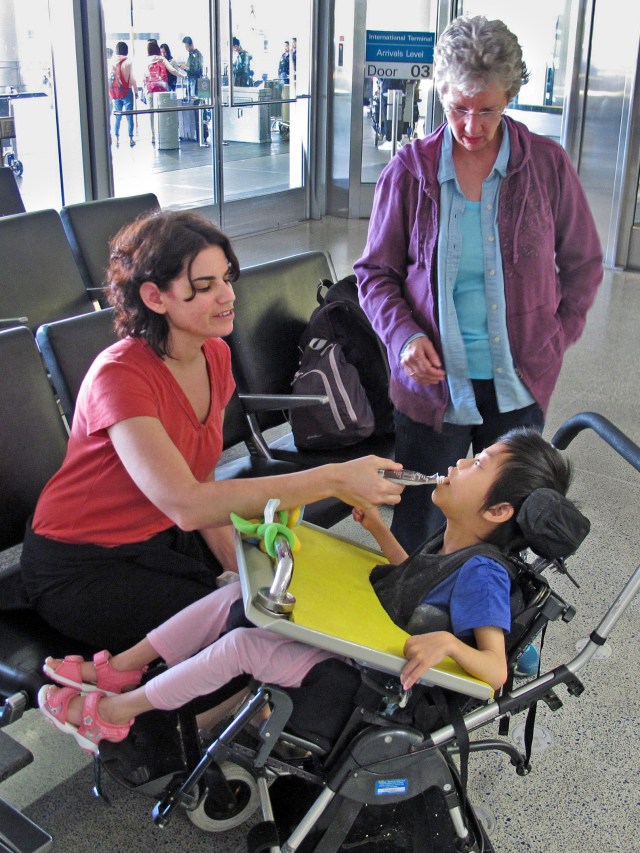
Annie has a snack… one of the illegal juice bags after her arrival in San Francisco.
6498 family minnie mouseCR

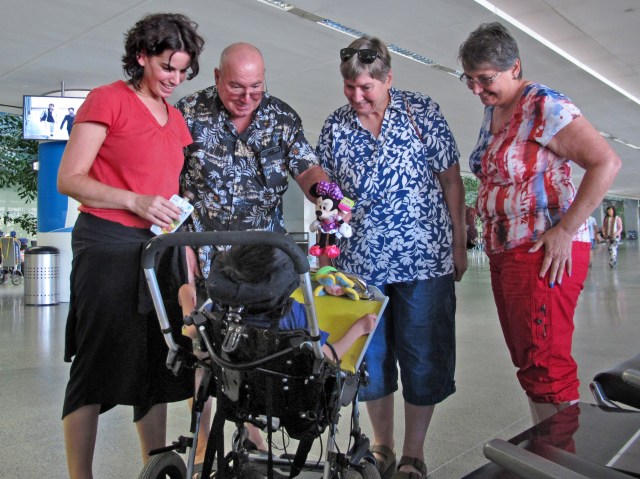
Annie meets her grandparents (left) and their friend Sharon (right) who have brought with them Minnie Mouse.

And there are hugs and greetings all around, especially for Annie. And after a bit, Nikki’s mom and dad and their friend Sharon appear, and this is the other moment I have been waiting to see: Annie meeting her grandparents, her new family, who stand before her in a little half circle, smiling delightedly down at her as she looks up at them. They have brought her a Minnie Mouse, which matches the one on the shoes we bought her in Guangzhou. Life bestows little blessings of coincidence more often than we realize.

This is where her American life begins, this child with her shiny new U.S. passport. Annie will be driven home by her grandparents to Sacramento with her good mother, their whole lives ahead of them sure to be the greatest, grandest adventure, full of love and joy, difficulties and miracles. Lots of miracles.

Enjoy the ride, my girls. I’ll be following you, eager to see how the road unfurls before you.

6326 arrival poseCR

Posted in Bringing Annie Home | 7 Comments

High tea

•IMG_0473a-ICC-Ritz

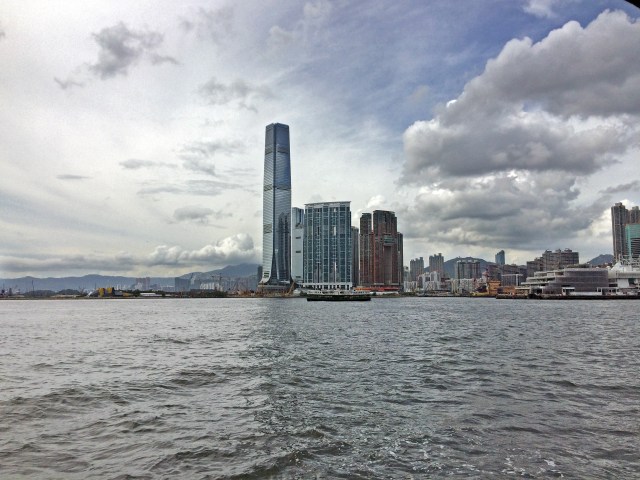
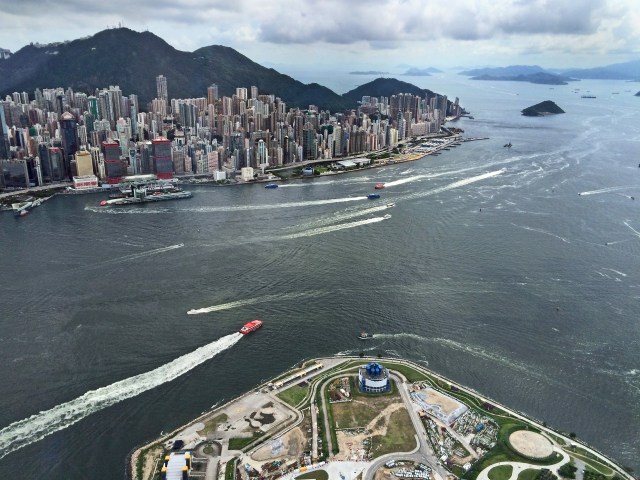
That tall building? The tallest one in Hong Kong? The International Commerce Center. Perfect place for high tea… once you get up there.

(#19 in the Annie series)

I love when Nikki said, “We’re going to high tea at the Ritz Carlton,” that she really meant HIGH tea. Not just a fancy, three-tiers-of-goodies kind of tea, but on the 103rd floor of the tallest building in Hong Kong kind of tea. That kind of high. The super-elegant kind of tea service that comes rarely in most of our lives. And it was, I have to say, a very nice first high tea for Annie.

It was also, however, a lesson in accessibility or a lack thereof.

•IMG_0621a

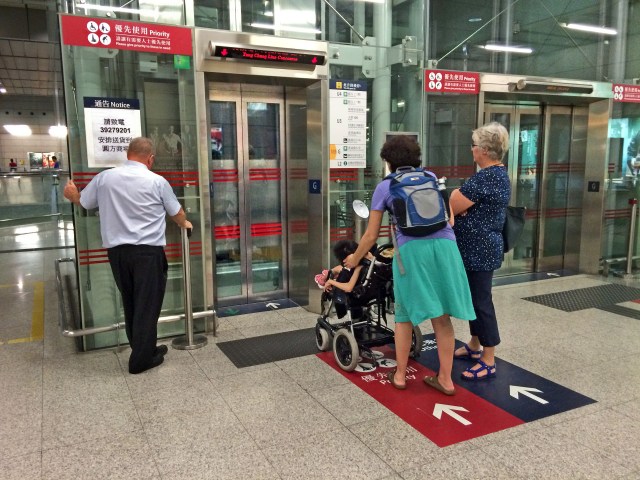
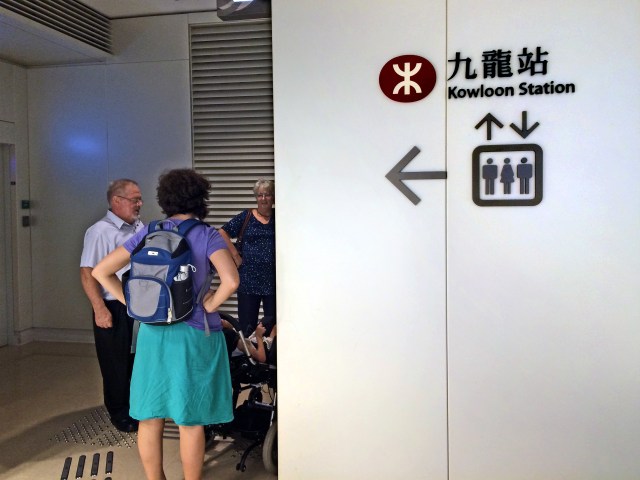
Waiting for the lift on the MTR in Hong Kong.

Anne and John, Nikki and Annie and I all took our usual walk to the MTR station (there’s an entrance right below their building via stairs or three blocks away to the entrance with a lift) to travel not all that far in kilometers but took much longer than it should have. It turned out to be an hour’s journey to get to the tallest building in HK. Not because we couldn’t find it, but because once we’d arrived, we couldn’t find a wheelchair-accessible way to reach the 103rd floor. Stairs, elevators, all kinds of ways to move people on foot, but not for someone in a chair.

This was stressful because Nikki had made a reservation that the Ritz folks made clear they would hold only for 15 minutes before giving it to someone else. And we had traveled so far for this tea—deep into China and back—that we so looked forward to these moments of elegance and yummy bites.

•IMG_0615a

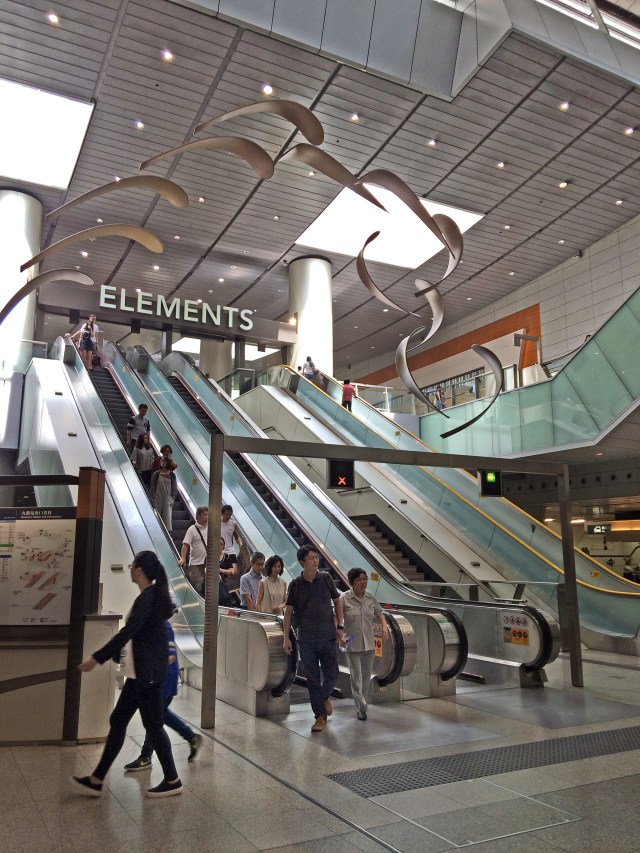
Escalators and stairs: lovely but not wheelchair-friendly.

The Ritz Carlton occupies the top floors of the International Commerce Center, which consists of 108 floors, though it claims 118 above ground and four below. (It turns out that the Chinese/Hong Kongers believe that 4 is an unlucky number, so there are no floors with the number 4 in them in this building.) The Ritz Carlton occupies floors 102-118 and has, according to its website, 312 rooms that, if you look on TripAdvisor, start at about $400 U.S. per night. Also the world’s highest swimming pool and bar (called Ozone—great name) are on the 118th floor.

•IMG_0735aThis is all fine. What’s distressing is that this building opened in 2011—five years ago—and should have ideally been designed to get people high up in it without having to search for elevators, let alone change from one to another, necessitating the location of the new elevator because they are not all in the same place on every floor. (Not all the lifts go to all the floors, which is how things are done in tall buildings—I understand that.)
•IMG_0624a

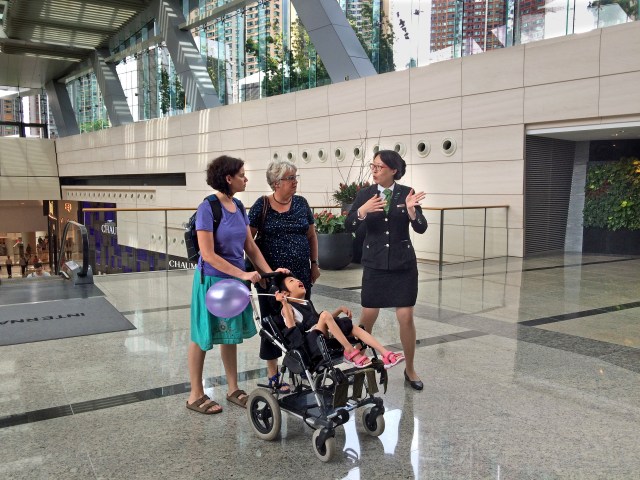
Nikki and Anne talk to an ICC employee about how to get to the 103rd floor.

But from the time we entered the ground floor, it became a challenge to make our way through the shopping mall (everywhere in HK lies a mall with the highest of high-end shops—who actually shops at Tiffany, Gucci and Louis Vuitton?) and locate elevators after asking too many people who didn’t know. We’d get to, say, the 48th floor and have to find another lift to the 102nd floor, the Ritz Carlton’s lobby, one floor below where we needed to be. Do you think we could find a lift to the 103rd floor? No, because there’s an escalator that most people use to get to that one last level. Even the front desk clerks were not sure how to direct us.

•IMG_0618aC

We’ve done our share of escalators and stairs on this trip, lifting Annie up and down, but, without saying so, Nikki and I were done with that. Our eyes must have flashed, “Find us a lift, dammit. This is a hyper-modern skyscraper. You can’t get all of us easily to the place we need to be?”

We were late for our reservation, but the staff had held it for us, though by the time we arrived, I could see steam puffing out of Nikki’s ears. (My ears were similarly steamy.) And I realized that we have become people who say things like, “Really? You can’t make an easily located elevator to the 103rd floor? You dump us out at 102 and expect us to get this child in a wheelchair up the escalator?”

•IMG_0738a

There was, of course, a lift wedged into an obscure angled corner of floor 102, but it was not obvious and involved a confusing, circuitous route around mirrored walls that created a funhouse effect that was, by that time, not fun. Worse still was the path to the lift on floor 103—more mirrors that left us utterly turned around.

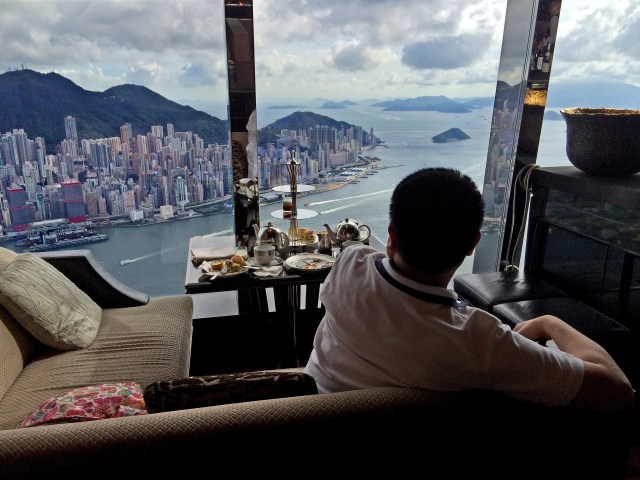
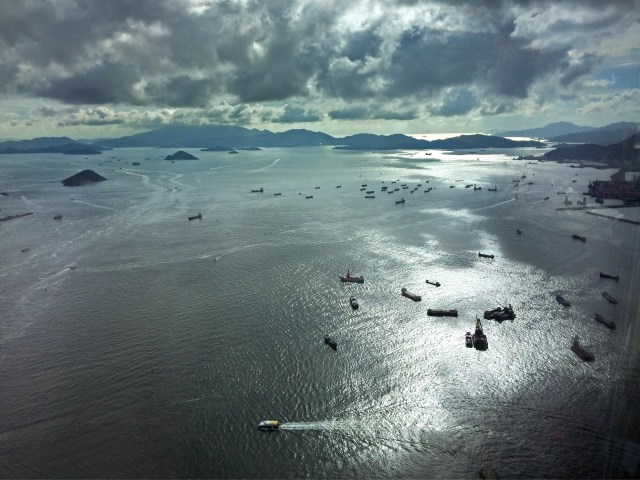
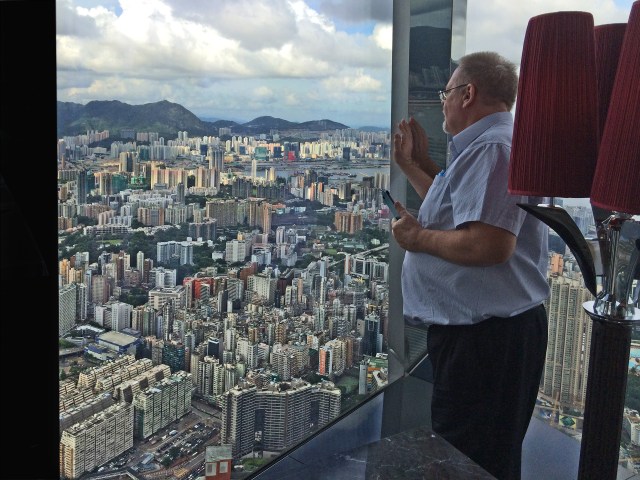
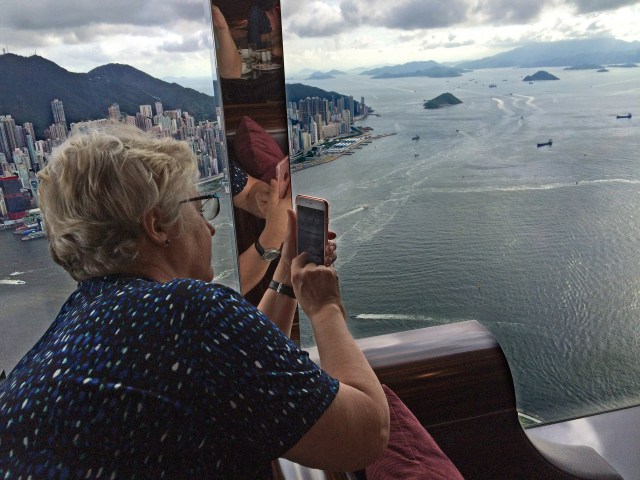
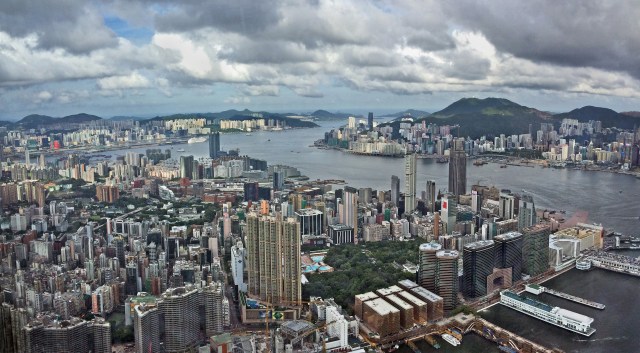
But by the time we had to make our way down, we had been well fed with yummy savories and sweets and teas, and we were not nearly as crabby. But when we arrived in the 103rd floor lounge area where they serve high tea, my mood was already changing. We could see through the floor-to-ceiling windows that we were, indeed, on top of the world. Nothing like a huge change in perspective to give you a new view of things. Such a sight from, oh, about 1,000 feet high can either make your blood pressure rise or fall, depending on how you feel about heights. Mine probably soared—not because I’m fond of heights—but to see Hong Kong so beautifully arrayed before us, like sweets on the triple-decker tray soon served to us, on a clear day with fast-moving clouds and blue sky and… oh, oh, oh, what magnificent light.

•IMG_0640a

View from the 103rd floor of the ICC.

I forgot all about what it had taken to get us up there as we settled into cushy booths by the windows, Anne and John on one side of a nice table, Nikki and I on the other, Annie parked in her chair by Nikki. •IMG_0644aAnd as I calmed down and took in the breathtaking view (it really does take one’s breath away), I thought, Well, finally. Here we are. We have almost completed this incredible journey. Our last day in Hong Kong. Annie’s last day in Asia, for the foreseeable future.
Then came the next series of thoughts: All we have to do now is get home. On the plane. With Annie and all our stuff.

As the anxiety started to work its way up my neck, I pushed those worries away. Not now, I told myself. For a couple of hours on the top of the world, I relaxed, soaking up the elegance and the view. And the tea. I had lots of good tea. The four of us chatted as grownups do, and Annie had samples of all the sweets and savories and tea; there was nothing she didn’t like.


•IMG_0642a

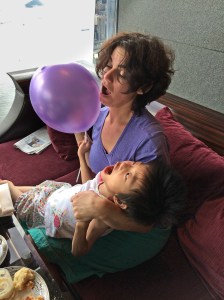
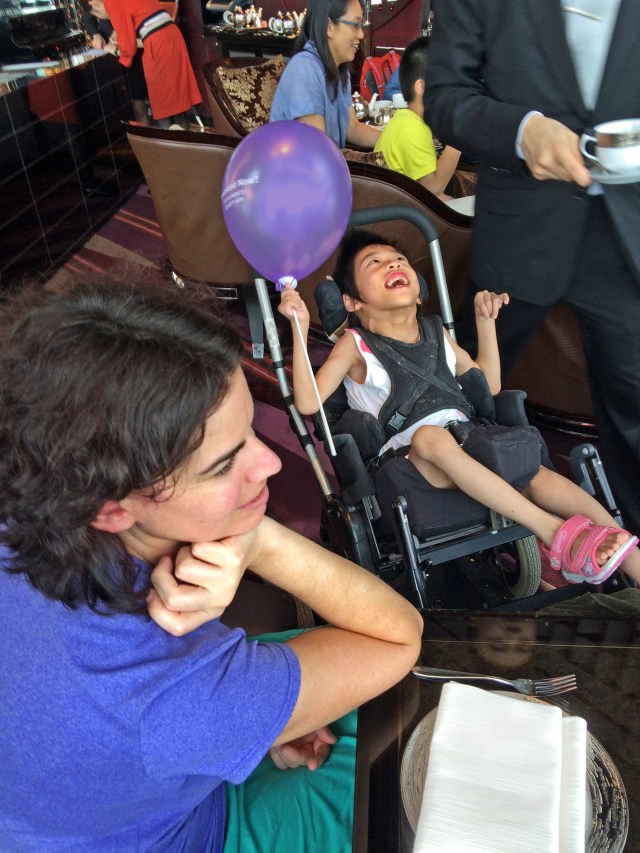
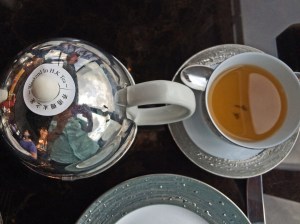
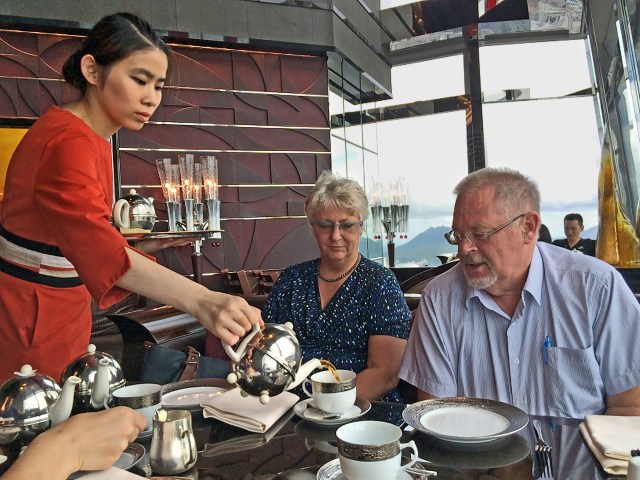
We each got to choose the variety of tea we liked, brought to each of us in a round silvery pot. •IMG_0685aCI ordered Weekend in Hong Kong Tea; Anne had Moroccan Mint; John had Choco Mint Truffle, and Nikki had French Earl Gray. Annie got a purple balloon on a stick, which she liked a lot, too.
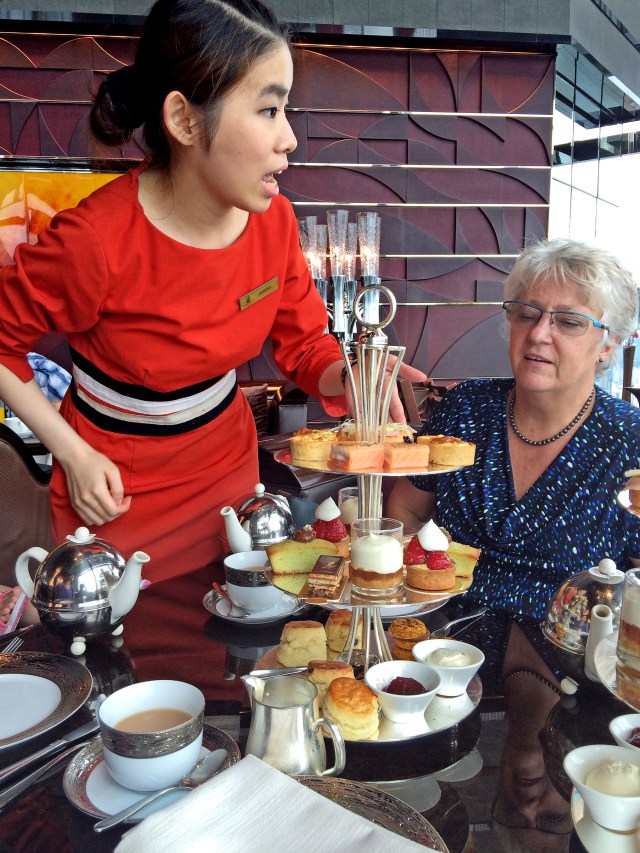
•IMG_0652aC

This nice young woman delivered our tea and served our first cuppa, as they say in England.

•IMG_0649a

And the food… it’s hard not to enthuse about the food. When the triple-decker plate arrived, it was all we could do not to dive in immediately—savories on the top deck, sweets on the middle deck, scones and cream and jam on the bottom deck. And yes, it all tasted as good as it looks.

•IMG_0654a

And all this with the most gorgeous views out the windows:


•IMG_0686a

I looked out the window behind me to see gorgeous shafts of godlight beaming onto the harbour.

•IMG_0713a

John looked out a corner window to see if he could locate their apartment building from on high. He thought he’d found it.

•IMG_0724a

Anne takes in the view, too, as I did… with the amazing camera on the iPhone:

•IMG_0708a

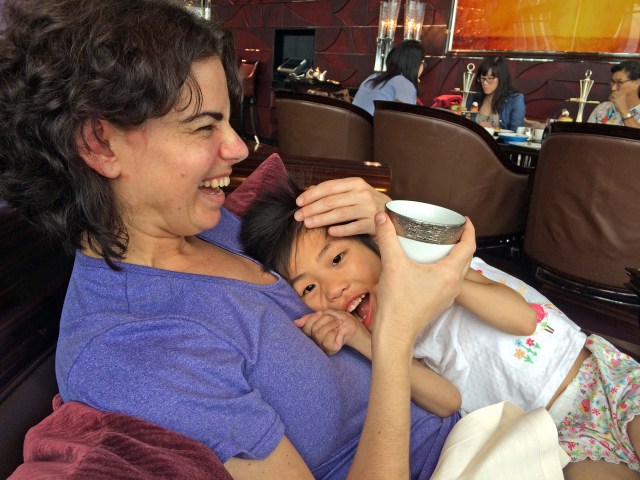
And, through it all, this new mother and daughter duo snuggled and laughed, thoroughly enjoying their high tea in such a high place.

•IMG_0694aC

•IMG_0695a

How much fun can two people have with a purple balloon? Quite a bit, it turns out, and this is how I will remember Nikki and Annie on their last day in Hong Kong. Despite the challenges of becoming a family, of getting to this high place, they persevered as a team. They made it. I get the feeling that this is a metaphor for their life together: There will be barriers. Meet them. Go the extra mile when necessary. Breathe. Have patience. Find ways around them.  Laugh about them with others.

•IMG_0669a

Because time with family and friends and loved ones, smiling and laughing, is everything.

I love to see your face when you’re laughin’… as Antsy McClain sings.

•IMG_0718+0720 Pano

He also has a song that says, It’s a way cool world that we’re livin’ in.

If I look at it from a different perspective, a higher angle, I see how true that is. No matter how many challenges life presents, we have what it takes to meet them, and this journey has made me appreciate this way cool world even more.

Thankyouthankyouthankyou.


Posted in Bringing Annie Home | 3 Comments

Playing tourist

•IMG_0481a

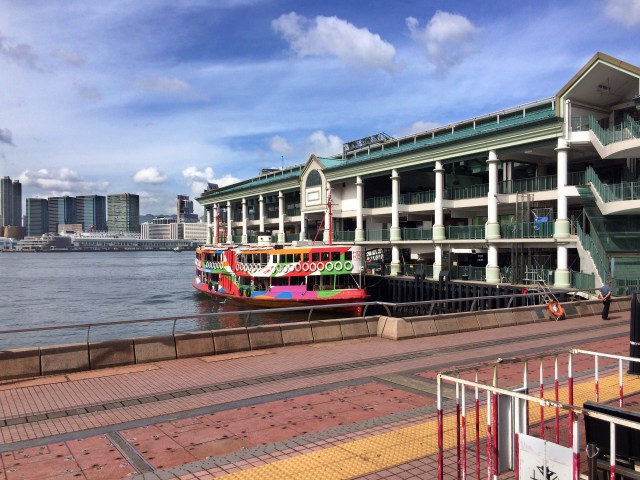
Riding the Star Ferry from Kowloon to Hong Kong Island.

(#18 in the Annie series)

So on this trip, in two-and-a-half weeks, we have experienced more forms of transportation than I have ridden on during any other fortnight in my life. By its end we will have traveled by:

  • (big ol’) jet airliner (nearly 14,000 air miles round trip)
  • trains (from the 200 mph super-fast to the not-so-fast)
  • subway (the world-class MTR in Hong Kong, aboveground and under Victoria Harbour)
  • taxis (cars and vans)
  • historic ferry (the Star in HK)
  • double-decker bus (up Victoria Peak)
  • historic tram (down Victoria Peak in a funicular tram)

So, consequently, has Annie, who had, as far as we know, never ridden in anything motorized other than a car or van. We think she is a pretty good sport to be enduring all these modes of travel. And, it turns out, she loves them. This kid likes being on the move.

On our second-to-the-last (penultimate) day in Hong Kong, we played tourist, Nikki, Annie and I, taking four methods of transport in a single afternoon. Annie and Nikki swam in Liberté’s pools in the morning (thanks, John for getting us in!), then we had lunch and Annie had a brief nap, and then Nikki wanted to show me some of Hong Kong’s best stuff.

Anne and John had to work, unfortunately for us, so we three set out on foot (and in chair) to the MTR station near the Macphersons’.

•IMG_0438aC

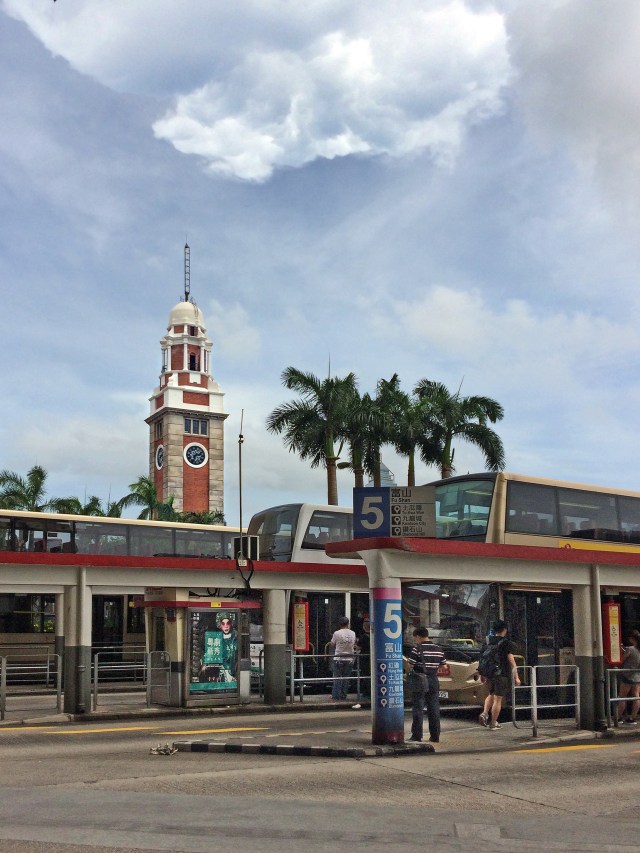
The bus depot near the ferry building, Kowloon.

Apparently, some of that best stuff is seen from on high, accessed by one of the oldest ferry systems and tramways in the world. I didn’t realize before coming to this part of the world that Hong Kong is made up of islands and part of mainland China. Hong Kong Island was the original British holding beginning in 1841, after the Brits invaded China in 1839 in what is called the First Opium War and took over HKI. The new colony flourished as an East-West trading center.

In 1898 Britain was granted a 99-year lease over Hong Kong, including territory on mainland China. All that, including HKI, was returned to China in 1997. Since then Hong Kong has existed as “one country, two systems, preserving HK’s role as a principal capitalist center in Asia,” according to history.com.

•IMG_0443aC

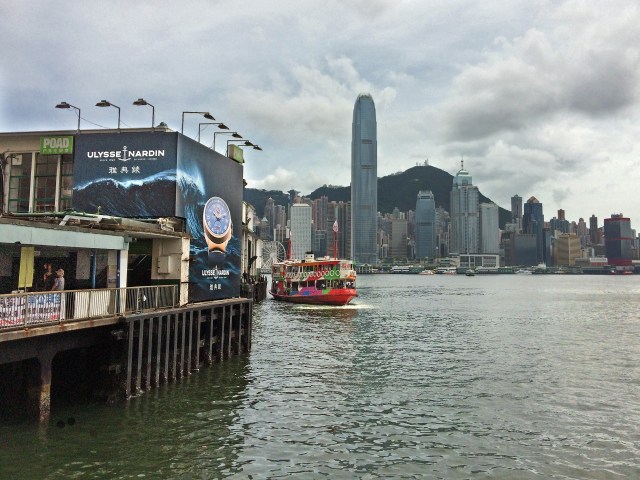
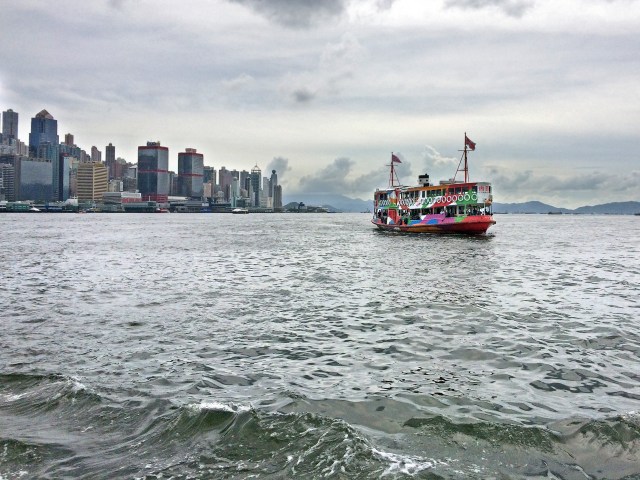
The Star Ferry coming into Kowloon. Hong Kong Island and Victoria Peak (center, with the Anvil) in the distance.

So when you stand on the Kowloon side looking across Victoria Harbour to HKI, it’s hard in the 21st century to imagine people crossing that harbour (we’ll spell it the British way because that’s how it’s done in HK) in sampans. But they did for centuries. In 1871 a British-built steamship, the Morning Star, began ferrying folks across the harbor, and the Star Ferry line was born.

Every since there has been a series of Star ferries with names like Evening, Rising, Guiding, Morning, Northern, Southern, Golden, Shining and, after one of Annie’s favorite songs, Twinkling—all bearing the word “Star” after their first names. It’s the quaint way to get to Hong Kong Island, which can be accessed by the MTR subway, too, traveling in a tube underwater.

•IMG_0466a

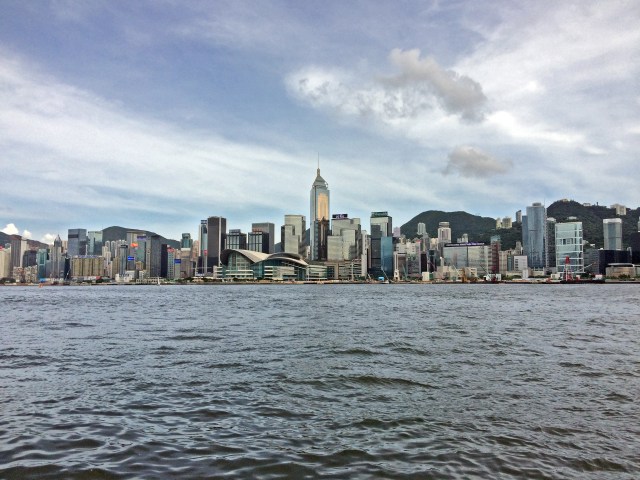
Hong Kong Island (HKI) from the Star Ferry.

The company’s name has a literary origin, according to (yep) Wikipedia. An Indian man named Dorabjee Naorojee Mithaiwala (is that a great name or what?) founded the Kowloon Ferry Company in 1888 and renamed it the Star Ferry ten years later because he loved Alfred Lord Tennyson’s poem “Crossing the Bar.” The first line reads, “Sunset and evening star, and one clear call for me!” From that nearly 120 years of ferry names was born.

•IMG_0492a

The Star Ferry on the HKI side.

We took the MTR to Tsim Sha Tsui (known in HK as TST) where the ferry docks on the Kowloon side. Nikki got Annie a mango icy treat before we took the ride, and we stood on the dock looking at the stunningly clear day before us—Hong Kong Island rising not far away at all.

“See that dip in the mountain up there?” Nikki asked me as we took turns spooning orangey slush into Annie, who quite liked it.

I did.

“That’s Victoria Peak,” she said. “That’s where we’ll ride the tram.”

It’s not the tallest peak on HKI—that was obvious—but the tram is also a historic mode of transport in Hong Kong and a “must do” on the tourist list.

“On a day like today we should have great views from up there,” Nikki predicted.

•IMG_0448a

But first we got to have sparkling views from the water aboard a classically painted green and white ferry. I love ferries of all shapes and sizes—from the small ones that cross sloughs in the Sacramento-San Joaquin Delta to the huge Black Ball Ferry that moves people and cars from Victoria, B.C., to Port Angeles, Washington. The Washington ferry system and the B.C. one, too, are amazing, so I am always up for a ferry ride—especially on a beautifully clear (though still hot and humid) sunny day on such a historic craft.


•IMG_0450a

The Star Ferry.

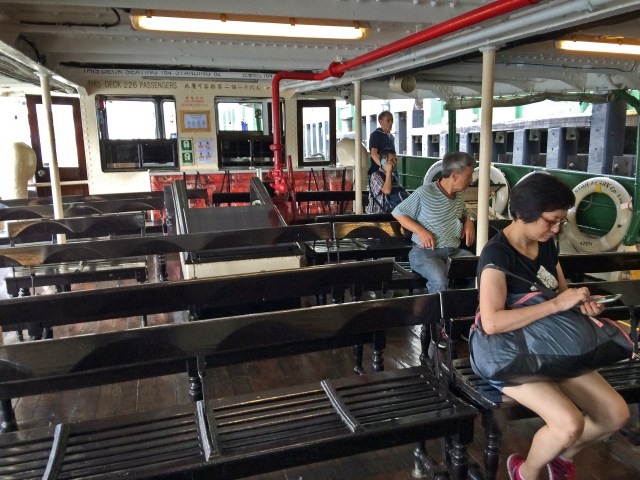
•IMG_0468aWe boarded by walking/wheeling down an old-fashioned wooden gangplank with raised cross pieces of wood every few feet (bump, bump, bump went Annie’s chair), and we settled on wooden benches with backs that folded down on either side of the benches, so you could position the backs depending on which direction the boat was headed. Annie had a good view of the water and the world going by, and we set off.
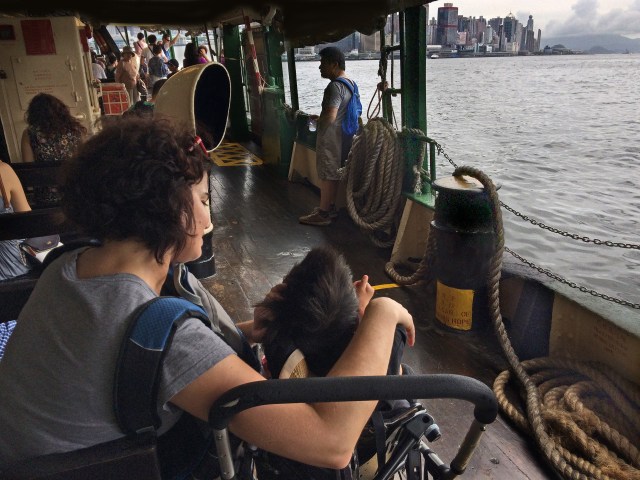
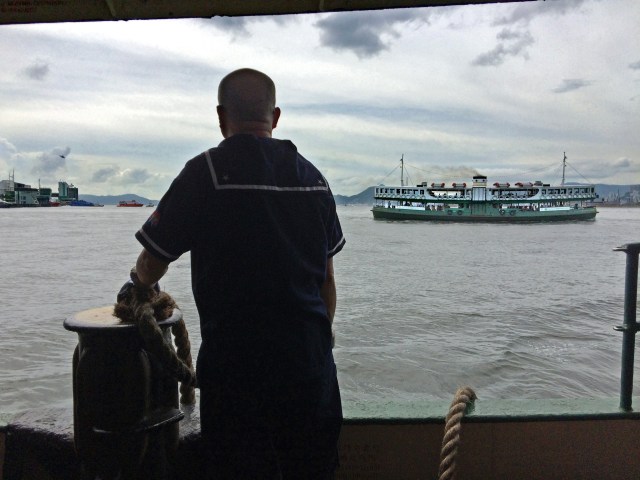
•IMG_0453a

Annie and Nikki ride the Star Ferry.

I moved around the boat, taking photos, wondering how many millions of people had taken this short journey in the last 100-plus years, imagining the different clothes and hats people must have worn. And I looked back to see a new mother with her daughter, pointing out things that surely must have been new to that daughter—riding across an expanse of water, which, I imagined, was new for her. I had to smile to see them so peaceful and happy after such an ordeal to get here.

•IMG_0459a

Rising the Star Ferry from Kowloon to Hong Kong Island (HKI).


Star_Ferry billhook

Docking the ferry with the billhook. (Photo courtesy of Star Ferry)

Even the method of ferry docking is historic. A staff member with a billhook (a long pole with a hook on it) reaches for the large hank of rope tossed by the deckhand, as the ferries have done since their inception.
No modern chains or cleats—old fashioned rope ties the wooden ferry to the dock on each side of the harbour.

•IMG_0491a

Fish and chips on HKI.

When we got to HKI and disembarked (a word I love), we were hot and thirsty, so Nikki found a convenience store on the dock and bought us some water. I noticed a fish and chips place and decided that we could use a snack, so I ordered (lots of people speak English in HK) a bit of the classic English pub grub for us. We sat at outdoor tables looking at the water, watching the ferries come and go.

•IMG_0440aCThen a brilliant move on Nikki’s part—rather than walking to the base of The Peak, she decided that we should take a double-decker bus UP the mountain and ride the tram DOWN the mountain. We didn’t have to wait long for the #15 bus, and the kind bus driver used some hydraulics magic to lower the bus so Nikki could easily get Annie’s chair aboard. Once on, the driver seatbelted Annie’s chair in place. She looked delighted.
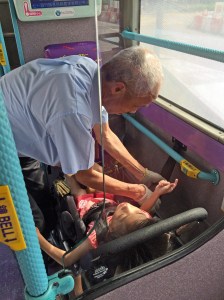
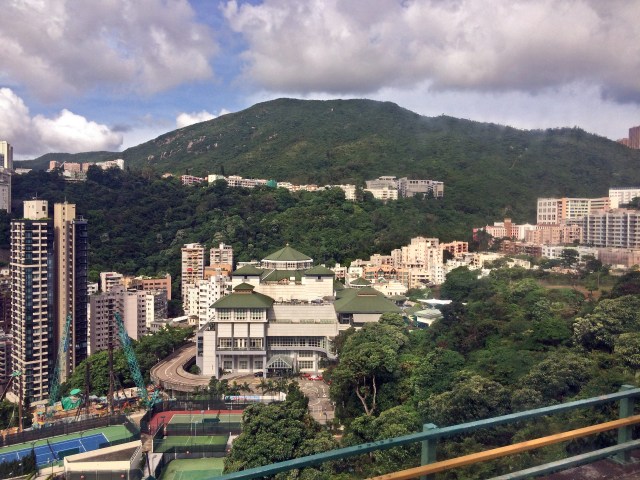
“You should go sit up top,” Nikki said. “You’ll like the view.”

•IMG_0498a

Waiting for the bus on HKI.

•IMG_0500a

Strapping Annie in.

So, for the first time since I was in London many years ago, I rode on top of a double-decker bus, which, given the twists and turns up the peak was a bit of a whoopee ride. That driver clearly had the route embedded in his DNA, but it was new to us. I wondered how Annie was faring down below.

But oh, the views from up there as the bus circled up The Peak—HKI highrises rising as we did, passing a large cemetery that sprawled for miles over the hillside, seeing the tram itself on the way down. When we got to the top, the driver unstrapped Annie and with a little finagling to find the lift (aka “elevator), we went out to The Peak’s observation deck.

•IMG_0519a

The view from the bus going up The Peak.

•IMG_0527a

The back side of Victoria Peak and the harbor beyond it.

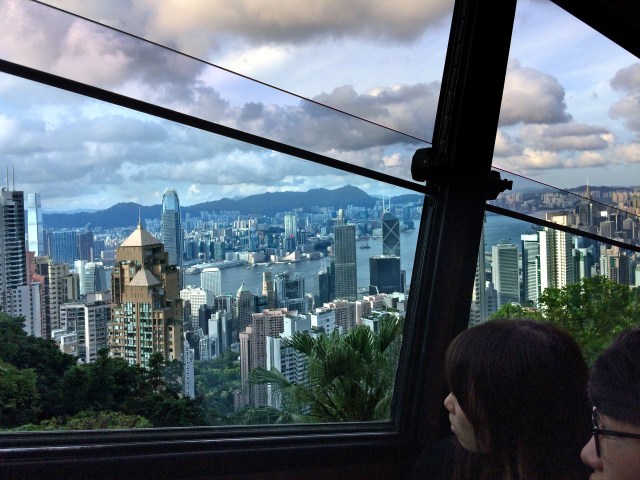
The view did not disappoint. There stretched Hong Kong—the island and Kowloon behind it in front of us under fluffy clouds. We could have gone up in another observation tower locals call The Anvil because of its shape, but we were content to see the city from the outdoor area.

•IMG_0532a

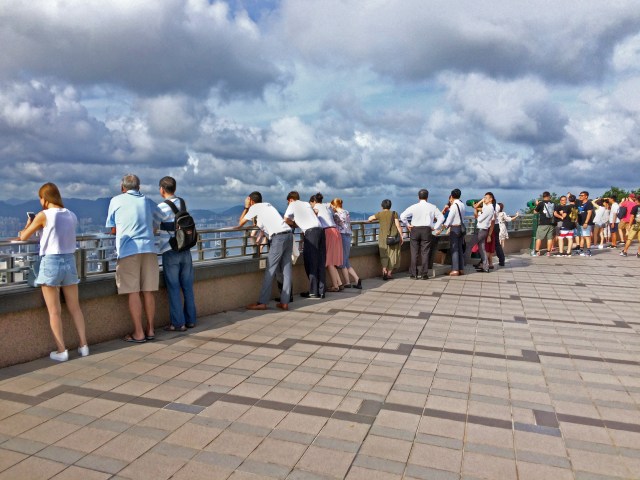
Observation deck, Victoria Peak, Hong Kong Island.

“This is an incredible day,” Nikki said, adding that she’d been up there a number of times, some of them when the clouds hung over the city.

•IMG_0536a

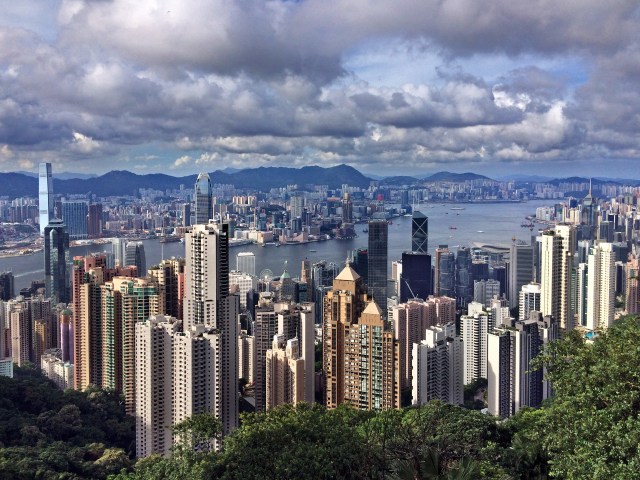
The view from Victoria Peak.

And I could see that it was. It is monsoon season in this part of the world, but we’ve had so little rain and mostly blue-sky or semi-cloudy days that, despite the heat and humidity, make tourists like me think it must look like this all the time. Again, thanks to the weather gods for giving us such a spate of pleasant conditions for this time of year.

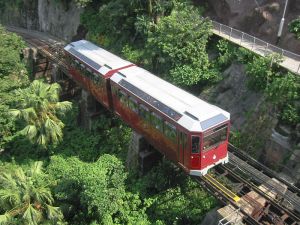
When we’d soaked up as much view as we could stand, we made our way down (doing a little shopping on the way—every public structure has shops and more shops in HK, it seems) to The Peak tram station. The route is a little less than a mile and feels sharply angled up or down, depending on how you ride it, and climbs or descends about 1,300 feet.

Hongkong_peak_tram

(photo courtesy of the Peak Tram)

The Peak Tram was the brainchild of Scotsman Alexander Findlay Smith (another fine name) and has been running on these tracks (and their newer descendants) since 1888, first as a coal-fired, steam-powered line and as of 1926 by electricity. It’s gone from carrying folks in wooden cars to lightweight metal cars in the mid-1950s to the modern trams built by a Swiss company and put into use in 1989. According to The Peak website, the tram carries 4 million passengers a year, an average of more than 11,000 a day.

•IMG_0539a

The Peak Tram.

OCTOPUS CARDaC

(photo courtesy of MTR)

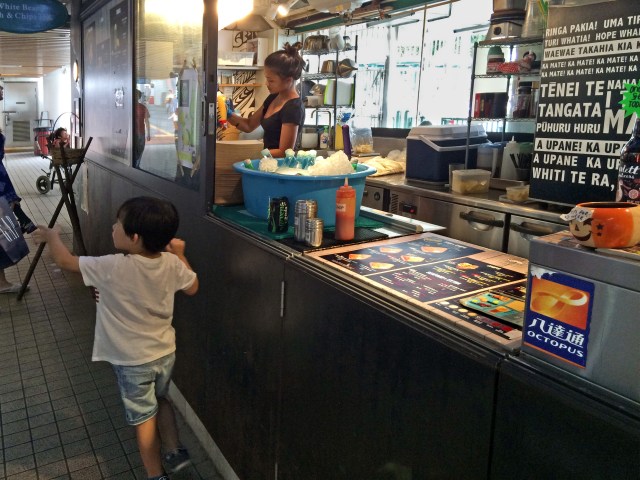
What I love about both of these modes of transport—all three, actually, counting the MTR—is that we could use our Octopus card for all of them. It’s so powerful it can be read through a purse or pack at the entrance turnstile at each station, and boom—paid for, please get on board. So very easy and efficient, the Octopus.

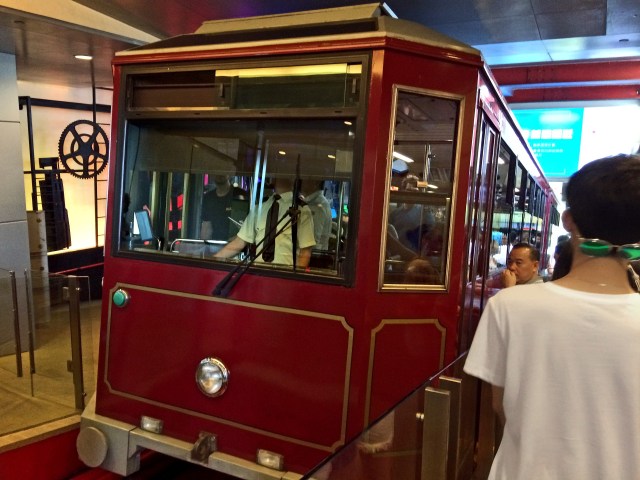
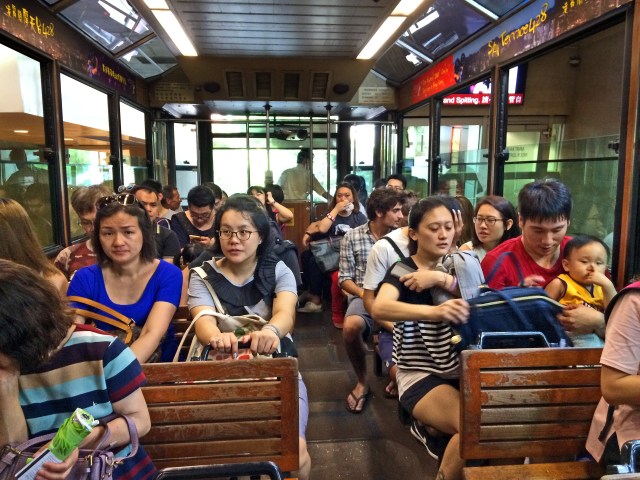
Once again, Annie got special treatment at the tram. We stood in a line to ourselves, nicely apart from the dozens of people waiting to board. Three crew members lifted her chair onto the tram car and one strapped her chair in place. We sat right behind her, but Annie had a great window view and chortled as we went downdowndown the hill backward (they don’t turn the cars around) at a fairly steep angle.

•IMG_0543a

The Peak Tram on the way down Victoria Peak.

•IMG_0547a

At the bottom we waited till everyone got off the tram, and again, nice staff people got Annie and her chair out and then walked us through a mob of people to get out of the station. That’s when I realized how brilliant Nikki was not to try to get us on the tram from the bottom of the mountain—that’s what everyone does. We had a cool, uncrowded bus trip on the way up and an escort on the way out. “You are awesome!” I hollered at her as we made our way through the crowd. “The bus up and the tram down!” She laughed at me.

•IMG_0555a

Hong Kong Island from the bottom of the Peak Tram station.

Then we had to find our way to the MTR, which proved to be more difficult. We walked and walked, looking for an entrance with a lift, but all we could find were stairs—lots of stairs. “I know there’s one entrance with a lift somewhere,” Nikki said. So we kept walking and walking until (whew!) a lift appeared to take us below ground where we boarded the subway for the trip underwater. We crossed the harbour in a tube through water this time, as opposed to the ferry. I would’ve loved another ferry ride, but this was more efficient to get us back to Anne and John’s at dinner time.

We arrived at Liberté about an hour after we got off the tram, pooped and hot, to find that John had made us dinner—a good tomato/meat sauce with pasta that really hit the spot. It was so good to spend time with Anne and John, talking about our day, soaking up the kindness of these old friends of Nikki’s. It made all the difference in the end of our trip, being in their home. We will always be grateful for that.

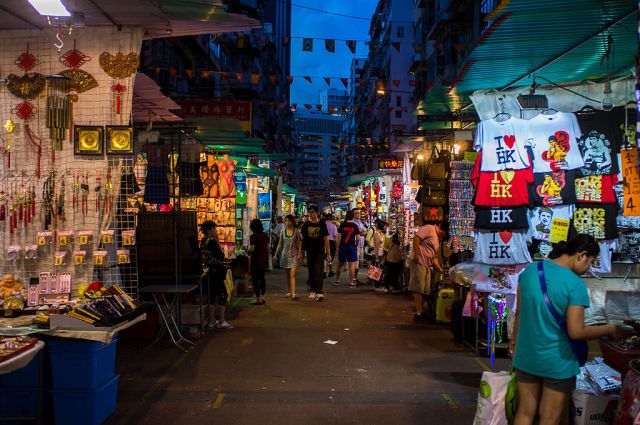
1024px-NightMarketTempleStreet

The Temple Street Night Market, Kowloon. (Photo courtesy of HK Tourism)

After dinner, Anne offered to take me to the Temple Street Night Market, which, Nikki had told me, was a not-to-be-missed HK experience. Anne had worked all day, and this would involve another hot walk and some time on the MTR, but she very kindly said, “Oh, you’ll like this,” so off we went.

I wasn’t sure what to expect in a night market—stalls with fruits and vegetables like the outdoor market we’d walked through in Changsha? It turns out that it is situated in the Jordan area of Kowloon and has more than a hundred stalls selling everything from trinkets and food to watches and clothing, T-shirts, lighters, jewelry, magnets, handbags, tea and teaware, flash drives and all kinds of electronics.

54951-Temple-Street-Night-Market

The Temple Street Night Market (photo courtesy HK Tourism)

If you inquire about a price, the haggling begins. The seller would say, “35,” and Anne would shake her head and offer 20. “No! No!” the seller would shout in English. “30!” And on it would go. We walked away from most of the sellers, though I did buy a few ornaments and Anne bought a flash drive that didn’t turn out to work very well. But the sounds and smells, the people jammed in there were certainly a sight to see. It feels like a street bazaar in a movie, and indeed, the Temple Street Night Market has been used as a backdrop in films.

It gave me a taste of HK that made me want to explore more, and for the first time I thought about what it might be like to return one day.

As we got ready to leave the market, Anne said, “We have two choices here: We can walk by the karaoke or go through the porn.”

I laughed. “Really?”

She nodded, a big grin crossing her face.

“The karaoke, I think,” I said.

Anne nodded. “Yeah, the porn’s not anything special now that you can get so much of it online,” she said.

That made me laugh as we walked through a section of side-by-side karaoke places with a wall of sound that made it impossible to really hear anything—each place with a person belting into a microphone American pop songs. This amused me, to hear Cantonese versions of “American Pie” and “Margaritaville” powered out by small-framed Asian women.

The karaoke vendors occupied one side of the street; on the other were the fortune tellers with their small tent-like covering set up to do business. If I’d have understood them, I would’ve been tempted just for the amusement to see what a Hong Kong fortune teller might have to reveal.

Instead, Anne and I headed home on the MTR after a long day for each of us, ready for sleep. Because—speaking of peak experiences—the next day, our last full day, Nikki was treating us all to high tea at the Ritz Carlton at the top of the tallest building in Hong Kong.

•IMG_0465aC

The Star Ferry on its way from Hong Kong Island to Kowloon.


Posted in Bringing Annie Home | 3 Comments

Annie goes swimming

•IMG_0379aC

(#17 in the Annie series)

So in a previous life, at a high school pool in a galaxy far, far away, I had a several-summers-long career as a swimming instructor, lifeguard and synchronized swim team coach. I often tell people that’s where I learned to teach, and it’s true. If you could keep 10 squirmy kids occupied on the side of the pool, each taking turns to push off and swim to you, and return them intact to their moms (it was all moms in those days) after a half hour, despite the fact that you’d been accidentally kicked/bitten/groped/spat at by those kids, then you were well on your way to a teaching career. If you wanted one.

I did not at the time.

I did, however, love to swim. My mom enrolled me in Greta Andersen’s swim school in Southern California, when I was 3. Mom recalls that I initially did not take to the water. Later I learned that kids at about 3 figure out that they can drown, and an innate fear takes over. Sometimes it’s best to let the kid wait a year or so and then attempt swimming lessons. Others, though, swim right through this phase and onto swim teams.

I was in the former category. But my mom, because she and my dad were avid water skiers, wanted to get her daughters acclimated to water as soon as possible. She remembers that the teachers at Greta Andersen’s (herself a former Olympic gold medalist) were a bit rough in their methods, plunking kids underwater, much to their surprise and, in my case, horror. We generally avoided that in my pool days, letting kids take their time, coaxing them to blow bubbles on top of the water and gradually going lower till they felt comfortable blowing those bubbles underwater.

Irene & Jan synchro

Jan and Irene, duet partners in costume, circa 1974.

I don’t remember any of this, fortunately. By the time I got to Roseville High School pool, an 11-year-old joining the synchronized swim team, I’d completed all the Red Cross swimming lesson levels and was very comfortable in the water—more so than on land where I could be (still can be) quite klutzy. And though I was far from the best synchro swimmer on the Aqua R’s (for Roseville), I had a blast learning the underwater stunts and participating in water ballet routines to music, especially with my duet partner and good buddy, Irene Mahan. I spent my days as a water safety aide, helping the older instructors teach lessons, my nights on the synchro team, and, when I was 16, I became one of those instructors and assistant coaches myself.

Teaching was the furthest occupation from my mind. I wanted to be a Journalist. Preferably traveling the world and writing about exciting happenings. Teaching sounded like the dullest profession on the planet. Who would want to teach for a living?

Those who know me know the punch line to this joke: I do. And though I got my (small) day in the journalistic sun, working for small papers, a bigger one, one international news service and a magazine, I did not travel the world exactly, though I did get around the western U.S. a fair amount. And along the way I got to dust off those teaching swimming chops to teach a journalism class or two or sometimes four at a university and in community colleges, and I quite liked the teaching thing, after all. By 1993 I was a full-time professor at one of those community colleges, a job I still hold today.

I have a lot of (former) little kids (and some big ones) to thank for that at Roseville High School Pool in the mid-1970s. They taught me a lot about patience and meeting people where they are instead of where you think they should be.

It doesn’t matter if someone is of an age to be able to do a head-down crawl the length of the pool. If that someone is still afraid to put her head underwater, it ain’t gonna happen. It’s the teacher’s job to work (often slowly, with incredible patience) to help that someone get to a comfortable level in the water… for that someone. Everyone’s level is different.

Teaching, I still remind myself, is a process of beginner’s mind, as the zen practitioners say—remembering what it was like when you didn’t know how to do whatever it is you’re teaching. About not having expectations. About seeing the best in every student. About accepting students where they are in the moment you’re with them, knowing that can and will change. And then being patient with that, too.

This is harder than it sounds, as anyone knows who has tried to teach anyone else anything. Which is pretty much everyone. We are all teachers; we are all students.

==========

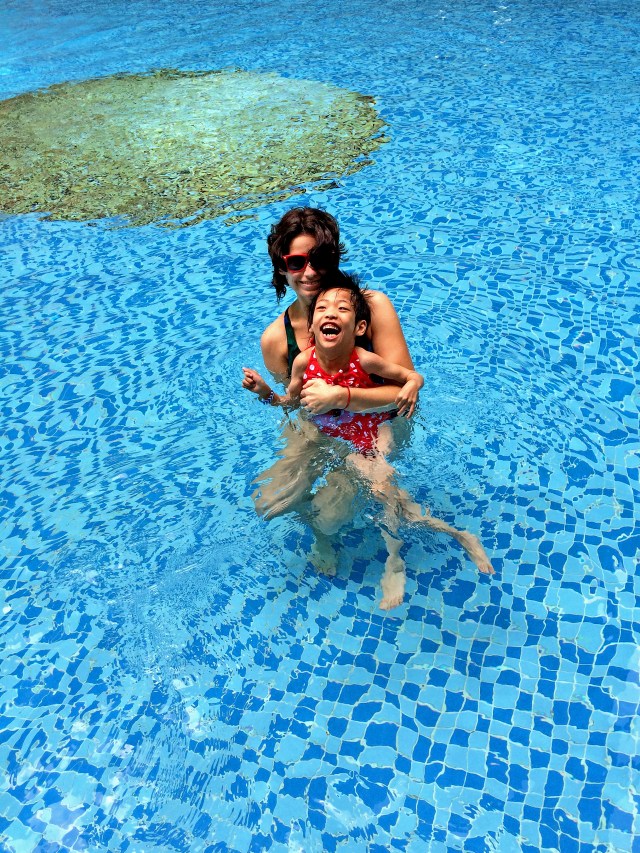
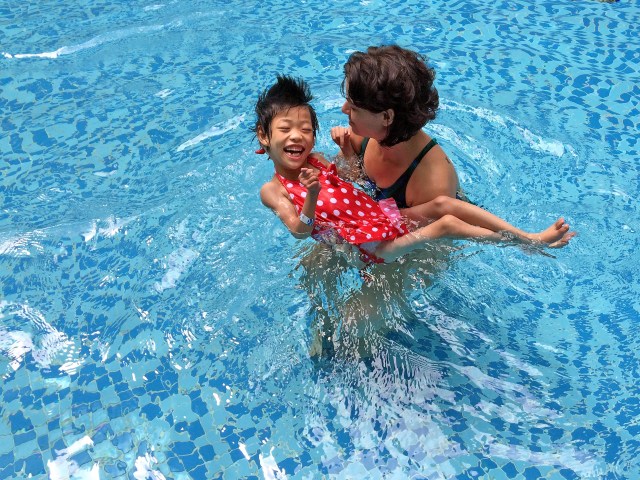
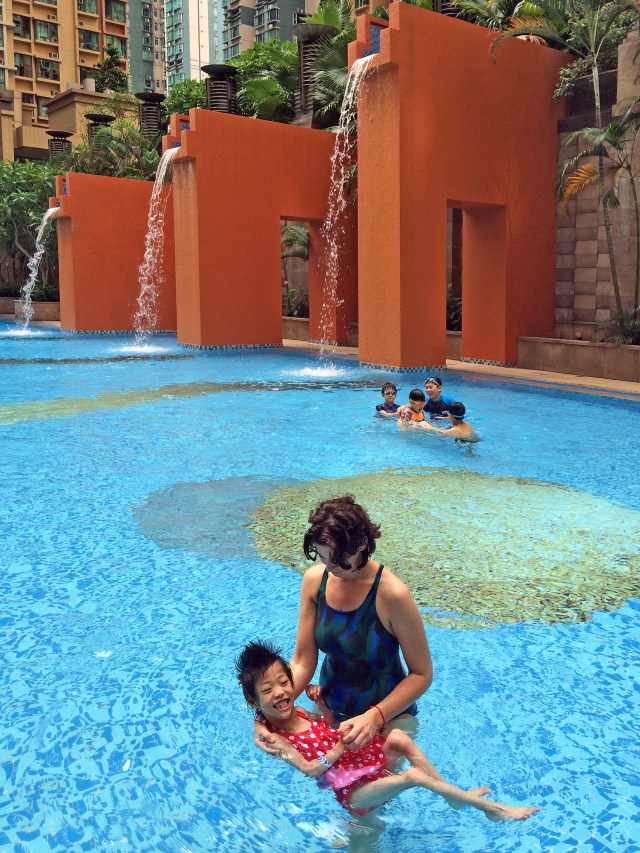
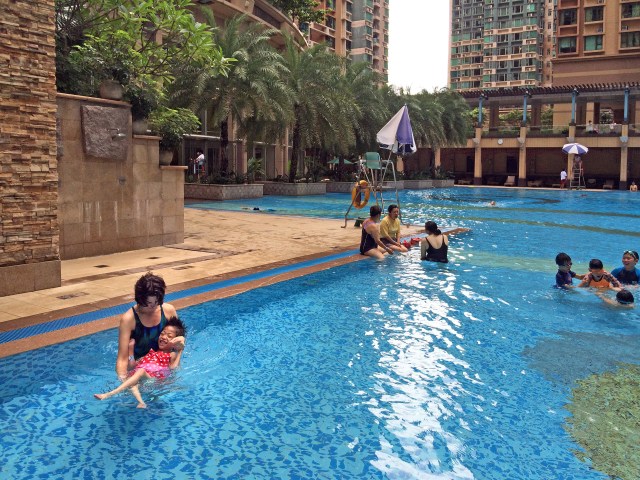
The great thing about watching Annie get in a swimming pool for the first time with Nikki and the next time with me was that we had no expectations of where she should be—and literally where we were was pretty fabulous. In the big pool at Liberté, the Macphersons’ huge apartment complex in Kowloon. Liberté’s pools are worthy of Hearst Castle, and actually, I think William Randolph would be envious of these pools. Though there is no huge statue of Venus rising from her shell, there is an indoor and an Olympic-sized outdoor pool, the latter of which has three waterfalls people can stand under and get a pounding massage. There is a long warm pool (not as hot as the hot tub) for soaking tired muscles. There are diligent young lifeguards who must have been pinching themselves to stay awake on their towers. It’s so quiet and peaceful in the mornings, I figured the heat and humidity must be lulling them to sleep.

We, on the other hand, were rarin’ to go. And by “we,” I mean Annie. Nikki had brought the only bathing suit among us, so we got Annie a red suit with white polka dots while in Guangzhou. I elected to stay dry and take photos, and I’m so glad I did. Because, well… look:

•IMG_0384aC

Annie took to the water like the proverbial fish. There was nothing about it she didn’t like, even laughing like crazy when Nikki took her under the huge waterfalls (after plugging Annie’s nose and covering her mouth). But we learned that Annie likes being dunked, doesn’t mind getting her head wet at all. And, like a lot of other little kids I saw in my swim-class days, she has to be reminded to close her mouth before she goes underwater… she’s laughing that hard.

•IMG_0390a

•IMG_0428aC

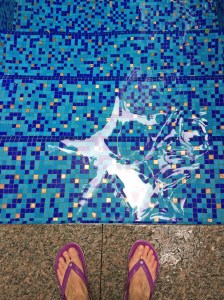
Ayi Jan’s flip-flop feet on the edge of the warm pool.

Look at this pool, by the way. I stood there, taking photos, feet on the top step of the warm pool, torn between having pool envy and wanting to take photos. Good thing I didn’t have a suit. This would’ve been the stuff of dreams for my young synchronized swimming self. Irene and I would’ve had a great time doing our routines in this gorgeous pool.

•IMG_0421a

•IMG_0395a

Although the big pool was warm, Annie’s teeth began to chatter after a fairly short time in the water (this kid has absolutely no body fat). Fortunately, this complex has a warm pool behind the main pool, in addition to its actual hot tub, so Nikki took Annie in the warm pool with jets spouting water below the surface. I love the artfully placed heliconia hanging over the pool, too… yes, it was real.

•IMG_0418aC

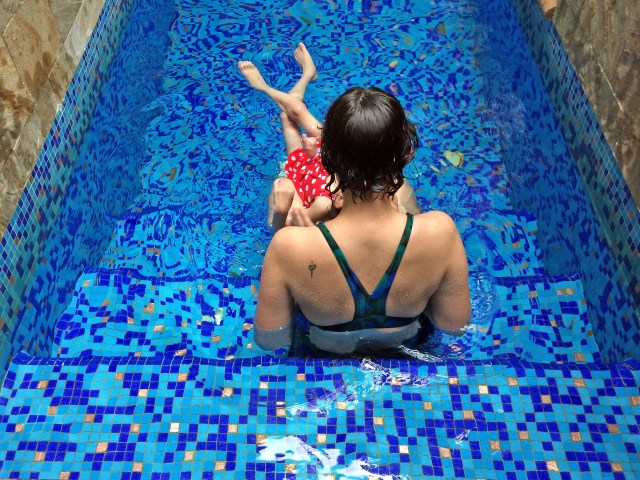
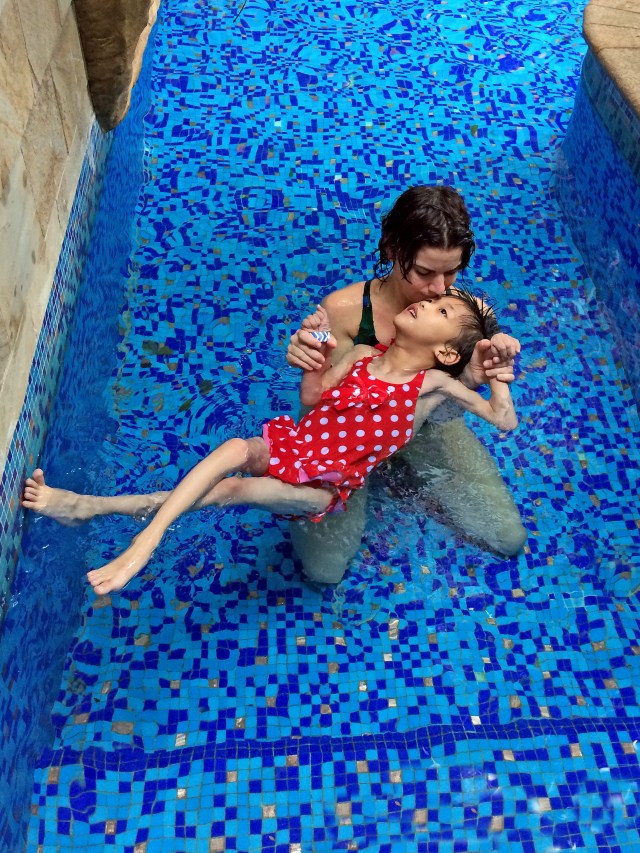
In the warm pool, as we had hoped, not only was she a happy kid… Annie’s limbs also relaxed. When I took her in the water the next day (after borrowing Nikki’s suit), in less than ten minutes Annie’s legs uncrossed. Her arms, usually bent  at a 90-degree angle at the elbows, lengthened. We put her feet up to the warm jets, and she giggled as her feet relaxed. She did not want to leave that pool, and I couldn’t blame her. In the water, she’s weightless, free to move as she likes. Her bound-up body is no longer bound by spasms, made heavy by gravity. She floats like a winged thing riding a thermal high in the sky.

•IMG_0399aC

We had suspected warm water therapy would be good for Annie, and this was proof of that. Nikki and I each had Annie in the warm pool for a good half hour. We were prunes coming out of there, all wrinkly on our palms and bottoms of feet, but we had never seen a limp-noodle Annie before. Now we know that it’s possible to get her that relaxed, Nikki’s going to be looking for hydrotherapy for Annie in Sacramento, for sure.

•IMG_0412aC

Is this the sweetest photo of these two, or what? Might be my very favorite from the whole trip… mother and daughter, happy and relaxed in warm water.

Here’s wishing them many more sessions in warm pools and many warm moments like this one… in and out of the water.


Posted in Bringing Annie Home | 10 Comments

Back to Hong Kong

•IMG_0342a

The ceiling of the Guangzhou train station.

(#16 in the Annie series)

•IMG_0339a

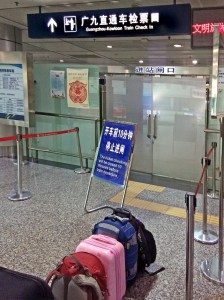
Our luggage at the front of the line.

At the Guangzhou train station, in the queue to go to the platform, we stand between two other sets of adoptive parents. (Wait, did I just make it sound as if I was a parent? No, no… just the auntie.) A husband looks at his sweating wife who is carrying a chubby baby in a tummy pack. The baby is sleeping, much to their relief. The wife had been a student in China a dozen years ago. Now they are back to adopt this child to take home to their other children.

This is a common theme, I’ve learned. Parents can’t stop at just one. Apparently adopting Chinese babies is like eating M&M’s. I understand why: These are the cutest children on the planet. But these parents are, like Nikki, adopting special needs kids. This, in my book, makes them extra-super humans. They are going to have challenges most parents don’t have. But they are also going to have extra-super joys, too.

•IMG_0357a

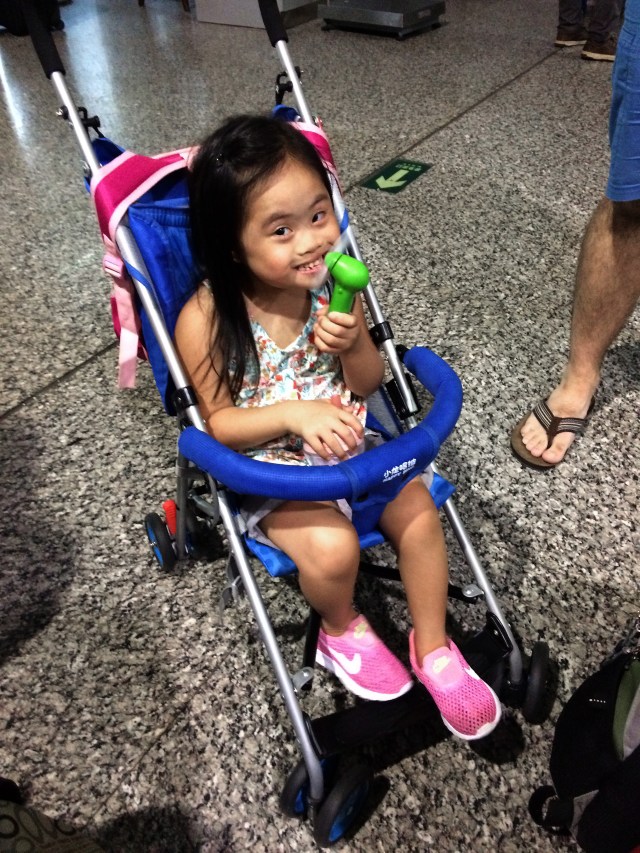
For example: Eloise (above). Her father, named Brent, has come from North Carolina to adopt her. Eloise’s new mommy is at home with her three new siblings, one of whom was adopted from Africa. That was a nightmare scenario; it took them weeks to get through the red tape as judges and other officials tried to shake them down for more money. Brent’s wife ended up staying longer than planned to wait it out—five weeks total.

This time Brent has traveled solo to get Eloise. And though she is 5 and has Down Syndrome and allegedly speaks only Chinese, she does as she’s told when Brent nicely asks her in English to sit in her little blue stroller with her battery-powered fan. She has a smile that could melt iron. It’s a good thing she’s spoken for because after seeing her for five minutes, I was smitten. I’d have taken her home with me.

•IMG_0343aC

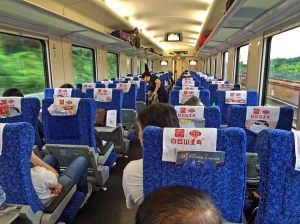
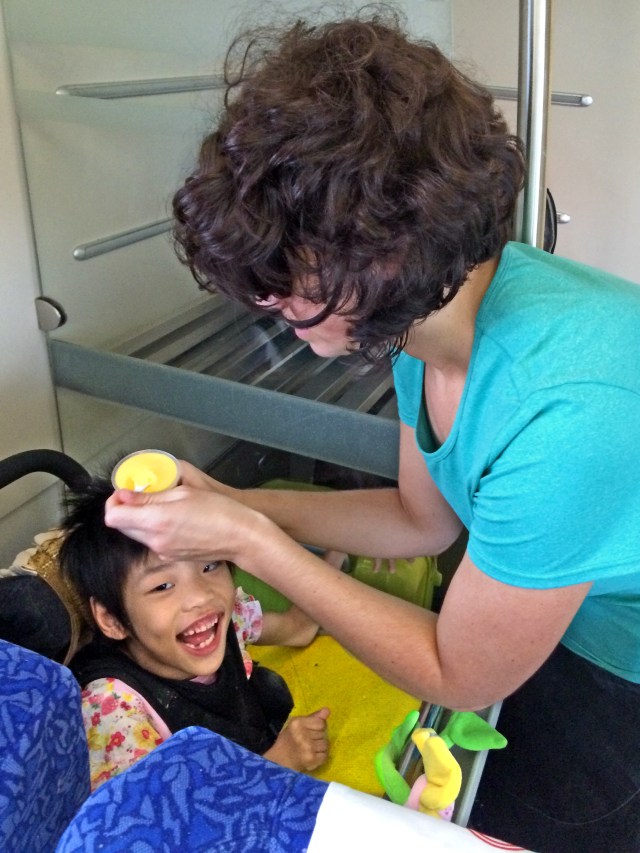
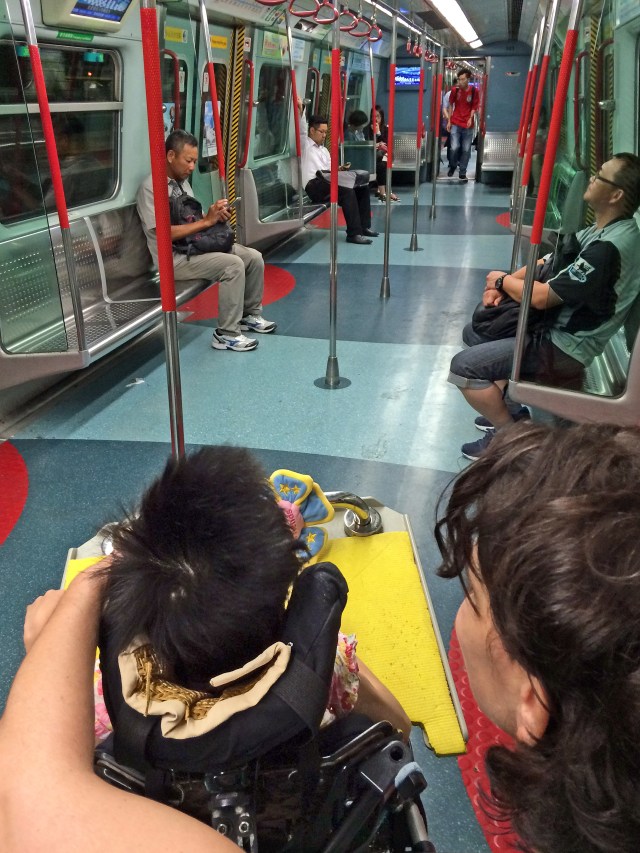
So all in all, a much smoother train experience, leaving Guangzhou. Yes, we had to find a lift to get us down to the platform, and Annie’s wheelchair didn’t fit down the aisle, so we had to park her at the back of one of the cars (not near our assigned seats). •IMG_0360aBut a kind attendant let us move to another car where we could sit right in front of where the chair had to park. One attendant did suggest that we could stand for the three-hour trip in the space between the cars, but Nikki put her foot down at that. We got seats in a less-crowded car, and Annie spent part of the time in her chair and part of it lying down on two seats with Nikki. I sat in front of them, two seats all to myself. It felt quite spacious.
 

•IMG_0365aC

Nikki feeds Annie mango pudding on the train. Yum! (One of Annie’s new English words)

The darkening world rolled by again, in reverse this time, the mountains and rice paddies, the rivers and farms, the factories, a couple of quick stops at other stations. We were heading into night, and it felt far more peaceful returning than it had on the way out. All in all it was a much easier ride into Hong Kong than out of it, and I was reminded of one more difference between China and HK: On the train the attendants close the restrooms as the train enters HK territory because the waste is expelled directly onto the tracks. This is considered OK in China, not OK in HK.

By the time we got to the MTR (short Mass Transit Railway, and HK’s is one of the best subways in the world) station with Nikki pushing Annie and me pulling our two pieces of rolling stock, things felt familiar to me. It was Annie’s first ride on the subway, though, and since it was after 9 p.m., things were much quieter. Nikki, once again at home in the HK transit world again, easily found the platforms and right trains (I was still turned around) to take the MTR to Anne and John’s.

•IMG_0373a

Riding the MTR (the mass transit railway) through Hong Kong to John and Anne’s.

•IMG_0376a

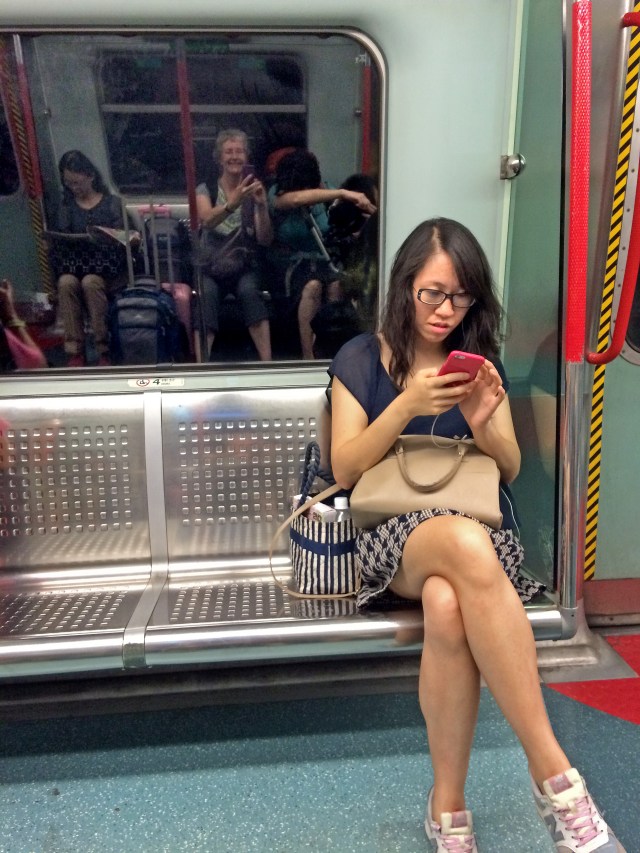
Some people text on the subway; others take photos.

This time we both know the direction to head out of the station, walking the four-ish city blocks to the Macpherson’s Liberté apartment complex and head up to the 37th floor of Block 6. Anne and John greet three of us this time with great welcoming hugs, delighted to see Annie. They ask if we’re hungry, and though Nikki says she’s not, I’m starving (I’m always starving on this trip, though I figure I’ve lost a good 5 pounds by now). John goes to the kitchen and makes us a late dinner of scrambled eggs, toh-mah-toes and bacon. Perfect.

We each have our own rooms again, and I am, as I was before, captivated by the view out the window. I spend the first part of the night gazing out at the HK cityscape. When I was last in this room, we were two and had the whole trip ahead of us. Now we are three and almost done in Asia. We are almost on our way home.

Before I turn out the light, I see this on the small desk by the computer. One of them has been working here. John, I believe, leads Bible study at their church, The Vine, where they met Nikki years ago.

•IMG_0377a

It says: “Your heart is purified by faith. Faith allows God to bless you.”

And it hits me that faith has been the theme of this journey. Nikki had faith in the process and in her ability to bring Annie home. I had faith in Nikki and Annie, both of them strong, can-do-anything people. Nikki and I both carry faith in, as I like to joke, all the gods and goddesses and ascended masters, as well as in our persistent, always-there companion spirits. We have felt their help and blessings every step of the way. We have had assistance when we needed it, sometimes when we didn’t know we needed it.

And I went to sleep looking out at the lights of Kowloon, Hong Kong, from the 37th floor, offering one of my favorite prayers to all who might receive it:

Thankyouthankyouthankyou.

Posted in Bringing Annie Home | 5 Comments

Barrier-free passage

•IMG_0301a

Guanghzou’s rugby team is named The Rams after the local creation myth about five celestial beings riding into the city on five rams carrying sheaves of rice. Blessing the land, the rams turned to stone once the celestials left. Their statue is in Yuexiu Park in Guangzhou, which means “broad region.”

(#15 in the Annie series)

To love means loving the unlovable. To forgive means pardoning the unpardonable. Faith means believing the unbelievable. Hope means hoping when everything seems hopeless.
—G.K. Chesterton
(a quote I carried in my travel journal throughout China)

“Tell the sky you don’t want it to rain.”

Nikki just said that to Annie. It’s 11:30 a.m. on the day we depart by train for Hong Kong. “Let’s hope for better weather in Hong Kong,” Nikki says to me. “Or at least in Hong Kong you can walk for miles and never go outside. We can show you the malls and the glitzy side of Hong Kong.”

It is, after all the rainy season here, and one expects this. But we’ve had days and days of blue skies, very little pollution (I was prepared for a lot more) and no rain until yesterday, the 12th day of the trip.

Nikki and Annie are sitting in the big chair by the window of room 1140 in the Guo Men Hotel in Guangzhou, Nikki’s feet on the ottoman, and she and Annie are chatting, mostly in Chinese, though Nikki is working on English, too. She has been asking Annie, “Where is my nose?” in English, hoping Annie will point to it or at least swing her clenched fist on her bent arm in that direction. Sometimes she does, but Nikki can’t tell if that’s on purpose.

•IMG_0292a

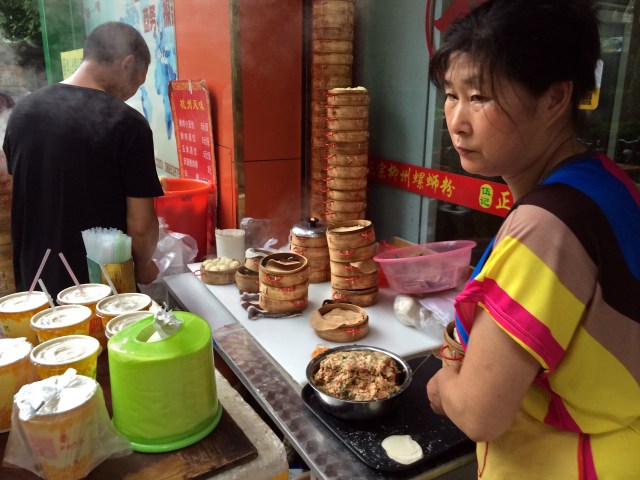
The dumpling people preparing breakfast.

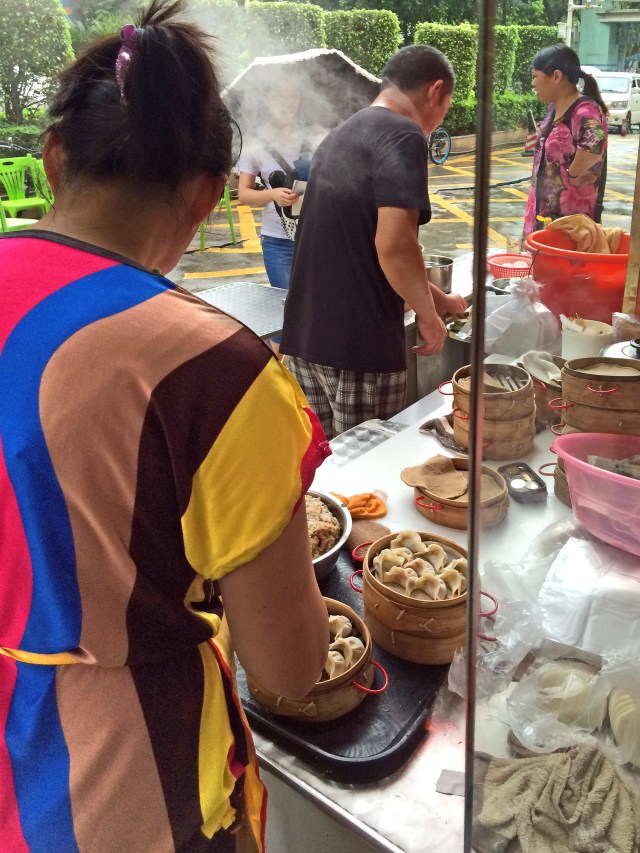
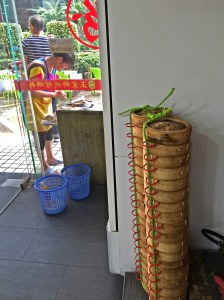
We have just come back from breakfast out—dumplings from one of the little shops on a nearby alley where Nikki has bought a lot of our meals. (Here, it’s not Chinese takeout; it’s just takeout.) Dumplings in China are a breakfast food, and the family that owns this shop stands outside. A woman puts a bit of pork mixture into soft pillows of dough and folds them so precisely you could mail them. •IMG_0295aShe puts the dumplings into circular bamboo baskets, and a man puts each basket into the steamer. I couldn’t tell how long it takes to cook, but I imagine not long, and you have fresh, steaming dumplings. You pick them up with your chopsticks (no forks or knives here), and you transfer that warm bundle to your mouth, which explodes with happiness because THIS is what dumplings should always taste like. This has completely redefined “dumpling” for me. This is change-your-life food, and it is, without question, one of the best things about my Chinese experience.
•IMG_0293a

This time we thought we’d eat out… side. The shops in this alley have a number of outdoor tables, but a pourdown swept us inside where we had a good view of the proceedings (dumpling making and buying) on the covered walkway outside the shop. As we watched people hurry by with their umbrellas up, I told Nikki that in Hawaii people say that if you don’t like the weather, just wait ten minutes. It took about 15, but that pourdown passed. It’s the tropics here, too, and Nikki says that in the summer rainy season it can pour all day.

•IMG_0307a

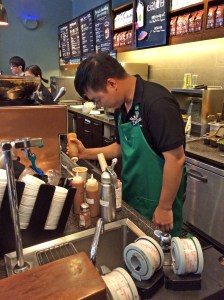
Making Nikki’s macchiato, which was supposed to be an Americano.

After breakfast we knew Annie would enjoy a good, long stroll, so we walked over to Starbucks, not far from our hotel. Nikki had been craving good coffee, so in my newfound I-can-order-in-China spirit, I tried to order Nikki an Americano—mostly coffee and a little milk—but instead, I ended up with a macchiato—mostly milk and a little coffee with a caramel drizzle on it. Oops. The lady asked me in English, too, “a little coffee and milk?” and I said yes, and obviously, I had it backward, though I thought I had it right. But Nikki is nothing if not a good sport, and she drank it. Annie wanted to try the macchiato, too, so she got a sip, which she seemed to like, but she really enjoyed the cinnamon cake we got her. (New middle name for this kid: Annie CAKE! Cardoza.)

I had the green tea latte, which Nikki says is different here than at home. I quite liked it.

We have our room at the Guo Men Hotel till 3:30 p.m. today. Elsie the translator will meet us in the lobby at 3:45 to go in the van with us to the train station, which is very nice of her. She will also bring Annie’s passport with the U.S. Visa in it, which is crucial and the thing we’ve been waiting for, the reason we’re still in Guangzhou.

•IMG_0311a

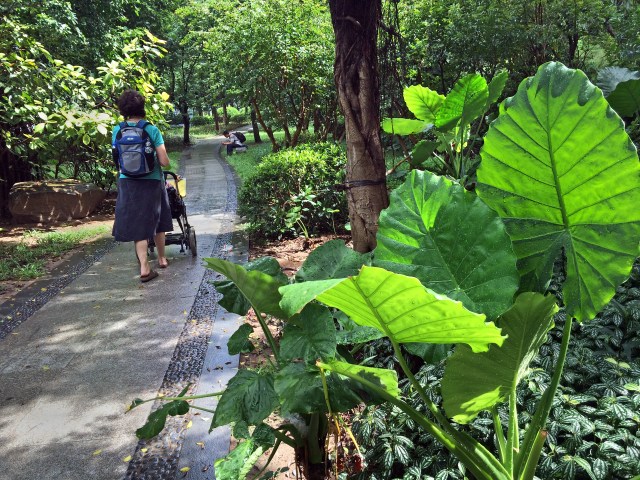
•IMG_0313aBut in between the morning pourdowns, we walked under blue sky, fat clouds and sun. After we’d crossed a major road with eight lanes of traffic moving in two directions, we found a nice little narrow garden area where Nikki pushed Annie, and I followed, taking photos. “The Chinese love their gardens,” Nikki says, taking an opportunity to plant something green wherever possible, and this is a particularly nice one.
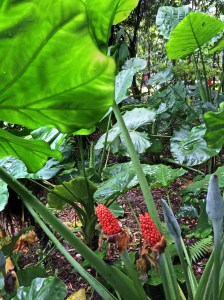
The walkway was still damp, which made if feel as if the humidity was rising through our feet, and I got a whiff of Hawaii. Some of the same gigantic ape (elephant ear plants, pronounced “ah-pay”) and philodendron flourish in both places, though I imagine they have different names, maybe even different varieties, in China.

•IMG_0320a

An after-showers stroll in Guangzhou.

•IMG_0321aIt struck me after we came back to our room after our stroll, as we crammed our belongings into our bags, that today we leave China, all of us possibly never to return. We will spend the last part of our trip as we spent the first part: in Hong Kong staying with Nikki’s friends, Anne and John MacPherson. It’s so nice of them to host three of us in their tiny apartment. But for now we still have to leave Guangzhou, maneuver another train station, feed and change Annie on the train, get the subway to John and Anne’s. I cannot think of all that at once. As my mother likes to say, “You can only eat an elephant a bite at a time.”
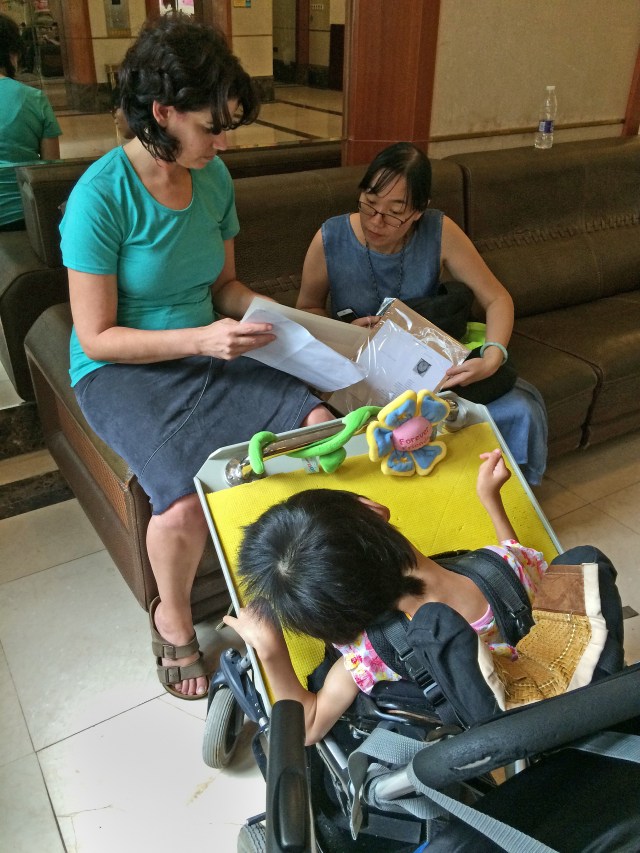
My attention comes back to the two people sitting in the big chair by the window. “Look at you, Farty McFarterson,” Nikki says to Annie, who’s laughing and passing gas at the same time. “You’re crop dusting me here.”

I love this mother/daughter bonding time. This, to me, is what this trip is all about, the essence of it all—these two becoming a family. I am so fortunate to have witnessed and recorded some of it.

There’s no doubt that this has been a wrenching experience for Annie, leaving everything she knows. Though we’re sure, as did the people who cared for Annie, that she’ll have better access to all kinds of therapies and opportunities in the U.S., it’s not gonna be easy. It hasn’t been so far—we have a few upset/crying sessions a day, sometimes when she’s hot or hungry or tired and other times… well, we can’t tell why. It doesn’t matter.

The point is that now we are truly on our way home, back to the place Annie will call home—with a pool in her condo complex and a kitty, where she will go to school and have physical therapy and become the best version of herself she can be. Whatever that is, she has the very best mom for the ride, one who understands better than most this incredible transition from one side of the world to another, who adores her, who will always be there for her, even on a gray day when the sky rains.


•IMG_0331a

Nikki and Elsie go over Annie’s final documents for the journey to her new home.

Elsie meets us in the lobby after Nikki checks us out of the Guo Men Hotel. The van driver arrives and parks in the street. Why the parking lot attendants don’t let him into their lot baffles us; they’ve been helping us for days lift Annie and her chair up and down the ten steps that lead to the hotel. They know what we’re up against here. China.

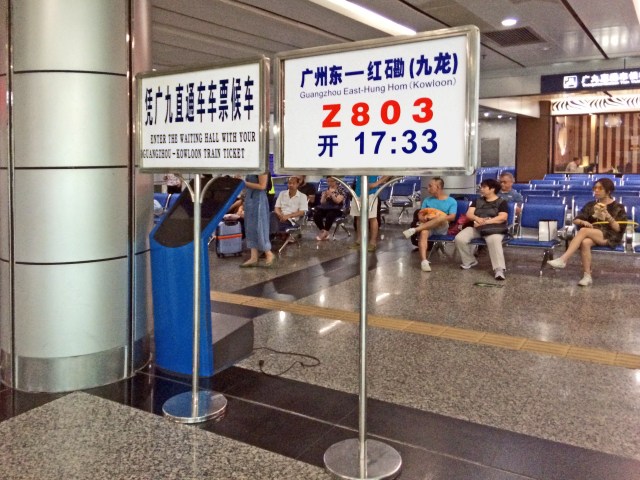
It’s a little precarious getting Annie into the back of the van with all the traffic going by. Nikki is concerned about whether the chair will fit. But it does, fortunately. After about a 20-minute drive Elsie directs the van driver to the back entrance of the Guangzhou train station where the fast train to Hong Kong leaves. Elsie escorts us to a service elevator that clearly is not marked for the general public (bless her) and waits with us about a half an hour till we go through the glass doors to the waiting area. It’s warm, but (thankyouthankyouthankyou) not nearly as hot and humid as the Changsha train station.

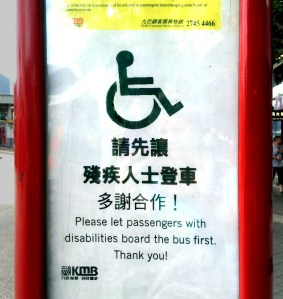
I leave Nikki with the luggage chatting with Elsie and other adoptive parents in the waiting area and, to avoid a meltdown, I wheel Annie around a large rotunda, in relative coolness. She stays happy. At one point I park her chair under a sign next to the universal symbol of someone in a wheelchair that says in English and Chinese, “Barrier-free passage.”

•IMG_0350a

“Look at you!” I tell her as I step away to take her photo there. This, to me, is a mantra for Annie’s future life. Of course, there’s no such thing as a truly barrier-free passage in the U.S. either, just as there isn’t in China. But on this trip we have spent a lot of time looking for just that—places without barriers that make it easier for people with mobility issues to get around. I think guiltily of the loft where my writing groups meet in Sacramento with its narrow wooden stairs (two sets of them), the only way to get in that room. I love that space, but it is by no means barrier-free. Still, I have found other ways to remove barriers, especially in writing, and giving people the freedom and confidence to write what needs to be written, sing their own songs, make their own way.

Annie has given me a new reason to think about this—not that I haven’t before—but now I’m looking for places wide enough for her chair, for the lift as opposed to the escalator, for (and I love this term) the barrier-free passages through life… for all of us.

In the photo, Annie has her head back, her mouth open in a wide chortle. I look at it now and think, “This is what I wish for you, my dear, the fewest possible barriers going forward. All the possibilities. Clearly you will run up against obstacles. But you and your mama and those who love you will do their best to find ways around them. You will thrive and grow and become the best possible you in this new place, with new people.”

I want to tell her: “We are not perfect, we Americans, not by a long shot. We are taking you back to a country deeply troubled by racial divides and outbreaks of violence while we’ve been gone, even in our own city, at our state Capitol. The Chinese must imagine that you are going to a very dangerous place. We don’t see it that way, of course. But we have to believe that you will have a better life, an easier life, a life with more promise than you had in Changsha. You are in the hands of a very good mama with family and friends who will work hard to give you a place of peace and healing and safety, where you can grow and thrive.”

Let the barriers come down for Annie and for everyone who has them placed in their way. Let us all find that place of peace and healing and safety. Amen.

•IMG_0303a

A patron’s bag at Starbucks, Guangzhou.


Posted in Bringing Annie Home | 9 Comments

Hair wash

•IMG_0220a

Me: pre-hair wash… aka, my usual hair.

(#14 in the Annie series)

So in China, besides going for a foot massage, which is more like a mostly clothed, all-over massage that leaves you like (pardon the cliché, but it’s so true here) a wet noodle, Nikki says a hair wash will change your life. Or at least make you feel better. It’s an inexpensive way to restoreth the soul, allowing you to emerge with clean hair, a well-massaged head, neck and shoulders, and blow-dried hair that makes you look like an entirely new person.

So on our final afternoon in Guangzhou, Nikki and I took turns going for a hair wash so one of us could stay with Annie.

Nikki and various female friends living and working in China used to get themselves a good hair wash on a regular basis. It feels good and doesn’t cost a lot, so why not? Yet every time Nikki has had this done, she says the stylist, who is always an incredibly thin young man, comes at her with a round brush and a blow dryer, determined to straighten her lovely curly hair. I, too, have curly hair and, after years of fighting it, I’ve embraced it. In fact, on this trip, I’ve been washing my hair and then letting it air dry, finger combing the curls as they pop up. I have to say that I think it’s kinda cute.

So I was curious to see what a thin, young male stylist would do to my hair. The hair wash that used to cost Nikki and her friends 15 RMB (about $2 U.S.) is now 35 RMB, which is about $5 U.S.—in Guangzhou anyway. I thought it was a bargain for a very nice head, neck and shoulder massage, let alone the shampoo and blow dry.

•IMG_0249aC

The hair washers in pink.

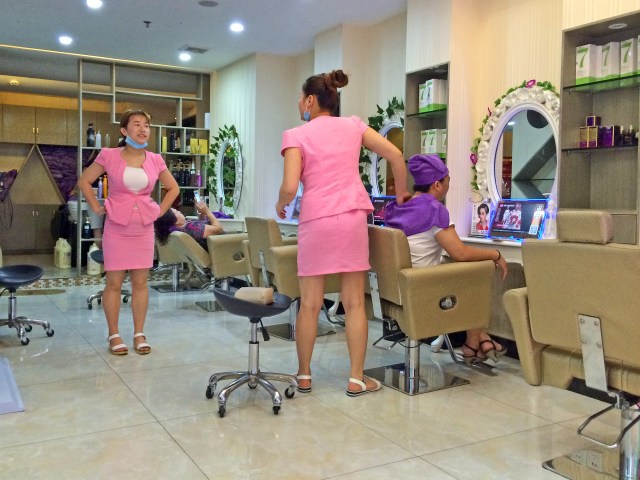
But, oh, what a hierarchy in the salon. The hair washers are all young women who, at this place, wore short pink skirts and short-sleeved jackets over white or black camisoles. One could not miss the fact that these young Chinese women had bigger chests than mine. Nikki had earlier pointed out to me while walking past a “palace of beauty” that Guangzhou is the plastic surgery capital of southern China, and that it’s considered essential for young women to have (to quote the wild and crazy guys of the late 1970s “Saturday Night Live” skits) big, American breasts. Clearly, every hair washer in the place had had her augmentation. I wondered if that was a requirement for employment.

But boy, do these young women know their stuff. They•IMG_0251a have fingers of steel and, since I was alone and no one spoke English, I could not figure out how to say, “Lighten up, wouldja?” The woman thumbing and digging into my skull would occasionally say, “OK?” and because I didn’t know how to say “gentler” and I’d forgotten how to say “no”—and I only knew those words in Mandarin and they speak Cantonese in Guangzhou—I just said “OK.” My head kind of ached in a good way when she stopped, though, and the sore spots I hadn’t known were there until she mashed them were not as sore. Maybe, I thought, there’s something to this tough-love massage, which I am not used to.
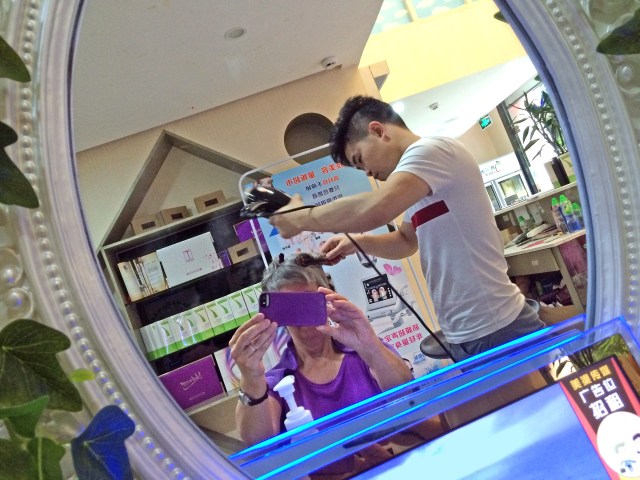
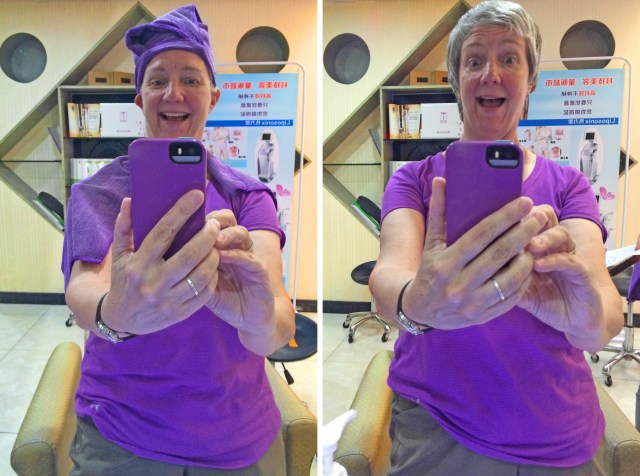
Then she took me to sit in a chair before a mirror for the head massage and the comb out (raking the head with a wooden comb—rather nice, that part). That took a good 20 minutes. And then he came to stand behind me, looking down at my head (perhaps taking in my graying strands) with a funny look on his face. This young male stylist (photo below) was not as flashy as one of the other young men in the salon, obviously a Stylist of Note in his bright yellow pants and turquoise tennis shoes whose hair hung down one side of his face in an asymmetrical way (it’s a look). But he took to my head with a small round brush and a blow dryer with an intense look on his face rather like a concert pianist. He was going to Tame That Hair.

•IMG_0266a

And he did, though it took him about 20 minutes, pulling on the hair to straighten it as he dried it, layering the top with a side part like some of the guys at my high school wore in the 1970s. In fact, by the time he was done, I could have passed for one of those guys. I blinked at myself in the mirror, amused. I flashed him a grin, took photos as he worked and afterward, which did not make him smile. When he was finished, he all but dropped the brush as if it were a microphone and stalked away like Mick Jagger onstage.

This was the result:

•IMG_0268b x2

I think the boyish look is funny for an about-to-be 58-year-old woman. Nikki had come back with her curly tresses tamed, too, and joked that because of the humidity they’d be back to curly before she went to bed. I was hoping mine would, too, because, as I said, I’ve embraced my naturally curly hair of many shades (nearly 50 of them gray). I didn’t want to dis the stylist’s work, but I couldn’t wait till morning when I’d shower myself into my usual look.

The head massage, though? For the first time on our trip, I slept like a log that night, even on the hard Chinese bed atop my little pillow padding, my scalp tension-free at last.

That young woman in pink with the enhanced gazongas who spoke only Cantonese did me a huge favor. Though I thanked her at the time in the best way I knew how—with a smile and a “shay-shay,” the Mandarin pronunciation of “thank you”—I wish I’d have been able to go back and given her a hug. My head with its boyish hairstyle felt lighter than it had since we began this trip. And, I have to say that for once, I did not mind thinking of myself as an airhead.

•IMG_0148a


Posted in Bringing Annie Home | 2 Comments

Joyful Purple Dragon

•IMG_0216a

(#13 in the Annie series)

The day before we left Guangzhou Nikki asked Elsie, our translator, what Annie’s Chinese name means in English. It’s:

Long Xin Zi

We knew that Long is her last name, but Elsie told us that it means “dragon,” for the year Annie was presumed to be born, 2009. Xin means “joyfulness,” Elsie said, and Zi means “purple.”

In translation, her name would be:

Dragon Joyfulness Purple

But to turn it around English-style, she is:

Joyful Purple Dragon

Of course, Aunt Jan had to go on Amazon, right there in Guangzhou, and locate a soft purple dragon, which was easily found. Pretty cute one, too. I wouldn’t be surprised if it was made in China, like Annie. I knew it would be waiting for Annie when she got to Sacramento.

•IMG_0142a

Annie and Nikki in Guangzhou.

Joyful Purple Dragon had an interview at the U.S. Consulate in Guangzhou today, around the corner and down the block from our hotel. Well, her new mama did the talking, and dealt with paperwork and heard details like after she goes to the U.S., Annie cannot use her Chinese passport again. She will be officially American, and the Chinese will no longer recognize the passport they just issued her here. It’s a one-time usage, that little red passport, and tomorrow, Elsie will deliver Annie’s new blue U.S. passport, so that on July 2, when she gets off the plane and goes through customs in San Francisco, Annie will be a U.S. citizen. Just like that.

As if it were that easy. As if Nikki hasn’t been working on this process for years, raising money and setting up everything so she could travel here to retrieve a little girl she met years ago when she volunteered at an orphanage and a hospice for dying children, the hospice that took Annie in and saved her life.

•IMG_0086a

Classic Chinese broom and transport.

But we are about to leave Guangzhou after Annie’s passport and visa arrive tomorrow, taking the fast train back to Hong Kong, going through Chinese customs and then Hong Kong customs. This is the beginning of the journey home. We’ll stay for two days with Anne and John Macpherson, then make the long plane trip to California. Like so many of her countrymen and women before her, Annie will cross the great Pacific Ocean to land in San Francisco to begin her life as an American.

Annie saw the U.S. consulate for the first time with me a couple of days ago. It was a Sunday, and Nikki and Elsie had gone out to find medication for Annie. It turned out that The Lighthouse did not give Nikki all of Annie’s meds when we went to visit, and her seizure medication is an important one. I offered to take Annie for a walk in a direction we had not gone before, so Nikki and Elsie could locate the right medication in (and this is what took them to five different locations, including a couple of hospitals) the right dosage.

•IMG_0070a

We headed out to the big building (above) where Annie had her medical appointment the morning after we arrived in Guangzhou. It seemed like weeks earlier, when it had only been a couple of days. I parked her in the Sunday-quiet walkway outside the building to take her photo, this small person surrounded by such a big structure, such a big world.

It turned out that the U.S. consulate was across the street from the medical building, though I didn’t know that until we’d walked around a corner and saw the words emblazoned on a nondescript building behind a tall fence: U.S. Consulate General. On weekdays dozens of Chinese line up outside the consulate, hoping to get temporary visas to come to the U.S. for work or school or to marry. But on Sunday all was quiet on that western front.

I was surprised on that quiet Sunday, pushing Annie alongside the consulate fence, to find myself with an actual lump in my throat and tears in my eyes. It was, as usual, sweltering under the bright blue day with no breeze. The American flag hung limp as a dishrag on its pole outside the consulate. Still, I thought, that’s a bit of home. That limp piece of red, white and blue is tangible evidence of my people. It’s not a perfect country, but it’s mine, and there’s something about being very far from home that made me want to salute that flag, to say that yes, I am proud to say that I’m an American. It’s something many, many Chinese would love to be, or at least many of them would love to spend time in my country. And this little girl, her mama and I get to go back to that place we call home.

•IMG_0092a

The spaceship-like Guangzhou Opera House

Annie and I continued on our way, crossing the street to walk by the Guangzhou Opera House, which looks like a huge, misshapen spaceship that hosts world-class performers. It was designed by Zaha Hadid to look like a “double pebble,” it says on its website, and was completed in 2010 at a cost of about $200 million (U.S.).

•IMG_0099a

The Guangzhou Opera House looks spaceship-py from this side, too.

We strolled by a basketball court where, as in our own country on a weekend morning, small boys ran around tossing balls toward seemingly out-of-reach baskets.

•IMG_0113a

Next to the basketball court sat the impressive Guangzhou No. 2 Children’s Palace where many kids and parents swarmed in for arts activities, including piano lessons, I deduced from all the pianos behind glass on one side of the building.

•IMG_0108a

We saw the 712-foot lattice telecommunication tower (Guangzhou Tower) that has observation platforms on floors 107 and 108. Nearby is the Guangdong Olympic Stadium, which holds 80,000 people for football matches (soccer to us Yanks). Very impressive architecture compared to the modest U.S. consulate.

•IMG_0098a

The Guangzhou Tower next to the Guangdong Olympic Stadium next to the Opera House.

But I was OK with that. I liked that the Americans weren’t trying to show off in this city of super-tall, unusually shaped buildings. And by the time we walked back by the consulate, there was a breeze. The flag unfurled and waved at us.

•IMG_0117a

U.S. Consulate, Guangzhou, Guangdong Province.

“That’s gonna be your flag now,” I said to Annie. “Land of the free. Home of the brave. Like you, who are very brave. In America you can be anything you want to be and live anywhere you want to live.”

This is not possible in China, I had learned. Most people live their whole lives in the city, as well as the province, in which they were born. Translator Elsie, for example, would love to live someplace else, but to do so, she needs a document from her hometown, which she has to travel there to get. And she can’t travel out of Guangzhou. Chinese Catch-22.

I didn’t try to explain to Annie why there was also a rainbow flag in a window of the consulate or point out the huge banner announcing that it was June, Pride month in the U.S. My heart swelled a bit with—yes—pride for that bold move on the consulate’s part.

“Good thing it’s behind a fence,” Nikki told me later. “The Chinese hate that idea. Not long ago the president of China said that there were no gay people in China.”

•IMG_0102a

Joyful Purple Dragon naps.

And this is one more reason I am grateful to live in the land of liberty, though that liberty has not always been applied equally. It still isn’t. But we’re getting there. Ten years ago—heck, three years ago—I bet no U.S. consulate was flying a rainbow flag in June, especially in China. This one is now, as I imagine others are, too. Progress comes in inches, not feet.

And when I looked down at her again, I saw that Joyful Purple Dragon had fallen asleep on our morning stroll. I realized that this child will grow up with her Chinese heart and a blue American passport. I’m sure her mama will put away JPD’s red passport and her adoption papers for her to look at when she’s older and tell her the story again of how she came to be her mama’s daughter, Rosie Suzanne Cardoza—known now as Annie—who will always carry Long Xin Zi inside her.

•IMG_0137aC

Going for a walk in the more accessible Tianhe district of Guangzhou.


Posted in Bringing Annie Home | 5 Comments